This site is supported by our readers. We may earn a commission, at no cost to you, if you purchase through links.
The moment you cut into fabric using someone else’s pattern for the first time, something shifts. Suddenly you’re not just following instructions—you’re decoding a visual language that tailors have refined across centuries. That folded tissue paper or downloaded PDF holds more intelligence than it looks: seam allowances calculated for specific fabrics, notches positioned to prevent assembly errors, grainlines that determine whether a garment drapes or fights your body.
Here’s what most beginners don’t realize: the pattern itself isn’t the hard part. Choosing the right one, sizing it to your actual measurements, and pairing it with fabric that behaves the way the designer intended—that’s where confidence gets built. Sewing patterns for clothing become far less intimidating once you understand the system behind them.
Table Of Contents
Key Takeaways
- Pattern sizing runs on its own logic — your bust, waist, and hip measurements call the shots, not the size on your clothing tag.
- Matching your fabric to your pattern isn’t optional: knits, wovens, weight, and drape all change how the finished garment fits and moves.
- Sewing a cheap muslin test garment before cutting your real fabric is the single best way to catch fit problems before they cost you.
- PDF patterns and indie designers have made quality sewing patterns more accessible than ever, with instant downloads, real-body fit guidance, and community reviews to help you choose wisely.
Best Clothing Sewing Pattern Types
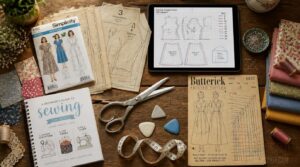
Not all sewing patterns are created equal, and the format you choose can make or break your whole experience. Whether you’re just picking up a needle for the first time or you’re ready to tackle something seriously ambitious, there’s a pattern type built for exactly where you are right now. Here’s a look at the main types you’ll come across.
If you’re brand new to all this, starting with something simple—like a beginner-friendly summer dress pattern—can help you build confidence without getting overwhelmed.
PDF Sewing Patterns
Downloading sewing patterns as PDFs puts every size, piece, and symbol in your hands instantly. No waiting, no shipping. Your file arrives as a single download packed with tiled pages you print, trim, and tape together at home.
Vector-based lines stay crisp at any zoom. Layered sizes let you print only what you need, and you can annotate directly for a truly personal fit.
The approach utilizes a GarmentCode domain-specific language to synthesize accurate, centimeter‑level patterns automatically.
Printed Paper Patterns
Printed paper patterns arrive folded in envelopes, ready to cut and sew. Pattern paper grammage matters — tissue around 25–35 gsm folds easily but tears faster, while sturdier 60+ gsm stock survives repeated alterations.
- Semi-transparent sheets for transparency tracing
- Printed notches alignment guides built in
- Reinforced grainline arrows for accurate drape
Your pattern template, built to last.
Beginner Garment Patterns
Every beginner needs a gentle starting point. Beginner garment patterns keep things simple — think A-line skirts, elastic-waist pants, and boxy tops built on basic garment blocks with minimal shaping.
Straight seams, no darts. Your notions list stays short: thread, elastic, done. Cotton’s your best friend here — stable, forgiving, easy to press.
Your first DIY clothing win is closer than you think.
Advanced Clothing Patterns
Once you’ve outgrown elastic waistbands, sophisticated clothing patterns open a whole new world. Think custom jackets with canvas interlining, princess seams, and bound buttonholes — construction that shapes with your body.
- Princess seams for contoured fit
- Pad stitching for lapel roll
- Couture fell stitching on linings
- Graded seam allowances reducing bulk
Knit Versus Woven Patterns
Knit vs. woven patterns — your choice shapes everything.
| Feature | Knit | Woven |
|---|---|---|
| Stretch | High | Minimal |
| Needle | Ballpoint | Regular |
| Drape | Fluid | Structured |
| Patterns | Fewer darts | Princess seams |
| Yardage | Less needed | More required |
Knits move with you. Wovens hold their shape.
That built-in stretch is exactly why pattern alterations for knit fabrics differ so much from what you’d do with a stiff cotton or linen.
Where to Find Clothing Patterns
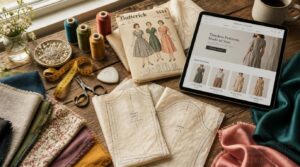
Once you know what kind of pattern you want to make, the next step is tracking one down — and honestly, there are more places to look than you might expect. Your options range from big commercial brands to scrappy indie designers selling directly to the sewing community. Here’s where to start your search.
Major Pattern Companies
The Big Four — McCall’s, Simplicity, Butterick, and Vogue — have shaped home sewing since the 1800s. Each brand brings something different: Vogue leans couture and complex, while Butterick keeps things approachable.
Simplicity partners with fashion designers for runway-inspired looks.
All four offer printed and digital PDFs, so wherever you sew, your next pattern is never far away.
Indie Pattern Designers
Indie designers bring something the Big Four often can’t: modern wardrobe styling built for real bodies and real life. These small studios obsess over fit, offering pattern hack options and full bust guidance baked right into the instructions.
Many run pattern testing communities where sewists give feedback before release. Look for digital pattern bundles on their own sites — fresh, intentional, and yours instantly.
Free Pattern Websites
Free pattern websites are a genuine goldmine. Sites like AllFreeSewing and So Sew Easy offer thousands of free clothing patterns — from beginner sewing lessons to structured jackets — all as instant sewing patterns PDF downloads.
Top picks for your bookmark bar:
- AllFreeSewing — massive aggregated library
- So Sew Easy — wardrobe staples
- BurdaStyle — community pattern library
- Mood Fabrics — curated pattern blogs
Vintage Sewing Patterns
Vintage sewing patterns are little time capsules. Each envelope carries the era’s silhouette — pencil waists from the 1950s, A-line skirts from the 1960s. Sizes ran by a single measurement, so check your bust carefully.
| Era | Key Style |
|---|---|
| 1940s | Structured shoulders |
| 1950s | Fitted bodices |
| 1960s | Shift dresses |
PDF Pattern Marketplaces
Think of PDF pattern marketplaces as your personal pattern library on demand. Sites like Etsy and The Fold Line let you use marketplace search filters to sort by garment type or size range.
Check user reviews before downloading — real sewers flag fit issues fast. Many designers offer bundle discounts on downloadable pattern files too.
Choose The Right Pattern Size
Picking the right pattern size is where a lot of sewers go wrong — and it’s rarely their fault. Pattern sizing has its own logic, completely separate from the sizes on store-bought clothing tags. Here’s what you need to know to get it right from the start.
Bust, Waist, Hip Measurements
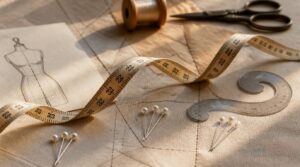
Three numbers determine your best fit: full bust, natural waist, and full hip. Measure the fullest part of your chest, the narrowest point of your torso, and the widest part of your hips.
Your tape measure should sit snug but not tight. Patterns use these — not clothing sizes — so measuring accuracy matters most.
Pattern Size Charts
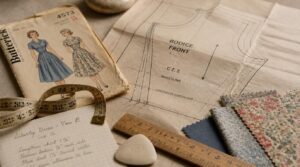
Once you’ve got your measurements, the pattern size chart tells you where you land. Pattern size charts map your bust, waist, and hip numbers to a specific size — and that size often looks nothing like your clothing tag. Ignore ready-to-wear sizing completely here.
Check the chart printed directly on your packet, since sizes shift between brands and years.
Finished Garment Measurements
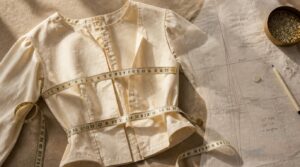
Size charts point you in the right direction, but finished garment measurements tell the real story — how much room you’ll actually have once the garment is sewn.
| Measurement | Body Size | Finished Garment |
|---|---|---|
| Bust | 38" | 40" |
| Waist | 32" | 34" |
| Hip | 38" | 40" |
That extra space is built-in ease — your breathing room.
Blending Between Sizes
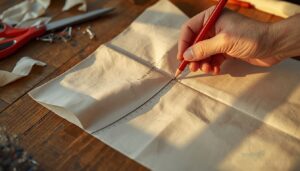
Blending between sizes means drawing a smooth curve that gradually shifts from one size line to another — say, a 14 at the bust tapering to a 12 at the waist. Follow the gentle contours of the printed lines.
Sharp angles create fit problems; smooth, gradual transitions don’t. Check that pockets and facings follow your new line too.
Full Bust Adjustments
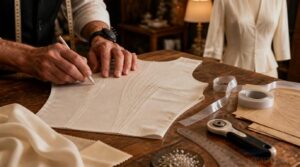
If you’re larger than a B cup, an FBA is your best friend. It adds volume to the front bodice without touching your shoulders or sleeves.
- Extend the tip point outward
- Rotate your dart to redistribute fullness
- Stabilize altered seams with stay tape
This prevents neckline gaping and keeps everything smooth.
Match Patterns With Fabric
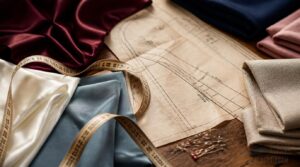
Getting your fabric choice right is just as important as nailing your size. The wrong match can throw off everything — the drape, the fit, even how easy it is to sew. Here’s what to look at when pairing your pattern with the perfect fabric.
Recommended Fabric Types
Natural fibers breathe best. Cotton, linen, and hemp keep air moving — ideal for warm-weather projects like sundresses or sleepwear.
Linen especially wicks moisture fast, staying cool even on hot days.
Silk works well in lightweight blouses but needs gentle hand washing.
For sustainable choices, bamboo and Tencel blends offer softness with a smaller environmental footprint.
Stretch and Drape
Stretch and drape quietly shape how a finished garment moves — and feels — on a real body.
- Knits stretch along the course direction, wrapping curves without pulling seams
- Wovens rely on weave density for controlled horizontal give
- A bias cut unlocks fluid, gravity-induced drape in otherwise stiff fabric
- Spandex blends add elasticity, helping fabric recover its shape after wear
Fabric Width and Yardage
Fabric width is the silent variable that makes or breaks your yardage math. Most fashion fabrics run 44–45 inches wide; wider options hit 54–60 inches.
Wider fabric means fewer yards needed — sometimes considerably less.
For knits, add 10–20% extra to account for shrinkage and recovery. Always check the bolt label first, then cross-reference your pattern’s yardage chart before cutting.
Directional Prints and Nap
Directional prints and nap fabrics demand one non-negotiable rule: all pieces face the same way.
- Lay out a full layout plan before cutting
- Mark nap direction on every piece
- Keep motifs consistently upright across panels
- Add extra yardage for orientation matching
- Check grain alignment before sewing
Mismatched nap changes perceived color entirely — a costly mistake.
Stripes and Pattern Matching
Stripes don’t forgive guesswork. Center front alignment is your anchor — place it first, then work outward. Match stripe edges at every seam before pinning. Print digital patterns at 100% scale and check your test square. Vertical stripes elongate; strategic placement shapes silhouette. Knit stripes match more forgiving curves than woven.
| Stripe Goal | Technique | Fabric Type |
|---|---|---|
| Smooth side seams | Pin along single stripe edge | Woven stable |
| Sleeve continuity | Mirror bodice stripe | Knit uniform |
| Bias chevron | Align seam start points | Woven contrast |
| Torso elongation | Vertical top-to-bottom stripes | Any |
| Waistline highlight | Strategic seam placement | Any |
Read and Sew Patterns Confidently
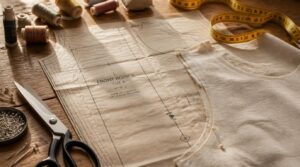
Once you’ve got your fabric prepped and ready, it’s time to actually make sense of what’s on the page in front of you.
Pattern instructions can look like a foreign language at first — all those symbols, lines, and tiny markings — but they follow a logic that clicks pretty fast.
Here’s what you need to know to cut, mark, and sew with real confidence.
Pattern Pieces and Symbols
Before you cut a single piece, get familiar with what’s printed on your pattern. Each piece has a number and cut quantity — telling you exactly what it is and how many to cut.
Circles, triangles, and squares mark pocket placement and joins. Transfer these marks to fabric using chalk, a tracing wheel, or erasable pen so nothing gets lost mid-sew.
Grainlines and Fold Lines
Once you’ve decoded your pattern pieces, two markings will make or break your layout: grainlines and fold lines.
The grainline arrow tells you to align that piece parallel to the selvage — the woven edge of your fabric. Get this right and your garment hangs evenly; ignore it and hems twist, seams pull, and drape goes rogue.
Align your grainline parallel to the selvage, or watch your hems twist and drape go rogue
Fold lines mean cut once, get two.
Notches, Darts, Markings
Now that grainlines and fold lines are locked in, it’s time to speak the language of pattern markings.
Notches identify alignment points — single for front pieces, double for back. Match them when joining seams and everything lines up cleanly. Darts shape your fabric into three dimensions; stitch from the wide end toward the tip, then press to set the curve without distortion.
Seam Allowances and Cutting
With markings sorted, seam allowances are next. That margin of fabric beyond your stitch line — commonly ⅝ inch — isn’t extra; it’s intentional. Heavier fabrics may need ¾ inch; knits often work better at ⅜ to ½ inch.
Use sharp scissors or a rotary cutter, pin your pattern securely, and cut with steady, deliberate strokes. Consistency here is everything.
Test Fitting Before Sewing
Before you cut into your final fabric, sew a muslin first. This cheap test garment reveals fit issues — at the bust, waist, and hip — before they cost you anything real.
Pin adjustments, check your ease and balance points, then wear-test it with your usual undergarments. Transfer every correction to your pattern pieces.
Then you’re ready to cut.
Frequently Asked Questions (FAQs)
What are the best websites for buying patterns?
Thousands of sites exist, but a handful truly deliver. Mood Sewciety, The Fold Line, and PatternReview offer curated designer marketplaces, community reviews, and instant pattern downloads — your one-stop shops for digital sewing PDFs.
Does Hobby Lobby have free sewing patterns?
Hobby Lobby doesn’t offer free sewing patterns, but their frequent sales drop prices to just a dollar or two. For truly free options, check indie blogs and free printable pattern sites.
What fabrics are best suited for different patterns?
Natural fibers breathe best. Cotton and linen suit breezy summer cuts. Stretch knits flex for fitted styles. Wovens hold pleats crisp. Match fabric weight to your pattern’s silhouette.
How do I adjust a pattern for a custom fit?
Use the slash and spread method to add width without losing seam lines. Always test with a muslin first. Reposition darts and adjust torso length so every seam sits exactly where it should.
Where can I find affordable sewing supplies?
Check Joann or Hobby Lobby first — both run 40% off coupons regularly. Etsy and AliExpress keep notions cheap. Don’t overlook thrift stores or fabric swaps in your local sewing community.
What are common sewing pattern mistakes to avoid?
Even small slip-ups can unravel your best work. Avoid incorrect seam allowances, improper grainline alignment, fabric mismatch, and skipping test fittings. Always respect pattern symbols — they’re your roadmap to a perfectly fitting garment.
How do I care for finished garments made from patterns?
Prewash your fabric first. Hand wash delicates cold. Air dry knits flat. Store away from sunlight. Iron on low with a pressing cloth. Label each piece with care notes.
How do I adjust patterns for different fabrics?
Every fabric speaks a different language. Knit fabrics need negative ease built in. Wovens need bust adjustments. Match grainline to selvedge. Nap? Cut one direction only. Seam allowances shift with weight.
Can sewing patterns be reused multiple times?
Yes — and more than once. Trace onto tracing paper before your first cut. Digital PDFs reprint endlessly. Store flat, label by size, and your pattern collection lasts years.
What tools are essential for pattern work?
Precision measuring tools first. Flexible tape. French curve. Tracing wheel. Pattern weights. Sharp scissors. Tailor’s chalk. Awl for transfer. Colored pencils. Pattern envelopes. Your toolkit = your control.
Conclusion
Like any language, sewing patterns for clothing only feel foreign until you’ve spoken them enough times to think in them. Every grainline you align, every notch you match, every muslin you abandon brings you closer to that fluency.
You’re not just learning to sew—learning to see construction before the fabric even hits your machine. Trust the system, make it yours, and the garment you’ve been picturing will start meeting you halfway.
- https://thefoldline.com/blogs/pattern-series-get-ready-to-sew/a-beginner-s-guide-sewing-pattern-symbols-and-fabric-marking-tools
- https://www.inhousepatternsstudio.com/blog/18-how-to-add-a-size-to-a-pattern
- https://sewexpo.com/2017/11/17/pattern-sizing-made-simple
- https://www.thecuttingclass.com/grainlines
- https://susanyoungsewing.wordpress.com/2018/08/04/indie-patterns-vs-the-big-4-discuss