This site is supported by our readers. We may earn a commission, at no cost to you, if you purchase through links.
A dull needle doesn’t just slow you down—it silently wrecks your seam before you notice. Most sewers blame thread tension or machine settings when stitches skip or fabric puckers, but the needle is usually the culprit.
Needle diameter controls hole size, and hole size directly affects how much a seam can take before it tears. Drop one size too large on chiffon, and you’ve punched permanent damage into the weave. Go too small on denim, and the needle flexes, skips stitches, and snaps.
Understanding how needle size affects stitch quality means fewer ruined projects and cleaner results every time.
Table Of Contents
- Key Takeaways
- How Needle Size Affects Stitch Quality
- Sewing Needle Anatomy and Its Role in Stitching
- European and American Needle Sizing Systems Decoded
- Matching Needle Size to Fabric Weight
- Needle Types and Their Impact on Stitch Quality
- Thread-to-Needle Eye Compatibility
- Top 9 Sewing Needles for Better Stitch Results
- 1. Schmetz Universal Sewing Machine Needle
- 2. Organ Ball Point Sewing Machine Needles
- 3. SCHMETZ Stretch Sewing Machine Needles
- 4. Schmetz Jean Denim Machine Needle
- 5. SCHMETZ Leather Sewing Machine Needles
- 6. Euro Notions 14 90 Quilt Machine Needle
- 7. Brother Embroidery Needles 75 11
- 8. SCHMETZ Microtex Sharp Sewing Machine Needle
- 9. Schmetz Euro Notions Twin Stretch Needle
- Stitch Length and Tension Settings by Needle Size
- Troubleshooting Stitch Problems Caused by Wrong Needle Size
- Needle Replacement and Maintenance for Consistent Stitch Quality
- Frequently Asked Questions (FAQs)
- Conclusion
Key Takeaways
- Needle diameter controls hole size directly — going even one size too large on delicate fabric like chiffon punches permanent damage into the weave, while too small on denim causes skipped stitches and snapping.
- Matching needle type to fabric isn’t optional: ballpoint needles part knit fibers instead of piercing them, sharp Microtex needles cut visible puncture size by up to 70% on silk and microfiber, and wedge-point needles slice clean holes in leather instead of tearing.
- The needle eye should be roughly 1.4 times your thread diameter — a tighter fit creates friction that shreds specialty threads and causes up to 50% more breakage.
- Replace your needle every 8–12 hours of sewing time, or after each heavy-fabric project — a worn tip raises thread breakage by 30–50% and triggers skipped stitches, shaft wobble, and seam damage you won’t always spot until it’s too late.
How Needle Size Affects Stitch Quality
The needle you choose does more work than you might think. Its diameter directly controls how big a hole it punches, how the fabric holds up over time, and whether your tension stays balanced.
Getting the size right matters more than most beginners expect, so it’s worth understanding what sewing needle sizes actually mean before you start a project.
Here’s what’s actually happening beneath the surface.
Why Needle Diameter Determines Hole Size and Seam Durability
Every extra millimeter of needle diameter pushes more fibers aside — and that fabric fiber displacement adds up fast.
Here’s what needle diameter directly controls:
- Hole edge fraying — thicker needles increase tear risk at entry points
- Seam tear resistance — larger holes weaken fiber structure under load
- Stress distribution — uniform diameter spreads seam pressure evenly
- Seam flexibility — finer needles keep lightweight seams supple and strong
How Mismatched Needle Size Causes Puckering, Skipped Stitches, and Tension Issues
Wrong needle size throws off more than just the hole — it creates a chain reaction. Mismatched needle size disrupts Thread Path Friction, forcing the thread to drag unevenly, which triggers fabric puckering and skipped stitches almost immediately.
That friction also causes Stitch Density Shift, pulls the Feed Dog Interaction off-rhythm, and throws thread tension out of balance — wrecking your Fabric Grain Alignment and causing Seam Pull Distortion along the seam.
The Relationship Between Needle Gauge and Fabric Disturbance
Needle gauge doesn’t just make holes — it moves fibers. Here’s what happens as gauge increases:
- Penetration force rises, distorting woven fabric at entry points
- Fiber displacement widens, stressing the seam line
- Fabric strain concentrates around each stitch, weakening delicate weaves
- Seam flatness suffers on multilayer projects
Nonwoven distortion follows its own pattern — expect elongated holes when gauge is wrong.
Sewing Needle Anatomy and Its Role in Stitching
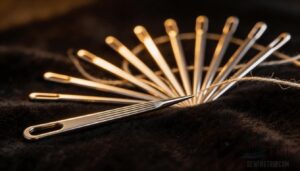
Every needle has a job, and its anatomy is what makes that job possible. Each part—from shank to point—plays a direct role in how your stitch forms and holds.
Here’s what you need to know about each one.
Shank, Shaft, Groove, Eye, and Point Explained
Think of a sewing needle as five parts doing one job.
The shank locks into your machine — shank reinforcement on specialty needles resists bending under pressure. The shaft gives shaft rigidity through dense layers. The groove creates a clean groove thread path for thread. The eye angle controls feeding precision. The point tip angle decides how cleanly it enters fabric.
| Part | Function | Key Detail |
|---|---|---|
| Shank | Anchors needle in machine | Flat side ensures alignment |
| Shaft | Penetrates fabric layers | Thicker = less flex |
| Groove | Guides thread downward | Prevents friction buildup |
| Eye | Feeds thread through | ~1.4× thread diameter ideal |
How Scarf Design Prevents Skipped Stitches
That small curved groove behind the needle eye — the scarf — does more than you’d think. Scarf geometry lets the hook catch the thread loop cleanly every single time. Without it, skipped stitches happen constantly.
Here’s what scarf design actually controls:
- Thread path alignment keeps thread feeding smoothly without snagging
- Fabric support layers stay stable behind the needle entry point
- Feed dog coordination prevents backward fabric slip between stitches
- Edge stabilization reduces missed catches along curled or rolled edges
- Needle anatomy here directly drives stitch quality on slippery or layered fabrics
Needle size matters too — a worn scarf groove breaks that timing fast.
How Point Style Affects Fabric Penetration and Stitch Formation
Point style is where needle anatomy gets personal with your fabric. The tip geometry controls entry angle, penetration force, and ultimately stitch rhythm consistency.
| Point Style | Best Use |
|---|---|
| Sharp/Microtex | Silk, microfiber |
| Ballpoint | Knits, jersey |
| Universal | Woven cottons |
| Wedge | Leather, vinyl |
| Reinforced | Denim, canvas |
Sharp microtex needles cut cleanly, improving fabric grain alignment. Ballpoint needles part fibers gently, protecting loop formation timing and preventing fabric damage.
European and American Needle Sizing Systems Decoded
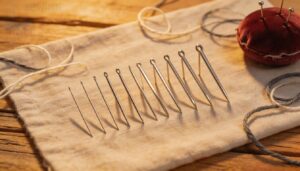
Needle sizing isn’t as confusing as it looks — once you understand the logic behind the numbers, it clicks fast. Both European and American systems follow a clear pattern, though hand‑sewing needles flip that pattern completely.
Here’s exactly how each system works.
How European (NM) Sizing Uses Diameter in Hundredths of a Millimeter
European sizing runs on a hundredth millimeter scale — size 80 means a 0.80 mm diameter needle, full stop. That precision matters because manufacturers use machine grinding techniques to hold needle diameter tolerances within micrometers.
Here’s what the NM system tells you at a glance:
- Size 60 = 0.60 mm — your go-to for silk and voile
- Size 90 = 0.90 mm — solid all-purpose range for cotton and linen
- Conversions between NM and American needle sizes are straightforward: NM 90 equals US size 14
- Precision labeling practices on packaging let you reorder the exact same needle every time
Use a needle size chart with gauge to NM mapping, and fabric weight correlation becomes second nature.
Once you’ve matched your needle to the fabric, dialing in the right stitch length is just as important—adjusting stitch length for different fabric weights walks you through the settings that keep everything from silk to denim looking clean and professional.
How Hand-sewing Sizing Works in Reverse Compared to Machine Needles
Hand-sewing flips the script entirely. While machine needles get bigger as numbers climb, hand needle numbering runs the opposite way — a size 1 hand needle is thick and chunky, while a size 12 is hair-fine. That’s reverse gauge logic in action.
Manual needle selection here leans heavily on thread size emphasis and fabric grain tolerance, so always cross-reference a needle conversion chart before you start.
Matching Needle Size to Fabric Weight
Getting needle size wrong is one of the fastest ways to ruin a project. The good news is there’s a simple logic to it: fabric weight tells you which size to reach for.
Here’s how that breaks down across three weight categories.
Fine Needles (60/8–70/10) for Silk, Chiffon, and Voile
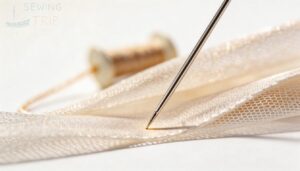
Delicate fabrics like silk, chiffon, and voile demand a 60/8–70/10 needle — and needle size matters more here than anywhere else. These fine needles measure just 0.6–0.7 mm wide, so they support Voile Transparency Maintenance and Chiffon Edge Smoothness without tearing fibers.
Fine Needle Flexibility also means less Heat Build-up Reduction during fast passes, protecting Silk Luster Preservation.
Match your needle eye size carefully — fine threads need a proportionally small eye for clean feed.
Medium Needles (80/12–90/14) for Cotton, Linen, and Quilting Fabrics
Cotton and linen are the workhorses of any sewing room — and medium needles (80/12–90/14) are built for exactly that load. An 80/12 keeps Fabric Feed Consistency smooth on quilting cotton while supporting Stitch Visibility Reduction across seam lines.
For denser linen, step up to 90/14. Both sizes handle Thread Breakage Prevention well with all‑purpose thread, giving you clean Quilting Edge Finish every time.
Heavy Needles (100/16–110/18) for Denim, Canvas, and Upholstery
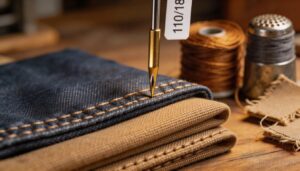
When denim or canvas hits your machine, you need a 100/16 to 110/18 needle. These heavy needles (0.75–0.88 mm diameter) pierce dense layers without deflecting.
Heavy Needle Coatings, like titanium nitride, cut Canvas Needle Wear substantially.
Denim Penetration Speed stays consistent, and Upholstery Stitch Consistency holds firm. Match with 40–60 weight thread for Thread Tension Optimization — that’s the impact of needle choice on stitch quality.
Needle Types and Their Impact on Stitch Quality
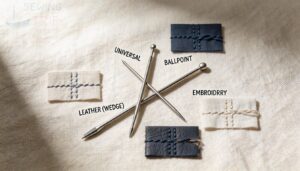
Not all needles are created equal, and choosing the wrong type can ruin an otherwise perfect seam. The point style alone changes everything — how the needle enters the fabric, how fibers respond, and whether your stitches hold.
Here are the four needle types that matter most for everyday sewing.
Universal Needles for Everyday Woven Fabrics
Universal needles are your everyday workhorse for woven fabrics — cotton, linen, polyester blends. Their slightly rounded tip accommodates most weaves without snagging.
needle selection based on fabric type, match fabric weight to size: 70/10 for light voile, 80/12–90/14 for mid-weights, 100/16 for dense twills. Right needle size means cleaner stitch quality and no unnecessary holes.
Ballpoint Needles for Knits, Jersey, and Fleece
Woven fabrics forgive a lot. Knits don’t.
A sharp needle slices through jersey loops instead of sliding past them — causing snags, runs, and ruined seams.
Ballpoint needles solve this with Tip Radius Variants and Fabric Glide Optimization, letting the tip push fibers apart cleanly. Groove Width Tuning, Elastane Compatibility Range, and Color-Coded Size System match needle size to fabric weight for consistent stitch quality.
Microtex/Sharp Needles for Silk and Microfiber
Silk and microfiber punish the wrong needle fast. sharp Microtex needle manages Silk Fiber Shear cleanly — its polished needle shaft cuts through tight weaves without lifting fibers or leaving visible holes.
Polished Needle Shaft also reduces Microfiber Friction, keeping Thread Glide Efficiency high even during High-Speed Silk Sewing. Microtex needles cut visible puncture size by up to 70%.
Check your needle size chart before starting.
Denim, Leather, Stretch, and Specialty Needle Applications
Each fabric group needs its own needle.
A denim needle drives through heavy layers with a slim, sharp point — boosting stitch consistency by 25%. Leather needles use Wedge Point Geometry to pierce hides cleanly, reducing tearing. Stretch needles protect knit loops from runs. Titanium Coated Needles resist wear longer, improving Seam Strength Metrics. Wrong needle choice raises Thread-Needle Friction fast.
Thread-to-Needle Eye Compatibility
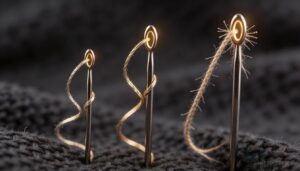
The eye of your needle does more than just hold thread — it directly controls how smoothly that thread moves and how clean your stitches look. Get this pairing wrong, and you’ll fight shredding, breakage, and tension problems, no matter how good your machine is.
Here’s what you need to know about matching thread to needle eye correctly.
Why Eye Diameter Should Be Approximately 1.4× Thread Diameter
The needle eye isn’t just a hole—it’s your thread’s highway; too narrow, and friction shreds fibers, spikes heat dissipation, and kills stitch quality fast. The 1.4× rule keeps thread glide smooth along the entire thread path.
Three reasons this ratio matters:
- Vibration Reduction – Proper clearance dampens micro-vibrations during speed optimization
- Thread Path stability – Thread thickness and needle eye size compatibility prevents looping
- Even tension – Correct needle eye diameter eliminates bird-nesting
Matching Fine, All-purpose, and Heavy Decorative Threads to Correct Needle Sizes
Think of thread weight as a tiered system — and your needle choice has to match that tier exactly.
| Thread Type | Denier Classification | Needle Size |
|---|---|---|
| Fine/delicate | 100 denier and below | 70/10–90/14 |
| All-purpose | 150–300 denier | 80/12–100/16 |
| Heavy decorative | 350+ denier | 90/14–110/18 |
| Metallic/specialty | Variable | Large-eye MF type |
| Embroidery rayon | Medium-heavy | 90/14 enlarged eye |
Thread Core Stiffness matters here too. Polyester cores feed differently than cotton, affecting Needle Eye Clearance needs. Always cross-reference Thread Size Charts against your fabric weight — that Compatibility Matrix keeps your needle-fabric pairing precise and your stitch quality consistent.
How Thread-eye Mismatch Causes Shredding, Breakage, and Poor Tension
A too-small needle eye is basically a chokehold on your thread. Eye Edge Abrasion starts immediately — the thread catches, frays, and shreds under Friction Heat Build-up, especially at high speeds.
Thread Eye Stress compounds this, weakening fibers stitch by stitch. Poor Thread Eye Alignment then throws fabric tension off completely.
Wrong needle size causes up to 50% more thread breakage. Thread compatibility isn’t optional — it’s everything.
Wrong needle size causes up to 50% more thread breakage — compatibility isn’t optional
Top 9 Sewing Needles for Better Stitch Results
Knowing the right needle type matters more than most sewers realize. The nine options below cover everything from everyday cotton projects to tricky stretch fabrics and thick denim.
Each one earns its spot for a specific reason.
1. Schmetz Universal Sewing Machine Needle
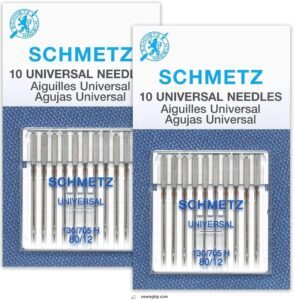
The Schmetz Universal (Model 1833) is a solid everyday pick. You get 20 needles across two cards for $11.67 — practical value for any hobby sewer.
The 80/12 size hits the sweet spot for medium-weight fabrics like cotton and linen, and the slightly rounded point works with most wovens without snagging knits.
It fits nearly every domestic machine brand, so you won’t need an adapter. Just know not built for denim or leather — those need a specialized tip.
| Best For | Hobbyists and everyday sewers who work with medium-weight fabrics like cotton and linen on standard home machines. |
|---|---|
| Brand | Schmetz |
| Needle Count | 20 |
| Price | $11.67 |
| Fabric Compatibility | Wovens and knits |
| Machine Compatibility | Most household brands |
| Needle Size | 80/12 |
| Additional Features |
|
- 20 needles for $11.67 — solid value that keeps you stocked without breaking the bank
- Fits almost every domestic sewing machine brand, so no compatibility headaches
- The slightly rounded point plays nice with both wovens and knits
- Not the right tool for heavy fabrics like denim or leather — you’ll need a specialty needle for those
- Only one needle type in the pack, so specialty projects mean a separate purchase
- Size 80/12 is great for medium weights but won’t cut it for very thick or very delicate materials
2. Organ Ball Point Sewing Machine Needles
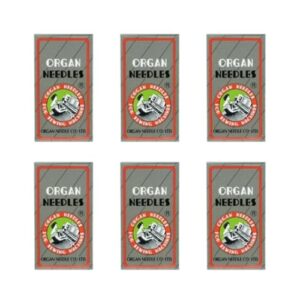
Knits need a needle that parts fibers, not stabs them. The Organ Ball Point set does exactly that — its rounded tip slides between fabric fibers instead of piercing them, so your jersey and fleece stay run-free.
You get 60 needles across six sizes (65/9 through 100/16), covering lightweight to heavier knits in one purchase. Two threaders are included.
At $15.97, it’s a practical buy for anyone who sews stretch fabrics regularly.
| Best For | Home sewers who regularly work with knit, jersey, or stretch fabrics and want a reliable needle set that prevents runs and snags. |
|---|---|
| Brand | NaFurAhi (Organ) |
| Needle Count | 60 |
| Price | $15.97 |
| Fabric Compatibility | Knits and stretch fabrics |
| Machine Compatibility | Brother, Janome |
| Needle Size | 65/9 to 100/16 |
| Additional Features |
|
- Six size ranges in one pack — covers lightweight to heavy knits without buying multiple sets
- Ball-point tip slides between fibers instead of piercing them, keeping stretch fabrics clean and run-free
- Comes with two needle threaders, which is a nice bonus at this price point
- Not useful for woven or non-stretch fabrics — you’ll still need a separate sharp needle for those
- Compatibility isn’t guaranteed on all industrial or specialty machines
- No detailed needle classifications beyond "ball point," so it can be hard to know exactly what you’re getting for specialty projects
3. SCHMETZ Stretch Sewing Machine Needles
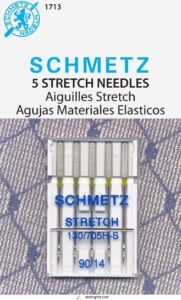
For stretch fabrics, ballpoint tips get you halfway there — but skipped stitches are a different problem entirely. That’s where the SCHMETZ Stretch needle earns its spot.
Its specially designed scarf smooths the thread path to prevent those frustrating gaps in your seams. The size 90/14 works well for most knits, and the slightly enlarged eye accommodates high-twist stretch threads without shredding.
Compatible with any home machine, this pack of five covers several projects before a swap is needed.
| Best For | Sewers who regularly work with knits, spandex, or other stretch fabrics and want clean, skip-free seams. |
|---|---|
| Brand | Schmetz |
| Needle Count | 5 |
| Price | Not listed |
| Fabric Compatibility | Stretch and elastic fabrics |
| Machine Compatibility | All home brands |
| Needle Size | 90/14 |
| Additional Features |
|
- The specially designed scarf and enlarged eye work together to stop skipped stitches before they start
- Fits any home sewing machine, so no compatibility headaches
- Pack of five means you’re covered for multiple projects without constantly reordering
- Built specifically for stretch fabrics — grab a different needle for wovens or denim
- Tension and stitch length may need tweaking on your machine to get the best results
- A few buyers have reported receiving the wrong product, so double-check your order when it arrives
4. Schmetz Jean Denim Machine Needle
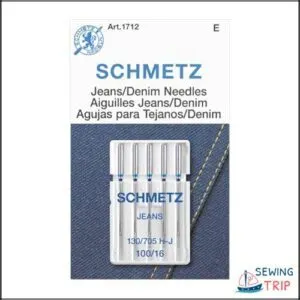
When denim’s involved, you need a needle built for battle.
The Schmetz Jean Denim size 16/100 has a reinforced shank and a sharp, sturdy point that punches through dense weave without snagging. Its polished shaft cuts friction across multiple layers, and the larger eye accommodates heavy topstitching threads cleanly.
At $4.72 for five needles, it’s a practical pick for hemming, upholstery, or canvas work — anywhere lightweight options would bend or skip stitches under pressure.
| Best For | Anyone who regularly sews denim, canvas, or heavy upholstery and needs a needle that won’t bend, skip, or snap under pressure. |
|---|---|
| Brand | Schmetz |
| Needle Count | 5 |
| Price | $4.72 |
| Fabric Compatibility | Denim and heavy fabrics |
| Machine Compatibility | Wide range including Juki |
| Needle Size | 100/16 |
| Additional Features |
|
- Tough enough to punch through multiple layers of thick fabric without breaking
- Works with a wide range of home and professional sewing machines
- Great value at $4.72 for a pack of five
- Size 16/100 is too heavy for lightweight or delicate fabrics
- Five needles per pack runs out fast if you sew often
- No info on tip type or warranty, so you’re guessing on compatibility with specialty materials
5. SCHMETZ Leather Sewing Machine Needles
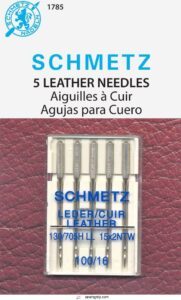
Leather is a different beast entirely.
The SCHMETZ Leather needle (model 73083) uses a wedge-shaped LL cutting point that slices clean holes instead of tearing through hide. That matters — torn holes weaken seams fast. The left-twist angled point creates precise perforations, and the larger eye accommodates heavy-duty polyester or waxed thread without shredding.
At $8.90 for five size 100/16 needles, it’s built for handbags, belts, and upholstery — up to 3mm leather — without constant breakage.
| Best For | Anyone working with leather, vinyl, suede, or heavy non-woven materials on a home sewing machine — think handbags, belts, wallets, and upholstery projects. |
|---|---|
| Brand | Schmetz |
| Needle Count | 5 |
| Price | $8.90 |
| Fabric Compatibility | Leather and vinyl |
| Machine Compatibility | Brother, Juki, Husqvarna |
| Needle Size | 100/16 |
| Additional Features |
|
- The LL cutting point slices clean holes instead of tearing, which keeps seams strong and looking good
- Works with popular home machines like Brother, Juki, and Husqvarna — no special setup needed
- Handles up to 3mm of leather without snapping, so you’re not constantly swapping needles mid-project
- Strictly for leather and similar materials — use these on knit or woven fabric and you’ll ruin it
- You may need to slow your machine down and add a little lubrication to get the best results
- Five needles for $8.90 is a bit steep if you’re only doing the occasional small project
6. Euro Notions 14 90 Quilt Machine Needle
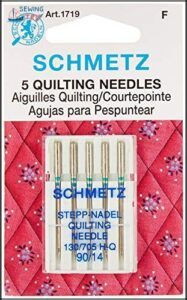
Quilting calls for a different kind of precision. The Euro Notions 71834 gives you that with its size 14/90 needle — 0.90mm diameter — built specifically for layered quilt sandwiches.
Its slightly rounded sharp point pierces multiple fabric layers cleanly without fraying cotton or cotton blends. The polished chrome finish cuts friction, and the calibrated eye feeds 40–60 weight quilting thread smoothly.
At $8.49 for five German-made needles, it’s a solid pick for free-motion work and high-seam-count projects.
| Best For | Quilters and sewists who tackle layered fabric projects and need a reliable needle that handles high stitch counts without shredding fabric. |
|---|---|
| Brand | Euro-Notions |
| Needle Count | 5 |
| Price | $8.49 |
| Fabric Compatibility | Quilting fabrics |
| Machine Compatibility | Most home machines |
| Needle Size | 90/14 |
| Additional Features |
|
- Special tapered point slides through multiple layers cleanly, which is a real win for free-motion quilting
- Color-coded shank makes it easy to grab the right size fast when you’re juggling different needle types
- German-made construction holds up well through long stitching sessions
- Only comes in size 14/90, so you’ll need to shop elsewhere if your project calls for a finer or heavier needle
- Five needles per pack goes quick if you’re doing high-volume work — reordering becomes part of the routine
- A few users flagged that the needle holder looks different from standard Schmetz packaging, which raised some authenticity questions
7. Brother Embroidery Needles 75 11
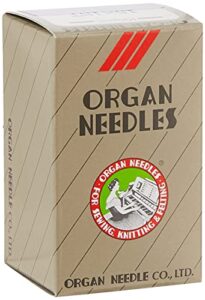
Embroidery work demands a needle that keeps up — and the Brother SAEMB7511 delivers. This 75/11 size (0.75mm shaft) hits the sweet spot for lightweight to medium fabrics like cotton, polyester blends, and even delicate voile.
The polished shaft reduces friction at high embroidery speeds, and the enlarged eye feeds rayon and polyester embroidery threads cleanly without shredding.
You get 100 needles across 10 foil-wrapped packs for $31.50 — that’s enough supply to change needles every 8 hours without hesitation.
| Best For | Hobbyists and small-production embroiderers who use compatible Brother machines and want a reliable, cost-effective needle supply on hand. |
|---|---|
| Brand | Brother |
| Needle Count | 100 |
| Price | $31.50 |
| Fabric Compatibility | Embroidery fabrics |
| Machine Compatibility | Brother models |
| Needle Size | 75/11 |
| Additional Features |
|
- 100 needles for $31.50 means you can swap needles often without worrying about the cost
- Works with automatic needle threaders, so setup is faster and less fiddly
- Handles everything from lightweight polyester to heavy towels without constant thread breakage
- Only compatible with specific Brother models — won’t work on non-Brother or unsupported machines
- Packaging can get crushed during shipping, though the needles inside usually come out fine
- Price fluctuates, so you might see it cheaper right after you buy
8. SCHMETZ Microtex Sharp Sewing Machine Needle
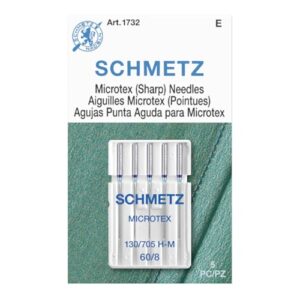
When precision matters most, the SCHMETZ Microtex Sharp (60/8) is hard to beat.
Its ultra-thin, polished point slides through silk, satin, chiffon, and microfiber without leaving visible holes — reducing puncture size by up to 70% compared to standard needles. The slim eye holds fine threads steady, keeping tension consistent and stitches clean.
At $9.49 for a 5-needle card, it’s purpose-built for quilting, appliqué, and topstitching on delicate fabrics.
Just don’t use it on denim — the thin shaft will snap.
| Best For | Sewers working with delicate fabrics like silk, chiffon, and microfiber who need clean, precise stitches without damaging the material. |
|---|---|
| Brand | Schmetz |
| Needle Count | 5 |
| Price | $9.49 |
| Fabric Compatibility | Fine and delicate fabrics |
| Machine Compatibility | All home machines |
| Needle Size | 60/8 |
| Additional Features |
|
- Ultra-sharp point glides through fine fabrics cleanly, leaving almost no visible puncture marks
- Keeps thread tension steady for smooth, professional-looking stitches
- Great value at $9.49 for five needles, color-coded so you always grab the right size
- Thin shaft snaps easily if you push it on heavier fabrics like denim or canvas
- The tiny eye can be a real pain to thread, especially in low light or with thicker fingers
- A few customers got only four needles instead of five — seems to be a packaging issue
9. Schmetz Euro Notions Twin Stretch Needle
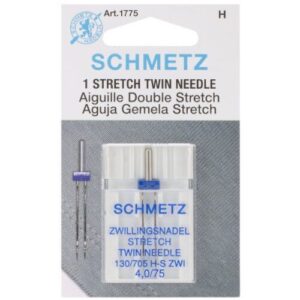
The Twin Stretch Needle from Schmetz Euro Notions does something no single needle can — it sews two parallel rows at once on knit fabrics like jersey, spandex, and lycra.
At $8.49 for one needle, it’s a smart alternative to a serger when hemming T-shirts or activewear. The dual shafts distribute thread tension across two points, cutting down on puckering by a noticeable margin.
Test on a scrap first and keep machine tension low. These needles can break under stress.
| Best For | Home sewers who want to hem T-shirts and activewear without buying a serger. |
|---|---|
| Brand | Euro-Notions (Schmetz) |
| Needle Count | 1 |
| Price | $8.49 |
| Fabric Compatibility | Elastic and knit fabrics |
| Machine Compatibility | Most home machines |
| Needle Size | 75mm twin |
| Additional Features |
|
- Sews two parallel rows in one pass — great for a clean, professional look on knit fabrics
- Works with most home sewing machines, so no special equipment needed
- At $8.49, it’s a cheap way to level up your hemming game
- Sold as a single needle, so stock up if you’re tackling a big project
- Can break fairly easily, especially if tension is too high or fabric is too thick
- Won’t clean up the inside seam — you’ll still need a serger for that polished interior finish
Stitch Length and Tension Settings by Needle Size
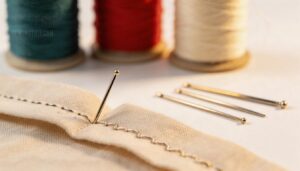
Getting your stitch length and tension right isn’t guesswork — it’s directly tied to the needle size you’re using. A small mismatch can mean bird-nesting, loose loops, or uneven seams before you’ve finished a single row.
Here’s what you need to know to dial it in correctly.
Recommended Stitch Lengths for Lightweight, Medium, and Heavy Fabrics
Stitch length isn’t one-size-fits-all — fabric weight calls the shots.
For lightweight stitch spacing on silk or chiffon, stay between 1.8–2.5 mm. Medium stitch spacing on cotton or linen works best at 2.0–3.0 mm. Heavy stitch spacing for denim or canvas needs 2.5–4.0 mm for seam bulk control.
Matching needle size to fabric weight keeps everything dialed in tight.
How Needle Thickness Affects Loop Formation and Tension Balance
Needle diameter quietly controls everything downstream. A thicker needle creates deeper, more elongated loops — pushing your Bobbin Tension Interaction harder and demanding higher Thread Path Compression to stay balanced.
Go too thin on heavy fabric, and Loop Height Variation collapses, wrecking Stitch Density Control. That mismatch disrupts Fabric Feed Consistency and causes seam puckering fast.
Match needle size chart specs precisely.
Tension Dial Settings to Eliminate Bird-nesting and Loose Underside Stitching
Bird-nesting usually means your upper thread tension is off.
For lightweight fabrics, set your tension dial to 3–4. Medium-weight cotton or linen? Try 4–5. Dense denim needs 5–6.
Tension dial calibration isn’t one-size-fits-all — thread type adjustments matter too. Metallic threads need lower tension, while cotton embroidery threads often need slightly higher.
Nail fabric-specific tension, and lower thread balance follows automatically.
Troubleshooting Stitch Problems Caused by Wrong Needle Size
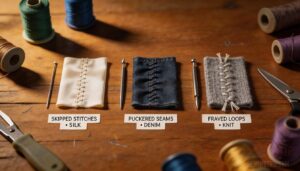
Most stitch problems trace back to one thing: the wrong needle. The fix is usually simpler than you’d think — just knowing which symptom points to which change makes all the difference.
Here are the three most common issues and exactly how to correct them.
Fixing Visible Holes by Switching to a Finer Needle
Switching to a finer needle solves visible holes faster than adjusting tension ever will. Microtex sharp needles reduce puncture size by up to 70% through Fiber Separation Mechanics — fibers part cleanly instead of tearing. That’s Hole Shadow Reduction in action, and it’s why needle size matters so much for Seam Visibility Minimization.
Three quick fixes using finer needles:
- Silk or voile showing holes? Drop to a 60/8–70/10 for Thread Path Precision and minimal Micro Perforation Effect.
- Cotton lawn fraying at seams? A 75/11 Microtex restores weave integrity without fabric damage.
- Lightweight blends puckering? Matching needle size to fabric weight eliminates over 50% of tension problems instantly.
Resolving Thread Shredding With a Larger-eye Needle
Thread shredding usually means your needle eye is too small. The eye diameter should be roughly 1.4 times your thread diameter — that’s not guesswork; it’s basic Eye size scaling.
A tight eye creates Thread glide friction that micro-tears specialty threads like metallics or rayon. Polished, hardened Eye material hardness and Eye surface smoothness let thread pass cleanly, cutting breakage noticeably.
Check your needle size chart and match up.
Addressing Skipped Stitches, Fabric Tearing, and Uneven Stitch Length
Once thread shredding is handled, skipped stitches are usually next on the list. Most come down to needle size or needle sharpness — a dull or wrong-sized needle throws off Feed Dog Timing and disrupts Stitch Density Control.
For fabric tearing, check Presser Foot Pressure and consider Fabric Stabilizer Use on delicate materials.
Slowing down with Machine Speed Optimization also keeps stitch length consistent.
Needle Replacement and Maintenance for Consistent Stitch Quality
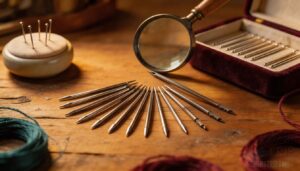
Even the best needle can’t stay sharp forever — and using a worn one is one of the fastest ways to wreck an otherwise good seam. Knowing when to swap it out, what warning signs to watch for, and how to store your needles properly makes a real difference in your results.
Here’s what you need to keep your stitching consistent.
When to Replace Needles — Intervals for Home and Industrial Machines
Think of your needle like a razor blade — it dulls faster than you’d expect. For home machines, replace it every 8–12 hours of Machine Runtime Hours, or after 1–2 projects when you switch fabric types.
Industrial Cycle Tracking runs tighter: every 8 hours, no exceptions.
- Replace after 8–12 hours of Hourly Stitch Count at home
- Follow Project-Based Replacement after every heavy-fabric job
- Increase Fabric Switch Frequency to trigger immediate changes between fabric types
- Track Machine Runtime Hours to schedule consistent swaps
- Industrial vs home sewing machine needles follow different cycles — industrial every 8 hours
Signs of Wear That Degrade Stitch Performance
Your needle wears out in ways you can’t always see.
Eye burrs catch and shred thread; groove wear causes bird-nesting; shaft wobble drifts your stitchline sideways. Point chipping and scarf flattening trigger skipped stitches and fabric damage almost immediately.
Thread breakage jumps 30–50% with a dull tip.
Don’t wait for a disaster — these signs mean replace it now.
Proper Storage, Cleaning, and Lubrication to Extend Needle Life
Store needles in a labeled case — humidity and moisture are their worst enemies, corroding steel fast. Control your workspace humidity, clean the eye and groove regularly, and follow your machine’s lubrication schedule to stay ahead of wear.
Wipe them down with lint-free cleaning tools after heavy use, and skip the oil on the shaft; oil-free needle handling keeps lint from building up.
Frequently Asked Questions (FAQs)
How does needle size affect sewing?
Size shapes everything.
The wrong needle tears fibers, skips stitches, and wrecks seam flexibility. Match fabric weight, thread thickness, and needle diameter correctly, and your stitch density, grain alignment, and production efficiency all improve instantly.
Should I get 4 inch or 5 inch knitting needles?
Your hand size and yarn weight decide this. For travel or light yarns, 4-inch needles work well. For chunky yarn or long sessions, 5-inch needles reduce wrist strain noticeably.
Can needle size affect seam strength over time?
Yes, absolutely.
Larger needles create cumulative hole damage along seam lines, weakening load-bearing capacity over time. Poor needle-thread pairing accelerates thread abrasion and edge fraying, causing seam fatigue well before the fabric itself wears out.
Do needle sizes vary between sewing machine brands?
Most machines use the 130/705H system, but brand size standards and proprietary shank designs vary. Always check compatibility charts and system code differences before buying needles for your specific machine.
How does needle size impact embroidery thread performance?
The right tool makes the work." Needle eye size directly controls luster preservation and surface abrasion on embroidery thread. A 4× eye-to-thread ratio ensures smooth pull-through resistance without shredding.
Should needle size change for layered fabric projects?
Yes, needle size should shift for layered fabric projects. A 70/10 to 80/12 works well for multi-layer stitching. Always do layered fabric testing on scraps first.
Can the wrong needle size damage a sewing machine?
Yes, the wrong needle size can damage your machine. Oversized needles cause needle bar stress, motor strain, feed dog wear, and bobbin area stress.
Vibration damage accelerates over time, making regular needle replacement and maintenance guidelines essential.
Conclusion
The thread of success is woven with the right needle size. Now that you’ve got a grip on how needle size affects stitch quality, it’s time to put this knowledge to work.
Match your needle to your fabric, and you’ll be stitching like a pro in no time. Remember, a needle that’s just right is the key to smooth seams and professional-looking results. Make the switch and see the difference for yourself immediately.