This site is supported by our readers. We may earn a commission, at no cost to you, if you purchase through links.

tangled heap of floss can unravel a project faster than a dropped needle. Thread slips off bobbins, colors bleed onto each other, and that perfect shade of dusty rose disappears into a knotted pile right when you need it most.
Good storage isn’t about being tidy—it’s about protecting your materials and keeping your creative momentum alive.
The right system means less time untangling and more time stitching. Whether you’re working with a few dozen skeins or hundreds of spools, knowing how to store embroidery thread properly makes every project smoother from start to finish.
Table Of Contents
Key Takeaways
- Sorting your thread by brand and official color number — then tucking tails under tension bands — saves you more time than any fancy organizer ever will.
- Light, heat, and humidity above 60% are quietly destroying your collection; sealed containers, silica gel packets, and UV-blocking storage stop all three in their tracks.
- You don’t need to spend much: a pegboard, a few dowels, or a repurposed card catalog can handle dozens of spools for under ten dollars.
- Cotton, silk, and linen need to breathe, so skip the airtight bins and use muslin or cotton bag liners instead — trapping moisture around natural fibers and they’ll degrade fast.
Smart Ways to Sort Thread

A good sorting system saves you more time than you’d expect. Once your threads have a proper home, finding the right color takes seconds instead of minutes.
Starting with a quick sort by type and color — as this guide to organizing sewing thread at home walks through — makes the whole system click into place from day one.
Here are five practical ways to keep everything in order.
Organize by Brand and Official Color Number
Sorting your thread by brand and official color number is one of the smartest moves you can make. Use Brand‑Specific Bins and a Color Number Index so every spool lands exactly where it belongs.
Keep Label Font Consistency across containers, add a Cross‑Reference Sheet for quick lookups, and set up Digital Inventory Tracking — your collection stays organized, searchable, and always project-ready.
Use Manufacturer Color Charts to Verify Shades
Once your spools have color numbers, verify those shades against the manufacturer’s color chart before storing. Lighting conditions matter more than you’d think — metamerism awareness saves you from mismatches that only show up mid-project.
- Hold the chart under natural daylight for accurate shade documentation
- Use a neutral background for cross-brand matching comparisons
- Record exact color numbers for all embroidery floss
- Note finish variants affecting thread labeling decisions
Keep Each Brand in Its Own Container
Once you’ve verified your shades, keep each brand in its own container — mixing brands invites color confusion quickly.
Use color-coded lids and transparent front windows so you can spot what you need without digging.
Good labeling standards matter here: mark brand name, color number, and batch tracking codes on every label spot.
Stackable racks make organizing embroidery threads simple and space‑efficient.
| Container Feature | Why It Helps |
|---|---|
| Transparent Front Windows | Identify threads without opening |
| Color-coded Lids | Instant brand recognition |
| Customizable Thread Labeling | Tracks lot codes and shades |
Tuck Thread Tails Under The Tension Band
Once your containers are labeled and sorted, don’t overlook the small stuff — loose thread tails are a real snag hazard.
Tuck each tail under the tension band using a simple Alignment Technique: fold at a shallow angle, guide it flush with a fine needle, and press flat.
This DIY embroidery thread organization habit keeps your thread organizer tidy and your threads ready to use.
Rotate Older Spools First With FIFO
Think of FIFO — first in, first out — as a simple rule that keeps your thread storage fresh and waste-free. Age-based labeling makes it easy:
- Mark each spool with its arrival date for batch tracking.
- Set a weekly rotation schedule to move older stock forward.
- Run a quick shelf audit when inventory alerts flag aging thread.
Managing thread inventory and rotation this way prevents brittleness before it starts.
Protect Thread From Damage

Your thread can unravel faster than a project gone wrong — and the culprit is usually where you store it. Light, heat, and moisture are the three biggest threats to keeping your colors bright and your fibers strong.
Light, heat, and moisture are silently unraveling your thread collection right now
Here’s what you can do to protect your thread from day one.
Keep Storage Away From Direct Sunlight
Sunlight is a silent thread killer. Even a few weeks near a window can fade colors, weaken fibers, and crack plastic spools.
Use UV Blocking Containers or Amber Tinted Boxes to shield your collection.
Practice Sunlight Mapping — trace where light hits your room throughout the day, then choose Window Free Shelving for storage.
You can also safeguard your threads by storing them in climate-controlled storage for temperature sensitive possessions.
| Risk | Cause | Solution |
|---|---|---|
| Color fading | Light exposure | Amber Tinted Boxes |
| Mold growth | Heat-driven humidity | Sealed, shaded storage |
| Fiber weakening | UV rays | UV Blocking Containers |
Maintain Stable Temperatures and Low Heat
Heat quietly destroys thread over time. Aim for 60–75°F (15–24°C) using Insulated Storage Containers or Temperature‑Controlled Cabinets — both cut temperature swings substantially.
Fanless Cooling Pads help maintain a steady zone underneath your boxes. Seal gaps with Weatherstripping. Seal Gaps to block warm air from sneaking in.
Digital Thermometer Logging lets you spot heat patterns before they cause real damage.
Prevent Humidity Above 60% to Stop Mold
Humidity above 60% is where mold wins. Once moisture creeps past that threshold, mildew can take hold within 24 to 48 hours — and your threads pay the price.
A digital hygrometer gives you real-time readings so you’re never guessing. Pair it with smart ventilation strategies, like cracking a window or running a fan, and strategic dehumidifier placement to keep things consistently dry.
Use Silica-gel Packets to Control Moisture
Silica-gel packets are quiet workhorses for moisture control. Drop a few inside your storage containers and they’ll keep humidity safely between 40–60%, stopping mildew before it starts.
- Placement Strategies: Tuck packets near the base of sealed boxes.
- Quantity Planning: Use one 5g packet per small container.
- Indicator Colors: Blue-to-pink color shifts signal saturation.
- Regeneration Methods: Bake spent packets at 275°F for one hour.
- Container Pairing: Combine with airtight boxes for best thread longevity.
Store Thread in Sealed Boxes or Zip-top Bags
Think of sealed boxes and zip-top bags as your thread’s first line of defense. Both box sealing techniques and zip-top bag materials block out dust, hair, and accidental spills.
Clear storage solutions for embroidery floss let you spot colors instantly — no rummaging needed.
Compact labeling methods outside each bag or box, and you’ve got an easy Ziploc bag storage solution that’s both budget-friendly and beautifully practical.
Choose Breathable Storage for Cotton, Silk, and Linen
Sealed containers work great for synthetics, but cotton, silk, and linen need to breathe. Trap moisture around organic fibers and they’ll go stale fast.
Instead, try:
- Cotton bag liners — allow airflow and reduce humidity buildup
- Muslin dust shields — block debris while letting fibers breathe
- Silk sack friction protection — soft wrapping prevents abrasion on delicate threads
Linen pouch ventilation and hemp durability make both solid long-term choices, too.
DIY Embroidery Thread Storage Ideas
You don’t need to spend a lot to keep your threads neat and within reach. Some of the most practical storage setups come from a little creativity and materials you might already have at home.
Here are six DIY ideas worth trying.
Use Wall-mounted Rods to Display Floss Bundles
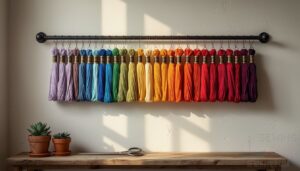
A DIY wall-mounted thread rack turns bare wall space into a working display. Choose your Rod Length Selection carefully — rods range from 24 to 60 inches, holding 20 to 40 floss bundles. Eye Level Positioning makes browsing easy.
| Feature | Detail |
|---|---|
| Rod lengths | 24–60 inches |
| Bundle capacity | 20–40 per rod |
| Finish options | Brushed nickel, matte black |
| Load capacity | Up to 1.5 lbs |
| Mounting hardware | Stainless steel screws + anchors |
Match your Finish Matching Décor preference — brushed nickel or matte black both blend in beautifully. For Mounting Hardware Tips, drill into studs and use stainless screws. Good Load Capacity Planning keeps everything secure and tangle-free.
Add Pegboard Hooks for Visible Spool Access

Pegboard hooks take your DIY wall thread rack a step further.
Hook Placement Strategy matters: space hooks one inch apart at eye level so every spool stays visible.
For Hook Material Choice, pick corrosion-resistant metal. Hook Angle Adjustment — tilted upward — keeps spools from rolling off.
With smart Load Capacity Planning and Color-Coded Hooks, your pegboard thread storage holds up to 30 spools beautifully.
Repurpose Card-catalog Drawers for Skeins
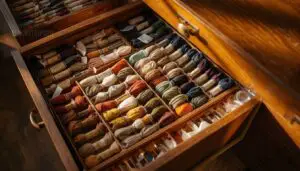
Wall hooks are great, but card catalog drawers take organization to a whole new level.
Card Catalog Drawer Storage turns thrift-store finds into beautiful embroidery thread organization. Each drawer holds skeins sorted by color family, with labels facing out for quick checks. Try these DIY storage hacks to get started:
- Add custom divider inserts to adjust spacing
- Create a drawer front index for each color range
- Place silica gel packets inside to control moisture
Organize Drawers With IKEA ALEX Units

If you’re ready to take your embroidery thread storage seriously, IKEA ALEX drawers are hard to beat. Nine shallow compartments keep everything sorted without digging. Use adjustable dividers and drawer inserts to separate brands, bobbins, and needles. A simple labeling system on each drawer front speeds up your workflow quickly.
| Drawer Zone | What to Store | Pro Tip |
|---|---|---|
| Top drawers | Small bobbins, needles | Label by brand |
| Middle drawers | Frequently used spools | Sort by color number |
| Bottom drawers | Large cones, bulk thread | Store upright |
| Side inserts | Scissors, marking tools | Use snug-fit inserts |
| Any drawer | Silica gel packets | Control moisture levels |
Vertical stacking lets you double your capacity in tight spaces. Combine with wall-mounted integration — hang rods nearby for floss bundles — and you’ve got one of the most practical DIY embroidery thread storage solutions around. Budget-friendly thread organizers don’t get more flexible than this.
Install a Door-behind Spool Organizer
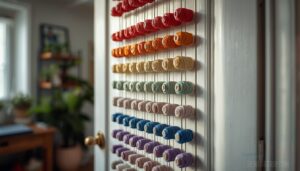
Tucking a spool organizer behind your door is one of the smartest space-saving storage moves you can make. It keeps threads hidden but instantly accessible — no drilling required.
- Adjustable height fits most standard interior doors
- Rod configuration holds 6–12 spools per tier
- Weight capacity runs 2–5 lbs per level
- Maintenance routine is simple: wipe rods monthly
Your threads stay dust-free and light-protected automatically.
Use Clothespins or Dowels for Budget-friendly Storage

Spending under ten dollars can transform a handful of clothespins and a wooden dowel into a surprisingly capable Clip-and-Dowel Organizer. Mount a dowel horizontally, then clip spools along it — your Clothespin Color Belt keeps every shade visible and tangle-free. Notches prevent rolling, and labels handle identification.
| Method | Capacity | Cost |
|---|---|---|
| Dowel Rack System | 20–30 spools | ~$5 |
| Budget Thread Grid | 30+ spools | ~$8 |
| Clothespins on a Frame | 12–15 spools | ~$3 |
Top 4 Embroidery Thread Storage Products
Sometimes a good product does the heavy lifting for you. If you’d rather skip the DIY route, there are some well-made storage options worth knowing about.
Here are four that stand out for different reasons.
1. DMC Magnetic Embroidery Organization Cards
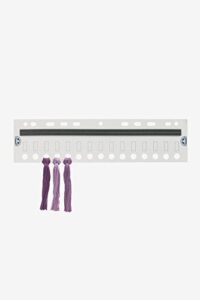
These little cards do more than you’d expect. The DMC Magnetic Embroidery Organization Cards come in a pack of three and attach directly to any magnetic board near your workspace, keeping shade numbers and skein references right where you need them.
Each card holds color codes, displays individual skeins for quick comparison, and resists wear from regular handling.
At just 0.08 kg per card, they’re light enough to carry between projects. A simple upgrade that saves real time.
| Best For | Embroiderers and cross-stitch enthusiasts who work with lots of thread colors and want a quick, tangle-free way to stay organized. |
|---|---|
| Primary Material | Plastic/Magnetic |
| Storage Type | Thread Cards |
| Portability | Stackable Cards |
| Organization Style | Magnetic Attachment |
| Target Craft | Embroidery/Cross-Stitch |
| Package Contents | 3 Cards |
| Additional Features |
|
- Magnetic attachment keeps skeins visible and easy to grab mid-project
- Nestable design saves space when storing multiple cards together
- Super lightweight at 0.08 kg each, so they’re easy to move around
- May not hold heavier or bulkier yarns securely
- Only comes in white, so color-coding your system isn’t really an option
- The 34.5 cm size might feel awkward in a tight workspace
2. Korbond Enchanted Park Sewing Basket
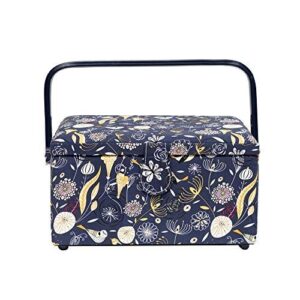
The Korbond Enchanted Park Sewing Basket is a solid pick if you want storage that looks as good as it works.
Its wicker body is sturdy enough for regular transport, while the lift-out plastic tray gives you two clear levels to separate threads, scissors, and small tools.
The built-in lid pin cushion keeps sharp items safe and handy.
Measuring roughly 14.5 × 19 × 26 cm, it holds a decent range of embroidery supplies without feeling cramped — practical and pretty in one.
| Best For | Sewists who want a stylish, portable basket to keep small accessories like bobbins, needles, and pins neatly organized at home or on the go. |
|---|---|
| Primary Material | Polyester & Plastic |
| Storage Type | Sewing Basket |
| Portability | Woven Handle |
| Organization Style | Compartment Tray |
| Target Craft | General Sewing |
| Package Contents | 1 Basket |
| Additional Features |
|
- The clear plastic tray with multiple compartments makes it easy to find small items at a glance
- The "Enchanted Park" lilac fabric wrapping looks great in a craft room and makes it a lovely gift
- A secure woven carry handle makes it easy to grab and go for workshops or travel
- The plastic tray sits flush with the lid, so you can’t stack anything on top of the basket
- The magnetic closure can pop open if you lift it too quickly, which could send things flying
- The medium size won’t cut it for bigger projects or bulkier sewing tools
3. Embroidery Tool Storage Bag
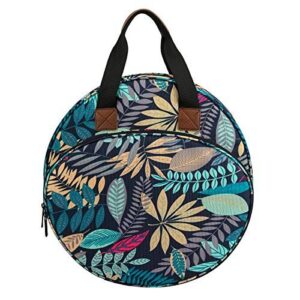
If you’re always on the move, the Embroidery Tool Storage Bag might be exactly what your kit needs.
Built from 600D Oxford cloth with reinforced stitching, it’s water-resistant and machine-washable — practical for classes, craft fairs, or workshops. The round main compartment fits circular hoops neatly, while elastic rings, mesh pockets, and a zip interior pocket keep threads, scissors, and accessories sorted.
At 40 × 31 × 6 cm, it’s compact enough to carry comfortably without leaving your supplies behind.
| Best For | Embroiderers who regularly travel to classes, craft fairs, or workshops and want one organized bag for all their tools. |
|---|---|
| Primary Material | 600D Oxford Cloth |
| Storage Type | Carry Bag |
| Portability | Top Carry Handle |
| Organization Style | Multiple Pockets |
| Target Craft | Embroidery/Hoops |
| Package Contents | 1 Bag |
| Additional Features |
|
- Made from tough, water-resistant 600D Oxford cloth that’s also machine-washable — easy to keep clean
- Lots of smart storage: mesh pockets, elastic rings, a zip interior pocket, and a slot for scissors or a tape measure
- The round main compartment is designed specifically for circular hoops, so everything fits the way it should
- Only 6 cm deep, so larger or thicker hoops may not fit comfortably
- No padding inserts or dividers included — you get the bag, nothing else
- The two-way zipper could snag or wear down over time if you’re stuffing it with sharp tools regularly
4. DMC Wooden Thread Collector Box
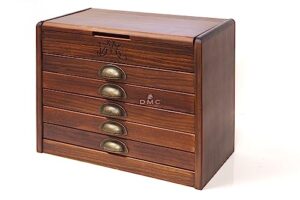
For a permanent home base, the DMC Wooden Thread Collector Box is hard to beat. It holds all 500 shades of DMC Mouliné Stranded Cotton in one sturdy wooden chest — drawers included, organized to match DMC’s own color chart.
Antiqued brass grips, smooth interior lining, and removable dividers make it genuinely satisfying to use.
At £387.13, it’s a serious investment. But if you’re committed to embroidery long-term, this box keeps your entire palette protected, visible, and ready.
| Best For | Dedicated embroiderers and cross-stitchers who want a complete, permanent thread collection in one organized home. |
|---|---|
| Primary Material | Wood & Cotton |
| Storage Type | Collector Box |
| Portability | Fixed Box |
| Organization Style | Internal Dividers |
| Target Craft | Embroidery/Cross-Stitch |
| Package Contents | 1 Box + 500 Skeins |
| Additional Features |
|
- All 500 DMC Mouliné shades in one box — no more hunting down individual skeins
- Organized to match DMC’s color chart, so finding the right shade is quick and easy
- Durable wooden chest protects threads and keeps colors vibrant over time
- Build quality can disappoint at this price — some buyers report particle-board drawers and warped slats
- Fulfillment issues have left some customers receiving an empty box, requiring a reorder
- High upfront cost plus shipping times that can stretch past a month
Frequently Asked Questions (FAQs)
How to organize leftover thread from embroidery?
Sort leftovers by brand first, then record each official color number on a master list.
This keeps fiber types consistent and makes finding the right shade fast when your next project calls for it.
How to store thread without tangling?
Tuck thread tails under each spool’s tension band before storing. Keep spools upright in labeled containers and rotate older ones first.
This stops loose ends from catching and tangling over time.
How long does embroidery thread last before going bad?
Embroidery thread doesn’t have a set expiration date. Polyester can last 10–20 years, while cotton and silk may weaken within 5–10 years. How you store it makes all the difference.
Can you store different thread types together safely?
It depends on the type. Nylon and polyester share a container just fine.
But keep cotton away from polyester — dye transfer is a real risk.
Metallics and silk? Always store those separately.
Whats the best way to store thread while traveling?
Pack light, pack smart, pack with care.
Use a sealed zip-top bag or rigid case with dividers, tuck thread tails under tension bands, and add a silica gel packet to keep moisture out.
How do you label thread spools for quick identification?
Write the brand name and color number on each spool label. If the sticker wears off, use a fine-point marker.
Add a short color description so you can grab the right shade at a glance.
Should you buy thread in bulk or as needed?
Buying in bulk saves both budget and time — bulk spools can cut costs by up to 40 percent.
But for rare shades, buy as needed to avoid idle stock cluttering your space.
Conclusion
Thread lightly — because knowing how to store embroidery thread is what keeps your creative flow from coming completely undone. Sorted by color, shielded from moisture, and tucked into the right container, your collection stays ready for whatever project calls next.
Whether DIY a wall display or invest in a dedicated box, the goal is the same: less searching, more stitching. Your thread deserves a home as thoughtful as the work it helps you create.
- https://www.sylviasstitches.com/2017/07/easy-diy-thread-storage-cart.html
- https://yhandmade.wordpress.com/2014/03/14/colorful/
- https://www.1dogwoof.com/embroidery-thread-storage-organization
- https://goto.walmart.com/c/1942563/565706/9383?veh=aff&sourceid=imp_000011112222333344&u=https%3A%2F%2Fwww.walmart.com%2Fip%2FMainstays-32IN-White-Wall-Ledge%2F491570786