This site is supported by our readers. We may earn a commission, at no cost to you, if you purchase through links.
A needle too large for chiffon doesn’t just leave holes—it tears the fiber structure, and no amount of careful pressing fixes that. Sheer fabrics punish wrong tool choices immediately and visibly. The difference between a 60/8 and a 90/14 isn’t subtle; it’s the difference between a clean seam and a ruined yard of silk organza.
Choosing the right sewing machine needles for delicate and sheer fabrics hinges on understanding shaft diameter, point geometry, and how these variables interact with loosely woven or slippery fibers. These factors directly determine whether the needle glides through fibers or damages them.
Master these elements, and even the most unforgiving sheers behave. Get them wrong, and the fabric’s integrity fails instantly.
Table Of Contents
- Key Takeaways
- Best Needles for Delicate Sheer Fabrics
- 1. Organ Microtex Ultra Fine Sewing Needles
- 2. Schmetz Microtex Sharp Sewing Needle Size 60 8
- 3. Universal Sewing Machine Needles
- 4. Universal 65/9 Sewing Machine Needles
- 5. Willbond Universal Sewing Machine Needles
- 6. Schmetz Microtex Sharp Sewing Needles Assortment
- 7. Universal Sewing Machine Needle Set
- 8. Large Eye Sewing Machine Needles
- Needle Anatomy and Fabric Protection
- Best Needle Sizes for Sheers
- Needle Types for Delicate Fabrics
- Fabric-Specific Needle Recommendations
- Thread and Needle Pairing Tips
- Needle Care and Troubleshooting
- Frequently Asked Questions (FAQs)
- Conclusion
Key Takeaways
- Needle size directly determines fabric survival: use 60/8 or 70/10 for sheers, because even one size up leaves permanent, unfixable holes.
- Microtex needles outperform universal and ballpoint types on delicate fabrics — their acute tip pierces fibers cleanly instead of pushing them apart.
- Thread and needle must be matched by eye size, not guesswork: a 60-weight thread pairs with a 65/9 needle, and deviating from that ratio causes breakage or skipped stitches.
- Replace your needle every 8–10 sewing hours or at every fabric switch — a dull tip quietly ruins sheers before you notice the damage.
Best Needles for Delicate Sheer Fabrics
The right needle makes or breaks your work with sheer fabrics — one wrong choice and you’ll see every hole.
For delicate layers like satin, choosing the right needle for baby blanket sewing can mean the difference between clean stitches and a fabric you’ve ruined.
With sheer fabrics, the right needle is everything — one wrong choice and every hole shows
These picks cover the most reliable options sewists reach for when working with chiffon, organza, silk, and other delicate weaves. Here’s what’s worth keeping in your kit.
1. Organ Microtex Ultra Fine Sewing Needles
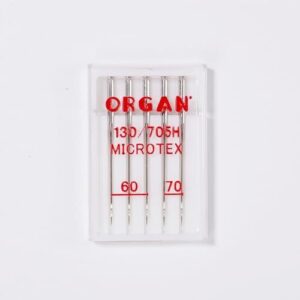
Organ Microtex Ultra Fine needles are a serious tool for serious fabric work. The ultra-sharp tip pierces fibers without pushing them aside, ensuring the difference between a clean seam and a puckered mess. The slim shaft leaves almost no trace on silk, chiffon, or viscose blends.
You get two sizes in one pack: 60/8 for delicate work and 70/10 for fabrics with slightly more body. This versatility accommodates a range of projects, from the most fragile to moderately structured materials.
Made in Japan, these needles deliver precision that cheaper alternatives simply can’t match. Their consistent performance makes them indispensable for achieving professional results in high-stakes fabric work.
| Best For | Sewists working with delicate or slippery fabrics like silk, microfiber, or synthetic leather who need clean, professional results without snags or distortion. |
|---|---|
| Pack Quantity | 5 needles |
| Needle Sizes | 60/8, 70/10 |
| Machine Compatibility | Home machines |
| Material | Steel |
| Fabric Range | Delicate/fine only |
| Price | $9.99 |
| Additional Features |
|
- Ultra-sharp tip pierces fabric threads cleanly, so you get near-invisible holes and smooth seams on even the most delicate materials.
- Two needle sizes in one pack (60/8 and 70/10) gives you flexibility across a range of fine-fabric projects.
- Great for detail-heavy work like paper-piecing, appliqué, and topstitching where precision really matters.
- Only five needles per pack, which may not last long on bigger projects that require frequent needle changes.
- Not built for heavy fabrics — denim, canvas, or upholstery will wear these out fast or just not work well.
- No warranty or performance guarantee comes with the pack, so you’re going mostly on reputation and reviews.
2. Schmetz Microtex Sharp Sewing Needle Size 60 8
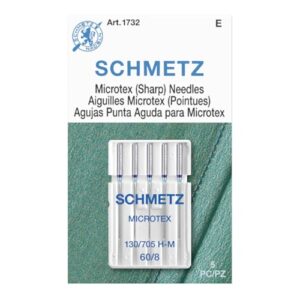
Schmetz takes precision in a different direction — offering five dedicated 60/8 needles per pack, all the same size. This consistency is intentional, especially when crafting delicate garments like a full silk blouse or an organza overlay, where uniformity matters more than variety.
The acute Microtex point creates the smallest possible hole in tightly woven sheers, while the slim blade profile resists binding even in high thread-count fabrics. These features ensure minimal fabric disruption and smooth stitching.
At a 0.60 mm shaft diameter, the needles won’t leave visible perforations, maintaining the fabric’s integrity. They are compatible with any standard home machine using the 130/705 H system, ensuring versatility for precision work.
| Best For | Sewists working with delicate, tightly woven fabrics like silk, organza, and microfibers who need clean, precise stitching without damaging their material. |
|---|---|
| Pack Quantity | 5 needles |
| Needle Sizes | 60/8 |
| Machine Compatibility | All home machines |
| Material | Steel |
| Fabric Range | Delicate/fine only |
| Price | £6.36 |
| Additional Features |
|
- The ultra-sharp Microtex point glides through fine, dense fabrics without snagging or distorting the weave
- Works with any standard home machine on the 130/705 H system, so no compatibility headaches
- Engineered for longer-lasting sharpness, meaning you get more mileage out of each needle
- Only five needles per pack, so bigger projects might mean buying multiple packs
- Not the right pick for heavy fabrics like denim or canvas — you’d want a thicker needle for those
- Sized specifically for home machines, so it won’t work if you’re running an industrial setup
3. Universal Sewing Machine Needles
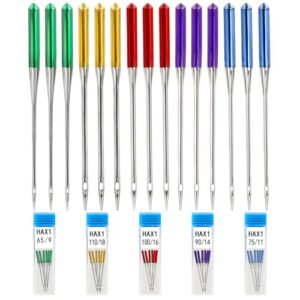
Not every project calls for specialist needles. Sometimes a good universal needle is exactly what you need — especially for lighter everyday sheer fabrics that aren’t ultra-fine.
This 30-needle set covers five sizes, from 65/9 up to 110/18, with color-coded shanks to eliminate squinting at tiny numbers mid-project.
The titanium-plated iron alloy construction resists breakage, while the slightly tapered point manages woven blends without snagging.
Compatible with Singer, Brother, Janome, and most domestic machines right out of the pack.
| Best For | Home sewers who want one reliable needle set that handles everything from lightweight silks to heavy denim without swapping between specialty packs. |
|---|---|
| Pack Quantity | 30 needles |
| Needle Sizes | 65/9–110/18 |
| Machine Compatibility | Singer, Brother, Janome |
| Material | Titanium-plated iron alloy |
| Fabric Range | Light to heavy |
| Price | Not listed |
| Additional Features |
|
- Five sizes in one pack (65/9 to 110/18) means you’re covered for nearly any fabric weight, light or heavy.
- Color-coded shanks make grabbing the right needle fast — no more holding them up to the light trying to read tiny numbers.
- Titanium plating adds real durability, so you’re not snapping needles mid-seam or dealing with unexpected jams.
- No specialty options here — if you need ball-point, stretch, or quilting needles, you’ll have to shop elsewhere.
- The color coding can be hard to read in dim lighting, which partly defeats the purpose.
- Needles come loose in the pack with no case or organizer, so keeping them sorted is on you.
4. Universal 65/9 Sewing Machine Needles
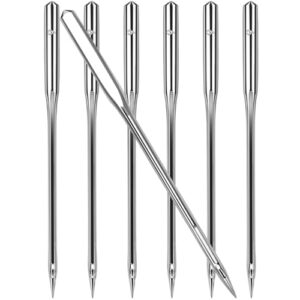
The AUGHOA 65/9 set offers a no-frills option built for lightweight fabrics, with sixty needles per pack ensuring months of regular sewing. Its flat-backed shank locks into most Singer, Brother, and Janome machines without fuss, providing broad compatibility.
At size 65/9, the shaft diameter is optimized for delicate materials like silk blends and light chiffon. It strikes a balance—small enough to avoid visible holes, sturdy enough not to snap mid-seam—making it ideal for precise work.
Users should note occasional size inconsistency; verifying tension before starting a project is recommended to ensure seamless results.
| Best For | Home sewers and small-business embroiderers who regularly work with lightweight fabrics like silk, chiffon, or thin cotton and want a reliable bulk supply on hand. |
|---|---|
| Pack Quantity | 60 needles |
| Needle Sizes | 65/9 |
| Machine Compatibility | Singer, Brother, Janome |
| Material | Iron alloy |
| Fabric Range | Lightweight only |
| Price | Not listed |
| Additional Features |
|
- 60 needles per pack means you won’t be scrambling for replacements anytime soon
- Flat-backed shank fits most Singer, Brother, and Janome machines right out of the box
- Size 65/9 is gentle on delicate fabrics, leaving minimal marks and distortion
- Some needles run slightly larger than true size 9, which can throw off thread tension
- Eye alignment issues on certain machines lead to frustrating thread breakage mid-project
- Packaging is flimsy and non-resealable, making storage a bit of a hassle
5. Willbond Universal Sewing Machine Needles
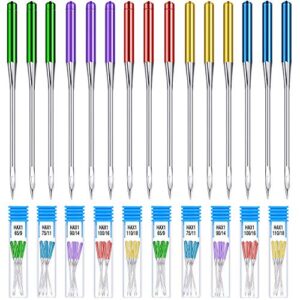
Willbond’s 30-needle pack covers five sizes — 65/9 through 110/18 — making it genuinely all-purpose for mixed-project sewing rooms.
The smallest size, 65/9, manages lightweight chiffon and silk without punching visible holes. Each size is color-coded, eliminating mid-project guesswork.
The flat shank ensures secure seating in most domestic machines, including Singer and Brother.
One caveat: these are regular-point only. If your sheer fabrics demand Microtex precision, this pack won’t replace that — but for everyday delicates, it holds its own.
| Best For | Home sewers who work across a range of fabrics and want a reliable stash of everyday needles without constantly reordering. |
|---|---|
| Pack Quantity | 30 needles |
| Needle Sizes | 65/9–110/18 |
| Machine Compatibility | Domestic machines |
| Material | Titanium-plated iron alloy |
| Fabric Range | Light to heavy |
| Price | Not listed |
| Additional Features |
|
- Five size ranges in one pack handle everything from silk to denim, so you’re covered for most projects.
- Color-coded sizes make grabbing the right needle fast — no squinting at tiny markings mid-project.
- 30 needles per pack means you’re not running out anytime soon, even if a few break along the way.
- Regular-point only, so you’ll still need to buy ballpoint or stretch needles separately for knits and specialty fabrics.
- Durability is just okay — some users report tip wear or breakage sooner than expected.
- Not built for heavy-duty or industrial machines, so if you’re pushing thick layers regularly, these may struggle.
6. Schmetz Microtex Sharp Sewing Needles Assortment
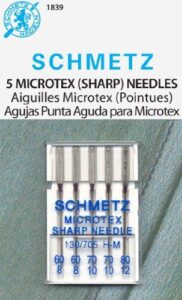
For precision-critical work on silk, rayon challis, or dupioni, the Schmetz Microtex Sharp Assortment (model 1839C) earns its place.
Its fine, sharp point glides through delicate weaves without snagging—worth pairing with a solid understanding of sewing machine needle types and when to replace them to keep your work flawless.
The pack includes five needles across sizes 60, 70, and 80 — enough range to move from chiffon to mid-weight satin without switching brands. The acute slim point creates clean entry with minimal distortion, while the carded finish reduces friction on slick fibers.
At $9.99, it’s a practical investment — just verify you’ve received H-M needles, not H-J jeans needles before you start.
| Best For | Sewists working with delicate or slippery fabrics like silk, rayon challis, or dupioni who need clean, precise stitching without snags or distortion. |
|---|---|
| Pack Quantity | 5 needles |
| Needle Sizes | 60, 70, 80 |
| Machine Compatibility | Home machines |
| Material | Steel |
| Fabric Range | Delicate to heavy |
| Price | $9.99 |
| Additional Features |
|
- The slim acute point glides through microfibers and coated materials cleanly, keeping seams sharp and distortion-free.
- Three size options (60, 70, 80) in one pack give you good range without buying multiple assortments.
- At $9.99, it’s an affordable pick from a trusted brand that serious sewists rely on.
- Five needles won’t last long on bigger projects — you’ll likely need to stock up on multiple packs.
- Some buyers have gotten H-J jeans needles by mistake, so double-check the package before you sew.
- Stock can be spotty, which means slower shipping when supplies run low.
7. Universal Sewing Machine Needle Set
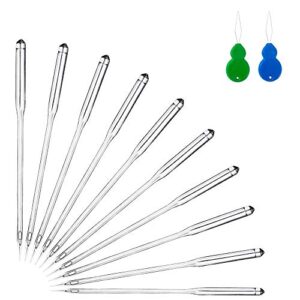
The Duvliet FRJZ0001 is a versatile and affordable 50-piece needle set covering five sizes (9 through 18). Compatible with most home machines, including Singer, Brother, and Janome, it offers reliable performance for everyday fabrics at just $5.99.
Constructed from durable iron alloy, these needles handle routine sewing tasks effectively. The set includes two threaders, streamlining size changes and reducing setup time between projects.
Avoid sizes 14–18 for true sheers; these larger needles are better suited for heavier materials. For delicate or lightweight fabrics, stick to the smaller size 9 or 11 needles to prevent damage.
| Best For | Home sewers who work with a range of fabrics and want one reliable needle set that covers everything without breaking the bank. |
|---|---|
| Pack Quantity | 50 needles |
| Needle Sizes | 9–18 |
| Machine Compatibility | Singer, Brother, Bernina, Janome |
| Material | Iron alloy |
| Fabric Range | Chiffon to leather |
| Price | $5.99 |
| Additional Features |
|
- Five sizes in one pack means you’re ready for anything from chiffon to denim without hunting down separate sets.
- Works with most popular home machines like Singer, Brother, and Janome — no brand-matching headaches.
- At $5.99 for 50 needles, it’s hard to beat the value for everyday sewing.
- No specialty coatings like titanium or gold, so high-speed or heavy-duty abrasive fabrics may wear them down faster.
- Won’t work with industrial or handheld machines — strictly for standard home use.
- You’ll need to double-check your machine’s needle-size chart to make sure you’re grabbing the right size for each project.
8. Large Eye Sewing Machine Needles
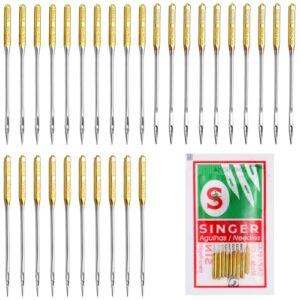
Threading a large-eye needle transforms the sewing experience. The SynHHergyx model 5128JNVA8360 offers a 30-piece assortment in sizes 14, 16, and 18, designed to accommodate specialty, metallic, or multi-strand threads without shredding during use.
Constructed from titanium-plated stainless steel, these needles resist corrosion and withstand frequent use. The durable build ensures longevity, even with demanding projects.
The enlarged eye significantly reduces friction heat and thread breakage, critical for delicate fabrics. This feature is particularly beneficial when working with sheers specifically, where avoiding snags is essential.
| Best For | Home sewers who work with specialty, metallic, or multi-strand threads and want faster threading and fewer frustrating breaks. |
|---|---|
| Pack Quantity | 30 needles |
| Needle Sizes | 14–18 |
| Machine Compatibility | Standard home machines |
| Material | Titanium-plated stainless steel |
| Fabric Range | Light to medium |
| Price | $6.99 |
| Additional Features |
|
- Enlarged eye makes threading quick and easy, even with thick or tricky threads
- Titanium-plated steel holds up well over time and resists rust
- 30 needles across three sizes gives you solid variety for everyday home sewing projects
- Doesn’t include larger gauges, so heavy fabrics like leather or thick denim aren’t really covered
- No guarantee it’ll work with industrial or specialty machines
- No warranty info included, which makes it hard to know what you’re getting quality-wise
Needle Anatomy and Fabric Protection
Every part of a sewing needle has a job — and on delicate fabrics, each one matters more than you’d think. Getting the anatomy right is what separates clean, invisible stitches from puckered, damaged fabric.
Here’s what each component does and why it directly affects your results.
How The Shank Affects Machine Stability
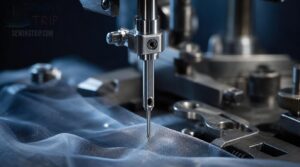
The shank is your needle’s anchor — and a loose anchor sinks the ship. Shank rigidity and mounting precision determine how steadily the needle tracks through fabric. Poor machine compatibility means vibration, skipped stitches, and snags on delicate fabrics.
Flat shank designs lock into most home machines with zero rotational play, keeping runout tolerance tight. Shank locks should seat fully, every time.
Material stiffness and thermal stability also matter — these factors ensure consistent performance under varying conditions.
Why Shaft Grooves Reduce Thread Friction
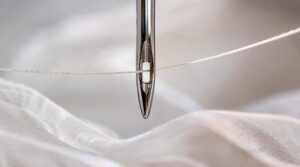
Think of the needle groove as a micro-reservoir — it traps lubricant right where thread meets metal. Groove geometry drives the micro-reservoir effect, holding fluid at the contact zone to create continuous lubrication.
The result? Lower thread friction, smarter stress distribution, and a disrupted wear mechanism that stops fraying before it starts. Silk and chiffon demand nothing less.
Small Eyes for Fine Sheer-fabric Threads
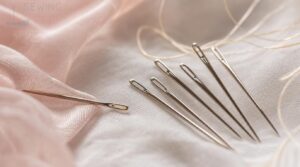
Eye size matters more than most sewists realize. A smaller needle eye reduces bulk at the thread entry point — keeping stitches flat and nearly invisible on silk and chiffon. Better eye finish means smoother thread glide, less friction, and no fraying. Precise eye placement also controls thread visibility in sheer weaves.
With a thin sharp needle, delicate fabrics stay unblemished. The enlarged oval eye design lowers thread friction, which helps preserve delicate fibers.
How The Scarf Prevents Skipped Stitches
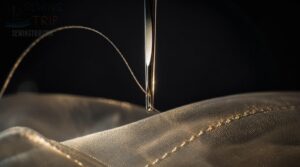
Just past the eye sits the scarf — a small recess ground into the needle’s back. This feature creates space for the bobbin hook to catch the thread loop at exactly the right moment. Without it, loop timing precision fails, leading to skipped stitches.
On delicate fabrics, the scarf reduces friction, ensuring smooth accommodation of fine threads. This protects seam quality throughout the stitching process.
Point Shape and Visible Fabric Holes
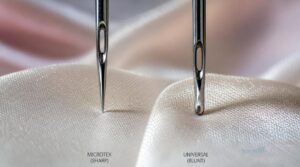
Point shape is the detail that separates clean seams from ruined fabric. Tip geometry directly influences this—an acute microtex point slips between fibers cleanly, while a blunt universal tip forces them apart. On silk or chiffon, that difference shows.
Key hole visibility factors include:
- Needle size relative to fabric thread count
- Point sharpness and fiber pull minimization
- Consistent hole pattern along the grain
Sheen preservation holes—tiny, evenly spaced—keep your fabric looking uninterrupted.
Best Needle Sizes for Sheers
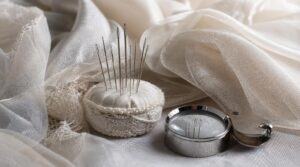
Needle size is the single most direct variable you can control to protect sheer fabric. Even a half-step up in diameter can leave permanent holes you can’t press out.
Here’s what each size actually does — and when to reach for it.
Why 60/8 Suits Ultra-sheer Fabrics
The 60/8 is the go-to for ultra-sheers—and the math backs it up. At just 0.60 mm in diameter, it delivers minimal hole size and low thread friction, ensuring silk stays smooth and chiffon doesn’t pucker.
Fiber stress reduction is real here: less thread means less drag, preserving fabric integrity. This design minimizes resistance, allowing delicate materials to maintain their natural flow.
The result? Enhanced drape retention and an invisible seam appearance that lets your fabric speak for itself.
When to Choose 65/9 Needles
When 60/8 feels too fragile for the job, 65/9 is your next move. It’s the sweet spot for slightly heavier sheers — silk, satin, crepe de chine — where needle size and fabric weight compatibility actually matters.
- Manages lightweight lace detailing without snagging
- Assists delicate pleat work and fine embroidery design
- Works best at a slow sewing speed with low tension settings
- Covers needle recommendations for silk and chiffon fabrics precisely
Using 70/10 for Chiffon and Voile
Chiffon and voile are where 70/10 earns its place. The slim shaft slips through without punching visible holes — needle size and fabric weight compatibility is exactly why this matters on light fabrics.
| Setting | Chiffon | Voile |
|---|---|---|
| Stitch Length | 2.0–2.2 mm | 2.2–2.4 mm |
| Tension Calibration | Slightly reduced | Standard |
| Foot Pressure | Light | Light-medium |
Before cutting into your actual piece, scrap testing confirms that your seam allowance sits clean and flat. These are the needle recommendations for silk and chiffon fabrics that ensure a secure hold — choosing the right sewing machine needle for fabric type starts here, with needle point types doing the quiet work.
Avoiding Oversized Needles on Organza
Organza doesn’t forgive oversized needles — every puncture is permanent. Stick to size 60/8 or 70/10, and always run scrap fabric trials before touching your main piece. Needle size testing on scraps catches damage before it counts.
Avoid these mistakes on organza:
- Using sizes above 70/10 — causes visible, unfixable holes
- Skipping stabilizer selection tips — light fabrics shift and pucker without support
- Ignoring thread tension balance — loose tension distorts the weave
- Reusing bent needles — needle bend avoidance protects the fabric’s integrity
Choosing the right sewing machine needle for fabric type means respecting how needle point types interact with open weaves.
European Vs American Needle Sizing
European sizing measures shaft diameter in millimeters (60 = 0.60 mm), while American sizing uses a numbered scale. Dual labeling like 60/8 simplifies metric conversion.
Use a size equivalence chart to cross-reference both systems accurately. Verify machine compatibility before switching brands, as calibration matters.
For sheers, European 60–70 equals American 8–10 on sewing machine needle charts.
Needle Types for Delicate Fabrics
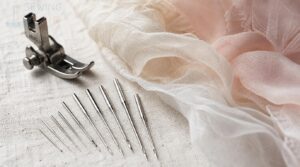
Not all needles are built the same, and that difference matters the moment you put sheer fabric under the presser foot. The wrong point type can pucker, snag, or punch visible holes — even at the right size.
Here’s what you need to know about each type before you thread up.
Microtex Needles for Clean Penetration
Microtex needles are built for one thing: getting in and out of delicate fabric without leaving a trace. The slim shaft and polished surface cut drag dramatically.
That ultra-fine needle tip — what you’d call micro-precision penetration — punches clean holes in silk and sheers without pulling fibers. Less distortion, faster stitching.
SharpMicrotex needles don’t just protect fabric; they prevent damage before it starts.
Sharp Needles for Fine Woven Fabrics
Sharp needles excel at piercing fine woven fabrics like voile, batiste, and georgette without dragging fibers. Their precision tips enable Fabric Pull Minimization and Seam Visibility Reduction, surpassing universal points in performance.
Pairing the correct needle size (70/10 for most sheers) with a small needle eye, fine thread, and proper Thread Tension Matching ensures clean, invisible seams every time.
Universal Needles for Lighter Everyday Sheers
Not every sheer needs a specialist needle. For lighter everyday fabrics—think cotton voile or loosely woven gauze—a universal needle manages the job well. Its Shank Compatibility and Scarf Alignment work reliably across most machines, supporting smooth Thread Glide without fuss.
Stick to a smaller needle size like 70/10, match it to your fabric weight guide, and you’ll achieve solid Needle Longevity with real Cost Efficiency.
Why Ballpoint Needles Can Damage Sheers
Universal needles work for casual sheers — but ballpoint needles? That’s where real fabric damage starts. Designed for knits, the rounded needle point shape pushes silk and sheer weave fibers aside rather than piercing cleanly, causing fiber snagging, micro-hole formation, and stitch distortion.
- Thread friction increases as the tip drags fine yarns
- Repeated passes widen gaps, causing visible puckering on organza
- Loose weft threads catch and run along seam lines
Before committing, always do swatch testing first.
Needle Types to Avoid Completely
Beyond needle systems built for resistance—such as denim, leather, and heavy-duty sharp types—cause significant damage by failing to accommodate delicate fibers.
Excessive needle length increases deflection and skipped stitches, while an oversized eye and wide scarf disrupt fine threads, pulling them off-track.
Even a dull tip or heavy coating buildup snags fragile weaves, leading to ruined seams. Wrong needle, ruined seam.
Fabric-Specific Needle Recommendations
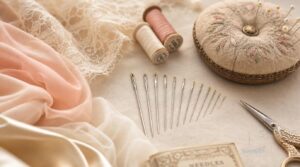
Different fabrics have different rules — and using the wrong needle can ruin a project fast.
Chiffon, silk, organza, and lace each responds differently to point type and size. Here’s what works best for each one.
Best Needles for Chiffon
Chiffon punishes the wrong needle fast — puckered seams, snags, fabric damage you can’t undo. A Microtex needle in size 60/8 or 65/9 solves most of that.
Its needle tip geometry creates a precise insertion angle, ensuring thread glide stays smooth and seam visibility remains clean.
Keep bobbin tension light and thread tension management consistent — chiffon has no tolerance for guesswork.
Best Needles for Silk and Satin
Silk and satin demand precision — one wrong needle and you’re dealing with snags, skipped stitches, or permanent holes. Stick to Microtex needles in size 60/8 or 65/9.
Coated needle benefits include reduced friction on smooth fibers, which directly improves satin stitch consistency.
Keep needle eye size fine, match it to 16–24 wt polyester thread, and satin stitch guidance becomes straightforward quickly.
Best Needles for Organza
Organza punishes the wrong needle immediately — visible holes that don’t close. Your best options are a Microtex or standard sharp needle in size 60/8 or 70/10.
Needle anatomy and its impact on stitch quality matters here: a fine needle eye reduces thread drag, while coated needle advantages include smoother fiber penetration.
Always apply the swatch test method first, adjust thread tension tweaks accordingly, and aim for an ideal stitch length of 11–13 spi.
Skip fabric stabilizer use unless absolutely necessary.
Best Needles for Lace
Lace demands a needle that respects its structure. Use Microtex sharp in size 60/8 to 70/10 — the slim point pierces without snagging.
Coated Lace Needles reduce drag on glossy surfaces; check Lace Brand Picks like Schmetz for reliable Lace Needle Color‑Coding.
Verify your Lace Sharpness Test on a scrap first. Mind your needle eye, thread tension, and Lace Needle Storage to prevent fabric puckering.
Best Needles for Cotton Lawn
Cotton lawn is durable yet delicate — it requires the right needle partner. A Microtex needle in size 60/8 ensures optimal needle size and length alignment, with a fine shaft thickness that preserves the fabric’s drape.
Avoid a ballpoint needle entirely, as it risks snagging the weave. For denser fabric blends, size 65/9 delivers stitch visibility and clean seams.
Your needle choice ultimately depends on thread weight: pair fine cotton thread with size 60/8 to achieve a silk-smooth finish.
Best Needles for Batiste and Voile
Batiste and voile are two of the most unforgiving fabrics you’ll work with — one wrong needle leaves you with puckered seams. For both, a regular sharp needle in size 70/10 hits the sweet spot in any needle size guide. It delivers clean punctures without distorting the weave.
Fabric compatibility stays consistent when you match stitch length to 11–13 stitches per inch (spi).
Best Needles for Georgette
Georgette sits somewhere between chiffon and crepe — and your needle choice has to match that middle ground. A Microtex sharp in size 60/8 or 70/10 manages fabric compatibility well, creating precise entry points without enlarging holes.
For needle testing, always run a scrap first. Machine tension settings matter too — keep them light.
This lightweight needle approach delivers clean edge-stitch details and smooth seam finish techniques every time.
Thread and Needle Pairing Tips
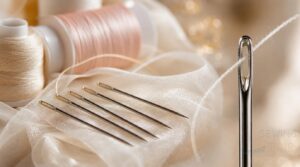
The right needle and wrong thread gets you halfway there — but pair it with the wrong thread, and you’re back to puckered seams and broken loops. Thread weight, fiber type, and eye size all work together, and small mismatches show up fast on delicate fabrics.
Here’s what to know before you thread up.
Fine Polyester Thread for Silk and Satin
For silk and satin, fine polyester thread—60 to 90 weight is your best ally. Choose filament over spun; it delivers a lightweight finish with low friction against glossy surfaces. Pair it with a size 60/8 or 65/9 Microtex needle, matching the needle eye size to the thread weight.
Colorfast performance and dimensional stability ensure seams remain flat and clean after washing.
Cotton Thread Pairings for Cotton Lawn
Switch to 60-weight cotton thread when working with lawn fabric—it matches the fabric’s drape without crowding seams. For cotton ply choice, two-ply mercerized cotton ensures smoothness and adds mild luster, coordinating seamlessly without gloss.
Bleed control is also crucial: prewash both fabric and thread together to prevent color transfer.
Consider coated thread benefits, such as reduced fraying, particularly for machine-sewn lawn hems.
Matching Thread Weight to Needle Eye
Thread weight and needle eye size are interdependent, governed by a critical ratio: the needle eye should be roughly 1.4 times the thread’s diameter. Deviating from this balance risks issues: an eye too small causes Thread Compression Issues, while one too large compromises Thread Slip Prevention.
Eye Geometry Selection comes down to this:
- 60 wt thread → 65/9 needle (Ideal Eye Diameter for sheers)
- 50 wt thread → 80/12 needle minimum
- Silk thread → Eye-to-Thread Ratio guides 70/10 pairing
- Matching needle size to thread weight prevents skipped stitches on fine weaves
- Test the needle-to-thread match on scrap fabric before seaming
Always validate pairings through practical testing to ensure stitch integrity.
Preventing Thread Breakage on Sheer Fabrics
Even with the right needle size, thread snapping prevention comes down to a few tight variables. Loosen top tension slightly for ultra-sheers — overtightened stitches concentrate stress at every entry hole. Responsive tension adjustment matters here.
Keep your thread path cleaning routine consistent; lint in the groove heats fine thread fast.
Ballpoint needles compound fabric damage by snagging weave structure, so avoid them entirely on wovens.
Stitch Density for Clean Delicate Seams
Stitch density is where needle size, type, and fabric compatibility intersect. For ultra-sheer fabrics, aim for 10–12 stitches per inch—this provides sufficient strength without overcrowding the delicate weave.
Too-tight stitching risks creating tension ridges, as thread tension pulls seams unnaturally. Always conduct swatch testing first to calibrate settings and avoid fabric distortion.
Even feed mechanisms are critical to prevent layers from shifting during stitching, ensuring seamless alignment. Prioritize edge reinforcement at stress points to safeguard fragile fibers while maintaining minimal bulk.
Needle Care and Troubleshooting
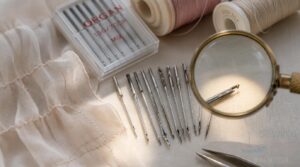
Even the best needle won’t perform if you ignore what it’s telling you.
Dull points, skipped stitches, puckered seams are all fixable — once you know what to look for.
Here’s what to watch, fix, and do to keep your delicate-fabric sewing on track.
When to Replace Delicate-fabric Needles
Delicate fabrics don’t forgive a tired needle. Follow these guidelines for needle replacement frequency:
- Replace after 8–10 hours of active sewing to avoid fabric damage from needle wear indicators like puckering.
- Change at every fabric switch trigger — moving from chiffon to voile counts.
- Swap immediately when loud popping signs appear or lint obstruction warnings arise.
Temperature stress and thick layers accelerate wear. Replace needles regularly — no exceptions.
Signs of a Dull or Damaged Needle
A worn needle rarely announces itself — it just quietly ruins your work.
Watch for thread breakage on fine fibers, fabric snags at the seam line, or that telltale loud stitching thud. Eyewear causes fraying; needle wobble means a bent shaft.
These needle wear indicators signal real fabric damage fast.
Consistent needle maintenance is your best needle breakage prevention.
Fixing Puckering on Sheer Fabrics
Puckering on sheers almost always traces back to three things: wrong needle size, poor tension adjustment, or missing stabilizer application. Start fresh — install a 60/8 or 70/10, then lower upper thread tension by 0.5 units. Add tissue-paper stabilizer beneath slippery layers.
Fabric pre-washing relaxes fibers before cutting. A walking foot feeds layers evenly, and an edge stay-stitch locks seam lines flat before final stitching.
Solving Skipped Stitches and Snags
Skipped stitches usually point to one culprit — and it’s rarely tension. Check needle insertion angle first; a needle seated even slightly off-center misses the hook timing. Verify your thread path verification before anything else. Then confirm bobbin tension settings and fabric compatibility with your needle type.
Reduce machine speed reduction on slippery sheers, apply stabilizer application beneath layers, and match thread and needle pairing guidelines to the fabric weight.
Cleaning Lint From The Needle Groove
Lint in the needle groove is a silent wrecker — it raises the tip just enough to skip stitches on sheers.
Your needle maintenance starts here. After every few meters, perform a mid-project groove check. Begin with a soft brush choice, then use the alcohol wipe technique for residue. When applying compressed air, never aim at the tip to avoid damage.
A lighted groove inspection confirms clearance before resuming work.
Storing Fine Needles Safely
Once your groove is clean, store needles properly in a secure needle box with a tight lid to protect fine points. Add protective needle caps before boxing to prevent damage.
Use color-coded labeling to separate Microtex from Universal sets for instant identification. Maintain organization by grouping similar types together.
Follow an inventory rotation schedule: always prioritize oldest stock first to ensure freshness and usability.
Store needles in a controlled storage climate—cool, dry, and away from magnetics—to preserve integrity and longevity.
Frequently Asked Questions (FAQs)
What needle should I use for delicate fabric?
For delicate fabric, use a Microtex needle in size 60/8 or 70/ Its fine point pierces cleanly without tearing fibers — less puckering, better control.
What sewing machine needle for thin fabric?
For thin fabric, use a Microtex size 60/8 or 70/10. Sharp needles keep stitch length clean, thread tension balanced, and needle size small enough to avoid visible holes.
Can I reuse needles across multiple delicate projects?
Technically, yes — but you shouldn’t. Cumulative wear effects are real. A fresh needle policy protects your fabric. Cross-project contamination, dull tips, and groove lint silently wreck sheer seams.
Replace it. Always.
Does sewing speed affect needle performance on sheers?
Higher speeds cause heat buildup, needle wear, fabric slippage, and thread tension fluctuations — all of which trigger puckering on sheers.
Moderate your pace for stitch consistency and longer needle lifespan.
Which presser foot works best with sheer fabrics?
A walking foot feeds layers evenly, preventing slippage.
For hems, the narrow hem foot delivers crisp, clean edges.
Use a straight stitch foot for seams — it stabilizes sheers and minimizes needle deflection.
How does needle brand quality vary between manufacturers?
Not all brands are equal. Steel grade, bevel consistency, and coating durability separate premium from budget needles. Better quality control means longer needle lifespan and fewer skipped stitches mid-project.
Conclusion
Picture a needle gliding through silk organza like a whisper through still air—no drag, no distortion, just clean stitches holding perfectly. That’s what the right sewing machine needles for delicate and sheer fabrics actually deliver. Size, point geometry, and needle type are not minor details; they’re the entire difference between fabric that survives and fabric that doesn’t.
Choose deliberately and replace them often, and your sheers will behave exactly as they should.
- https://www.missouriquiltco.com/collections/sewing-machine-needles/shop-by-quilting-sewing-tools?srsltid=AfmBOop92l-TiVILFJwHWjEhFRdBYCyAxJb3F0LMe-bkSzgs7bA4NtN3
- https://www.goldstartool.com/blog/the-complete-guide-to-sewing-machine-needles-and-sizes.htm
- https://www.patternsforpirates.com/sewing-needles-101/
- https://www.thorntonco.com/the-right-needle.htm
- https://www.thesewingdirectory.co.uk/sewing-machine-needle-guide/