This site is supported by our readers. We may earn a commission, at no cost to you, if you purchase through links.

Fabric with raw, fraying edges is one of those small frustrations that sneaks up mid-project and refuses to let go. A serger solves that problem faster than any other machine in your sewing room—trimming, encasing, and finishing a seam in a single pass while your regular machine is still warming up.
For hobbyists, that efficiency isn’t a luxury; it’s what keeps momentum alive when inspiration strikes. The right serger machine manages everything from slippery chiffon to stubborn denim without demanding a degree in mechanical engineering.
Knowing which features actually matter separates the machines worth your money from the ones that collect dust.
Table Of Contents
- Key Takeaways
- Top 10 Serger Machines for Hobbyists
- 1. Brother 3/4 Thread Serger Refurbished
- 2. Brother 2340CV Coverstitch Serger
- 3. Janome MOD 8933 Serger Lay-In Threading Differential Feed
- 4. Singer S0230 Heavy Duty Serger
- 5. Singer X5004HD Metal Frame Serger
- 6. Singer Professional 5 Metal Frame Serger
- 7. Brother AIR1800 Air Serger
- 8. Singer S0100 Metal Frame Serger
- 9. Juki MO-655 Pearl Serger
- 10. American Home Portable Serger Machine
- Best Sergers by Hobbyist Need
- Best Budget-friendly Serger for Casual Sewing
- Best Beginner Serger for Learning Overlock Stitches
- Best Heavy-duty Serger for Denim and Thick Fabric
- Best Portable Serger for Small Sewing Spaces
- Best Air-threading Serger for Convenience
- Best Multi-thread Serger for Advanced Projects
- Best Serger for Stretchy Knit Fabrics
- Key Features to Compare
- 3. thread, 4-thread, and 5-thread Stitch Options
- Stitch Speed and Overall Sewing Performance
- Differential Feed for Knits and Puckering Control
- Adjustable Stitch Length and Stitch Width
- Presser-foot Pressure Adjustment
- Disengageable Upper Knife for Specialty Stitches
- Built-in Waste Collectors and Trim Management
- LED Lighting and Workspace Visibility
- Threading and Ease of Use
- Fabric and Project Compatibility
- Sergers for Lightweight Fabrics and Rolled Hems
- Sergers for Knits, Stretch Fabrics, and Activewear
- Sergers for Denim, Canvas, and Layered Fabric
- Flatlock Seams for Decorative and Functional Finishes
- Blind Hems for Garments and Home Décor
- Overlock Seams for Fray-resistant Raw Edges
- Choosing Thread Count by Project Type
- Buying Tips for Hobbyist Sergers
- Matching Price Tier to Sewing Frequency
- Choosing Between Compact and Full-size Machines
- Comparing Metal Frames and Machine Durability
- Checking Warranty Coverage Before Buying
- Evaluating Included Accessories and Presser Feet
- Considering Noise, Vibration, and Stability
- Balancing Beginner-friendly Features With Long-term Growth
- Frequently Asked Questions (FAQs)
- Conclusion
Key Takeaways
- The right serger matches your actual sewing habits—buy for how often you sew today, not the ambitious version of yourself you’re hoping to become.
- Features like differential feed, color-coded threading, and adjustable stitch width aren’t just nice-to-haves; they’re what separates a machine you’ll love from one that collects dust.
- Fabric type drives machine choice—lightweight knits need differential feed control, while denim and canvas demand a heavy-duty metal frame and high-torque motor.
- Air-threading and automatic tension systems aren’t luxury extras anymore; they’re genuine time-savers that let you spend more time creating and less time troubleshooting.
Top 10 Serger Machines for Hobbyists
Finding the right serger doesn’t have to feel overwhelming, even with so many options out there. Whether you’re just starting out or ready to level up your sewing game, there’s a machine on this list that fits your needs and budget.
If budget is your main concern, it helps to know what sergers typically cost across different tiers before you start comparing models.
Here are ten hobbyist sergers worth your attention.
1. Brother 3/4 Thread Serger Refurbished
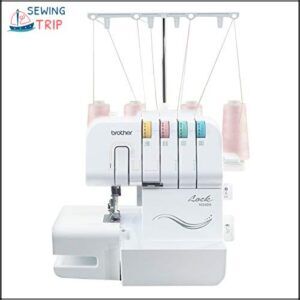
Brother 3/4 Thread Serger Refurbished offers professional seam finishing at a budget-friendly price, making it ideal for beginners. With 22 stitch functions—including rolled hems and flat-lock options—it delivers versatility, while the differential feed prevents knits from stretching during use.
Color-coded threading guides simplify the set-up process, and the built-in LED light ensures a well-illuminated workspace. Weighing approximately 13.9 lbs, its compact design suits smaller craft rooms without sacrificing functionality.
| Best For | Home sewers and beginners who want professional-looking seam finishes on knits, activewear, and delicate fabrics without spending a fortune. |
|---|---|
| Thread Capacity | 3-4 thread |
| Differential Feed | 0.7–2.0 ratio |
| Max Stitch Speed | Not listed |
| Weight | 13.9 lb |
| Color-Coded Threading | Yes |
| Rolled Hem Capable | Yes |
| Additional Features |
|
- 22 stitch functions give you a lot of range — rolled hems, flat-lock, ribbon-lock, and more all in one machine
- Differential feed keeps stretchy and delicate fabrics from puckering or distorting as you sew
- Color-coded threading guides and included manuals make setup way less intimidating for new serger users
- It runs louder than higher-end sergers and can vibrate noticeably on lighter tables
- Being refurbished means you might deal with cosmetic wear or dull cutting blades that need replacing
- Some plastic components in the frame add shakiness at higher speeds compared to all-metal machines
2. Brother 2340CV Coverstitch Serger
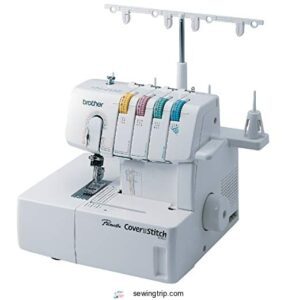
If you’re ready to take your knit hems to the next level, the Brother 2340CV Coverstitch Serger is worth a serious look. Unlike a standard serger, this machine is purpose-built for cover stitches — giving you that clean, professional finish you see on store-bought activewear and swimwear. It runs up to 1,100 stitches per minute, manages 2-to-4 thread configurations, and its color-coded threading guides make setup surprisingly quick.
At $499.99 with a 25-year warranty, it’s built to last.
| Best For | Sewists and small-studio owners who regularly work with knits, stretch fabrics, or activewear and want a dedicated cover stitch machine that can keep up with a real production pace. |
|---|---|
| Thread Capacity | 2-3-4 thread |
| Differential Feed | 0.7–2.0 mm |
| Max Stitch Speed | 1,100 spm |
| Weight | 13 lb |
| Color-Coded Threading | Yes |
| Rolled Hem Capable | No |
| Additional Features |
|
- Handles 2-to-4 thread cover stitch configurations, so you can do narrow hems, wide hems, and decorative finishes all on one machine
- Color-coded threading and the fast looper system cut down setup time significantly between projects
- A 25-year warranty backed by a metal frame means this thing is built to stick around
- At 13 lbs with a metal build, it’s not something you’re easily packing up and taking to a class or retreat
- Triple-cover stitch chews through thread fast, which gets wasteful (and pricey) on lighter fabrics
- Getting clean results takes some dialing in — thread tension, spool placement, and release technique all matter more than you’d expect
3. Janome MOD 8933 Serger Lay-In Threading Differential Feed
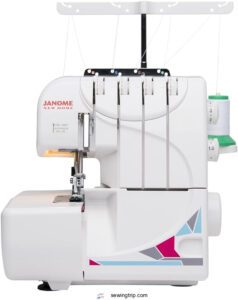
Now, if cover stitches aren’t your thing and you want an all-around workhorse, the Janome MOD-8933 is hard to beat at $299. Its lay-in threading system with color-coded guides takes the guesswork out of setup — a real win for first-timers. Differential feed keeps knits smooth and wovens crisp, while the quick-change rolled-hem attachment speeds up edge finishing. At 6.5 kg with a compact footprint, it fits comfortably on any home sewing table.
| Best For | Sewists who are new to serging and want a reliable, easy-to-thread machine that handles everything from knits to heavy canvas without breaking the bank. |
|---|---|
| Thread Capacity | 3-4 thread |
| Differential Feed | Yes |
| Max Stitch Speed | Not listed |
| Weight | 14.3 lb |
| Color-Coded Threading | Yes |
| Rolled Hem Capable | Yes |
| Additional Features |
|
- Color-coded lay-in threading makes setup fast and way less frustrating, especially if you’re just getting started with sergers
- Differential feed does a great job keeping fabrics smooth — no puckering on stretchy knits or stiff denim
- Solid metal build keeps things steady during long sewing sessions, so it doesn’t wobble around on your table
- No free-arm attachment, which makes cuffs and narrow tubes a real headache
- The upper knife knob takes more force than it should — it feels awkward mid-project
- Gets noticeably loud at high speeds, which might bother you in a shared space
4. Singer S0230 Heavy Duty Serger
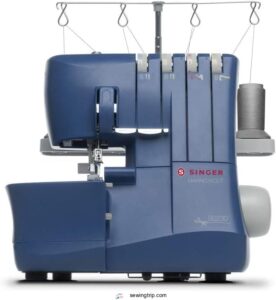
If you work with denim, canvas, or anything that eats lesser machines for breakfast, the Singer S0230 Heavy Duty Serger deserves a serious look. Its metal frame keeps vibration low even at 1,300 stitches per minute, ensuring consistent seams on thick layers.
Differential feed manages everything from knits to heavy wovens without puckering.
You also get a built-in rolled-hem plate, LED lighting, and a color-coded threading system that eliminates guesswork.
| Best For | Sewists who regularly work with heavy fabrics like denim or canvas and want a fast, reliable serger that handles both thick and stretchy materials without fuss. |
|---|---|
| Thread Capacity | 2-3-4 thread |
| Differential Feed | Yes |
| Max Stitch Speed | 1,300 spm |
| Weight | Not listed |
| Color-Coded Threading | Yes |
| Rolled Hem Capable | Yes |
| Additional Features |
|
- Stitches at 1,300 SPM with a color-coded threading system, so setup is quick and production stays efficient.
- Differential feed handles everything from delicate knits to heavy wovens without stretching or puckering.
- Built-in rolled-hem plate and free arm make clean finishes on cuffs, collars, and small openings a lot easier.
- No thread catch bin, so trimmed threads just pile up on your work surface as you sew.
- The instruction manual is PDF-only, which gets annoying fast if you’re mid-project and need a quick reference.
- Some users have run into timing and needle-alignment issues that needed professional adjustment out of the box.
5. Singer X5004HD Metal Frame Serger
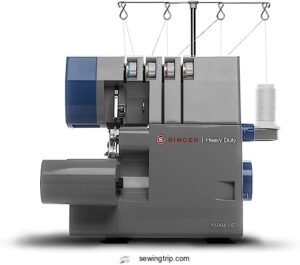
The Singer X5004HD Metal Frame Serger is engineered for tackling denim, upholstery, or thick, unforgiving materials. Its heavy-duty metal frame ensures stability, maintaining rock-solid performance at 1,300 stitches per minute.
A 60% larger cutting knife slices through tough layers cleanly, while the adjustable differential feed keeps knits smooth and pucker-free. Two LED lights illuminate the workspace for precision.
At $309.99, this serger delivers professional-grade performance without the premium price, combining durability, speed, and versatility for demanding projects.
| Best For | Sewers who regularly work with heavy fabrics like denim, leather, or upholstery — and anyone running a small home sewing business who needs speed and reliability without spending a fortune. |
|---|---|
| Thread Capacity | 2-3-4 thread |
| Differential Feed | Yes |
| Max Stitch Speed | 1,300 spm |
| Weight | 15.5 lb |
| Color-Coded Threading | Yes |
| Rolled Hem Capable | No |
| Additional Features |
|
- Blazing fast at 1,300 stitches per minute, so big projects move quickly
- That oversized cutting knife handles thick, tough materials without chewing up the blade
- Rock-solid metal frame with suction cups keeps it planted — no dancing around on your table
- Threading is genuinely tricky, and there’s no printed manual to help you figure it out
- The lint bag is tiny and will need replacing or modifying pretty fast
- No thread included, so budget a little extra before you can get started
6. Singer Professional 5 Metal Frame Serger
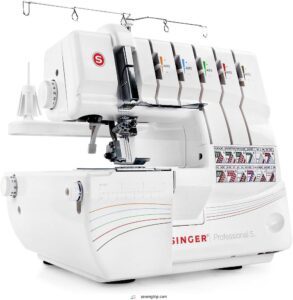
Meet the machine that does it all in one pass. The Singer Professional 5 Metal Frame Serger manages 2–5 thread configurations, so you’re covered whether you’re finishing raw edges or laying down a clean coverstitch.
Its fully automatic tension system takes the guesswork out of switching fabrics — from delicate knits to thick fleece.
At 1,300 stitches per minute, you’ll move fast without sacrificing quality.
The color-coded threading chart keeps setup manageable, even when you’re mid-project and short on patience.
| Best For | Home sewers and small-batch garment makers who want a serger and coverstitch machine rolled into one without the extra equipment cost. |
|---|---|
| Thread Capacity | 2-3-4-5 thread |
| Differential Feed | Yes |
| Max Stitch Speed | 1,300 spm |
| Weight | 18.6 lb |
| Color-Coded Threading | Yes |
| Rolled Hem Capable | No |
| Additional Features |
|
- Handles everything from lightweight knits to heavy denim with automatic tension — no fiddling required.
- Blazing fast at 1,300 stitches per minute, so you spend less time sewing and more time finishing projects.
- Solid metal frame with a trim trap keeps things sturdy and your workspace clean.
- Threading is a real learning curve — budget 10–30 minutes until it clicks, especially early on.
- The motor kicks in abruptly, which can catch you off guard if you’re used to a gentler start.
- No free arm makes tight spots like sleeves a bit of a wrestling match.
7. Brother AIR1800 Air Serger
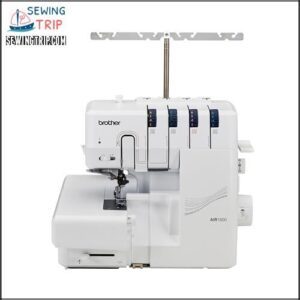
Threading a serger used to mean 20 minutes of squinting and muttering. The Brother AIR1800 fixes that with one button — a blast of air pushes thread through both loopers instantly.
Once threading is dialed in, keeping sewing machine tension tools and settings optimized ensures those perfect stitches actually stay that way.
At 1,300 stitches per minute, your seams come together fast, and the LED-lit work area ensures dark fabrics finally get the visibility they deserve.
With 2-, 3-, or 4-thread options and a differential feed range of 0.7–2.0 mm, the machine handles everything from jersey knits to rolled hems.
| Best For | Sewers of all levels who work regularly with knits, jersey, or stretchy fabrics and want to spend less time threading and more time actually sewing. |
|---|---|
| Thread Capacity | 2-3-4 thread |
| Differential Feed | 0.7–2.0 mm |
| Max Stitch Speed | 1,300 spm |
| Weight | 21.5 lb |
| Color-Coded Threading | Yes |
| Rolled Hem Capable | Yes |
| Additional Features |
|
- One-button air threading is a genuine time-saver — no more wrestling thread through tight loopers by hand.
- Handles a wide range of techniques (overlock, flatlock, rolled hem) with flexible 2-, 3-, or 4-thread options and solid differential feed control.
- The LED work area lighting makes a real difference when you’re working with dark or low-contrast fabrics.
- Plastic housing feels less sturdy than metal-chassis sergers, especially at this price point.
- The air-threading system can malfunction, which means keeping a manual threading tool on hand just in case.
- US-only voltage (120 V) limits use abroad, and extras like the extension table and thread catcher cost more on top of the $899.99 base price.
8. Singer S0100 Metal Frame Serger
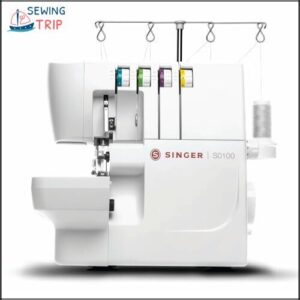
Solid as a rock and priced at $299.99, the Singer S0100 Metal Frame Serger earns its place on any hobbyist’s shortlist.
Its metal body keeps vibration low even at 1,300 stitches per minute, so your seams stay clean from first stitch to last.
Color-coded threading guides eliminate setup guesswork, while the built-in free arm simplifies sewing cuffs and sleeves.
With 2-, 3-, and 4-thread capability plus six stitch types, it evolves alongside your growing skills.
| Best For | Hobbyists and home sewers who want professional-looking seams on garments, knitwear, and stretch fabrics without spending a fortune. |
|---|---|
| Thread Capacity | 2-3-4 thread |
| Differential Feed | Yes |
| Max Stitch Speed | 1,300 spm |
| Weight | 13.5 lb |
| Color-Coded Threading | Yes |
| Rolled Hem Capable | No |
| Additional Features |
|
- Metal frame keeps things stable even at full speed (1,300 stitches per minute), so you’re not chasing the machine across your table
- Color-coded threading guides and a built-in free arm make it genuinely easier to tackle tricky spots like cuffs and sleeves
- Handles 2-, 3-, and 4-thread setups with six stitch types, so it grows with you as your skills do
- Despite marketing claims, it often arrives unthreaded — and threading it can be a tight, frustrating process for beginners
- The instruction manual is hit or miss; a lot of users end up on YouTube just to get started
- Accessories like tweezers are sometimes missing out of the box, and there’s no protective cover included
9. Juki MO-655 Pearl Serger
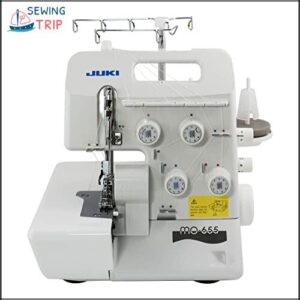
Step up to five-thread capability, and your sewing game changes completely. The Juki MO-655 Pearl Serger manages 2 to 5 thread configurations, letting you switch between basic overlock and heavy-duty safety stitches without breaking a sweat.
Its differential feed ratio—adjustable from 0.7 to 2.0—keeps knits smooth and stretch fabrics cooperative.
At 1,500 stitches per minute with a cast-metal frame, it’s built to last. Yes, threading takes patience, but the results are worth every minute.
| Best For | Home sewists and small-shop makers who want professional-grade seams and the flexibility of 2–5 thread configurations across a wide range of fabrics. |
|---|---|
| Thread Capacity | 2-3-4-5 thread |
| Differential Feed | Yes |
| Max Stitch Speed | 1,500–2,200 spm |
| Weight | 21.4 lb |
| Color-Coded Threading | No |
| Rolled Hem Capable | Yes |
| Additional Features |
|
- Handles everything from lightweight cotton to denim and fleece with clean, professional results
- Five stitch types (overlock, flatlock, rolled hem, chain stitch, and more) give you real versatility in one machine
- Built-in work light, adjustable tension knobs, and a needle threader make everyday use more manageable
- Threading is genuinely tricky—expect a learning curve and heavy reliance on the included needle threader
- Some units arrive missing the fifth cone holder or waste bin, so you may need to track down accessories separately
- Voltage labeling can be inconsistent, and refurbished models sometimes show up with cosmetic damage or oil residue
10. American Home Portable Serger Machine
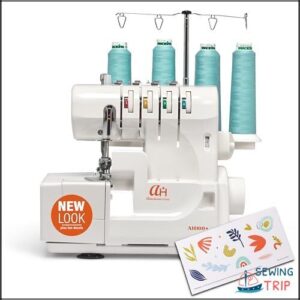
The best serger is the one you’ll actually bring with you. At just 14.6 lb with a built-in handle, the American Home Portable Serger fits comfortably in a tote bag and sets up anywhere — a friend’s studio, a class, your kitchen table.
Color-coded threading guides walk you through 2-, 3-, and 4-thread configurations, while the free-arm design simplifies cuffs and sleeves.
It handles rolled hems, blind hems, elastic seams — all the essentials.
For $234.95 and a 25-year warranty, that’s serious value.
| Best For | Sewers who want a portable, beginner-friendly serger they can take to classes, small studios, or anywhere creativity strikes. |
|---|---|
| Thread Capacity | 2-3-4 thread |
| Differential Feed | Yes |
| Max Stitch Speed | Not listed |
| Weight | 14.6 lb |
| Color-Coded Threading | Yes |
| Rolled Hem Capable | Yes |
| Additional Features |
|
- Color-coded threading makes setup way less intimidating, even if you’ve never touched a serger before.
- The free-arm design is a genuine time-saver for hemming sleeves, cuffs, and tight spaces.
- 25-year warranty on a $234.95 machine is hard to argue with.
- Threading for rolled-edge work can be fiddly — budget some patience for the initial setup.
- No automatic thread cutter, so you’re trimming by hand every time.
- It runs louder than some comparable models, which gets old fast in a quiet space.
Best Sergers by Hobbyist Need
Not every hobbyist sews the same way, and the right serger really does depend on what you’re making. Whether you’re on a tight budget, tackling heavy denim, or just getting started with overlocking, a machine built for exactly that.
Here’s a look at the best sergers matched to the needs you actually have.
Best Budget-friendly Serger for Casual Sewing
The Brother 1034DX is your best value pick for budget-friendly serging, typically priced between $200 and $310. Its low-maintenance design, compact size, and thread efficiency make it ideal for casual projects.
This model strikes the perfect balance among affordable sergers: reliable overlock stitching, competitive pricing, and an affordability index that simplifies the choice between budget and professional options.
Many entry-level models, including the Brother 1034DX, feature a color-coded threading system to streamline setup for beginners.
Best Beginner Serger for Learning Overlock Stitches
If you’re new to overlock stitching, the Janome MOD-8933 is the best serger for beginners. Its easy threading system and automatic tension eliminate guesswork in stitch formation basics, letting you focus on creativity.
- Color-coded guides simplify thread tension basics instantly
- Differential feed prevents knit puckering on beginner project ideas
- Compact design facilitates safe, stable overlock sewing
Best Heavy-duty Serger for Denim and Thick Fabric
Ready to tackle denim? The Singer X5004HD is your best serger for denim, built with a High Torque Motor, Heavy-Duty Cutting Knife, and metal frame durability to handle multi-layer denim capacity without flinching.
Its Reinforced Presser Foot keeps thick seams moving smoothly, while differential feed benefits prevent creasing.
Follow longevity maintenance tips—clean the knife and lint trap regularly—and this heavy-duty serger stays sharp for years.
Best Portable Serger for Small Sewing Spaces
Not every sewing setup has room for a full-size machine. A lightweight portable serger fits where it counts — on a small desk, a folding table, or tucked into a corner.
- Space-saving Design — Desk-friendly footprint under 14 inches tall
- Lightweight Build — Most weigh 6–12 pounds for easy repositioning
- Low Noise Operation — Compact motors keep shared spaces peaceful
Best Air-threading Serger for Convenience
Threading a serger can feel like solving a puzzle — air threading technology changes that entirely. With an air threading system, you just press a button and watch threads guide themselves through every looper automatically, cutting setup time by up to 60 percent.
| Air Threading Feature | Your Benefit |
|---|---|
| One-touch needle threader | Hands-free setup, no squinting required |
| Thread path visibility panels | Rapid thread change with zero guesswork |
| Automatic tension adjustment | Perfect stitches on the first seam |
| Quiet operation motor | Comfortable, distraction-free sewing sessions |
Baby Lock models lead here, featuring FAST threading and a quick thread system that makes every project feel easy.
Best Multi-thread Serger for Advanced Projects
When your projects demand more than basic finishing, a professional serger takes your work to another level. Five-thread configurations combine safety overlock with cover stitch for garments built to last.
Sophisticated serger capabilities deliver:
- Stitch Library Innovation with programmable stitch patterns
- Motor Torque Optimization reaching 1,600 spm
- Noise Dampening Technology for comfortable long sessions
- Fabric Layer Handling through dense denim with 4-thread sergers
Best Serger for Stretchy Knit Fabrics
Knit fabrics can be tricky — one wrong setting and your seams pucker like a crumpled grocery bag. That’s why differential feed is non-negotiable for knit fabric sewing. It controls fabric glide and maintains seam elasticity stitch after stitch.
| Feature | Why It Matters for Knits |
|---|---|
| Differential Feed | Prevents stretching and waving edges |
| Needle Tension | Controls looper synchronization for smooth seams |
| 4-Thread Overlock | Best for stretch fabrics and thread stretch compatibility |
| Stitch Length Control | Keeps handling stretchy and knit fabrics consistent |
Dial in your settings on a scrap first — your finished garment will thank you.
Key Features to Compare
Not all sergers are built the same, and the differences really do matter once you’re mid-project.
Before you spend a dollar, it helps to know which features will actually work for the way you sew. Here’s what to look at.
3. thread, 4-thread, and 5-thread Stitch Options
Think of thread count as your serger’s power dial. 3-thread sergers deliver a lightweight edge finish and seam flexibility — best for beginners working with knits or sheers.
Step up to 4-thread sergers for stronger stitch strength on everyday garments.
Need maximum durability? 5-thread options add a safety stitch, boosting thread efficiency on denim and canvas.
Your stitch options shape every result.
Stitch Speed and Overall Sewing Performance
Stitch Speed is where performance gets real. Hobbyist sergers operate at 1,300–1,600 stitches per minute, delivering reliable results for casual use.
Top serger models for 2025 rely on brushless motor technology, ensuring quieter operation and superior heat control even at high sewing speeds. These advancements prioritize efficiency without compromising precision.
A built-in speed limiter allows users to reduce stitching rates for delicate projects, while enhanced motor output guarantees consistent stitch uniformity—eliminating skipped stitches and ensuring flawless, drama-free outcomes every time.
Differential Feed for Knits and Puckering Control
Ever wonder why your knit seams come out wavy no matter what you do? Differential feed saves the day. With Feed Ratio Tuning between 0.7 and 2.0, you achieve Knit Stabilization and Wave Prevention across fabrics like jersey and activewear.
Differential feed prevents puckering by independently controlling front and rear feed speeds — your go-to fix for Elastic Edge Control and stretch fabrics.
Adjustable Stitch Length and Stitch Width
Once you’ve tamed puckering with differential feed, fine-tuning your stitch dimensions takes things further. Precise Length Adjustment lets you dial between 1.0 and 4.0 mm — tighter for delicate fabrics, looser for decorative finishes. Variable Width Settings range from 3 to 7 mm, giving every sewing hobbyist real Edge Finish Customization.
This is Seam Density Management and Fabric Stretch Compensation working together, beautifully.
Presser-foot Pressure Adjustment
Presser foot pressure quietly controls everything, regulated by a small Pressure Dial Mechanics control—typically a dial or screw. This mechanism adjusts Foot Pressure Calibration for every fabric, ensuring precise handling.
Lower settings prevent knit stretching, while higher pressure secures thick layers in place. Material-Specific Settings are critical, as they determine how the presser foot adapts to diverse textures.
Switching snap-on presser feet between lightweight sheers and heavy canvas demands Fine-Tuning Techniques. Mastering these adjustments ensures flawless stitching across all projects.
Disengageable Upper Knife for Specialty Stitches
Upper knife toggle gives you real creative control. Flip the knife safety lock to disengage the retractable knife blade, and suddenly decorative edge options open up — flatlock stitching, rolled hems, coverstitch functionality — all without trimming your fabric.
Monitor blade wear regularly to keep cuts clean when re-engaged.
Adjustable cutting knives for flatlocking make budget-friendly serger choices genuinely adaptable for specialty projects.
Built-in Waste Collectors and Trim Management
Trimming fabric is satisfying — cleaning it up afterward, not so much. That’s where integrated waste collection features genuinely earn their place. A quick-release mount lets you pop the trim trap off without tools, and the overflow indicator tells you when it’s time to empty. Bin capacity matters more than you’d think.
- Channels trim routing channels guide offcuts straight into the bin
- Maintenance cleaning stays simple with smooth interior walls
- Budget-friendly serger choices still include basic trim management
- Best for beginners: machines that prevent fiber buildup near the motor
LED Lighting and Workspace Visibility
Good lighting isn’t a luxury — it’s what separates a clean seam from a costly mistake. LED lighting on sergers delivers high CRI Color Accuracy, ensuring fabric colors and thread contrasts appear true. Features like Adjustable Dimming, Glare Reduction, and Heat Management maintain eye comfort during extended sessions, while Smart Controls enhance adaptability.
| LED Feature | Why It Matters |
|---|---|
| CRI Color Accuracy | Reveals true fabric and thread color |
| Adjustable Dimming | Matches light to your comfort level |
| Glare Reduction | Prevents reflection off shiny fabrics |
| Heat Management | Keeps your workspace cool and steady |
| Smart Controls | Auto-adjusts brightness as needed |
LED illumination for threading — especially around the needle plate — makes a real difference. The impact is immediate: fewer misthreads, less squinting, and more sewing.
Threading and Ease of Use
Threading a serger can feel like solving a puzzle the first time you sit down with one. Today’s machines are packed with features that make the process way less intimidating.
Here’s what to look for regarding threading and ease of use.
Color-coded Threading Guides for Beginners
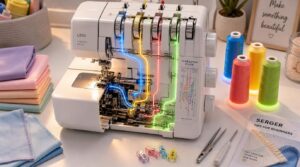
Threading a serger doesn’t have to feel like defusing a bomb. Color-coded threading guides turn confusing thread paths into a simple follow-the-rainbow system — your best tool for beginner error reduction right out of the box.
Visual thread paths marked in distinct hues act as a color memory aid, so guide layout simplicity wins every time. It’s the easiest threading system any beginner serger can offer.
Lay-in Threading Systems and Looper Access
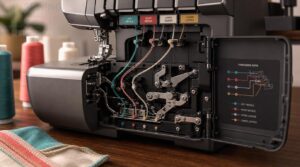
Lay-in threading takes the guesswork out of looper access entirely. With a Guide Lever Mechanism and Looper Panel Design built for real people — not engineers — you drop threads into place instead of fishing them through tight loops.
- Thread Path Clarity makes every route visible at a glance
- Quick Release Looper and snap-on system speed up rethreading
- Maintenance Access Points keep your machine running smoothly
Air-threading Sergers for Faster Setup
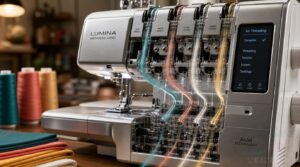
Air threading technology in modern sergers is a genuine major breakthrough. With an automatic threading system, sealed air channels push thread through loopers in seconds — cutting setup time nearly in half.
LED threading feedback confirms every step, while maintenance-free air ports and color-coded threading guides keep things stress-free.
You get rapid looper setup and air pressure optimization doing the heavy lifting, so you can just sew.
Quick-thread Lower Looper Features
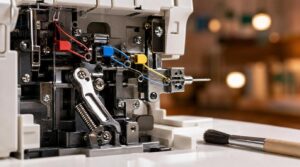
The lower looper is the trickiest part of any serger — but a spring-loaded lever changes everything. It guides your thread along a direct Horizontal Looper Path straight to the eye, while a Threading Window keeps the route visible throughout.
Color-coded threading guides and a clear Tension Scale eliminate guesswork.
A quick swipe with your Maintenance Brush keeps those guides lint-free and reliable.
Pre-threaded Machines for Out-of-box Sewing
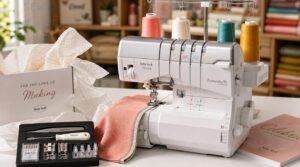
Some machines skip the setup headache entirely—you’re sewing the moment you unbox it. A beginner serger with an easy threading system and color-coded threading guides eliminates frustrating first-day tangles.
Look for these out-of-box advantages:
- Factory preset tensions calibrated for everyday fabrics
- Pre-wound spools loaded and ready via a snap-on system
- Easy-to-use threading with an out-of-box stitch library included
- Ready-to-sew accessories packaged alongside the machine
- Integrated thread cartridges that keep tension consistent from stitch one
Tension Controls and Automatic Tension Settings
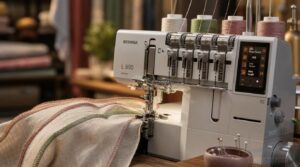
Once you’re threaded, tension is where the magic happens. Self-adjusting tension systems use load cell sensors and dancer roller feedback to keep every stitch balanced automatically — no guesswork.
Auto tension calibration reads your fabric and adjusts the adjustable tension discs in real time. Tension memory presets save your favorite settings, so switching fabrics takes seconds.
Regular sensor maintenance tips your stitches toward precision.
Learning Curve for First-time Serger Users
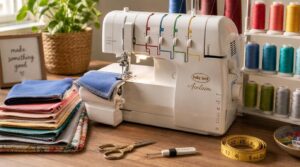
Once tension clicks, everything else falls into place faster than you’d expect. Most beginners nail their Initial Stitch Accuracy after just two or three short sessions — especially with color-coded threading guides doing the heavy lifting.
Practice Scrap Fabrics are your best friend here. Use Speed Increment Strategies to build Muscle Memory Development gradually, and keep Workspace Organization Tips in mind.
A tidy setup is honestly half the battle.
Fabric and Project Compatibility
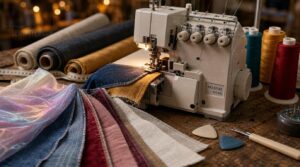
Not every serger manages every fabric the same way, and knowing that difference can save you a lot of frustration. Your project type — whether it’s a flowy chiffon blouse or a heavy denim jacket — should guide which machine you reach for.
Here’s a breakdown of what each fabric and finish type calls for.
Sergers for Lightweight Fabrics and Rolled Hems
Working with lightweight fabrics is where your serger’s rolled hem feature truly shines. Chiffon, organza, and voile need a delicate touch — and the right setup makes all the difference.
- Fine Thread Choice keeps edges neat without bulk
- Knife Sharpness prevents fraying on sheer materials
- Edge Tension ensures the hem curls evenly under
- Fabric Grain Alignment stops waviness on curved hems
Sergers for Knits, Stretch Fabrics, and Activewear
Knit fabric is a whole different animal from chiffon. Your serger’s differential feed is the real hero here — adjust it right, and you’ll nail knit tension balance without puckering.
Whether you’re finishing activewear edge finishes on leggings or creating moisture-wicking hems, seam elasticity testing matters. Handling stretchy and knit fabrics with a serger demands models optimized for stretch textiles, including elastic seam reinforcement.
Sergers for Denim, Canvas, and Layered Fabric
Denim and canvas don’t forgive a weak machine. The best serger for denim requires wide knife clearance, a high torque drive, and a reinforced metal chassis to push through thick, stubborn layers without skipping a beat.
Bump up to large needle sizes like 110/18, dial in your multi-layer tension and differential fabric feed, and handling heavy denim and multiple layers becomes surprisingly manageable.
Flatlock Seams for Decorative and Functional Finishes
Flatlock stitching is your secret weapon for activewear that actually moves with you. Unlike overlock stitching, the choice between flatlock versus overlock hinges on bulk — flatlock seams lie completely flush, delivering edge-flush finishes and reduced chafing during workouts.
Use contrast threading or patterned flatlock designs to transform seams into decorative stitches, enhancing both aesthetics and functionality. This approach maintains strong seam stretchability while ensuring durability.
Adjustable cutting knives designed for flatlocking guarantee clean, precise results, making the technique ideal for sewing hobbyists seeking professional-quality finishes.
Blind Hems for Garments and Home Décor
Blind hems revolutionize garment and curtain edge finishes. Your serger’s rolled hem feature creates invisible stitches beautifully—just match your thread color to your fabric and follow hem allowance tips for clean results.
Easy-to-use serger designs simplify the process for beginners, making this technique accessible.
For extra stability, fusible hemming tape is ideal for home projects, ensuring durable and professional-looking hems.
Overlock Seams for Fray-resistant Raw Edges
Raw edges don’t stand a chance against a well-set overlock stitch. With the right loop tightness and edge seal strength, your serger wraps every cut edge in layers of interlocking thread — clean, durable, done.
- Fabric Grip locks fibers in place instantly
- Seam Flexibility keeps stretch fabrics moving naturally
- Pull Resistance prevents seam pops under tension
Choosing Thread Count by Project Type
Not all fabrics play by the same rules.
For blouse fabric count (180–230), your serger glides without puckering.
Knit wear thread (180–280) performs best when using differential feed to preserve stretch.
Denim thread count (200–350) ensures clean overlock seams for projects.
Curtain and table linen counts (200–350) work well with 4-thread options for lasting edges.
Buying Tips for Hobbyist Sergers
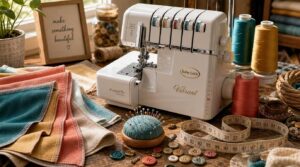
Buying a serger isn’t just about picking the prettiest machine on the shelf — it’s about finding one that actually fits how you sew. A few smart questions before you buy can save you a lot of regret later.
Here’s what to think about before you commit.
Matching Price Tier to Sewing Frequency
How often you actually sew should drive what you spend. Frequency budgeting isn’t just smart — it’s how you avoid buying a $1,499 Baby Lock Victory when a $200 Brother 1034DX covers your once-a-month projects perfectly.
Buy for how often you actually sew, not for the machine you wish you needed
- Occasional – budget-friendly serger choices under $300
- Monthly – mid-range $350–$500 for best value and tiered maintenance
- Weekly – price vs performance evaluation points to $500+ investment scalability
- Daily – budget vs professional serger options justify premium builds for home sewing projects
Choosing Between Compact and Full-size Machines
Compact sergers, with their smaller footprint efficiency and weigh around 6–10 pounds, are perfect portable serger options for home sewing space constraints.
Full-size machines offer better stability versus portability trade-offs, a wider bed width range, and are suitable for heavier projects.
Match the machine’s weight management and power usage to your actual workspace, not your wishlist.
Comparing Metal Frames and Machine Durability
Material density matters just as much. A heavy-duty metal frame keeps vibration low and ensures consistent stitches — that’s where durability and build quality assessment really pays off.
Metal frame construction analysis shows that steel and aluminum frames excel in corrosion resistance, joint reinforcement, and long-term repairability options.
Models like the Singer X5004-HD demonstrate how weight translates to stability you’ll feel on every seam.
Checking Warranty Coverage Before Buying
A solid frame means nothing if the warranty doesn’t back it up. Before buying, check Coverage Duration—Brother and Singer offer up to 25 years, while Juki covers 5.
Understand Parts vs. Labor differences, Exclusions Overview, and Transferability Details if you resell. These nuances determine what’s protected and under what conditions.
Don’t skip the Registration Requirement—missing that step can void your machine warranty entirely.
Evaluating Included Accessories and Presser Feet
What comes in the box matters more than most buyers realize. A well-stocked accessory kit stretches your machine’s capabilities from day one.
- Check Foot Compatibility Charts to confirm which snap-on presser feet work with your model
- Look for organized Accessory Storage Solutions like built-in trays or clear foot boxes
- Inspect Wear Indicators on presser foot edges before each project
- Confirm Specialized Stitch Feet — gathering, blind-hem, and rolled-hem — are included
- Follow Foot Maintenance Tips: clean snap-on accessory foot channels regularly to prevent snags
Considering Noise, Vibration, and Stability
Ever notice how a rattling machine breaks your creative flow? Metal frame durability keeps frame resonance control in check, while elastomeric mounts cut vibration transmission by up to 60 percent.
Pair your heavy-duty serger with anti-vibration mats for quieter runs. Quiet drive mechanisms and differential feed tuning further smooth operation — perfect for compact design for small workspaces where noise and vibration reduction in sergers really matters.
Balancing Beginner-friendly Features With Long-term Growth
The best serger for beginners doesn’t just make today easier — it grows with you. Look for machines that pair pairing easy threading systems and color-coded threading guides with expandable features that support skill progression over time.
- Adaptive Training: Built-in guides reduce setup time by 40%
- Growth Design: Differential feed manages knits and wovens
- Future Upgrades: Air threading and extra loopers await
- Beginner-friendly serger designs that access sophisticated stitches gradually
Beginner-friendly serger designs ensure users can access sophisticated stitches gradually, fostering confidence and creativity as skills evolve.
Frequently Asked Questions (FAQs)
Is there a difference between a serger and an overlock machine?
Short answer: not really. The terminology overlap is mostly a labeling difference — serger and overlock machines are functionally equivalent. Both trim and finish edges simultaneously.
Don’t let the naming confuse your shopping.
Can a serger replace a regular sewing machine?
Think of a serger as your finishing specialist — fast, precise, and excellent for finishing edges. But it can’t replace a sewing machine.
Stitch range limits and gaps in seam construction mean you’ll always need both.
How often should a serger be professionally serviced?
For most hobbyists, a professional service every 12 months works well. Heavy use? Go every six. Expect to pay 60–120 euros, and don’t wait if stitches look off.
What thread types work best in sergers?
Thread is the lifeblood of every stitch.
Polyester vs Nylon comes down to stretch needs; woolly nylon loopers shine on activewear.
Thread weight selection and cone thread handling keep tension control smooth.
How do serger stitches differ from standard lockstitches?
Serger stitches wrap thread loops around raw edges for built-in edge sealing and trim integration, while lockstitches simply run parallel seams.
Overlock stitching delivers seam elasticity and stitch encapsulation that standard machines can’t match.
Conclusion
Choosing serger machines for hobbyists doesn’t require mastery on day one—it requires the right fit for where you’re now. A machine that tackles your current projects confidently will teach you more than one loaded with features you’re not ready to use.
Start with what solves your immediate frustrations, whether fraying edges or slow seam finishing. The right serger won’t just improve your projects; it will quietly expand what you believe you’re capable of making.