This site is supported by our readers. We may earn a commission, at no cost to you, if you purchase through links.
Finishing a quilt on a standard sewing machine is a bit like trying to parallel park a moving truck—the tool works, technically, but you’re fighting it the whole way. Bunched layers, skipped stitches, and the exhausting gymnastics of muscling a king-size quilt through a narrow throat space are not signs you are doing it wrong. They are signs you are using the wrong machine.
A dedicated quilting machine solves these problems by design, not by accident—with extended throat space, synchronized feed systems, and stitch regulation built specifically for thick, multi-layer work.
Understanding the benefits of using a dedicated quilting machine could be the shift that finally makes large, complex projects feel manageable rather than miserable.
Table Of Contents
Key Takeaways
- A dedicated quilting machine’s extended throat space and synchronized feed systems eliminate the bulk-wrestling and skipped stitches that make large quilts so frustrating on a standard machine.
- Built-in stitch regulators, tension controls, and laser guides give you consistent, professional results regardless of your stitching speed or fabric thickness.
- Smart features like automatic thread cutters, break sensors, and touchscreen pattern libraries cut down on setup time, so you spend more time actually quilting.
- Over time, the investment pays for itself through faster project completion, lower labor costs, and the kind of repeatable quality that keeps clients coming back.
What is a Dedicated Quilting Machine?
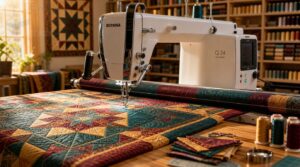
A dedicated quilting machine isn’t just a fancy sewing machine — it’s a completely different tool built for one job and built to do it well.
From throat space to feed systems, every detail is engineered for layered fabric — which is why quilting machines for heirloom projects demand such specialized design.
Before you decide if one belongs in your workspace, it helps to understand what sets it apart.
Here’s what you need to know.
How It Differs From a Regular Sewing Machine
Think of a regular sewing machine as a reliable sedan — it gets you there, but it wasn’t built for hauling. Quilting machines feature a larger harp size, giving you that critical large throat space for bulky layers. The feed system manages multiple fabric layers evenly, the needle bar powers through thick sandwiches, and the walking foot prevents shifting — delivering real speed and productivity improvements a standard machine simply can’t match.
Research indicates that repetitive arm work on standard sewing machines can lead to shoulder muscle fatigue, increasing the risk of musculoskeletal disorders.
Domestic, Mid-arm, and Longarm Quilting Machines
Not all quilting machines are created equal. Shortarm quilting machines suit home studios with limited space — lighter machine weight, modest power usage, and manageable noise level make them apartment-friendly.
Step up to midarm quilting machines for better reach and increased productivity and efficiency on larger projects.
Longarm quilting machines, though demanding higher electrical requirements and careful transport logistics, deliver superior precision stitching capabilities across queen- and king-size quilts.
Why Quilting Needs Specialized Machine Support
Working across multiple fabric layers isn’t like sewing a blouse — bulk batting resistance alone can stall a standard machine mid-seam. That’s why precision stitching capabilities and fabric stability matter so much here.
Your quilts demand:
- Layered fabric handling without shifting
- Even needle penetration through thick sandwiches
- Precise pattern alignment across long seams
- Bulk batting resistance your motor can sustain
The benefits of using a dedicated quilting machine become obvious fast.
Who Benefits Most From a Quilting Machine
Professional quilters and small business owners running quilt shops get the most obvious payoff — consistent output, faster turnaround, and room to scale.
Hobbyist quilters tackling king-size projects finally stop wrestling with repositioning.
Designer pattern makers gain the control their work demands.
And time-efficiency seekers? The benefits speak for themselves.
More Precise, Consistent Stitching
One of the biggest frustrations with a regular sewing machine is that your stitching quality changes the moment your pace does.
A dedicated quilting machine solves that problem in several concrete ways. Here’s what makes the difference.
Built-in Stitch Regulation for Even Stitch Length
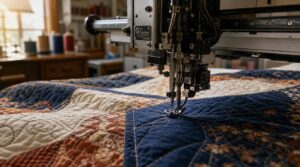
Every stitch tells a story — and a built-in stitch regulator ensures yours stays consistent. Using encoder accuracy and real-time feedback, your machine’s servo stabilization and adaptive adjustment systems automatically maintain adjustable stitch length, no matter how fast your hands move.
Sensor calibration keeps the spacing uniform through every layer, so precision stitching and stitch consistency come standard, not by chance.
Better Tension Control Across Quilt Layers
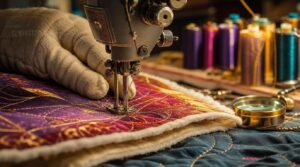
Tension is where most quilts win or lose. A dedicated quilting machine gives you real thread tension fine-tuning across every layer — top, batting, and backing — so your layer tension balance stays true throughout.
A machine built for quilting also tends to pair better with specialty feet, as explored in this breakdown of key differences between sewing and quilting machines.
Needle-thread compatibility, proper basting stabilization, and foot pressure tuning work together to keep your thread tension adjustment accurate, delivering the precision stitching that defines professional results.
Fewer Skipped Stitches and Puckering Issues
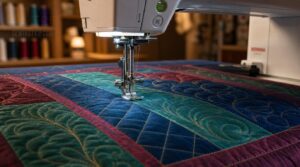
Skipped stitches and puckering don’t have to be part of your quilting story. With proper fabric prep, feed dog sync, and stitch regulation working together in harmony, your machine maintains uniformity and consistency across every pass.
Needle choice and thread compatibility also play a critical role. When matched correctly, they ensure proper stitch density and optimal thread tension, delivering true precision stitching and reliable stitch quality throughout your project.
Laser Guides for Straighter Quilting Lines
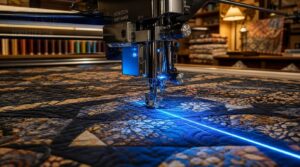
A laser guide functions as your quilting GPS, projecting a precise beam directly onto fabric to eliminate chalk marks and guesswork. With adjustable offset fine-tuning and mounting compatibility across domestic and longarm frames, it ensures seamless integration into your workflow. Visibility settings adapt to both dark and light fabrics, maintaining clarity under any conditions.
Grid overlays support echo quilting, enabling precision stitching and unwavering consistency. This alignment system keeps every row uniformly straight, transforming complex patterns into effortless, accurate designs.
Decorative and Quilting-specific Stitch Options
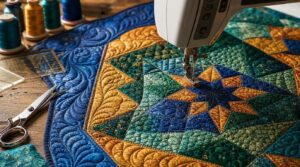
Dedicated quilting machines open up a whole world of creative possibilities with adaptable quilting machines — from Feather Stitch Borders and Cable Echo Outlines to Star Motif Patterns and Pebble Fill Textures.
With adjustable stitch length, adjustable stitch width, and Stitch Density Control, your stitch options expand dramatically.
Precision stitching becomes easy, letting you shift between intricate decorative fills and clean geometric designs without missing a beat.
Faster Quilting and Higher Productivity
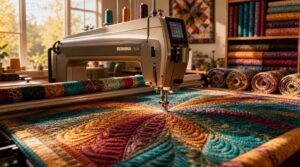
Speed changes everything when you’re working through a large quilt project. A dedicated quilting machine gives you the power to move faster without sacrificing the quality you’ve worked so hard to achieve.
Here’s how that speed advantage actually shows up in your work.
Higher Stitching Speeds for Large Projects
Speed changes everything when you’re working on a king-sized quilt. Dedicated machines reach 600 to 1,600 stitches per minute — transforming a full project into hours, not days.
Benefits include Dual-Drive Synchronization and Real-Time Feed Adjustment, which ensure fabric moves cleanly at high speeds. These features maintain precision and flow during operation.
High-speed sewing with Energy-Efficient Operation keeps productivity high while preventing burnout. This balance supports sustained, efficient quilting without compromising performance.
Stronger Motors for Thick Quilt Sandwiches
Your heavy-duty motor is what actually carries you through thick batting without hesitation. Torque Optimization and Servo Drives deliver consistent power, ensuring precision stitching remains reliable even through dense quilt sandwiches.
Brushless Design extends motor longevity, while smart Heat Dissipation keeps everything running cool. These features minimize slowdowns, empowering you to complete more quilts on your terms.
Continuous Stitching for Complex Quilting Designs
Powerful motors keep your pace steady — and continuous stitching let that momentum shine.
Edge-to-edge flow carries complex motifs across your entire quilt surface without interruption, while real-time feed sync and macro curve stitching deliver smooth, consistent precision stitching throughout.
- Continuous motif memory recalls long sequences instantly
- Automated lock ends secure each pass without manual tying
- Real-time stitch monitoring catches irregularities mid-run
- Design flexibility with various fabrics and battings stays intact
- Automated thread cutting tidies every finish automatically
Speed Control for Different Fabrics and Battings
Silk feed speed demands a gentle, slow pace to prevent snags, while denim stitch rate thrives at higher settings for clean penetration. Wool batting pace benefits from a measured rhythm to avoid compression.
With adjustable speed and flexible material compatibility, your machine adapts—whether handling delicate fabrics, knit fabrics’ adjustment needs, or heavy battings and cotton batting timing.
Time-saving Benefits for Frequent Quilters
Once your speed control is dialed in, the time savings really start stacking up. Frequent quilters know how much those minutes matter — and a dedicated machine delivers exactly that through:
- Batch Pattern Loading and Preset Speed Switching cut setup between projects
- Auto Fabric Alignment and Real-Time Error Correction keep workflow optimization steady
- Quick Thread Change with automated quilting features streamlines finishing
- Built-in thread break sensors prevent costly do-overs, boosting productivity improvement
Easier Handling of Large Quilts
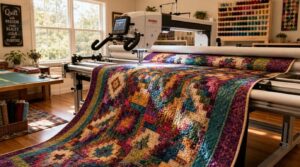
Large quilts have a way of taking over your workspace fast—and struggling with all that bulk is one of the quickest ways to lose both accuracy and enthusiasm. A dedicated quilting machine is built to handle that challenge head-on, providing the necessary space and support you actually need.
Here’s what makes the difference when you’re working big: dedicated quilting machines are engineered to manage large projects efficiently, ensuring your workspace remains functional and frustration-free.
Expanded Throat Space for Bulky Projects
Think of throat space as your quilting breathing room — without enough of it, large quilts fight back. Extended Harp Geometry and Wide Throat Maneuverability enable Edge-to-Edge Access across king-size layers, minimizing constant repositioning.
Bulk Fabric Feeding remains smooth when Frame-Table Synergy supports the weight, ensuring seamless handling of heavy materials.
| Throat Space Impact | Quilt Size Handled |
|---|---|
| Under 10 inches | Small lap quilts |
| 10–12 inches | Twin-size quilts |
| 12–17 inches | Full/Queen quilts |
| 18–24 inches | King-size quilts |
| 24+ inches | Commercial/oversized |
Large throat space directly determines how confidently you manage bulky fabrics.
Benefits of Mid-arm and Longarm Machines
Mid-arm and longarm machines aren’t just bigger — they’re built differently. Frame rigidity keeps everything locked in place while multi-layer feeding pulls fabric through evenly, so your quilt sandwich moves as one. Precision alignment stays consistent from the first stitch to the last.
- Low vibration motors protect delicate layers at high speed
- Custom speed zones adapt to batting thickness on the fly
- Longarm vs midarm vs shortarm quilting machines each suit different project scales
- Mechanical quilting machine advantages include reduced fatigue across long sessions
Extension Tables and Frame Compatibility
Extension tables transform what your machine can actually handle. With universal mounting plates and alignment guides locking into most mid-arm and long-arm quilt frames, setup stays precise without guesswork.
A rigid surface supporting up to 120 pounds adds 6 to 18 inches of usable workspace — enough to manage a king-size quilt sandwich without constant repositioning.
Adjustable extension options make frame compatibility genuinely flexible for any quilt-making project.
Walking Feet for Even Fabric Feeding
A walking foot is where fabric handling technology earns its keep. Its built-in Layer Synchronization pulls your top and bottom layers at the same rate, ensuring Even Feed Curves remain consistent through dense batting.
Thick Fabric Compatibility means knits, satin, and heavy quilt sandwiches feed without crushing or shifting.
Always perform a Setup Test Swatch first, and match your needle to the fabric for clean penetration each time.
Reduced Repositioning on Queen and King Quilts
Queen and king quilts can feel like wrestling a sail indoors — but dedicated machines change that entirely. With expanded throat space and mobile frame systems, your repositioning is minimized, letting you quilt more efficiently.
- Sidearm positioning keeps bulk from bunching at your sides
- Quilt alignment aids hold layers true between passes
- Quick-release clamps let you reset without losing tension
- Rotating workstations enable smooth directional shifts
That’s workflow optimization for quilters who mean business.
Smarter Features Improve Workflow
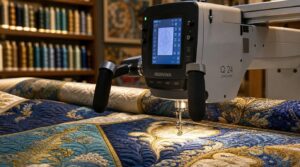
Today’s dedicated quilting machines don’t just sew — they think alongside you. The built-in technology manages the small stuff so you can stay focused on the creative work.
Here’s a look at the smart features that quietly transform how you work.
Automatic Thread Cutters for Cleaner Finishing
Every loose thread end poses a small threat to stitch quality — and automatic thread cutters eliminate that risk entirely. By addressing vulnerabilities in thread management, these systems ensure consistent, high-quality seams across quilting projects.
The cutter’s jam-resistant design seals out lint, while blade calibration maintains precise cut timing across diverse fabrics. Sensitivity settings dynamically adjust to handle delicate or densely layered materials, and trimmed thread routing prevents re-entanglement near the needle, ensuring smoother operation.
| Feature | Function | Benefit |
|---|---|---|
| Blade Calibration | Standardizes cut length | Consistent thread quality |
| Cut Timing Control | Syncs with needle position | Cleaner seam finishes |
| Trimmed Thread Routing | Redirects cut ends away | Fewer tangles, smoother flow |
Thread Break Sensors to Prevent Mistakes
Thread break sensors take your machine’s protection one step further. When a thread snaps mid-stitch, real-time alerts pause operation instantly through a safety stop mechanism — no ripped seams, no wasted fabric. Multi-thread monitoring watches every line simultaneously, while sensitivity settings let you calibrate response to your specific thread quality.
Here’s what sensors quietly handle for you:
- Detect breaks via optical or mechanical real-time stitch monitoring
- Trigger automatic stops before puckering spreads
- Provide audible or visual alerts for fast response
- Allow sensor calibration for different thread weights
- Reduce rework by catching faults at the source
Touchscreen Controls and Stitch Selection
Sensors handle the invisible — but touchscreen controls put everything in plain sight.
Touch-Activated Libraries let you tap through hundreds of stitch options instantly, while Swipe Pattern Browsing scrolls designs in seconds. Interactive Grid Guides overlay your fabric digitally, and the Tap-to-Trim Function finishes threads cleanly. Profile-Based Tension adjusts automatically per fabric.
Easy-to-use touchscreen interfaces and tutorials mean less guessing, more quilting.
Built-in Memory for Saving Patterns
Touchscreens show what’s possible — but built-in memory lets you hold onto it. Your custom patterns, stitch sequences, and project setups save directly to onboard storage, ready to recall in seconds using Quick Save Shortcuts.
Pattern Organization Tools sort designs into folders so nothing gets buried.
Need changes? Editing Saved Designs adjusts scale, rotation, or mirroring instantly.
Backup and Transfer to USB keeps your work protected.
Tutorial Features for Beginner-friendly Operation
Saving your patterns is only half the story — knowing how to use them is where the real confidence comes from. Guided practice and onboard help systems walk you through each step, while visual aids and quick reference guides keep you on track.
Progress tracking shows exactly where you stand, and safety setup instructions mean you’re never guessing. It’s user-friendly from the very first stitch.
Better Long-Term Quilting Value
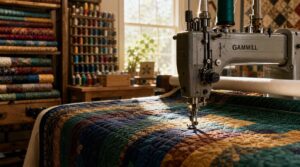
A dedicated quilting machine isn’t just a tool — it’s a long-term investment in your craft. The real value shows up over time, in fewer hours spent per project, stronger results, and a machine that holds up through years of heavy use.
A dedicated quilting machine pays for itself over time through faster projects, stronger results, and lasting durability
Here’s what makes that investment genuinely worth it.
Durable Frames for Frequent Use
Titanium frame strength keeps weight low without sacrificing durability, while stainless steel rigidity withstands the daily demands of a heavy-duty motor pushing through thick layers.
Beta titanium flexibility reduces joint stress over time, and aluminum weight savings make repositioning easier.
Frame compatibility and longevity of machinery start here.
Maintenance Alerts and Easier Servicing
When your machine flags a belt wear monitoring issue or triggers temperature warnings before failures occur, you avoid costly repairs. These proactive alerts keep operations running smoothly.
Lubrication reminders and routine cleaning alerts maintain performance consistency, while service calendar integration streamlines maintenance planning around critical projects. This ensures uptime during peak workloads.
Remote fault reporting accelerates technician diagnostics, minimizing downtime. Over time, regular oiling and yearly servicing become ingrained habits, not reactive afterthoughts, fostering long-term equipment reliability.
Lower Labor Time Per Quilt
Every hour saved on setup translates directly into lower labor costs and more quilts completed. Reduced setup time, simplified fabric loading, and optimized needle changes eliminate inefficiencies that drain productivity.
Small delays—like cumbersome setup and needle changes—are quietly addressed, ensuring steady workflow momentum. Automated pattern switching and batch production workflows transform speed and efficiency from aspirational goals into daily standards.
For quilters, workflow optimization makes cost reduction through quilting automation tangible. This approach delivers measurable productivity gains, turning incremental time savings into significant output increases.
Professional-quality Results for Paid Projects
When clients pay premium pricing, they expect perfect results — and that’s exactly what professional quilting tools deliver. Consistent stitch alignment, balanced tension, and precise pattern replication meet the standards that build your brand reputation and strengthen your portfolio showcase.
Benefits of using a dedicated quilting machine include reduced turnaround time without sacrificing quality, giving you the client satisfaction that turns one-time buyers into loyal customers.
When The Investment Becomes Worthwhile
The break-even timeline arrives faster than most quilters expect. Once increased order volume offsets upfront costs, the ROI calculation starts working in your favor — labor cost reduction alone can deliver a meaningful profit margin boost within months.
Factoring in financing incentives from dealers further strengthens the case. These combined benefits transform the decision into a clear, compelling cost-benefit analysis for improving quilting business efficiency.
How to Choose The Right Quilting Machine
Choosing the right quilting machine hinges on four critical factors: your budget range, brand reliability, warranty coverage, and how well the machine fits your workspace. Additionally, accessory compatibility—such as walking feet, extension tables, and presser foot options—plays a significant role, often more than anticipated.
Matching key features to your project scale ensures a wise, long-term investment. This approach guarantees a decision that pays off long-term.
Frequently Asked Questions (FAQs)
Is Kelly Clarkson a quilter?
Kelly Clarkson is a quilter. She has made handmade quilts for her The Voice co-hosts, sharing her personal inspiration through social media posts.
These posts sparked genuine fan engagement in celebrity quilting, highlighting the intersection of her creativity and public interest.
How many quilts does the average quilter make a year?
Most quilters finish one or two quilts a year — but with weekly sewing time, dedicated space availability, and solid fabric stock levels, your hobbyist output can easily climb higher.
Can quilting machines handle specialty or unusual fabrics?
Dedicated quilting machines handle specialty fabrics surprisingly well, from foam battings and metallic textiles to leather vinyl, pile fabrics, and stretchy nonwovens.
Their fabric handling versatility gives you real flexibility in design and fabric selection.
What accessories are essential for dedicated quilting machines?
Essential quilt accessories include a walking foot, extension table, quilt ruler, spare needles, needle threader, thread nets, bobbin winder, and quilt frame.
These tools ensure keeping your workflow smooth, your layers aligned, and your stitching consistently clean.
How do quilting machines perform with computerized design files?
Computerized quilting machines translate digital design files into precise needle paths in real time, much like a GPS guiding every turn.
They support File Format Support across DXF, HQF, and QLI formats with accurate real-time stitch translation.
Are quilting machines compatible with embroidery hoops or frames?
Compatibility varies by model, so always check manufacturer guidelines first.
Many longarm and mid-arm machines support hybrid frames, but standard domestic quilting machines may need a dedicated embroidery machine for precise hoop work.
Conclusion
The right tool doesn’t just make the work easier—it makes the work possible. When your equipment is built for the task, your skill finally has room to show up.
Consistent stitches, smooth handling of large quilts, and smarter workflow features aren’t luxuries—they’re the conditions under which your best work gets made.
Stop fighting your machine. Start finishing quilts you’re genuinely proud of.
- https://www.janome.com.au/what-makes-a-quilting-machine-different-from-a-sewing-machine/
- https://www.quiltingboard.com/main-f1/pros-cons-domestic-machines-quilting-frames-t243484.html
- https://handiquilter.com/longarm-quilting-systems/?srsltid=AfmBOorM8od_nA1LtKjhl7sSp7qlUFvjxDKq232W2NWj5X-SYA9LgtqN
- https://modishquilter.com/2023/01/18/top-7-best-sewing-machine-features-for-quilters/
- https://gammill.com/