This site is supported by our readers. We may earn a commission, at no cost to you, if you purchase through links.
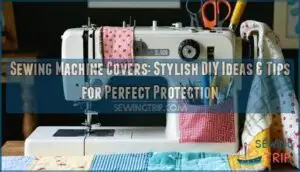
Dust settles fast. Leave your machine uncovered for a week, and you’ll find lint packed into the feed dogs and a fine grey film across the tension dial. For daily sewers, that’s not just annoying—it accelerates wear on the parts that matter most.
The right cover blocks debris, buffers humidity, and takes the occasional bump without complaint. Fabric weight, liner material, and fit tolerances all separate a cover that lasts from one that bags out after a month.
These nine picks cover everything from budget-friendly slip-ons to quilted organizers built for serious daily use.
Table Of Contents
- Key Takeaways
- Top 9 Daily Sewing Cover Picks
- 1. Simplicity A2106 Sewing Machine Cover Organizer
- 2. Brother XR3774 Sewing and Quilting Machine
- 3. Brother XM2701 Lightweight Sewing Machine
- 4. Janome 2222 Mechanical Sewing Machine
- 5. Brother CS7000i Sewing and Quilting Machine
- 6. Janome HD9 Heavy Duty Sewing Machine
- 7. Juki TL2010Q High Speed Sewing Quilting Machine
- 8. Juki TL2000Qi Sewing Quilting Machine
- 9. Juki HZL-F300 Sewing and Quilting Machine
- Why Daily Sewers Need Covers
- Best Materials for Everyday Covers
- Measure Before Buying a Cover
- Storage Features Worth Comparing
- DIY and Custom Cover Options
- Frequently Asked Questions (FAQs)
- Conclusion
Key Takeaways
- A cover isn’t optional gear—dust and humidity above 60% actively corrode bobbin cases, feed dogs, and needle assemblies between sessions.
- Fit is the whole game: measure width, height, and depth with 2–4 mm clearance, and account for protruding spool pins, extension tables, and cord gaps before you buy.
- Cotton canvas handles daily home use best—it’s washable, breathable, and holds its shape; upgrade to heavy polyester canvas only if your machine weighs 20+ pounds or travels regularly.
- Built-in pockets aren’t a bonus—elastic cord keepers, deep front pouches for foot pedals, and side slots for bobbins cut real time off every setup and breakdown.
Top 9 Daily Sewing Cover Picks
Not every cover fits every machine — or every sewer’s routine. These nine picks cover a solid range of styles, sizes, and daily habits. Here’s what made the cut.
Whether you sew for an hour or all day, pairing your cover with the best sewing chair for long sessions makes a real difference in comfort and focus.
1. Simplicity A2106 Sewing Machine Cover Organizer

The Simplicity A2106 isn’t just a cover — it’s a cover with a job. This paper pattern weighs barely 1.76 ounces, but pulls double duty: one template serves both a fitted machine cover and a built-in organizer.
Pockets hold your essentials — needles, bobbins, and scissors — right where you need them. It’s a one-size design, so unusually small or large machines may need adjustments.
You supply the fabric and thread — cotton canvas works well — but the layout does the thinking.
| Best For | Sewists who want a custom, fabric-matched cover that keeps their machine protected and their notions close at hand. |
|---|---|
| Product Type | Sewing Pattern |
| Brand | Simplicity |
| Housing Material | N/A |
| Weight | 1.76 oz |
| Power Requirement | N/A |
| Price | N/A |
| Additional Features |
|
- Covers and organizes in one go — no need for a separate notion holder
- One-size template means less guesswork and faster cutting
- Totally customizable — pick any fabric, color, or style you like
- Won’t fit unusually large or compact machines without modifications
- No materials included — you’ll need fabric, thread, and tools on hand
- Requires some sewing confidence to pull it off well
2. Brother XR3774 Sewing and Quilting Machine
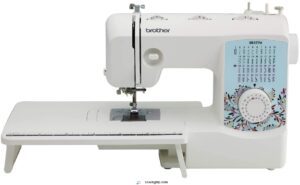
The Brother XR3774 ships at $164.99 and measures 15.3 inches wide, 12 inches tall, and 5.8 inches deep. Its compact design and metal-plastic build (15 lb) balance durability with portability, though it still requires daily protection.
It features 37 built-in stitches, a drop-in top-loading bobbin, and an automatic needle threader for streamlined operation. These functional elements cater to both beginners and experienced users seeking efficiency.
The wide extension table is removable, a critical consideration when sizing your cover. A snug fit ensures dust stays out of the bobbin case, maintaining performance over time.
While not fragile, the machine’s metal-plastic construction underscores the need for consistent safeguarding against wear and environmental factors.
| Best For | Beginners and intermediate sewists who want a reliable, feature-packed machine for quilting, everyday sewing, and light repairs without spending a lot. |
|---|---|
| Product Type | Sewing Machine |
| Brand | Brother |
| Housing Material | Metal/Plastic |
| Weight | 15 lb |
| Power Requirement | 110V |
| Price | $164.99 |
| Additional Features |
|
- 37 built-in stitches plus a 1-step buttonhole give you plenty of variety for quilting, hemming, and decorative projects
- The automatic needle threader and drop-in bobbin make setup quick and frustration-free, especially for newer sewists
- At 15 lb and $164.99, it’s genuinely portable and affordable without feeling cheap
- Gets loud and vibrates noticeably at higher speeds, which can make big or heavy projects harder to manage
- Struggles with thick layers of fleece or minky, and the needle threader can be finicky if you’re not precise with it
- Only works with 110V U.S. outlets, and some units arrive without the advertised DVD
3. Brother XM2701 Lightweight Sewing Machine
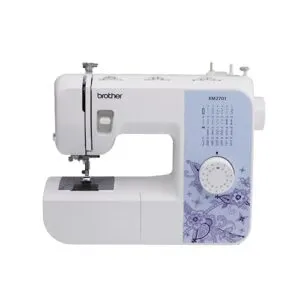
Step down in price and the Brother XM2701 earns its spot at $149.00. It’s lighter than the XR3774 — 12.6 pounds — with dimensions of 15.3 × 5.86 × 12.01 inches. That slim 5.86-inch depth is easy to cover, but don’t let the compact frame fool you.
It packs 27 built-in stitches, a jam-resistant top-drop bobbin, and an automatic needle threader.
A snug cover — add 2–4 mm clearance on all sides — keeps lint away from that bobbin system daily.
| Best For | Beginners and hobbyists who want a reliable, easy-to-use machine for everyday sewing projects without spending a lot. |
|---|---|
| Product Type | Sewing Machine |
| Brand | Brother |
| Housing Material | Metal |
| Weight | 12.6 lb |
| Power Requirement | 120V |
| Price | $149.00 |
| Additional Features |
|
- Automatic needle threader and jam-resistant bobbin make setup fast and frustration-free
- 27 built-in stitches cover everything from basic seams to buttonholes and decorative finishes
- Lightweight and compact — easy to move around or tuck away in a small space
- Struggles with heavy fabrics like thick denim, leather, or multiple layered materials
- Fewer features than computerized machines — no LCD screen or embroidery options
- Only works on US 120V power; using it abroad voids the warranty
4. Janome 2222 Mechanical Sewing Machine
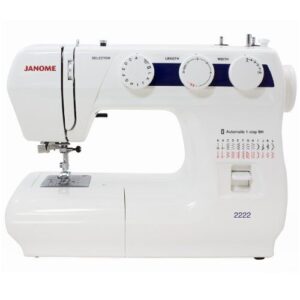
The Janome 2222 sits in the sweet spot—mechanical, no-fuss, and built for daily work. It measures 6 × 15.2 × 11.6 inches and weighs 13.2 pounds.
Its white-and-blue plastic housing scratches easily, so a snug cover is essential. Add 2–4 mm clearance when sizing to ensure a proper fit.
The machine features 22 built-in stitches and a manual tension dial, keeping operation straightforward.
A quilted or cotton canvas cover protects the finish while allowing airflow to prevent heat buildup near the motor vents.
| Best For | Beginners, hobbyists, and anyone who wants a reliable, no-frills machine for everyday sewing projects like repairs, mask making, or basic quilting. |
|---|---|
| Product Type | Sewing Machine |
| Brand | Janome |
| Housing Material | Plastic |
| Weight | 13.2 lb |
| Power Requirement | N/A |
| Price | N/A |
| Additional Features |
|
- Simple mechanical controls make it easy to pick up and use right away, even with no sewing experience.
- Lightweight at 13.2 lbs with a retractable handle, so it’s easy to take to class or a friend’s place.
- Quiet and steady at higher speeds, which makes longer sewing sessions a lot less tiring.
- The bobbin setup is a bit awkward—checking thread and re-threading takes more fiddling than it should.
- The plastic housing isn’t built to handle heavy, day-in-day-out use the way a metal-frame machine would.
- No electronic extras like a needle threader or LCD screen, and thread breakage can happen when reversing at seam ends.
5. Brother CS7000i Sewing and Quilting Machine
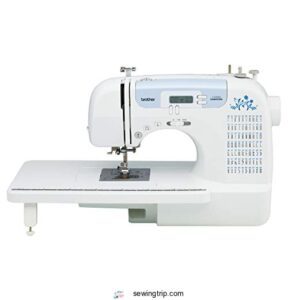
The Brother CS700i is a workhorse — featuring 70 built-in stitches, a drop-in bobbin, and a backlit LCD within a compact 16.02 × 6.69 × 12.09-inch frame. Weighing around 13 pounds, it balances portability with substantial construction.
The detachable wide quilting table significantly increases bulk when attached, so measure with it off for accurate storage or transport planning.
A snug cotton canvas cover with 2–4 mm clearance protects the plastic chassis and LCD screen. Keep a front-pocket cover accessible for storing its 10 presser feet and cord.
| Best For | Beginners and hobbyists who want a versatile, easy-to-use machine for quilting, garment sewing, and home décor projects without breaking the bank. |
|---|---|
| Product Type | Sewing Machine |
| Brand | Brother |
| Housing Material | Metal |
| Weight | N/A |
| Power Requirement | 120V |
| Price | $349.99 |
| Additional Features |
|
- 70 built-in stitches plus an automatic needle threader make it genuinely beginner-friendly — less fussing, more sewing
- The detachable quilting table and free-arm give you real flexibility for everything from quilt blocks to hemming sleeves
- Comes with a hard case and 10 presser feet, so you’re pretty much ready to go right out of the box
- Struggles with heavy fabrics like denim or leather — it’s not built for tough stuff
- The plastic chassis can feel a bit lightweight compared to pricier, all-metal machines
- No presser-foot pressure adjustment, which makes it harder to dial in on tricky or delicate materials
6. Janome HD9 Heavy Duty Sewing Machine
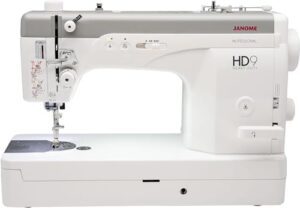
At 21 pounds with a solid metal chassis, the HD9 is a serious machine for serious work. It operates at 1,600 stitches per minute, handles denim effortlessly, and features an independent bobbin-winding motor to eliminate mid-project interruptions.
For projects involving heavy zippers, understanding zipper pull tab retention and slider interlock mechanics can save you from frustrating mid-seam failures.
Dimensions measure 18.5 × 8.5 × 13.47 inches. For protection, use a heavy polyester canvas cover, allowing 2–4 mm clearance around all edges.
A deep front pocket neatly stores the foot-control pedal and extra bobbins, ensuring organized accessibility.
| Best For | Small-business owners and dedicated hobbyists who regularly sew through heavy fabrics like denim or canvas and need a machine that can keep up. |
|---|---|
| Product Type | Sewing Machine |
| Brand | Janome |
| Housing Material | Metal |
| Weight | 21 lb |
| Power Requirement | N/A |
| Price | $2,099.00 |
| Additional Features |
|
- Punches through thick, heavy-duty materials that most home machines choke on
- Runs at 1,600 stitches per minute, so production moves fast
- Built with a solid metal chassis — it’s sturdy and stable during long sessions
- At 21 lb, "portable" is generous — it’s not something you’ll want to lug around often
- The $2,099 price tag is a tough sell if you’re only sewing occasionally
- Limited details on stitch variety and advanced features, so it may not suit highly specialized or technical sewing needs
7. Juki TL2010Q High Speed Sewing Quilting Machine
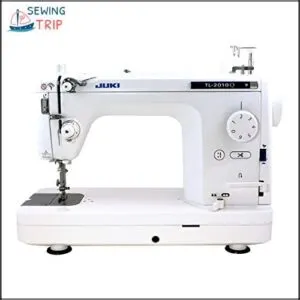
At 25 inches wide and 39 pounds, the Juki TL-2010Q isn’t a machine you tuck away lightly. It tops out at 1,500 stitches per minute with an all-metal frame that barely vibrates—even at full speed.
For a cover, size up—its 14 × 25 × 18-inch footprint needs a large semi-industrial pattern with 2–4 mm clearance on all sides. Add a deep front pocket to keep its eight bobbins and presser feet organized and ready.
| Best For | Serious quilters and sewists who work with heavy fabrics and need a fast, reliable straight-stitch machine that can keep up with big projects. |
|---|---|
| Product Type | Sewing Machine |
| Brand | JUKI |
| Housing Material | Metal |
| Weight | 39 lb |
| Power Requirement | N/A |
| Price | $1,301.46 |
| Additional Features |
|
- Blazing speed (up to 1,500 stitches per minute) with an all-metal frame that stays rock-solid—no creeping or vibrating across your table.
- The extended throat and large work area make it genuinely easy to maneuver bulky quilts and thick layered fabrics without fighting the machine.
- Comes with a solid bonus pack—three presser feet, eight bobbins, needles, and tools—so you’re ready to go right out of the box.
- Straight stitch only—if you ever want decorative stitches or zigzag, you’ll need a second machine.
- The bobbin isn’t visible while you sew, and it needs daily oiling, which adds a little messy maintenance to your routine.
- Swapping presser feet means unscrewing them every time, and they’re not compatible with standard universal feet—which gets old fast.
8. Juki TL2000Qi Sewing Quilting Machine
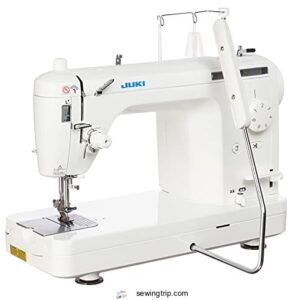
The Juki TL-2000Qi is lighter than the TL-2010Q but equally capable, operating at 1,500 SPM with an aluminum die-cast frame to minimize vibration. Its compact dimensions—8.6 in deep, 17.8 in wide, and 13.8 in tall—ensure a space-efficient design.
A large semi-industrial cover with 2–4 mm clearance and a 10–12 mm front gap accommodates the foot-pedal cord without obstruction.
The machine features a deep front pocket to store the knee lifter and spare bobbins, maintaining a clutter-free workspace.
| Best For | Quilters and sewists who work with heavy fabrics or large projects and need a fast, reliable straight-stitch machine that can keep up with serious production. |
|---|---|
| Product Type | Sewing Machine |
| Brand | JUKI |
| Housing Material | Aluminum |
| Weight | 25.4 lb |
| Power Requirement | 110V |
| Price | $899.00 |
| Additional Features |
|
- Blazing fast at 1,500 SPM with a sturdy aluminum frame that keeps vibration low, so you stay in control even at full speed.
- The included extension table and walking foot give you a wide work area—great for wrestling king-size quilts or thick layered materials.
- Quiet and solid construction makes long sewing sessions genuinely comfortable, not exhausting.
- Straight stitch only—if you need zigzag or decorative stitches, this isn’t your machine.
- No variable speed control means you’re managing pace entirely through foot pressure, which takes some getting used to at high speeds.
- The automatic needle threader tends to disappoint, and extras like a free-motion foot aren’t included, so expect a few more purchases out of the gate.
9. Juki HZL-F300 Sewing and Quilting Machine
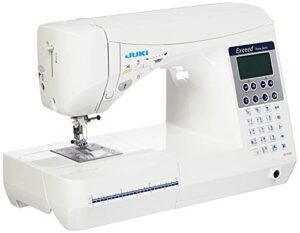
The Juki HZL-F300 packs 106 stitches and 16 buttonhole styles into a metal-framed machine measuring 8.3 in deep, 17.5 in wide, and 11.4 in tall. At 25 lb, it’s not going anywhere without a handle.
A small-machine cover fits cleanly—add 2–4 mm clearance and a 10–12 mm front gap for the foot-pedal cord. A front pocket with elastic keepers holds bobbins and spare needles.
Cotton canvas works well here; it’s washable and holds shape after daily use.
| Best For | Home sewers and quilters who regularly work with heavy fabrics like denim or wool and want a reliable, no-fuss machine that handles the tough stuff without a lot of manual setup. |
|---|---|
| Product Type | Sewing Machine |
| Brand | Janome |
| Housing Material | Metal |
| Weight | 25 lb |
| Power Requirement | 120V |
| Price | N/A |
| Additional Features |
|
- The box feed system chews through thick layers and multiple fabrics without skipping a beat—great for quilts, coats, and denim projects.
- Auto needle threading and a built-in thread cutter cut down on the little annoyances that slow you down mid-project.
- 106 stitches plus an LCD preview makes it easy to dial in decorative work exactly the way you want it.
- No knee lever included, and the presser-foot selection is pretty bare-bones out of the box—walking and free-motion feet cost extra.
- Only one LED light over the stitch area, so detailed throat work can still feel a little dim.
- It’s a 120V machine, so if you’re outside the U.S., you’ll need a transformer to make it work.
Why Daily Sewers Need Covers
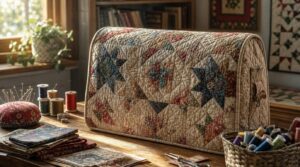
Your machine works hard — it deserves protection that keeps up. A good cover does more than gather dust itself; it blocks lint, moisture, UV rays, and the random bump that sends your bobbin case into chaos.
Daily sewers treat covers as non-negotiable gear, recognizing their critical role in safeguarding equipment from everyday hazards.
Dust Protection for Bobbin Cases and Feed Dogs
Lint is the quiet enemy of a well-tuned machine. Every session pushes fibers toward the bobbin case and feed dogs — and once they’re in, they stay.
Lint is the quiet enemy of every sewing machine, sneaking into the bobbin case and feed dogs where it silently stays
A proper dust cover with Dust Shield Design and Bobbin Case Seal features blocks that path completely:
- Seals lint out of the bobbin race
- Facilitates Lint Filter Integration at the feed dog lip
- Protects internal gaskets — Gasket Maintenance gets easier
- Guards the Feed Dog Lip from fiber buildup
- Acts as your first machine protection solution between sessions
Follow a proper bobbin case cleaning guide to keep the machine running smoothly.
Humidity Resistance to Reduce Rust Risk
Humidity above 60 percent accelerates corrosion, causing rust to form quietly on bobbin carriages and needle assemblies before you notice it.
Humidity-Barrier Fabrics with sealed edges block moisture intrusion, while Desiccant Integration actively maintains ambient humidity below 40 percent.
Ventilation Slot Design, breathable fabric, and Anti-Rust Coatings combine to create Climate-Controlled Storage without the cost.
UV Protection for Machine Finishes
Rust isn’t the only quiet threat. UV absorbers in quality cover fabrics block damage before it starts. Inorganic shields like titanium dioxide reflect radiation away. UV-stable pigments resist yellowing in plastics. Clear UV coatings preserve logos and decals. A heat-reflective layer adds temperature and moisture protection too — solid protective cover design, front to back.
Scratch and Impact Protection During Daily Use
UV blocks fading — but knocks and scrapes are just as sneaky. Daily handling adds up fast. Here’s what good protective cover design actually does:
- Microfiber scratch shield deflects zipper snags and fabric contact
- Foam impact pads absorb small drops before they reach metal
- Dual‑density padding spreads force across surfaces, not into them
- Corner shock guards take the hit from chair legs and tight spaces
Seam‑tight pressure keeps everything even — no hard points digging into panels. In the hard case vs. fabric cover debate, fabric wins daily-use flexibility; hard cases win rough transit. Either way, the impact of cover material on machine longevity is real.
Protect your sewing machines like the tools they are.
Mold Prevention for Machines Stored in Closets
Closets harbor more than clutter — mold starts growing when humidity climbs above 60 percent.
A breathable fabric cover manages dust and humidity protection for sewing machines, but pair it with silica gel packs or a closet dehumidifier for real control.
Airflow grilles and leak detection before water damage sets in provide additional defense.
Mold-resistant paint on closet walls adds another quiet layer of defense.
How Covers Extend Sewing Machine Lifespan
Every cover you put on your machine buys it more time. Here’s what’s actually happening under the fabric:
- Lubrication Preservation — dust-free internals keep oil where it belongs
- Vibration Absorption — padded covers cushion daily handling
- Temperature Control — breathable liners reduce heat stress on components
- Cable Wear Reduction — pocket organizers stop cord friction damage
That’s machine longevity, compounding quietly every day.
Best Materials for Everyday Covers
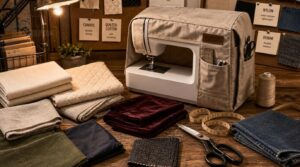
The material your cover is made from matters more than most people think. It’s the difference between a cover that holds up for years and one that pills, warps, or traps moisture against your machine.
Seven materials worth knowing before you buy or sew your own include options that balance durability, breathability, and protection. Understanding these choices ensures your cover meets your needs without compromising longevity or functionality.
Cotton Canvas for Washable Durability
Cotton canvas is the workhorse of sewing machine covers — and for good reason. Its plain weave tightness (7–14 oz per square yard) delivers serious fiber integrity and tear resistance. Machine-wash at 40°C without guilt.
| Property | Cotton Canvas |
|---|---|
| Water Repellency | Treated variants only |
| Stain Resistance | Good with mild detergent |
| Fabric Breathability | Excellent |
| Eco Longevity | Biodegradable, repairable |
Protecting sewing equipment from dust doesn’t get more practical.
Polyester Canvas for Lightweight Water Resistance
Polyester canvas serves as a lightweight travel sewing cover material that effectively blocks water. An acrylic coating enhances its functionality by providing hydrostatic head resistance (1,000–2,500 mm HH), ensuring spills bead up instead of soaking in.
The material maintains a low weight ratio (5–10 oz per square yard), making it ideal for portable use. Its coating breathability prevents condensation buildup inside soft fabric covers, ensuring dust protection remains effective without trapping moisture against your machine.
Linen Blends for Breathable Structure
Linen blends bring real breathability to soft fabric covers — something polyester simply can’t match. A 60/40 linen-cotton blend hits the sweet spot: fiber composition stays linen-dominant, weave openness remains high, and fabric weight stays under 260 g/m². This ensures strong air permeability without trapping heat. Skip heavy finish treatments.
Your sewing machine cover breathes, your machine stays dry, dust protection holds.
Quilted Covers for Padded Protection
Quilted covers hit differently when your machine takes daily abuse. fabric layers construction — quilted top, batting core, linen or cotton backing — creates genuine impact absorption.
Padding density runs 8–12 oz per square yard. Seam grid patterns lock fill in place; no shifting, no thin spots.
Quilted thickness options usually add 1–2 inches. That’s real machine protection from dust and contact damage.
Moisture-resistant Liners for Humid Rooms
Humidity is a machine killer — slow, silent, and expensive. If your sewing room experiences sticky summers or damp winters, your liner material matters.
Silicone liners offer a non-absorbing surface that blocks moisture on contact.
Multilayer barrier films cut vapor transmission better than single-layer options.
For serious humidity, metallized foil laminates block moisture and oxygen most effectively.
Desiccant integrated liners actively pull ambient humidity down inside the cover.
Ventilation edge channels along the seams keep air moving for dust and humidity control.
Bias-tape Seams for Long-lasting Edges
Raw edges fray fast — and a cover that falls apart at the seams isn’t protecting anything. Bias tape fixes that. Cut at 45 degrees, it stretches around corners without puckering, giving you clean seam finishing techniques that actually hold up.
- Match thread compatibility to your cover fabric — cotton tape needs cotton thread
- Press fold alignment flat before stitching for a crisp, accurate bind
- Use shorter stitch length for stronger seam reinforcement along every edge
- Maintain consistent stitch tension — too tight warps the tape; too loose lets it lift
- Double-fold bias binding fully encases raw edges, maximizing edge longevity on your sewing machine cover
Hard Cases Versus Soft Fabric Covers
Bias tape locks down your edges — but what about the cover itself? Hard cases win on rigid shell durability and seal performance, resisting moisture and impact consistently. Soft fabric covers offer real flexible fabric benefits: lighter weight, easier daily access, and a lower-cost protection ratio.
The weight portability tradeoff is real. For dust prevention on machines at home, fabric covers do the job well.
Measure Before Buying a Cover
Buying a cover without measuring first is like buying shoes without knowing your size — frustrating and expensive.
Your machine’s width, height, and depth all matter, and so do the small gaps for cords and grips. Here’s exactly what to check before you spend a single dollar.
How to Measure Machine Width
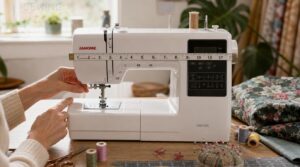
Width trips up a lot of sewers — but the fix is simple. Use the Tape Measure Technique: lay a flexible tape flat across the front, capturing the widest point. That means Protrusion Identification first — spool pins, levers, control panels.
Width Verification Steps:
- Set the needle to Home Needle Position
- Identify every protrusion
- Record Horizontal Reach Recording of the largest one
- Add 2–4 mm clearance tolerance
- Log final custom measurements for your cover order
How to Measure Machine Height
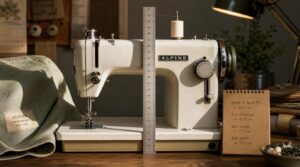
Datum Selection: Place your ruler at the machine’s base plate, not a handle or decorative trim.
Ruler Alignment parallel to the front face prevents parallax errors—read at eye level.
Accessory Inclusion: Include raised presser feet and spool pins.
Add 1–2 cm Ventilation Clearance on top.
Log your custom measurements for an adjustable height fit.
How to Measure Machine Depth
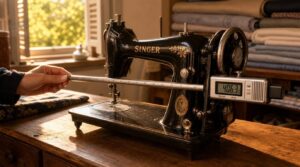
Depth runs front to back, which is easy to underestimate. Set a depth gauge on the zero reference surface at the machine’s rear edge. Depth gauge selection matters: digital reads fastest.
Full rod extension hits the front face; reading verification confirms no drift. That single number—usually 6 to 9 inches—is critical for establishing measurement tolerance for covers.
Clearance Needed for a Snug Slip-on Fit
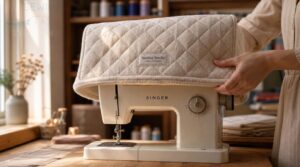
Once you have all three dimensions, slip-on tolerance is your next calculation. Clearance — the gap between the machine and the cover edge — determines whether your cover slides on cleanly or resists you every morning.
- Uniform edge space: 5–10 mm around all sides
- Material flexibility: Add 2–4 mm for quilted or padded covers
- Clearance verification: Recheck fit with the machine in its normal position
- Adjustable fit features: Elastic panels compensate for measurement tolerance for covers
Handle-slot Measurements for Portable Machines
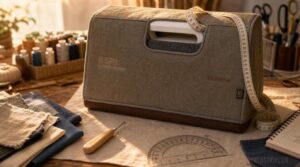
Width tolerances run 90–120 mm; add 5–8 mm for protruding knobs. Height clearance requires a 60–75 mm minimum. Depth buffer must extend 15–20 mm past the handle projection.
Deburr and felt-line the edge to ensure smooth operation. An angled slot—5–15 degrees—guides insertion cleanly.
Measure your machine before ordering any custom-fit cover.
Cord and Foot-pedal Access Gaps
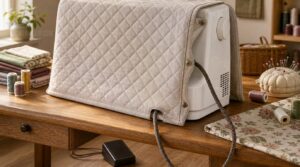
Cord routing channels and pedal clearance width matter more than most sewers realize. Aim for a 0.5–1.25 inch gap where cords exit — tight enough to block dust, loose enough to avoid friction.
Friction-reduction fabrics around openings prevent cord wear over time. Check adjustable access openings for snap closures or front zipper pockets.
Monitor gap wear monthly — frayed edges quietly shrink your clearance.
When to Choose a Custom Cover
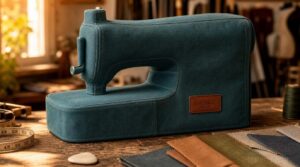
Off-the-shelf covers won’t cut it when your machine has unusual dimensions, protruding accessory shelves, or specialized accessories like needle clamps. A custom sewing machine cover fits exactly — no gaps, no flaps.
Custom protective covers for sewing equipment also support industry branding and extended warranty confidence.
Frequent transport demands reinforced seams.
Custom fit solutions for sewing tools beat guessing every time.
Storage Features Worth Comparing
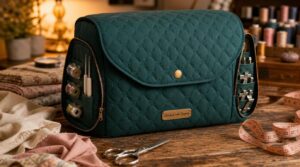
Not all covers are built the same regarding storage. The right pockets and closures can save you real time during a busy sewing session.
Here’s what to look at before you buy.
Front Pockets for Pedals and Cords
A large front pocket does more than hold a foot pedal — it keeps your whole setup tangle-free. Look for front zipper pockets with strain-relief cord loops and a ventilated pocket design that prevents heat buildup. Magnetic pocket closure snaps shut without snagging thread.
Some covers add a removable liner pocket or adjustable pocket angle for quick-access tool storage integrated into covers — genuinely useful for daily sewers.
Side Pockets for Needles and Bobbins
Side pockets handle the small stuff front pockets can’t — needles, bobbins, spare threads.
Look for elasticized openings that grip without fasteners and microfiber linings that won’t snag delicate needle tips.
Reinforced stitching along pocket edges ensures durability for daily use.
Color-coded labels and removable dividers let you sort by needle size quickly.
Mesh side pockets show contents at a glance — no digging required.
Elastic Keepers to Prevent Cord Tangles
Tangled cords waste setup time. Elastic keepers — flat bands between 6 mm and 20 mm wide — slot into integrated storage sleeves inside the front pocket, separating foot-pedal cords from power lines.
Keeper placement every 10–15 cm prevents loose spans from crossing.
Polyester-blend elastic wins on material durability in humid rooms. Elastic tension fades eventually, but replacement is simple: seam-rip, swap, resew.
Dual-side Zippers for Quick Tool Access
Elastic keepers sort your cords — dual-side zippers handle the rest. Two sliders on one track enable opening from either end, ensuring quick-access tool storage integrated into covers functions effectively.
Slider ergonomics matter: textured pull tabs reduce fumbling, enhancing ease of use.
Zipper seal integrity keeps dust out between sessions, maintaining protection for stored items.
Valuable installation tips: align pulls to your natural reach and verify compatibility standards with your cover’s seam allowance before retrofitting.
Reversible Covers With Double-sided Storage
Zippers sorted — now flip the whole cover. A reversible sewing machine cover doubles your options without adding bulk. Style switching takes seconds: fabric weight matching between both faces prevents awkward bunching.
The Symmetrical Pocket Layout ensures dual-side pockets mirror each other exactly — bobbins left, cords right.
Seam Strength Balance and reinforced bias edges hold through every rotation, keeping the structure intact during use. The Flip-access Mechanism enables seamless transitions while maintaining Quick-access tool storage integration.
Flat-fold Designs for Small Sewing Spaces
Tight on space? Flatfold designs solve that without sacrificing protection. Tri‑fold construction collapses to 6–10 inches thick — drawer-friendly, shelf-ready.
A spine hinge holds the cover open during use, while fold‑line reinforcement prevents tearing at stress points. Ventilation channels keep air moving inside.
- Adjustable panels fit machines 14–18 inches wide
- Compact sewing machine storage under 1 inch flat
- Corner gussets maintain shape when unfolded
Lightweight Covers for Daily Setup
Daily setup shouldn’t feel like a chore. Lightweight soft-sided fabric cases — built with breathable fabrics and elastic hemming — slip on in under 60 seconds. Rapid slip-on designs skip rigid frames entirely.
Ventilation channels prevent heat buildup; magnetic fasteners snap shut without snagging threads.
Weight optimization keeps total fabric under a few hundred grams.
Foldable and flat-fold cover designs for small areas store flat, and quick-access pockets keep dust covers within reach.
DIY and Custom Cover Options
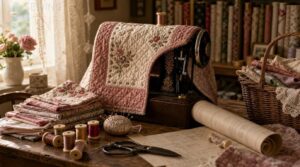
Sometimes the best cover is the one you make yourself. Whether you’re working with a vintage machine that no store-bought sleeve will fit or just want something that actually matches your sewing room, DIY and custom options are worth a serious look.
Here’s what’s available — from free printable patterns to fully handmade alternatives to plastic cases.
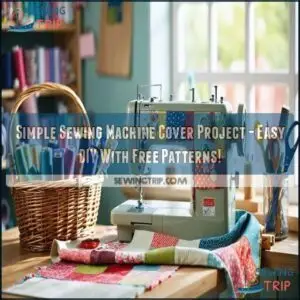
Free Sewing Machine Cover Patterns
Free sewing machine cover patterns are a solid starting point — no guesswork, no wasted fabric. Most come as downloadable PDFs with labeled pieces, size options, and a clear tool requirement list built in. Pattern accessibility options vary, but you’ll usually find three sizes covering compact to semi-industrial machines.
- Check PDF compatibility before printing — letter vs. A4 matters
- Review the pattern revision history for fit corrections
- Read user modification tips in blog comments for real-world adjustments
Printable Dust Cover Tutorials
Printable tutorials take the mystery out of custom sizing. Download a printable PDF version using standard digital file formats — PDF or DXF both work. Print at 100% scale, then verify scale calibration with the built-in test square.
Transfer paper die lines onto fabric using chalk for clean marker transfer.
A step‑by‑step video alongside free printable sewing patterns for home projects simplifies seam allowance adjustments — usually ⅛-inch increments.
Quilted DIY Cover Construction
Quilted covers are not complicated — they’re just three layers working together: a top fabric, a 3-to-5-ounce batting thickness in the middle, and a lining. Spray-basting locks the quilt sandwich flat before stitching begins.
Run grid quilting patterns every 2–4 inches, maintaining a stitch length of 2.5–3.0 mm for consistency.
Reinforce seams at corners with backstitching, then finish each edge with a binding stitch to ensure long-lasting durability.
Directional Fabric and Decorative Stitch Ideas
Directional prints can make or break a cover’s look. Keep motif orientation consistent — all pieces face the same way, no exceptions.
Use nap-aligned stitching on velvet or corduroy to prevent puckering. Stripe-matching seams take patience but pay off visually.
Try contrast stitch direction along borders for a sharp decorative edge. Directional appliqué adds personality without bulk — just mind the grain.
Custom-fit Covers for Unusual Machine Sizes
Sometimes your machine just doesn’t fit the mold — literally. Offset controllers, protruding handles, an irregular silhouette — standard covers gap and bunch. That’s where a custom fit cover earns its keep.
CAD modeling maps exact contours. Reinforced edges withstand daily removal. Rapid prototyping ships a test cover within five business days.
Weight customization runs 150–300 gsm. Measuring sewing machines accurately upfront keeps everything snug.
Paid Patterns With Organizer Pockets
If a custom job feels like overkill, paid premium cover patterns strike a balance. Think ‘Simpli-ty’ or ‘Scrap Buster’—bundled pattern packages offering multipocket fabric cover designs, customizable pocket layouts, and a convertible work-mat bonus.
Digital delivery options enable instant download, while video tutorial integration guides users through every step.
Their pricing models typically bundle multiple sizes, delivering solid value for quick-access pockets and full accessory organization via machine cover pockets.
Handmade Covers Versus Plastic Alternatives
Paid patterns get you organized. But handmade vs plastic covers is a different debate entirely.
Fabric wins on longevity: canvas and linen outlast thin clear vinyl in daily use. Repairability benefits are real—a torn seam takes minutes to fix.
Tactile comfort and noise dampening also matter. Plastic rattles; quilted fabric absorbs sound.
With a smaller eco footprint and longer life, the performance comparison between hard cases and fabric covers isn’t close.
Frequently Asked Questions (FAQs)
Should you cover your sewing machine when not in use?
Yes. Dust, humidity, and UV exposure quietly degrades your machine between sessions.
A sewing machine dust cover blocks lint, resists moisture, and shields the finish — protecting sewing machines from dust costs only thirty seconds.
What is the most sought after sewing machine?
The Brother CS7000i leads in top-model popularity right now.
Its 70 built-in stitches, automatic threader, and wide quilting table drive consumer demand — strong feature desirability keeps it ahead in market sales rankings.
How to make a soft cover for a sewing machine?
Measure your machine, cut fabric with seam allowance, and sew a DIY custom sewing machine cover using a simple sewing machine cover pattern.
Enhance the design by adding bias tape installation, reinforced corners, and a ventilation slot for improved functionality.
The result is a clean, protective soft-sided fabric case that safeguards your machine effectively.
Do magnetic closures snag thread or fabric?
Magnetic closures can snag — but only when magnet housing design is rough or unfinished. Smooth housings rarely cause thread snag prevention issues.
Tight‑weave fabrics resist pulls well.
Test closure edge finish on scraps first.
Can covers stay on during machine transport?
Most can’t. Soft fabric covers shift at highway speeds without secure elastic edges.
Hard cases with carrier latching requirements hold better. Wind-resistant design matters more than you’d think—loose fabric flaps fast.
How soon does custom pricing email arrive?
Your custom pricing email usually lands within 1 to 24 hours — most quick response email replies arrive in 4 to 6 business hours.
Submit complete machine specs upfront to hit the faster end of that Response Time Benchmarks window.
Are covers made with domestic US materials?
Yes. Many covers use cotton canvas from U.S. mills — featuring real Made-USA Certification, Domestic Fiber Sourcing, and Local Mill Support.
US Production Standards and Supply Chain Transparency back every handmade machine cover built here.
Do vents prevent heat buildup inside covers?
Vents work. Vent placement near the cover’s peak lets hot air rise and escape naturally, boosting airflow efficiency and cutting moisture buildup — your best defense against rust and heat damage.
Conclusion
Your machine works hard—it deserves a little shelter from the storm. The right sewing machine covers for daily sewers don’t just block dust; they quietly extend the life of every part beneath.
Fit matters. Material matters. Storage features matter more than most buyers expect.
Whether you stitch every morning or run full production days, a cover that actually fits means fewer repairs, less grime, and one less thing competing for your attention.
- https://www.jinaobellowscover.com/news/protecting-your-cnc-machine-the-importance-of-dust-covers-and-bellows-covers/
- https://madamsew.com/blogs/sewing-blog/make-a-sewing-machine-cover?srsltid=AfmBOor8qmghLxtMjUpLYsznozQHNdgTqihlTpdWbNZQo94zxGTeoP_r
- https://www.applegreencottage.com/sewing-machine-cover-pattern/
- https://sewingcraft.brother.eu/en/blog/sewing-room/2024/bomb-machine-cover
- https://www.professorpincushion.com/professorpincushion/sewing-machine-cover/