This site is supported by our readers. We may earn a commission, at no cost to you, if you purchase through links.
Broderie perse nearly disappeared from quilting circles entirely—not because crafters lost interest, but because the glazed chintz fabrics it depends on became nearly impossible to source. That scarcity made finished pieces rare, which quietly turned them into heirlooms.
The technique itself dates to 17th-century Europe, when imported Indian chintz was so expensive that sewers cut individual motifs from worn fabric and stitched them onto fresh backgrounds rather than waste a single flower. That thrifty instinct produced some of the most intricate textile art of the era.
Today, broderie perse appliqué techniques are more accessible than ever—the fabrics are back, the tools are better, and the results still carry that same handcrafted elegance that made early examples worth saving.
Table Of Contents
Key Takeaways
- Broderie perse traces back to 17th-century Europe, where sewers cut motifs from expensive Indian chintz rather than waste a scrap — a thrifty habit that accidentally produced some of the era’s finest textile art.
- Fabric prep and motif selection do most of the heavy lifting: prewash everything, choose prints with clean color boundaries, and plan your layout before fusing a single piece.
- The right tools — micro-tip scissors, serrated fussy-cutting shears, and a PTFE pressing sheet — make the difference between clean, precise results and frustrating do-overs.
- Your stitch choice shapes the final look: a narrow zig-zag works fast and holds firm, while needle-turn or blanket stitch gives that handcrafted finish worth showing off.
What is Broderie Perse Appliqué
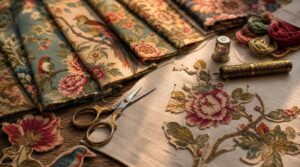
Broderie perse is a centuries-old appliqué technique where you cut printed motifs from fabric and stitch them onto a background to create decorative designs.
It pairs beautifully with other methods like fused or reverse appliqué, which you can explore through these quilting block patterns and design ideas.
It sounds simple, but there’s real craft behind choosing the right fabrics, cutting cleanly, and placing everything just so.
Here’s what you need to know to get started.
Motif-cut Appliqué Basics
Motif-cut appliqué is simpler than it sounds. You select a printed fabric motif, cut it out with fabric-cutting precision, and fuse it onto a background using a fuseable web technique. Edge reinforcement through stitching locks everything in place.
Good design layout planning—testing placements with paper templates, checking color harmony, and thinking through motif selection—makes the whole composition click. Using freezer paper templates can boost placement accuracy by up to 30%.
Chintz Fabric Origins
That fabric obsession didn’t happen overnight. Chintz began in India through Kalamkari painting and Indian block printing — vibrant, colorfast cotton that Dutch trade routes carried into European homes around 1600. It caused such a stir that France and England issued European chintz bans to protect local weavers.
Indian chintz was so coveted that France and England banned it to protect their own weavers
By the roller printing era, what once traveled the silk trade influence had sparked the entire foundation of Broderie Perse.
Traditional Quilt Applications
Those banned chintz prints didn’t just inspire smugglers — they shaped an entire quilting tradition. Early broderie perse became the heart of heirloom storytelling, with makers arranging cut motifs across quilt tops using careful Color Palette Coordination and Border Framing to unify the design.
Traditional quilt making leaned on this appliqué technique for:
- Block Integration into Nine Patch or Log Cabin layouts
- Centering florals as Dresden Plate focal points
- Layering motifs for Quilt Top Layering depth
- Framing blocks with historical quilting-inspired borders
Modern Sewing Uses
Broderie perse has traveled far from its chintz-and-contraband roots. Today, you can use Computerized Embroidery and Digital Patterning to plan layouts before cutting a single thread.
Serger edge finishing keeps raw edges clean on modern appliqué projects.
On-demand production and boutique customization mean your DIY sewing projects — from pillows to wall art can go from sketch to finished piece faster than ever.
Top 4 Broderie Perse Tools
Good tools make the difference between frustrating and fun.
For broderie perse, a few key items will carry you through almost every project you tackle. Here are the four worth keeping close.
1. Fiskars Micro Tip Sewing Scissors
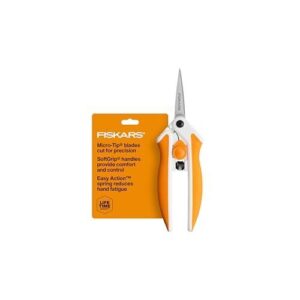
These scissors are a quiet workhorse in any broderie perse toolkit. The Fiskars Micro-Tip Spring Action Scissors ($12.97) feature precision-ground stainless-steel blades that stay sharp right to the very tip — exactly what you need when trimming around delicate printed flower petals.
The spring-assist mechanism automatically reopens the blades, preventing hand fatigue during extended use. This ergonomic design ensures comfort and reduces strain mid-session.
At just over six inches long, with a soft ergonomic grip, they offer exceptional nimbleness for navigating tight curves without sacrificing control. Their balanced construction makes them ideal for intricate tasks.
Their precision really shines when working detailed hand embroidery stitches like satin and chain stitch, where steady control makes all the difference.
| Best For | Quilters, sewists, and crafters who do fine detail work — especially anyone trimming delicate fabrics like silk or felt where precision really matters. |
|---|---|
| Material | Stainless steel blades |
| Primary Use | Fabric cutting |
| Price | $12.97 |
| Durability Feature | Precision-ground blades |
| Ergonomic Design | SoftGrip handle |
| Heavy Material Limit | Not for denim/leather |
| Additional Features |
|
- Blades stay sharp all the way to the tip, so you can get into tight corners and cut fine details cleanly
- The spring-assist opens the blades for you after each snip, which is a lifesaver during long sewing sessions
- At under $13, they punch well above their price — solid stainless steel with an ergonomic grip included
- Too small for heavy materials like denim or leather — you’ll need something beefier for those
- The spring mechanism can wear out over time with heavy use, so it may not stay as snappy as it once was
- Only comes in one size, which means bigger projects will call for a different pair of scissors
2. Gingher Stork Embroidery Scissors with Leather Sheath
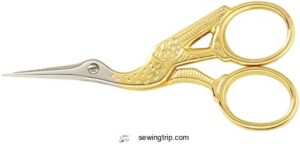
Think of the Gingher Stork Embroidery Scissors as the heirloom tool in your broderie perse kit. At just 3.5 inches, their slender, precision-ground blades slip into tight curves and corners with ease — exactly where delicate printed motifs demand accuracy.
The chrome-over-nickel finish keeps blades sharp and smooth, while gold-plated handgrips add a touch of elegance you’ll appreciate during long sessions.
The included leather sheath protects those fine tips between projects.
Plus, a lifetime warranty means these are scissors you’ll reach for for years.
| Best For | Embroiderers, quilters, and needlework enthusiasts who need precise, comfortable scissors for detail work with delicate fabrics and fine threads. |
|---|---|
| Material | Stainless steel blades |
| Primary Use | Fabric cutting |
| Price | Not listed |
| Durability Feature | Chrome-over-nickel finish |
| Ergonomic Design | Double-loop handle |
| Heavy Material Limit | Not for thick leather |
| Additional Features |
|
- Slender, precision-ground blades make clean cuts in tight spots — great for intricate motifs and curved edges.
- Ergonomic ambidextrous handles reduce hand fatigue during long sewing or embroidery sessions.
- Lifetime warranty and durable chrome-over-nickel finish mean you’re buying these once.
- Not built for heavy-duty cutting — thick leather or stacked denim layers are a no-go.
- Gold plating can wear down over time, especially with frequent or harsh cleaning.
- The leather sheath, while protective, adds bulk that might feel clunky in a compact toolkit.
3. Karen Kay Buckley 6 Inch Serrated Scissors
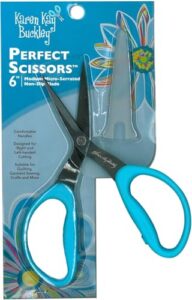
When you’re fussy cutting intricate floral motifs, fabric slippage is your worst enemy. That’s where the Karen Kay Buckley 6 Inch Serrated Scissors earn their spot in your kit. The micro-serrated stainless-steel blades grip fabric fibers as you cut, ensuring delicate edges stay put instead of shifting.
At 6 inches total with roughly 2 inches of blade, they’re compact enough for detailed work yet powerful enough to cut through up to eight cotton layers. This balance of precision and strength makes them ideal for intricate projects.
Soft ergonomic grips keep your hand comfortable through long cutting sessions, reducing fatigue during extended use.
| Best For | Quilters and sewers who work with delicate or layered fabrics and need precise, slip-free cuts on intricate projects like appliqué or fussy cutting. |
|---|---|
| Material | Stainless steel blades |
| Primary Use | Fabric cutting |
| Price | $31.41 |
| Durability Feature | Micro-serrated edges |
| Ergonomic Design | Soft molded handles |
| Heavy Material Limit | Not for leather/canvas |
| Additional Features |
|
- Micro-serrated blades grip fabric as you cut, so nothing shifts mid-snip
- Handles up to 8 layers of cotton, which is a real time-saver for quilting
- Ergonomic grips make long cutting sessions way more comfortable
- At $31.41, you’re paying a premium compared to standard sewing scissors
- The plastic blade cover sometimes doesn’t show up in the box
- Not the right tool for heavy stuff like leather or thick canvas
4. PTFE Teflon Heat Press Transfer Sheet
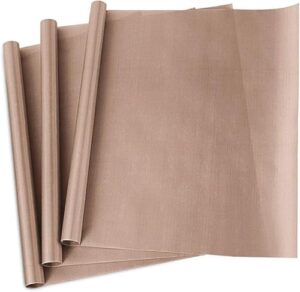
Your iron does the heavy lifting in broderie perse, but without a PTFE Teflon sheet underneath, you risk scorching motifs or leaving adhesive residue on your press plate. This non-stick, heat-resistant sheet acts as a protective barrier between your iron and the fusible web, ensuring delicate chintz pieces fuse cleanly every time.
The 16×20-inch sheets are reusable, easy to wipe clean, and can be trimmed to fit any project. Their durability and versatility make them an essential tool for precise, residue-free applications.
One small sheet, one big difference.
| Best For | Quilters and crafters who use fusible web or heat-transfer techniques and want to protect their iron or press plate from scorching and adhesive buildup. |
|---|---|
| Material | PTFE-coated paper |
| Primary Use | Heat transfer protection |
| Price | $7.89 (3-pack) |
| Durability Feature | Tear-resistant sheets |
| Ergonomic Design | Trimmable to size |
| Heavy Material Limit | Not for abrasive surfaces |
| Additional Features |
|
- Handles heat up to 600°C, so it holds up through even aggressive pressing sessions without breaking down
- Non-stick surface keeps adhesive residue off your press plate and helps motifs fuse cleanly every time
- Reusable and easy to wipe down, which saves money and speeds up projects that need multiple passes
- Thinner than advertised (0.01 cm vs. the claimed 0.03 cm), so long-term durability may not match expectations
- Can absorb moisture over time, which might cause slight warping or uneven heat distribution after heavy use
- Not transparent, so you can’t see through it for precision alignment during placement
Choosing Fabrics and Motifs
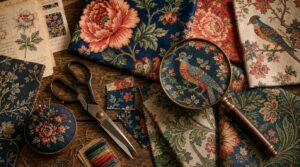
Fabric choice can make or break your broderie perse project before you even pick up your scissors. The right print gives you clean, cuttable motifs that practically beg to be arranged on your background cloth.
Here’s what to look for when you’re shopping.
Cotton Chintz Prints
Cotton chintz is the heart of broderie perse — and for good reason. Originally from India, it was hand-painted with natural dyes using madder and indigo, then finished with a glazed finish that gives it that signature sheen.
Today, modern color palettes and digital printing make finding the perfect chintz easier than ever. Look for quality cotton background fabric with crisp, bold florals and clean color boundaries that hold up beautifully once fused with fusible web.
Clear Repeatable Designs
Repeatable designs are the quiet backbone of beautiful broderie perse. When your appliqué patterns follow documented design rules—fixed motif dimensions, precise color hexes, template grid alignment, and uniform edge stitching—every piece you make holds together visually.
Here’s your quick guide to design arrangement consistency:
- Lock motif sizes so fabric cutting precision stays true
- Define your color palette with exact hex codes
- Use template grid alignment for balanced placement
- Apply uniform edge stitching across every piece
- Document your rules so future projects match effortlessly
Floral Motif Selection
Choosing the right floral motif is where broderie perse truly shines. Prioritize scale proportions—focal blooms work best at 2–4 inches for smaller projects. Bloom variety also matters: blend roses for romance with bold poppies for contrast. Finally, color harmony unifies the design.
| Design Factor | Practical Tip |
|---|---|
| Motif Clustering | Layer larger blooms forward, smaller ones behind |
| Background Compatibility | Match motif weight to fabric weave for clean edges |
Prewashing and Pressing
Before you fuse a single motif, prewash all fabric — sizing removal and shrinkage control matter more than most beginners expect. Conduct a quick color bleed test on reds and saturated prints first.
- Dry flat for proper post-wash handling
- Press background fabric smooth with dry iron technique
- Inspect for residual stiffness before fusible web application begins
Clean fabric means clean results.
Step-By-Step Appliqué Tutorial
Now that you’ve picked your fabric and chosen your motifs, it’s time to actually make something. The process breaks down into five clear steps, and each one builds on the last. Here’s exactly what to do.
Apply Fusible Web

Start by pressing your fusible web — HeatnBond Lite and MistyFuse onto the wrong side of your motif fabric. Use medium-low heat to prevent scorching, and leave the paper carrier on until positioning. Always perform a quick bond test on a scrap first.
For multi-layer fusion in broderie perse, apply lighter pieces before heavier ones to ensure proper adhesion.
Fussy Cut Motifs
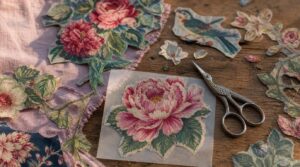
With your fusible web pressed on, it’s time for the satisfying part — fussy cutting your motifs. Use sharp micro-tip scissors to cut them out cleanly, leaving a narrow ¼-inch margin.
Color contrast planning is crucial here: pick motifs where the printed edge reads clearly against your background. This ensures crisp visibility during application.
These motif preservation techniques keep every petal and stem intact, guaranteeing crisp broderie perse appliqué results.
Arrange The Layout
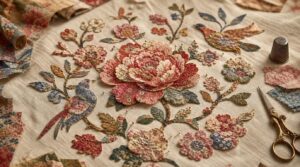
Now comes the part where your appliqué design really takes shape. Lay your cut motifs face-up on the background fabric and experiment with the arrangement before committing to anything.
Think about hierarchical flow — place your largest motif at the center, then work outward. This creates a natural focal point and visual rhythm.
Use grid alignment and consistent motif spacing to balance negative space, ensuring harmony in the composition. Pin them in place once the visual balance feels right, securing your design for the next steps.
Fuse With Dry Iron
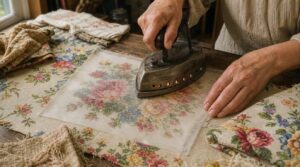
Once your motifs are pinned and positioned, it is time to bond them permanently. Set your hot dry iron to a medium-heat, no-steam setting—always test it on a swatch first. Lay a PTFE pressing barrier over the design.
Then, apply even pressure in short intervals. This fusible web technique seals each broderie perse motif cleanly. Allow a brief cooling interval before moving on.
Stitch Around Edges
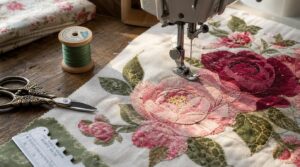
Thread your machine with a matching color and set your stitch length to around 1.5–2.0 mm. Attach your Edge Stitch Foot or Walking Foot for steady, even movement.
Check your Thread Tension on a scrap first.
Use Backstitch Anchors at the start and end for a clean, secure Invisible Edge Finish.
Broderie Perse Stitching Techniques
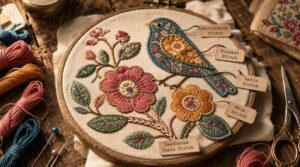
Now that your motifs are fused in place, the real magic happens at the stitching stage.
The stitch you choose shapes everything — from how polished the edges look to how long the piece holds up over time.
Here are five techniques worth knowing, each with its own strengths.
Narrow Zigzag Stitch
The narrow zigzag stitch is your quiet workhorse in broderie perse. Set your stitch width between 0.5 and 2.5 mm for clean edge control — that’s your stitch width optimization sweet spot. Keep thread tension control low to avoid roping.
Use a walking foot on slippery backgrounds to ensure smooth fabric handling.
Always pair fusible web motifs with a tearaway stabilizer before machine stitching to maintain stability and precision.
Tiny Blanket Stitch
Think of the tiny blanket stitch as broderie perse’s quiet finishing touch. It provides edge reinforcement without overwhelming delicate floral motifs. Use 70–100 weight thread for precise loop spacing and maintain consistent stitch tension throughout.
- Set stitch length to 1–2 mm
- Maintain even loop spacing along curves
- Use a fine needle for clean hand stitching
- A raised edge adds subtle definition
Satin Stitch Edges
Satin stitch edges give your broderie perse motifs a polished, almost jeweled border. Dense, parallel stitches create that smooth raised line with real presence. Choose high-sheen thread to boost the effect, and match your needle size to your fabric weight.
| Element | Recommendation | Why It Matters |
|---|---|---|
| Thread sheen selection | Rayon or silk thread | Boosts lustrous edge quality |
| Needle size | Fine sharp or microtex | Ensures precise stitch placement |
| Edge tension control | Balanced, even pressure | Prevents puckering along curves |
Always use stabilizer application beneath the background, control edge tension carefully, and skip finishing knots on visible edges.
Needle-turn Appliqué
If needle-turn appliqué is its quiet, handcrafted opposite, satin stitch feels bold and graphic. This technique skips fusible web entirely — no raw edge appliqué vs. needle-turn debate here, just your needle doing the work.
Use template guidance from freezer paper, focus on seam allowance trimming at curves, and choose thread blending carefully.
Fabric pre-washing and edge alignment keep every broderie perse motif crisp and flat.
Decorative Machine Stitches
Chain stitch traces motif edges with linked loops that echo hand embroidery. A spiky hybrid pairs satin stitch bursts with a zig zag stitch for texture. Try an overlock edge or laser stitch for bold borders.
Metallic thread elevates machine appliqué into something that genuinely catches the light.
Frequently Asked Questions (FAQs)
What is the Broderie Perse technique?
Broderie perse is a fabric appliqué technique where motifs are cut from printed cloth and stitched onto a background fabric.
This art form is rooted in textile art history and Silk Road influence dating back centuries.
What are the basic appliqué techniques?
There are a few core methods worth knowing.
You can use fusible web for quick results.
Try needle turn appliqué for clean edges.
Explore raw-edge appliqué for a relaxed, textured finish.
What are the three types of appliqué?
Three edge styles define appliqué: raw edge texture leaves fabric unfinished for a relaxed look, turned edge seam creates a smooth finish, and needle-turn detail produces hand-stitched precision.
How did trade routes influence broderie perse origins?
Trade routes carried more than goods — they carried ideas.
Through Maritime Silk Pathways and Port City Exchanges, Eastern textile imports landed in European hands, and Price-Driven Motif Adoption quietly gave birth to broderie perse.
Which stabilizers work best for machine appliqué projects?
For machine appliqué, tear away stabilizer is your go-to — it helps stitching cleanly, then peels away without bulk. On knits, reach for cutaway stabilizer instead.
Can broderie perse motifs be applied to clothing?
Yes, broderie perse motifs work beautifully on clothing. Apply them as yoke embellishments, sleeve accents, or back panel patches — just match fabric drape and use fusible web for laundry durability.
How do you layer motifs for a collage effect?
Start with your largest motifs and work forward in scale.
Group pieces by color palette, ensuring harmonious visual cohesion.
Use value contrast to suggest depth and dimensionality within the composition.
Leave negative space to allow each motif to breathe naturally within the fabric collage.
Conclusion
Every motif you cut and stitch is a small act of preservation—keeping alive a craft that survived centuries because someone refused to let beauty go to waste. Broderie perse appliqué techniques give you that same connection to history, to fabric, and to your own growing skill.
Start with one well-chosen floral, take your time at the edges, and trust the process. The finished piece won’t just look handmade. It’ll feel worth saving.
- https://createwhimsy.com/projects/broderie-perse
- https://sherriquiltsalot.com/2023/01/18/broderie-perse-the-applique-of-wealth-loop-holes-and-subterfuge
- https://www.textilemonth.nyc/nytm-exhibitions-2024
- https://sewguide.com/broderie-perse-applique-technique
- http://www.metmuseum.org/art/collection/search/451186