This site is supported by our readers. We may earn a commission, at no cost to you, if you purchase through links.
Your table is either your best tool or your biggest obstacle—professional seamstresses know this the moment they try squeezing a complex bridal train across a surface that’s two feet too narrow.
The right sewing machine table does more than hold your machine; it shapes your posture, your precision, and how long you can work before your shoulders start staging a protest. Weight capacity, vibration dampening, storage within arm’s reach—these aren’t luxury specs, they’re the difference between a workspace that fights you and one that disappears beneath your hands.
Whether you’re eyeing a cabinet with a hydraulic lift or a heavy-duty fixed table that won’t budge under an industrial machine, these ten options cover every serious setup.
Table Of Contents
- Key Takeaways
- Top 10 Sewing Machine Tables
- 1. Diagonal Seam Tape Quilting
- 2. Vividwood Large Sewing Machine Table
- 3. Magshion 60in Sewing Table with Drawers
- 4. Sew Ready Folding Multipurpose Sewing Table
- 5. Giantex Foldable Sewing Table With Power
- 6. VEVOR Foldable Sewing Table
- 7. Kangaroo Joey Dual Rail Sewing Cabinet
- 8. Arrow Aussie Kangaroo Sewing Cabinet
- 9. Sauder Vintage Oak Sewing Craft Cart
- 10. Kangaroo Bandicoot Sewing Cabinet
- Professional Table Buying Criteria
- Ergonomics for Seamstresses
- Storage and Workspace Features
- Compatibility, Pricing, and Support
- Frequently Asked Questions (FAQs)
- Conclusion
Key Takeaways
- Your table’s work surface, weight capacity, and vibration dampening aren’t optional extras — they’re what separate a workspace that flows from one that fights you every step of the way.
- From a $200 folding table to a $2,199 hydraulic cabinet, the right pick comes down to your machine’s weight, your project size, and how many hours you’re actually sitting there.
- Ergonomics aren’t just comfort — adjustable height, proper foot pedal angle, and forearm support directly affect your stitch quality and how long you can work before your body starts pushing back.
- Built-in storage like drawers, spool pegs, and fold-out leaves aren’t conveniences — they’re what keep your focus on the seam and your hands moving, not the search.
Top 10 Sewing Machine Tables
Your table is the foundation of everything you sew — get it wrong, and every project feels like a fight. These 10 options cover the full range, from foldable budget picks to professional-grade cabinets built for serious output. Find the one that matches how you actually work.
Pair your table with the right seat by checking out this guide to finding the best sewing chair for your body and workspace—comfort from both angles makes a real difference.
1. Diagonal Seam Tape Quilting
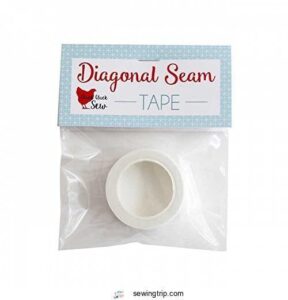
Diagonal seam tape is a revelation for quilters. Stick it to your machine bed, and it gives you a clear diagonal guide — no marking, no measuring.
The Cluck Cluck Sew CCS192 uses a washi‑style format with a printed red stitching line and 1/4″ seam‑allowance guides.
It removes cleanly, leaves no residue, and fits right in front of the feed dogs.
Perfect for half‑square triangles and chain‑piecing — fast, accurate, repeatable.
| Best For | Quilters of any skill level who want to skip the hassle of marking diagonal lines and sew faster, more accurate half-square triangles and chain-pieced blocks. |
|---|---|
| Material | Washi paper |
| Weight | Not listed |
| Storage | None |
| Color/Finish | Black and blue print |
| Assembly Required | No |
| Multi-Purpose Use | Sewing guidance only |
| Additional Features |
|
- No more drawing lines on fabric — just stick the tape and sew
- Consistent 1/4″ seam allowance built right in, so your accuracy stays on point
- Residue-free and easy to remove, so your machine bed stays clean
- The tape can start to curl with extended use, so you may need to flatten it down every now and then
- Guide lines can be hard to spot through thicker or multiple fabric layers
- Oily hands can mess with the adhesive, so you’ll want to handle it carefully
2. Vividwood Large Sewing Machine Table
The Vividwood Large Sewing Machine Table keeps things practical. You get a 45.5" × 23.5" work surface — enough room for your machine, fabric, and tools without crowding. The adjustable machine platform fits different base heights, so you’re not locked into one setup.
Steel legs with four floor levelers handle uneven floors cleanly. The fold-away side shelf adds 9.5" when you need it. Assembly runs 40–60 minutes. Best for light to mid-weight machines.
| Best For | Home sewers, quilters, and crafters who want a roomy, stable workspace for light to mid-weight machines without spending a lot. |
|---|---|
| Material | Engineered wood, steel legs |
| Weight | 43 lb |
| Storage | Lower open shelf |
| Color/Finish | White |
| Assembly Required | Yes, 40–60 min |
| Multi-Purpose Use | Sewing, quilting, laptop stand |
| Additional Features |
|
- Big 45.5" work surface gives you real room to spread out fabric and tools
- Adjustable platform works with different machine heights — doubles as a laptop stand too
- Floor levelers and fold-away shelf make it practical for everyday use
- Noticeable vibration at high speeds, especially with the platform set lower
- Assembly takes 40–60 minutes and the included screwdriver might not cut it
- Lighter steel frame isn’t built for heavy industrial machines
3. Magshion 60in Sewing Table with Drawers
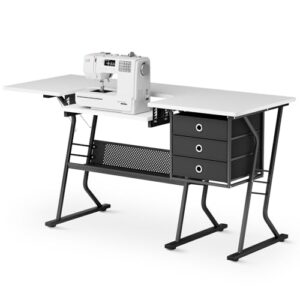
If 60 inches sounds like a lot, wait until you’re spreading out a quilt backing or draping a gown — you’ll use every inch.
The Magshion 60in Sewing Table gives you that real estate, plus three built-in drawers for threads, notions, and tools. The height-adjustable platform fits your machine and your posture. A 305‑lb weight capacity holds serious machines. Six floor levelers keep everything steady, even on uneven floors.
| Best For | Sewers, quilters, and crafters who need serious workspace and want one table that pulls double duty as a home office desk. |
|---|---|
| Material | Engineered wood, steel frame |
| Weight | 45.86 lb |
| Storage | 3 drawers, open grid shelf |
| Color/Finish | Black |
| Assembly Required | Yes, instructions unclear |
| Multi-Purpose Use | Sewing, computer, home office |
| Additional Features |
|
- 60 inches of workspace plus a fold-down side shelf — plenty of room for big projects like quilts or garments
- Height-adjustable platform and six leveling feet make it easy to dial in a comfortable, stable setup
- Three drawers and an open lower shelf keep threads, tools, and supplies close without cluttering the surface
- Assembly instructions can be confusing, especially sorting out the hardware
- At nearly 46 lbs, it’s tough to move or return on your own
- Power cords have to run from the front, so cable management is a bit of a workaround
4. Sew Ready Folding Multipurpose Sewing Table
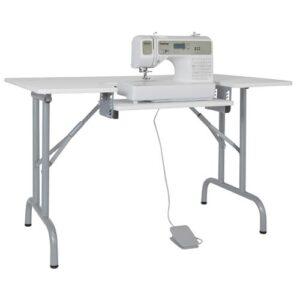
Not every sewing space has room for a 60-inch table. That’s where the Sew Ready Folding Table earns its spot.
It folds flat for closet storage, yet opens to a 47.5-inch work surface — plenty of room for everyday projects. The drop-down shelf adjusts to six height settings, aligning your machine perfectly. Four floor levelers handle uneven floors. At just 20 lb, you can move it anywhere without help.
| Best For | Sewists and crafters with limited space who need a table that can tuck away when not in use. |
|---|---|
| Material | Alloy steel frame |
| Weight | 20 lb |
| Storage | None |
| Color/Finish | White |
| Assembly Required | Yes, instructions confusing |
| Multi-Purpose Use | Sewing, crafting, computer |
| Additional Features |
|
- Folds flat so it fits in a closet, under a bed, or in a small RV with no hassle
- The 47.5-inch surface gives you real working room, not just a cramped little corner
- The drop-down shelf adjusts to six heights, so your machine sits right where you need it
- The legs can wobble if screws aren’t fully tightened — you’ll want to check them regularly
- Assembly can be tricky since the legs aren’t the same length and the instructions aren’t great
- Heavier machines may cause the tabletop to bow a bit, so it’s not built for industrial-weight equipment
5. Giantex Foldable Sewing Table With Power
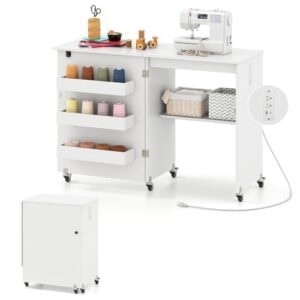
Few tables pull double duty quite like the Giantex Foldable Sewing Table With Power. It expands to 45.5 inches and folds down when you’re done — no wasted floor space.
If you’re still weighing your options, these practical tips for choosing a sewing machine extension table can help you decide whether a foldable setup like this is the right fit for your workspace.
The built-in power strip gives you 2 AC outlets, a USB, and a Type-C port right at your fingertips. No more floor‑level extension cords.
Five casters keep it mobile, with three that lock. Side bins and an open shelf keep threads and tools within reach.
| Best For | Crafters, sewists, and small-space dwellers who need a flexible workstation that can tuck away when the project’s done. |
|---|---|
| Material | Engineered wood |
| Weight | Not listed |
| Storage | 3 side bins, open shelf |
| Color/Finish | White |
| Assembly Required | Yes, 2–3 hours |
| Multi-Purpose Use | Sewing, crafting, light computer |
| Additional Features |
|
- Built-in power strip with AC, USB, and Type-C ports keeps your devices charged without hunting for an outlet
- Folds down significantly to save floor space — great for apartments or studios
- Rolls where you need it and locks in place when you’re ready to work
- Assembly can eat up 2–3 hours, and the illustrated instructions aren’t always easy to follow
- The tabletop can fold unexpectedly if you don’t lock it down properly
- Storage bins are on the smaller side, so bulky fabric rolls or larger tools probably won’t fit
6. VEVOR Foldable Sewing Table
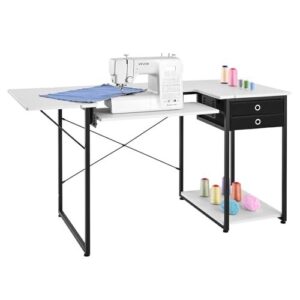
The VEVOR Foldable Sewing Table gives you a serious 47.2 × 23.6-inch work surface — then folds flat into a compact side cabinet when you’re done. Six casters (three locking) keep it mobile without sacrificing stability mid-seam.
Storage is no afterthought: 20 wooden pegs, three-tier bins, and a rear cabinet handle everything from thread spools to fabric bolts. The 88-pound weight capacity supports most home and light professional machines comfortably.
| Best For | Sewers and crafters who need an organized, flexible workstation that can pull double duty as a desk or art table. |
|---|---|
| Material | Engineered MDF, carbon steel |
| Weight | 42.7 lb |
| Storage | 3 drawers, open side shelf |
| Color/Finish | White |
| Assembly Required | Yes |
| Multi-Purpose Use | Sewing, quilting, art studio |
| Additional Features |
|
- The fold-out side shelf is a game-changer for big fabric projects — extra space when you need it, out of the way when you don’t.
- Three drawers plus an open shelf keep your tools, notions, and supplies within arm’s reach and actually organized.
- The adjustable shelf fits different sewing machine bases and works as a laptop or keyboard tray, so it’s not a one-trick pony.
- At about 43 pounds, you’ll probably want a second set of hands if you need to move it.
- MDF doesn’t love moisture, so you’ll need to be careful about spills and wipe-ups.
- The side shelf can wobl shift a bit under uneven loads — it needs something with a little weight to hold it steady.
7. Kangaroo Joey Dual Rail Sewing Cabinet
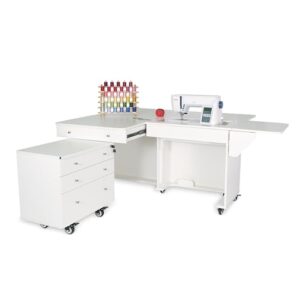
The Kangaroo Joey Dual Rail Sewing Cabinet brings electric lift technology to your sewing room. A programmable dual-rail system adjusts your machine to the perfect height — no manual cranking.
It holds machines up to 65 pounds with minimal wobble. The rear quilt leaf opens your workspace to 40.5 inches deep. Four built-in drawers keep notions close.
At 55 inches wide, it fits most home studios comfortably.
| Best For | Quilters and home sewers who want a dedicated, clutter-free workspace with the convenience of an electric lift for longer sewing sessions. |
|---|---|
| Material | Hardboard (Masonite) |
| Weight | 65 lb |
| Storage | 4 built-in drawers |
| Color/Finish | White Ash (multiple options) |
| Assembly Required | Yes, 10+ hours |
| Multi-Purpose Use | Sewing, quilting, L-shaped workstation |
| Additional Features |
|
- The dual-rail electric lift adjusts your machine height effortlessly — no cranking, no strain.
- The removable quilt leaf opens up a generous 40.5-inch-deep surface, perfect for big fabric projects.
- Four built-in drawers keep your threads, notions, and tools right where you need them.
- Assembly takes 10 hours and really goes smoother with a second set of hands.
- The drawer slides can be stiff out of the box and may need some adjusting.
- The lift mechanism sometimes needs a spring tension check after shipping, which adds a setup hurdle.
8. Arrow Aussie Kangaroo Sewing Cabinet
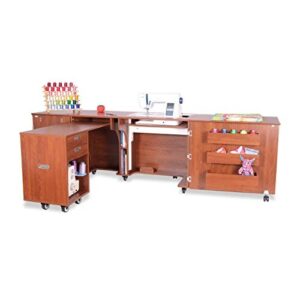
The Arrow Aussie Kangaroo Sewing Cabinet is built for seamstresses who refuse to compromise on space or function.
Its three-position hydraulic lift supports machines up to 55‑lb, switching smoothly between free arm and flat bed modes.
A rear quilt leaf expands your workspace for large projects, while the pull-out caddy keeps your serger within arm’s reach.
Five casters make it easy to reposition.
At $2,199.99, it’s a serious investment — but serious sewers know the difference.
| Best For | Serious sewists who want a dedicated, multi-machine setup that handles everything from quilting to serging in one organized, moveable station. |
|---|---|
| Material | Laminated pressboard |
| Weight | 65 lb |
| Storage | Pull-out caddy, notions storage |
| Color/Finish | Teak laminate |
| Assembly Required | Yes, time-consuming |
| Multi-Purpose Use | Sewing, serger, quilting, laptop |
| Additional Features |
|
- The hydraulic lift smoothly switches between positions and handles machines up to 55 lb — no awkward manual adjusting
- Rear quilt leaf plus the pull-out caddy gives you real room to work, whether you’re cutting big fabric pieces or running a serger side by side
- Five casters make it easy to roll the whole setup wherever you need it
- Assembly can be a real headache — instructions are often unclear, and a video tutorial basically becomes required reading
- Some users have run into misaligned caster holes or a stiff lift platform that needs extra hands or tools to sort out
- It’s particleboard under that laminate finish, so if you’re used to solid wood furniture, it might feel a little less sturdy
9. Sauder Vintage Oak Sewing Craft Cart
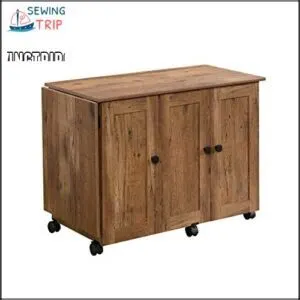
Not every sewing station needs to cost $2,000 to earn its place in your workspace. The Sauder Vintage Oak Sewing Craft Cart brings practical organization at a friendlier price point.
Its drop-leaf surface adds 16 inches of extra room when you need it, and rolls away neatly when you don’t. Behind the roll-open door, you’ll find dedicated machine storage plus two adjustable shelves. Lockable casters keep it steady during use.
| Best For | Sewers and crafters who want a tidy, mobile workspace without spending a fortune. |
|---|---|
| Material | Engineered wood |
| Weight | Not listed |
| Storage | 2 bins, concealed shelf |
| Color/Finish | Vintage Oak |
| Assembly Required | Yes, 2–3 hours |
| Multi-Purpose Use | Sewing, quilting, crafting |
| Additional Features |
|
- The drop-leaf top gives you 16 extra inches when you’re working on big projects — folds away when you’re done.
- Lockable casters mean you can wheel it where you need it and keep it from drifting while you work.
- Built-in storage behind the roll-open door keeps your machine and supplies out of sight but easy to reach.
- The back panel is thin cardboard-style material, so it’s not built to take a beating long-term.
- Casters can still creep on smooth floors even when locked — worth keeping in mind if you have hardwood.
- Assembly can run 2–3 hours and really goes smoother with a second set of hands.
10. Kangaroo Bandicoot Sewing Cabinet
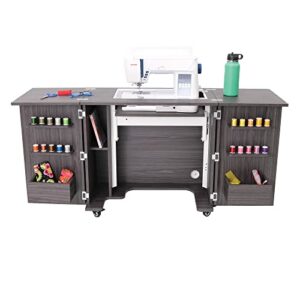
The Bandicoot means business. This cabinet features a 3-position hydraulic lift — free-arm, flat-bed, and storage — so switching between garment sewing and quilting takes seconds.
At $899.99, you get hardwood construction, a lifetime warranty, and heavy-duty locking casters. It holds machines up to 55 lb and stores 20 thread spools behind the doors.
Note: the acrylic insert is sold separately.
| Best For | Serious sewists and quilters who want a dedicated, organized workspace and switch often between project types. |
|---|---|
| Material | Hardwood |
| Weight | 104 lb |
| Storage | Thread holders, dual shelving |
| Color/Finish | Gray |
| Assembly Required | Yes, extensive |
| Multi-Purpose Use | Sewing, quilting, ergonomic studio |
| Additional Features |
|
- The hydraulic lift makes it genuinely easy to go from free-arm sewing to flat-bed quilting in seconds — no lifting, no fussing
- Lifetime warranty and locking casters give you real long-term value, especially if you’re in a shared studio space
- Built-in spool storage for 20 threads plus extra cubbies keeps everything within arm’s reach
- Assembly is a real project — lots of cams and screws, and most people end up watching the video instructions to get through it
- The acrylic insert isn’t included, so factor in that extra cost (or time, if you go the DIY route)
- At this price point, the build quality feels closer to flat-pack furniture than heirloom cabinetry — a few buyers noticed chipped corners right out of the box
Professional Table Buying Criteria
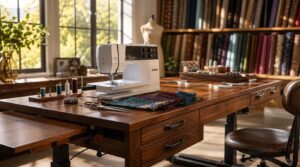
Choosing the right sewing table isn’t just about looks — it’s about how well it holds up when you’re deep in a project. Before you spend a dollar, there are five criteria every professional seamstress should weigh carefully. Here’s what actually matters.
Work Surface Dimensions
Work surface dimensions make or break your workspace. Standard tops run 24 to 36 inches wide. Professional tables stretch to 60 inches.
A Large Table 18 x 24 suits compact studios. Step up to a Big 24 x 24 Table or Giant 24 x 32 Table for quilting.
Depth options from 18 to 30 inches handle most machines. Need more room? Expandable surfaces add 12 to 24 inches instantly.
For dual‑monitor setups, aim for a desk length of at least 55 inches, matching the recommended dual‑monitor desk size.
Machine Weight Capacity
Size gets the spotlight, but machine weight capacity is what separates a reliable workhorse from a wobbly disappointment. Portable tables handle 40–80 lb.
Industrial and heavy-duty sewing tables support 150–400 lb. Know your machine’s weight before you buy.
Exceed the limit, and you risk voiding your warranty — and your stitches won’t thank you either.
Industrial Leg Stability
Weight capacity tells you what a table can hold — leg design tells you how well it holds it.
A wide leg base design spreads load evenly, preventing tipping under heavy industrial machines.
Adjustable feet compensate for uneven floors, while anti-slip pads grip the surface firmly.
Torsional rigidity keeps the frame locked during high-speed stitching.
That’s industrial leg stability working for you.
Vibration Reduction Features
Leg stability keeps your machine planted — but vibration is a different fight.
Isolation pads beneath the mount cut transmitted vibration by 40 to 60 percent. Magnetic coupled dampers reduce peak amplitude by up to 8 dB. Active control systems hold stitch accuracy within two thousandths of an inch.
Surface layering and leg mounts handle the rest.
Long-term Durability
A heavy duty sewing table isn’t a one-season purchase — it’s a decade-long commitment. High-grade steel frames resist corrosion for 15+ years.
Commercial laminate surfaces shrug off solvents and daily wear.
Reinforced joints with stainless steel fasteners won’t loosen under vibration.
When parts finally do wear, modular replacement keeps you running — no welding, no downtime, spare parts available for five years minimum.
Ergonomics for Seamstresses
Your table setup can make or break a long sewing session — and ergonomics is where comfort meets craft. The right height, pedal position, and surface flow all work together to keep fatigue away and your focus sharp. Here’s what to look for when evaluating the ergonomic strengths of each table on this list.
Ergonomics is where comfort meets craft — the right table setup keeps fatigue away and your focus sharp
Adjustable Table Height
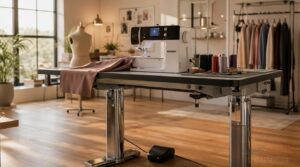
Your table height makes or breaks a long sewing session. Sew Perfect’s height-adjustable steel legs span 27 to 33½ inches — enough range to dial in your exact comfort zone. Here are five adjustable height features that matter most:
- Electric height adjustment runs on 110–240V with safety overload protection
- Hydraulic lift system delivers zero-backlash, precise positioning
- Manual crank control adjusts in 1–2 inch increments
- Memory height presets save two to four custom settings
- Silent servo motors keep noise under 40 decibels
An ergonomic sewing workstation reduces shoulder fatigue fast.
Sit-to-stand Sewing Options
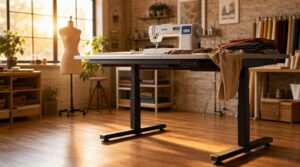
Standing up mid-project changes everything. A sit-to-stand sewing option lets you shift from seated to upright in seconds — no stopping, no stiffness.
Look for a height range of 28 to 45 inches and lift speeds of 1–2 inches per second for smooth transitions.
A wide base footprint with anti-slip feet keeps your ergonomic sewing workstation rock-solid at any height.
Foot Pedal Placement
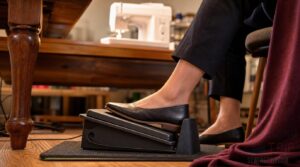
Your foot pedal controls the rhythm of your work — get the placement wrong and you’ll feel it in your ankles fast.
- Pedal tilt angle should sit between 15–20 degrees for natural ankle motion
- A heel rest design keeps your foot positioned for long seams
- Reach distance adjustment targets 16–18 inches from your chair edge
- Footplate height settings shift up to 0.75 inches to match your leg length
- A pedal alignment guide centers your foot and reduces lateral drift
Arm and Shoulder Comfort
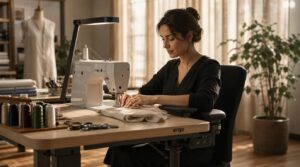
Your shoulders carry more than you think — every seam, every long session adds up.
Forearm Support keeps your arms parallel to the work surface, spreading load evenly. Armrest height set at 90–100 degrees prevents that telltale shoulder shrug. Use an adjustable height workstation to dial in posture alignment fast.
| Problem | Fix |
|---|---|
| Shoulder tension | Lower armrest height |
| Forearm fatigue | Add memory foam padding |
Smooth Fabric Movement
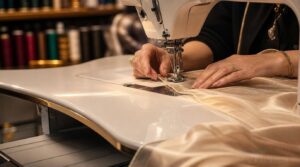
Fabric that snags mid‑seam doesn’t lie — your table surface is working against you. A Teflon coating and fabric glide pads cut friction dramatically.
Surface flatness within 0.5mm prevents dips that catch long seams. Edge bevel design guides cloth smoothly past the needle. Pair that with vibration reduction design and every stitch lands clean.
Storage and Workspace Features
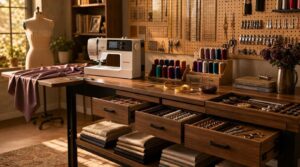
A great sewing table does more than hold your machine — it keeps your whole workflow within arm’s reach. The best ones pack in smart storage and flexible workspace without eating up your room. Here’s what to look for.
Built-in Drawers
Built-in drawers make or break a professional sewing setup. Look for full-extension ball-bearing slides rated 100–180 lbs per pair — they handle heavy fabrics without flinching. Dovetail or mortise-and-tenon joints keep drawer boxes tight over years of daily use.
Good drawers sit 6–12 inches deep, clearing your machine comfortably. Soft-close mechanisms prevent slamming mid-project.
Thread Spool Storage
Once your drawers are sorted, thread storage is next.
Peg style racks hold up to 120 spools across six rows — everything visible, nothing buried. Wall mounted frames free up your table surface entirely. Sliding drawer inserts group by color. Magnetic strip holders keep pins ready. A rotating lazy susan cuts reach distance by 40 percent.
Fold-out Side Leaves
Side leaves flip out in seconds. Deploy one-handed and your workspace grows by up to 24 inches instantly. When you’re done, they fold flush — no wasted floor space.
Locking hinges hold at 90 degrees for stable, snag-free feeding.
Laminate surfaces match your main top and clean easily.
Lubricate the pivot points occasionally, and they’ll stay smooth for years.
Rear Extension Space
Side leaves give you width. But what about depth?
Rear extension space pushes your work surface back toward the wall — adding up to 20 × 48 in of extra real estate. The Rear Extension Kit runs $325 and locks flush with your main top. Every Sew Perfect table accommodates it. More room. Same footprint. Zero compromise.
Cutting and Quilting Area
Quilters know the truth: workspace is everything.
A built-in Self-Healing Mat protects your acrylic work surface while absorbing rotary blade pressure cut after cut. The Rotary Cutter Holder keeps your tool within reach. A Vacuum Dust Port clears scraps instantly. With Locking Casters and an Adjustable Tilt Surface, your expanded quilting area adjusts to every project.
Compatibility, Pricing, and Support
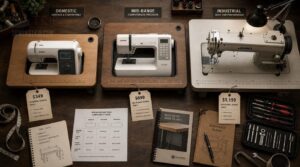
Finding the right table isn’t just about size — it’s about whether it actually works with your machine, your budget, and your long-term needs. From entry-level domestic setups to heavy industrial rigs, compatibility and cost vary more than you’d think. Here’s how the top options stack up across five key factors.
Domestic Machine Fit
Getting the fit right matters more than most sewists realize. Your domestic machine needs a mounting space of 16 to 22 inches wide and a level surface within 1/8 inch. The Sew Perfect Mini Table manages this perfectly. Here’s what to check:
- Machine Width Range matches your model
- Knee Lift Port stays unobstructed
- Cable Management Channel keeps cords clear
Industrial Machine Fit
Industrial machines are a different beast entirely.
Your industrial sewing table must handle machines weighing up to 300 pounds without flinching. Load distribution design spreads that weight evenly, preventing edge sag. Mounting plate standards guarantee a snug, gap-free fit. Quick change system lets you swap machine brands fast. Cable management channels keep power cords and foot pedal wires out of your way.
Extension Kit Compatibility
Kit version matching is non-negotiable. Your Front Extension Kit must align with your specific table model — mismatched versions cause mounting gaps and surface wobble. All Sew Perfect tables accept the 20 in × 24 in Front Extension Kit ($199).
- Adapter requirements vary by rail spacing
- Load distribution plates prevent edge sag
- Quick release clamps enable fast reconfiguration
- Surge protection circuit recommended for high-powered machines
Price Range Comparison
Price tells the whole story before you even sit down. Compact folding tables run $1,200–$2,000. Mid-tier tables with drawers land at $1,900–$3,200. Full cabinets with power reach $3,000–$4,500.
Material matters too — solid hardwoods push past $3,000, while laminated steel frames average $1,800–$2,600. Your budget shapes every other decision.
Warranty and Dealer Support
A solid warranty separates a smart buy from a costly gamble. Look for coverage on materials and workmanship, and always register within the required window — missing that deadline voids your protection.
Dealers handle claims fast, usually within one to three weeks. Keep your receipt.
Extended warranty options exist for heavy industrial use, and parts replacement support runs through the authorized dealer network.
Frequently Asked Questions (FAQs)
Can sewing tables accommodate multiple machine brands?
Yes. Most sewing tables use Universal Mounting Plates and Adjustable Cutout Options to fit Brother, Singer, and Janome. Brand Adapter Kits and a Modular Insert System extend cross brand compatibility further.
Are custom cutouts available for specific machine models?
Custom cutouts are available for specific machine models. Cutout customization fees usually add 10–25% to base price. Cutout lead times run 7–21 days. Sew Perfect adds a stitch regulator cutout for $
How do anti-vibration features improve stitch quality?
Anti-vibration features keep your needle path steady. Rubber isolation feet, mass dampers, and vibration absorbing mats absorb machine buzz before it disrupts stitch formation — giving you cleaner, more consistent results at any speed.
What finishes protect table surfaces from wear?
Like armor on a knight, polyurethane coating seals surfaces against spills and daily wear. Epoxy resin adds impact resistance, while varnish blends maintain clarity over time. Both protect reliably.
Conclusion
Your table is the foundation every stitch is built on. The right sewing machine tables for professional seamstresses aren’t just furniture—they’re the silent partners behind every clean seam and spotless finish.
Surface that fits your machine, maintains your posture, and keeps your tools within reach transforms how you work.
Choose wisely, and your workspace stops being something you manage. It becomes something that works with you, hour after hour, project after project.
- https://www.flexispot.com/spine-care-center/benefits-of-adjustable-sewing-tables-for-your-designer-office
- https://www.countrylanefurniture.com/resources/adjusting-sewing-cabinet-lift
- https://www.shopartograph.com/collections/sewing-tables-1
- https://www.shesewingtables.com/products/aussie-sewing-cabinet
- https://www.bsewinn.com/blogs/inspiration/height-adjustable-sewing-table