This site is supported by our readers. We may earn a commission, at no cost to you, if you purchase through links.
Most beginners assume their sewing struggles come from technique—tension too tight, seams that pucker, fabric that shifts at the worst moment. The table rarely gets the blame.
A surface that’s too narrow forces you to wrestle yards of cotton into submission, and one set at the wrong height quietly wrecks your posture long before you notice the neck stiffness.
The right sewing machine table for beginners eliminates those invisible friction points before they become habits.
What follows cuts through the noise on dimensions, stability, storage, and ergonomics so your setup works with you, not against you.
Table Of Contents
- Key Takeaways
- Top 9 Sewing Machine Tables for Beginners
- 1. Pakasept Folding Sewing Table Storage
- 2. Best Choice Folding Sewing Craft Table
- 3. Best Choice Folding Sewing Table
- 4. Sauder Soft White Drop Leaf Sewing Cart
- 5. Magshion 60in Sewing Table with Drawers
- 6. VIVOHOME Folding Sewing Table with Shelves
- 7. Sew Ready Adjustable Folding Craft Table
- 8. VIVOHOME Folding Sewing Craft Table
- 9. Kangaroo Bandicoot Sewing Cabinet
- Beginner Sewing Table Buying Factors
- Best Sewing Table Height
- Compact Tables for Small Spaces
- Storage Features Beginners Need
- DIY Sewing Table Alternatives
- Common Sewing Table Mistakes
- Frequently Asked Questions (FAQs)
- Conclusion
Key Takeaways
- Your table height matters more than you think — sitting 2–3 inches below your elbow keeps your shoulders relaxed, your wrists neutral, and your seams accurate through a long session.
- Stability isn’t just about weight capacity; cross-bracing, leveling feet, and anti-vibration pads are what actually stop a sewing machine’s rhythmic motion from throwing your stitches off course.
- Compact spaces don’t have to mean cramped setups — drop-leaf carts, folding craft tables, and IKEA hacks can give you a full working surface that disappears when the project’s done.
- Built-in storage for thread, notions, and cutting tools isn’t a luxury; it’s what keeps you sewing instead of searching, and the right table puts everything within a comfortable arm’s reach.
Top 9 Sewing Machine Tables for Beginners
Finding the right sewing table as a beginner doesn’t have to feel overwhelming. These nine options cover a range of budgets, space constraints, and storage needs — so there’s a strong fit no matter where you’re starting from. Here’s what made the cut.
Before diving into the list, it helps to think through your setup — this guide on choosing and making a sewing table covers exactly what to look for.
1. Pakasept Folding Sewing Table Storage
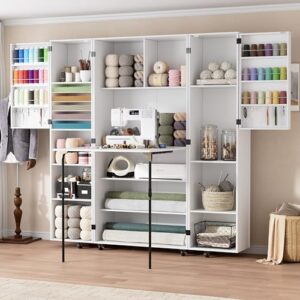
The Pakasept Folding Sewing Table is one of the more adaptable entries in this category, functioning as a compact cabinet when closed — folded dimensions hit 35.4 × 28.3 × 78.7 inches — then unfolding into a full work surface across three modes.
Eight lockable caster wheels keep it steady during use and mobile when you need to reclaim floor space.
MDF construction with a white finish looks tidy, though it won’t handle very heavy equipment or moisture well.
| Best For | Crafters and sewists who want to save space without sacrificing a real work surface — especially in small rooms that pull double duty. |
|---|---|
| Material | MDF |
| Mobility | 8 lockable casters |
| Storage | Hidden compartments |
| Folding Design | 3 unfolding modes |
| Assembly Required | Yes |
| Multi-purpose Use | Craft, display, side table |
| Additional Features |
|
- Folds into a clean, compact cabinet so it doesn’t eat up your room when you’re not crafting
- Three unfolding modes give you flexibility depending on the project
- Eight lockable casters make it easy to move around or tuck away without a hassle
- MDF isn’t great with moisture or heavy gear, so it’s not ideal for bulkier equipment
- Assembly takes time and effort, even with hardware included
- Storage and surface space max out at the unit’s dimensions, so big projects might feel cramped
2. Best Choice Folding Sewing Craft Table
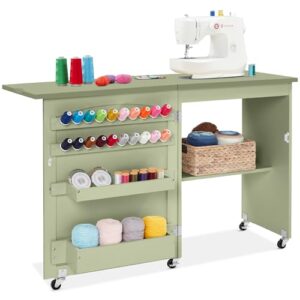
Where the Pakasept leans into cabinet-style storage, the Best Choice Folding Sewing Craft Table takes a leaner approach — prioritizing surface and mobility over enclosed compartments. At $98.99, it opens to 46 × 14.75 × 30.5 inches, giving you a usable work surface without overwhelming a small room. Lockable casters let you roll it aside when you’re done.
The MDF frame feels sturdy enough for lightweight machines, though heavy equipment may cause noticeable flex along the unsupported open edge.
| Best For | Crafters and sewists in small apartments or shared spaces who need a flexible, mobile work surface that tucks away when not in use. |
|---|---|
| Material | MDF |
| Mobility | Lockable casters |
| Storage | Pegs, trays, shelf |
| Folding Design | Fold-down tabletop |
| Assembly Required | Yes |
| Multi-purpose Use | Sewing, craft, desk |
| Additional Features |
|
- Folds down to roughly half its size, so it slips into tight corners or closets without a fuss
- Lockable wheels make it easy to roll between rooms and stay put when you’re actually working
- Built-in pegs, trays, and a shelf keep your tools within reach without needing a separate organizer
- Assembly can take 2–3 hours and often requires a drill, misaligned holes, and an extra set of hands
- The tabletop is only supported on one edge when open, so heavier machines can cause noticeable wobble
- MDF veneer is prone to chipping if you overtighten screws, and the finish may look grayer in person than it does in photos
3. Best Choice Folding Sewing Table
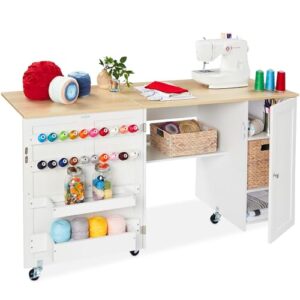
If the previous model felt a bit compact, the Best Choice Folding Sewing Table scales things up considerably. Unfolded, it stretches to 62 × 19 × 31.25 inches — enough room for your machine, a cutting mat, and your current project all at once.
Two pegboard rows, attached storage trays, and a three‑section adjustable cabinet keep notions within arm’s reach.
At 70 pounds with 330 lb capacity, it’s built to hold without wobbling, and lockable casters make repositioning smooth.
| Best For | Sewists and crafters who need a full workspace but don’t have a dedicated room for it — especially anyone working in a small apartment or shared space. |
|---|---|
| Material | MDF |
| Mobility | Lockable casters |
| Storage | Pegboard, trays, shelves |
| Folding Design | Folds to side table |
| Assembly Required | Yes |
| Multi-purpose Use | Sewing, computer, hobby |
| Additional Features |
|
- Tons of storage built right in — pegboards, trays, and an adjustable cabinet keep everything you need close at hand.
- Lockable casters make it easy to roll out when you’re working and tuck away when you’re done.
- Doubles as a side table or hobby desk, so it earns its floor space even on off days.
- Assembly takes a few hours and really goes smoother with a second person helping.
- The table height is fixed, so if your sewing machine sits awkwardly, you may need to improvise a riser.
- MDF construction means it’s functional but not the most rugged — the paint can chip and it won’t feel as solid as real wood.
4. Sauder Soft White Drop Leaf Sewing Cart
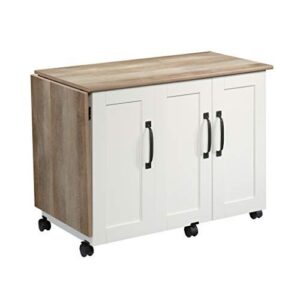
Not every sewing space has room for a 62-inch spread. The Sauder Soft White Drop Leaf Sewing Cart is built for exactly that reality — a compact 19.5″ × 38.5″ footprint that expands when you need it and tucks away when you don’t. At 28.5 inches tall, it hits the ergonomic sweet spot for most seated sewers.
Two storage bins, adjustable shelves, and four rolling casters (two lockable) keep your setup organized and moveable without sacrificing stability.
| Best For | Sewers, quilters, and crafters working in small spaces who need a tidy, portable setup that can expand for bigger projects and close back up when done. |
|---|---|
| Material | Engineered wood |
| Mobility | 4 casters (2 lockable) |
| Storage | Bins and shelves |
| Folding Design | Drop-leaf extension |
| Assembly Required | Yes |
| Multi-purpose Use | Sewing, quilting, homework |
| Additional Features |
|
- The drop-leaf design adds about 16 inches of extra workspace when you need it — handy for larger projects without permanently hogging floor space.
- Four rolling casters make it easy to chase the best light or just get it out of the way; the two lockable wheels keep it steady once you’re set up.
- Built-in bins, adjustable shelves, and a hidden shelf for your sewing machine mean everything has a home and stays off your work surface.
- Engineered wood and a cardboard back panel keep costs down, but don’t expect it to feel as solid as something built from hardwood.
- Assembly can run 2–3 hours and a few reviewers had trouble lining up the doors and safety pin — worth roping in a second pair of hands.
- Storage is practical for everyday use but won’t cut it if you’re hauling around a serious stash of fabric and notions.
5. Magshion 60in Sewing Table with Drawers
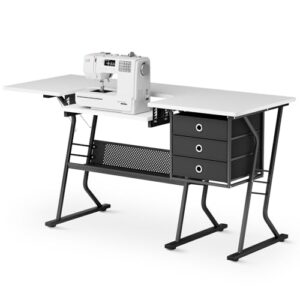
The Magshion 60-inch Sewing Table gives you room to actually work — a full 60 × 23.5‑inch surface that accommodates machine sewing, pattern layout, and pressing without cramping your style.
Three drawers, a lower open shelf, and a 9.5‑inch fold‑down side shelf keep notions close and clutter controlled.
The height‑adjustable platform lets you dial in ergonomic alignment, while six floor levelers and a 305 lb weight capacity keep everything rock‑solid, even mid‑project.
| Best For | Sewists, quilters, and crafters who need a spacious, organized workstation that can double as a home office desk. |
|---|---|
| Material | Engineered wood |
| Mobility | 6 floor levelers |
| Storage | 3 drawers, open shelf |
| Folding Design | 9.5-in fold-down shelf |
| Assembly Required | Yes |
| Multi-purpose Use | Sewing, computer, office |
| Additional Features |
|
- The 60-inch surface gives you real room to spread out — great for pattern layouts, machine sewing, and pressing all in one spot.
- Three drawers plus an open shelf keep your threads, tools, and supplies within arm’s reach without taking over your table.
- Six adjustable floor levelers and a 305 lb weight capacity mean even your heaviest machine sits steady without any wobble.
- Assembly instructions can be confusing, especially when it comes to sorting out which screws go where.
- At nearly 46 lbs, moving or returning it solo is a real workout — plan ahead if you think placement might change.
- Power cords have to run from the front, so cable management isn’t exactly clean if that kind of thing bothers you.
6. VIVOHOME Folding Sewing Table with Shelves
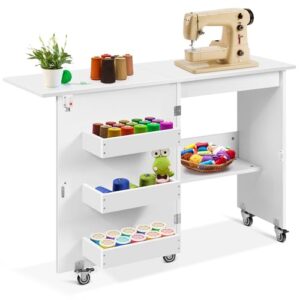
Few sewing tables pack this much function into such a compact footprint. The VIVOHOME Folding Sewing Table opens to a 46 × 16‑inch work surface and folds down to half that width — a genuine space‑saver for studio apartments or multi‑purpose rooms.
Pair it with a compact organizer like those in these thread storage solutions for sewing spaces to keep spools tidy without eating into your folded footprint.
Three hidden bins and an interior shelf keep threads and notions organized, while five casters, two of which lock, let you reposition the whole setup without disassembly.
At 31 inches tall, it sits at a workable height for most beginners.
| Best For | Beginners and hobbyists who need a full-size sewing station but are short on space. |
|---|---|
| Material | Particle board |
| Mobility | 5 casters (2 lockable) |
| Storage | 3 bins, interior shelf |
| Folding Design | Folds to 23 in |
| Assembly Required | Yes |
| Multi-purpose Use | Sewing, desk, dining |
| Additional Features |
|
- Folds down to half its width, so it tucks away easily in small apartments or shared rooms.
- Five casters (two lockable) make it easy to roll around without taking anything apart.
- Three hidden bins and a shelf keep your threads, needles, and notions right where you need them.
- Assembly takes a while — expect 2 to 3 hours, and some panels may need extra drilling.
- The interior shelf and door bins can get in the way of larger sewing machines.
- Mixed brass and chrome hardware looks a little inconsistent, and hinge alignment issues have been reported.
7. Sew Ready Adjustable Folding Craft Table
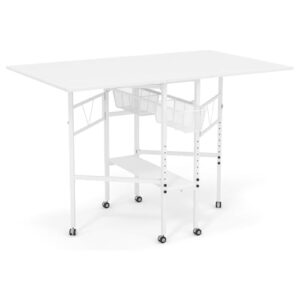
The Sew Ready Adjustable Folding Craft Table is built for sewists who want more room to breathe. When fully extended, it stretches to 58.75 × 36.5 inches — enough for cutting, quilting, and machine work side by side.
Height adjusts from 29.75 to 38.75 inches, accommodating both seated and standing sessions. Two slide-out mesh drawers and a bottom shelf keep notions within reach.
The powder-coated steel frame supports heavier machines without flexing, though height adjustments require a screwdriver rather than a quick-release lever.
| Best For | Sewists and crafters who need a flexible, organized workspace that can fold away when not in use. |
|---|---|
| Material | Engineered wood |
| Mobility | 6 casters (4 lockable) |
| Storage | 2 mesh drawers, shelf |
| Folding Design | Folds to 12.25 in |
| Assembly Required | Yes |
| Multi-purpose Use | Sewing, cutting, craft |
| Additional Features |
|
- Tons of room to work — nearly 59 inches wide when fully extended, so cutting and sewing at the same time is no problem.
- Built-in mesh drawers and a bottom shelf keep your tools and supplies close without cluttering the surface.
- Adjustable height means you can sit or stand, which is a real back-saver during long project sessions.
- Changing the height means breaking out a screwdriver — no quick levers here, so mid-project adjustments are a hassle.
- The casters are a weak spot; some users report wobbling or breakage with regular use.
- Heavy to move and tricky to assemble solo — you’ll probably want a second set of hands.
8. VIVOHOME Folding Sewing Craft Table
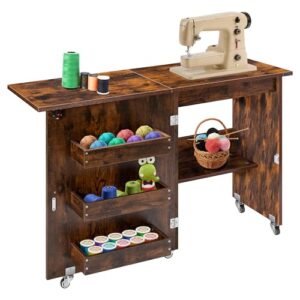
The VIVOHOME Folding Sewing Craft Table is a practical pick if your studio doubles as a living room. It unfolds to 46 × 16 inches of workspace, then collapses to half that footprint for storage.
Three concealed storage bins plus an interior shelf keep threads and notions organized without cluttering your surface.
Five casters — two lockable — let you reposition freely, then hold firm mid‑stitch. Note that larger machines may prevent the cabinet door from closing fully.
| Best For | Crafters and sewists living in small apartments or studios who need a workspace that pulls double duty and tucks away when the day’s done. |
|---|---|
| Material | Particle board |
| Mobility | 5 casters (2 lockable) |
| Storage | 3 bins, interior shelf |
| Folding Design | Folds to 23 in |
| Assembly Required | Yes |
| Multi-purpose Use | Sewing, laptop, dining |
| Additional Features |
|
- Folds down to half its size, so it’s easy to stash in a closet or corner when you’re not using it.
- Built-in bins and a shelf keep your threads, scissors, and notions off the table and within reach.
- Rolling casters make it simple to move around, and the lockable wheels keep it steady while you work.
- Assembly takes a while — expect 2 to 3 hours, and you may need to drill your own pilot holes.
- Larger sewing machines can block the cabinet door from closing all the way.
- Some users have reported quality control hiccups, like mis-drilled panels and confusing hinge instructions.
9. Kangaroo Bandicoot Sewing Cabinet
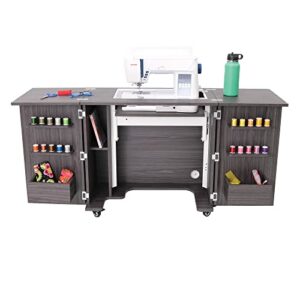
The Kangaroo Bandicoot sits at the premium end of this list, and it earns that position.
At $899.99, you get a 3-position hydraulic lift, a 60.25‑inch hardwood surface, and 20 thread‑spool holders built into the doors.
The lift accommodates machines up to 55 lb, smoothly switching between free‑arm and flat‑bed modes.
Note that the acrylic insert costs extra, and assembly is involved — but the lifetime warranty and locking casters make it a serious long‑term investment.
| Best For | Dedicated sewists and quilters who want a permanent, organized workspace and plan to sew regularly for years to come. |
|---|---|
| Material | Hardwood |
| Mobility | Heavy-duty locking casters |
| Storage | Spool holders, cubbies, shelving |
| Folding Design | 3-position lift |
| Assembly Required | Yes |
| Multi-purpose Use | Sewing, quilting studio |
| Additional Features |
|
- The 3-position hydraulic lift makes switching between free-arm and flat-bed sewing effortless — no lifting or repositioning your machine
- 20 thread-spool holders plus extra cubbies keep everything you need right at your fingertips
- Lifetime warranty and heavy-duty locking casters make it a buy-once, keep-forever kind of cabinet
- Assembly is a real project — lots of cams and screws, and you’ll probably want to pull up a video tutorial
- The acrylic insert isn’t included, so budget extra for that if you want the flush work surface
- Build quality is closer to flat-pack furniture than heirloom hardwood, and a few buyers have noted chipped corners out of the box
Beginner Sewing Table Buying Factors
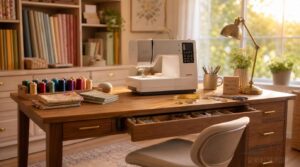
Picking the right sewing table isn’t just about looks — it’s about finding a setup that actually works for how you sew. Before you commit to anything, a few key factors will make or break your decision. Here’s what to weigh as you shop.
Table Size and Workspace
The table’s footprint shapes everything else.
For most setups, 48 to 60 inches wide gives you room for your machine plus accessories without crowding your elbows.
Depth matters just as much — 28 to 36 inches keeps fabric spread comfortably without forcing you to lean. Ensuring you meet the recommended desk depth range reinforces ergonomic comfort.
Going shallower than 24 inches makes fabric handling genuinely awkward.
Machine Weight Capacity
Your machine’s weight matters more than most beginners expect. A standard home sewing machine runs 15–25 pounds, but once you add fabric, notions, and a recessed machine well insert, loads add up fast.
Look for tables rated at 150 pounds minimum — steel-frame designs handle this comfortably, while thin particleboard tops flex under uneven loads and shorten the table’s lifespan considerably.
Stability and Vibration Control
Weight sets the stage, but stability under motion is what actually keeps your work precise. A sewing machine cycles through hundreds of needle strokes per minute, and that rhythmic force travels straight into the table if nothing absorbs it.
Isolation mats beneath the feet, rubber neoprene pads, and viscoelastic dampers all interrupt that transfer — reducing surface vibration noticeably during longer sessions.
Cross bracing and diagonal frame bracing prevent lateral sway, while leveling feet keep the table within a true, even plane so the recessed machine well stays properly aligned throughout.
Foldable Versus Fixed Designs
Once stability is sorted, the next question is whether your table stays put or folds away.
Foldable designs suit beginners with limited space — drop-leaf and fold-down sewing table configurations collapse to a compact profile, freeing your room between sessions.
Fixed tables skip the hinges entirely, offering uninterrupted surface area and a longer service life under consistent daily use.
Storage Needs for Beginners
Storage grows into a real concern the moment you start accumulating fabric scraps, threads, and notions.
A table with integrated storage for thread — such as labeled clear bins — gives you clear bin visibility without unpacking anything.
Fabric scrap cubbies sized around 12×12 inches keep remnants sorted by color, while a drawer divider setup keeps pins, bobbins, and seam rippers from merging into chaos.
Best Sewing Table Height
Getting the height right on your sewing table isn’t a small detail — it’s the difference between a productive session and an aching back by dinnertime. Most beginners don’t realize how much a few inches can affect their posture, wrist comfort, and overall control at the machine. Here’s what you need to know to dial in the right fit.
A few inches of table height can mean the difference between a productive sewing session and an aching back
Seated Elbow Height Rule

The seated elbow height rule is simple: your table should sit 2–3 inches below your elbow when you’re comfortably seated. Measure from your chair to your elbow with your forearm resting naturally — that’s your baseline.
A neutral posture angle of 90–110 degrees between forearm and upper arm keeps fatigue away and protects your shoulders during long sewing sessions.
Comfortable Chair Positioning

Getting your chair right matters just as much as the table itself. An ergonomic sewing chair bolsters your posture from the ground up — literally.
- Seat height places feet flat, knees at 90°
- Arm rest alignment keeps elbows relaxed, forearms parallel
- Backrest support follows your spine’s natural curve
- Lumbar adjustment fits the small of your back
- Foot rest position maintains even weight distribution
Needle Alignment and Posture
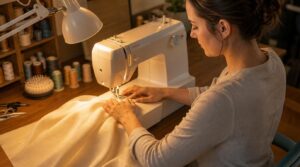
Posture alignment at your sewing station directly affects needle control and stitch accuracy. When your table sits 2–3 inches below your elbow, your forearms stay level, your shoulders stay relaxed, and your hands grip the fabric with steady, confident precision.
A tense grip causes drift. Visual focus on the needle tip — not the presser foot — keeps your trajectory true.
Adjustable-height Table Benefits
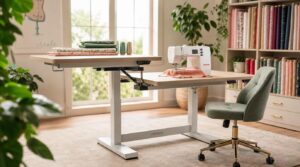
An adjustable height desk changes the game for beginners and seasoned sewists alike. Switching between seated and standing postures throughout a long session keeps your body engaged and your focus sharp.
Flexible height adjustment also means two people sharing the same ergonomic sewing table can each dial in their ideal setting without compromise — no awkward reaching, no compensating posture.
Avoiding Shoulder and Wrist Strain
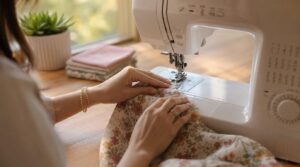
Shoulder and wrist strain don’t announce themselves — they build quietly until a session ends in discomfort. Your ergonomic sewing table and body alignment work together to prevent that.
- Keep elbow height alignment at 2–3 inches above the tabletop
- Maintain neutral wrist position while guiding fabric
- Practice shoulder relaxation techniques — relax away from your ears
- Follow a microbreak stretching routine every 20–30 minutes
Compact Tables for Small Spaces
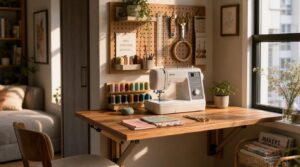
A small sewing space doesn’t have to mean compromises — it just means being smarter about the table you choose. The right compact setup can give you a real working surface without taking over your room. Here are five design features worth knowing before you decide.
Drop-leaf Sewing Carts
A drop-leaf sewing cart might be the smartest small-space investment you’ll make. The leaf design folds flat against the cart when you’re done, then flips out to expand your work surface from roughly 28 to 40 inches — enough room for most projects.
| Feature | Benefit |
|---|---|
| Caster stability | Lock wheels prevent shifting mid-stitch |
| Space efficiency | Folds compact for tight rooms |
Easy assembly means most carts are ready in under an hour.
Folding Craft Table Designs
Folding craft tables take small-space thinking one step further than drop-leaf carts. With fold-out wings extending to roughly 60 inches when open and collapsing to under 12 inches for storage, these designs are genuinely space-smart.
Cross bracing beneath the center panel keeps the surface steady under machine vibration, while non-slip rubber feet handle the rest.
Lockable Caster Wheel Options
Non-slip feet keep a folding table steady, but lockable swivel casters take portability further — wheel your station to better light, then press the foot pedal down to lock it solid.
Look for total lock casters that freeze both roll and swivel, a rubber or polyurethane wheel, and a load rating above 50 kg per caster.
Vertical Pegboard Storage
Once your table is locked in place, look up — your wall is untapped storage. Vertical pegboard panels mount on standard 1-inch-spaced holes, keeping scissors, rulers, and rotary cutters at eye level.
Use zone planning to cluster what you reach for most, and add magnetic strips for metal tools.
A well-arranged pegboard genuinely cuts the time you spend hunting for things mid-project.
Hidden Compartments for Tools
Pegboard covers what’s visible — but hidden compartments take smart organization a step further. A false bottom storage cavity, usually 1–2 inches deep, tucks bobbins and needles out of sight. Magnetic latch systems keep lightweight tools secure yet instantly accessible. Consider these discreet solutions:
- Secret drawers design using flush slides under a false top panel
- A tool roll sleeve mounted behind a slim side panel
- Pegboard integration concealed behind a color-matched door
- Flip-top sections hiding up to 96 thread spools
Storage Features Beginners Need
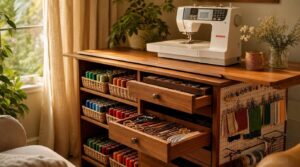
Good storage isn’t a bonus feature — it’s what keeps your sewing space from turning into a tangled mess of thread and forgotten notions. As a beginner, having the right spots for your supplies means less time hunting and more time actually sewing. Here’s what to look for regarding storage that genuinely works.
Thread Spool Organization
Thread spool management quietly determines how fast you move from idea to finished seam. Closed containers and drawers shield spools from dust and sunlight, preserving both color accuracy and fiber strength. Color labels and spool racks let you locate shade families instantly. A dedicated thread storage drawer with separate bobbin storage ideas built in prevents tangles and keeps feeding consistent.
| Storage Method | Key Benefit |
|---|---|
| Closed containers | Blocks dust and UV fading |
| Color-labeled racks | Fast shade identification |
Humidity control — even a few silica gel packets — protects natural fibers from moisture damage. Simple inventory tracking, whether a handwritten card or phone note, cuts duplicate purchases and keeps your sewing accessories organization genuinely useful.
Fabric Cubbies and Shelves
Fabric cubbies bring order to the chaos of a growing stash. Modular cubby systems — usually 12 to 14 inches square per pocket — let you expand storage as your fabric collection grows, adding or removing sections without tools.
Canvas bins handle heavier fabric cuts confidently, while nonwoven polypropylene options resist moisture in less-than-perfect spaces.
Drawer Space for Notions
Notions drawers reward a little planning. Narrow compartments of 1–2 inches in height keep bobbins, needles, and pins sorted and labeled so you’re never digging mid-project.
Clear acrylic front drawers let you spot what you need at a glance, while deep 4-inch drawers handle bulkier items like spool organizers.
Add soft felt lining to protect specialty presser feet from scratches.
Cutting Tool Storage
Sharp tools deserve sharp organization.
A magnetic strip mounted to your table’s side panel keeps rotary cutters and seam rippers visible and within your 30-centimeter reach radius, so you’re not rummaging mid-cut.
Group blades by type in labeled drawer compartments, and tuck a desiccant packet inside to keep steel edges rust‑free in humid workrooms.
Portable Storage Solutions
Not every sewing setup lives in a dedicated room — and that’s perfectly fine.
- Foldable modular designs collapse flat between sessions
- Weather-resistant seals protect notions from humidity
- Integrated power ports keep your machine and lamp charged
A portable sewing station with biometric access control and compact, space-saving cubbies means your tools stay organized, wherever you set up.
DIY Sewing Table Alternatives
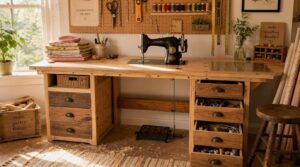
Building your own sewing table is more achievable than it sounds, even if you’ve never picked up a circular saw.
With materials costing as little as $40 and a free weekend afternoon, a DIY build can fit your exact space, height, and storage needs better than most store-bought options.
Here are five approaches worth considering, from basic plywood surfaces to IKEA hacks with real staying power.
Budget Plywood Work Surfaces
Plywood is one of the most practical starting points for a small sewing machine table project. A ¾-inch cabinet-grade plywood sheet gives you dimensional stability and a smooth veneer face — enough to support a machine up to 25 pounds without flex or sag. A standard 4×8 sheet runs $40–$60, keeping your total material cost well under $100.
| Feature | Budget Option | Upgrade Option |
|---|---|---|
| Plywood Thickness | ¾ inch | 1½ inch |
| Surface Finish | Clear varnish | Water-based polyurethane |
| Moisture Resistance | Sealed faces | Exterior-grade plywood |
Two coats of water-based polyurethane deliver a reliable fabric cutting surface — smooth enough that material glides without snagging. Add edge banding or veneer tape along exposed sheet edges to improve durability and prevent moisture intrusion over time.
IKEA-hack Sewing Tables
If plywood gives you the raw bones of a workspace, an IKEA sewing table hack hands you a polished, modular system at a fraction of custom cabinet pricing.
Pairing a Kallax base with a Bekant top creates a wide, stable surface with built-in cubbies — materials usually run $80–$150, and most builds finish in three to five hours.
Fold-down Extension Builds
Where the IKEA hack gives you a modular base, a fold-down extension build gives you flexibility — extra surface area when you need it, compact footprint when you don’t.
A hinged extension can increase your workspace by up to 50% when deployed, then fold flat against the table, reducing width by 6–12 inches.
Beginner-friendly Tool Requirements
Building a fold-down table doesn’t demand a fully equipped workshop.
For most beginner-friendly DIY sewing table plans, a pocket-hole jig, drill/driver, and circular saw handle the bulk of the cuts and joints.
Budget roughly $40–$80 in materials, clear a weekend afternoon, and you’re equipped to build a stable, functional surface without expert woodworking experience.
Basic Finishing for Smooth Fabric
Once the cuts are done and joints are set, the work surface itself needs attention. Two coats of water-based polyurethane reduce fabric drag considerably — fabric glides rather than catches, which matters more than it sounds mid-seam. Sand lightly between coats for the smoothest result.
- Apply polyurethane in thin, even coats
- Sand at 220-grit between layers
- Let each coat cure fully before the next
- Buff the final surface with fine steel wool
Common Sewing Table Mistakes
Even a well-priced table can quietly sabotage your sewing if a few key details get overlooked. Most beginners don’t realize how much height, stability, and surface quality affect both comfort and results. Here are the most common sewing table mistakes — and what to watch for instead.
Choosing The Wrong Height
Height is the most overlooked variable in a beginner’s sewing setup — and the damage it does is slow, quiet, and cumulative.
The ergonomic height rule is straightforward: your tabletop should sit 2–3 inches below your seated elbow, keeping your arms at roughly 90°. Most dining tables land around 31 inches, which pushes your shoulders nearly 10 inches higher than a comfortable sewing position.
| Height Problem | Consequence |
|---|---|
| Table too high | Shoulder and neck tension |
| Table too low | Upper back strain, hunching |
| Needle plate above elbow | Reduced seam precision |
| Wrong chair alignment | Wrist extension, fatigue |
That misalignment doesn’t just hurt — it quietly undermines your control. Needle visibility drops, fabric feeding becomes inconsistent, and seam allowances drift. Your arms compensate with muscle instead of smooth wrist motion, which accelerates fatigue during longer sessions.
Adjustable-height tables, ranging from 28 to 48 inches, solve this without compromise. They let you dial in your exact ergonomic position and adapt as your projects change.
Ignoring Table Wobble
A wobbly table doesn’t just feel unstable — it actively fights your stitching.
- Loose joints or uneven legs shift during needle penetration, pulling seams off-line
- Anti-slip pads and adjustable feet correct floor irregularities without rebuilding anything
- Diagonal cross-bracing eliminates lateral rocking that tightening screws alone can’t fix
Check all fasteners before each session and replace worn levelers promptly.
Buying Too Little Workspace
A table that’s too small doesn’t just feel cramped — it quietly sabotages every project you attempt. Insufficient workspace can increase session time by up to 25 percent, forcing constant stops to reposition fabric. Aim for a minimum 30 × 50 inches, with 60 inches preferred for pattern layouts where errors compound fast.
Overlooking Machine Clearance
Clearance is the invisible margin that separates a frustrating session from a fluid one. Front side clearance of 6–12 inches prevents fabric bunching, while foot pedal space needs at least 8 unobstructed inches. Consider these four zones every beginner overlooks:
- Accessory access zone behind the machine for presser foot swaps
- Wall proximity gap of 6–12 inches for thread reach
- Rounded edge design to protect fabric and wrists
- Recessed machine well for flush, snag-free feeding
Skipping Smooth Surface Finishes
Unfinished wood grabs fabric like velcro.
On DIY sewing table plans, two coats of water-based polyurethane create a hard, clear layer that resists moisture, heat, and everyday wear — without the fumes. For budget-friendly workshop builds, a shellac sealing layer underneath improves adhesion.
A quick wipe with a damp microfiber cloth keeps your stable work surface dust-free and smooth for years.
Frequently Asked Questions (FAQs)
How do I protect my sewing table surface?
Start with a polyurethane topcoat or hard wax oil, then use a self-healing mat daily. A felt underlay absorbs vibration, a spill mat catches drips, and daily dusting keeps the finish lasting longer.
Can I use a dining table for sewing?
Yes, but with trade-offs. A standard dining table sits too high at 31 inches, raising your shoulders and straining your back. Protect the surface, reduce vibration with a non-slip pad, and keep sessions short.
What lighting works best above a sewing table?
Daylight-balanced bulbs rated 5000K–6500K with a CRI above 90 give you the truest read on fabric color and thread tone. Position lights to eliminate operator shadows and reduce eye strain during long sessions.
How often should I clean my sewing workspace?
A tidy workspace is your silent partner. Do a daily fabric wipe, weekly dust removal, and biweekly tool clean. Monthly, check lint buildup and organize supplies. Seasonally, deep clean everything.
Are sewing tables suitable for other craft projects?
Sewing tables work beautifully for other crafts. Their large, smooth surfaces handle cutting mats, scrapbooking layouts, and fabric projects equally well — making them genuinely multipurpose furniture worth the investment.
Conclusion
Funny how a table—something so unglamorous—turns out to be the quiet foundation of every seam you’ll ever sew.
The right sewing machine tables for beginners don’t just hold your machine; they hold your posture, your workflow, and your patience intact through every learning curve ahead.
Get the height, the surface, and the stability right from the start, and the technique problems you’ve been blaming yourself for may simply disappear.
- https://suzyquilts.com/the-best-sewing-cabinet-for-quilting-crafting
- https://seekatesew.com/the-best-sewing-machine-table-sew-station-review
- https://bestcraftorganizer.com/blog/how-to-organize-your-sewing-room-
- https://siemachtsewingblog.com/2016/12/sewing-table-buying-guide
- https://www.nytimes.com/wirecutter/reviews/best-sewing-machine