This site is supported by our readers. We may earn a commission, at no cost to you, if you purchase through links.
A dull blade gets most of the blame when cuts go crooked, but the mat underneath does more work than tailors usually credit it for. Grip, grid accuracy, and surface recovery all shape whether your fabric behaves or fights you. The wrong mat telegraphs every wobble straight into your seam allowance.
Fabric cutting mats for professional tailors range from flimsy craft-store sheets to dense, precision-marked workhorses built for daily garment construction—and the gap between them shows up fast. Knowing exactly what separates one from another saves you from buying twice.
Table Of Contents
- Key Takeaways
- 9 Best Fabric Cutting Mats
- 1. Large Self Healing Rotary Cutting Mat
- 2. Anezus Self Healing Sewing Craft Mat
- 3. Sullivans Large Hobby Grid Cutting Mat
- 4. Newbraug Large Self Healing Cutting Mat
- 5. Dritz Superboard Kraft Pattern Cutting Board
- 6. Honeys Heaven Lavender Rotary Cutter Kit
- 7. Headley Tools Self Healing Cutting Mat
- 8. Headley Tools Rotary Cutter Set
- 9. ArtAt Large Self Healing PVC Cutting Mat
- Choosing The Right Mat Size
- Self-Healing Cutting Mat Features
- Measurement Grids and Cutting Accuracy
- Durability for Professional Tailoring
- Price Versus Professional Value
- Cutting Mat Care and Maintenance
- Frequently Asked Questions (FAQs)
- Conclusion
Key Takeaways
- A 5-ply PVC self-healing mat isn’t just a cutting surface — it’s blade protection, grip, and measurement accuracy all rolled into one tool that quietly shapes every cut you make.
- Mat size should match your actual workload: small 12×18 mats handle detail work fine, but full garment panels and coat pieces demand at least 36×72 inches to avoid repositioning mid-cut.
- Budget mats priced under $15 cost you more over time through faster groove wear, faded grid lines, and quicker blade dulling — mid-range options between $40 and $120 are where professional value actually starts.
- Keeping your mat flat in storage, cleaning lint after every session, and never letting a hot iron touch the surface directly are the three habits that separate a mat that lasts a decade from one that warps in a year.
9 Best Fabric Cutting Mats
Finding the right cutting mat can make or break your workflow at the cutting table. These nine options cover a solid range of sizes, materials, and price points to suit different tailoring needs. Here’s what made the cut.
Each pick was tested against real tailoring demands, so you can dig into the full cutting mats for professional sewists breakdown to see exactly how they compare side by side.
1. Large Self Healing Rotary Cutting Mat
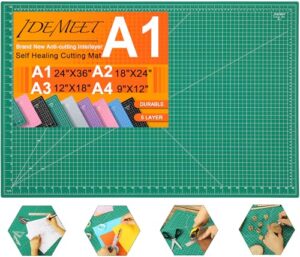
The Large Self-Healing Rotary Cutting Mat measures 24 x 36 inches — that’s A1 size, giving you room to spread a full bolt width without constant repositioning. Its 5-ply, 2600g construction absorbs blade impact while the self-healing surface quietly closes cuts after each pass.
Double-sided grids cover inches, metric measurements, and bias angles at 30°, 45°, and 60°. A non-slip base keeps everything steady, even during aggressive cuts.
| Best For | Quilters, sewers, and hobbyists who need a large, reliable cutting surface for precise, repeat work. |
|---|---|
| Dimensions | 24 x 36 in |
| Material | 5-Ply Density-Upgraded |
| Weight | ~2600g (5.7 lb) |
| Grid Markings | Inches, metric, angles |
| Surface Protection | Desktops and tables |
| Primary Use | Quilting, sewing, modeling |
| Additional Features |
|
- The 5-ply self-healing surface holds up to heavy use and keeps closing cuts so it stays smooth over time.
- Double-sided grids with inches, metric, and bias angles make measuring fast and accurate without extra tools.
- At 24 x 36 inches, there’s enough room to work with full fabric widths or large project layouts without constant adjusting.
- The size is generous, but that also means it can be a pain to store if your workspace is on the smaller side.
- It may be too big for standard drafting or drawing tables, so check your desk dimensions first.
- A handful of users have flagged inconsistencies with color shading or branding, so what you see in photos may vary slightly from what arrives.
2. Anezus Self Healing Sewing Craft Mat
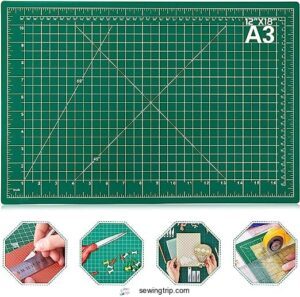
If the 24×36 mat feels like more real estate than you need right now, the Anezus 12×18 inch mat is a smart step down — without the trade-offs you’d expect. At just 200 grams and $8.99, it punches above its price.
The 5-layer PVC construction still self-heals after each cut, and both sides carry imperial and metric grids with angle guides. Compact, affordable, and genuinely capable for scrapbooking, vinyl work, and smaller sewing tasks.
| Best For | Crafters and sewers who need a reliable, compact cutting mat for smaller projects like scrapbooking, vinyl cutting, or light quilting without spending much. |
|---|---|
| Dimensions | 18 x 24 in |
| Material | Plastic |
| Weight | 1.5 lb |
| Grid Markings | Inch, metric, bias lines |
| Surface Protection | Work surfaces |
| Primary Use | Sewing, quilting, scrapbooking |
| Additional Features |
|
- Self-healing 5-layer PVC means it holds up well over time and keeps your cuts clean
- Double-sided grid with both inch and metric markings plus angle guides — handy for precision work
- Super lightweight at 200 grams and easy on the wallet at $8.99
- Not heat resistant, so keep it away from irons or anything warm or it may warp
- The 12×18 size is great for small tasks but will feel cramped if you’re working on bigger projects
- Heavy use can leave light scratches on the grid lines over time
3. Sullivans Large Hobby Grid Cutting Mat
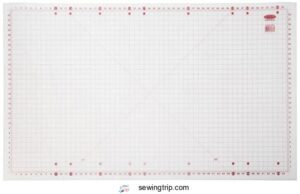
If the Anezus feels a bit small for bigger projects, the Sullivans 59 x 36 inch mat gives you serious room to work. The 33 x 56 inch grid area keeps your cuts accurate without cluttering the surface with markings.
Made from odorless low-density polyethylene, it stays flexible and rolls for storage. Yardage markings on both edges and 45-degree bias guides make long cuts straightforward. It won’t self-heal like PVC mats, but the surface holds up well under regular rotary cutter use.
| Best For | Quilters and crafters who work with large fabric pieces and need a spacious, stable surface for long cuts and heavy rotary cutter use. |
|---|---|
| Dimensions | 17.76 x 11.93 in |
| Material | Polyvinyl Chloride |
| Weight | 200g (0.44 lb) |
| Grid Markings | Inch and metric |
| Surface Protection | Worktables and tools |
| Primary Use | Quilting, sewing, vinyl cutting |
| Additional Features |
|
- Massive 59 x 36 inch surface means less repositioning mid-project
- Odorless, flexible LDPE construction rolls up for easy storage
- Yardage markings and bias guides make long, accurate cuts simple
- Needs time or warmth to lie flat after unrolling
- Surface can score under too much pressure, and it won’t self-heal
- Can be slippery, so a non-slip mat underneath might be necessary
4. Newbraug Large Self Healing Cutting Mat
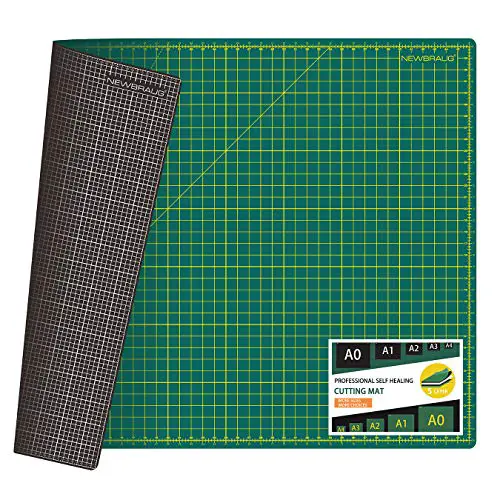
If you need a mat that self-heals reliably, the Newbraug is worth a close look. Its 5-ply PVC construction sits at 3mm thick — firm enough to support heavy fabric stacks, forgiving enough to protect your rotary blades. The dual-sided grid includes both metric and imperial markings, plus 30° and 45° angle guides for clean bias cuts.
The non-slip backing keeps everything steady while you work, and the dye-resistant surface stays clean through long projects.
| Best For | Quilters, sewers, and crafters who need a large, stable cutting surface that handles heavy-duty projects without wearing down blades. |
|---|---|
| Dimensions | 59 x 36 in |
| Material | Low Density Polyethylene |
| Weight | 6 lb |
| Grid Markings | Grid layout, yardage |
| Surface Protection | Pins, scissors, blades |
| Primary Use | Quilting, heavy rotary cutting |
| Additional Features |
|
- Self-healing 5-ply PVC construction protects rotary and straight blades, so they stay sharp longer
- Dual-sided grid with both metric and imperial markings makes measuring and angled cuts much easier
- Big 48 x 36 inch surface gives you plenty of room for large fabric pieces or complex layouts
- At 5.9 kg, it’s heavy enough that repositioning mid-project gets awkward fast
- The large size demands serious storage space — not great for smaller workrooms
- Some users have noted minor sizing inconsistencies, so double-checking measurements is a good habit
5. Dritz Superboard Kraft Pattern Cutting Board
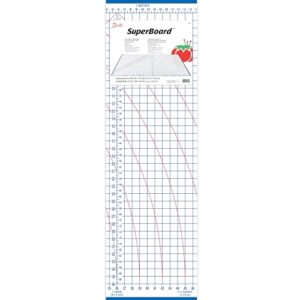
The Dritz Superboard is a different animal altogether — it’s a pattern cutting board, not a rotary mat. Unfolded, it opens to a generous 39¾ x 71¾ inches, giving you a full runway for large pattern layouts. Bias guidelines, scallop traces, and metric grids are all printed on the Kraft board surface.
Just keep your rotary cutter away — this cardboard construction won’t survive it. For pattern tracing and pinning, though, it’s genuinely hard to beat.
| Best For | Sewers and crafters who need a large, portable surface for laying out patterns, tracing, and pinning fabric without sacrificing table space. |
|---|---|
| Dimensions | 48 x 36 in |
| Material | 5-Ply PVC |
| Weight | 5.9 kg (13 lb) |
| Grid Markings | Imperial and metric |
| Surface Protection | Workbenches, desktops |
| Primary Use | Quilting, sewing, model making |
| Additional Features |
|
- Opens up to nearly 40 x 72 inches — plenty of room for full-size pattern layouts
- Printed guides for bias strips, scallops, and metric spacing make precision work a lot easier
- Folds down compact, so it’s easy to store or take to a class
- Cardboard, not plastic — once it bends, it’s bent for good
- Can’t use a rotary cutter on it, so it won’t replace a cutting mat
- Edges can get dinged up in shipping before it even reaches you
6. Honeys Heaven Lavender Rotary Cutter Kit
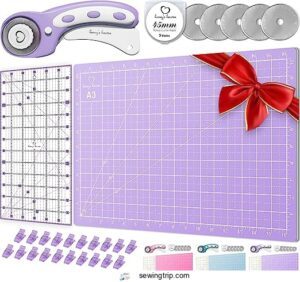
The Honeys Heaven Lavender Rotary Cutter Kit bundles everything you need into one tidy package — a 45 mm SKS-7 steel rotary cutter, an A3 self-healing cutting mat, five spare blades, an acrylic ruler, and craft clips, all for $26.90.
The mat’s double-sided grid means it genuinely serves both left- and right-handed cutters — a small detail worth understanding when you’re shopping for the right cutting mat for your sewing setup.
The ergonomic trigger handle reduces hand fatigue and locks safely when you set it down. It’s a solid starter kit for quilting or patchwork, though very thick materials may slow the blade.
| Best For | Beginner crafters, quilters, and anyone with limited hand strength who wants a safe, easy-to-use cutting kit without breaking the bank. |
|---|---|
| Dimensions | 39.75 x 71.75 in (open) |
| Material | Cardboard |
| Weight | 2.23 lb |
| Grid Markings | Imperial, metric, diagonal |
| Surface Protection | Furniture during projects |
| Primary Use | Pattern layout, fabric pinning |
| Additional Features |
|
- Comes with everything you need out of the box — cutter, mat, five spare blades, ruler, and clips for $26.90
- Ergonomic trigger handle is easy on the hands, especially if you deal with arthritis or fatigue
- Built-in safety lock keeps the blade tucked away when you’re not cutting, great for shared spaces or classrooms
- Struggles with really thick or heavy materials past the six-layer limit — too much pressure and the blade stalls
- The acrylic ruler is smaller than the mat, so you may need a second ruler for bigger projects
- The screw-based blade adjustment can loosen over time and needs the occasional tighten-up
7. Headley Tools Self Healing Cutting Mat
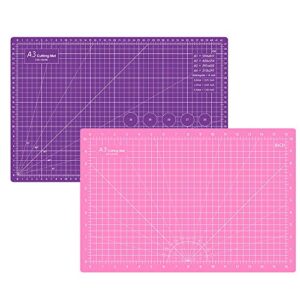
The Headley Tools Self Healing Cutting Mat is a reliable workhorse at a practical size. Its five-layer PVC construction measures 12 by 18 inches and sits 3mm thick, giving you a firm, stable surface that doesn’t buckle mid-cut.
The double-sided imperial and metric grid keeps your measurements consistent, and the non-slip backing holds steady without drifting. Self-healing performance is solid for everyday use, though very sharp blades will eventually leave their mark.
| Best For | Quilters, sewers, and DIY crafters who need a dependable, dual-sided cutting mat that handles rotary cutters and straight blades without slipping around. |
|---|---|
| Dimensions | 18 x 12 in (mat) |
| Material | 5-Ply PVC (mat) |
| Weight | 1.01 kg (2.2 lb) |
| Grid Markings | 16 x 10 in printed grid |
| Surface Protection | Work surfaces (mat) |
| Primary Use | Quilting, patchwork, crafts |
| Additional Features |
|
- Five-layer PVC build feels solid and stays flat — no warping mid-project
- Double-sided grid with both inch and metric scales makes measuring a breeze
- Self-healing surface holds up well for everyday cutting tasks
- Can have a noticeable smell right out of the box that takes a bit to air out
- Firmer feel than traditional soft mats, so it might take some getting used to
- Very sharp blades will eventually leave visible scratches over time
8. Headley Tools Rotary Cutter Set
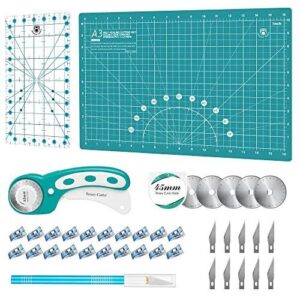
This set is more than just a cutting mat — it’s a complete starter kit for precise fabric work. You get a 45 mm rotary cutter with a double-sided ergonomic handle, a 3 mm self-healing mat, a quilting ruler, 20 sewing clips, and 15 replacement blades, all for $26.90.
The SKS-7 steel blades cut cleanly through cotton, denim, and leather. The safety-button lockout and textured grip make it comfortable for long sessions, left- or right-handed.
| Best For | Quilters, sewists, and crafters of all skill levels who want a ready-to-go cutting setup without buying pieces separately. |
|---|---|
| Dimensions | 17.72 x 11.81 in |
| Material | 5-Ply PVC |
| Weight | 1.4 lb |
| Grid Markings | Inch and metric |
| Surface Protection | Floors, furniture, tables |
| Primary Use | Quilting, sewing, DIY crafts |
| Additional Features |
|
- Comes with everything you need out of the box — cutter, mat, ruler, clips, and 15 replacement blades
- Ergonomic double-sided handle works for both left- and right-handed users and is easy on the hands during long sessions
- SKS-7 steel blades cut cleanly through a wide range of materials, from cotton and fleece to denim and leather
- The cutting mat is on the smaller side, so bigger projects may feel cramped
- Plastic construction means it’s not the best choice for heavy-duty or high-volume cutting over time
- Replacement blades and clips are finite, so frequent crafters will eventually need to restock
9. ArtAt Large Self Healing PVC Cutting Mat
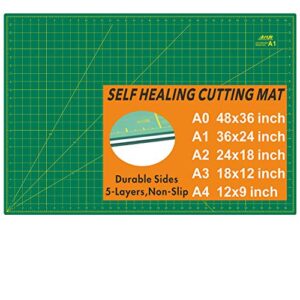
If you need a mat that means business, the ArtAt Large Self Healing PVC Cutting Mat delivers exactly that. It measures 36 x 24 inches with a 3 mm thick, five-layer PVC surface that closes blade marks after every pass.
Double-sided gridlines cover both imperial and metric measurements, and the non-slip backing keeps everything steady while you cut. At 16 ounces, it’s large enough for wide fabric panels without being a burden to move.
| Best For | Quilters, sewers, and crafters who need a large, reliable cutting surface for high-volume or wide-format projects. |
|---|---|
| Dimensions | 10 in (mat) |
| Material | 5-Ply PVC (mat) |
| Weight | 1.13 kg (2.5 lb) |
| Grid Markings | Imperial and metric |
| Surface Protection | Work surfaces (mat) |
| Primary Use | Quilting, sewing, patchwork |
| Additional Features |
|
- Self-healing surface closes up blade marks, so the mat stays smooth and lasts longer
- Double-sided grid with both inch and metric markings plus built-in angle guides makes precise cuts easy
- Non-slip backing keeps it firmly in place while you work
- At 36 x 24 inches, it takes up a good chunk of desk or table space and can be tricky to store
- May arrive with dimples or raised bumps from shipping, which can affect cutting accuracy
- Single thickness option means it won’t suit anyone needing a thicker or thinner surface
Choosing The Right Mat Size
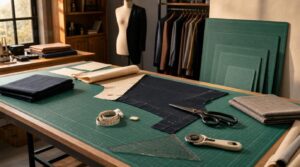
Mat size is the first decision that shapes everything else about your cutting setup. Get it wrong and you’re either cramped or storing something the size of a dining table. Here’s how each size fits into real working conditions.
Small Craft Cutting Mats
Small craft mats, sized around 12" x 9", are your go-to for detail work — think appliqué, paper piecing, or trimming small pattern pieces. They’re light, portable, and easy to tuck into a bag. Additionally, glass media mats provide a durable and precise work surface.
- Compact size fits any corner of a workspace
- Self-healing surface closes blade grooves quickly
- High-contrast markings keep cuts accurate on small pieces
- Budget-friendly designs often run under $15
Medium Sewing Room Mats
When small mats aren’t quite enough, a medium sewing room mat — commonly 24" x 36" — gives you room to lay out a full bodice front and back without repositioning. For a professional tailor, that matters.
Features like a nonslip surface, reinforced edges, and a 5-ply construction keep things steady, while clear grid lines help you cut seam allowances confidently every time.
Large Garment Cutting Mats
Once you move beyond bodice pieces, you’re working with full sleeves, trouser legs, and coat panels — and that’s where a large garment cutting mat earns its place. Sizes like 36" x 72" let you cut long pattern pieces without folding or shifting fabric mid-cut, keeping your cutting precision intact from start to finish.
Extra-large Tailoring Workspaces
For tailors running a full production setup, an 8 by 4 foot cutting mat changes everything. That’s 32 square feet of uninterrupted workspace — enough for full garment panels, long coat pieces, and wide yardage cuts without repositioning fabric.
Here’s what makes an extra-large workspace worth it:
- Two-person cutting workflow lets two operators cut simultaneously in separate zones without interference.
- Integrated edge channels on premium mats keep fabric from sliding off during long cuts.
- Daylight-balanced LED lighting eliminates color distortion and shadows across wide cutting surfaces.
Storage and Table Fit
Once you’ve settled on a size, the next question is whether it actually fits your setup. An edge lip design keeps the mat from sliding, while non-slip pads underneath add up to 40 N of grip on wooden tables.
For tighter spaces, a compact size with a storage sleeve on the back lets you flip or store it flat without hassle.
Self-Healing Cutting Mat Features
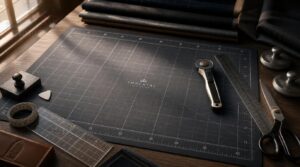
A good self-healing mat does more than survive your rotary cutter — it actually works with you. The right features make every cut cleaner, safer, and more consistent over time. Here’s what to look for.
Multi-layer PVC Construction
Think of a cutting mat as a small sandwich — its strength comes from what’s inside. Five-layer PVC construction stacks a rigid core between softer, flexible facings, giving the mat both firmness and impact absorption.
The core layer design uses closed cell PVC, which resists liquid absorption and keeps edges clean under humid tailoring conditions. Heat fusion bonding joins each layer without adhesives, eliminating peeling gaps. UV inhibitor protection in the facing prevents yellowing from shop lighting, preserving grid visibility through years of heavy use.
This build is where cutting mat durability truly starts.
Surface Recovery Performance
Every cut you make closes itself — that’s the real promise of a self-healing mat.
A self-healing mat silently closes every cut you make, keeping your surface smooth and your work precise
The self-healing surface restores to within 98 percent of its original smoothness in under two minutes. Groove closure happens in 60 seconds or less, and surface flatness retention stays within 0.5 mm after 100 blade passes, keeping your cuts accurate every time.
Rotary Blade Protection
A good mat works quietly in your favor — especially for protecting your rotary blade. Cushioned multi-layer surfaces absorb each pass, reducing wear that dulls edges prematurely. The 5-ply PVC construction softens blade impact without sacrificing stability.
Pair that with a blade guard system and safe two-handed handling, and your blades stay sharper, longer.
Non-slip Cutting Stability
Fabric slipping mid-cut is a small mistake with big consequences. That’s why non-slip cutting stability matters so much.
The micrograin texture on the top surface creates multiple contact points that hold fabric firmly in place. Combined with backing adhesion to your table, the mat stays put. Weight-induced grip from layered fabric adds even more control.
Smooth Fabric Movement
A smooth cut starts before your blade even moves. The Fabric Glide Surface on a quality mat lets fabric shift and reposition without catching or snagging.
- Low Friction Layer keeps lightweight silks and slippery fabrics controlled
- Surface Microtexture prevents fabric lifts during long cutting sessions
- Clean mats reduce lint drag for consistent precision cutting
- Material Compatibility improves across wovens, knits, and coated fabrics
Measurement Grids and Cutting Accuracy
A good mat does more than protect your table — it helps you cut accurately, every single time. The grid system printed on the surface is what separates a precise cut from a wasted piece of fabric. Here’s what to look for when evaluating measurement grids and cutting accuracy.
Imperial and Metric Grids
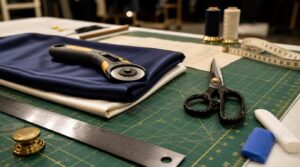
The grid on your mat is basically a built-in ruler you never have to hunt for. Most quality fabric cutting mats feature dual scale markings — imperial on one side, metric on the other — so you’re never fumbling with conversions mid-cut. Imperial grids run in clean 1-inch intervals with every 1/8-inch marked for precision, while metric and imperial grids pair 1-centimeter divisions with 1-millimeter fine lines.
Some mats even include a small conversion chart integration printed right on the surface. Combined with contrast grid lines that resist glare under bright shop lighting, your alignment accuracy stays sharp from the first cut to the last.
Bias Angle Guide Markings
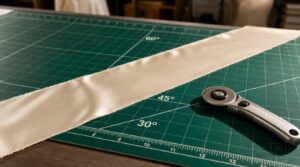
Bias angle guide markings take your accuracy a step further than basic grids. Lines calibrated at 30, 45, and 60 degrees run across the mat surface so you can position fabric for precise bias cuts without guesswork.
High-contrast inks keep them visible under bright studio lighting, and some mats include tactile bias guides — slightly raised lines you can feel as much as see.
Grainline Alignment Marks
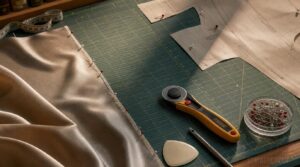
Angle guides handle the diagonal cuts, but grainline alignment marks take care of something just as important — keeping every pattern piece true to the fabric grain. These marks run parallel to the selvage edge, so your pieces drape and hang exactly as intended.
Misaligned grain causes twisted seams and uneven hems, problems no amount of pressing will fix.
High-contrast Grid Visibility
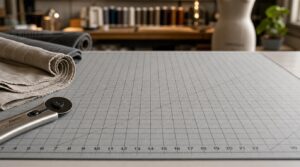
Grainline marks keep your pieces honest, but none of that precision matters if you can’t actually read the grid clearly. That’s where high-contrast grid visibility earns its place.
- Bold border lines create crisp outer boundaries within 1mm precision.
- Color contrast schemes — black on light gray — deliver maximum legibility.
- Anti-glare matte surfaces eliminate reflections under workshop lighting.
- Line weight design uses 2mm major lines for fast, accurate target acquisition.
Precision Seam Allowance Cutting
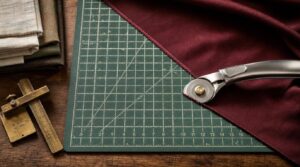
Getting the seam width right starts with your mat’s grid. A self-healing cutting mat with 1/8-inch increments lets you cut consistent seam allowances without guesswork.
For bias cuts, add a little extra — fabric stretches, and that allowance disappears fast. Your rotary cutting line should match your pattern’s marked seam, every single time.
Durability for Professional Tailoring
A mat that falls apart under daily use isn’t just frustrating — it costs you time, blades, and money. Professional tailoring demands a surface that holds up through long hours and heavy fabric. Here’s what to look for when durability is your priority.
Mat Thickness Comparison
Thickness is the quiet backbone of a mat’s durability. A 3mm cushioning mat works fine for light, occasional cutting, but it compresses quickly under heavy use. Step up to 5mm stability, and you get a reliable cutting plane for longer sessions.
Need serious impact absorption? 8mm impact mats protect your table and your blade. For demanding work, 10mm recovery and 12mm durability mats resist deep grooves longest.
Heavy-duty Surface Density
Surface density separates a mat that lasts from one that doesn’t. High-density 2600g PVC, like in five-layer PVC construction, compresses less under repeated blade passes, keeping your grid intact longer.
For professional quilters, a density-upgraded mat means fewer measurement errors and cleaner cuts throughout long sessions — real durability where your work demands it most.
Resistance to Deep Grooves
Deep grooves are a slow drain on precision.
A quality self-healing mat with 5-ply construction distributes blade force across layers, keeping groove depth minimal even after thousands of passes. Elastic surface recovery closes minor cuts within hours, limiting permanent widening to under 0.3 mm.
When grooves do appear, wear depth indicators tell you exactly when it’s time to replace.
Dye and Stain Resistance
Stains on a cutting mat aren’t just ugly — they creep into your grid markings and quietly ruin your accuracy. A non-porous PVC surface with water repellent coating keeps waterborne dyes from soaking in, even after repeated cleaning. Combined with an oil resistant finish, it blocks pigment transfer from fabric dyes and lubricants alike.
Here’s what solid dye resistance actually means in practice:
- Colorfast surface holds grid line contrast after 20-plus cleaning cycles
- UV protection limits hue shift to under 5 delta E units after extended light exposure
- Self-healing PVC closes micro-cuts before dyes can settle into grooves
- Stain removal stays easy — mild soap and warm water do the job without dulling markings
The 5-ply construction and selfhealing properties of quality PVC mats reduce porosity, cutting dye absorption by up to 40 percent. That durability keeps your mat looking sharp and readable for years.
Replacement Wear Indicators
Every mat tells you when it’s done — if you know what to look for.
Color shift markers fade from crisp white to yellow, and grid fade alerts signal fading measurement lines that quietly steal your accuracy.
Watch for layer delamination signs like micro-buckles in the 5-ply construction, and check edge wear indicators before deep grooves start costing you replacement blades.
Price Versus Professional Value
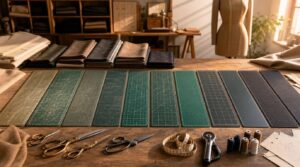
Price matters, but so does what you get for it. The right mat can save you money over time by lasting longer and protecting your blades. Here’s how the options stack up across every budget.
Budget Cutting Mat Limits
Budget mats, usually priced between $5 and $15, seem tempting — but the tradeoffs add up fast.
Thin PVC means slower self-healing, faster groove formation, and faded grid lines that hurt your cutting accuracy. On large cuts especially, worn markings become a real problem.
You often end up replacing them sooner, which quietly erases any savings.
Mid-range Tailoring Options
Mid-range mats, usually priced between $40 and $120, are where most professional tailors land — and for good reason. You get 5-ply construction, reliable self-healing mat performance, and grid lines that stay sharp through daily fabric cutting. Many include a double-sided design with imperial and metric grids, which saves real time.
- Portability considerations: thicknesses around 5mm balance rigidity without excessive weight
- Eco-friendly materials: some brands now offer PVC alternatives with lower chemical content
- Workspace integration tips: neutral color scheme options like gray blend into most studio setups
Use a simple brand comparison guide to check grid contrast, mat dimensions, and warranty length before buying.
Premium Mat Advantages
Premium mats earn their price tag through construction quality alone.
5-ply construction gives you real rigidity — no flex, no curl, no shifting mid-cut. The anti-curl design keeps edges flat across large layouts, while surface resilience means the self-healing mat closes blade paths cleanly.
Add edge protection, wear indicators, and a large size built for precision and durability, and you’re cutting at a professional level.
Long-term Cost Per Use
Think of cost per use as simple math: total price divided by total cuts.
A premium self-healing mat with 5-ply construction can last 5–10 years, spreading that upfront cost thin. Add blade protection that slows dulling, and professional sewists spend less replacing both mat and blades over time.
Durability pays for itself.
Best Value Buying Factors
Value isn’t just about the lowest price tag. The best mats combine 5-ply construction, reliable self-healing recovery, and sharp grid lines that stay legible for years.
That’s where price efficiency meets real-world use. A mat that holds up daily cuts, resists grooves, and protects your blades delivers the strongest budget ROI — long after cheaper options have worn out.
Cutting Mat Care and Maintenance
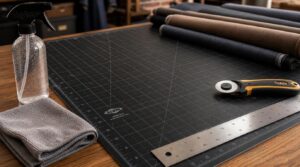
A good mat can last years, but only if you treat it right. How you clean, store, and handle it makes all the difference. Here’s what every serious tailor should know.
Cleaning Lint and Threads
Lint builds up faster than you’d expect on a self-healing cutting mat.
After every session, use the Lint Roller Technique — roll over the surface in overlapping passes. For finer fibers, the Microfiber Wipe Method works well: slightly dampen the cloth and wipe center-outward. Use a soft brush for Brush Groove Cleaning along grid lines, dislodging trapped threads without scratching.
Preventing Heat Damage
Pressing fabric directly on your mat is where heat damage quietly begins.
Most quality self-healing cutting mats use a Heat Resistant Coating that withstands up to 120°C briefly, but repeated contact degrades the surface over time. The 5-ply construction and Protective Backing Layer in PVC-based mats buffer heat from reaching your table, preserving both durability and grid clarity.
| Risk | Prevention |
|---|---|
| Hot iron contact | Use a pressing cloth |
| Heat buildup | Apply Cooling Ventilation Practices |
| Blade warmth | Follow Tool Heat Management |
| Room temperature | Keep 20–24°C |
Temperature Management Tips extend the life of your cutting mats considerably.
Flat Storage Methods
Flat storage is the simplest way to protect your cutting mats long-term. Laying a large self-healing mat flat on low shelving or a rolling cart prevents warping that ruins the 5-ply construction.
Wall mount systems and drawer integration keep double-sided designs accessible without bending. Stackable reserves work well for smaller mats — just interleave protective sheets between them.
Protecting Grid Markings
Grid markings are the backbone of accurate cuts, so protecting them matters more than most tailors realize. A Protective Film Layer shields printed lines during storage, while a Grid Overlay Sleeve keeps accidental blade contact from scoring the surface. High-Contrast Ink on your double-sided design stays legible longer when you store the mat covered.
- Use Non-Slip Backing to keep the mat flat and prevent grid distortion during use
- Clean gently with a soft cloth — harsh scrubbing fades markings faster than blade wear
- Keep Replacement Grid Sheets handy when lines become too worn to trust for precision cuts
Your self-healing mat’s 5-ply construction protects the grid from below, but surface care keeps it accurate above.
Extending Rotary Blade Life
A dull blade doesn’t just struggle — it damages your self-healing mat faster.
Rotate blades on a Blade Rotation Schedule to share wear evenly. Control your Cutting Pressure — light, consistent strokes reduce heat buildup.
Follow a Blade Cleaning Routine, wiping with mineral oil after heavy use. Track blade life with a Blade Life Log to time replacements smartly.
Frequently Asked Questions (FAQs)
Can cutting mats handle heavy industrial shears?
Most cutting mats can handle light fabric shears, but heavy industrial shears demand more. Look for 5-ply construction and reinforced cores — they resist groove formation and hold up under repeated heavy-duty cuts.
Are cutting mats safe for childrens craft projects?
Yes, they can be — if you pick the right one. Look for non-toxic materials, smooth edge design, and odor-free surfaces. Avoid small detachable parts to prevent choking hazard risks.
Do cutting mats work on uneven work surfaces?
A perfectly flat table makes every cut predictable. An uneven one fights you the whole way. Self-healing mats with 5-ply construction can bridge minor dips, but they won’t fix a seriously warped surface.
Which mat colors reduce eye strain during use?
Soft green, blue, gray, beige, and lavender all reduce eye strain. Green and blue lower glare, gray cuts reflections, beige eases long-session fatigue, and lavender soothes eyes during extended precision work.
Can mats be used outdoors for tailoring events?
Yes, mats can work outdoors. Choose one with a non-slip underside, UV-resistant surface, and 5-ply PVC construction. Secure it on flat ground, use a canopy, and pack it up before weather turns.
Conclusion
The right mat holds your fabric steady, honors your measurements, and protects the blade you depend on every shift. Fabric cutting mats for professional tailors aren’t accessories—they’re the silent foundation every precise cut is built on.
A worn, slippery, or poorly marked surface quietly undermines work that deserves better. Choose the thickness that matches your workload, the grid that matches your method, and you’ll notice the difference before the first seam is even pinned.