This site is supported by our readers. We may earn a commission, at no cost to you, if you purchase through links.

Most sewing problems trace back to one small dial nobody explains properly. Thread tension controls everything — stitch quality, seam strength, even how your fabric lies flat afterward.
Get it wrong, and you’ll see loops bunching under the fabric, thread pulling up from the bobbin, or seams that pucker like a wrinkled shirt fresh from the dryer.
Needle and thread tension problems frustrate sewers at every skill level, mostly because the fix isn’t obvious.
Two separate tension systems have to work in sync, and when they don’t, the clues are right there in your stitches — if you know what to look for.
Table Of Contents
Key Takeaways
- Before touching the tension dial, always raise the presser foot and rethread completely — most "tension problems" are actually threading problems in disguise.
- Balanced stitches happen when upper and bobbin threads interlock at the exact center of your fabric, and any shift in either direction shows up immediately as loops, puckering, or pulled seams.
- Always adjust tension one number at a time, test on a same-fabric scrap after each change, and log what works — guessing and jumping settings makes things worse, not better.
- Needle choice, thread weight, and fabric type have to match each other; a mismatch quietly throws off tension even when your dial setting is technically correct.
How Sewing Machine Tension Works
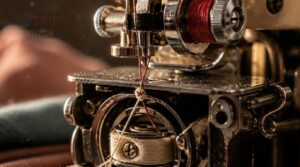
Tension is the invisible handshake between your upper thread and bobbin thread — get it right, and every stitch locks cleanly in place. Most problems trace back to just a handful of moving parts, each playing a specific role. Here’s what’s actually happening inside your machine.
For a deeper look at each component’s role, the ultimate sewing machine tension guide walks you through every adjustment with real troubleshooting examples.
Tension is the invisible handshake between threads — get it right, and every stitch locks perfectly in place
Upper Thread Tension
The upper thread runs through a series of guides and tension discs before reaching the needle. Those discs apply pressure that controls how freely the thread moves.
Your tension dial — usually numbered 0 to 9 — adjusts that pressure. Most fabrics start well at 4 or 5.
Keep your thread path clean and properly seated for consistent results. Always perform test stitches on scrap fabric before final adjustments.
Bobbin Thread Tension
The bobbin thread works from below, and bobbin tension controls how freely it feeds out. A small spring inside the bobbin case applies baseline pressure on the thread.
You can fine‑tune this with the bobbin tension screw — turn it clockwise to tighten, counter‑clockwise to loosen. Always adjust in ¼-turn increments, then test.
Tension Disks and Springs
Those two springs don’t work in isolation. Tension disks sit at the heart of the upper mechanism — paired spring steel plates that grip your thread with controlled axial compression.
Their preload determines grip force, so even small wear changes how tightly they hold. Surface coatings protect against corrosion.
A properly configured disk stack keeps pressure consistent every single stitch.
Balanced Stitch Formation
All that grip and pressure from the tension disks functions one goal: a balanced stitch. This happens when your upper thread and bobbin thread interlock at the exact center of your fabric layers — not at the top, not at the bottom.
Here’s what balance actually looks like:
- Stitch depth centering — the thread interlock point sits mid-fabric, creating no surface bulk.
- Visible stitch alignment — stitches appear even on both sides, with no loops or pulls.
- Seam allowance flatness — fabric layers lie smooth, with no puckering along the edges.
When sewing machine tension is off, that interlock point shifts. Too much upper thread tension drags the stitch upward. Too little bobbin thread tension lets the bobbin thread rise to the surface. Either way, fabric layer interaction suffers — and your seam shows it.
Default Tension Settings
Most machines leave the factory with upper tension pre-set between 4 and 6 — that’s your manufacturer baseline standard. Think of it as a starting point, not a rule. Lightweight fabrics often need a lower setting; thick materials need more. Start at 4, test on scrap, then adjust one number at a time.
Common Needle and Thread Tension Problems
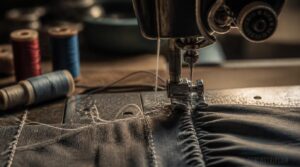
Tension problems tend to show up fast — and they usually look worse than they are. Most issues fall into a handful of recognizable patterns, each one pointing to a specific fix. Here’s what to watch for.
Loops Under Fabric
Loops beneath your seam are a telltale sign that the upper thread is too loose. The stitch can’t lock correctly, so the thread pools on the underside instead.
Lightweight fabrics make this worse — less weight means less pull.
Check your take-up lever is threaded properly, and make sure your needle isn’t dull.
A clean pierce keeps tension balanced.
Bobbin Thread on Top
When bobbin thread pokes through on the front, your upper tension is pulling too hard. The stitch lock sits too high instead of mid-fabric.
Check thread weight mismatch and bobbin case cleanliness first. Dense embroidery designs make this worse.
Loosen upper tension slightly, then run a tension balance test on scrap fabric before adjusting bobbin tension.
Seam Puckering
Seam puckering is tension’s way of telling you something’s off. When your upper tension is too tight, the thread pulls the fabric inward as the stitch locks, creating folds along the seam. Fabric density makes it worse — tightly woven cloth has nowhere to give.
Try shortening your stitch length and easing the tension dial down one setting at a time.
Skipped Stitches
A skipped stitch isn’t random — it means the hook missed the thread loop entirely. Hook timing is the usual culprit.
- Wrong needle size disrupts loop formation
- A bent or burred needle shifts the catch point
- Fabric feed disruption throws off hook-to-needle timing
- Shuttle race wear causes recurring misses
Replace your needle every 8–12 hours. Rethread completely before adjusting tension.
Thread Nesting
That tangled clump under your fabric — that’s a birds nest stitch, and it almost never comes from bobbin tension alone.
The real cause is usually improper threading. If you threaded with the presser foot down, the tension disks stayed closed. Thread skipped the take-up lever? Same result.
Fix it: raise the foot, rethread completely, confirm bobbin installation, then test.
Check Threading and Needle Setup
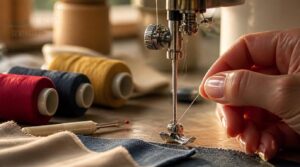
Before you touch the tension dial, check your threading — that’s where most problems actually start. A misrouted thread or the wrong needle can mimic a tension issue and send you chasing the wrong fix. Run through these quick checks first.
Raise The Presser Foot
Raising the presser foot first is the single most overlooked fix for tension problems. Lift it before touching the thread.
This opens the tension disks, giving the upper thread a clear path through them. With the foot up, you also get fabric alignment precision and safer needle path access.
It takes two seconds — skip it and you’ll fight tension issues the whole seam.
Rethread Upper Thread
With the presser foot raised, now rethread the upper thread completely — don’t skip steps.
Follow this sequence carefully:
- Pull thread through every thread path guide in order
- Seat it fully inside the tension disk slot
- Loop it through the take-up lever slot
- Pass it straight down to the needle eye
Incorrect threading causes loose, uneven stitches immediately. Afterwards, tug gently — thread should feed smoothly without catching.
Check Take-up Lever
Once your machine is rethreaded, look at the take-up lever next.
This little arm pulls thread from the spool and feeds your needle. Move the handwheel by hand — the lever should rise and fall smoothly, with no binding.
Check lever clearance and needle bar alignment too. Thread should sit snug in the lever slot, not snagging, with proper synchronization timing between lever and needle.
Match Needle and Thread
Your take-up lever is sorted — now check that your needle and thread are actually matched to each other.
Think of it like pairing shoes to socks: the wrong combo throws everything off. Needle eye diameter must suit your thread weight. A heavy thread crammed through a fine needle creates friction, uneven feeding, and tension problems.
Quick reference for getting it right:
- Universal size 80/12 accommodates medium-weight cotton and polyester thread well
- Size 90/14 suits heavier thread and denim or canvas fabrics
- Size 70/10 works for lightweight fabrics paired with fine thread
- Needle size and thread weight should always scale together — never mix extremes
- Thread type selection matters too: metallic thread needs a larger eye to reduce friction
Replace Damaged Needles
A dull or bent needle is one of the sneakiest tension saboteurs out there.
Before swapping it out, unplug your machine. Raise the presser foot, then loosen the needle clamp screw. Slide the old needle out and discard it safely. Insert the fresh needle flat side back, fully seated in the clamp. Tighten the screw firmly, then test on scrap fabric.
Adjust Upper and Bobbin Tension
Once you’ve confirmed your threading is correct, tension adjustments are your next move. The process is more methodical than complicated — small changes, one at a time, with a test stitch after each one. Here’s exactly how to work through it, starting with upper tension and finishing with the bobbin.
Test on Fabric Scraps
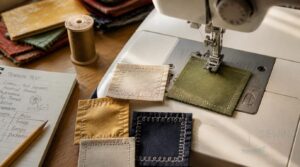
Before touching your tension dial, always test on scrap fabric first. Cut scraps into 4-by-4-inch squares from the same fabric as your project. Stitch a few lines, then flip the scrap over.
Check both sides for loops, puckering, or gaps. Document what works — fabric type, thread weight, dial setting. That record saves you from guessing next time.
Change One Number Gradually
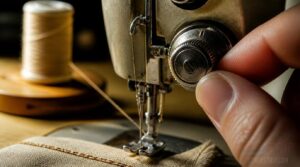
Move the tension dial one number at a time — never skip settings. That single-step rule keeps you in control and prevents overcompensation.
- Start at your current setting
- Shift one number up or down
- Sew a test line on a scrap
- Check both fabric sides
- Log the result before moving on
Tighten Loose Upper Tension
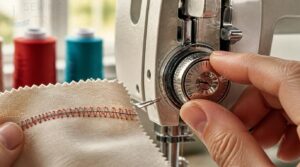
Loops on the underside mean your upper thread is too loose. Increase the tension dial by one number, then sew a test line on scrap fabric. Check both sides before moving on.
If loops disappear on the underside and the stitch looks even on top, you’ve found your setting. Log that number for next time.
Loosen Tight Upper Tension
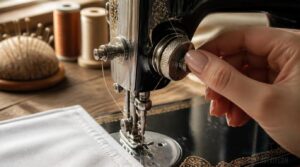
Puckering is your signal that upper thread tension is gripping too hard. Turn the tension dial down one number, then sew a test line on scrap fabric. Check both sides.
Here’s your three-step reset:
- Drop the dial by one notch
- Rethread to secure proper thread seating
- Confirm stitch balance on both fabric sides
Adjust Bobbin Screw Carefully
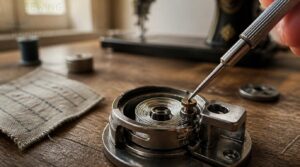
The bobbin screw is tiny but mighty — small turns carry real consequences.
Unplug your machine first, then remove the needle plate to access the bobbin case.
Use a precision screwdriver and turn the screw clockwise to tighten, counterclockwise to loosen.
Make only quarter-turn increments.
After each turn, run a test line on scrap fabric and check both thread sides for balance.
Match Fabric, Thread, and Needle
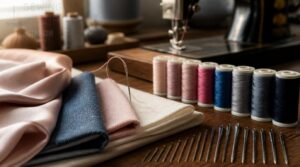
Tension problems don’t always start at the dial. Sometimes the real issue is a mismatch between your fabric, thread, and needle. Here’s how to pair them up the right way.
Lightweight Fabric Settings
Lightweight fabrics like chiffon and fine cotton demand a lighter touch.
Drop your upper tension to around 3 — anything higher risks puckering those delicate fibers. Pair that with size 9–11 Microtex needles and fine 50-weight thread.
Keep your stitch length between 2.0–2.5 mm, and use a walking foot to stop fabric from shifting as you sew.
Thick Fabric Settings
Heavy fabrics flip the script on everything you learned about lightweight settings.
Bump your upper tension down to 3–4 and move to a size 100–110 heavy-duty needle. Pair that with Tex 40–60 thread for real holding power. Use a walking foot to keep layers feeding evenly, and set your stitch length to 3.0–3.5 mm to prevent bulk buildup.
Knit Fabric Needles
Knits need a different needle than thick wovens — switch to a ball point needle before you touch tension settings.
Ball point geometry slides between fibers instead of cutting them, preserving jersey knit integrity and preventing fabric runs. Stick with sizes 70/10 to 90/14 based on weight.
For stretch fabrics like spandex blends, a stretch needle’s reinforced shaft manages tension adjustment better, stopping skipped stitches before they start.
Woven Fabric Needles
Wovens play by different rules. Swap to a sharp needle — sizes 70/10 to 90/14 — before adjusting tension. The fine tip pierces threads cleanly without snagging.
A titanium or chromium needle coating reduces friction, keeping tension consistent, pass after pass. The scarf area ensures proper bobbin loop pickup, locking balanced stitches right where you need them.
Specialty Thread Adjustments
Specialty threads don’t follow standard rules.
Metallic thread breaks easily — loosen top tension by one or two steps. Monofilament benefits from slightly looser bobbin tension.
Silk and rayon need a finer needle and slower speed.
For polycore or braided threads, route carefully to prevent fraying.
High-density fibers need a dedicated thread path to stay consistent.
Prevent Future Tension Issues

Good tension doesn’t just happen stitch by stitch — it’s built through habits you keep up between projects. A little routine maintenance goes a long way toward keeping your machine dialed in. Here’s what to stay on top of.
Clean Tension Disks
Think of your tension disks like brake pads — grime builds up and performance drops. Disk debris removal is simple but critical. Use a dry lint-free cloth or small nylon brush to clear buildup. Avoid liquid cleaners directly on the disks; moisture leaves residue that worsens friction.
Friction material wear is sneaky. Inspect disks for glossy spots or scoring — those signal it’s time for disk replacement. Match replacement disks to your machine model.
| Cleaning Tool | Best Use | Avoid |
|---|---|---|
| Lint-free cloth | Surface lint | Wet cloths |
| Nylon brush | Stubborn threads | Metal tools |
| Compressed air | Between disks | Harsh solvents |
| Vacuum hose | Deep debris | Direct heat |
For heavy projects, clean every 8–16 sewing hours. Before any thread tension adjustment, clean first — dirty disks skew your baseline. This one step keeps your tension mechanism honest and your stitches consistent.
Remove Bobbin Lint
Lint is the quiet saboteur of consistent tension. It builds up fast around the bobbin case lip, the tension spring underneath, and the shuttle race channel — especially after fleece or flannel projects.
Use a small lint brush to sweep debris out. Skip compressed air; it drives lint deeper. A vacuum attachment works better for stubborn buildup.
Clean every 8–12 sewing hours, then rethread and test on a scrap to confirm balanced stitches.
Lubricate Moving Parts
Friction is the silent enemy your tension system fights every stitch cycle. A light application of sewing machine oil on moving metal parts keeps that fight in your favor.
Follow your manufacturer’s oil schedule — usually every 8–10 hours of use. Use a low-viscosity synthetic oil, never grease, which can thicken into sludge and drag on fast-moving components.
Store Thread Properly
Bad thread storage causes tension headaches before you even sit down to sew. Keep spools in a dry, temperature-controlled environment, ideally 64-72°F with 50-60% humidity, to stop thread fatigue and corrosion.
- Clear, dustproof containers
- Labeled by brand, weight, and fabric type
- Sorted by color family
- Off the floor, away from sunlight
- Silica packs for moisture control
Good organization prevents contamination and keeps thread quality solid for years.
Schedule Yearly Servicing
Your machine deserves more than a quick dust-off once a year. Annual professional servicing covers tension disk inspection, timing alignment, lubrication of moving parts, and full component wear checks — things you simply can’t see or reach yourself.
| Service Area | What’s Checked | Why It Matters |
|---|---|---|
| Tension system | Disks, springs, upper/bobbin balance | Prevents uneven stitches |
| Timing | Needle-to-hook alignment | Stops skipped stitches |
| Lubrication | Shuttle, race, moving parts | Reduces friction wear |
| Thread path | Guides, take-up lever | Ensures smooth feeding |
| Consumables | Needles, bobbin parts | Catches hidden damage |
Book it before problems start.
Frequently Asked Questions (FAQs)
How does thread tension work on a sewing machine?
Thread tension is the mechanical tension balance between your upper thread and bobbin thread. Spring-loaded disks grip the upper thread while a bobbin spring controls the lower, locking both into balanced stitches inside the fabric.
Does needle size affect thread tension?
Yes — needle size directly shapes tension. A larger needle reduces friction, easing thick thread through. Too small a needle artificially tightens top tension. Match needle to thread weight for balanced stitches.
How to avoid sewing machine tension issues?
Avoid tension issues before they start. Clean tension disks monthly, match needle size to thread weight, store thread between 65–75°F, and schedule yearly servicing. The right fabric-to-needle match prevents most problems.
What happens if thread tension is imbalanced?
Imbalanced tension is like a tug-of-war neither side wins. You get fabric puckering, loose stitches, loops on the underside, thread breaks, stitch skewing, grain distortion, and weakened seams.
Why do my needle and thread keep getting stuck?
A stuck needle usually means friction is building up somewhere in the path. Lint in the tension disks, a dull needle, or a missed threading guide — any one of these stops smooth thread flow fast.
How do I fix my thread tension?
Start with your thread tension dial — set it to 4 or Sew a scrap test. Loops underneath mean loosen it; puckering means tighten. Adjust one number at a time.
Can decorative stitches require different tension settings?
Yes — decorative stitches often need different tension settings than straight stitches. Pattern density, stitch width, and thread texture all shift the balance your machine needs to keep stitches clean and stable.
Does thread color affect how tension appears visually?
Thread color absolutely shapes how tension looks — even when the actual stitch quality hasn’t changed. High-contrast thread on dark fabric amplifies every irregularity. A matte, matched thread quietly hides minor imbalances your eye would otherwise catch.
How does stitch length impact overall thread tension?
Stitch length directly shifts tension load. Shorter stitches demand more upper thread force; longer ones ease it. Lightweight fabrics feel this shift fast. Always calibrate both together for balanced stitch formation.
Can old or cheap thread cause tension inconsistencies?
Old thread is a quiet saboteur. Aged fibers shed lint, clog tension disks, and feed unevenly. Cheap thread adds irregular diameter. Both cause puckering, breakage, and skipped stitches. Store thread at 65–75°F and replace old spools regularly.
Conclusion
Tension is a conversation — one thread speaking to another, meeting in the middle of every stitch.
Once you understand that, needle and thread tension problems stop feeling like machine failures and start feeling like clues worth reading. You’ve learned where to look, what to adjust, and when to leave things alone.
Trust the process, test on scraps, and change one setting at a time.
Good stitches don’t happen by accident — they happen because you knew what to fix.
- https://tillyandthebuttons.com/blogs/sewing/thread-tension-troubleshooting
- https://www.thesewingdirectory.co.uk/thread-tension
- https://paigehandmade.com/sewing-machine-basics/tension
- http://ohyoucraftygal.blogspot.com/2013/10/sewing-lesson-10-how-to-fix-tension-on.html
- https://madamsew.com/blogs/sewing-blog/how-to-deal-with-thread-tension