This site is supported by our readers. We may earn a commission, at no cost to you, if you purchase through links.
Pin holes piercing silk brocade. A velvet panel shifting two millimeters mid-cut—enough to ruin a collar entirely. These aren’t beginner mistakes; they’re the predictable result of reaching for pins when the job calls for something better.
Pattern weights for cosplay costume making solve a problem that pins never fully could. They hold templates flat without puncturing fibers, keep foam sheets stable under a rotary cutter, and let you reposition in seconds rather than minutes. On a six-panel armor build or a structured Regency bodice, that precision compounds fast.
Knowing which weights to use, how to select them for different fabrics, and when to make your own changes everything about how accurately your cuts land.
Table Of Contents
Key Takeaways
- Pattern weights eliminate pin holes in delicate fabrics like silk and velvet while keeping templates stable under a rotary cutter—making them essential for high-precision cosplay cuts.
- Weight shape matters: circular weights handle curves, rectangular ones align straight grain lines, and teardrop forms lock corners where standard weights can’t reach.
- Your weights only perform as well as the tools paired with them—a titanium rotary blade and a self-healing mat are what turn steady fabric into clean, repeatable cuts.
- You can make effective DIY weights from stacked washers or polymer pellets in felt or cotton pouches, often outperforming commercial sets because you tailor mass and shape to your specific fabrics.
Why Cosplayers Use Pattern Weights
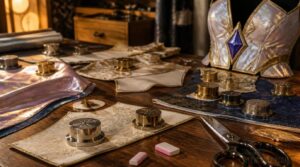
Pattern weights solve real problems that pins simply can’t — and once you start using them, you’ll wonder how you managed without them. For cosplayers especially, the benefits go beyond convenience and directly affect the quality of your finished costume. Here’s why so many costume makers have made the switch.
Even younger sewists can get in on the action — pattern weights for kids are a great way to build good habits from the start.
Cleaner Foam Template Cutting
Cutting foam templates cleanly depends on keeping the template perfectly still. When a pattern shifts mid-cut, even a millimeter, your armor edge ends up uneven.
Pattern weights hold acrylic or laminated templates flat against the foam surface, letting you trace or cut along the edge without drift. Pair them with a fresh blade and precision alignment marks, then sand burrs away after.
No Pin Holes in Fabric
Foam templates forgive a lot, but fabric doesn’t. A single pin through silk, velvet, or a stretch knit can leave a permanent fiber puncture — visible long after the costume is finished.
Pattern weights eliminate that risk entirely, holding fabric flat without piercing a single thread, which matters most when working with knits prone to runs or delicate weaves that distort around needle pressure.
Faster Pattern Placement
Pinning takes time — placing a weight doesn’t. You drop fabric weights onto pattern pieces, check alignment, and start cutting, with no threading, no pressing through layers, no accidental snags on slippery materials.
Stabilizing slippery fabrics this way reduces repositioning passes greatly, keeping your layout tight and your cuts progressing without constant stops to re-anchor shifting pattern pieces.
Better Grainline Alignment
Speed alone doesn’t win the battle — grain does. Pattern weights let you align grainline arrows to the selvage and hold them there without displacement, so fabric warp stays consistent across every pattern piece. Misalignment causes seam puckering and skewed hems that no amount of pressing will fix.
Speed means nothing if your grain is off — misaligned fabric warps into puckers no iron can fix
Weights make that precision achievable without the stretch risk pinning introduces. It’s essential to make sure the pattern grainline alignment remains parallel to the fabric’s selvage.
Safer Rotary Cutting
Hidden pins are a blade’s worst enemy — strike one mid-cut and you risk a nicked rotary cutter edge, a deflected blade, or worse, sudden contact with your hand.
Pattern weights eliminate that hazard entirely, keeping fabric flat without buried metal. Pair them with a self-healing cutting mat, maintain sharp blades, and your rotary cutter tracks cleanly through every pass.
Top 4 Pattern Cutting Tools
Pattern weights don’t work in isolation—the tools you pair them with determine how clean and accurate your cuts actually turn out.
Getting the right combination of weights, cutters, and mats makes the difference between a precise costume piece and one that needs rework. Here are four tools worth having in your cutting setup.
1. Quilted Bear Fabric Pattern Weights
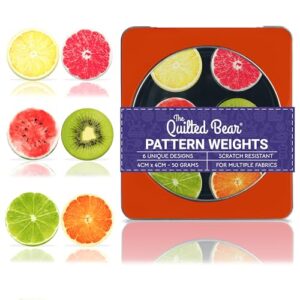
The Quilted Bear Pattern Weights (model QB-OD2) come as a set of six high-density plastic discs in a "Funky Fruit" printed design, packaged in a tin storage container. Their scratch-resistant finish makes them safe on both delicate fabrics and paper patterns — a practical detail when you’re repeatedly placing and lifting weights across a multi-panel costume layout.
For most cosplay work, they hold their position reliably, though very large or heavy pattern pieces may need supplemental pinning. Handle the internal plastic holder carefully, as some units have reported cracking.
| Best For | Quilters, dressmakers, and paper crafters of all skill levels who want a quick, pin-free way to keep patterns in place while adding a little personality to their workspace. |
|---|---|
| Material | High-density plastic |
| Quantity Included | 6 weights + tin storage |
| Primary Use | Pin-free pattern placement |
| Craft Compatibility | Quilting, dressmaking, paper crafting |
| Color / Finish | Funky Fruit printed design |
| Storage Solution | Included tin container |
| Additional Features |
|
- Pin-free design keeps patterns and fabric pieces steady without leaving holes or marks
- Scratch-resistant finish is safe on both delicate fabrics and paper surfaces
- The "Funky Fruit" design and included tin make them a fun, decorative addition to any craft table
- May not hold down very large or heavy pattern pieces on their own
- The tight-sealed packaging can be frustrating to open for the first time
- Some units have had the internal plastic holder crack, so they need to be handled with a bit of care
2. Wisemen Glass Pattern Weights
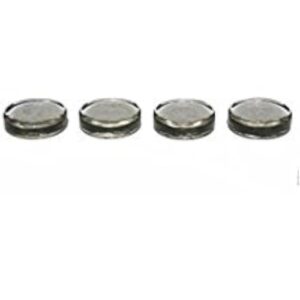
Clear glass discs roughly 2¾ inches across and weighing about 5.5 oz each, the Wisemen Glass Pattern Weights come four per pack — enough to anchor most mid-sized pattern pieces without reaching for a single pin.
The lead-free, food-grade glass construction means no rust, no corrosion, and no surface residue transferring onto silk or satin mid-cut. That transparency isn’t cosmetic, either — you can confirm grainline alignment and read chalk markings directly through the disc while it’s still in place.
Even so, they’re not indestructible. Drop one on a hard floor and you’re dealing with chips or micro-fractures, so padded storage between sessions is non-negotiable. For heavy fabrics like denim or canvas, their 5–6 oz mass may not hold reliably without supplemental pins at key anchor points.
| Best For | Sewists and pattern makers working with delicate fabrics like silk or satin who want a pin-free cutting experience with precise grain-line visibility. |
|---|---|
| Material | Lead-free food-grade glass |
| Quantity Included | 4 discs per pack |
| Primary Use | Pin-free pattern placement |
| Craft Compatibility | Quilting, sewing, paper patterns |
| Color / Finish | Clear / transparent |
| Storage Solution | No included storage |
| Additional Features |
|
- Lead-free, food-grade glass leaves zero residue on delicate fabrics, making them safe for silk, satin, and similar materials
- Fully transparent discs let you read chalk markings and check grain alignment without ever lifting the weight
- No pins means no snags, holes, or distortion in fine or fragile fabric
- Glass construction means a hard drop can chip or fracture a disc, requiring careful storage between uses
- At 5–6 oz each, they may not hold heavy fabrics like denim or canvas without extra pins at key points
- The roughly 2¾-inch diameter can feel larger than expected, which may be awkward on small or narrow pattern pieces
3. Fiskars 45mm Rotary Fabric Cutter
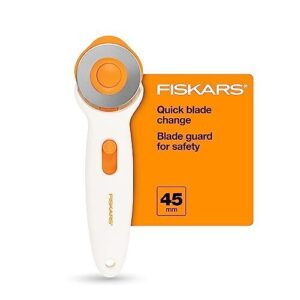
The Fiskars 45mm Rotary Cutter is the workhorse that actually keeps pace with pattern weights. Its titanium carbide blade slices through multiple fabric layers — felt, vinyl, high-GSM convention fabrics — in a single, uninterrupted pass, which means your weights stay exactly where you placed them rather than shifting under repeated pressure.
The ambidextrous loop handle locks the blade open during cuts and retracts it instantly for storage — no fumbling, no accidental nicks between pieces.
| Best For | Quilters, sewists, and crafters who regularly cut multiple layers of fabric, felt, or vinyl and need clean, precise edges with minimal hand fatigue. |
|---|---|
| Material | Stainless steel / titanium carbide |
| Quantity Included | 1 rotary cutter |
| Primary Use | Fabric and material cutting |
| Craft Compatibility | Sewing, quilting, felt, vinyl |
| Color / Finish | Silver stainless steel |
| Storage Solution | Sliding blade retraction lock |
| Additional Features |
|
- Titanium carbide blade powers through multiple fabric layers in a single pass, keeping cuts clean and accurate
- Ambidextrous handle works equally well for left- and right-handed users, with a locking mechanism that makes blade management safe and simple
- Quick-snap blade replacement requires no tools, and the full lifetime warranty on the cutter itself adds long-term value
- The blade warranty is excluded, so frequent cutters working with thick or abrasive materials may face added replacement costs as it dulls faster
- Not suited for deco mesh or specialty meshes, with some users reporting the blade stalling during use on those materials
- At just over 6.5 inches long, it’s a dedicated cutting tool — not a multipurpose option for non-fabric tasks
4. Fiskars Large Self Healing Cutting Mat
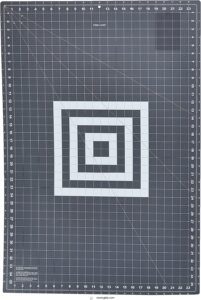
At 24 × 36 inches, this mat gives you room to lay out full costume panels — armor templates, robe fronts, layered tunics — without constantly repositioning. The self-healing polymer surface reseals after each rotary pass, keeping the top layer smooth so your blade stays sharp across long cutting sessions.
The 30°, 45°, and 60° bias lines remove the guesswork from angled cuts, and the double-sided grid means you’re getting extended life from a single mat.
| Best For | Cosplayers, quilters, and crafters working with large fabric panels or complex angled cuts who need a durable, full-sized work surface. |
|---|---|
| Material | Self-healing multi-layer polymer |
| Quantity Included | 1 cutting mat |
| Primary Use | Cutting surface and protection |
| Craft Compatibility | Sewing, quilting, scrapbooking |
| Color / Finish | Gray |
| Storage Solution | Rolls or lays flat |
| Additional Features |
|
- Massive 24 × 36 in surface handles full-width fabric bolts and large costume panels without repositioning
- Self-healing polymer reseals after cuts, keeping the surface smooth and extending blade life
- Built-in 30°, 45°, and 60° bias lines make precise angled cuts easy without extra tools
- The size and weight (2.61 lb) can feel cumbersome in small workspaces or on the go
- Adhesive residue from packaging stickers can be tricky to remove without damaging the surface
- Repeated deep cuts in the same spot will wear down the self-healing layer over time
Choosing Cosplay Pattern Weights
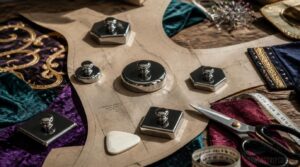
Not all pattern weights are created equal, and the wrong choice can throw off your entire cutting process. Before you invest in a set, there are a few key factors that’ll make a real difference for cosplay work specifically. Here’s what to look for:
Best Weight Shapes
Shape does more work than you’d expect. Circular and oval weights handle curved edge conformity naturally, while rectangular ones serve as reliable edge alignment tools along straight grain lines.
- Teardrop forms lock corner stability on notches
- Wedge shapes sit flush against seam allowances
- Flat discs distribute pressure across large foam pieces
- Narrow strips conform to irregular DIY sewing pattern weights
Specialized geometry utility keeps every edge clean.
Ideal Weight Range
Weight in a cosplay context means 50 to 250 grams per piece — light enough to reposition quickly, heavy enough to hold 230+ GSM fabrics flat without shifting.
Heavier fillings suit thick armor base layers; lighter ones serve draped tunic panels. Going outside that range risks either fabric creep or pattern distortion during cutting.
Fabric-safe Outer Materials
The outer shell of your sewing weights matters as much as the fill. Felt or sturdy cotton resists tearing and won’t leach dye onto delicate costume fabrics — look for OEKO-TEX certified materials when sewing pattern weights or DIY donut pattern weights.
- Organic cotton or linen — breathable, skin-safe outer shells
- Recycled polyester — durable, colorfast, washable
- Laminated or coated shells — moisture barrier technology for humid convention floors
Thick Fabric Considerations
Heavy cosplay materials — canvas, dense twill, layered foam-backed fabrics — resist weight placement differently than lightweight cloth. Your pattern weights need enough mass to hold without shifting, but bulky weights can distort the natural drape.
For fabrics 230+ GSM, pair heavier disc weights with a size 90/14 needle and slightly longer stitch lengths to prevent seam bunching during construction.
Detailed Pattern Areas
Intricate areas — collar points, dart tips, pocket placement zones — are where weights alone won’t cut it. Supplemental pins hold notch alignment and dart placement stability at tight corners where even triangular pattern weights can’t fully reach.
Use pins selectively on these pattern pieces, letting your sewing weights handle the broader coverage while pins lock down only what demands it.
DIY Pattern Weights Tutorial
Making your own pattern weights is straightforward, and the materials are cheap enough that you can build a full set without much investment. The key is choosing the right filler and casing combination for the fabrics you work with most. Here’s how to put them together, step by step.
Gather Washers or Fillers
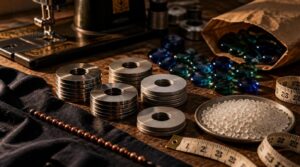
Start with fender washers—stack four or five 1.5–2 inch units deep for solid, roll-resistant mass. Stainless steel resists corrosion; aluminum cuts overall weight.
Prefer polymer pellets or glass gems when metal feels excessive—both offer customizable density without bulk. BBs work for narrow conforming strips. Avoid spherical fillers; they shift under pressure and undermine the whole point.
Cut Fabric Covers
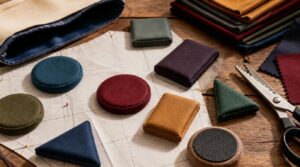
Felt and sturdy cotton are the go-to choices here — they resist tearing and won’t leach dye onto your fabric.
Cut circles, rectangles, or triangles to match your filler shape:
- Felt for roll-resistant discs
- Cotton blends for washable rectangular pouches
- Nylon for high-abrasion strips
- Non-woven fabric for lightweight disposable covers
Add a non-slip coating to the underside before sewing.
Sew Three Pouch Sides
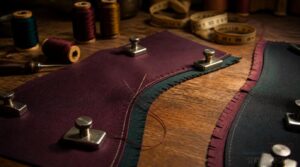
Two exterior pieces, right sides together, form one panel — repeat with all lining pieces to build three. Align all panels end to end, sew two long seam lines, and leave a turning gap open.
| Step | Technique | Purpose |
|---|---|---|
| Join panels | Right sides together | Clean seam allowance |
| Reduce bulk | Clip notches at curves | Flat finish |
| Box corners | Match side seams | Even compartments |
Fill and Seal Securely

Use a funnel to pour poly pellets or metal shot into your pouch, filling it to roughly three-quarters capacity.
Apply a thin bead of silicone-based or hot-melt adhesive along the open edge — surfaces must be clean and dry first. Clamp the seam flat and allow a full curing period before handling, ensuring your DIY donut pattern weights won’t split mid-cut.
Test on Scrap Fabric

Before trusting your finished pattern weights on final fabric, run them against a prewashed scrap first. Check for:
- Shrinkage assessment after a standard wash cycle
- Colorfastness testing under light and moisture exposure
- Grainline verification once weights are placed
- Marking tool bleeding along cut edges
If seam puckering appears during test stitching, adjust tension before committing to your actual sewing project.
Cutting Cosplay Patterns Accurately

Getting your weights ready is only half the battle — how you use them at the cutting table determines everything.
Accurate cosplay cutting comes down to a repeatable sequence of steps that keeps your fabric stable, your lines true, and your rotary cutter moving without interruption. Here’s exactly how to work through that process from start to finish.
Prepare Fabric and Patterns
Before placing a single weight, your fabric needs to be ready to cut. Prewash and press everything first — wrinkles or residual finishes will throw off your measurements.
Straighten the edges by aligning the selvages, then identify which side is right-side down. Transfer all notches and seam allowances onto the fabric now, so nothing gets lost once cutting begins.
Align The Grainline
With edges straightened, lay each pattern piece so its grainline arrow runs parallel to the selvage at both ends — not just one. This alignment locks the warp threads under your cut, which is what prevents seams from drifting during long wear.
Knits demand extra care; their stretch can shift if the grain skews even slightly, causing the finished garment to twist.
Place Weights Strategically
With grainline confirmed, set your first weights at the pattern corners — these resist curling most aggressively. Work inward from there, spacing weights every few inches along outer edges to distribute tension evenly.
On curved sections, cluster more weight along inner curves where lifting starts. For large pieces, a staggered grid prevents the center from ballooning up mid-cut.
Cut With Rotary Tools
With weights locked in place, pick up your 45mm rotary cutter and start moving.
- Score lightly on the first pass to establish your cut line
- Keep the blade perpendicular to the foam surface throughout
- Work at the lowest effective speed to prevent scorching
Replace dull blades immediately — ragged edges ruin clean cosplay pattern making. Inspect your power cord before each session.
Add Pins When Needed
Rotary cuts handle the bulk of the work, but pins earn their place when pattern drift threatens accuracy.
On complex curves or nesting edges, place pins perpendicular to the pattern edge, spacing them 0.5 to 1 inch apart. Pins at grainline junctions lock fabric orientation where weights can’t reach. Remove them progressively as each section stabilizes.
Frequently Asked Questions (FAQs)
How do I store pattern weights between projects?
Store them in a labeled, moisture-free container with silica gel packets to prevent rust on metal cores. Group by shape and weight range, and log the last-used project date for fast retrieval next build.
Can pattern weights damage delicate metallic fabrics?
Like a heavy hand pressed against foil, even modest pressure leaves its mark. Yes — metallic surface compression causes indentations and shine disruption. Use wide, cloth-covered weights and always test on scraps first.
How many weights does a typical cosplay need?
Most cosplays need 6 to 12 weights per session, scaling with pattern piece count and fabric surface area. Complex armor builds may require more to manage multiple simultaneous pieces.
Are commercial weights better than handmade ones?
Commercial weights win on mass consistency and manufacturing tolerances, but handmade sewing weights often outperform them where it matters most — your specific fabric. For cosplay, homemade sewing aids shaped to your patterns beat standardized options every time.
Can weights work on vertical or angled cutting surfaces?
Yes — on flat surfaces only. Vertical or angled setups cause weight slip and fabric shift, undermining precision. Flat-bottomed, non-slip bases help on mild angles, but standard cutting mats remain the most reliable surface.
Conclusion
Precision, patience, and proper pattern weights for cosplay costume making separate builds that merely impress from ones that genuinely endure. Every clean cut you make without a pinhole is a decision that shows up in the finished piece—no apologies, no rework, no wasted fabric.
Your armor panels will sit flush. Your brocade won’t bleed. Master the weight placement, master the build. The tools are straightforward; the discipline to use them correctly is what defines the craftsperson.