
This site is supported by our readers. We may earn a commission, at no cost to you, if you purchase through links.

A sewing machine can produce thousands of stitches without complaint—right up until it can’t. When thread starts looping, bunching, or snapping for no obvious reason, most sewists reach for the tension dial. But the dial isn’t always the problem. The real culprit is often hiding a few millimeters behind it: contaminated tension discs quietly coated in lint, oxidized oil, and fine dust that no one thinks to check.
These discs control how firmly thread feeds through your machine. Even a thin film of residue disrupts that grip, throwing off stitch balance in ways that no amount of dial-turning will fix.
Cleaning and maintaining your tension discs isn’t complicated—but it does require knowing exactly what to do, and what to avoid.
Table Of Contents
Key Takeaways
- Tension problems are rarely about the dial—contaminated tension discs coated in lint, oxidized oil, and dust are the true culprit behind most persistent stitch failures.
- Cleaning tension discs requires no disassembly: simply raise the presser foot, then slide a dry fleece strip between the discs to lift debris and restore consistent thread grip.
- Never oil your tension discs—oil destroys the friction they depend on and actively attracts the lint buildup you’re trying to prevent.
- Monthly fleece-strip cleaning, quality low-lint thread, and annual professional servicing are the three habits that keep tension problems from coming back.
Why Tension Discs Get Dirty

Tension discs don’t fail without reason — something specific gets in the way and throws off the thread’s grip. The culprits behind most tension problems are easier to identify than you might think. Here’s what’s actually working against your discs every time you sew.
Once you spot the pattern, balancing upper and lower thread tension is usually the fastest way to get your stitches back on track.
Lint and Thread Buildup
Every stitch deposits tiny fibers between your tension discs. High-shedding fabrics like fleece or bulky cotton blends accelerate this process greatly, and lower-quality threads compound the problem by dispersing lint particles into disc gaps where they’re nearly invisible.
That buildup increases friction along the thread path, causing tension drift. Regular lint removal — ideally every one to two hours of sewing — keeps thread tension control stable and stitches consistent. Neglecting this can lead to thread jams in tension and uneven stitch quality.
Sticky Old Oil Residue
Lint isn’t the only culprit. Over time, old oil residue oxidizes and polymerizes on disc surfaces, forming a tacky film that grips thread instead of guiding it. Heat accelerates this process, making the buildup rubbery, then hard.
That sticky layer traps lint or debris, compounding tension problems. Isopropyl alcohol dissolves it — but apply it to your fleece strip, never directly onto the machine.
Dust Between Disc Gaps
Even without visible grime, microscopic debris drifts into disc gaps during sewing. Particle migration patterns and gas-dust drag push fine dust toward pressure zones, where gap boundary buildup accumulates — altering local opacity and disrupting thread flow through your tension disc mechanism.
Watch for:
- Thread loops forming under fabric
- Debris trapped at disc edges
- Inconsistent stitch tension
- Resistance during precision cleaning
Rust, Burrs, and Wear
Dust isn’t the only silent threat working against your tension disc mechanism. Steel components corrode when moisture and heat combine, creating micro-roughness that snags thread fibers and accelerates wear at contact surfaces.
Burrs form at disc edges over repeated cycles, scoring the metal and disrupting smooth thread flow. For machine longevity, inspect these surfaces regularly with a loupe and remove burrs before they compound the damage.
Signs of Poor Tension
When tension discs fail, your fabric tells the story first. Fabric puckering forms along seam lines, edges curl away from the needle, and uneven stitch bite leaves irregular gaps.
Loose upper thread loops visibly beneath the material, while thread breakage clusters near the needle entry. Repeated tension adjustments that won’t stabilize these breaks signal disc wear requiring immediate attention.
Tools for Safe Disc Cleaning
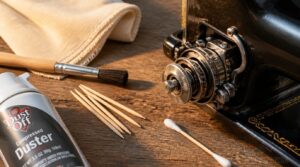
Cleaning tension discs doesn’t require a trip to the hardware store or a drawer full of specialty gadgets. In fact, most of what you need is probably already within reach. Here are the tools that’ll get the job done safely and effectively.
Soft Brush and Tweezers
Two tools do most of the heavy lifting when you clean tension discs: a soft-bristle brush and fine-pointed tweezers.
For stubborn lint packed around the discs, a quick pass with compressed air works wonders — the same technique covered in this sewing machine feed dog cleaning guide applies here too.
The brush — ideally nylon or microfiber — sweeps loose fibers from the tension disc mechanism without scratching metal surfaces. Tweezers handle what bristles can’t reach, gripping isolated thread fragments with tip precision.
Store both in a sealed container to avoid cross-contamination between sessions.
Fleece Cleaning Strip
A fleece cleaning strip — non-woven, roughly 0.5 mm thick — slides between tension discs to physically lift lint and debris without scratching metal surfaces. Its densely packed fibers trap buildup rather than smear it.
You can mist one end lightly with isopropyl alcohol for stubborn residue. Replace the strip once it shows visible wear or stops picking up lint efficiently.
Dental Floss Method
Waxed or unwaxed dental floss works equally well here — the key is its ability to reach where your fingers can’t.
Thread roughly 18 inches of floss, holding a taut 1–2 inch working section, then slide it gently between the tension discs using a controlled up-and-down rubbing motion rather than snapping it through. Advance to a fresh floss segment between each disc gap.
Isopropyl Alcohol Use
When old oil turns tacky, isopropyl alcohol cuts through residue that dry buffing can’t touch. Apply it to your fleece strip rather than directly onto the discs — this protects any shellac finish nearby.
Because alcohol evaporates quickly, it leaves no moisture behind. Always follow up with a dry fleece pass to fully polish the surface clean.
Compressed Air Precautions
Compressed air clears stubborn lint or debris from the tension disc mechanism, but it demands respect.
Always wear safety glasses before directing any blast near the machine — particles move fast. Keep pressure at 30 psi or below, use a nozzle guard, and never point the nozzle at skin. A quick burst, aimed at an angle, is all you need.
Clean Tension Discs Without Disassembly
Cleaning your tension discs doesn’t have to mean taking your machine apart. A few straightforward steps done in the right order will get the job done safely and effectively. Here’s exactly what to do.
Unplug The Sewing Machine

Before you touch a single component, switch the machine off at the main power switch — then pull the plug from the wall outlet by gripping the plug head, never the cord. Tugging the cord can damage insulation over time.
Once disconnected, confirm the machine has fully stopped moving. Your workspace should be well-lit and clear of loose pins or needles.
Remove Thread and Bobbin

With the machine unplugged, remove all thread from the upper path by pulling it gently back toward the spool.
Open the bobbin cover, lift out the bobbin case, and clear any thread entanglement you find there. Check for lint using a soft brush. Reinstall the bobbin only after the area is fully clear, ensuring it is correctly seated.
Raise The Presser Foot

With the bobbin area clear, raise the presser foot lever before touching the tension discs.
This single action opens the threading disc access, releasing pressure so you can clean between the discs effectively:
- Unlocks tension discs for unrestricted cleaning
- Prevents skipped stitches caused by debris trapped under pressure
- Gets ready the path for accurate thread tension adjustment
- Clears space when managing bulky seams during reassembly
Don’t skip this step.
Slide Fleece Between Discs
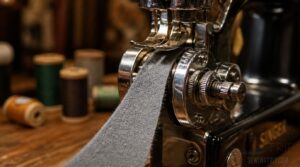
With the presser foot raised and discs unlocked, cut a fleece strip 8 to 10 inches long — roughly 0.5 to 1.5 millimeters thick — and slide it gently between the discs using minimal lateral pressure.
| Action | Why It Matters |
|---|---|
| Move fleece back and forth | Lifts lint without scratching disc faces |
| Keep fleece dry during insertion | Prevents liquid wicking into the mechanism |
Buff With Dry Fleece
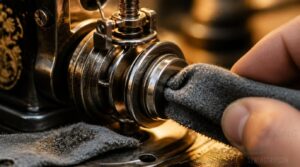
Once the fleece strip has lifted the debris, swap it for a clean, dry piece and run it between the discs using the same back-and-forth motion. This final pass polishes the metal surface smooth.
Apply isopropyl alcohol to the fleece — never directly to the discs — to protect any shellac finish nearby, then finish with a dry buffing pass to seal the clean tension discs.
Fix Tension Problems After Cleaning

Cleaning the discs is only half the job — what comes next determines whether your stitches actually improve. A few quick checks will tell you if the machine is responding the way it should. Here’s what to work through before you start your next project.
Rethread The Upper Path
After cleaning the tension discs, the upper thread path needs rethreading to restore proper thread passage:
- Seat thread firmly in the take-up lever groove
- Pass through each thread guide without friction points
- Confirm upper path clearance at every hook
- Balance settings so bobbin thread tension matches
- Eliminate crossovers that disrupt tension disc contact
A misaligned path always causes skipped stitches.
Test on Scrap Fabric
Grab a scrap that matches your project’s fabric weight — lightweight cotton behaves nothing like denim, and your tension settings won’t transfer between the two.
Run a short seam and check both sides. Uniform stitch length and a clean underside signal balanced tension. Start at midrange, then make 0.5 to 1 notch changes only, testing after each.
Check Underside Thread Loops
Flip your test fabric over — the underside tells the truth. Underside thread loops appear as small rounded bubbles mirroring your top stitch pattern, ranging from subtle arches to 2–3 mm gaps per stitch.
- Small loops = partial disc engagement
- Consistent loops at seam starts = threading error
- Bird nests = upper thread missing discs entirely
- Loops at thick sections = feeding mismatch
That pattern points directly to whether you need to clean tension discs or reseat your upper thread.
Adjust Tension Gradually
One notch at a time — that’s the only safe rule for tension adjustment after cleaning.
Set a mid-range baseline first, sew a short test seam on scrap fabric, then shift by one increment only. Record each change alongside the stitch result.
| Symptom | Adjustment | Re-test Step |
|---|---|---|
| Loops on underside | Increase upper tension | Sew a 3-inch seam |
| Thread breaks | Decrease tension slightly | Recheck threading path |
| Fabric puckers | Reduce in small steps | Switch to similar scrap |
Stop immediately if stitches skip.
Inspect Check Spring Movement
The check spring is the tension disc’s silent partner — if it misbehaves, no amount of disc cleaning will fix your stitches. Cycle the tension mechanism through its full range with no thread loaded and observe:
- Gritty or seized movement — debris trapped inside the spring housing
- Delayed tension response — misalignment or degraded spring force
- Spring won’t return to rest — clear sign of material fatigue
Prevent Future Tension Disc Issues

Cleaning your tension discs solves today’s problem, but a few consistent habits keep those problems from coming back. Think of it less as maintenance and more as protecting a tool you rely on. Here’s what actually makes the difference long-term.
Clean Monthly During Use
Regular maintenance doesn’t have to mean tearing your machine apart. Cleaning tension discs monthly during active use keeps lint, thread frays, and dust from wedging between disc gaps before they quietly wreck your stitch quality.
Slide a fleece strip between the released discs, buff, and you’re done — no disassembly, no disruption, just consistent machine performance through every project.
Never Oil Tension Discs
Oil does exactly what tension discs can’t afford — it reduces surface friction, undermining the consistent grip your discs rely on to feed thread evenly.
Oil is tension discs’ worst enemy — it destroys the very friction they need to grip thread evenly
Worse, oil attracts lint and dust, turning a small residue into a sticky trap that compounds buildup fast. When you clean tension discs, keep them completely dry. Never oil tension discs — not even lightly.
Cover Machine After Sewing
Keeping oil away from the discs is only half the battle. Dust settles constantly, even between sessions.
A fitted sewing machine cover — cotton canvas, laminated polyester, or quilted foam — blocks airborne particles from reaching internal components like the tension assembly. Velvet linings discourage adhesion, while sealed seams prevent infiltration.
Key cover features worth prioritizing:
- Breathable interior lining to prevent moisture condensation on metal parts
- Water-resistant outer shell for spill protection
- Elasticized edges to prevent shifting
- Double-layer construction to cut dust intrusion greatly
Cover your machine every time you finish sewing.
Use Quality Sewing Thread
A dusty cover protects your machine from outside — but what runs through it matters just as much.
Low-lint thread keeps tension discs cleaner between sessions. Polyester and core-spun options shed far less fiber than cheap alternatives.
| Thread Type | Best Use | Lint Level |
|---|---|---|
| Polyester | Woven fabrics | Low |
| Cotton | Lightweight garments | Moderate |
| Core-spun | General sewing | Very low |
Match thread weight to fabric — mismatches cause puckering.
Schedule Yearly Servicing
Even the most diligent home cleaning has limits. Once a year, a trained technician should inspect your machine’s internal timing, tension calibration, and safety systems — catching wear you simply can’t see.
- Book the service during a slow production period
- Bring your maintenance log
- Request tension disc inspection
- Ask about worn consumables
- File the report for warranty records
Frequently Asked Questions (FAQs)
Can tension discs wear out and need replacing?
Yes, tension discs do wear out. Continuous friction from thread and fabric gradually degrades their surfaces, and repeated high-tension adjustments accelerate that process — eventually making replacement the only reliable fix for restoring consistent stitch quality.
How do tension discs differ between sewing machine brands?
Brand manufacturing tolerances and disc materials vary widely — steel, brass, or coated plastics — affecting thread grip and stitch quality. Some brands integrate cartridge replacement systems for quick swaps, while others require servicing to accommodate different thread weights.
Can a beginner safely disassemble tension disc components?
Disassembly isn’t recommended for beginners. Spring tension hazards, warranty void risks, and small component loss make it genuinely risky. When in doubt, professional servicing protects both you and your machine far better than improvised repairs.
Conclusion
The assumption that tension problems always demand dial adjustments doesn’t hold up under scrutiny—most persistent stitch issues trace back to discs that simply haven’t been cleaned. Tension discs cleaning and maintenance isn’t a repair task reserved for technicians; it’s a baseline habit that keeps your machine performing consistently.
Clear the residue. Rethread with intention. Test before committing to a project. A machine that feeds thread cleanly doesn’t fight you—it works with you.
- https://www.sewingstreet.com/sewingstreet-hub/article/68/looking-after-your-sewing-machine
- https://quiltingroomwithmel.com/sewing-machine-tension-disks-cleaning
- https://pungolivinghome.com/2019/07/16/kenmore-upper-tension-assembly-how-to-disassemble-and-reassemble-it-the-right-way
- https://crafts.stackexchange.com/questions/10623/are-you-supposed-to-oil-the-upper-thread-tension-discs-on-a-sewing-machine
- https://www.productionmachining.com/articles/cleaning-and-corrosion-protection-with-solvents