This site is supported by our readers. We may earn a commission, at no cost to you, if you purchase through links.
The stocking hung by your grandmother’s fireplace probably wasn’t store-bought. Someone made it—stitched it by hand, chose the fabric with care, maybe embroidered a name near the cuff. That kind of stocking doesn’t just hold candy and small gifts; it holds decades of Christmas mornings.
Making your own puts you in that same tradition, and it’s far more achievable than most people expect. With the right fabric, a few key tools, and a clear sequence of steps, you can sew a Christmas stocking that your family will pull out of storage every single year.
Table Of Contents
Key Takeaways
- Choosing the right fabric — velvet, flannel, wool, or cotton — paired with mid‑loft batting and a cotton‑poly lining gives your stocking the structure and durability to last decades.
- Most standard stockings need less than a yard of fabric each for the exterior and lining, so careful measuring upfront saves you money and wasted material.
- Following a clear order — sewing the exterior, attaching batting, adding the lining, then finishing with the cuff and hanging loop — keeps the process smooth and beginner‑friendly.
- Small finishing details like clipping curves, pressing seams flat, and reinforcing the hanging loop are what separate a polished handmade stocking from one that looks rushed.
What Materials Do You Need to Sew a Stocking?

Before you cut a single piece of fabric, it helps to know what you’re working with.
A quick read through this beginner-friendly apron sewing guide can save you from costly mistakes before scissors ever touch your material.
Having the right tools and materials on hand makes the whole process smoother and a lot more enjoyable.
Here’s everything you’ll need to get started.
Essential Sewing Tools and Machines
The right tools make all the difference. Before you cut a single piece of fabric, gather these essentials:
- A free-arm machine for sewing curved stocking cuffs with ease
- A walking foot to feed batting layers evenly
- Proper needle selection — size 80 for cotton, size 90 for heavier layers
- The correct presser foot types for topstitching and trim
- Sharp cutting tools like rotary cutters and dressmaker shears
For precise stitching, consider the Clover 6-in-1 guide.
Best Fabrics for Stockings
Now that your tools are ready, it’s time to pick your fabric. Each material brings something special.
Velvet Luxury gives your stocking a rich, classic look.
Flannel Softness keeps things cozy and warm.
Wool Resilience holds its shape season after season.
Linen Versatility works beautifully for embroidered designs.
And Cotton Durability means your stocking endures years of holiday excitement without losing its charm.
Batting, Lining, and Interfacing Choices
Once your fabric is chosen, the inside layers make all the difference. Think of them as your stocking’s hidden foundation.
- Use mid-loft batting for soft, structured dimension without bulk.
- Try eco-friendly bamboo batting for a gentler, natural option.
- A cotton-poly lining keeps seams tidy and adds durability.
- Apply fusible interfacing to stiffen cuffs with just an iron.
- The layered quilting technique builds shape and holiday-worthy plushness.
Trims, Ribbons, and Embellishments
Now for the fun part. Trims and embellishments are where your stocking gets its personality.
Faux Fur Cuffs give that classic plush look — just cut your fur edges to reduce bulk before sewing. Satin Bow Techniques using red and gold ribbon for timeless elegance. Grosgrain Pattern Bows hold their shape beautifully over time. Add Pom Pom Placement at the toe for whimsy, or stitch Rickrack Braid Designs across the cuff in festive rows.
For a polished finish on your faux fur cuffs, mastering French seam techniques for clean interior edges keeps bulk minimal while locking everything neatly in place.
Consider hang stockings on mantel shelves for a sturdy, decorative base.
How Much Fabric is Needed for a Christmas Stocking?

Before you cut a single piece of fabric, it helps to know exactly how much you’ll need.
Getting the amounts right saves you from running short mid-project or buying way more than necessary.
Here’s a simple breakdown to guide you through fabric for the exterior, lining, and cuff.
Standard Stocking Size and Yardage Guide
Most standard Christmas stockings run 18 to 24 inches long, with a top opening between 6 and 9.5 inches wide — and those length-width ratios matter more than you’d think.
Your yardage calculation formula starts simple: half a yard covers one average stocking body.
Cuff height impact adds nearly 5 inches to your total, while foot section dimensions need roughly 8 inches in height.
Keep pattern scaling tips in mind if you’re sizing up or down.
Calculating Fabric for Exterior and Lining
Once you know your stocking size, the math gets surprisingly straightforward. Here’s what to plan for:
- Yardage formulas start at 7/8 yard for a cotton exterior
- Grainline alignment keeps directional prints from looking sideways
- Shrinkage allowance means prewashing cotton saves headaches later
- Layout efficiency lets you cut two exterior pieces from just 1/4 yard
- Pattern scaling adjusts these amounts up or down proportionally
Tips for Choosing Cuff and Accent Fabrics
Your cuff does more heavy lifting than you’d think. For Cuff Texture Pairing, try faux fur or soft fleece against a quilted exterior — the contrast feels intentional.
Accent Color Contrast works best with white or cream against deep red or bottle green.
Keep Weight Matching in mind: medium-weight cotton around 135–270 GSM holds shape beautifully.
Pattern Coordination and Durability Considerations matter too — pre-wash everything first.
How to Cut and Prepare Stocking Pieces

Once you’ve got your fabric ready, it’s time to cut everything into the right shapes.
This part feels a little like solving a puzzle — and getting it right sets you up for smooth sewing later.
Here’s how to print your pattern, cut each layer, and prep your cuff and hanger pieces.
Printing and Assembling a Stocking Pattern
Start by grabbing your PDF Download from a sewing site — it saves instantly and includes full printing instructions.
Before printing all pages, check your Printer Settings: select US letter or A4, then print page one only to run a quick Scale Verification using the 2‑inch test square. Once everything measures correctly, print the rest, follow the Page Alignment diagram, and use the Taping Technique to join rows cleanly.
Cutting Outer, Lining, and Batting Layers
Once your pattern is taped and ready, it’s time to cut. Fold your outer fabric right sides together, then align the pattern with the grain — Grain Alignment keeps curved seams from stretching out of shape.
Use Rotary Cutter Tips like steady, single-pass strokes through all layers for clean edges.
Follow a smart Layer Stacking Order: outer, batting, then lining separately.
For Batting Thickness Selection, low-loft works beautifully.
Apply Seam Allowance Strategies — add 1/2 inch around each piece.
Marking and Preparing Cuff and Hanger Pieces
Two small pieces, one big impact.
For your cuff, fold it in half with right sides together, sew the side seam, then turn it out and fold again — this gives you natural Quarter‑Mark Placement points for Pinning for Even Spacing around the top edge.
Use Air Marker Selection like an air-erasable pen for clean, temporary marks.
For Hanger Strip Folding, press each long edge inward, fold lengthwise, and topstitch.
Follow Seam Alignment Tips by pressing seams open before layering.
Step-by-Step Instructions to Sew a Christmas Stocking
Now comes the fun part — actually putting it all together. Each step builds on the last, so you’ll want to follow them in order. Here’s how to sew your stocking from start to finish.
Sewing Exterior and Lining Sections
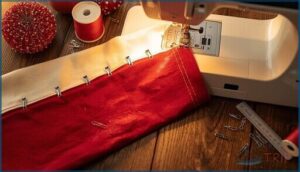
Place your two exterior pieces together, right sides facing in, and sew around the sides and bottom using a consistent half-inch seam allowance — seam allowance consistency matters more than you’d think.
Then do the same for the lining, but leave a two-inch opening for turning at the bottom. Use the curve clipping technique and pinning for curve stability so everything lies smooth and flat.
Attaching Batting for Structure

Now that your exterior and lining are sewn, batting gives your stocking that satisfying, structured feel. Here’s how to attach it cleanly:
- Choose wisely — fusible batting bonds with a hot iron; spray basting works great for quick layering.
- Trim edges for seam bulk management before stitching.
- Use needle-punch stability batting around curves to hold crisp shapes.
- Try quilting stitch patterns spaced 2–3 cm apart for even structure.
Constructing and Adding The Cuff

With your batting secure, the cuff is where your stocking really starts to look like Christmas. Cut your cuff fabric 5.5 by 19.5 inches, fold it wrong sides out, and stitch the short edge. These Cuff Seam Techniques keep everything aligned.
| Step | Detail |
|---|---|
| Cuff Fabric Choice | 5.5" × 19.5" rectangle |
| Cuff Topstitch Details | Fold bottom edge twice, topstitch flat |
| Cuff Trim Integration | Align trim to raw bottom edge |
Use Cuff Positioning Tips to tuck the cuff inside the stocking, right side facing the lining, matching raw edges carefully.
Sewing and Reinforcing The Hanging Loop

Now that your cuff is in place, the hanging loop needs just as much attention. Good loop seam reinforcement is what keeps your stocking on the mantel — not the floor.
- Use loop positioning tips: center the loop at the back seam, raw edges up, 1/2 inch from the top.
- Apply zigzag edge strength or double straight stitching for reinforcement stitching methods that hold firm.
- Finish with bar tack placement across the base for maximum hold.
How to Finish and Personalize Your Stocking

You’re almost there — hard part is done.
Now it’s time to give your stocking a finished, personal touch that makes it truly yours.
Here’s how to wrap things up and make it look like it came straight from a boutique.
Folding and Securing The Cuff
This is where stocking really comes to life.
Once your top seam is complete, pull the cuff out through the lining opening and fold it down evenly over the stocking body.
| Step | Detail |
|---|---|
| Cuff Alignment | Match seam to heel side |
| Layer Pinning | Secure all four layers |
| Ironing Technique | Press fold for crisp edge |
| Seam Reinforcement | Backstitch over loop area |
| Hanging Loop Placement | Position at heel corner |
Adding Decorative Trims and Embroidery
Personalizing your stocking is the most rewarding part of the whole project. Whether you’re focusing on Pom Pom Placement along the cuff fold or adding Piping Integration between layers, small details make a big difference.
Small details like pom poms and piping transform a simple stocking into something truly personal
- Faux Fur Detailing adds warmth and that classic Santa look
- Chain Stitch Names turn a simple stocking into a keepsake
- Satin Stitch Motifs like snowflakes bring festive sparkle to the cuff
Tips for a Professional-Looking Finish
Finishing strong is what separates a handmade stocking from a store-bought one. Focus on these details and your result will look truly polished.
| Technique | What to Do | Why It Matters |
|---|---|---|
| Seam Pressing | Press all seams flat with steam | Crisp, clean edges |
| Curve Clipping | Clip every ½ inch around curves | Smooth, pucker-free turns |
| Invisible Lining Closure | Ladder stitch the gap closed | Neat, hidden finish |
| Precise Topstitching | Stitch ⅛ inch from cuff edge | Secure, professional look |
| Hanging Loop Reinforcement | Stitch forward and back three times | Strong, lasting hold |
Frequently Asked Questions (FAQs)
What kind of fabric do you use to make Christmas stockings?
You can use cotton, velvet texture, flannel warmth, felt durability, brushed cotton, or tartan patterns. Each brings something different — cozy, festive, or structured — so pick what fits your style best.
How much fabric do I need to sew a stocking?
For most standard stockings, you’ll need about 7/8 yard each for the exterior and lining. Smart yardage calculations prevent fabric waste and keep budget-friendly sourcing realistic for your seasonal fabric choices.
Are Christmas stockings hard to sew?
Not at all. learning curve is gentle, the skill prerequisites are minimal, and the time commitment is under two hours.
basic straight stitches and simple tools, you’ll nail it on your first try.
How many layers are there when making a Christmas stocking?
Most Christmas stockings have three to five layers: an outer layer, a lining layer, and often a batting layer for body.
Add a cuff layer and loop layer, and you’re looking at five or more.
How much fabric is needed for standard-sized stockings?
For a standard 18-to-24-inch stocking, about 5/8 yard covers the exterior and lining of each.
Smart Yardage Estimation prevents Fabric Waste Reduction mistakes.
Budget Fabric Options stretch further with careful Pattern Scaling.
Can Christmas stockings be made without sewing machines?
Yes, you can absolutely make a stocking without a sewing machine.
Felt construction, no‑sew adhesives, glue techniques, ribbon loop hangers, and DIY patterns make it simple — hot glue bonds edges beautifully in minutes.
Whats the best way to store handmade stockings?
Store your handmade stockings in breathable storage bags with silica gel packets to control moisture.
Wrap each one in acid‑free tissue paper, keep them in temperature‑controlled closets, and try rotating stock placements every few months to prevent creases.
How long does it take to complete one stocking?
Most sewists spend 2 to 3 hours on one lined stocking. Prep Time runs 15 to 30 minutes, Sewing Duration varies by skill, and Finishing Time adds extra.
Beginner vs Expert gaps are real, but Batch Efficiency helps.
Are there beginner-friendly stocking patterns available for download?
Free PDF patterns, printable templates, crochet alternatives, knit patterns, and felt templates are all available online at no cost — giving you plenty of beginner-friendly options to download and start stitching right away.
Can beginners sew a stocking without prior experience?
Absolutely — and you don’t need much to get started.
A basic sewing machine, sharp scissors, and a free pattern are all it takes.
quick learning tips, simple tool setup, and avoiding common beginner mistakes build real confidence fast.
Conclusion
Stitch by stitch, you’ve just learned how to sew a stocking for Christmas that carries real meaning. This isn’t a craft project you’ll tuck away and forget—it’s something your family will reach for, year after year, recognizing the care sewn into every seam.
The cuff, the lining, the loop—each piece you cut and joined tells a quiet story. And every December, that story gets a little longer.
- https://londonsewingcourses.co.uk/sewing-blog/7-must-have-novice-sewing-machine-features/
- https://singerco.com.au/learn-create/sewing-machine-features-you-might-be-ignoring
- https://www.selfmade.com/nl-be/inspiration/ideas-for-sewing-projects/sewing-machine-needles-the-ultimate-guide/
- https://www.seamwork.com/sewing-tutorials/the-10-best-presser-feet-for-sewing-clothing
- https://www.artisanstitch.co.uk/sewing-machine-features/