This site is supported by our readers. We may earn a commission, at no cost to you, if you purchase through links.

The difference between a beautiful embroidered design and a mangled mess of thread often comes down to one thing: the software running behind the scenes. Ask any machine embroiderer what tripped them up first, and they’ll tell you it wasn’t the needle tension or the stabilizer choice—it was staring at a screen full of file formats they’d never heard of, wondering why their.PES file looked nothing like the preview.
Embroidery software has gotten genuinely good in recent years. The gap between a $39 thumbnail organizer and a $169 editing suite matters enormously once you understand what each one actually does. The best embroidery software for your setup depends on your machine, your skill level, and honestly, how deep you want to go.
Table Of Contents
- Key Takeaways
- Top 10 Best Embroidery Software Options
- 1. Embrilliance Essentials Embroidery Software
- 2. Embrilliance Enthusiast Embroidery Software
- 3. Embrilliance StitchArtist Level One
- 4. Embrilliance Embroidery Thumbnail Viewer
- 5. Embrilliance AlphaTricks Font Mapping Software
- 6. Brother Stitch Express Auto Digitizer
- 7. BuzzXplore Embroidery Design Manager
- 8. Letter It Embroidery Software
- 9. Embroidery Design Editing Software
- 10. Monogram It Embroidery Designer
- Types of Embroidery Software
- Key Features to Compare
- Choosing Software for Your Machine
- Pricing, Trials, and Licensing
- Best Picks by User Level
- Frequently Asked Questions (FAQs)
- Conclusion
Key Takeaways
- Embrilliance Essentials hits the sweet spot for most users at ~$139–$169, handling resizing, lettering, and multi-format merging without the steep learning curve or price tag of professional suites like Wilcom.
- Embroidery software splits into five distinct categories — thumbnail viewers, file converters, editors, auto-digitizers, and manual digitizing tools — and knowing which type you actually need stops you from overpaying for features you’ll never touch.
- Your machine’s brand dictates your file format (PES for Brother, JEF for Janome, DST for commercial machines), and not every software exports all three cleanly, so checking the export list before buying is non‑negotiable.
- Free trials typically run 14–30 days and often gate the most powerful features like photo‑stitch conversion behind upgrade prompts, so stress‑test with your real designs and actual export needs rather than just clicking through the demo.
Top 10 Best Embroidery Software Options
Whether you’re just getting started or ready to take your embroidery game to the next level, the right software makes all the difference.
Exploring home embroidery software options can help you find the perfect tool to match your skill level and creative goals.
These ten picks cover everything from budget-friendly basics to pro-grade digitizing tools, so there’s something here for every skill level and budget. Here’s what made the cut.
1. Embrilliance Essentials Embroidery Software
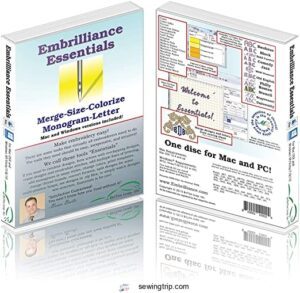
Embrilliance Essentials sits at $139 USD — a reasonable middle ground between free tools and pro-grade packages costing thousands.
It controls the tasks most embroiderers actually need: resizing designs with automatic stitch recalculation, merging files from multiple formats, recoloring thread palettes, and adding lettering in monogram or circular styles. The built-in stitch simulator lets you catch problems before wasting stabilizer and thread.
One honest caveat — it won’t convert JPG or PNG images into stitch files. That’s StitchArtist’s job.
| Best For | Hobbyists and small-business owners who want to edit, resize, and customize purchased embroidery designs without investing in a full digitizing suite. |
|---|---|
| OS Support | Windows 10/11, macOS 12+ |
| File Format Support | DST, PES, JEF, VP3, EXP, HUS, CSD |
| Design Preview | Stitch simulator |
| Installation Method | Disk-free download |
| Primary Function | Design editing |
| Target Skill Level | Hobbyist / Small business |
| Additional Features |
|
- Resizes existing stitch files with automatic recalculation, so designs scale cleanly without manual rework
- Handles lettering in monogram, multi-line, and circular styles using 21 built-in fonts plus importable BX fonts
- Cross-platform and easy to update — runs on both Windows and macOS with free downloadable updates
- Can’t convert raster images (JPG, PNG) to embroidery files — you’ll need a separate StitchArtist product for that
- No bundled guide or on-screen help system; you’re relying on external video tutorials to learn the software
- At $139 upfront, it may feel steep for casual users who only embroider occasionally
2. Embrilliance Enthusiast Embroidery Software
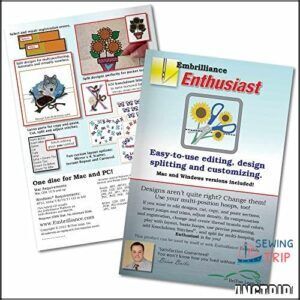
Think of Enthusiast as Essentials with the volume turned up. At $169 USD, it unlocks per-stitch and per-color selection, so you’re not stuck editing whole design blocks when one rogue satin column needs fixing.
The real draws are knockdown stitching — a lifesaver for towels and fleece — plus virtual-hoop support and repeat tools like carousel, scatter, and circular layouts. Enhanced stitch density controls let you push or pull coverage by up to 25 percent. Precise, practical, genuinely useful.
| Best For | Embroiderers working with textured or looped fabrics like towels and fleece who need advanced repeat tools and per-stitch editing without jumping to full digitizing software. |
|---|---|
| OS Support | Windows 10/11, macOS 13+ |
| File Format Support | Multiple embroidery formats |
| Design Preview | On-screen preview |
| Installation Method | Disk-free download |
| Primary Function | Repeat layout |
| Target Skill Level | Intermediate |
| Additional Features |
|
- Knockdown stitching makes clean embroidery on towels, fleece, and faux fur actually achievable
- Repeat layout tools (carousel, scatter, circular) speed up production of patterned apparel and décor
- Virtual hoop and multi-section design support cuts down on re-hooping time
- The advanced thread editor requires a separate Embrilliance Essentials purchase to unlock
- Steep learning curve with fewer official tutorials than more beginner-friendly options
- Not a full digitizing tool — you’re editing and arranging designs, not building them from scratch
3. Embrilliance StitchArtist Level One
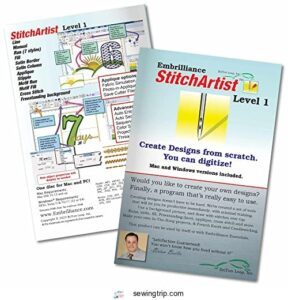
Once you’ve mastered Enthusiast’s editing tricks, StitchArtist Level One pulls you into actual digitizing, building designs from scratch instead of tweaking existing ones.
At $169, it hands you an automated shape tool for squares, circles, and ovals that converts instantly to running, satin, or fill stitches—no mode-switching needed. Bezier curves handle custom outlines too.
It’s beginner-friendly by design, though it sticks to simple appliques and fills rather than chasing logo-level complexity.
| Best For | Hobby embroiderers ready to move beyond simple edits and start digitizing their own basic appliqué, running-stitch, and fill designs from scratch. |
|---|---|
| OS Support | Windows 10+, macOS 10.15+ |
| File Format Support | Multiple embroidery formats |
| Design Preview | On-screen simulation |
| Installation Method | DVD + optional download |
| Primary Function | Basic digitizing |
| Target Skill Level | Beginner |
| Additional Features |
|
- Automated shape tool instantly converts squares, circles, and ovals into running, satin, or fill stitches without switching modes
- Bézier curve drawing allows for custom outlines beyond the basic shape presets
- Beginner-friendly toolset makes true digitizing approachable for first-time users
- Limited to basic stitch types, so logo-level or advanced embroidery techniques require pricier Embrilliance products
- Still involves a learning curve, particularly when adjusting entry/exit points and tracing
- Physical DVD installation can be inconvenient for users without an optical drive, requiring a separate digital download
4. Embrilliance Embroidery Thumbnail Viewer

Not every tool here is about building designs—sometimes you just need to find the darn thing in your folder. That’s where the Thumbnail Viewer earns its $39 price tag, generating realistic 3D previews right in Windows Explorer or Finder instead of generic icons.
Mac users should know. EXP files won’t preview on Big Sur or Monterey, though.
Still, for sorting a bloated design library, it beats squinting at filenames all day.
| Best For | Embroiderers and small studios juggling large, mixed-platform design libraries who want to visually spot and locate patterns right from Windows Explorer or Finder instead of clicking through files one by one. |
|---|---|
| OS Support | Windows XP–10, macOS 10.5+ |
| File Format Support | DST, PES, JEF, SVG, FCM, .studio |
| Design Preview | Realistic 3D thumbnails |
| Installation Method | Disk-less download |
| Primary Function | File thumbnail browsing |
| Target Skill Level | All levels |
| Additional Features |
|
- Generates realistic 3D preview thumbnails instead of generic file icons, making designs easy to recognize at a glance
- Works across both Windows and macOS, so mixed PC/Mac studios get consistent preview functionality
- Windows version also handles vector and cutting files like.svg, .fcm, and.studio, not just embroidery formats
- .EXP files won’t generate thumbnails on macOS Big Sur or Monterey due to OS restrictions
- Some users report compatibility issues with Windows 11 and certain bundled design packs
- Installation may require temporary admin privileges, which can be a hurdle on standard-user accounts
5. Embrilliance AlphaTricks Font Mapping Software
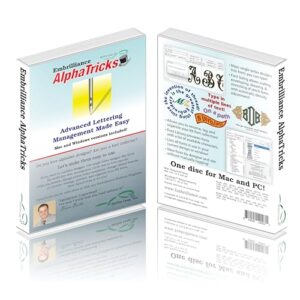
Font collectors, this one’s for you.
AlphaTricks ($105.56) solves a genuinely annoying problem: you’ve got dozens of beautiful letter files scattered across folders, but your embroidery software treats them like strangers. AlphaTricks maps those letters to keyboard keys, so they behave like built-in fonts inside any Embrilliance program — multi-line text, curved layouts, monograms, all without manually placing each letter.
The UI looks like it time‑traveled from 1998, and sizing happens post‑import rather than before, which takes some getting used to.
Given the steep learning curve on top of machine embroidery digitizing software costs that can reach $3,500, that workflow quirk is worth factoring in before you buy.
| Best For | Embroiderers who’ve built up a personal stash of letter files and want to turn that collection into a real, type-ready font for fast lettering work. |
|---|---|
| OS Support | Windows & macOS |
| File Format Support | BX font format |
| Design Preview | Visual font preview |
| Installation Method | Disk-free download |
| Primary Function | Font management |
| Target Skill Level | Intermediate |
| Additional Features |
|
- Maps individual letter files into a keyboard-ready font, so typing text works just like using a built-in font in any Embrilliance program
- Handles complex layouts easily, including multi-line text, monograms, italics, and text on a circle or spiral, without placing each letter by hand
- Comes with free downloadable updates and disk-free installers for current Windows and macOS, plus solid font organization tools for naming, sorting, filtering, and tagging
- The interface still looks like it’s stuck in the Windows 95 era, and there’s no word on future updates to modernize it
- Some users run into installation or serial-number hiccups that require reaching out to support
- Sizing happens after mapping rather than before, which can throw off your workflow if you’re used to setting size early on
6. Brother Stitch Express Auto Digitizer
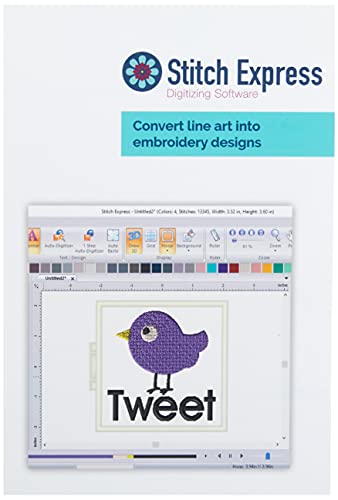
Got a logo or signature sitting in a folder, just waiting to become a patch? That’s exactly what Stitch Express ($199 or so, PC only) controls. Its wizard walks you through importing line art, picking from 60+ built-in designs, and filling shapes with 14+ patterns, no manual digitizing required.
Hoop support tops out at 10"x16", fine for hats and shirts. Just don’t expect it to handle intricate curves gracefully — the auto-digitizing engine keeps things basic, and some users find the interface clunky.
| Best For | Beginners and small-business owners who want to turn logos, signatures, or simple line art into embroidery files without hiring a professional digitizer. |
|---|---|
| OS Support | Windows only |
| File Format Support | Common embroidery formats |
| Design Preview | Wizard-guided preview |
| Installation Method | Physical media |
| Primary Function | Image digitizing |
| Target Skill Level | Beginner |
| Additional Features |
|
- Wizard-guided workflow makes it easy to import designs and get started with no prior digitizing experience
- Supports hoop sizes up to 10"×16", covering common projects like shirts, hats, and patches
- 60 built-in designs and 14 fill patterns give you plenty of creative options right out of the box
- Windows only — Mac users are completely left out
- Struggles with complex curves and detailed images, so results can look rough on intricate artwork
- The interface has a learning curve, and there’s no native drawing tool — you can only work with imported images
7. BuzzXplore Embroidery Design Manager
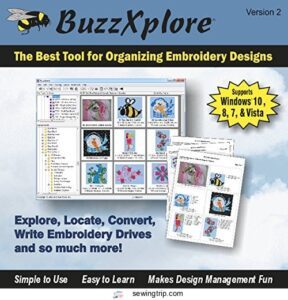
Think of BuzzXplore as the filing cabinet your design collection desperately needs. It browses, organizes, converts, and previews embroidery files — all in one place — so you’re not juggling three separate programs just to find a.dst file buried in a ZIP archive.
The 3-D thread preview is genuinely useful for visualizing stitches before you sew a single test run. Batch conversion, duplicate detection, and printable actual-size templates round it out nicely. Windows only, though.
| Best For | Embroidery enthusiasts and small shop owners on Windows who want one tool to browse, convert, and manage a large design library without paying for multiple vendor programs. |
|---|---|
| OS Support | Windows XP–10 |
| File Format Support | DST, PES, JEF, EXP, ZIP |
| Design Preview | Full-screen thumbnail view |
| Installation Method | Direct download |
| Primary Function | File conversion |
| Target Skill Level | All levels |
| Additional Features |
|
- Handles a wide range of file formats (.pes, .jef, .dst, .exp) and opens ZIP archives directly, so you’re not constantly unzipping folders manually
- Fast automatic conversion to.dst makes it a time-saver for anyone running 12-needle commercial machines
- Visual catalog with image thumbnails makes finding the right design quick, even in a large collection
- Intermittent crashes are a real frustration, especially mid-workflow
- Folder scanning only covers one directory at a time, so managing a deeply nested file structure gets tedious
- Windows-only with no macOS support, and some older machines like the Janome MC-10000 may run into compatibility issues
8. Letter It Embroidery Software
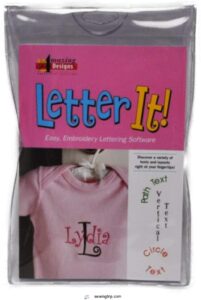
Lettering is where most embroidery projects live or die, and Letter It keeps it refreshingly simple. You get 35 built-in fonts, circular and path-based text layouts, and a Font Importer that lets you bring in any alphabet you already own — handy for brand consistency.
The real-time 3-D preview shows exactly how your text sits in the hoop before you commit. One catch: it’s locked to older 32-bit Windows versions, so Windows 10/11 users will need a workaround.
| Best For | Embroiderers who focus heavily on lettering and want a dedicated, easy-to-use tool for creating custom monograms, names, and text-based designs. |
|---|---|
| OS Support | Windows XP/Vista/7 |
| File Format Support | Common embroidery formats |
| Design Preview | Realistic 3D view |
| Installation Method | Direct download |
| Primary Function | Lettering |
| Target Skill Level | Beginner / Intermediate |
| Additional Features |
|
- 35 built-in fonts with flexible layout options — single-line, circular, path-based, and more
- Font Importer lets you bring in your own alphabet collections for brand consistency or unique styles
- Real-time 3-D preview shows exactly how text will sit in the hoop before you stitch
- Only compatible with older 32-bit Windows versions (XP, Vista, 7) — no native support for Windows 10/11 or macOS
- No built-in tutorials or user guide, so beginners are largely on their own
- Expanding your font library may cost extra, as premium fonts aren’t included
9. Embroidery Design Editing Software
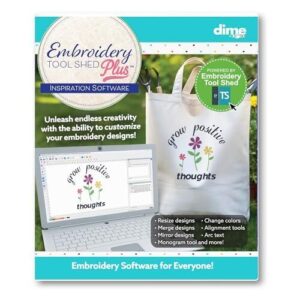
When a design isn’t quite right, editing software is your repair shop. You can adjust stitch density, clean up jump stitches, tweak underlays, and simplify paths — all without starting from scratch.
Batch processing processes multiple files at once, and undo/redo history saves you from small disasters. Formats like DST, PES, EXP, and JEF are all fair game. Think of it as fine-tuning an engine: the design already runs, you’re just making it run better.
| Best For | Hobbyists and small business owners who want to customize and combine existing embroidery designs without a steep learning curve. |
|---|---|
| OS Support | Windows 10+, macOS 10.13+ |
| File Format Support | Common embroidery formats |
| Design Preview | Dedicated preview module |
| Installation Method | USB bundle + download |
| Primary Function | Wireless design transfer |
| Target Skill Level | Beginner |
| Additional Features |
|
- Wireless transfer directly to supported Brother and Baby Lock machines makes sending designs fast and cable-free
- Works on both Windows and macOS, so you’re not locked into one platform
- Intuitive text tools make adding monograms and decorative lettering quick and easy
- Can’t create original stitch patterns from scratch — you’re limited to editing and merging existing designs
- Wireless transfer only works with select Brother and Baby Lock models, leaving other machine brands out
- Some users have run into file loading issues or corrupted installations
10. Monogram It Embroidery Designer
Monogram It is the rare tool that knows exactly what it is — and doesn’t try to be anything else. 24 monogram fonts, 25 built-in frames, and export to 18+ formats make it deceptively capable for something so focused.
You pick your initials, choose a frame, preview the stitch path, and export. That’s the whole loop. Windows XP through 7 only, though, so check your system specs before getting attached.
| Best For | Hobbyists and small-business owners who want a no-fuss way to create personalized monograms for apparel, tote bags, and gifts without a steep learning curve. |
|---|---|
| OS Support | Windows XP/Vista/7 |
| File Format Support | BLF, PES, JEF, VIP, 18+ formats |
| Design Preview | Draw Bar preview |
| Installation Method | Download available |
| Primary Function | Monogram creation |
| Target Skill Level | Beginner |
| Additional Features |
|
- 24 monogram fonts and 25 built-in frames give you plenty of variety without overwhelming you
- Stitch path preview helps you catch mistakes before you ever touch the embroidery machine
- Exports to 18 file formats, so it plays nicely with a wide range of hardware
- Font quality is hit-or-miss, and some popular styles (like the beloved "swirly" font) are missing entirely
- Only runs on Windows XP through 7, which is a dealbreaker for anyone on a modern system
- Activation key issues have been reported, which could mean extra troubleshooting before you even get started
Types of Embroidery Software
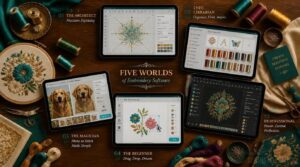
Not all embroidery software does the same job — and knowing the difference saves you from buying a $1,200 program when a free one would do. Each type is built around a specific task, whether that’s organizing your files or building a stitch design from scratch. Here are the five main types you’ll run into.
Thumbnail Viewers
Picture flipping through hundreds of.pes files without opening one. Thumbnail viewers give you that **visual verification**, displaying.jef, .pes, and.dst designs instantly. Why does this matter?

1. Spot mismatched colors fast

2. Skip corrupted files early

3. Compare designs side-by-side

Batch management and hardware acceleration keep large libraries smooth, while metadata overlays and cloud synchronization simplify **design library management**.
File Conversion Tools
Once thumbnails sort your keepers, embroidery file conversion bridges machine gaps. File conversion software controls Format Compatibility between.jef, .pes, .dst—no re-digitizing needed.
Batch Processing converts hundreds at once; Conversion Error-handling flags corrupt files. These design file conversion utilities preserve Metadata Preservation and enable Workflow Automation, even helping convert images to embroidery while smoothing design import/export across brands.
Editing Programs
Once your files convert cleanly, editing programs let you actually shape the design. This is where resizing designs, splitting patterns, and stitch color modification happen, plus thread color changes and layout tweaks.
- Resize without distorting density
- Split oversized patterns for smaller hoops
- Recolor threads to match fabric
- Adjust layout before stitching
Good embroidery editing software controls this fast, no re-digitizing required.
Auto-digitizing Software
Editing tools shape designs; autodigitizing software builds them from scratch, no manual plotting needed.
| Feature | What It Does |
|---|---|
| AI Tracing Accuracy | Raster-to-Vector Conversion follows edges precisely |
| Stitch Density Optimization | Balances fabric stability, thread use |
| Automated Color Mapping | Matches threads to artwork |
| Real-time Stitch Preview | Shows paths pre-export |
This embroidery digitizing software speeds image to embroidery conversion dramatically—handy embroidery design software, honestly.
The software also offers AI driven accuracy for cleaner outlines and smoother stitching.
Manual Digitizing Applications
Unlike auto-digitizing, manual digitizing software hands you total creative control — stitch by stitch. Using a digitizing tablet, you place nodes, pull Bezier levers, and fine-tune curves with surgical precision.
Pull compensation settings prevent fabric distortion, while stitch density optimization keeps texture consistent. It’s slower, but for professional embroidery services demanding pixel-perfect fidelity, nothing else comes close.
Manual digitizing is slower, but for pixel-perfect fidelity, nothing else comes close
Key Features to Compare
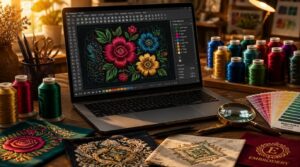
Not all embroidery software features are created equal, and the ones that matter most depend entirely on what you’re trying to make. Before you spend a dime, there are a handful of capabilities worth checking off your list. Here’s what to look for when you’re comparing your options.
Auto-fabric Assist
Auto-fabric assist is the feature that stops you from guessing. Instead of manually tuning stitch spacing, pull compensation, and underlay patterns for every fabric, the software reads your fabric type — cotton, knit, twill — and sets those parameters automatically.
Knits get stretch-aware underlays. Dense fabrics trigger wider satin underlays. It even recommends stabilizer weight, keeping your embroidery design workflow consistent without trial-and-error ruining a single stitch.
Multi-hooping Support
When a design outgrows your hoop, multi-hooping support takes over — splitting the artwork into synchronized sections so nothing gets lost between passes.
Good software controls this through:
- Registration marks printed on fabric before stitching begins
- A sequential hoop order (left-to-right or top-to-bottom)
- A hooping log tracking size, orientation, and stitch counts per section
That structure keeps your embroidery production clean and your alignment errors nonexistent.
Photo-Stitch Conversion
Think of photo-stitch conversion as a translator — it takes a photograph and renders it in thread.
The software uses feature detection methods and panorama alignment techniques to map your image accurately, then applies smooth color blending and image exposure balance to keep tones consistent.
That pixel-to-stitch conversion process reduces stitch distortion dramatically, turning a snapshot into embroidery‑ready data through clean auto‑conversion from SVG or raster sources.
Font Conversion Tools
Your lettering is only as good as your font engine plugin can translate it. Converting TTF to OTF — or pushing either into embroidery file formats — means preserving kerning data so letters don’t crowd or drift.
Three reasons font tools matter:
- Batch font processing saves hours when digitizing entire alphabets
- Dyslexia-friendly fonts improve accessibility across projects
- Automatic font digitizer tools eliminate tedious stitch-by-stitch lettering work
Redwork Outline Function
Redwork strips embroidery down to its purest form — single line outlines that trace a motif cleanly, without dense fills weighing things down. Your digitizing software controls this through continuous loop creation, planning a stitch path that starts and ends at the same point.
That’s what eliminates awkward stops mid-design. Good stitch path optimization in your embroidery design editor keeps jump stitches nearly invisible, honoring the delicate running stitch aesthetics, redwork is built on.
Choosing Software for Your Machine
Not every piece of software plays nicely with every machine, and picking the wrong one can mean hours of reformatting headaches before you stitch a single thread. Your machine’s brand, hoop size, and operating system all quietly shape which software will actually work for you. Here’s what to check before you commit.
Operating System Compatibility
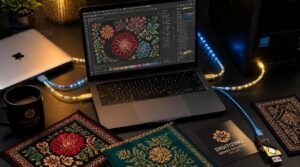
Before downloading anything, check whether it runs on your OS. Embrilliance and Hatch support both Windows and macOS natively, while Floriani Total Control U is Windows-only. Ink/Stitch covers Linux too.
64-bit architecture is increasingly required, and outdated OS versions cause driver conflicts. Keep security patches current — some tools verify licenses online, and an unpatched system can quietly block that handshake.
Machine File Formats
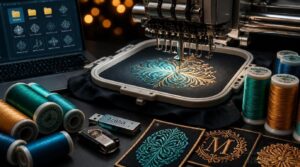
Your OS compatibility is sorted — now your software needs to actually speak your machine’s language.
Every brand has its own format: DST, PES, JEF are common, but proprietary formats pack in machine-specific commands that generic files can’t replicate. Conversion between formats risks minor detail loss — color stops, fill timing, underlay settings.
- DST: widely compatible, minimal metadata
- PES: Brother-native, richer color data
- JEF: Janome-specific encoding
- Open formats: broader but less precise
- Proprietary formats: full-feature, brand-locked
Check your software’s export list before buying.
Hoop Size Support
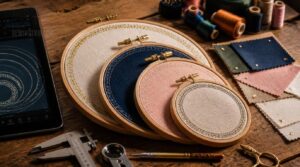
File format sorted — now hoop size is where things get physical.
Your software needs to know your hoop’s exact inner diameter, because hoop measurement precision affects stitch registration, especially near edges. Heavier fabrics need larger openings; lighter ones hold tension better in smaller hoops. For multi-hoop projects, look for software that maps segments automatically — otherwise, aligning panels becomes a guessing game.
Brand-specific Workflows
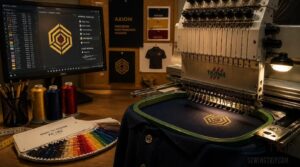
Hoop size gets your panels lined up — but brand-specific workflows keep everything on-brand once the stitching starts.
If you’re producing for a client or running a shop, your software needs to enforce asset naming conventions, flag unapproved fonts, and route designs through approval gates before export. Skipping that step is how a logo ends up slightly off-color on a thousand hats.
Hardware Requirements
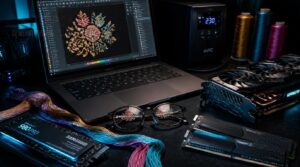
Your machine’s ability to keep up matters more than people expect. 4 GB RAM minimum, though 8 GB controls multitasking without grinding to a halt.
- 64-bit CPU at 2 GHz+ for modern software compatibility
- SSD storage cuts load times dramatically
- Dedicated GPU improves Photo-Stitch color accuracy
- UPS protection guards designs during power outages
Pricing, Trials, and Licensing
Embroidery software pricing can feel like a maze — and getting it wrong means either overpaying or getting locked into something that doesn’t fit your workflow. Before you spend a single dollar, there are a few things worth understanding about how these programs are sold, tested, and licensed. Here’s what to know before you commit.
Free Versus Paid
Free embroidery digitizing software like Ink/Stitch costs nothing upfront, but you’ll hit walls fast — limited auto-digitizing, narrow format exports, and community-only support when things break.
Paid embroidery digitizing software flips that. You get full precision tools, regular updates, and actual vendor help. The hidden cost of free? Lost time patching workarounds. For serious projects, that trade-off rarely wins.
Subscription Versus One-time
Think of it like buying a sewing machine versus renting one.
One-time purchases — like Embrilliance Essentials at $149 — give you permanent ownership with no renewal anxiety. Subscriptions, though, bundle updates and support into the monthly cost.
If embroidery drives your income, that steady access has real value.
Casual hobbyists? A perpetual license almost always wins on total spend.
Free Trial Strategy
Most embroidery software trials run 14 to 30 days — enough time to test real workflows, not just poke around menus. Use that window deliberately: load your own designs, test auto-digitizing, and try exporting actual files.
Watch for feature gating. Powerful tools like Photo-Stitch often hide behind upgrade prompts, so you know exactly what you’re paying to enable.
Authorized License Sources
Buying from authorized retailers only protects you from cracked software loaded with malware — and keeps your license valid for updates and official support.
- Verifying licensee status before purchase
- Access to official support channels
- Protection against malware risks
- Eligibility during license compliance audits
Many vendors offer 14-day refund policies as backup if a trial didn’t reveal everything.
Best Picks by User Level
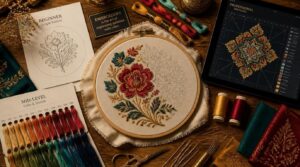
Not every embroidery software fits every person — what works for a beginner fumbling through their first design is going to frustrate a commercial digitizer who needs speed and precision.
Your skill level, workflow, and goals should drive the decision more than any feature list or price tag.
Here’s how the best options stack up across five different types of users.
Beginners
Starting out, Embrilliance Essentials makes the most sense — drag-and-drop placement, built-in guided tours, and beginner hoop presets for 4×4 and 5×7 sizes mean you’re not guessing. Swap thread colors with one click, lean on starter motif libraries, and use the free trial before committing.
Digitizing for beginners doesn’t have to be overwhelming when the software genuinely holds your hand.
Hobby Sewists
Hobby sewists juggle home decor projects, upcycling old clothes, and beginner sewing projects — embroidery software needs to flex with that range.
A free trial version of Embrilliance Essentials covers most bases:
- Recolor designs to match fabric selection
- Resize motifs for cushion covers or curtains
- Merge lettering onto upcycled garments
- Share finished files with community sewing groups
Unlike a commercial digitizer, you don’t need industrial precision — just reliable, simple tools.
Monogramming Projects
Monogramming sits at the sweet spot between custom gift ideas and professional branding. Whether you’re stitching baby keepsake projects or adding logos to company polos, the right embroidery design editor controls lettering and fonts without headaches.
| Project Type | Software Pick | Key Feature |
|---|---|---|
| Baby blankets | Embrilliance Essentials | Font conversion |
| Business apparel | Stitch Artist | Logo digitizing |
| Home decor | Hatch Embroidery | Multi-hooping |
Thread color contrast and textile placement tips — like centering initials just 3 inches from a shirt collar — separate rushed results from truly polished ones.
Design Organization
Once your monogram library starts growing, chaos creeps in fast. Batch processing tools and cloud-based design storage keep hundreds of files searchable instead of being buried.
Embrilliance’s customizable workspace lets you assign folders by project type, while a shared design library template gives your whole team consistent access. Good workflow documentation means no one is hunting down the right .pes file at deadline.
Commercial Digitizers
When file organization is dialed in, the next bottleneck is usually output quality.
For commercial digitizers, that means one thing: Wilcom. It’s the industry standard for professional quality stitching — precise, adaptable, built for volume.
The enterprise-level features justify the price if embroidery is your business, not just your hobby.
Frequently Asked Questions (FAQs)
What is embroidery digitizing software?
The strangest thing about embroidery digitizing software is that it turns a picture into thousands of tiny decisions — automatically. It controls stitch path creation, assigns satin or fill stitches, and outputs machine-ready files your embroidery machine can actually sew.
What is the best embroidery software?
The answer depends entirely on where you are in your embroidery journey. Embrilliance Essentials suits most users, while serious digitizers lean toward Hatch or Wilcom for precision and power.
How many embroidery software options are there?
Depending on what you count, there are 8 to 12 widely used programs for home and small business use — though niche tools push that number past a dozen when you include format-specific utilities.
What are the best embroidery digitizing services?
Like scribes illuminating manuscripts, the best embroidery digitizing services combine artistry with precision. Top picks offer 2–24 hour turnaround, DST/PES/JEF compatibility, manual stitch quality, and transparent pricing — often per 1,000 stitches.
What software is best for embroidery designs?
Wilcom EmbroideryStudio leads for professional digitizing workflows, while Embrilliance Essentials suits beginners. For open-source vector conversion, Ink/Stitch wins. Brother PE Design controls machine-friendly formats best.
What is the best embroidery software for 2026?
Embrilliance Essentials controls most tasks beautifully at $149, but for serious commercial digitizing, Wilcom EmbroideryStudio e4 remains the industry leader — precise, production-ready, and worth every penny.
Do you need embroidery software?
Not always. If you’re stitching ready-made designs, your machine controls it fine via USB. Software becomes essential when you want to create or customize your own work.
What is embroidery editing software?
Embroidery editing software translates digital artwork into stitch data your machine can actually sew — letting you resize, recolor, and preview designs before a single thread touches fabric.
What is the best cross stitch software for embroidery?
The best cross stitch software actually does less, not more. PCStitch wins for chart creation tools and pattern library access, while Embird’s cross-stitch plugin controls cross-stitch conversion with solid texture impression features — ideal for beginners.
How does embroidery software enhance creativity?
Good software turns a blank hoop into a creative playground. With rapid design refinement, real-time stitch simulation, and tools for mastering color palettes, you can experiment freely — and see exactly how your ideas will stitch out.
Conclusion
A craftsman is only as good as their tools. The best embroidery software won’t replace your eye for design, but it will stop your machine from turning a clean monogram into a knotted disaster.
You’ve now got the full picture—from thumbnail viewers to professional digitizing suites—so the guesswork is gone. Match software to your machine, your skill level, and where you want to go next.
The right choice is already in this list.
- https://www.machineembroiderygeek.com/what-embroidery-digitizing-software-should-i-buy-pros-and-cons-of-the-most-popular-digitizing-software
- https://www.embpunch.com/blog/best-free-embroidery-digitizing-software-we-tested-them-all
- https://www.maggieframes.com/blogs/embroidery-blogs/auto-digitizing-embroidery-software-transform-images-into-flawless-stitches-effortlessly
- https://hatchembroidery.com
- https://risedigitizing.com/auto-digitizing-embroidery-software