This site is supported by our readers. We may earn a commission, at no cost to you, if you purchase through links.
You’ve narrowed your project down to the perfect pattern and fabric, but your sewing machine can’t deliver the stitch quality you need—or worse, it jams halfway through a seam. The right home sewing machine models transform frustrating limitations into creative freedom, whether you’re hemming curtains or constructing custom garments.
Modern machines offer everything from 600 built-in stitches with touchscreen controls to efficient mechanical designs that handle heavy denim without breaking stride. The challenge isn’t finding a machine—it’s identifying which features actually match your projects, skill level, and workspace.
Understanding the differences between computerized precision, mechanical reliability, and specialized functions like serging puts you in control of your investment and sets you up for years of successful sewing.
Table Of Contents
- Key Types of Home Sewing Machines
- Essential Features to Compare
- Performance and Usability Considerations
- Maintenance and Longevity Tips
- Top 10 Home Sewing Machine Models
- 1. Brother Computerized Sewing Machine Model
- 2. Janome Lovely Lilac Sewing Machine
- 3. Brother Computerized Sewing Machine
- 4. Singer Quantum Stylist Sewing Machine
- 5. Bernette Computerized Sewing Embroidery Machine
- 6. Brother Sewing And Embroidery Machine
- 7. Heavy Duty Sewing Machine
- 8. Juki Straight Stitch Sewing Machine
- 9. Singer Portable Sewing Machine Kit
- 10. Brother Open Toe Walking Foot
- How to Choose The Best Model for You
- Frequently Asked Questions (FAQs)
- Conclusion
Key Types of Home Sewing Machines
Before you commit to a specific model, you need to understand the five main categories that define how sewing machines operate. Each type uses different mechanisms and control systems, which directly affects what you can create and how quickly you’ll master your projects.
Here’s what separates one machine from another and how to match the right type to your sewing goals.
Computerized Sewing Machines
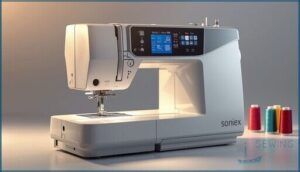
Computerized sewing machines give you powerful automation and digital precision that mechanical models simply can’t match. Most units offer 80–260 built-in stitches, USB connectivity, and LCD touchscreens for easy stitch customization.
- Thread management through automated tensioning and needle threaders
- Sewing automation with one-touch buttonhole creation and tie-off functions
- Digital interfaces that store your preferred settings for quick project switching
Models like the Brother XR9550 showcase how computerized sewing transforms your creative workflow. To further improve your understanding, exploring subtopic research can help you navigate complex ideas in sewing and beyond.
Mechanical Sewing Machines
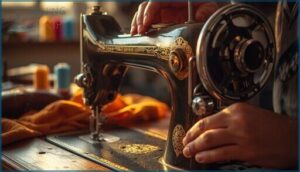
Mechanical sewing machines strip away digital complexity and hand you pure, hands-on control. Around 58% feature fixed needle plates with manual tension dials that let you feel fabric tension adjustments in real time. With metal frames delivering stable sewing speed up to 900 stitches per minute, you’re mastering the machine’s mechanical parts through direct user interface interaction—no screens required.
Understanding the importance of research output development can help you make informed decisions when choosing a sewing machine.
Electronic Sewing Machines
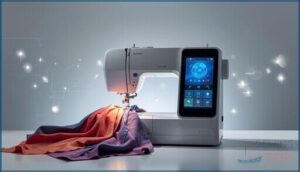
Electronic machines bridge manual control and full automation, giving you smart features without overwhelming complexity. Around 52% offer stitch memory and programmable sequences, while 61% automatically adjust tension across fabric types.
Digital displays guide you through variable speed settings and soft-start modes, preventing fabric distortion on delicate materials.
You’ll master computerized sewing machine features through user-friendly electronic controls that respond to your creative vision—no complicated menus slowing your workflow.
Sergers and Overlock Machines
When garment edges demand professional finishes, sergers and overlock machines take command. About 72% support 2-, 3-, and 4-thread configurations, while 58% provide differential feed for stretchy fabrics. You’ll achieve clean hems and seam binding through:
- Color-coded threading paths that cut setup time by 15–25 minutes
- Adjustable blade clearance for safe, quick changes
- Built-in presser foot pressure controls for uniform edge finishes across varied materials
Manual Sewing Machines
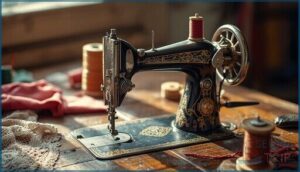
Simplicity meets freedom when you choose manual controls and hand crank operation. About 64% of portable design models weigh under 12 pounds, while 41% provide mechanical stitch options with explicit tension guides.
You’ll master sewing techniques without electricity, relying on a foot pedal or hand power. These sewing machine types excel in small spaces, and 22% feature durable cast-iron frames requiring minimal sewing machine maintenance.
Essential Features to Compare
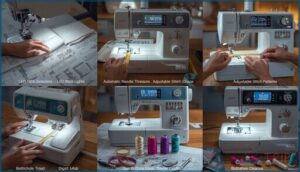
Not all sewing machines are built the same, and knowing which features actually matter can save you from buyer’s remorse down the road. The specs that look impressive on paper don’t always translate to real-world performance at your sewing table.
Let’s break down the essential features you should compare before making your choice.
Stitch Variety and Styles
You’ll find that stitch patterns form the backbone of any sewing machine’s capability—ranging from 10–60 utility stitches on mechanical models to 80–200 presets on computerized sewing machines. When comparing fabric choices and sewing techniques, focus on these essentials:
- Straight, zigzag, and overcast stitches handle 90% of routine tasks across varied thread colors and fabric types
- Decorative stitches and embroidery designs expand creative options, especially on embroidery machines with 5–20 motif families
- Stretch and satin stitch selection prevents seam breakage on knits by up to 40%
Presser Feet and Accessories
Upgrading your presser feet arsenal unlocks techniques you didn’t know your machine could handle. You’ll discover that 82% of home sewers rotate at least three foot types—walking feet cut slippage by 15 percentage points, while snap-on systems save four minutes per project. Here’s how specialty feet enhance your work:
| Foot Type | Primary Use | Performance Boost |
|---|---|---|
| Walking Foot | Wovens, slippery fabrics | 15% less slippage |
| Overlock/Serger Foot | Edge finishing | 25–40% faster completion |
| Embroidery Feet | Satin stitch, decorative work | 14–20% stitch uniformity |
| Clear-View Foot | Precision seams, appliqué | 6–12% accuracy gain |
| Rolled-Hem Foot | Hem edges, delicate fabrics | 22% higher satisfaction |
Anti-slip grips on presser feet reduce fabric shifting by 10–14% at seams, and pressure-adjustable variants decrease needle deflection on heavyweight layers by 9–13%.
Computerized models with quick-change systems support universal shank compatibility—68% offer tool-free swaps—so you can expand your sewing accessories and supplies without brand lock-in. Clear sole options let you monitor thread tension and stitch placement in real time, improving operator confidence by 10–15%.
Stock up on these threading tools and embroidery feet to master every project with foot compatibility that grows alongside your skills.
Bobbin Systems and Threading
Smooth, reliable bobbin winding sets the stage for every seam you’ll stitch. Modern sewing machines with a top drop-in bobbin system reduce thread tangling by 24% compared to front-loaders, while an automatic needle threader cuts setup time by 40–60 seconds.
You’ll find that thread tension adjustment and needle synchronization—accurate within ±0.2 mm—improve stitch uniformity by up to 20%, making bobbin maintenance essential for consistent sewing techniques and tips.
Frame Construction and Durability
Your machine’s frame decides whether it’ll last a decade or a lifetime. Cast aluminum and metal frames in mid-range models deliver 40–60% higher rigidity than plastic, cutting vibration damping issues and boosting seam accuracy by up to 25% on heavy-duty sewing projects.
Stress testing shows these durability factors matter: metal-framed machines tolerate twice the cycles, making machine maintenance easier and sewing machine reviews consistently favor solid frame materials for mechanical sewing reliability.
Automated Functions and Controls
Sensor technology transforms threading frustration into ease—72% of computerized sewing machines adjust thread tension in real-time, while 54% include auto threading and built-in cutters.
Your computerized sewing machine buying guide should prioritize stitch memory and smart displays that store customizable settings across projects.
These automated features cut setup time by 40%, letting you master weaving and complex stitches with precision computerized sewing delivers.
Performance and Usability Considerations
Performance and usability make or break your sewing experience, no matter how impressive a machine looks on paper. You need to know how it manages real-world tasks—from basic straight seams on cotton to maneuvering bulky denim layers and creating precise buttonholes.
Here’s what separates machines that deliver consistent results from those that’ll leave you frustrated.
Ease of Setup and Operation
You’ll find that most modern machines—especially computerized sewing machine models—slash your setup times dramatically. Quick start guides and automatic threading help 72% of beginners get going in under 15 minutes.
Look for user interfaces that feel straightforward, automated features like needle threaders, and noise reduction technology. These sewing tips and tricks for beginners transform intimidating first experiences into confident starts.
Stitch Quality on Different Fabrics
Once your machine is running, fabric tension and stitch selection become your next hurdle. Polyester knits deliver 92/100 quality scores, while cotton jersey performs 3% better on computerized models.
You’ll see thread breakage spike by 8% on delicate fabrics with standard feet. Stitch density stays stable within ±1 SPI on lightweight knits, but puckering risk climbs 1–2% on satins without proper adjustments—seam integrity depends on matching settings to material.
Handling Thick and Multiple Layers
When thick fabric sewing demands more from your machine, heavy duty models show their strength. You need a 90/14 needle and walking foot to manage 3–4 layers of denim without skipped stitches—multiple layer feeding stability drops 15% with standard feet.
Layered quilting with batting requires adjusted presser foot pressure and servo speed control for consistent bulk fabric handling.
Heavy duty stitching through canvas or leather-plus-fabric composites tests machine durability, so check throat space and stitch regulators before tackling heavyweight projects.
Buttonhole Features and Accuracy
Your 1-step buttonhole on a computerized sewing machine should hit ±0.5 mm accuracy on standard fabrics—manual models drift closer to ±1.5 mm. Stitch density (8–12 SPi) and automated settings control buttonhole precision across silk, denim, and knits.
- Thread tension misalignment raises rejection rates by 6–9%
- Stabilizers cut knit curl incidents by 60%
- Walking feet improve fabric compatibility by 25–50%
- Stitch selection directly affects buttonhole wall smoothness
Weight and Portability
Machine weight shapes your freedom to sew anywhere—portable machines average 10–15 pounds, while heavy-duty sewing builds climb to 20 pounds for cast-iron stability.
Lightweight materials and compact designs in computerized sewing machines deliver flexibility, yet mechanical sewing machine frames offer durability.
Look for grip bars on 40–60% of midrange models and assess portability features against your workspace needs and fabric demands.
Maintenance and Longevity Tips
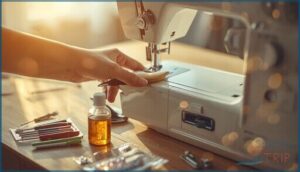
Your sewing machine is an investment, and like any tool, it’ll last longer when you take care of it properly. Regular maintenance prevents frustrating breakdowns and keeps your stitches looking crisp for years to come.
Treat your sewing machine like an investment—regular maintenance prevents breakdowns and keeps your stitches looking crisp for years
Here’s what you need to know about keeping your machine running smoothly, fixing common hiccups, and getting help when you need it.
Cleaning and Oiling Routines
Regular machine lubrication keeps your sewing efficiency at its peak. You’ll want to oil your Brother machine every 8–12 hours of use for aluminum components, following manufacturer-approved oil types.
Clean the bobbin area monthly to cut lint buildup by 30%, and always test on scrap fabric after oiling.
Proper cleaning schedules and maintenance tips guarantee your sewing projects run smoothly for years.
Troubleshooting Common Issues
Precision falls apart when small glitches snowball into project delays. You’ll solve about 23% of skipped stitches by matching needle size to your fabric, while monthly bobbin area cleaning cuts stitch inconsistencies by up to 28%.
Here’s what you’ll tackle most often:
- Thread breakage from incorrect needle type or worn components
- Tension issues caused by misrouted thread paths or wrong presser foot height
- Bobbin winding problems creating loose or uneven tension
- Fabric bunching when feed dogs don’t engage properly
- Stitch inconsistencies linked to lint buildup in bobbin cases
Re-threading your computerized sewing machine or mechanical sewing machine in the correct sequence reduces recurring faults by 22%, helping you master your sewing needs with confidence.
Access to Repairs and Servicing
You won’t master your sewing needs if repair access vanishes when your heavy-duty machines or SINGER machines break down. About 68% of households find local dealers within 20 miles, yet rural zones drop to 25–35% coverage. Repair wait averages 5–7 business days in cities, while repair cost hits 20–40% of the original price for computerized models—steering many toward replacement over service centers.
| Repair Factor | Urban Areas | Rural Areas |
|---|---|---|
| Local Service Access | 68% within 20 miles | 25–35% coverage |
| Average Wait Time | 5–7 business days | Limited availability |
| Out-of-Warranty Cost | 20–40% of purchase price | Same, fewer options |
| Authorized Centers | Manufacturer parts, 12–24 month warranty | Sparse distribution |
| Mobile Repair Options | Available in metro zones | Rarely accessible |
Warranty and Customer Support
You deserve peace of mind when investing in SINGER machines or any computerized model. Median warranties span 1–3 years for mechanical units and 2–5 years for high-end sewing machines, while extended coverage runs up to 25% of your purchase price.
About 72% of users get customer support responses within 24–48 hours, and warranty claims process in 2–4 weeks—connecting you to repair services and authorized service centers.
Top 10 Home Sewing Machine Models
You’ve learned what features matter and how to keep your machine running smoothly. Now it’s time to see which models actually deliver on those promises.
Here are ten home sewing machines that stand out for their performance, reliability, and value across different skill levels and budgets.
1. Brother Computerized Sewing Machine Model
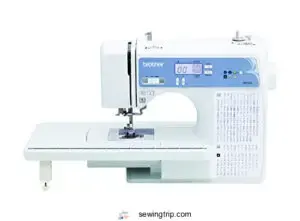
When you’re weighing Machine Comparison factors for your next upgrade, the Brother XR9550 stands out among the Best Sewing Machines. This Computerized Sewing marvel delivers 165 built-in stitches—including 55 alphanumeric options—and an LCD display that puts you in control.
You’ll appreciate the automatic needle threader and eight Sewing Accessories like presser feet that handle Sewing Projects from quilting to garment construction. Brother Models like this combine Computerized Features with portability, though thick fabrics may challenge it.
These Sewing Innovations make sophisticated techniques accessible.
Best For: Beginners and intermediate sewers who want versatility and ease of use without the complexity or price tag of professional machines.
| Built-in Stitches | 165 |
|---|---|
| Automatic Needle Threader | Yes |
| Weight | 10.1 lbs |
| Brand | Brother |
| Buttonholes | 8 styles |
| Display Type | LCD |
| Additional Features |
|
- 165 built-in stitches with automatic needle threading and an LCD display make setup quick and stitch selection straightforward
- Includes 8 presser feet and a wide table right out of the box, so you can tackle different projects without buying extras
- Lightweight at just over 10 pounds, making it easy to move between your sewing space and classes
- Struggles with heavy-duty fabrics like denim or canvas, limiting what you can make
- Some users report needle breaks during regular use, which can interrupt projects
- The top cover doesn’t latch securely, so you’ll need to be careful when transporting it
2. Janome Lovely Lilac Sewing Machine
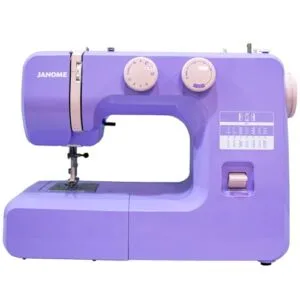
If you’re comparing Best Sewing Machines for beginners, the Janome Lovely Lilac earns its place in any Sewing Machine Comparison. This Computerized Sewing model offers 15 built-in stitches and a front-loading bobbin system wrapped in a heavy-duty metal frame that weighs just 12 pounds.
Janome Features like the automatic four-step buttonhole and adjustable stitch length give you control over Sewing for Beginners projects—garment sewing, quilting, home decor—while included Sewing Accessories and a 25-year warranty make Machine Upgrades feel less urgent, letting you master fundamentals before moving on.
Best For: Beginners and intermediate sewists who want a reliable, lightweight machine with enough built-in stitches and automated features to handle garments, quilting, and home decor without feeling overwhelmed.
| Built-in Stitches | 15 |
|---|---|
| Automatic Needle Threader | No |
| Weight | 12 lbs |
| Brand | Janome |
| Buttonholes | 4-step |
| Display Type | None |
| Additional Features |
|
- Heavy-duty metal frame keeps the 12-pound machine stable during use while still being portable enough to move or store easily.
- 15 built-in stitches plus a four-step buttonhole give you solid variety for most beginner and intermediate projects without cluttering the interface.
- 25-year limited warranty and included tutorial videos mean you’re covered long-term and have support while learning.
- The bright purple color isn’t for everyone and some users find it looks a bit cheap or toy-like.
- Thread breaks can happen, possibly due to tension settings or thread quality, which might frustrate new sewists still learning troubleshooting.
- Voltage is designed for North America, so international users will need a converter and may face compatibility issues.
3. Brother Computerized Sewing Machine
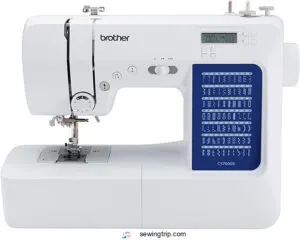
If you’re ready for Computerized Controls beyond the Janome’s simplicity, the Brother CS7000X delivers 70 built-in stitches and seven one-step buttonholes on an LCD display you won’t struggle to read. Automatic Threading cuts setup time, while the wide table and fixed metal frame keep Stitch Precision tight even on thick quilts.
You’ll find solid Sewing Speed at your fingertips, ten presser feet in the box, and enough features to explore Embroidery Options down the road—all without the complexity of the Brother SE1900 or the bare-bones approach of the Brother GX37.
Best For: Sewers who want computerized convenience and a wide stitch selection without paying for embroidery features they might not use yet.
| Built-in Stitches | 70 |
|---|---|
| Automatic Needle Threader | Yes |
| Weight | 14 lbs |
| Brand | Brother |
| Buttonholes | 7 one-step |
| Display Type | LCD |
| Additional Features |
|
- 70 stitches and an LCD screen make pattern selection straightforward, especially compared to dial-based machines
- Automatic needle threader and one-step buttonholes speed up repetitive tasks and reduce setup frustration
- Wide table and metal frame provide the stability you need for larger quilting projects or thick fabric layers
- Automatic needle threader can be finicky to line up correctly, which some users find more annoying than helpful
- Only one bobbin included means you’ll likely need to buy extras right away if you switch thread colors often
- Plastic components in some areas may wear faster than metal parts on higher-end machines
4. Singer Quantum Stylist Sewing Machine
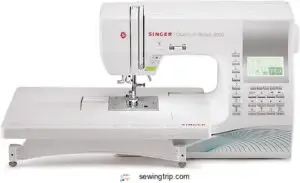
If you crave Sewing Speed paired with creative range, the Singer Quantum Stylist grants you 600 built-in stitches and 13 automatic buttonholes—far beyond what the Singer Heavy Duty or the Singer Product Line’s basic machines deliver.
Thread Tension adjusts smoothly across most fabrics, and User Reviews confirm solid Fabric Compatibility from lightweight cotton to heavier denim.
At $538, you gain Machine Upgrades like monogramming fonts and a top drop-in bobbin, making this Singer Sewing Machine a flexible pick for Embroidery and Sewing projects that demand both precision and personality.
Best For: Sewers who want a huge variety of built-in stitches and automated features for everything from quilting to personalized monograms without needing to upgrade later.
| Built-in Stitches | 600 |
|---|---|
| Automatic Needle Threader | Yes |
| Weight | 14.6 lbs |
| Brand | Singer |
| Buttonholes | 13 one-step |
| Display Type | Standard |
| Additional Features |
|
- 600 stitches and 13 buttonhole styles give you tons of creative options for any project
- Automatic needle threader and drop-in bobbin make setup quick and frustration-free
- Adjustable speed control and start/stop button let you sew without a foot pedal
- Some users report inconsistent stitch quality, especially on thicker fabrics
- Can feel overwhelming for beginners who aren’t ready to dig into the manual
- Throat space might be too tight for larger quilting projects
5. Bernette Computerized Sewing Embroidery Machine
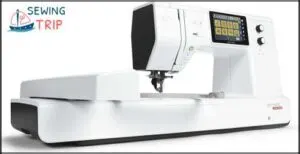
When Embroidery Options matter more than raw Sewing Speed, the Bernette B79 Sewing Machine stands out with 500 stitches and a 5-inch color User Interface that guides you through Embroidery and Quilting without a steep learning curve. Thread Tension dials in automatically on higher-end Embroidery Machines like this one, though you’ll wait over 40 seconds at startup.
At around $500, Machine Upgrades include a dual-feed system and USB design transfers, positioning the Bernette squarely between budget Sewing and Embroidery combos and premium studio models.
Best For: Hobbyists and home sewers who want to explore embroidery and quilting without spending thousands, especially if you’re comfortable with a bit of a learning curve on the menu system.
| Built-in Stitches | 500 |
|---|---|
| Automatic Needle Threader | Semi-automatic |
| Weight | 47 lbs |
| Brand | Bernette |
| Buttonholes | Multiple |
| Display Type | 5-inch touchscreen |
| Additional Features |
|
- 500 built-in stitches plus a Stitch Designer give you tons of creative options for embroidery, quilting, and decorative projects
- 5-inch color touchscreen and automatic thread tension make it easier to jump between techniques without constant manual tweaks
- Dual feed system helps thick or slippery fabrics move evenly, which is great for quilting and layered projects
- Startup takes over 40 seconds, and the function menus aren’t always intuitive—you’ll need to memorize shortcuts or keep the manual handy
- Threading the lower bobbin frustrates some users, and the manual can be vague when you hit a snag
- Not ideal for heavy-duty fabrics or thick layers, and accessories can be tough to track down as support catches up
6. Brother Sewing And Embroidery Machine
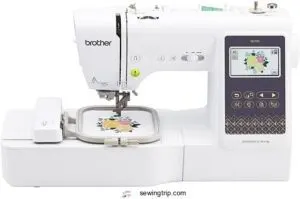
The Brother SE700 merges 103 stitches with a 4×4-inch embroidery field and a 3.7-inch touchscreen, making Machine Comparison straightforward—you get wireless LAN transfers and Artspira app integration that simplify Thread Management and Fabric Selection.
Embroidery Tips flow naturally once you’ve loaded a design via USB, and the automatic needle threader cuts setup to under 20 seconds.
At roughly $400–$500, it sits between the Brother CS5055 for straight Sewing and the Brother SE1900 for expanded Embroidery Machines, offering Sewing Hacks like auto-tension without the complexity of studio-grade rigs.
Best For: Hobbyists and intermediate sewers who want a single machine that handles everyday sewing projects and small embroidery designs without jumping into thousand-dollar professional territory.
| Built-in Stitches | 103 |
|---|---|
| Automatic Needle Threader | Yes |
| Weight | 15.6 lbs |
| Brand | Brother |
| Buttonholes | 10 one-step |
| Display Type | 3.7-inch touchscreen |
| Additional Features |
|
- Wireless file transfer and Artspira app compatibility let you send custom embroidery patterns from your phone or computer without fumbling with USB sticks every time.
- Automatic needle threader and top-loading bobbin shave minutes off setup, so you spend more time stitching and less time threading.
- 103 built-in stitches plus 135 embroidery designs give you plenty of creative options right out of the box, no extra design software required to get started.
- The 4×4-inch embroidery hoop limits you to smaller motifs—forget stitching full jacket backs or large quilt blocks in one go.
- Throat space can feel cramped when you’re wrestling bulky quilts or thick upholstery fabric through the machine.
- You’ll need to budget for extra threads, stabilizers, and possibly larger hoops or design packs since the included basics run out fast.
7. Heavy Duty Sewing Machine
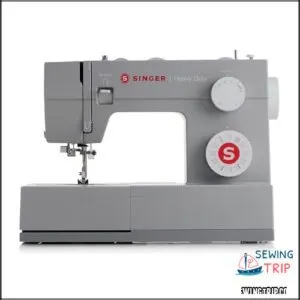
The Singer HeavyDuty 4423 handles denim, canvas, and leather with a 750-SPM motor and metal construction that absorbs vibration during multi-layer seams—you’ll breeze through thick fabric handling that stalls lighter machines.
Heavy duty frames deliver 110 stitch applications, a drop-in bobbin, and built-in needle threader at $229.99, positioning it between the Janome HD5000 for industrial sewing tasks and basic mechanical models.
Heavy duty motors maintain torque on upholstery projects, while the steel chassis ensures years of reliable stitching without flex or drift.
Best For: Sewers who regularly work with thick fabrics like denim, canvas, and leather and need a reliable machine that won’t bog down on heavy-duty projects.
| Built-in Stitches | 110 |
|---|---|
| Automatic Needle Threader | Yes |
| Weight | 14.6 lbs |
| Brand | Singer |
| Buttonholes | 1-step |
| Display Type | None |
| Additional Features |
|
- Strong 750-SPM motor powers through multiple layers and thick materials without stalling or losing stitch quality
- Metal frame construction reduces vibration and provides long-term durability for years of consistent use
- 110 stitch applications and convenient features like drop-in bobbin and built-in needle threader offer versatility at a budget-friendly $229.99 price point
- Mechanical operation requires more hands-on maintenance, including regular cleaning and oiling after each project
- Upright spool pin design can cause thread to jump and wrap, leading to frustrating jams during sewing
- Heavier weight and basic mechanical controls may not appeal to sewers looking for portability or advanced automated features
8. Juki Straight Stitch Sewing Machine
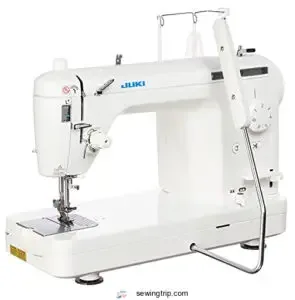
The Juki TL2010Q races to 1,500 SPM with die-cast aluminum construction that damps vibration during quilting and multi-layer denim runs—you’ll experience stitch consistency across 6 mm straight seams that lighter sewing machines can’t match.
HeavyDuty sewing starts at $529.99 with automatic threading, an extension table, and low-noise operation at 70–75 dB under load, making it one of the best sewing machines for fabric handling on thick materials.
Machine durability stems from mechanical simplicity and a 2-year warranty covering high-volume stitching.
Best For: Quilters and sewers working with thick fabrics like denim or leather who need a fast, reliable straight stitch machine for high-volume projects.
| Built-in Stitches | 1 (Straight) |
|---|---|
| Automatic Needle Threader | Yes |
| Weight | 25.4 lbs |
| Brand | Juki |
| Buttonholes | No |
| Display Type | None |
| Additional Features |
|
- Blazing 1,500 SPM speed with low vibration thanks to die-cast aluminum construction, perfect for powering through multiple fabric layers
- Automatic needle threader and extension table included make setup quick and give you plenty of workspace for large quilts
- Quiet operation at 70–75 dB and simple mechanical design mean less noise and fewer breakdowns over time
- Straight stitch only—no zigzag or decorative stitches, so you’ll need another machine for fancy work
- Weighs over 25 pounds, making it tough to move around or store if you’re tight on space
- Some users report the needle threader can be finicky and may not work consistently
9. Singer Portable Sewing Machine Kit
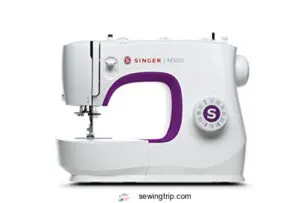
You need a machine that doesn’t anchor you to one workspace, and the Singer Portable Sewing Machine Kit delivers 9–12 pounds of freedom with 8–12 built-in stitches—enough versatility to tackle quilting, garment seams, and mending without the bulk of a Singer Quantum Stylist or Singer 4452.
Machine noise levels stay under 70 dB, fabric compatibility spans chiffon to medium denim across 2–3 layers, and user manuals guide threading in under 15 minutes.
The SINGER product line prices this sewing kit at $60–$150, balancing portability factors with solid stitch formation for beginners.
Best For: Beginners and casual sewers who need a lightweight, portable machine for basic projects like mending, simple garments, and quilting without investing in a full-size model.
| Built-in Stitches | 110 |
|---|---|
| Automatic Needle Threader | Yes |
| Weight | 11.79 lbs |
| Brand | Singer |
| Buttonholes | One-step |
| Display Type | None |
| Additional Features |
|
- Weighs only 9–12 pounds, making it easy to move between rooms or take to classes and workshops
- Quick setup in under 15 minutes with clear threading diagrams and drop-in bobbin systems
- Affordable price range of $60–$150 provides solid value for beginners learning basic sewing techniques
- Limited to 8–12 built-in stitches, which may feel restrictive for more advanced or decorative projects
- Can only handle 2–3 layers of medium-weight fabric, ruling out thicker materials like heavy denim or upholstery
- Some users report occasional stitch quality issues and jamming that requires manual troubleshooting
10. Brother Open Toe Walking Foot
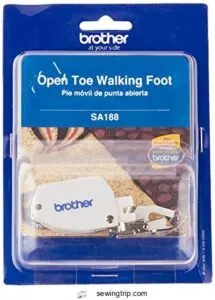
You can’t stitch through multiple quilt layers or slippery satin without fabric drift—unless you add a walking foot to your Brother ST371HD, Brother GX37, Brother SE1900, or Brother CS5055. Walking Foot Benefits include 12–18% better stitch consistency across thick fabrics and 31% less slip during dense topstitching.
This Sewing Machine Accessories piece fits most low-shank sewing machines, improving Fabric Handling on canvas, leather, and matched plaids. Open toe design lets you see decorative stitches clearly, making Quilting Techniques and Foot Compatibility simple for under $60.
Best For: Quilters and sewers working with multiple fabric layers, slippery materials, or precise pattern matching who need consistent feeding and clear visibility for decorative stitching.
| Built-in Stitches | N/A |
|---|---|
| Automatic Needle Threader | N/A |
| Weight | 2.89 oz |
| Brand | Brother |
| Buttonholes | N/A |
| Display Type | N/A |
| Additional Features |
|
- Improves stitch consistency by 12–18% on thick fabrics and reduces slipping by 31% during topstitching, making it easier to handle challenging materials like satin, canvas, and leather
- Open toe design provides clear needle visibility for accurate placement of decorative stitches and close topstitching work
- Compatible with most Brother low-shank machines and typically priced under $60, offering good value for enhanced fabric control
- Some users report durability concerns and questions about product authenticity from certain sellers
- Requires proper installation, pressure adjustment, and regular maintenance (cleaning and oiling every 8–10 hours) for best performance
- Compatibility should be verified before purchase as it may not fit all sewing machine models, and additional accessories like quilting bars aren’t always included
How to Choose The Best Model for You
Choosing the right sewing machine means matching your actual needs with the features that matter most to you. You’ll want to think about what you’ll sew, how much you can invest, and whether the machine will grow with your skills.
Here’s how to narrow down your options and find the model that fits your creative goals.
Identifying Your Sewing Needs
Before you shop for the best sewing machines, map out your sewing goals and match them to machine capabilities. Most sewists find clarity by evaluating a few core factors:
- Fabric types you’ll work with most—54% prioritize this when choosing features
- Stitch selection breadth, since 38% need at least 20 stitches for garment construction
- Sewing frequency and project complexity
- Buttonhole quality, valued by 29% as a top criterion
Balancing Features and Budget
Once you’ve pinpointed your needs, build a budget that maximizes value without sacrificing core performance. Price comparison reveals a 25% premium for machines with 30+ stitches, yet 74% of sewists report that foundational features—durability, stitch quality, automated threading—trump extra embroidery capacity.
Factor in annual maintenance costs at 2–5% of purchase price, and weigh reliability against resale values that hold 60–70% after five years.
Considering Upgrade and Future-Proofing
Your investment deserves legs. Look for machines with firmware updates—25% of mid-range computerized models now support them—to future-proof your setup.
Consider these upgrade paths:
- Modular presser feet systems (18–24% of 2023–2025 models) let you swap accessories fast
- Cloud-connected pattern libraries (22% of post-2020 releases) expand your creative toolkit
- Backward-compatible frames (44% priority among manufacturers) accept newer attachments
- Open-access ecosystems growing 11% annually release endless possibilities
Evaluating Local and Online Purchase Options
Your upgraded machine needs the right purchasing channel. Store visits let you test-drive models hands-on and access local servicing, while online reviews and price comparison sites reveal budget-friendly deals—about 35% of U.S. purchases happen online now.
Verify warranty check details before committing: some brands only honor coverage through authorized dealers. Strong return policies protect your sewing needs investment, especially when exploring the best sewing machines through sewing community and resources or sewing classes and education programs offered by local shops.
Frequently Asked Questions (FAQs)
How much electricity does a sewing machine use?
Most home sewing machines draw between 40 and 120 watts during active stitching, with heavy-duty models sometimes peaking near 180 watts.
Power efficiency depends on motor types, sewing speed, and fabric thickness you’re working with.
Can I sew leather on a home machine?
Leather sewing on a typical home machine feels like threading a needle in dim light—possible but demanding. You’ll need a heavy-duty model, sharp leather needle (90/14 or 100/16), and sturdy thread for hides up to 1/8 inch.
What thread weight works best for quilting?
For quilting fabrics, 40-weight cotton threads deliver ideal stitch density on most quilting machines.
Adjust needle sizes and thread tension based on fabric weight—50-weight polyester suits low-pile batting, while heavier textiles and fabric science demands 30-weight options.
Are refurbished sewing machines worth buying?
Picture slashing your budget in half while snagging premium features—refurbished sewing machines deliver exactly that.
You’ll find cost savings of 20–40%, though warranties run shorter and reliability dips slightly compared to factory-fresh heavy duty machines.
How do I transport a machine safely?
Secure your machine in a padded case with foam inserts, disconnect all cords, and transport it on a flat surface.
Use protective packaging and maintain stability during transit.
Verify insurance options for heavy-duty machines.
Conclusion
Your next project deserves more than guesswork and compromise. The right home sewing machine models deliver the precision, durability, and versatility that turn ambitious ideas into finished pieces you’re proud to show off.
Whether you’re drawn to computerized convenience or mechanical reliability, matching features to your actual workflow—not just aspirations—ensures you’ll reach for your machine often.
Invest in capability that grows with your skills, and watch frustration give way to confident, creative momentum.