This site is supported by our readers. We may earn a commission, at no cost to you, if you purchase through links.
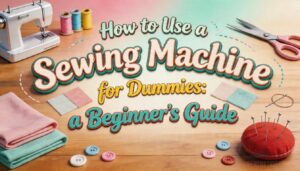
That first time you sit down at a sewing machine, it can feel like you’ve inherited someone’s spaceship—dials, levers, and a needle that moves so fast it’s practically invisible. Most beginners assume they’re missing some sewing gene, when really, they’re just missing a clear starting point.
machine isn’t complicated; it’s just unfamiliar. Once you know what each part does and how the thread flows from spool to stitch, everything clicks into place.
Learning how to use a sewing machine for dummies isn’t about dumbing anything down—it’s about building real confidence, one stitch at a time.
Table Of Contents
- Key Takeaways
- Getting Started With Sewing Machines
- How to Use a Sewing Machine for Dummies
- Threading and Winding The Bobbin
- Mastering Basic Sewing Techniques
- Working With Different Stitches
- Setting Up Your Sewing Machine
- Troubleshooting Common Issues
- Mastering Sewing Machine Settings
- Practicing on Scrap Fabric
- Advanced Techniques and Decorative Stitches
- Frequently Asked Questions (FAQs)
- Conclusion
Key Takeaways
- Learning your machine’s key parts — presser foot, bobbin, tension dial, and foot pedal — gives you the foundation to troubleshoot and sew with real confidence.
- Threading correctly and winding the bobbin with proper tension is the single step that determines whether your stitches hold or fall apart.
- Matching your stitch type and length to your fabric (straight for wovens, zigzag for knits, shorter for delicates) is what separates clean seams from frustrating ones.
- Practicing every new technique on scrap fabric first — tension, corners, backstitch — is the fastest way to build skill without ruining your actual project.
Getting Started With Sewing Machines
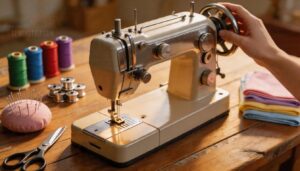
Before you sew a single stitch, you need to know what you’re working with.
A solid beginner’s guide to sewing machine basics can save you a lot of frustration before you even thread the needle.
A sewing machine has more parts than it looks like, and each one plays a specific role.
Here’s what to get familiar with first.
Locating Machine Parts
Think of your sewing machine as a cockpit — every part has a job. Here are the key ones to find first:
- Power Switch – turns the machine on and off
- Stitch Selector Dial – picks your stitch style
- Thread Guide Path – routes thread to the needle
- Bobbin Access Cover – opens for bobbin loading
- Tension Dial Indicator – controls thread tightness
Spot these, and you’re already ahead. The continuous up‑and‑down cycle of the take‑up lever ensures proper stitch formation.
Identifying Foot Pedal and Hand Wheel
Now that you know where the parts live, let’s talk about the two controls you’ll use most.
The foot pedal sits on the floor — your speed indicator for every seam.
Light pressure crawls, firm pressure flies.
Meanwhile, the hand wheel on the right side gives you hand wheel manual needle control, one stitch at a time.
Always turn it toward you for safe, smooth wheel orientation and safety positioning.
Understanding Presser Foot Function
The foot pedal controls your speed — the presser foot controls your fabric. This small metal clamp is your grip on every stitch.
When you lower the Presser Foot Lever, it locks fabric against the feed dogs, so nothing slips or wanders. That’s Fabric Grip Dynamics in action.
Foot Pressure Control matters more than most beginners expect:
- Use Presser Foot Pressure Adjustment for thick layers — lower pressure prevents bunching
- Slip Prevention Techniques start with choosing the right foot
- Foot Type Selection changes everything: zipper, walking, or straight-stitch feet serve different jobs
- Shank Compatibility determines which feet actually fit your machine
- Installing and Using the Presser Foot correctly, and using presser foot variations, makes seams smoother from the very first stitch
Familiarizing With Feed Dogs and Bobbin Case
Now that the presser foot holds your fabric in place, something else moves it forward — the feed dogs. These small, serrated metal teeth sit right beneath the needle plate and grip the underside of your fabric with each stitch. Feed Dog Visibility is easiest when the presser foot is raised and the machine is still.
The bobbin case sits just below, keeping your lower thread taut through the feed mechanism. Bobbin Case Cleaning prevents jams before they start.
How to Use a Sewing Machine for Dummies
Once you know machine’s parts, actually sewing is easier than you’d expect. Place your fabric under the presser foot, lower it, and hold both thread ends. Press the foot pedal gently — foot pedal speed control techniques matter here, so start slowly. Let the feed dogs move the fabric; don’t force it.
- Watch the seam guide, not the needle, for straight stitches
- Never skip backstitching — it locks your seam in place
- Practice basic sewing machine setup on scrap fabric first
- Follow sewing machine safety practices: keep fingers clear of the needle path
Threading and Winding The Bobbin
Threading and winding the bobbin is where most beginners feel a little lost — and that’s completely normal. Once you get the hang of it, the whole process takes less than two minutes.
Once threading clicks, you can explore how adjusting serger stitch length for seam finishing changes everything from fabric bulk to edge coverage.
Here’s exactly what you need to know to get it right.
Winding The Bobbin Correctly
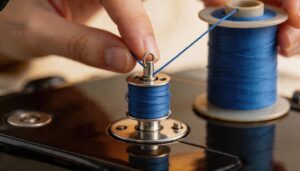
Getting the bobbin right is half the battle. Start by placing your spool on the pin and guiding the thread through the bobbin winding guide — skipping this step kills your bobbin tension.
Push the bobbin onto the spindle for proper spindle engagement, then press the pedal at a steady winding speed. Most machines stop automatically at full bobbin finish.
Even winding direction matters — check your manual.
Threading The Machine Step-by-Step
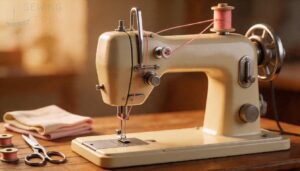
Threading the machine is easier than it looks — think of it like following a map. Start at the Spool Pin Setup, then trace the Thread Guide Path down toward the Tension Disc Position. From there, loop up through the Take-up Lever Threading before heading down to Needle Eye Threading.
Here’s what to nail every time:
- Raise the needle and presser foot first
- Follow your machine’s numbered arrows through each thread guide
- Seat the thread firmly between the tension discs
- Pull the thread tail several inches past the needle
Miss one stop, and your thread tension suffers.
Securing Thread on The Bobbin and Machine
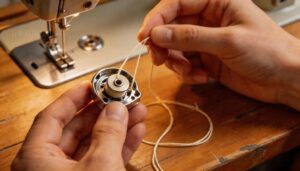
Locking in your thread is the step that separates a clean seam from a frustrating tangle. Once you wind the bobbin, drop it into the bobbin case so the thread trails counter‑clockwise — you’ll feel a slight tug when Bobbin Spring Tension kicks in correctly.
Then thread the machine from top to bottom, making sure Take‑up Lever Threading is complete. Turn the hand wheel toward you once to catch the bobbin thread from below.
| What to Check | How to Know It’s Right |
|---|---|
| Bobbin placement | Thread pulls with light resistance |
| Hook Area Clearance | No wobbling or catching |
| Thread Tail Length | About 2–3 inches free |
Hold both tails gently and test on scrap fabric first.
Choosing The Right Thread for Fabric Type
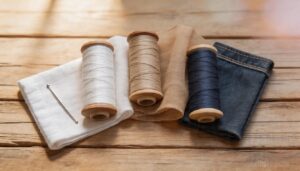
Thread choice is like picking the right shoes—wrong fit and everything falls apart. For thread compatibility, match fiber to fabric: cotton thread suits natural wovens, while polyester manages synthetics with better stretch recovery. Nylon holds up beautifully on canvas and upholstery.
Match thread to fabric like shoes to an outfit — cotton for naturals, polyester for synthetics, nylon for the tough stuff
Factor in heat resistance too—cotton manages pressing safely, and polyester resists shrinkage after washing. For color coordination, go a shade darker when matching is tricky.
- Fiber Compatibility: Cotton for cotton, polyester for synthetics
- Thread Weight Matching: Light thread for delicate fabrics, heavy for denim
- Select appropriate thread for fabric: Test on scrap first, always
Mastering Basic Sewing Techniques
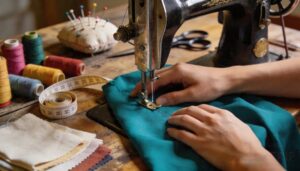
Once you’ve got your thread sorted, it’s time to actually sew something.
The good news? A handful of basic techniques will carry you through most beginner projects.
Here’s what you need to get comfortable with first.
Setting Stitch Length and Type
Stitch length is your secret weapon — tiny tweaks make a big difference. Use Machine Dial Settings or Digital Length Adjustment buttons to dial in the right feel. Smart Stitch Length Calibration starts around 2.5mm for everyday seams.
- Match Fabric Weight with length: delicate fabrics need shorter stitches.
- Use your stitch selector for straight stitch, zigzag, or decorative options.
- Control Stitch Density by adjusting length before you sew.
Positioning Fabric for Straight and Zig-Zag Stitches
Once your stitch length is set, placement is everything. For a straight path, slide your fabric under the presser foot with the bulk to the left — this gives you control without crowding your hands. Line up your edge alignment with the throat plate guides.
For a zigzag stitch, the zigzag swing needs room, so let the feed dogs do the work. Don’t tug — trust the machine.
Backstitching for Secure Seams
Good fabric placement sets you up perfectly — now lock it in. Backstitching is your seam reinforcement safety net. Use the reverse lever to sew backward over your first few stitches, creating a stitch overlap ratio that keeps seams from unraveling.
- Backstitch at the beginning and end — about ¼ inch secures most seams
- Watch your fabric edge handling: don’t stretch or bunch the material while reversing
Nail backstitch timing every seam.
Turning Corners and Curves
Sharp corners are easier than they look. Stop with your needle down in the fabric, lift the presser foot, and pivot. Lower the foot and keep going.
For curves, slow your speed before the bend — just like steering a car. Let the feed dogs do the work, guiding fabric edges smoothly without pulling or forcing anything.
Working With Different Stitches
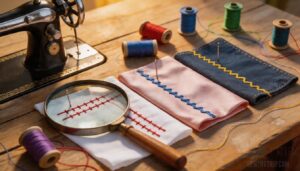
Every stitch on your machine has a job — and knowing which one to reach for changes everything. Once you understand few key options, choosing the right stitch becomes second nature.
what you need to know about the ones you’ll use most.
Using Straight Stitch for Versatility
Think of the straight stitch as your sewing Swiss Army knife. It takes care of seams, hemming applications, and topstitching basics with equal ease.
For most woven fabrics, set your stitch length between 2.5–3.5 mm — shorter for fine cotton, longer for denim. Always mind your seam allowance, and use basting techniques on scrap fabric before committing to your project piece.
It’s also great for fabric edge finishing and seam reinforcement. Master this one stitch, and you’ll cover nearly every beginner sewing guide essential.
Zigzag Stitch for Stretch and Durability
When your fabric needs to move, zigzag stitch is the answer. Unlike straight stitching, it flexes with stretch fabrics instead of snapping under pressure — that’s Stress Distribution doing its job.
- Switch your machine to zigzag mode.
- Dial in your Stitch Width Optimization — medium works for most Elastic Edge Finish applications.
- Set stitch length for your fabric.
- Adjust thread tension to avoid puckering.
- Use Three Step Zigzag for maximum Fabric Compatibility on heavy knits.
Selecting Stitch Options for Specific Fabrics
Not every fabric plays by the same rules.
Stable cotton stitches call for a straight lockstitch — clean, strong, no fuss.
Stretch knit stitches need zigzag so seams flex instead of snap.
Sheer fabric stitches should stay light and open to avoid puckering.
Heavy denim stitches need longer lengths and a stronger lockstitch.
Delicate lace stitches? Keep tension minimal and use fine thread.
Your stitch selector makes choosing stitch types for different fabrics simple.
Setting Up Your Sewing Machine
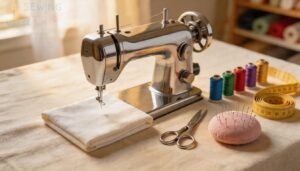
Setting up your machine the right way makes everything that follows so much easier. A few key choices — thread color, stitch type, and tension — can mean the difference between a clean seam and a frustrating mess.
what to get right before you sew a single stitch.
Choosing The Right Thread Color
Thread color is like choosing the right seasoning — too much and it’s all anyone notices. For most seams, go one shade darker than your fabric; it disappears better than a lighter match.
Always do a Fabric Swatch Test in natural light for true Color Value Balance. Use Thread Color Charts for repeatable results.
Contrast Stitching works beautifully on topstitching, bags, and denim details.
Selecting Stitch Type and Length
Your stitch selector is the control center of the whole machine. For general seams, straight stitch at 2.5 mm is your reliable starting point.
Fabric Weight Matching matters here — lighter fabrics need shorter stitch lengths for Stitch Density Control, while denim works with 3–3.5 mm easily.
Zigzag Width Adjustment for knit edges, Basting Stitch Length around 4–5 mm for temporary holds, and explore Decorative Stitch Choice on scrap first.
Adjusting Thread Tension for Even Stitching
Think of your thread tension dial as a volume knob — too loud or too quiet ruins the whole song.
The default sits around 4 to 4.5 for most fabrics.
Follow these Dial Calibration Steps:
- Loosen for thick fleece or heavy layers — Fabric Tension Matching keeps stitches balanced
- Tighten for lightweight silks needing Upper Lower Balance
- Apply Thread Weight Adjustments when switching thread types
- Always do Test Stitch Evaluation on scrap fabric first
Troubleshooting Common Issues
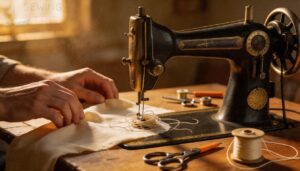
Every sewing machine hits a snag now and then — that’s just part of the process. The good news is most problems come down to a couple of fixable things.
what to check when something feels off.
Identifying Machine Parts
Knowing your machine is like knowing your car — you can’t fix what you can’t name. Start by locating the Power Switch Location (usually right side or rear), then find the Hand Wheel, Stitch Selector Dial, Thread Tension Dial, and Presser Foot. Understanding Sewing Machine Parts makes troubleshooting so much faster.
- Locate the Needle and Bobbin Winder Mechanism first.
- Identify the Bobbin case beneath the needle area.
- Spot the Needle Selector Lever for fabric-specific adjustments.
Adjusting Tension and Stitch Setting
Once you know your machine’s parts, fixing it gets a whole lot easier. Most hiccups come down to two things: thread tension and stitch settings.
Start with the tension dial — a middle setting around 4 or 5 works for everyday sewing. Run some Thread Balance Testing on scrap fabric first. If loops appear underneath, loosen it. If the top looks messy, tighten slightly. Bobbin Tension Tweaks are usually last resort fixes.
| Problem | Quick Fix |
|---|---|
| Puckering fabric | Lower tension dial |
| Loose, sloppy stitches | Raise tension dial |
| Skipped stitches | Adjust stitch width |
| Stiff seams | Shorten stitch length |
Stitch Density Control matters too — shorter lengths mean stronger seams.
Mastering Sewing Machine Settings
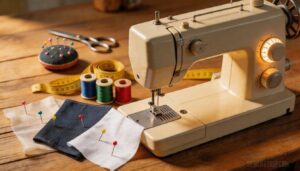
Once you’ve sorted out those common hiccups, it’s time to own your settings like you mean it.
Here’s what to dial in for consistent, beautiful results:
- Thread tension — Set it between 4 and 5 for balanced stitches; lower it for silk, raise it for denim.
- Stitch length — Use 2.5 mm for everyday cotton, 1.5 mm for delicate fabrics, and up to 4 mm for heavy layers.
- Stitch width adjustment — A 3.5 to 4.5 mm zigzag works with woven cotton beautifully.
- Needle positioning — Shift left for quilting seams, right for clean topstitching.
- Feed dog height — Keep them raised for guided sewing; lower only for free‑motion work.
Use your stitch selector confidently. Speed regulation matters too — slow down on curves, open up on long straight seams.
Practicing on Scrap Fabric
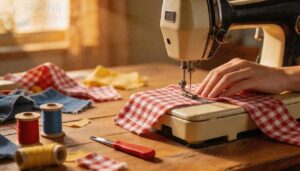
Once your settings feel solid, it’s time to put them to work — on scraps first.
Using scrap fabric for practice is the smartest move a beginner can make. It costs nothing and teaches you everything. Before touching your real project, run a few test rows on offcuts.
Try these drills to sharpen your skills:
- Sort scraps by color for easy scrap color sorting and clearer thread-contrast checks
- Mark your seam allowance before sewing for consistent stitch line accuracy every time
- Practice fabric grain alignment on woven scraps to understand how fabric moves and feeds
- Focus on practicing straight stitches on scrap fabric, then add basic backstitching at each end
- Stop with the needle down for corner pivot practice before turning
Adjusting thread tension for even stitches is also easier when you’re not afraid to experiment. Scraps give you that freedom. Use them generously.
Advanced Techniques and Decorative Stitches
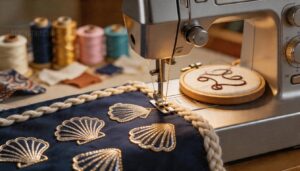
Scraps gave you confidence — now let your machine show off a little.
Most machines pack in built-in Decorative Stitch Patterns like shells, scallops, and waves. These are perfect for dressing up hems and quilt edges. Flip through your stitch selector like you’re browsing a menu, then test each one on scrap fabric before committing.
Ready to go deeper? Try these sophisticated decorative stitch techniques:
- Satin Stitch Borders wrap letters and shapes in smooth, glossy coverage — great for Appliqué and Monogramming techniques on tote bags or kids’ clothes
- Couching Details stitch thick cords or yarn onto fabric for bold, rope-like outlines with real texture and dimension
For something truly freeform, Free Motion Embroidery Basics lets you draw with thread — just lower the feed dogs and move the fabric like a pen. Add Metallic Thread use for sparkle on borders and highlights, and slow your speed to stop it from shredding.
Frequently Asked Questions (FAQs)
What is the easiest thing to sew on a sewing machine for beginners?
Practice makes perfect" — and the best place to start is simple.
Pillow covers, pillowcases, bunting flags, coaster projects, and simple tote bags are perfect beginner sewing projects built on straight stitch basics and easy fabric handling.
Can a beginner use a sewing machine?
Absolutely — beginners can use a sewing machine. Start slow, follow your manual, and practice on scrap cotton. A little patience builds real confidence fast.
What parts of a sewing machine should a beginner learn?
Start with five essentials: the presser foot, foot pedal, hand wheel, bobbin, and stitch selector.
Add the needle, thread guide, tension dial, take-up lever, and needle clamp — and you’re ready to sew anything.
How to use a sewing machine?
Think of it like driving — threading the machine and loading the bobbin case come first.
Then pick your stitch, slide fabric under the presser foot, lower it, and ease into the foot pedal.
How do you take up a sewing machine?
Plug in your machine, flip the power switch, and watch for the ready light. Thread it, wind your bobbin, set your tension, then test everything on scrap fabric first.
Can anyone use a sewing machine?
Yes, anyone can.
Most machines use Age-Friendly Design and Adaptive Controls for varied needs.
With basic Safety Training, good Learning Resources, and patience, you’ll master sewing basics faster than you’d expect.
How do you set up a sewing machine?
Setting up a sewing machine isn’t as scary as it looks.
Place it on a stable surface, handle Power Outlet Safety and Cable Management first, then position your foot pedal where it feels natural.
Can I teach myself to use a sewing machine?
Absolutely — most people learn sewing solo. Grab your manual, study the basic sewing machine parts overview, practice threading the machine, and run basic stitching techniques on scrap fabric.
Patience development and consistent practice routines get you there fast.
How to use a sewing machine step by step?
A good beginning makes a good ending.
Before you sew a single stitch, read your manual, wind your bobbin, and thread the machine carefully.
Lower the presser foot, press the foot pedal gently, and go.
How do you sew step by step for beginners?
Thread the machine, wind the bobbin, and adjust your settings.
Place fabric under the presser foot, lower it, then gently press the pedal.
Guide the fabric forward and backstitch at both ends to lock your seams.
Conclusion
Every stitch you’ve made today was a quiet conversation with your machine—and now you finally speak its language. Learning how to use a sewing machine for dummies was never about limitations; it was about finding the clearest door into a craft that rewards patience. You’ve threaded the needle, tamed the tension, and turned fabric into something intentional.
The machine hasn’t changed—but you have. Keep practicing, and watch how quickly "beginner" becomes a word you’ve already outgrown.