This site is supported by our readers. We may earn a commission, at no cost to you, if you purchase through links.

The right rotary cutter doesn’t just make cutting faster—it changes how accurately you work. A dull blade or the wrong size forces you to drag fabric instead of slicing it, and that’s where your precise lines start drifting.
Blade size alone shapes your results more than most crafters expect. A 28mm wheel controls tight appliqué curves with control a 45mm can’t match, while a 60mm powers through denim and batting in a single clean pass. That gap in performance comes down to matching the tool to the task.
Knowing which cutter fits your projects—and why—turns frustrating cuts into confident ones.
Table Of Contents
- Key Takeaways
- Top 10 Rotary Cutters for Crafts
- 1. Fiskars 45mm Rotary Fabric Cutter
- 2. Fiskars Titanium Rotary Fabric Cutter
- 3. Olfa Standard Rotary Cutter
- 4. Olfa Ergonomic 60mm Rotary Cutter
- 5. Olfa Rotary Fabric Cutter
- 6. Headley 45mm Rotary Cutter Blades
- 7. Olfa Aqua Rotary Cutter 45mm
- 8. Fiskars Rotary Cutter Ruler
- 9. Fiskars Rotary Cutting Kit
- 10. 45mm Pink Ergonomic Rotary Cutter
- Best Rotary Cutter Sizes
- Blade Materials and Longevity
- Ergonomic Handle Features
- Safety Locks and Guards
- Blade Replacement and Compatibility
- Best Uses by Craft Type
- Accessories Worth Buying
- Care and Cutting Tips
- Frequently Asked Questions (FAQs)
- Conclusion
Key Takeaways
- Blade size drives results more than any other factor — a 28mm handles tight appliqué curves, a 45mm covers everyday multi-layer cutting, and a 60mm powers through denim and batting in a single clean pass.
- Titanium-coated and Japanese-steel blades stay sharp significantly longer than standard carbon steel, meaning fewer mid-project swaps and cleaner edges throughout heavy use.
- Ergonomic features like squeeze-trigger handles, finger grooves, and balanced weight distribution aren’t just comfort upgrades — they directly reduce fatigue and improve cut accuracy across long sessions.
- A self-healing mat, sharp blade, and proper safety lock aren’t optional add-ons — they protect your work surface, extend blade life, and keep every cut safe from start to finish.
Top 10 Rotary Cutters for Crafts
Finding the right rotary cutter can make or break your next project. Whether you’re slicing through quilting cotton or tackling thick denim, the tool in your hand matters more than you’d think. Here are ten cutters worth your attention in 2026.
If you want to dig deeper before committing, this guide to the best rotary cutters and mats for sewing and quilting breaks down what separates a frustrating tool from a great one.
1. Fiskars 45mm Rotary Fabric Cutter
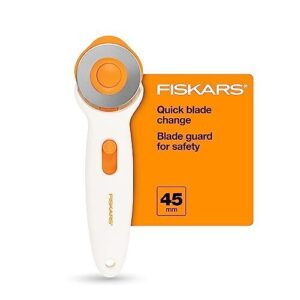
The Fiskars 45mm Rotary Fabric Cutter is a solid starting point for quilters and crafters who want reliable, clean cuts without a steep learning curve. Its symmetrical ambidextrous handle means you don’t have to hunt for a left‑handed version — it works either way.
The sliding button lock keeps the blade retracted when you’re not cutting, and the quick‑snap blade replacement means downtime stays minimal.
At just 0.11 lb, it won’t tire your hand through long sessions.
| Best For | Quilters, sewers, and crafters who want clean, precise cuts through multiple fabric layers without the hassle of scissors or a tool-specific learning curve. |
|---|---|
| Blade Size | 45mm |
| Blade Material | Titanium carbide |
| Weight | 0.11 lb |
| Cutting Capacity | Multiple fabric layers |
| Hand Compatibility | Ambidextrous |
| Primary Use | Quilting and sewing |
| Additional Features |
|
- Works for both right- and left-handed users thanks to the symmetrical ambidextrous handle
- Lightweight at just 0.11 lb with a sliding lock button that keeps things safe between cuts
- Quick-snap blade replacement means you’re back to cutting fast, no tools needed
- Blade durability takes a hit with thick or abrasive materials, so expect more frequent replacements
- The lifetime warranty doesn’t cover the blade itself — that cost falls on you over time
- Not suited for deco mesh or specialty meshes, with some users reporting the blade can stall mid-cut
2. Fiskars Titanium Rotary Fabric Cutter
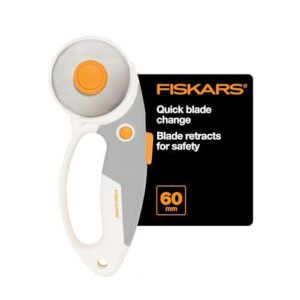
Step up from the standard model, and you get something built for serious volume. The titanium carbide coating on this 60 mm blade makes the cutting edge three times harder than plain steel, which means fewer blade swaps and cleaner cuts through denim, batting, and dense fleece.
The loop handle with sliding push-button controls extension, locking, and retraction in one motion. It’s ambidextrous, lightweight, and backed by a full lifetime warranty.
| Best For | Quilters, sewists, and crafters who cut frequently and in high volume, especially those working with thick or layered fabrics. |
|---|---|
| Blade Size | 60mm |
| Blade Material | Titanium carbide |
| Weight | 0.24 lb |
| Cutting Capacity | Thick fabrics and foam |
| Hand Compatibility | Ambidextrous |
| Primary Use | Thick fabric cutting |
| Additional Features |
|
- Titanium carbide coating keeps the blade sharper longer, meaning fewer replacements and consistently clean cuts through heavy materials like denim and batting
- The loop handle with single push-button control makes it easy to extend, lock, and retract the blade safely, even during long cutting sessions
- Ambidextrous design and a full lifetime warranty make it a genuinely versatile, long-term investment
- The retaining screw can loosen with heavy use and needs occasional tightening to keep the blade secure
- Not the best choice for cutting thick foam boards around 2 inches deep — it’ll struggle with that
- You really need a self-healing cutting mat to get the most out of it; skipping one will wear the blade down faster
3. Olfa Standard Rotary Cutter

If the Fiskars models feel a bit premium for your budget, the Olfa Standard Rotary Cutter is worth a hard look. It’s a no-frills tool that works with quilting cotton, felt, and light vinyl cleanly.
The ambidextrous straight handle works for left- and right-handed users equally well, and the sliding blade safety cover keeps the 60 mm blade locked when you’re not cutting. Simple, reliable, and easy to find replacement blades.
| Best For | Budget-conscious crafters, quilters, and sewists who want a straightforward, reliable rotary cutter without paying a premium price. |
|---|---|
| Blade Size | 60mm |
| Blade Material | Metal |
| Weight | 3.17 oz |
| Cutting Capacity | 6–8 fabric layers |
| Hand Compatibility | Ambidextrous |
| Primary Use | Quilts, cosplay, leather |
| Additional Features |
|
- The 60 mm blade cuts through multiple layers of fabric—including heavier materials like leather, foam, and upholstery—with minimal effort
- Ambidextrous design makes it equally comfortable for right- and left-handed users
- The sliding blade safety cover locks the blade securely when not in use, making it safer to handle in a busy workspace
- The sliding knob sits close to the handle, so there’s a real risk of accidentally opening the blade if you’re not careful
- Replacement blades are sold separately, adding to the long-term cost
- Requires a cutting mat underneath—use it without one and you risk damaging your work surface
4. Olfa Ergonomic 60mm Rotary Cutter
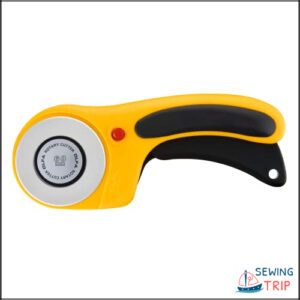
Where the Standard keeps things basic, the Olfa Ergonomic 60mm steps up with a squeeze-trigger handle that auto-retracts the blade the moment you lift it. That alone makes it safer in a shared workspace.
The curved rubber grip with molded finger grooves fits naturally in either hand, and the dual-action safety lock holds the blade open for long cutting runs.
At 60mm, it slices through up to 12 layers of cotton cleanly — denim and batting, too.
| Best For | Quilters, tailors, and crafters who work with multiple fabric layers or spend long sessions cutting, especially those with arthritis or limited grip strength, and left-handed users who want full compatibility without compromise. |
|---|---|
| Blade Size | 60mm |
| Blade Material | Endurance steel |
| Weight | 4 oz |
| Cutting Capacity | Up to 12 cotton layers |
| Hand Compatibility | Ambidextrous |
| Primary Use | Quilting and tailoring |
| Additional Features |
|
- The squeeze-trigger handle auto-retracts the blade the moment you let go, making it genuinely safer in shared or busy workspaces
- Cuts through up to 12 layers of cotton in one clean pass, handling denim, batting, vinyl, and more without fuss
- Ambidextrous design lets left- and right-handed users reposition the blade to whichever side works for them
- Performance drops off fast with a dull blade, so you’ll need to stay on top of replacements — especially during heavy projects
- Very thick or dense materials can push past the 12-layer limit, so it’s not the right tool for everything
- Carries a Prop 65 warning for DEHP chemical exposure, which is worth noting if you’re using it in a classroom or with kids around
5. Olfa Rotary Fabric Cutter
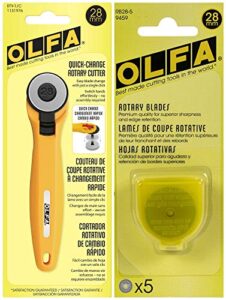
If you want a 45mm all-rounder without extras, the Olfa Rotary Fabric Cutter delivers exactly that. Its Japanese carbon tool steel blade comes double-honed for a sharp edge right out of the box. The balanced, ergonomic handle works for both left- and right-handed users, and the retractable blade guard keeps things safe between cuts.
It’s straightforward, reliable, and pairs well with any standard Olfa mat or ruler.
| Best For | Quilters and sewers with smaller hands who need precise control on curves and tight-radius cuts without spending a lot. |
|---|---|
| Blade Size | 28mm |
| Blade Material | Alloy steel |
| Weight | 0.06 kg |
| Cutting Capacity | 1–2 fabric layers |
| Hand Compatibility | Ambidextrous |
| Primary Use | Detail quilting work |
| Additional Features |
|
- Ambidextrous design works comfortably for both left- and right-handed users
- 28mm blade is ideal for detailed, curved cuts and intricate piecing work
- Comes with five spare blades so you’re set for a good while before needing to restock
- Struggles with more than two layers of thick fabric at a time
- Feels a bit plasticky compared to pricier rotary cutters
- The small size can be awkward when working with large fabric sheets
6. Headley 45mm Rotary Cutter Blades
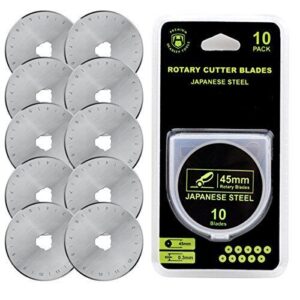
If you’re burning through 45mm blades fast, the Headley 10-pack is worth keeping in your drawer. Each blade is made from Japanese SKS-7 steel, ground to a fine factory edge that cuts cleanly through up to ten layers of fabric in one pass. They fit Fiskars, Olfa, and most standard 45mm holders — no adapters needed.
The blades come pre-oiled, so wipe them down before your first cut. One small caution: they’re stacked without separators, so handle the pack carefully when grabbing a fresh blade.
| Best For | Quilters and sewists who go through rotary blades quickly and want a reliable, budget-friendly replacement that works across multiple cutter brands. |
|---|---|
| Blade Size | 45mm |
| Blade Material | SKS-7 steel |
| Weight | 1.44 oz |
| Cutting Capacity | Up to 10 fabric layers |
| Hand Compatibility | Universal fit |
| Primary Use | Blade replacement |
| Additional Features |
|
- Made from Japanese SKS-7 steel for a sharp, long-lasting edge that handles fabric, leather, vinyl, and more
- Fits standard 45mm handles like Fiskars and Olfa — no adapters or adjustments needed
- Cuts through up to ten layers of fabric in a single pass, making it great for batch cutting and quilting projects
- Blades are stacked without individual separators, so you’ll need to be careful when pulling one out to avoid nicks
- Pre-oiled coating needs to be wiped off before use to prevent slippage or residue on your materials
- Not suited for very thick substrates — cutting capacity tops out around 8–16mm
7. Olfa Aqua Rotary Cutter 45mm

The Olfa Aqua 45mm earns its place on this list through thoughtful design rather than flashy specs. Its quick-change blade system lets you swap blades with a single lever action — no tools, no loose washers. The contoured handle fits naturally in either hand, and the finger-groove grip reduces fatigue during long cutting sessions.
For sewers who spend hours at the cutting table, guides like best rotary cutters for professional seamstresses often highlight how the Aqua 45mm’s retractable blade and ergonomic grip set it apart from the competition.
The blade guard covers the edge automatically when you set the cutter down, which matters more than you’d think mid-project.
| Best For | Quilters, sewers, and crafters who work with multiple fabric layers and want fast, safe blade changes without losing their rhythm. |
|---|---|
| Blade Size | 45mm |
| Blade Material | Tungsten-tool steel |
| Weight | 1.6 oz |
| Cutting Capacity | Up to 8 cotton layers |
| Hand Compatibility | Ambidextrous |
| Primary Use | Quilting and sewing |
| Additional Features |
|
- Single-lever blade swap means no fumbling with washers or tools mid-project
- Ambidextrous design with finger-groove grip keeps your hand comfortable through long sessions
- Cuts cleanly through up to 8 layers of cotton, handling most quilting and sewing needs with ease
- Always needs a cutting mat underneath — the blade will damage unprotected surfaces
- Sharp edge wears faster on tough materials like heavy leather or adhesive-backed fabrics
- Eight-layer limit means bulkier stacks may need multiple passes or a larger cutter
8. Fiskars Rotary Cutter Ruler
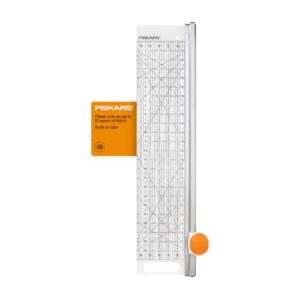
Think of it as your ruler and cutter rolled into one.
The Fiskars Rotary Cutter Ruler combines a spring-action 45 mm blade with a clear 24″ × 6″ acrylic grid, so you measure and cut in a single pass.
Angle guides at 30°, 45°, and 60° make bias cuts straightforward.
The magnetic blade-change system keeps swaps tool-free and safe.
It processes up to three denim layers cleanly — just don’t expect it to manage tight curves.
| Best For | Quilters, sewers, and craft enthusiasts who want an all-in-one measuring and cutting tool that speeds up straight cuts on fabric, paper, and multiple layers. |
|---|---|
| Blade Size | 45mm |
| Blade Material | Standard rotary steel |
| Weight | 2 lb |
| Cutting Capacity | Up to 3 denim layers |
| Hand Compatibility | Right and left hand |
| Primary Use | Straight fabric cutting |
| Additional Features |
|
- Ruler and rotary cutter in one tool — measure and cut in a single pass without juggling separate accessories
- Handles up to three denim layers cleanly, making it a solid choice for heavier quilting and sewing projects
- Tool-free magnetic blade swaps are quick and safe, keeping your workflow moving
- Minimum usable cut length of about 1.5 inches limits precision work on very small pieces
- The acrylic ruler can feel a bit flimsy under heavy pressure, so it needs a steady hand
- Not built for curves or intricate cutouts — you’ll need a separate tool for anything beyond straight lines
9. Fiskars Rotary Cutting Kit
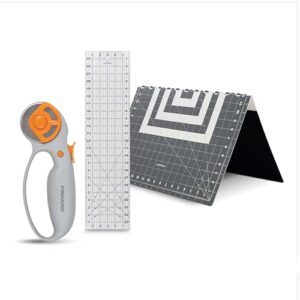
If you want one kit that gets you cutting from day one, this is it.
The Fiskars Rotary Cutting Kit pairs a 45 mm precision-ground blade with an 18" × 24" self-healing mat and a 6" × 24" acrylic ruler — everything locked in together. The comfort-loop handle suits both left- and right-handed users, and the mat folds flat for easy storage.
One heads-up: avoid cutting across the mat’s fold line. The flex can cause the blade to skip.
| Best For | Quilters, sewers, and crafters who want a complete, ready-to-use rotary cutting setup without sourcing each tool separately. |
|---|---|
| Blade Size | 45mm |
| Blade Material | Precision-ground steel |
| Weight | 3.9 lb |
| Cutting Capacity | Multiple fabric layers |
| Hand Compatibility | Ambidextrous |
| Primary Use | Quilting and sewing kit |
| Additional Features |
|
- The 45 mm precision-ground blade cuts cleanly through multiple layers of fabric, felt, paper, or vinyl in a single pass
- Comes with a self-healing 18" × 24" mat and a 6" × 24" ruler with angle guides — no extra purchases needed to get started
- The comfort-loop handle works for both left- and right-handed users, and the foldable mat makes it easy to take to classes or craft nights
- Cutting across the mat’s fold line can cause the blade to skip, so you’ll need to plan cuts around it
- The blade and mat aren’t covered by the lifetime warranty, meaning replacement costs add up over time
- Ruler markings are inches only, which is a drawback if you prefer working in metric
10. 45mm Pink Ergonomic Rotary Cutter

The 45mm Pink Ergonomic Rotary Cutter is a solid pick if you want comfortable daily use without spending much. The curved handle distributes pressure evenly, so long cutting sessions won’t punish your wrist. It works for both left- and right-handed users, and the sliding blade guard keeps things safe between cuts.
The carbon alloy steel blade cuts fabric, vinyl, and paper cleanly. The pink colorway won’t suit everyone, but the performance holds up.
| Best For | Quilters, crafters, and hobbyists who do frequent cutting sessions and want a comfortable, ambidextrous tool that’s easy to use safely. |
|---|---|
| Blade Size | 45mm |
| Blade Material | SKS7 stainless steel |
| Weight | 5.3 oz |
| Cutting Capacity | Multiple fabric layers |
| Hand Compatibility | Ambidextrous |
| Primary Use | Fabric and leather crafts |
| Additional Features |
|
- Ergonomic soft-grip handle works for both left- and right-handed users, reducing fatigue during long cutting sessions
- Comes with 5 extra replacement blades stored right in the cutter, so you’re never caught without a spare
- Integrated safety-lock folds the blade away securely, making it safer to handle and store
- Plastic housing feels less sturdy than metal-bodied cutters
- Only available in pink, which won’t appeal to everyone
- Not built for heavy-duty materials like thick leather or upholstery — stick to fabric, paper, and vinyl
Best Rotary Cutter Sizes
Picking the right rotary cutter size makes a bigger difference than most crafters expect. Each size has a specific job, and using the wrong one means more effort and messier results. Here’s what you need to know about the four main sizes before you decide.
28mm for Appliqué
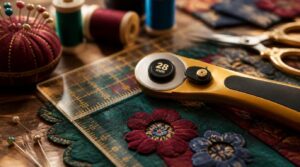
When the details matter most, reach for the 28mm rotary blade. This compact cutter gives you precision edge control on tiny fabric layers that a larger wheel would bulldoze right past.
Pair it with a straight ruler to keep decorative edges clean. For fine appliqué work, that tight clearance means cleaner lines and fewer slips on small stitch work.
Choosing the right size can boost cutting accuracy on tight curves by up to 40% according to tight‑curve accuracy boost.
45mm for Everyday Crafts
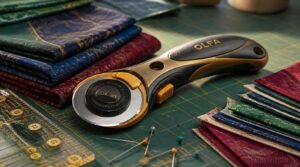
The 45mm rotary cutter is your everyday workhorse.
Where the 28mm shines on tight curves, this size controls multi-layer quilting, precision seam trimming, and vinyl appliqué accuracy with ease. It cuts through 3–6 layers of quilting cotton cleanly.
Grab one with an ergonomic handle for long sessions — your wrist will thank you.
60mm for Thick Layers
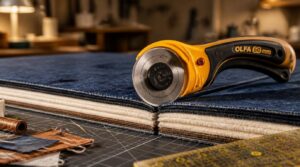
When you’re ready to go beyond everyday fabrics, the 60mm rotary cutter steps up. It slices through multiple fabric layers — dense denim, thick batting, even laminated material — in a single pass.
That’s fewer strokes, cleaner edges, and less hand fatigue. Reach for it when your project stops being ‘a few layers’ and becomes a serious stack.
75mm for Heavy Duty
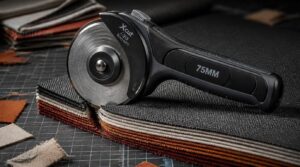
The 75mm is the big gun of rotary cutter sizes. When thick material penetration is your goal — think heavy canvas, upholstery fabric, or serious multilayer cutting stacks — this blade size grips what smaller cutters simply can’t. Reinforced grips and heavy-duty blade durability mean fewer pauses, more progress.
Grab one when your project demands industrial cutting speed at scale.
Size Versus Control
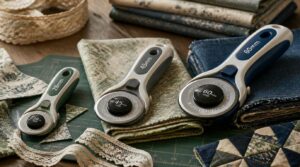
Blade size is ultimately a trade-off between speed and control.
Smaller blades like the 28mm give you tight curve accuracy on delicate fabrics, while a 60mm blade powers through thick layers faster, but drifts on sharp turns.
For beginners, start with a 45mm — it’s the most forgiving size across most materials and builds confident technique before you size up.
Blade Materials and Longevity

Not all blades are created equal, and the material your blade is made from determines how long it stays sharp and how cleanly it cuts. Whether you’re slicing through delicate silk or stacking up six layers of denim, the right blade material makes a real difference. Here’s what you need to know about the most common options.
Tungsten Tool-steel Blades
When hardness is everything, tungsten tool‑steel blades stand apart. Tungsten carbide particles embedded in a cobalt matrix give these blades enhanced wear resistance — they stay sharp three to five times longer than standard carbon steel.
The precision ground blade geometry resists chipping even on abrasive materials like vinyl or heavy batting.
One trade‑off: resharpening requires specialized grinding equipment.
Titanium-coated Steel Blades
Most steel rotary blades dull fast — titanium-coated blades don’t. The blade coating technology bonds a hard protective layer directly to the steel, giving you up to three times the hardness of uncoated carbon steel.
Key benefits you’ll notice:
- Sharpness retention across 1,000+ cuts
- Lower friction means less heat buildup during long sessions
- Corrosion resistance keeps blades performing in humid workshops
- Gold tinting acts as a visual wear indicator
Alloy-steel Blade Value
If you’re watching your budget without wanting to sacrifice too much performance, alloy-steel blades hit a sweet spot most crafters overlook. Chromium content fights corrosion, while nickel and molybdenum add toughness — meaning fewer chips mid-project. Hardness usually lands at 55–60 HRC, giving you solid sharpness retention without demanding constant replacements.
| Feature | Alloy Steel | Plain Carbon Steel |
|---|---|---|
| Hardness (HRC) | 55–60 | 50–55 |
| Edge Longevity | 15–40% longer | Baseline |
| Corrosion Resistance | Moderate | Low |
Japanese-steel Cutting Power
Japanese-steel blades earn their reputation through precision heat treatment — controlled heating and cooling cycles that create a hard cutting edge while keeping the spine flexible enough to absorb shock. That differential hardening means the edge stays sharper longer, rolls less under pressure.
Olfa’s precision-ground high-grade steel 45 mm blades cut fabrics up to 16 mm thick cleanly, with minimal force required.
Coated Blade Durability
The coating on a blade does more than add shine — it’s working hard every time you cut.
Titanium-coated blades resist micro-chipping, reduce friction, and disperse heat during long sessions, which protects blade edge retention far longer than bare steel.
Ceramic-based coatings also repel sticky residues, so you’re cleaning less and cutting more.
Ergonomic Handle Features
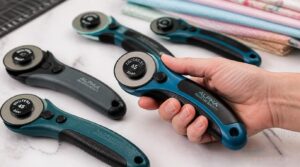
The handle you grip makes or breaks your cutting experience — and the best rotary cutters are designed with your hand in mind.
Whether you’re cutting for an hour or a full afternoon, handle shape, texture, and weight all play a bigger role than most people expect.
Here are the key ergonomic handle features worth knowing before you buy.
Curved Loop Handles
The curved loop handle wraps your palm in a near-complete circle, spreading grip force evenly so no single finger bears the strain. That even grip force distribution lets you guide your rotary cutter steadily without clutching tightly.
Most loops measure between 1.75 and 2.25 inches in diameter, fitting the majority of adult hands comfortably through longer sessions.
Soft-touch Textured Grips
Soft-touch textured grips take comfort a step further than loop handholds. Made from thermoplastic elastomer blends, they deliver a cushiony, slightly tacky surface that keeps your hand steady without forcing a tight grip.
Fine dimples and micro-ridges channel away moisture, giving you a reliable antislip grip even when your hands are warm or dusty mid-project.
Finger-groove Control
Textured grips keep your hand steady, but finger grooves take positioning one step further. Those subtle contours molded into the handle align your index and middle fingers at the same point every single cut — no guessing, no shifting.
That consistency matters. Proper finger alignment distributes cutting force across the pad of each finger rather than concentrating it in one spot, reducing fatigue on long projects.
Weighted Handle Balance
Where finger grooves lock in your positioning, handle weight distribution takes over to steady the entire cut. A well-balanced cutter shifts mass toward the rear, aligning with your natural wrist motion so your forearm isn’t fighting the tool on every pass.
That center of gravity placement is the difference between a cutter that glides and one that drags. Weighted designs — like the Creative Grids 45mm metal-body cutter — let you apply less downward pressure while maintaining clean, consistent contact with the mat.
The payoff is real wrist fatigue reduction, especially during long strip-cutting sessions.
Arthritis-friendly Designs
When your joints are working against you, the wrong cutter turns every project into a chore. That’s why arthritis-friendly handle design isn’t just a comfort upgrade — it’s a functional necessity.
Look for these features before you buy:
- Soft polyurethane or rubber coatings that cushion grip pressure and reduce finger pinch
- Optimized handle diameters between 28–36mm, which minimize wrist deviation during cuts
- Squeeze-trigger or low-effort blade mechanics that expose the blade without forcing a hard grip
Lightweight assembly matters just as much as shape. Cutters weighing under 250 grams place less load on inflamed finger joints during long sessions. The Martelli 60mm ergonomic cutter, for instance, pairs a rubber-coated handle with a natural wrist angle specifically designed for hand pain relief.
Hand strain prevention also comes down to blade sharpness. A dull blade forces you to press harder — exactly the kind of sustained effort that aggravates arthritis. Keep blades fresh, and your tool ergonomics do the heavy lifting.
A sharp blade does more for arthritis than any handle design — dull edges demand the pressure that hurts most
Safety Locks and Guards
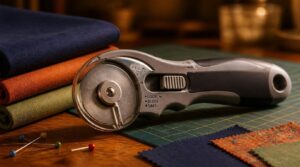
A rotary cutter’s blade is sharp enough to slice through multiple fabric layers in one pass — which means a reliable safety mechanism isn’t optional, it’s essential.
The right lock or guard keeps your fingers protected whether you’re mid-project or tucking the cutter away.
Here are the key safety features worth knowing before you buy.
Sliding Blade Locks
A sliding blade lock is one of the simplest safety features you’ll find on a rotary cutter — and one of the most important. Push the small bar sideways with your thumb, and a hardened steel locking bar drops into a notch on the blade tang, keeping the edge fully covered until you’re ready to cut.
| Feature | What It Does |
|---|---|
| Locking bar durability | Hardened steel resists wear through thousands of cycles |
| One-handed activation | Thumb-operated slider keeps fingers clear of the blade |
| Tactile engagement clicks | A detent confirms the safety is fully engaged |
| Spring-loaded return | Automatically resets to locked position when released |
That spring-loaded return mechanism means the safety lock re-engages the moment you lift your hand — no manual reset required. It also prevents blade drift by holding the blade root firmly seated during cutting, so your line stays true from start to finish. Check that your cutter produces a clean click when you engage it; a vague or mushy feel signals worn components that need attention.
Spring-loaded Blade Guards
Spring-loaded blade guards work the moment you lift the cutter — no button press, no manual reset. The spring returns the guard housing to its covered position automatically, cutting your exposure window to near zero.
Key things to check for:
- Guard retraction speed stays rapid but controlled, avoiding sudden snaps
- Steel spring fatigue resistance ensures smooth operation across thousands of cycles
- Polymer guard durability resists cracking and lint buildup over time
Auto-retractable Blade Designs
Auto-retractable designs take blade safety one step further. The moment you lift the cutter from your mat, a spring-loaded housing pulls the blade back inside automatically — no manual flick required.
A detent system holds the blade steady at your chosen cutting depth while you work, then releases when the pressure drops.
You’ll feel a subtle tactile click confirming full retraction.
Squeeze-trigger Mechanisms
Squeeze-trigger mechanisms give you real control — the blade only exposes when your fingers actively squeeze the handle, then retracts the instant you let go.
Trigger resistance usually ranges from 0.5 to 1.5 newtons, light enough to prevent finger fatigue across long sessions.
Travel distance runs 6 to 15 mm, and many designs deliver a tactile click at engagement so you always know the blade is live.
Safe Storage Features
Good rotary cutter safety doesn’t stop when you set the tool down. Blade cover and safety lock mechanisms matter just as much during storage as during cutting.
Look for tool grips with tamper-evident seals on compartment lids, pest-resistant seals, and moisture-control desiccants to keep spare blades dry and sharp — ready when you need them.
Blade Replacement and Compatibility
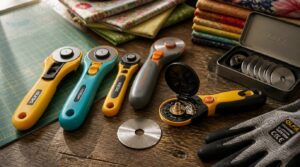
Swapping blades shouldn’t slow your project down. The right cutter makes replacement quick, safe, and straightforward — whether you’re mid-quilt or switching to a specialty edge. Here’s what to look for regarding blade compatibility and convenience.
Quick-change Blade Systems
A quick-change blade system is one of those upgrades that quietly transforms your workflow. Instead of fumbling with screws or tools, a single press or slide releases the old blade and seats the new one in seconds.
Magnetic blade retention holds everything steady during installation, while alignment notches guarantee precise, wobble‑free seating every time.
Standard 45mm Blades
The 45mm blade is the workhorse of precision cutting — adaptable enough for cotton, felt, vinyl, and leather, yet controlled enough for clean edges on finer fabrics. Universal fit compatibility means replacements drop straight into most major-brand cutters without hassle.
- Blade replacement cues: ragged edges, skipped threads, or increased pressure signal it’s time
- Titanium-coated variants resist dulling and corrosion from sticky or damp materials
- Tungsten-infused edges stay sharp longer through layered fabric stacks
- Wide material throughput balance suits both lightweight quilting cotton and thicker craft foam
- Packs of five or ten blades keep your rotary cutter ready without mid-project stops
Standard 60mm Blades
Step up from 45mm and you get serious cutting power. 60mm blades — built from high carbon stainless steel with hardness around HRC 56–60 — slice through dense materials like denim, batting, and fleece without forcing extra pressure.
Models like the Fiskars 60mm Rotary Cutter and Olfa Standard Rotary Cutter 60mm handle multilayer cutting capability with ease.
Built-in Blade Storage
Some cutters take blade management a step further than a quick-change system alone. Built-in blade storage keeps spare blades directly inside the handle, so you’re never hunting through your craft bag mid-project.
- Handle compartment access via recessed panel
- Magnetic recess holds one blade securely
- Integrated clip systems for 45mm spares
- Dust and moisture protection built in
- Safety lock re-engages automatically after swaps
Replacement Blade Packs
When your blade starts skipping stitches or dragging on fabric, a replacement blade pack is your fastest fix. Packs like the HEADLEY TOOLS 10 Pack give you bulk value without constant reordering.
Many packs are color-coded by blade type, so identifying straight versus specialty blades takes seconds. Look for packs with a built-in safety dispenser — far safer than loose blades rattling around your craft drawer.
Best Uses by Craft Type
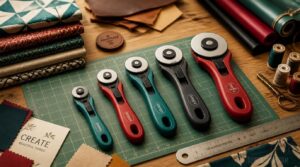
The right rotary cutter can make or break your project depending on what you’re actually cutting. Different craft types call for specific blade sizes, edge styles, and pressure techniques — and knowing which tool fits which job saves you time and wasted material.
Here’s how to match your cutter to your craft.
Quilting Cotton Strips
Quilting is where rotary cutters truly prove their worth. For strip piecing accuracy, a 45mm rotary cutter gives you clean, consistent edges across multiple layers of quilting cotton without shifting.
- Prewash strips to control shrinkage
- Align cuts with the fabric grain
- Use chain piecing to speed assembly
- Maintain a precise ¼-inch seam allowance
- Check colorfastness before combining fabrics
Sewing Pattern Cutting
Switching from scissors to a 45mm rotary cutter changes everything for pattern work. You get cleaner edges along curves and straight seams alike, with far less fabric drag.
Always check grainline alignment before your first cut — an off-grain piece will hang crooked no matter how precise your seam allowances are.
Keep seam allowance precision consistent by running the blade right along the pattern edge.
Felt and Appliqué Crafts
Felt forgives beginners — no fraying, no folded edges, just clean shapes ready to stitch. A 28mm rotary cutter cuts tight curves and small appliqué pieces with real precision.
- Trace paper templates onto felt before cutting
- Layer multiple felt pieces for dimensional effects
- Use blanket stitch or running stitch along stable edges
Vinyl and Leather Projects
Vinyl and leather demand sharper prep than most fabrics.
Before you cut, clean the leather surface with a pH-neutral cleaner, then lightly abrade it with a soft sponge for better adhesion.
For vinyl, cut from the backside to avoid surface marks.
A 45mm or 60mm rotary cutter on a self-healing mat gives you clean, controlled lines.
Paper Crafting Cuts
Paper cuts demand more finesse than fabric. Opt for a 45mm precision cutting tool on a self-healing mat, and cut from the back to keep edges crisp.
- Use 80–120 gsm paper for simple cuts
- Try vellum for translucent layers
- Make shallow passes on heavy cardstock
Replace dull blades fast — tears follow quickly.
Accessories Worth Buying
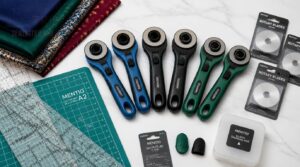
A good rotary cutter does most of the work, but the right accessories take your cutting game to the next level. Pairing your cutter with the proper tools protects your blades, improves accuracy, and saves you money over time. Here’s what’s worth adding to your setup.
Self-healing Cutting Mats
A self-healing cutting mat is the one accessory that protects both your blade and your work surface simultaneously. Every time you cut, the mat’s material closes back over the groove within minutes, keeping your surface smooth and your measurement grid intact.
| Mat Feature | Why It Matters |
|---|---|
| Self-healing surface | Closes after each cut, preventing permanent grooves |
| 3–7mm thickness | Thicker mats absorb heavy blade impact better |
| Non-slip backing | Keeps mat stable during intricate cuts |
| Printed grid lines | 1cm and 1-inch squares aid quick alignment |
| Easy maintenance | Wipe clean; store flat to prevent warping |
Thicker mats — closer to 7mm — handle rotary cutters and heavy fabrics without deflecting the blade, which directly improves your cutting precision. Non-slip backing matters more than most beginners expect; a mat that shifts mid-cut is a safety hazard and a precision killer. Wipe yours down regularly and always store it flat.
Rotary Cutter Rulers
Once your mat is locked in, a rotary cutter ruler takes your precision up another level.
TrueCut‑style rulers feature raised edges that guide your blade in a stable track, eliminating drift.
Clear rigid acrylic keeps fabric alignment visible underneath, while non‑slip grip textures hold the ruler steady.
Built‑in bias lines let you cut accurate angles without re‑measuring every time.
Pinking and Wave Blades
Rulers give you the straight edge — but sometimes you want anything but straight. That’s where pinking and wave blades earn their place.
Swap your standard 45mm blade for one of these and you get:
- Zigzag pinking edges that reduce fraying on woven fabrics
- Sinusoidal wave cuts for decorative paper and fabric borders
- The Olfa Pinking Blade for clean, snag-free results
Complete Cutting Kits
If pinking blades handle the decorative edge work, a complete cutting kit takes care of everything else.
You get a rotary cutter, replacement blades, a self‑healing mat, and a measuring tool in one purchase — no hunting for compatible pieces separately.
Many kits include built‑in blade storage to keep spare blades organized and ready.
Care and Cutting Tips
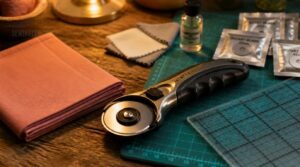
A sharp blade and good habits make every cut cleaner and safer. Taking care of your rotary cutter doesn’t take much time, but it makes a real difference in how long your tools last. Here’s what you need to know to keep everything in top shape.
Replace Dull Blades
A dull blade doesn’t just slow you down — it fights you. When your rotary blade starts dragging instead of slicing, fabric fraying increases, and your cut lines wander off course. That’s cutting precision loss in action.
Before each project, run a quick test cut on scrap material. If the edge looks fuzzy or the blade skips, swap it out.
Clean Lint Buildup
Lint is the silent enemy of a sharp blade. Fine fabric fibers wrap around the cutting edge and pack into the blade housing, dulling performance faster than heavy use alone.
After every session, brush out the blade gap with a soft brush and wipe the housing with a lint‑free cloth dampened with isopropyl alcohol to clear sticky residue.
Store Blades Retracted
Every rotary cutter should go into storage with its blade fully retracted. Leaving a blade exposed — even on a cutting mat — is a pocket safety risk and an accidental contact prevention failure waiting to happen.
Engage your safety lock before setting the cutter down. A self-retracting blade takes care of this automatically, but always confirm the lock has clicked.
Cut on Proper Mats
Your blade deserves a surface that works with it, not against it. A self-healing cutting mat absorbs each pass of the blade and closes back up, protecting both the edge and your table.
Mats with built-in grid lines keep your cuts straight without second-guessing every angle.
Store yours flat — a warped mat shifts fabric mid-cut.
Recycle Used Blades
Don’t toss that dull blade in the trash — it’s recyclable metal with a second life ahead of it.
- Rigid puncture-resistant containers keep blades safe during transport
- Mail-back programs from some manufacturers include prepaid shipping
- Scrap metal drop-offs or hazardous waste events accept used blades
- Craft store recycling drives periodically collect blades for proper processing
Frequently Asked Questions (FAQs)
Does Hobby Lobby have rotary cutters?
Yes, Hobby Lobby carries rotary cutters in its sewing notions aisle, including 45mm and 60mm options from Fiskars and Olfa. Check your local store or browse online to confirm current stock before heading in.
Can rotary cutters work on leather or vinyl?
Rotary cutters handle leather and vinyl well. Use a sharp 45mm or 60mm blade, apply light even pressure, and always cut on a self-healing mat to keep edges clean.
How long does a typical blade last?
Expect 150 to 300 cuts from a standard 45mm blade on light fabrics. Dense materials like vinyl or leather slash that number fast. Swap it the moment edges start fraying.
Are left-handed rotary cutters widely available?
Left-handed options are more available than you’d think. Brands like Martelli and Olfa offer dedicated or blade-swappable models. Most 45mm and 60mm cutters let you reposition the blade for either hand.
What cutting mat thickness works best?
A 3 to 4 mm self-healing mat hits the sweet spot — thick enough to protect your blade and absorb impact, light enough to stay portable without sacrificing cutting accuracy.
Can you sharpen blades instead of replacing?
Sharpening works, but results vary by blade type. Tungsten and Japanese steel respond best. Coated blades lose their protective layer when ground. Uneven sharpening risks blade thinning and chipping — often making replacement the smarter call.
Can rotary cutters replace scissors for all projects?
Think of scissors as a scalpel — precise, personal, irreplaceable for small notch accuracy and intricate curve precision. Rotary cutters can’t fully replace them. Use both for the best results.
How do I know when my blade needs replacing?
Your blade is past its prime when cuts start fraying, you’re pressing harder than usual, or the edge looks chipped. Replace it immediately — a dull blade drags instead of slices.
Are rotary cutters safe for children to use?
Rotary cutters aren’t designed for young children. Most manufacturers advise adult supervision only. Preteens with training and proper safety gear can try with oversight, but always engage the blade lock when not in use.
Can I use a rotary cutter without a mat?
You can, but it’s a bad idea. Without a mat, you’ll dull your blade fast, risk scratching your table, and lose cutting accuracy. A self-healing mat protects both.
Conclusion
What separates a clean cut from a frayed edge? The right tool in your hand.
Choosing the best rotary cutters for crafts means thinking beyond brand names—blade size, material, grip comfort, and safety all shape how confidently you work.
A sharp 45mm covers most projects, but having a 28mm for curves and a 60mm for thick layers gives you real control. Match the cutter to the job, and your fabric follows exactly where you lead.
- https://joanns-fabric.com/craft-diy-supplies/rotary-cutter-joann
- https://feelgoodfibers.com/how-to-find-the-best-rotary-cutter-for-your-next-project
- https://www.qualitysewing.com/collections/rotary-cutters-blades
- https://saltyhippo.com/blogs/the-salty-news/best-rotary-cutter-for-quilting
- https://suzyquilts.com/quilting-rotary-cutters-a-complete-guide