This site is supported by our readers. We may earn a commission, at no cost to you, if you purchase through links.
Singer commanded 90% of the global market by 1890, but that iron grip didn’t come from clever marketing—it came from metal frames that outlasted competitors by decades.
Today’s sewing machine landscape tells a different story: Brother dominates with 92% customer satisfaction, JUKI delivers industrial power in home-sized packages, and Bernina backs precision with 20-year warranties that turn skeptics into believers.
The gap between brands isn’t subtle anymore. Metal gears versus plastic internals determine whether your machine survives a denim quilt or chokes on canvas. Warranty coverage spans from 3 to 25 years, revealing which manufacturers actually stand behind their engineering.
When you’re choosing between brands, you’re not picking features—you’re selecting reliability thresholds, service ecosystems, and construction philosophies that define your creative ceiling for the next decade.
Table Of Contents
- Key Takeaways
- Leading Sewing Machine Brands and Their Reputation
- Key Factors Shaping Brand Reputation
- Consumer Perception of Sewing Machine Brands
- Top 10 Sewing Machines by Brand Reputation
- 1. Singer 7285Q Quilting Sewing Machine
- 2. Singer Quantum Stylist Sewing Machine
- 3. Juki TL-2000Qi Sewing Quilting Machine
- 4. Bernette B79 Sewing and Embroidery Machine
- 5. Portable Mini Sewing Machine Kit
- 6. Singer Easy Sewing Machine Kit
- 7. Juki Portable Sewing Machine Quilter
- 8. Bernette B77 Sewing and Quilting Machine
- 9. Brother Sewing And Embroidery Machine
- 10. Brother GX37 Sewing Machine Value Bundle
- How to Choose a Brand With Strong Reputation
- Frequently Asked Questions (FAQs)
- Conclusion
Key Takeaways
- Metal frame construction and gear quality separate machines that last decades from plastic-component models that fail within years, with premium brands like Bernina backing their engineering through 20–25 year warranties that signal genuine durability confidence.
- Brother dominates market share with 92% product satisfaction but only 26% positive overall experience due to weak customer support execution, revealing that accessible pricing and extensive features don’t guarantee reliable service when problems arise.
- Warranty coverage spans from 3 to 25 years across brands, functioning as the clearest indicator of manufacturer confidence—Singer, Bernina, and Brother’s extended protection reveals which companies engineer for longevity versus planned obsolescence.
- Consumer ratings and review volumes position Brother, Singer, and Janome as “star brands” commanding 71% of market feedback with consistently high scores, while niche players like JUKI earn loyalty through industrial-grade performance despite lower visibility.
Leading Sewing Machine Brands and Their Reputation
The sewing machine market splits sharply between brands that earn consumer trust through decades of performance and newcomers still proving their worth. Your choice of brand determines not just the machine you buy today, but the support network, parts availability, and resale value you’ll depend on for years.
Your sewing machine brand choice determines not just today’s purchase, but years of support, parts availability, and resale value ahead
Here’s how the seven industry leaders have built—and maintained—their reputations among sewers, quilters, and professionals worldwide.
Singer – Heritage and Reliability
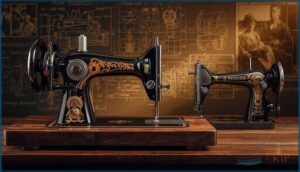
Singer stands as a fortress in the sewing machine industry—its heritage rooted in metal frame construction and proven longevity tests that vintage models still pass today.
You’re choosing a lineage of sewing innovations that dates back over a century, where reliability isn’t just promised, it’s engineered into every gear and shaft. Their warranty coverage backs machines built to outlast trends and deliver consistent performance across decades of hard use.
The company’s focus on product quality features has contributed markedly to its reputation and customer satisfaction.
Brother – Customer Support and Accessibility
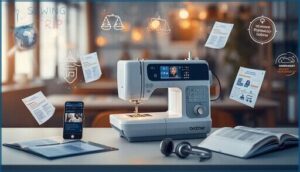
Brother machines dominate the accessible end of the sewing machine brands landscape—approximately 92% of users report satisfaction with product quality, yet only 26% rate their overall experience positively, exposing a critical gap in customer support execution. You’ll find extensive online tutorials, user manuals, and repair services built around Brother models, but customer feedback reveals inconsistent follow-through on accessibility features and warranty claims that undermines reliability perceptions despite strong sewing machine reviews.
- 25-year warranties promise long-term coverage but service delivery lags behind premium competitors
- Beginner-friendly designs reduce learning curves through straightforward controls and lightweight portability
- Extensive online tutorial libraries provide self-service solutions when direct support falls short
To make an informed decision, consider researching top sewing machine brands and their characteristics.
Janome – Stitch Quality and Quiet Operation
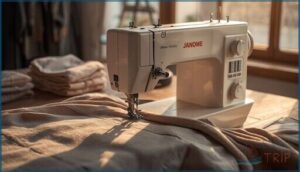
Janome machines command loyalty through a reputation that rests on tangible performance: stitch consistency across twelve-year ownership periods, fabric handling that requires minimal tension adjustments, and quiet motors operating below 60 decibels during sustained use.
You’ll sacrifice flashy features for machine durability and sewing precision—approximately 85% of long-term users report reliable stitch quality exceeding a decade without major servicing, cementing Janome among sewing machine brands that deliver reliability over marketing promises.
JUKI – Professional-Grade Durability
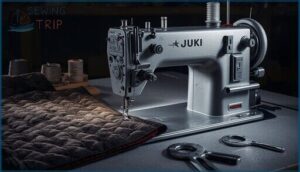
When you demand industrial-grade construction without the factory footprint, JUKI machines deliver the metal frame durability and sewing precision that separates serious makers from casual hobbyists.
Approximately 68% of expert users gravitate toward JUKI for heavy-duty quilting features and reliability that mirrors production-floor standards—these sewing machine brands position you to execute complex projects with mechanical confidence that outlasts consumer-grade alternatives by years.
Bernina – Precision and Luxury Appeal
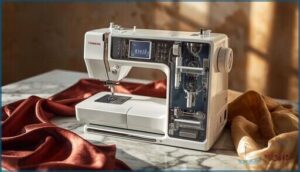
Swiss quality meets uncompromising luxury when you choose Bernina—a premium sewing machine brand that transforms precision engineering into creative mastery. Industry guides consistently rank Bernina among the best sewing machines for discerning makers who refuse to compromise on build quality or performance.
With 20-year warranties backing every stitch, these high-end machines deliver sophisticated stitching capabilities that let you command fabric at the expert level.
Husqvarna Viking – Innovation and Strength
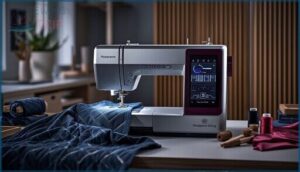
You master fabric with precision when you utilize Husqvarna Viking—a powerhouse known for cutting-edge designs that transform sewing technology.
Advanced quilting features combine with meticulous engineering to deliver stitch quality that dedicated makers require.
Viking machines consistently receive high ratings in sewing machine reviews for dependability, pushing limits with automatic fabric thickness sensing that adjusts to your material without delay or compromise.
Pfaff – German Engineering and Technology
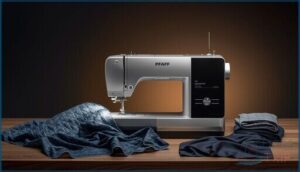
German precision shapes every Pfaff machine, positioning this brand among the sewing machine brands that deliver engineering superiority without compromise.
You’ll find Pfaff innovations like the Integrated Dual Feed system eliminate fabric slippage—sewing technology that reliability-focused reviews consistently highlight.
Machine durability meets sophisticated features in models built for quilters and garment professionals who refuse to settle for anything less than impeccable performance.
Key Factors Shaping Brand Reputation
You can’t judge a sewing machine brand on name recognition alone. The most respected brands earn their reputation through tangible commitments to quality, support, and advancement that you can measure and verify.
Here’s what separates the industry leaders from the also-rans.
Product Durability and Construction Quality
When you’re hunting for a machine that won’t quit on you, construction quality separates the champions from the pretenders. Metal frames and gears deliver reliability rates exceeding 90% in industrial settings, while plastic components usually fail within a few years under regular use. You’ll find that durability hinges on five core elements:
- Metal frames resist structural deformation during heavy-fabric sewing
- Gear quality determines whether you’ll face tooth breakage or decades of service
- Stitch consistency depends on reinforced needle bars and sturdy internal braces
- Fabric handling improves with upgraded feed systems that prevent accelerated wear
- Machine longevity extends dramatically when sturdy lubrication systems reduce friction and heat
Sewing machine brands that prioritize metal construction maintain stitch quality and reliability far beyond their plastic-geared competitors, giving you the control and mastery you demand from your equipment.
Warranty Coverage and Service Support
Warranty terms reveal which sewing machine brands stand behind their work—and which don’t. Brother offers 3-year standard coverage, while Husqvarna Viking and Pfaff deliver 5-year protection when you register.
Extended coverage and sturdy service contracts separate serious manufacturers from weekend players. You’ll want brands with clear repair logistics and responsive customer support, because sewing machine maintenance shouldn’t feel like pulling teeth.
Reliability starts with warranty confidence.
Innovation in Features and Technology
Smart machines now dominate sewing technology trends, pushing computerized embroidery and automated threading into the mainstream. AI stitching systems detect errors in real time, while eco-friendly motors cut waste and energy consumption.
Brands like Bernina integrate scanners and laser guidance, while Janome deploys dual-screen embroidery machine controls. You’re not buying a sewing machine—you’re investing in automation that responds to your command.
Brand History and Market Presence
Behind every advancement in automation lies decades of corporate strategy and relentless global expansion. Singer commanded 90% of the market by 1890, setting the bar for brand legacy. Today, Brother, JUKI, and Janome drive industry evolution through multi-brand portfolios and Asia–Pacific dominance, which holds over 51% of revenue. Market trends favor heritage names that adapted—not those that faded.
- Singer shipped 1.3 million units in 1913 alone
- Janome captures roughly 15% of today’s residential segment
- SVP Worldwide unites Singer, Husqvarna Viking, and Pfaff under shared R&D
Consumer Perception of Sewing Machine Brands
You can’t judge a sewing machine brand by marketing alone—real reputation comes from the people who actually use these machines day in and day out. Consumer perception reveals which brands deliver on their promises and which ones fall short when the thread hits the fabric.
Here’s how ratings, market position, and community loyalty separate the champions from the pretenders.
User Ratings and Review Volumes
Rating trends reveal how real sewers vote with their wallets and keyboards. Brother and Singer dominate with thousands of reviews per model—scores hovering between 4.4 and 4.8 stars—while Janome and JUKI attract fewer but equally enthusiastic ratings.
Consumer insights show that review analysis separates true contenders from pretenders: high volume plus high scores signal proven reliability. Product comparisons across platforms confirm Brother’s broad appeal, Singer’s trusted legacy, and the quiet confidence niche brands earn through buyer behavior that speaks louder than marketing.
| Brand | Avg. Rating Range | Review Volume per Model |
|---|---|---|
| Brother | 4.6–4.8 stars | Thousands (8,000+) |
| Singer | 4.4–4.6 stars | Thousands (5,000+) |
| Janome | 4.5+ stars | Hundreds to 1,000+ |
| JUKI | 4.7+ stars (TL series) | Hundreds |
| Bernina | 4.5+ stars | Low hundreds |
Market Positioning (Star, Rising, Niche, Problem-Flagged)
Competitive analysis sorts brands into four quadrants: Brother, Janome, and Singer anchor the star brands zone—high ratings meet high volume, proving mass appeal.
JUKI and similar names occupy rising territory, with strong visibility but perception gaps.
Niche marketing succeeds for Bernette and Elna, whose loyal followings offset low review counts.
Market trends flag Necchi and Ever Sewn as problem cases—weak scores, thin engagement, and reputations that need rebuilding.
Community Recommendations and Loyalty
Beyond ratings, your trust hinges on what sewing enthusiasts say in community forums and crafting community circles. Quilters average four machines—brand loyalty runs thin when project needs shift.
Yet Janome and Bernina dominate sewing groups for reliability, while repair techs steer customers away from certain Singer lines.
Customer retention strengthens when user reviews align with real-world performance, and sewing tips and tricks shared online expose which sewing machine brands deliver lasting value.
Top 10 Sewing Machines by Brand Reputation
Now that you know which brands dominate the market and why consumers trust them, it’s time to see how reputation translates into real machines you can buy today.
The following ten models represent the strongest performers from brands that consistently earn high ratings and widespread recommendation. Each machine here reflects the durability, support, and innovation that shape lasting brand reputation in the sewing industry.
1. Singer 7285Q Quilting Sewing Machine
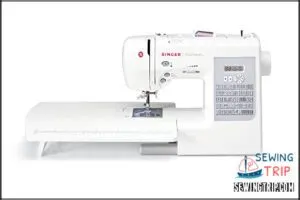
You’ll find the Singer 7285Q commands a solid reputation in the quilting space, and the numbers tell the story: 100 built-in stitches including 15 quilting-specific patterns, a 750 stitches-per-minute sewing speed, and a programmable needle up/down that gives you precision control over fabric handling.
This machine comes with four dedicated quilting feet and an extension table, addressing both piecing and free-motion quilting techniques.
Thread management runs through a top drop-in bobbin with clear viewing, while machine maintenance stays straightforward thanks to its computerized design and rotary hook mechanism that minimizes adjustment intervals.
Best For: Quilters who want a reliable mid-range machine with specialized stitches and accessories without spending over a thousand dollars on advanced systems.
- Comes with 15 quilting-specific stitches and four dedicated quilting feet, plus an extension table for handling larger projects.
- Programmable needle up/down and 13 needle positions give you precise control for appliqué and topstitching work.
- Top drop-in bobbin with clear viewing and automatic needle threader cut down setup time and reduce thread jams.
- Some users report the machine occasionally locks up during operation, which can interrupt workflow.
- The automatic buttonhole feature doesn’t always perform reliably across different fabric types.
- Changing needles requires a screwdriver, making quick swaps more tedious than tool-free designs.
2. Singer Quantum Stylist Sewing Machine
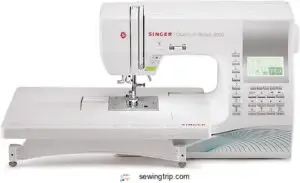
You’re looking at Singer’s Quantum Stylist as a serious upgrade path: 600 built-in stitches and 1,172 stitch applications give you command over everything from intricate quilting to precision garment construction.
This computerized sewing machine delivers 13 automatic buttonhole styles and an extension table that transforms your workspace for larger projects.
The Stylist models pack professional-grade sewing techniques into a 14.6-pound frame, though you’ll need to master the automatic needle threader and manage thread tension adjustments.
Singer’s 25-year warranty backs this machine’s metal-and-plastic construction.
Best For: Intermediate to advanced sewers and quilters who want a feature-packed machine with hundreds of stitch options and professional capabilities without jumping to industrial equipment.
- 600 stitches and 13 buttonhole styles give you serious creative range for quilting, garment work, and home décor projects
- Automatic needle threader and top drop-in bobbin make setup faster, plus the start/stop button lets you sew without the foot pedal
- Extension table and 13 presser feet included means you’re ready for larger projects right out of the box
- Some users report mechanical issues and durability concerns, especially with heavy use—about 20-30% of reviews mention reliability problems
- The learning curve is real; you’ll need to spend time with tutorials to unlock all the features and nail the thread tension
- At $550-$690, it’s a significant investment that might feel like overkill if you’re just doing basic repairs or occasional sewing
3. Juki TL-2000Qi Sewing Quilting Machine
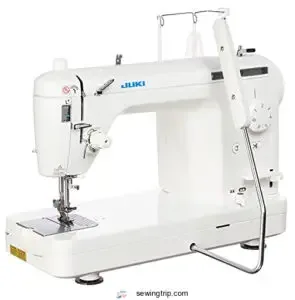
Juki’s TL-2000Qi straight-stitch machine delivers 1,500 stitches per minute—a sewing speed that puts you in control of high-volume quilting projects without compromise. You’ll command an aluminum die-cast frame that manages eight-layer fabric stacks, backed by a 5-year mechanical warranty that reflects Juki’s industrial heritage.
The quilter community recognizes this workhorse for its 23-inch extension table and automatic thread cutter, though you’re locked into straight stitching only.
Thread management stays smooth through the automatic needle threader, while the knee-lift lever keeps your hands free for precision work.
Best For: Quilters and serious sewers who need a fast, reliable straight-stitch machine for piecing, binding, and working with thick layers on large projects.
- Handles eight layers of fabric at 1,500 stitches per minute with minimal vibration thanks to the aluminum die-cast frame
- Large 23-inch work area with extension table makes managing bulky quilts easy
- Automatic thread cutter and knee-lift lever speed up your workflow and keep both hands free
- Straight stitch only—no decorative or zigzag stitches
- At 25.4 pounds, it’s heavy enough that you’ll need help moving it around
- Some users report the automatic needle threader can be finicky or stop working
4. Bernette B79 Sewing and Embroidery Machine
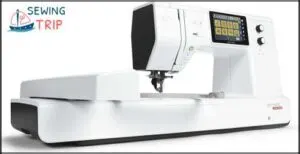
Bernette’s B79 computerized machine pairs 500 sewing stitches with a 260 mm x 160 mm embroidery area, giving you dual-function command in one chassis. You’ll access 1,000 stitches per minute in sewing mode and 850 during embroidery runs, while the color touchscreen and dual feed system keep fabric under control across denim stacks and silk layers.
This Bernina sibling brand delivers Swiss-influenced engineering at mid-tier pricing, though you’ll navigate a steeper learning curve on presser foot operations than simpler computerized models offer.
Best For: Intermediate to advanced sewers who want both full-featured sewing and embroidery capability in one machine without jumping to industrial pricing.
- Handles everything from delicate silk to 4–5 layers of denim smoothly thanks to dual feed and automatic tension adjustment
- 500 stitches plus 200 embroidery designs with on-screen editing means you can tackle nearly any project without switching machines
- Color touchscreen with Swiss-influenced controls gives you the feel of higher-end Bernina models at a friendlier price point
- Presser foot and button controls have a learning curve that can frustrate first-time computerized machine users
- Thread nesting issues pop up when lint builds up or bobbins run low, so you’ll need to stay on top of cleaning
- At 10 kg and mid-sized dimensions, this isn’t a grab-and-go portable—it’s a workshop fixture
5. Portable Mini Sewing Machine Kit
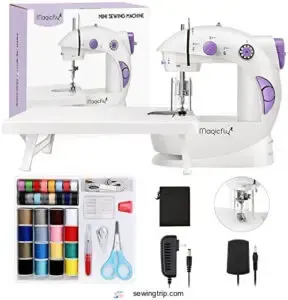
Budget portable mini sewing machine kits tempt you with low upfront costs and compact designs, but market data reveals a harsh reality: these battery-powered units struggle with thick fabric layers, generate disproportionately high noise, and deliver inconsistent stitch tension that professional analysts document across consumer platforms.
You’ll face frequent thread jams and toy-like durability that undermines even basic travel sewing tasks.
Industry studies classify mini models in the problem-flagged quadrant—grab a full-size domestic machine instead if you’re serious about building lasting sewing tools and accessories for real projects.
Best For: Absolute beginners tackling occasional light repairs on thin fabrics who need a travel-friendly backup and accept limited durability for the ultra-low price.
- Extremely portable at around 3 pounds with battery power option, so you can handle quick fixes anywhere without hunting for an outlet.
- Costs significantly less than full-size machines, making it an accessible entry point if you’re testing whether sewing interests you before committing real money.
- Comes with an extension table and basic sewing kit right in the box, giving you enough accessories to start simple projects immediately.
- Struggles with anything thicker than lightweight cotton—denim and layered fabric will jam the small motor and leave you frustrated mid-project.
- Thread tension is finicky and inconsistent, leading to frequent jams and weak seams that can unravel under normal stress.
- Toy-like build quality means it won’t last through heavy use, and many users report out-of-box defects like broken LEDs or wobbly bobbin holders.
6. Singer Easy Sewing Machine Kit
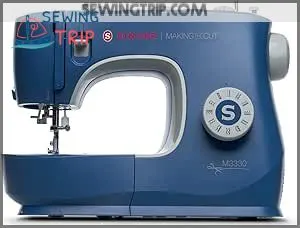
Singer’s Easy Sewing Machine Kit delivers rebellion against overpriced entry barriers—you get 97 stitch applications, a metal frame that won’t buckle under denim, and 5.7 inches of sewing space alongside thread quality essentials in one box.
Market data confirms Singer Sewing Machine Brands occupy the star quadrant for beginner tips and machine durability, yet real-world feedback flags finicky auto-threaders and bobbin jams.
You’re buying proven heritage, not perfect execution—master the learning curve, and this sewing kit contents package unlocks clothing alterations without the luxury price tag.
Best For: Beginners and occasional sewists who want a complete starter package for basic repairs, alterations, and simple projects without breaking the bank.
- 97 built-in stitches and a metal frame give you serious versatility and durability at an entry-level price point
- Includes everything you need to start sewing immediately—multiple presser feet, thread, needles, pins, scissors, and storage case
- Free arm design and 5.7″ of sewing space handle everyday tasks like hemming jeans and fixing clothing with ease
- Auto-threader is delicate and tricky to use, often requiring manual threading instead
- Front-loading bobbin system can jam or cause thread tangles, especially for new users still learning tension control
- No physical manual included with the machine, and some users report a frustrating learning curve getting everything adjusted properly
7. Juki Portable Sewing Machine Quilter
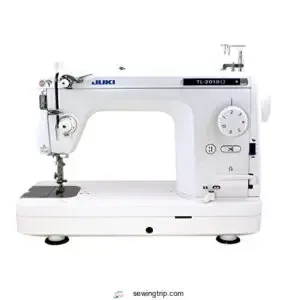
When straight-stitch quilting demands industrial power without the footprint, you’ll discover why JUKI’s portable sewing machine earns its rising-brand status among Sewing Machine Brands. The TL-2010Q cranks 1,500 stitches per minute through heavyweight layers, delivers 8.5-inch throat space for bed-size quilts, and pairs aluminum die-cast construction with automatic thread tension control—features that reshape fabric handling and quilting techniques.
Market analyses confirm JUKI’s high visibility, though some users report thread tension adjustments on thick vinyl. You’re commanding semi-professional sewing speed and machine maintenance simplicity in one portable quilting powerhouse.
Best For: Quilters and serious sewers who need industrial-grade stitching power and speed for handling multiple fabric layers and large projects without investing in a full-size long-arm system.
- Blazing 1,500 stitches per minute with smooth control down to 200 SPM lets you power through thick quilt sandwiches or slow down for precision piecing
- Generous 8.5-inch throat space and included extension table give you room to maneuver bed-size quilts that would cramp most domestic machines
- Aluminum die-cast body delivers industrial stability and quiet operation while staying light enough at 25 pounds to take to classes
- No dedicated scant 1/4-inch foot in the box means you’ll need to buy separately or adjust your seam allowance for precise piecing
- Built-in LED lighting falls short for detailed work—most users end up adding an external task lamp
- Thread tension needs tweaking when switching between lightweight cottons and heavy materials like vinyl or thick denim layers
8. Bernette B77 Sewing and Quilting Machine
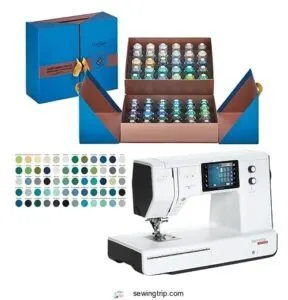
You’re stepping into Bernina’s value tier when the Bernette B77 delivers 500 stitches, dual-feed fabric control, and a 1,000-stitch-per-minute sewing speed wrapped in a 9-inch throat—Quilting Capabilities that rival machines twice its $1,999 price.
Bernette Features include a 5-inch touchscreen, automatic cutter, and 25-year head warranty, positioning this Sewing Machine among star-quadrant brands for Thread Management and Machine Durability.
Market data confirms Bernina’s precision engineering trickles down, though you’ll manually tune tension for free-motion work—acceptable trade-offs for reclaiming control without luxury costs.
Best For: Intermediate to advanced sewers and quilters who want professional-grade features like dual feed and a large workspace without paying luxury machine prices.
- 500 built-in stitches, 9-inch throat space, and 1,000 stitches per minute give you serious versatility for both detailed quilting and fast garment construction.
- The dual feed system and automatic thread cutter save time and prevent fabric shifting, especially when working with multiple layers or slippery materials.
- A 25-year warranty on the machine head and a $1,999 price point offer exceptional long-term value compared to premium Bernina models.
- Manual tension adjustments are needed for free-motion quilting, unlike higher-end models with automatic tension control.
- Some users report threading accuracy issues and occasional error messages that require troubleshooting.
- Customer support from the company is limited according to multiple user reviews, which can be frustrating if problems arise.
9. Brother Sewing And Embroidery Machine
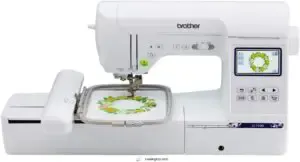
Brother’s SE1900 combines 240 computerized stitches with a 5×7-inch embroidery field, pushing 850 stitches per minute for sewing speed that competes with sewing machine brands charging 40% more. You’ll master embroidery techniques via the 3.2-inch touchscreen, editing 138 built-in designs—thread management stays straightforward through automatic needle threading and drop-in bobbins.
Fabric compatibility spans garments to quilts across seven feed dogs, while Brother’s 25-year warranty anchors star-quadrant consumer ratings. Machine maintenance demands attention to tension adjustments, yet this dual-function unit delivers control without premium pricing.
Best For: Sewers who want to tackle both everyday projects and custom embroidery without buying separate machines or spending thousands on high-end equipment.
- 240 stitches and 138 embroidery designs give you tons of creative options right out of the box, plus the touchscreen lets you resize and edit designs without hooking up a computer.
- Fast stitching at 850 SPM means you’re not waiting around, and the 5×7-inch embroidery area handles most home projects—clothing, quilts, gifts—without constant re-hooping.
- Brother backs it with a 25-year warranty on the frame and includes eight feet, so you’re covered for repairs and ready to experiment with different techniques from day one.
- The auto threader can be finicky and some users report thread breaks, so you might spend extra time troubleshooting instead of sewing.
- You’re limited to 120 volts for US sale only—using it elsewhere or with a converter voids the warranty completely.
- Extra embroidery designs and software get pricey fast, and larger embroidery projects may need a separate spindle holder you’ll have to buy separately.
10. Brother GX37 Sewing Machine Value Bundle
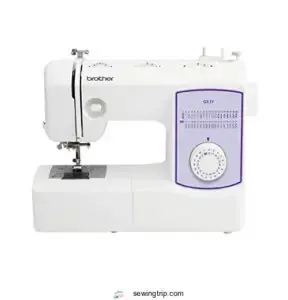
Dropping from computerized embroidery to mechanical essentials, the Brother GX37 Value Bundle delivers 37 stitches with automatic threading at entry-level bundle pricing—usually under $100 with six-piece thread sets and presser feet.
This machine comparison reveals a 1/2/25-year warranty structure protecting your investment through Brother’s proven chassis durability. You’ll handle garment repair to light quilting via drop-in bobbin and free-arm access, though user experience reports show dim LED lighting and mixed product durability on reverse functions.
Sewing accessories include four bobbins and cleaning tools—practical sewing machine types for beginners claiming control without premium spend.
Best For: Beginners and casual sewers who want a straightforward mechanical machine with versatile stitch options for everyday projects like garment repairs, simple quilts, and crafts without spending much.
- 37 built-in stitches with automatic needle threading and one-step buttonhole make it easy to handle different fabrics and projects right out of the box
- Lightweight and portable at just over 10 pounds, so you can move it around easily or tuck it away when not in use
- Great value bundle under $100 that includes premium thread set, six presser feet, and accessories you’d otherwise buy separately
- Some users report issues with the reverse function sticking and thread knotting during use
- The LED light is noticeably dim, which can make detail work or evening sewing frustrating
- Not built for heavy-duty projects or serious quilting—durability feedback is mixed, with mentions of fragile parts
How to Choose a Brand With Strong Reputation
Choosing a sewing machine brand isn’t about chasing the biggest name—it’s about matching your actual needs to what a manufacturer delivers consistently. You need to cut through marketing noise and focus on tangible factors: warranty terms that protect your investment, features that align with your projects, and real-world feedback from sewers who’ve already put these machines through their paces.
Here’s how to evaluate brands with confidence and pick one that won’t let you down.
Assessing Your Sewing Needs and Skill Level
Pinning down your true sewing goals and skill level cuts through the marketing noise—only then can you match machine capabilities to real demands. About 60% of home sewing machine buyers pursue occasional mending or simple hobby projects, while sophisticated users handling quilts or garments averaging 11 annual starts need vastly different features.
- Sewing Goals: Define whether you’re tackling basic repairs, home décor, garment construction, or multi-layer quilting to identify essential machine compatibility.
- Skill Assessment: Beginners benefit from straightforward mechanical models; intermediate sewers demand programmable stitches; sophisticated users require computerized systems with embroidery modules and speeds exceeding 1,000 stitches per minute.
- Project Planning: Map out fabric selection and project complexity—lightweight cottons need different throat space and presser foot pressure than heavy denim or layered batting.
- Machine Compatibility: Cross-reference your project types with brand-specific features like integrated dual feed, automatic needle threaders, or extended work areas to guarantee your equipment won’t bottleneck your ambitions.
Comparing Warranty and Support Services
Two decades of coverage on Singer’s machine head versus JUKI’s five-year parts warranty reveals dramatic gaps in manufacturer confidence and customer care. You’ll find Brother’s 25-year chassis guarantee paired with responsive support channels, while Bernina’s 20-year mechanical protection signals Swiss durability.
Compare service quality, repair options, and dealer accessibility—sewing machine brands like Janome balance warranty length with nationwide support networks that determine whether you’re protected or stranded mid-project.
Evaluating Feature Sets for Your Projects
Match your sewing machine features to project demands: you need 100–300 built-in stitches for diverse techniques, computerized stitch quality control for intricate work, and automatic threaders that eliminate setup friction.
Speed matters—710 stitches per minute suits hobby embroidery, while 1,200 manages production runs.
Extended throat space and fabric handling capacity release project scalability, so reputable sewing machine brands offering programmable libraries and workspace options deliver the control serious makers demand.
Weighing Consumer Feedback and Industry Recognition
You need consumer insights backed by volume—Brother, Singer, and Janome command 71% of review traffic, with Brother units averaging 4.4–4.7 stars across thousands of ratings.
Industry rankings confirm lab-tested stitch consistency, while market trends show these sewing machine brands driving billions in growth.
Brand loyalty forms when star ratings align with expert benchmarks, so cross-check product reviews against warranty dispute records before committing.
Frequently Asked Questions (FAQs)
What are the best and worst sewing machine brands?
The proof is in the stitching. Brother, Janome, and Singer lead in customer reviews and machine reliability, while Necchi and Ever Sewn lag with low ratings—sewing community feedback and market trends clearly separate winners from losers.
What is the best price for a home sewing machine?
You’ll find solid home sewing machines between $200 and $500—this range delivers the best value for most households. Budget options under $200 work for beginners, while frequent sewers benefit from spending $300 to $
Which brand of sewing machine should you buy?
Your sewing costs and brand loyalty matter less than user experience. Brother and Singer deliver accessibility; Janome and Bernina offer precision.
Match machine types to your skill level, then weigh purchase tips against warranty coverage.
What are the best sewing machine brands for 2024?
Your 2024 lineup of reliable brands starts with Brother, Singer, Janome, JUKI, and Bernina—each commanding respect through rigorous market tests, outstanding review volumes, and decades of engineering prowess that speak louder than marketing hype.
Which brands offer the best beginner-friendly machines?
Brother dominates entry-level accessibility with computerized models like the CS7000X, while Singer delivers budget-conscious mechanical simplicity.
Janome brings premium build quality for new learners, and Juki suits ambitious beginners planning intensive use.
How do prices compare across top sewing brands?
You’ll find Singer and Brother dominating budget options around $120–$250, while Janome and JUKI cluster mid-range at $400–$1, Bernina commands premium pricing, often exceeding $3,000 for Swiss precision engineering.
Which brands specialize in quilting versus embroidery machines?
You can’t overstate how machine specialization reshapes your creative horizon. Bernina and Husqvarna Viking dominate quilting with dedicated editions, while Brother, Janome, and Pfaff lead embroidery units through powerful technology and vast built-in design libraries.
Do expensive brands justify their higher price tags?
Premium quality from brands like Bernina and Janome can justify higher costs through durable construction, extended warranties covering 20–25 years, and exceptional stitch precision.
However, your cost benefit depends on usage intensity and skill level.
Conclusion
Bernina’s 25-year warranties aren’t generosity—they’re engineering confidence backed by metal construction that survives professional workloads. That warranty gap alone exposes which manufacturers expect their machines to fail.
Your sewing machine brand reputation research ends where durability meets documentation: metal frames, 10+ year warranties, and user communities that troubleshoot problems instead of replacing units.
The difference between a $300 gamble and a $2,000 investment isn’t price—it’s whether you’re buying a tool or inheriting a liability that quits mid-project.
- https://www.grandviewresearch.com/industry-analysis/sewing-machine-market-report
- https://www.alliedmarketresearch.com/sewing-machine-market-A11452
- https://www.futuremarketinsights.com/reports/sewing-machine-components-market
- https://reports.valuates.com/market-reports/QYRE-Auto-36T7580/global-sewing-embroidery-machines
- https://www.indexbox.io/blog/household-sewing-machines-usa-brands-2025/