This site is supported by our readers. We may earn a commission, at no cost to you, if you purchase through links.
Your quilts deserve better than a cramped, wrestle-with-fabric sewing session. When you’re piecing together a king-size quilt or tackling yards of upholstery fabric, your standard machine surface becomes a bottleneck—fabric bunches, seams wander, and your shoulders ache from holding all that weight mid-stitch.
A sewing machine extension table changes the game by giving you the expanded, stable workspace you need to keep everything smooth and level. The right table eliminates drag around the needle, holds heavy materials without sagging, and turns ambitious projects from frustrating to actually enjoyable.
Whether you’re shopping for your first extension table or upgrading to something sturdier, you’ll want to know which features matter most and which tables deliver real value for quilters, garment makers, and home décor enthusiasts alike.
Table Of Contents
- Key Takeaways
- Benefits of Sewing Machine Extension Tables
- Key Features to Look For
- Compatibility and Installation Guide
- Top 9 Sewing Machine Extension Tables
- 1. Vanely Sewing Machine Extension Table Gray
- 2. StitchTech Sewing Machine Extension Table
- 3. Singer Gray Extension Table Heavy Duty
- 4. Maxmartt Sewing Machine Extension Table Board
- 5. Portable Electric Sewing Machine with Table
- 6. CKPSMS Extension Table for Singer Sewing
- 7. Acouto Sewing Machine Extension Table Board
- 8. StitchTech Sewing Machine Extension Table White
- 9. CKPSMS Extension Table For Singer Sewing Machines
- Tips for Choosing The Right Extension Table
- Frequently Asked Questions (FAQs)
- Conclusion
Key Takeaways
- Extension tables triple your workspace and eliminate fabric drag, making large projects like king-size quilts manageable by keeping everything supported and level instead of bunching at the machine’s edge.
- The right table improves stitch accuracy by 20–30% through consistent fabric support, reducing seam wobble and giving you better control during free-motion quilting or long seam runs.
- Custom-fit tables deliver precision attachment for your specific machine model, while universal options offer flexibility across brands—both work if you verify compatibility and adjust legs to sit flush with your needle plate.
- Look for sturdy construction (cast acrylic or reinforced ABS plastic), adjustable legs for stability, and built-in measurement grids that help you align fabric without reaching for separate rulers.
Benefits of Sewing Machine Extension Tables
An extension table transforms your sewing machine into a workspace that can handle projects of any size. Whether you’re working on a king-size quilt or stitching delicate curtain panels, the right table makes a noticeable difference in how smoothly fabric moves and how accurate your seams turn out.
Let’s look at the specific ways an extension table improves your sewing experience.
Expanding Workspace for Large Projects
When managing large projects like queen-size quilts, standard sewing machine extension tables triple your usable workspace—expanding from 8–10 inches to platforms up to 24 × 24 inches. This workspace expansion transforms how you handle fabric drag on oversized work, keeping bulky layers supported rather than drooping off the edge.
Modular tables can even link together, creating ergonomic benefits by reducing arm strain during extended quilting sessions. These tables also provide enhanced support for preventing fabric bunching.
Improving Sewing Accuracy and Precision
Beyond a bigger surface, extension tables sharpen your sewing accuracy by keeping seams within ±0.5 mm tolerance. A level surface minimizes fabric distortion and drag, so your stitches stay straight and consistent. Here’s how precision improves:
- Seam allowance deviation drops 20–30% when fabric glides smoothly rather than snagging at machine edges.
- Stitch straightness increases on long runs—you’ll see 25% fewer wobbles on borders and hems.
- Free-motion control becomes easier, reducing skipped stitches during intricate quilting.
Ergonomic stability means less arm fatigue, so you maintain that smooth experience hour after hour.
Enhancing Fabric Support and Stability
Accurate stitches start with steady fabric support. A level surface distributes weight evenly across your material, preventing sag and reducing drag around the needle. Adjustable legs and reinforced construction deliver project stability so your fabric won’t shift mid-seam.
That ergonomic support lowers arm fatigue during quilting control and minimizes fabric stress on delicate pieces, keeping your sewing surface flat and dependable.
Using an extension table provides a large, level surface for sewing.
Reducing Fabric Bunching and Pulling
When fabric bunches or pulls, tension adjustment and needle selection become your first line of defense. Extension tables improve fabric support and stability by keeping your sewing surface flat and preventing edges from dragging or catching.
That consistent material handling reduces bunching by up to 50% on larger projects. Regular maintenance practices and stabilizer usage on your extended workspace deliver smoother stitching and better sewing comfort throughout every seam.
Supporting Quilting and Heavy Materials
When you’re quilting or working with heavy materials, proper load distribution across a stable surface becomes critical. Extension tables provide ergonomic support by reducing drag and preventing fabric weight from pulling on your needle area.
That improved fabric support and stability enhances stitch quality throughout large sewing projects. Application suitability makes these tables essential for supporting quilting and heavy materials effectively.
Key Features to Look For
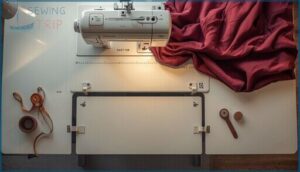
Not all extension tables are created equal, and the right one can make or break your sewing experience. When you’re shopping for a table, a few key features will determine whether it truly aids your work or just takes up space.
Let’s look at what separates a great extension table from one that’ll just frustrate you.
Table Size and Surface Area
When picking your extension table, workspace dimensions matter more than you might think. Tables range from compact 11.5 x 15-inch designs to giant 24 x 24-inch surfaces—the Large Deluxe 18 x 24 Table hits a sweet spot for expanding sewing area.
Consider your project size and ergonomic reach: wide extension tables like the 18in x 18in Extension Table give you better fabric control without overextending your arms during quilting.
Material Quality and Durability
Your table’s construction defines how long it’ll serve you. Look for sturdy plastic like ABS (with strength ratings around 40–60 MPa) or an acrylic table—Sew Steady uses cast acrylic with enhanced hardness and chemical resistance.
Plywood longevity beats MDF by years; metal leg stability prevents wobbling better than plastic.
Check customer reviews and product information for real-world surface wear before committing.
Printed Grid Markings and Rulers
When precision determines whether quilt blocks fit or seams pull, built‑in measurement tools become your best allies. Printed rulers and grids give you fast, consistent seam allowance checks and project alignment without fumbling for separate gauges.
- Dual‑scale markings (inch and metric measurements) eliminate conversion steps and reduce errors
- Zero‑at‑needle rulers offer measurement accuracy right where you stitch
- Grid lines improve workflow efficiency by aligning fabric edges before you sew
Look for clear design characteristics—embedded or printed ruler edges—that won’t fade under static cling rulers or fabric friction.
Adjustable and Stable Legs
A wobbly surface ruins straight seams faster than you can rethread a bobbin. Adjustable legs let you fine‑tune height adjustment so your sewing machine extension table sits flush with the needle plate—usually about 1/4 inch shorter than the free arm—while anti‑slip feet anchor stability on smooth floors.
Proper installation and ergonomic posture reduce shoulder strain, and table accessories that fold or retract simplify storage between sessions.
Transparent Vs. Opaque Tables
Light transmission through clear acrylic reveals your bobbin and feed dogs instantly, while opaque laminate blocks glare under bright task lights. When comparing Sew Steady tables and similar transparent extension table features, consider:
- Fabric glide – polished acrylic reduces drag on quilts
- Scratch resistance – opaque laminates hide wear better
- Glare reduction – matte finishes ease eye strain
- Cost comparison – clear custom‑fit options run higher than generic rectangular tops
Compatibility and Installation Guide
Getting the right extension table means making sure it actually fits your sewing machine and sits flush with your work surface. You don’t want gaps, wobbles, or a table that blocks important buttons or controls.
Let’s walk through how to check compatibility, install your table properly, and get everything adjusted so you can start sewing with confidence.
Checking Sewing Machine Model Compatibility
Before you buy an extension table, you need to confirm your sewing machine model matches the compatible models list. Major brands like SINGER, Janome, and PFAFF publish specific part numbers for defined machine series.
Check the product description carefully—measurement guides and model numbers guarantee your table fits correctly. A mismatch leads to gaps, wobbling, and poor stability, even if brands look similar.
Custom-Fit Vs. Universal Extension Tables
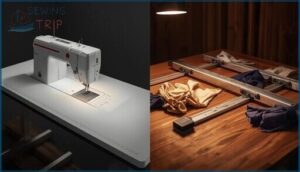
Once you’ve verified compatible models, you face a choice: custom tables designed for your exact machine model or adjustable options that work across brands. Custom tables deliver excellent fit precision and material quality, eliminating gaps entirely.
Universal versions offer installation ease and cost differences that appeal to many—you’ll trade some snugness for flexibility. User preference often depends on whether you value a specialized workspace or versatility.
Steps for Proper Installation
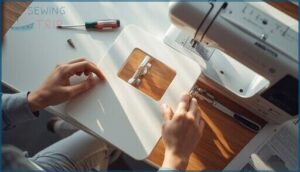
Whether you’ve picked a custom or universal table, proper installation sets you up for success.
Start with machine preparation: unplug your sewing machine and remove the free-arm storage compartment or accessory tray.
Next comes table assembly—attach any included legs to the extension table underside. Slide the table onto the free arm until the cutout fits snugly around your machine base, ensuring a stable foundation for your sewing machine setup.
Adjusting Table Height for Seamless Sewing
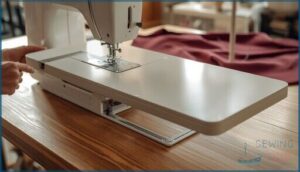
Once your extension table for sewing machines slides on, adjust the legs so the table sits flush with your machine’s needle plate—aim for a level surface within a quarter-inch. This ergonomic height prevents fabric catching at the seam and improves stitch quality dramatically.
Measure from your supporting workspace to the machine bed, then dial in leg ranges accordingly. A fluid sewing machine setup means smoother stitching and less strain on your shoulders.
Ensuring Table Stability and Leveling
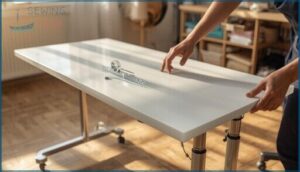
Because even the best extension table fails if it rocks or shifts mid-seam, you’ll want to verify solid footing before threading your first stitch. Wobble prevention starts with adjustable feet that compensate for uneven floors—aim for surface flatness within a few millimeters to protect stitch quality and vibration reduction.
- Check load capacity against your machine’s weight and fabric bulk
- Engage any table lock or suction leg to anchor the platform
- Test stability by pressing corners; zero flex means you’re ready to sew
Top 9 Sewing Machine Extension Tables
Now that you know what to look for and how to install one, let’s get to the good stuff. The following nine extension tables stand out for their fit, function, and real-world performance across different machine types and project sizes.
Each brings something useful to your sewing space, whether you’re tackling bed-sized quilts or just need a little extra elbow room.
1. Vanely Sewing Machine Extension Table Gray
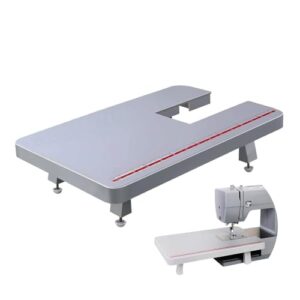
If you’re working with Singer heavy-duty machines like the 4411 or 4423, the Vanely gray extension table might catch your eye. This sewing machine accessory is designed specifically for six Singer models, expanding your workspace to about 163 square inches. The gray table design matches Singer’s aesthetic, and at just over a pound, it’s lightweight and portable.
However, installation issues pop up in user reviews—some find the attachment tricky, while others report stability concerns with the table moving during use. Pricing context varies by region, but it generally costs less than Singer’s own extension table.
Best For: Sewers with Singer heavy-duty machines (4411, 4423, 4432, 4452, 5511, 5523) who need extra workspace for quilting or larger projects and want a budget-friendly alternative to Singer’s official extension table.
- Adds about 163 square inches of flat workspace, making it easier to handle quilts, curtains, and bulky fabrics
- Lightweight at just over a pound, so it’s easy to attach and remove when you need to switch between projects
- Priced lower than Singer’s branded extension table while offering similar functionality
- Installation can be tricky at first, and some users report the table doesn’t always stay securely in place
- Compatibility is hit-or-miss even among the listed Singer models, depending on serial numbers and production runs
- Mixed reviews suggest it may not fit perfectly on all machines despite being advertised as compatible
2. StitchTech Sewing Machine Extension Table
For sewers tackling big quilts or bulky curtains, the StitchTech extension table brings 150 square inches of extra workspace to your Singer Heavy Duty machine. This sewing machine accessory snaps onto models like the 4411, 4423, and 4432 (manufactured fall 2019 or later), creating a smooth, flush surface for fabric support.
Its foldable legs lock into place for leg stability during use, then collapse flat for storage solutions in tight spaces.
While it’s designed for supporting large sewing projects, some users report mixed results with the installation process and overall sturdiness.
Best For: Quilters and home sewers working on larger projects who need extra table surface to support fabric on Singer Heavy Duty machines (4411, 4423, 4432, and similar models from fall 2019 onward).
- Adds 150 square inches of level workspace that sits flush with your machine bed, reducing fabric drag and bunching on quilts and wide hems.
- Foldable legs let you collapse the table to about 1 inch thick for easy storage in drawers or cabinets when you’re not sewing.
- Snaps on without tools, making setup quick and straightforward for compatible Singer Heavy Duty models.
- Some users report the table feels less sturdy than expected, especially when handling heavier quilts or multiple fabric layers.
- Fit issues pop up despite the compatibility list—a few customers struggle to get it to snap securely onto their machines.
- Mixed reviews on value for money, with concerns about whether the build quality justifies the price.
3. Singer Gray Extension Table Heavy Duty
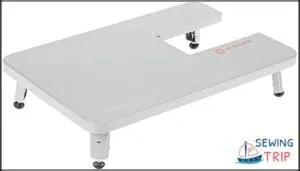
The SINGER Extension Table delivers precision fit for Heavy Duty models 4411, 4423, 4432, 4452, 5511, and 5523 made from fall 2019 onward. With surface dimensions of 15.25″ x 10″, you’ll gain workspace for supporting large sewing projects without fabric sagging.
User reviews average 4.3 stars from 176 customers who praise its fabric support and sturdy build, though some note model compatibility requires checking your machine’s Vietnam origin label.
Pricing analysis shows it at $52.99—pricier than generic tables, yet installation issues remain minimal when your sewing machine matches the specified serial numbers.
Best For: Sewers working on quilts, curtains, or other large projects who own a Singer Heavy Duty mechanical machine (models 4411, 4423, 4432, 4452, 5511, or 5523) made after fall 2019.
- Adds 15.25″ x 10″ of stable workspace that prevents fabric from sagging during big projects
- Snaps on and off quickly without tools, and folds up for easy storage when you’re done
- Built-in ruler markings help you line up seams and fabric edges while you sew
- Only works with specific Singer Heavy Duty models made in Vietnam after fall 2019—older machines may need modifications
- Costs around $53, which is more expensive than generic extension tables
- Some users report fit issues if their machine doesn’t match the exact compatibility requirements
4. Maxmartt Sewing Machine Extension Table Board
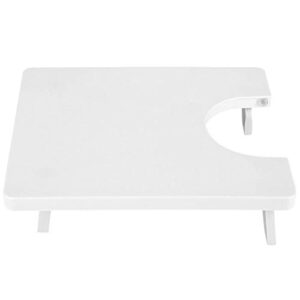
The Maxmartt Sewing Machine Extension Table Board targets mini machine use with its compact 10.1″ x 8.2″ plastic construction, offering a budget-friendly sewing accessory under $30. You’ll find intended compatibility centered on portable 505A-style models rather than heavy-duty machines.
While its comparative analysis reveals a much smaller footprint than premium acrylic tables—which start around $119—this lightweight extension table suits beginners tackling small projects.
Just keep in mind that its freestanding design lacks secure latching, so stability can be hit-or-miss during actual sewing sessions.
Best For: Beginners and hobbyists working on small DIY projects with portable mini sewing machines who need an affordable, space-saving extension surface.
- Compact and lightweight plastic design folds down for easy storage when not in use
- Budget-friendly price point under $30 makes it accessible for casual sewers and craft enthusiasts
- Smooth plastic surface provides a low-friction work area that helps guide lightweight fabrics through mini machines
- Freestanding design without latches or hooks means the table doesn’t secure to the machine and can shift during sewing
- Folding legs are prone to instability and may collapse unexpectedly under pressure
- Limited 10.1″ x 8.2″ work area restricts use to small projects and won’t accommodate larger fabric pieces or quilting work
5. Portable Electric Sewing Machine with Table
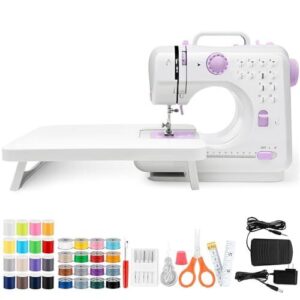
Looking for tabletop portability without sacrificing workspace? Portable electric sewing machines with integrated tables combine compact sewing solutions and budget machines into one space-saving package.
You’ll find these units—usually weighing under two pounds—ideal for beginner projects in dorm rooms or small apartments. Most models feature dual-speed settings and detachable extension tables that snap on in seconds, expanding your sewing machine portability options.
Priced between $15 and $25, these portable tables offer an affordable entry point, though their ABS plastic construction suits light fabrics better than heavy materials.
Best For: Beginners, students, and casual sewers working in tight spaces like dorm rooms or apartments who need an affordable, grab-and-go solution for basic repairs and small craft projects.
- Detachable extension table adds 4–8 inches of workspace and stabilizes the lightweight machine, making fabric handling easier for hemming and patching
- Dual power options (adapter or four AA batteries) let you sew anywhere without hunting for an outlet
- Budget-friendly price of $15–$25 makes it easy to test whether sewing is for you without a big upfront investment
- ABS plastic construction limits durability and struggles with thick fabrics like heavy denim or canvas
- Lightweight design (around 1.6 pounds) can vibrate or shift during use, even with the table attached
- Basic stitch options and simple mechanics mean you’ll outgrow it quickly if you move beyond beginner repairs
6. CKPSMS Extension Table for Singer Sewing
For Singer Heavy Duty owners on a budget, the CKPSMS Extension Table (KP-19242) offers a smart OEM alternative. This rubber and plastic accessory fits Singer models 4411, 4423, 4432, 4452, 5511, and 5523—snapping onto your sewing machine’s free arm in seconds. Its adjustable legs provide leg stability, fluid fabric support matching your machine bed height.
You’ll get the Installation Process down quickly: remove your accessory compartment, slide the table into place, and level the legs. At roughly 70 percent less than Singer-branded sewing machine accessories, it delivers solid Material Quality without breaking the bank.
Best For: Budget-conscious sewers with Singer Heavy Duty machines (4411, 4423, 4432, 4452, 5511, 5523) who need extra surface area for quilts, curtains, and larger projects without paying premium prices for OEM accessories.
- Costs about 70% less than Singer-branded extension tables while fitting the same six Heavy Duty models
- Adjustable legs let you level the surface to match your machine bed height, preventing fabric distortion at speeds up to 1,100 stitches per minute
- Quick snap-on installation takes seconds—just remove your accessory compartment and slide it into place
- May not fit non-Singer machines perfectly, so double-check compatibility before ordering
- Some users report issues with length or fit, making a flexible return policy important
- Lacks the ruler markings and premium finish of OEM Singer tables
7. Acouto Sewing Machine Extension Table Board
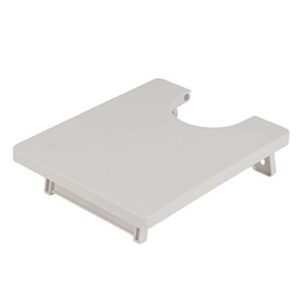
If you’re working with a Fanghua 202 or similar compact model, the Acouto Extension Table Board might catch your eye. This 10.1 by 8.2-inch plastic accessory weighs just 4.9 ounces and folds flat for storage—perfect when space is tight. You’ll appreciate the printed scales on the edges for quick measurements.
Installation Tips are simple: snap on the folding legs, remove your accessory tray, and slide it into place.
User Reviews highlight its portability, though Compatibility Issues arise if your machine’s opening doesn’t match the Fanghua footprint, so measure first.
Best For: Owners of Fanghua 202 or similar compact sewing machines who need extra workspace for larger projects but have limited storage space.
- Folds flat and weighs under 5 ounces, making it super easy to store and carry around
- Built-in measurement scales along the edges let you check fabric dimensions without grabbing a ruler
- Sturdy plastic construction keeps your work surface stable even during larger sewing projects
- Only fits machines with a specific opening size, so it won’t work with all mini sewing machines
- No installation instructions included, which might frustrate first-time users
- Product variations ship randomly, so you can’t choose between old and new versions
8. StitchTech Sewing Machine Extension Table White
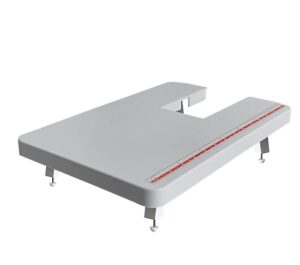
When you need room for quilts or curtains on your Singer Heavy Duty (4411, 4423, 4432, or similar models), this 15-by-10-inch white extension table snaps on in seconds. The foldable legs store flat, and you’ll gain project stability for hemming or piecing.
StitchTech sturdiness gets mixed reviews—some users praise the extra workspace, while others note fit quirks on unlisted machines. At around $33, value assessment depends on your needs, but if Singer compatibility matches your model, you’ll handle heavy materials with less fabric bunching.
Best For: Quilters and sewers with Singer Heavy Duty machines (4411, 4423, 4432, 4452, 44S, 5511, 5523, 5532, 6335) who need extra workspace for larger projects like blankets and curtains.
- Snaps on easily and provides a stable 15×10-inch work surface that helps prevent fabric bunching on bigger sewing projects
- Foldable legs make storage simple when you’re not using it
- Priced around $33, which is reasonable if your machine model matches the compatibility list
- Sturdiness gets mixed feedback—some users find it wobbly or less solid than expected
- Fit can be tricky even on supposedly compatible models, with some customers reporting installation struggles
- Value feels inconsistent depending on your specific machine and project needs
9. CKPSMS Extension Table For Singer Sewing Machines
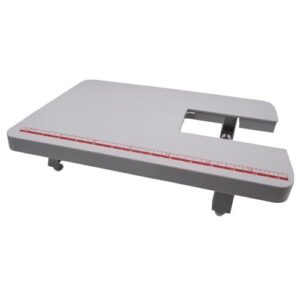
For Singer mechanical Heavy Duty models (4411, 4423, 4432, 4452, 5511, 5523) made since Fall 2019, the CKPSMS extension table delivers 15-by-10 inches of workspace with printed grid markings and adjustable folding legs.
User reviews average 4.4 stars—sewers praise the stability boost for quilting, though some note installation issues on older machines requiring tab removal.
At approximately $61.95, this sewing machine accessory offers model compatibility with Vietnam-manufactured Singers, and its no-tool setup makes it accessible when you’re tackling heavy materials.
Best For: Sewers with Singer Heavy Duty machines (models 4411, 4423, 4432, 4452, 5511, 5523) made since Fall 2019 who need extra workspace for quilting or large projects.
- Adds 15×10 inches of stable workspace with helpful grid markings for fabric alignment
- Simple no-tool installation—just slide it onto the free arm and you’re ready to go
- Folding legs make storage easy when you’re not using it
- Only works with newer Singer machines manufactured since Fall 2019 in Vietnam
- Some users report fitting issues on older models, even requiring tab removal
- At around $62, it’s a bit pricey for a plastic extension table
Tips for Choosing The Right Extension Table
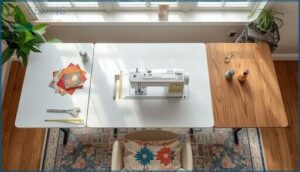
Picking the right extension table isn’t about grabbing the first one you see—it’s about matching the table to your machine and the projects you love to sew. A table that works for your neighbor’s setup might wobble on yours, or fall short when you’re wrestling with a king-size quilt.
Choosing the right extension table means matching it to your machine and projects—not just grabbing what worked for someone else
Here are five practical tips to help you choose an extension table that fits your sewing life perfectly.
Measuring Your Sewing Machine Base
Before you shop, you need to know your machine’s base dimensions. Measure length and width at the widest points, using a ruler or tape measure for accuracy. For irregular bases, trace the shape on paper to capture curves.
Don’t forget height clearance needs beneath the table. These measurements ensure your extension table installation fits flush, preventing gaps that disrupt fabric movement during sewing.
Assessing Your Sewing Project Needs
Think about the sewing projects you actually complete. If you tackle quilting projects or larger projects like curtains, you’ll need more surface area to handle fabric management. Heavy fabrics demand better support than lightweight cottons.
Your sewing frequency matters too—those 6+ hours a week add up, making ergonomic needs critical. Match your table to your project size, fabric type, and skill level for best results.
Considering Storage and Portability
If your workspace is tight, folding mechanisms can be a major advantage. Portable sewing tables like the SewEzi model fold down to roughly five inches thick, sliding under beds or into closets when you’re done.
Weight considerations matter too—around 22 pounds is manageable for one person carrying to classes. Detachable components let you store just the table separately, freeing up valuable floor space between projects.
Evaluating Additional Accessories and Features
Some extension tables go beyond the basics—integrated rulers on acrylic surfaces give you quick measurements, while low-friction coatings reduce surface friction for smoother fabric glide. Template systems support ruler work and free-motion quilting.
Storage options like built-in notions trays keep sewing tools organized. Lighting integration via LED strips brightens your needle area.
These sewing machine accessories transform your workspace into a complete creative hub.
Budget and Brand Reputation
Entry-level pricing starts around $20, but investing in a trusted brand pays off. Singer commands 43% of the market, while Brother, Janome, and Sew Steady deliver proven quality.
- Basic plastic tables run $20–$50 for budget-conscious sewers
- Mid-range Brother and Janome extension table for sewing machines cost $80–$180
- Sew Steady custom acrylic options reach $159–$289
- Look for warranty coverage and discount availability
- Value perception improves with positive reviews and brand popularity
Quality sewing machine accessories last years.
Frequently Asked Questions (FAQs)
Are sewing machine extension tables worth it?
Yes, they’re absolutely worth it if you regularly tackle quilts or large projects. Extension Tables from brands like Sew Steady provide essential fabric support, improving sewing accuracy and handling. For small crafts, alternative solutions might suffice.
What is a sewing machine desk called?
People call them sewing tables, sewing cabinets when they include storage, or industrial workstations for heavy-duty models.
Sewing machine extension tables attach to expand your workspace, while desk variations support the entire machine.
Do I need a sewing machine table?
Think of your workspace as a canvas—too cramped, and your masterpiece suffers. You need a sewing machine extension table when project size, sewing frequency, or ergonomic needs demand better fabric support and workspace beyond your machine’s standard surface.
Are sewing machine tables standard size?
Extension table size standardization doesn’t exist across brands. Custom dimensions dominate, requiring careful measurement for universal compatibility.
Height adjustability ranges from 5 to 5 inches, making table extensions critical sewing accessories for proper sewing machine support.
How do I stabilize an extension table?
A table shaking violently mid-stitch can ruin your seam.
Start by adjusting legs to match your surface leveling and primary table height—add a suction leg for extra support.
Damping vibration and tightening installation practices eliminate wobble instantly.
Can I make my own extension table?
Yes, you can build your own extension table using DIY materials like polycarbonate sheets, foam board, or bamboo cutting boards—often costing under $15.
Custom sizing ensures a perfect fit, though stability factors require careful leg placement.
Are extension tables universal for all machines?
Like a key cut for one lock, most extension tables won’t fit every sewing machine. Model-specific design means a Janome or Sew Steady table usually matches only certain machines, though some universal options accommodate dimension compatibility ranges.
How do I clean and maintain an extension table?
You’ll want to wipe your table daily with a soft microfiber cloth and mild soap to prevent scratches.
Polish acrylic surfaces with a dedicated Table Polishing Kit to maintain smooth fabric glide and material longevity.
What materials are best for extension tables?
High-strength plastics offer the sweet spot for your work surface. Acrylic durability and polycarbonate benefits shine through thickness that matters—around half an inch provides leg stability and surface smoothness you’ll appreciate every stitch.
How do I clean and maintain my extension table?
Clean your work surface with a microfiber applicator and mild soap, avoiding harsh chemicals. Use acrylic cleaning solutions or a table polish kit for scratch removal.
Regular dust prevention and hardware maintenance keep storage solutions functioning smoothly.
Conclusion
Picture yourself guiding yards of fabric across a steady, supportive surface—no bunching, no wrestling, just smooth, confident stitches from edge to edge. That’s the difference a well-chosen sewing machine extension table makes.
You’ve seen the options, learned what matters, and now you’re ready to expand your workspace with confidence. Whether you’re quilting king-size masterpieces or tackling upholstery projects, the right table turns ambition into accomplishment. Your next big project deserves that kind of freedom.
- https://www.qualitysewing.com/products/dream-world-sew-steady-large-18-24
- https://www.missouriquiltco.com/collections/sew-steady-tables
- https://www.rebeccagracequilting.com/2013/01/what-height-my-sewing-table-ergonomics.html
- https://www.quiltingboard.com/main-f1/question-advantage-sewing-cabinet-recesses-machine-t226992.html
- https://sewcare.com/sewing-machine-extension-table/