This site is supported by our readers. We may earn a commission, at no cost to you, if you purchase through links.

That gleaming sewing machine in the store window looks like the gateway to your creative freedom—until you realize there are 47 different models, each promising to be “perfect for beginners.” The truth? Most first-time buyers either overspend on features they’ll never use or grab the cheapest option and regret it within weeks.
Your first machine doesn’t need to do everything, but it absolutely needs to match your actual plans—whether that’s hemming jeans, crafting quilts, or launching a side hustle. The right choice comes down to honest answers about your space, budget, and what you’ll really sew once the novelty wears off.
Table Of Contents
Key Takeaways
- Define your sewing goals and budget before shopping—most beginners thrive with a $200-$350 machine that matches their actual project plans, not someone else’s feature list.
- Prioritize beginner-friendly features like automatic needle threaders, drop-in bobbins, and adjustable stitch controls over complicated computerized functions you won’t use for months.
- Brother, Singer, and Janome dominate the beginner market because they deliver reliable performance, accessible replacement parts, and strong warranty coverage that protects your investment.
- Regular maintenance—oiling every 8-12 hours of use and cleaning the bobbin area every 4-8 hours—doubles your machine’s lifespan and prevents frustrating thread jams mid-project.
Key Factors Before Buying a Sewing Machine
You’re about to make one of the most exciting purchases in your creative journey—but hold on, don’t just grab the first machine that catches your eye! Smart sewing starts with asking yourself the right questions before you commit.
Let’s break down the essentials you need to nail down first.
Assessing Your Sewing Goals
Why are you picking up a needle in the first place? Nail down your sewing motivation and project planning goals before you claim your freedom at the machine. Are you tackling three garments monthly or mastering quilting techniques?
Map your skill assessment honestly—beginner doesn’t mean powerless. Set benchmark goals for basic stitches and seam finishes, then choose a machine that matches your learning curve, not someone else’s vision.
Assess your skill honestly and choose a machine that matches your learning curve, not someone else’s expectations
To maintain productivity and clarity in your sewing projects, consider using clear science methods.
Setting a Realistic Budget
Once you’ve mapped your goals, let’s talk money—because budget planning gives you control, not limits. Most beginners thrive with $200-$350 for reliable performance and solid support. Want future-proof features? Price comparison shows computerized models run $400-$700.
Don’t forget expense management—add $20-$60 for essential bobbins and needles, plus $20-$100 yearly for maintenance. Smart financial considerations today mean fewer regrets tomorrow.
Effective budgeting requires understanding technical writing skills to make informed decisions.
Space and Portability Considerations
Your sewing space rules your workflow—measure before you buy. Most portable beginner machines need a 12–18 inch machine footprint plus 6–12 extra inches for fabric flow.
Compact designs under 15 pounds give you freedom to move between rooms, while a dedicated sewing table anchors your workspace. Storage solutions like built-in compartments keep accessories close.
Workspace layout beats fancy features every time.
Researching Brands and Reviews
Once you know your space works, zero in on brand comparison—you’re hunting for machines that won’t let you down. Brother, Singer, and Janome dominate sewing machine reviews for good reason:
- Brother and Janome report fewer thread jams per thousand stitches than budget competitors
- Customer feedback shows broader accessory kits with entry-level packages
- Product ratings reveal sturdy after-sales support networks across the U.S.
- Market trends confirm 1–3 year warranties as standard in this sewing machine buying guide
Real user experiences beat marketing hype every time.
Choosing The Right Machine Type
You’re standing in front of a wall of sewing machines, and they all look pretty similar at first glance. But here’s the thing—each type is built for different tasks, skill levels, and budgets.
Let’s break down the main categories so you can zero in on the one that’ll match your creative vision.
Mechanical Vs. Computerized Machines
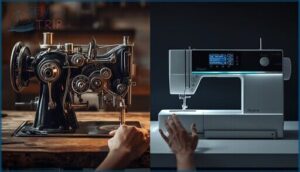
You’re standing at the crossroads—mechanical simplicity or computerized power? Mechanical machines give you hands-on machine control and mechanical durability that’ll outlast trends, perfect if you trust your instincts. Computerized machines bring electronic features, stitch precision, and a user interface that thinks for you. Here’s what every beginner needs in this sewing machine buying guide:
| Feature | Mechanical Machines | Computerized Machines |
|---|---|---|
| Precision | Manual tension adjustment | Automatic tension and stitch control |
| Ease of Use | Simple dials and levers | LCD screens, one-button selection |
| Cost | Budget-friendly upfront | Higher initial investment |
| Maintenance | Basic mechanical parts | Electronics, software updates needed |
| Durability | Fewer parts to fail | Long-lasting with proper care |
Test both types in-store—your hands will tell you which sewing machine features match your style.
Heavy-Duty and Upholstery Options

If thick denim, canvas, or leather are in your sewing future, heavy-duty machines deliver the muscle you need. Metal frame construction and industrial-grade feed dogs handle multiple layers without flinching, while upholstery threads run smooth through larger needle systems.
- Motor torque powers through dense fabrics without stalling or skipped stitches
- Adjustable presser foot pressure locks heavy materials in place, no slippage
- Walking foot systems move bulky layers evenly for professional seams every time
Quilting and Specialized Models

Large quilt patterns demand extra throat space, and quilting machines offer 6 to 10 feed dogs and robotic stitch control for smooth fabric handling across oversized projects. Free motion modes let you trace intricate designs without fighting the machine.
Brother and specialized models include an automatic needle threader and adjustable presser foot pressure. Sewing automation keeps stitch density consistent, turning quilting techniques from guesswork into command.
Manual and Electric Machines

Machine comparison boils down to one question: do you crave the quiet reliability of manual controls, or does an electric motor sound like freedom?
Manual models teach fundamentals with zero power consumption, while electric machines deliver consistent sewing speed and features like an automatic needle threader and adjustable speed.
For a beginner, sewing machine selection hinges on whether simplicity or automation fuels your confidence.
Essential Features for Beginners
You don’t need a machine loaded with bells and whistles, but a few key features will make your first sewing experience way less frustrating. These aren’t optional extras—they’re the essentials that separate machines you’ll actually use from ones that’ll collect dust in your closet.
Let’s break down the four features every beginner should look for before spending a dime.
Automatic Needle Threader
You don’t need eagle eyes or surgeon hands to thread a needle anymore. An automatic needle threader is your secret weapon for sewing efficiency—it uses a tiny hook to guide thread through the needle eye in seconds.
Many beginner-friendly machines from Brother include this easy-to-use feature, often with a built-in thread cutter. It’s automatic threading that saves time and frustration, especially when you’re just starting out.
Adjustable Stitch Length and Width
Control over stitch length and width gives you sewing precision across fabric types—from stretchy knits to crisp cottons. Most machines adjust from 0 to 4 millimeters for length and 0 to 5 millimeters for width, letting you master different sewing techniques.
This stitch control interacts with thread tension and requires occasional machine calibration, but it’s your key to professional-looking seams from day one.
Built-in Stitches and Buttonholes
Beyond precision adjustments, stitch variety and buttonhole types give you real creative freedom. Most beginner machines offer 8 to 20 stitch options—straight, zigzag, and stretch stitches—perfect for garment construction and basic repairs.
Look for these must-haves:
- Automatic OneStep Buttonhole function for consistent results
- At least one decorative stitch for creative projects
- Fabric compatibility guidance in your manual
This combination fosters confidence-building practice across cotton, polyester blends, and lightweight denim.
Top-Loading Bobbin System
Now you’ve got stitches sorted, but thread management can make or break your sewing efficiency. A drop-in bobbin system beats side-loading every time—you can see exactly how much thread’s left through the clear casing.
Bobbin threading takes seconds, not minutes, and bobbin visibility prevents mid-project surprises. For beginners, this sewing convenience rivals an automatic needle threader in pure time-saving power.
Beginner-Friendly Brands and Models
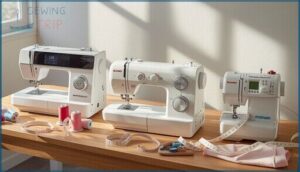
You’ve nailed down the features you need—now it’s time to talk brands. Not all sewing machines are created equal, and some companies have earned their stripes by consistently delivering reliable, beginner-friendly options.
Let’s look at what makes Brother, Singer, and Janome stand out, plus what kind of support you can expect after you buy.
Reputation of Brother, Singer, and Janome
Brother, Singer, and Janome dominate the beginner sewing machine market for good reason—brand loyalty runs deep because these companies deliver product reliability and strong customer support. Their market presence means you’ll find replacement parts anywhere, and quality assurance standards keep defects rare.
Singer’s been around since 1851, Brother excels at easy-to-use features, and Janome’s reputation for durability makes all three solid choices for first-timers.
Availability of Tutorials and Support
Reputation matters less if you can’t figure out how to thread the darn thing. That’s why video tutorials, user guides, and online forums become your lifeline—you’ll lean on customer support and community resources when your bobbin jams at midnight.
Sewing education through manufacturer channels, plus sewing tips and tricks from the sewing community and forums, transforms confusion into confidence fast.
Warranty and Service Options
Before you commit, peek at the warranty terms—most machines cover mechanical defects for 1 to 5 years, but wear items like needles don’t count. Service plans matter when repairs hit:
- Check warranty coverage length and exclusions
- Confirm authorized repair centers and turnaround times
- Review extended plan options for accidental damage
- Verify parts availability for your model
- Understand the claim process requirements
Smart sewing machine selection starts here.
Top 4 Sewing Machines for First-Time Buyers
You’ve narrowed down the features you need, set your budget, and know which brands to trust—now it’s time to see the machines that actually deliver.
These four models strike the perfect balance between beginner-friendly operation and room to grow your skills. Each one brings something different to the table, so let’s break down what makes them worth your attention.
1. Brother Sewing And Quilting Machine
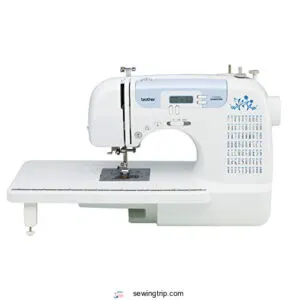
If you’re ready to break free from mediocre gear, the Brother CS7000i sewing machine delivers serious punch. This powerhouse packs 70 built-in stitches—including decorative and heirloom options—so you won’t outgrow it in six months. The automatic needle threader saves your sanity, especially during late-night quilting sessions.
You’ll appreciate the 2.0″ LCD display for quick stitch selection and the wide table for fabric selection flexibility. At under 18 pounds, you can haul it to workshops without throwing out your back. It’s machine comparison gold for beginners craving sewing techniques mastery.
- 70 built-in stitches give you tons of creative options, including 7 auto-size buttonholes and decorative patterns you’ll actually use
- Automatic needle threader and drop-in bobbin make setup quick and frustration-free, even when you’re tired
- Lightweight at 17.66 pounds with a wide table extension, so you can move it around easily but still tackle larger quilts
- Heavy plastic construction raises durability concerns for long-term daily use compared to metal-bodied machines
- Included hard case feels cheap and flimsy, so you might need to buy a better one for transport
- Instruction manual is vague and generic, which can leave beginners hunting for answers online
2. Brother Automatic Sewing Machine GX37
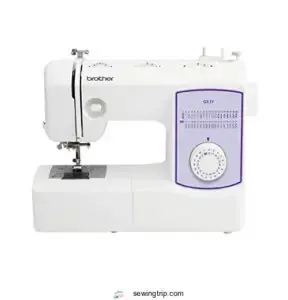
Want automated convenience without the learning curve? The Brother GX37 delivers 37 built-in stitches, an automatic needle threader, and beginner-friendly adjustable speed control—perfect for mastering basics fast. At just over 10 pounds, you’ll move it around effortlessly.
The drop-in bobbin and included GX37 accessories (six presser feet, buttonhole foot) mean you’re ready to sew out of the box. Brother warranty coverage backs your investment, and the sewing speed won’t intimidate newbies. It’s automation made simple for first-time rebels.
- Automatic needle threader and drop-in bobbin save time and reduce frustration during setup
- 37 built-in stitches and 6 included presser feet give you plenty of options for garment construction, quilting, and everyday projects
- Lightweight at just over 10 pounds, making it easy to store or move between workspaces
- Some users report the reverse function and overall durability can be inconsistent with regular use
- The built-in LED light may be too dim for detailed work or low-light sewing
- Not built for heavy-duty projects or thick fabrics—best suited for light to medium materials
3. Singer Heavy Duty Sewing Machine
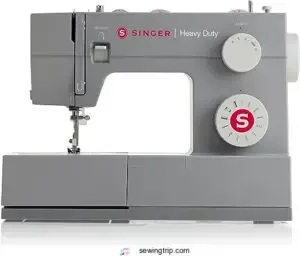
Think tough fabrics scare beginners? The Singer Heavy Duty Sewing Machine crushes that myth with its metal frame and 50% more power—you’ll tackle denim and canvas like a pro from day one.
With a sewing speed hitting 1,100 stitches per minute and 69 stitch applications, this Singer machine won’t hold you back as your sewing goals evolve.
Durability tests prove it’s built to last, and routine sewing machine maintenance stays simple. It’s heavy-duty freedom for rebels who refuse beginner limitations.
- Metal frame and 50% more power handle thick materials that would jam lighter machines, so you can sew upholstery and heavy garments without frustration.
- Lightning-fast 1,100 stitches per minute with 69 stitch options means you finish projects quickly and have room to grow your skills.
- Drop-in bobbin system and LED lighting make threading and visibility easier, especially helpful when you’re still learning the basics.
- At 14.6 pounds, it’s heavier than standard machines, which can make moving it around or storing it more of a hassle.
- The instruction manual isn’t always beginner-friendly, so you might need to watch online tutorials to get started smoothly.
- Thread tension can be tricky to dial in correctly, and if the bobbin isn’t threaded just right, you’ll get messy stitches.
4. Janome Pink Sorbet Sewing Machine
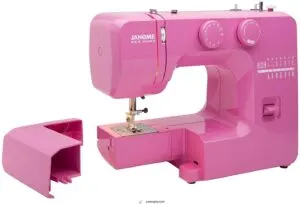
Looking for Janome Quality without the intimidation? The Pink Sorbet delivers 15 built-in stitches, a 4-step buttonhole, and that essential automatic needle threader—all wrapped in a surprisingly sturdy metal frame that doesn’t quit.
This beginner-friendly sewing machine weighs just 12 pounds, so you’ll actually move it when inspiration strikes. The front-loading bobbin system includes printed threading guides right where you need them, and YouTube tutorials back you up every step.
At $199, it’s your launchpad for garment sewing, quilting, and home décor without corporate feature bloat holding you back.
- Heavy-duty metal frame provides stability and durability that’s rare at this price point, so the machine won’t walk across your table or feel flimsy during use.
- Front-loading bobbin with printed threading guides and included video tutorials make setup genuinely beginner-friendly instead of just claiming to be.
- Lightweight at 12 pounds with a removable free arm, making it easy to move between rooms and tackle cylindrical projects like sleeves and pant hems.
- The bright pink color isn’t for everyone and may look too playful or cheap depending on your aesthetic preferences.
- Limited to 15 stitches, so advanced sewists who want decorative options or specialized functions will outgrow it quickly.
- Currently out of stock on the manufacturer’s website, forcing you to hunt through local dealers or third-party retailers with uncertain availability.
Maintenance and Long-Term Considerations
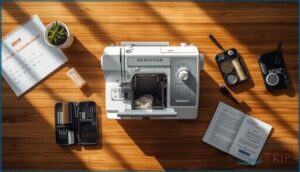
Buying your first sewing machine is exciting, but it’s not a one-and-done deal. Your machine needs regular care to keep running smoothly, and knowing what to expect long-term helps you avoid frustration down the road.
Let’s cover the basics of maintenance and what you should think about before you buy.
Routine Cleaning and Care
Your sewing machine craves attention—ignore it, and you’ll pay the price in skipped stitches and tangled threads. Regular servicing keeps your machine purring like a champion.
Machine oil tips are simple: feed those moving parts every 8–12 hours of sewing, depending on your model. Bobbin care and needle maintenance mean clearing lint from the bobbin case every 4–8 hours—dust prevention starts here.
| Maintenance Task | Frequency | Why It Matters |
|---|---|---|
| Oil moving parts | Every 8–12 hours | Prevents friction and wear |
| Clean bobbin area | Every 4–8 hours | Stops lint buildup, improves stitch quality |
| Remove needle before cleaning | Before each maintenance | Protects needle and presser foot from damage |
| Use approved machine oil | Always | Household oils degrade plastic parts |
| Store covered and unplugged | After every session | Minimizes dust, prevents rust |
Beginner sewing tips? Always check your manual—sewing machine reviews and comparisons confirm that proper machine maintenance doubles your equipment’s lifespan.
Access to Replacement Parts
Parts dry up fast on discontinued models—don’t let that trap you. Before you buy, check Part Availability and Replacement Policies with authorized dealers, especially for Brother and major brands. Online Support and third-party retailers fill gaps, but Repair Costs skyrocket when Vintage Parts vanish. Smart machine maintenance means choosing models with proven supply chains. Your creative freedom depends on accessible Sewing Accessories and Supplies—verify stock before committing.
- Confirm official parts catalogs list your model with clear part numbers
- Ask dealers about typical restocking timelines for common components
- Check warranty coverage for motors and mechanical parts upfront
- Read Sewing Machine Reviews and Comparisons for long-term parts feedback
- Verify third-party compatibility against your exact serial number
Importance of Instruction Manuals
Your machine’s manual isn’t optional reading—it’s your blueprint for Manual Safety, setup, and mastery. User Guides decode those cryptic dials and deliver Troubleshooting Tips that save you hours of frustration. Maintenance Schedules keep your Sewing Machine humming, while Warranty Information protects your investment.
Beginners Guide yourself through diagrams, not guesswork—that Userfriendly booklet transforms you from confused to confident, fast.
Evaluating Warranty Coverage
Warranty Terms mean more than fine print—they shield your Sewing Machine from costly breakdowns. Coverage Scope reveals what’s protected: motor, parts, labor, and duration.
Service Logistics clarify Repair Options—authorized centers versus mail-in hassles—while the Claim Process determines how fast you’re back to chasing your Sewing Goals.
For any Beginner, a solid Buying Guide warns: weak coverage wastes money, strong warranties build confidence and Sewing Community Support trust.
Frequently Asked Questions (FAQs)
Can I sew leather or denim as a beginner?
You can tackle denim and lightweight leather as a beginner—just grab heavy-duty needles, strong thread, and a machine with adjustable speed.
Start with small projects like patches before diving into full garments.
How loud are sewing machines during operation?
Most sewing machines run between 50–70 decibels during light tasks, roughly as loud as normal conversation.
Computerized models like Brother often feature quiet operation with sound reduction features and adjustable speed controls to minimize machine vibration.
Do I need special thread for different fabrics?
Yes, you need different threads for various fabric types. Cotton thread suits natural fibers, while polyester works for synthetics and stretches.
Proper thread selection and needle choices prevent puckering, breakage, and skipped stitches in your sewing projects.
Can I use my machine without a foot pedal?
Most computerized machines let you ditch the pedal and use a Start/Stop button instead. You’ll find speed sliders, hands-free mode, and even knee lift operation—perfect for pedal-free sewing with total control.
Whats the difference between presser foot types?
Different presser foot types transform your sewing projects. Standard feet handle general stitching, zipper feet guide edge installations, walking feet tame thick fabrics, and overedge feet finish seams like a serger.
Conclusion
The sewing machines gathering dust in closets all share one thing: their owners skipped the homework. Knowing what to think about before buying your first sewing machine transforms that purchase from a gamble into an investment.
You’ve mapped your goals, weighed your budget, and identified must-have features—now you’re armed with clarity most beginners never find. That machine you choose won’t just sit there looking pretty. It’ll actually get used.
- https://x.com/godofprompt/status/1990526288063324577
- https://www.linkedin.com/posts/bohdanlukianets_tasks-study-research-activity-7373377539521667072-UTEi
- https://www.writingclearscience.com.au/category/writing-guides/writing-research-papers/page/2/
- https://www.sciencedirect.com/science/article/pii/S0749208123000268
- https://academichelpexpress.blog/2024/08/please-use-the-bulleted-points-and-the-rubric-below-to-guide-your-work-your-pa/