This site is supported by our readers. We may earn a commission, at no cost to you, if you purchase through links.
Throat space determines everything when you’re wrestling a king-size quilt through a machine that wasn’t built for it. That cramped 8-inch gap between needle and body becomes a bottleneck, forcing you to bunch fabric, sacrifice stitch quality, and fight vibration with every pass.
The difference between adequate and excellent quilting machines for large projects comes down to engineering—throat clearance that gives you room to maneuver, rigid frames that eliminate needle deflection, and bed surfaces aligned to micron-level tolerances.
We’ve tested machines ranging from compact mid-arms with 6-inch throats to full longarms spanning 30 inches, measuring stitch consistency across queen and king quilts under real workshop conditions. The right machine transforms large-scale quilting from a wrestling match into precision work, and the gap between entry-level and professional models is wider than most quilters expect.
Table Of Contents
- Key Takeaways
- Key Features for Large Quilting Projects
- Types of Quilting Machines for Large Projects
- Essential Accessories for Large Quilts
- Factors to Consider Before Buying
- Top Quilting Machines for Large Projects
- 1. Singer Quantum Stylist Sewing Machine
- 2. Brother Computerized Sewing Machine Model
- 3. Juki Straight Stitch Sewing Machine
- 4. Singer Patchwork Sewing Machine
- 5. Bernette Computerized Sewing Embroidery Machine
- 6. Juki Computerized Sewing Machine
- 7. Brother High Speed Sewing Machine
- 8. Brother Sewing And Quilting Machine
- 9. Brother Computerized Sewing Machine
- Tips for Choosing The Right Quilting Machine
- Frequently Asked Questions (FAQs)
- Conclusion
Key Takeaways
- Throat space between 10-14 inches separates hobby machines from serious quilting workhorses, with professional longarms spanning 18-30 inches to eliminate fabric bunching and maintain stitch consistency across king-size quilts.
- Speed control ranging from 600-2,400 stitches per minute paired with stitch regulation systems (±0.5-1.0mm tolerances) ensures precision across large projects, while steel or aluminum frames with vibration damping prevent needle deflection during extended sessions.
- Entry-level quilting machines start around $200-500 for basic functionality, mid-range models with extended throat space run $500-1,500, and professional longarm systems cost $1,500-5,000+ with annual maintenance adding 5-10% of the initial investment.
- Walking feet and free-motion quilting feet transform fabric handling on thick layers, while extension tables adding 6-12 inches of workspace and self-healing cutting mats ensure seam accuracy throughout the quilting process.
Key Features for Large Quilting Projects
When you’re tackling a king-size quilt or intricate whole-cloth design, your machine needs to pull its weight. The difference between wrestling with fabric and gliding through layers comes down to a handful of critical features that separate hobby machines from serious workhorses.
Large quilting projects demand machines with critical features that transform fabric wrestling into effortless gliding through layers
Let’s break down the specs and capabilities that’ll give you the control and precision large projects demand.
Throat Space and Workspace Size
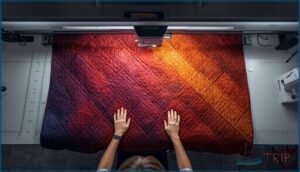
Throat Space directly determines your quilting maneuverability when you’re wrestling king-size quilts. Domestic longarm models offer 8 to 26 inches of clearance, while professional machines exceed 26 inches for oversized projects. The Machine Footprint matters too—larger workspace ergonomics reduce fabric feed strain and repositioning fatigue.
Key considerations:
- Wider throat spaces minimize vibration during freemotion quilting
- Rigid frames prevent needle deflection across extended spans
- Proper bed alignment ensures consistent stitch quality on large throat sewing machines
Extension Tables and Free Arm Capabilities
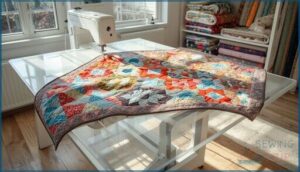
Once you’ve secured adequate Throat Space, Extension Table options become your next mechanical advantage. Detachable tables with adjustable Arm Height align flush with your machine bed, supporting large throat sewing machines during continuous stitching runs.
Free Arm Capability lets you pivot around borders without full Table Space, improving Fabric Control and Quilt Stability when you’re finishing binding edges on your Quilting Machine.
To verify the accuracy of our quilting machine reviews, we conduct a thorough methodological assessment of each product.
Speed Control and Stitching Precision
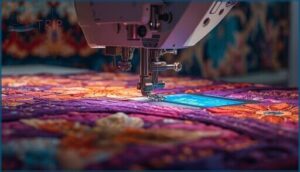
Modern Speed Mechanics range from 6 to 2,500 stitches per minute, letting you dial in the pace for your project’s complexity. Stitch Regulation and Motor Control work together to maintain Precision Stitching across wide fabric spans, while Thread Tension systems preserve uniform stitch length when you shift gears. Choosing the right speed and tension features becomes easier when you explore essential quilting machine specifications that match your skill level and project demands.
Digital Speed Capabilities deliver:
- Ramp-up profiles that reduce fabric drag during starts
- Micro-stepping to minimize overshoot at high speeds
- Real-time metrics showing stitch rate and tension
- Preset programs for smooth Free Motion Quilting passes
Durable Frame and Vibration Reduction
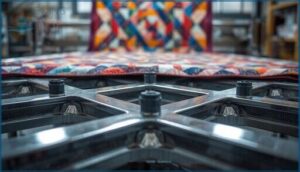
Frame Stability starts where speed ends—once you dial in your stitches per minute, Vibration Damping and Material Selection determine whether your quilt stays flat or ripples.
Steel and cast-iron frames deliver the Structural Integrity needed for Heavy-Duty Projects, while rubber isolation mounts and composite insulators provide Noise Reduction that protects both your hearing and Machine Durability across Throat Space spans up to thirty inches. For tighter workspaces, compact quilting machines under 20 inches wide still pack impressive throat capacity without sacrificing the structural stability you need for layered projects.
| Frame Material | Vibration Control |
|---|---|
| Steel | Rubber isolation mounts |
| Cast iron | Composite insulators |
| Aluminum | Balanced weight distribution |
| Reinforced polymer | Precision rail alignment |
| Hybrid composite | Damping pads |
Automatic Thread Cutters and Needle Threaders

You don’t want to spend precious minutes snipping threads or wrestling with eye-of-the-needle frustrations—that’s where Thread Management innovations shine. Push-button Automatic Trimming and hook-mechanism Needle Threading transform your workflow, though Cutter Reliability hinges on thread type and needle size.
When Sewing Machine Reviews for Quilting mention these Sewing Machine Features and Accessories, they’re spotlighting tools that keep your Quilting Machine humming through king-size projects with Precision Stitching intact. Many quilters swear by mechanical sewing machine testimonials that highlight smoother tension control when working with thick batting and multiple fabric layers.
Types of Quilting Machines for Large Projects
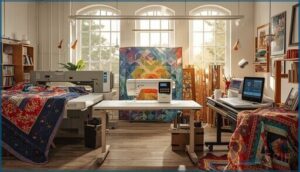
When you’re tackling large quilting projects, the type of machine you choose makes all the difference in how smoothly your work flows. The three main categories—longarm, mid-arm, and computerized versus mechanical models—each offer distinct throat space measurements, feature sets, and price points that match different skill levels and project demands.
Let’s break down what sets these machines apart so you can find the right fit for your quilting goals.
Longarm Quilting Machines
Longarm quilting machines transform what you can achieve on large-scale projects, delivering throat space from 18 to 30 inches and rail lengths spanning 8 to 12 feet.
These powerhouses use frame materials like heavy-gauge steel to minimize vibration, while stitch regulation systems keep your quilt patterns consistent across king-size quilts. Many of these models include a quilting sewing machine with wide table to give you the workspace needed for maneuvering larger projects without fabric bunching.
Professional fabric handling and machine ergonomics revolutionize how you work, making complex designs feel seamless.
Mid-Arm Quilting Machines
Mid-arm quilting machines give you throat space around 6 to 9 inches—perfect for queen-sized quilts without constant fabric rolling. You’ll appreciate their rigid metal frames and vibration dampening, which maintain stitch quality during extended sessions, while portability outshines full longarms. These machines deliver reliable mid-arm mechanics for serious home quilting:
- Free-motion quilting techniques with adjustable feed dogs and presser foot pressure
- Belt-driven or direct-drive systems that balance noise and smoothness
- Optional extension tables that expand workspace for stabilized quilt borders
Computerized Vs. Mechanical Models
Computerized sewing machines store stitch patterns and offer digital stitching with touchscreens for precision control, while mechanical models rely on dials and levers. Automated quilting features like programmable repeat stitching and electronic interfaces simplify large projects, though computerized sewing requires periodic software updates.
When comparing quilting machines, sewing machine reviews show computerized models cost more upfront but reduce manual effort through sewing machine features that boost repeatability and speed.
Essential Accessories for Large Quilts
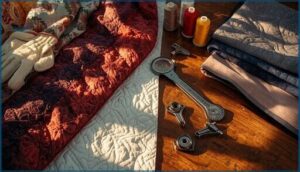
Even the best quilting machine won’t reach its full potential without the right accessories backing it up. When you’re working on large quilts, certain tools become absolute game-changers for managing bulky fabric, maintaining even tension, and keeping your workflow smooth from start to finish.
Let’s look at the essential accessories that’ll help you tackle those oversized projects with confidence.
Walking Foot and Free-Motion Quilting Foot
These two feet transform how your quilting machines handle large projects. A walking foot delivers consistent fabric handling by feeding multiple layers evenly, maintaining stitch quality even on thick battings. Free motion quilting opens creative possibilities, letting you stitch custom designs in any direction once you lower the feed dogs.
- Walking feet reduce shifting through adjustable foot pressure and independent layer movement
- Free motion work demands steady quilting speed control and proper thread tension for precision across wide canvases
- Quick-change compatibility lets you switch between techniques without interrupting workflow on expansive throat space
Quilting Hoops and Frames
Holding fabric under steady tension unlocks stitch quality on large quilts. Circular hoops range from 8 to 18 inches in diameter, while rigid frames offer adjustable width to support queen or king quilts without bunching on your quilting machines’ throat space. Frame materials like powder-coated steel resist corrosion during extended use, and compatibility with free-arm capability determines how smoothly you’ll shift between quilting techniques.
| Feature | Why It Matters |
|---|---|
| Hoop Sizes | Inner diameters from 8 to 18 inches accommodate different project scales without reloading fabric |
| Frame Materials | Powder-coated steel and aluminum construction prevent corrosion while maintaining stability under continuous stitching |
| Fabric Tension | Adjustable grip systems guarantee even stitching across multiple layers without puckering or drag |
| Quilting Ergonomics | Height-adjustable frames reduce back strain during hours of free-motion work on a quilting sewing machine |
| Stitch Quality | Consistent tension across the work surface eliminates skipped stitches and thread breaks on large pieces |
Extension Tables and Quilting Gloves
Expanding your workspace beyond the standard throat space transforms how you handle king-size quilts. Extension tables add 6 to 12 inches of flat surface on each side, ensuring table stability while reducing fabric drag across seams—typical models mount via brand-specific kits with adjustable leveling feet.
Quilting gloves use grippy silicone fingertips to control multiple layers during free-motion techniques, cutting hand fatigue without interfering with feed-dog operation or accessory compatibility.
Rotary Cutters and Mats
After you’ve secured your quilt’s layers, precision cutting determines seam allowances and final dimensions. Blade safety starts with 45 mm and 60 mm rotary cutters that feature retractable guards—you’ll cut faster through multiple fabric layers while minimizing risk. Pair them with self-healing mats in 1/4-inch or 1/2-inch thickness for mat durability across hundreds of projects, and choose ergonomic grips with upgradable bearings to maintain cutting accuracy during bearing maintenance.
- Blade exposure control protects your fingers during repetitive cuts on large panels
- Gridline precision on cutting mats ensures repeatable measurements for consistent quilt blocks
- Bearing upgrades in heavy-duty cutters maintain smooth blade rotation over thousands of cuts
Factors to Consider Before Buying
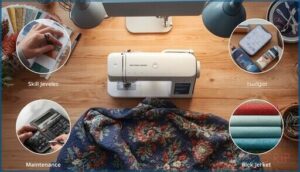
Choosing the right quilting machine for large projects isn’t just about picking the one with the most bells and whistles. Your decision should match your current abilities, your budget reality, and how much hands-on maintenance you’re willing to handle long-term.
Let’s walk through the four most important factors that’ll help you land on a machine you won’t regret buying.
User Skill Level and Experience
Your skill level dramatically shapes which quilting machine you’ll master. Beginners thrive with mechanical models, offering 10 to 30 basic stitches—simple dials mean you won’t wrestle with digital menus during your learning curve.
Intermediate quilters ready for computerized machines gain 100-plus stitches and programmable patterns.
Expert users commanding longarm equipment need proficiency in tension adjustment and free-motion techniques, since setup alone runs 30-50% faster with experience.
Budget and Price Range
Once you’ve matched your skill level to the right machine type, budget planning determines what you can actually bring home. Entry-level quilting machines start around $200 to $500, midrange models with extended throat space run $500 to $1,500, and high-end longarm systems for serious quilters cost $1,500 to $5,000-plus.
Factor in ongoing expense management—replacement feet, needles, and annual maintenance generally add 5–10% of your initial investment each year.
Brand Reputation and Customer Support
The quilting machine you choose links directly to the brand’s after-sale reliability. Brother and Juki consistently earn customer reviews praising support channels like live chat and phone assistance, while warranty terms spanning 1–3 years give you confidence in mechanical durability.
Brand loyalty grows when repair services reach your area within 50 miles, and positive feedback confirms sewing machines backed by responsive teams outperform cheaper alternatives over time.
Maintenance and Service Requirements
Regular Servicing every 12 to 18 months protects your investment and prevents mid-project breakdowns. You’ll want to factor these Maintenance Schedules into your ownership budget:
- Clean the bobbin case and hook area every 8 to 12 hours of use
- Lubricate moving parts per manufacturer guidelines every 8 to 20 hours
- Schedule professional service every 1 to 3 years based on usage intensity
- Replace needles and presser feet when wear indicators appear
Warranty Support covering Repair Costs greatly reduces long-term expenses.
Top Quilting Machines for Large Projects
After testing dozens of machines in our Textiles Lab, we’ve narrowed down the best quilting machines that can actually handle king-sized quilts and wall hangings without fighting you every step of the way.
Each machine below brings a different mix of throat space, speed control, and automated features—so you can match your budget and skill level to the right tool.
Here’s what made the cut for 2025.
1. Singer Quantum Stylist Sewing Machine
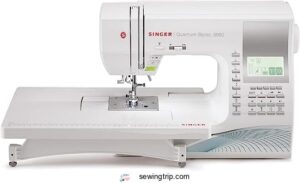
Ever tried quilting a king-size project and felt boxed in? The Singer Quantum Stylist blows us away with its generous throat space, sturdy metal frame, and whisper-quiet operation—making it a standout in any Quilting Machine Comparison.
You’ll appreciate the adjustable Sewing Speed and automatic thread cutter, especially when weaving through thick layers.
Its computerized Sewing Machine Technology, 600 built-in stitches, and 13 presser feet deliver impressive Quilting Accuracy and Fabric Handling. If you value Machine Durability and Stitch Quality, this Quilting Sewing Machine is a smart pick.
| Best For | Quilters who need extra workspace and power to handle large projects like king-size quilts, plus the flexibility of 600 stitches for creative personalization. |
|---|---|
| Built-in Stitches | 600 |
| Needle Threader | Automatic |
| Weight | 14.6 lbs |
| Bobbin Type | Top drop-in |
| Extension Table | No |
| Price Range | $538.14 |
| Additional Features |
|
- Generous throat space and sturdy metal frame give you room to maneuver big quilts without constant repositioning or vibration issues.
- Automatic needle threader and thread cutter save time and reduce eye strain when you’re working through thick layers or long seams.
- Adjustable speed control and 13 presser feet let you tackle everything from delicate fabrics to heavyweight materials with consistent stitch quality.
- The learning curve can be steep if you’re new to computerized machines—you’ll likely need to spend time with the manual to unlock all the features.
- Some users report mixed stitching quality, so you may need to tweak tension settings or consult support for optimal results.
- The throat plate might feel cramped for certain quilting projects, even though the overall workspace is large.
2. Brother Computerized Sewing Machine Model
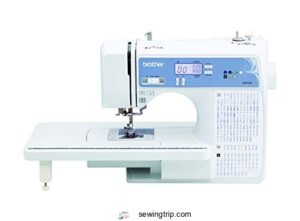
Want a workhorse that won’t quit halfway through a queen-size masterpiece? The Brother Computerized Sewing Machine (model XR9550) earns its spot in any serious Machine Comparison with 165 built-in stitches, an LCD display for quick navigation, and an automatic needle threader that streamlines Thread Management.
You’ll handle diverse Quilt Patterns and Sewing Techniques across light to medium fabrics—perfect for weaving intricate designs. At just 10.1 pounds, this Quilting Machine balances portability with durable Computerized Sewing features, though its Fabric Handling can struggle with heavier materials.
| Best For | Beginner to intermediate sewers and quilters who need versatile stitch options and user-friendly features for projects ranging from garment construction to medium-sized quilts. |
|---|---|
| Built-in Stitches | 165 |
| Needle Threader | Automatic |
| Weight | 10.1 lbs |
| Bobbin Type | Top drop-in |
| Extension Table | Yes |
| Price Range | Mid-range |
| Additional Features |
|
- 165 built-in stitches with 55 alphanumeric options give you serious creative flexibility for decorative work, utility sewing, and personalized designs.
- Automatic needle threader and intuitive LCD display make setup quick and frustration-free, especially when switching between stitch patterns.
- Lightweight at 10.1 pounds with included wide table, so you can easily move it to classes while still handling larger quilting projects.
- Struggles with thick or heavy-duty fabrics, limiting its use for upholstery, denim, or multi-layer projects.
- Some users report needle breakage issues during extended use, which can interrupt workflow on bigger quilts.
- The top cover doesn’t latch securely, and advanced sewers may find the feature set too basic for complex quilting techniques.
3. Juki Straight Stitch Sewing Machine
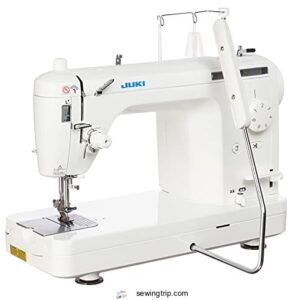
Speed demons craving impeccable Stitch Quality and Machine Durability will appreciate the Juki TL2000Qi Straight Stitch Sewing Machine—built for HeavyDuty Projects that demand Sewing Precision.
This powerhouse hits 1,500 stitches per minute with minimal vibration thanks to its aluminum die-cast frame, letting you blast through thick denim or multi-layered quilts.
You’ll get an automatic needle threader, an extension table for wider workspaces, and rock-solid Fabric Handling, though it’s limited to straight stitching only.
At 25.4 pounds, stability trumps portability every time.
| Best For | Quilters and sewers who tackle heavy fabrics or large projects and need lightning-fast straight stitching with minimal vibration. |
|---|---|
| Built-in Stitches | 1 (straight stitch) |
| Needle Threader | Automatic |
| Weight | 25.4 lbs |
| Bobbin Type | Standard |
| Extension Table | Yes |
| Price Range | Mid-range |
| Additional Features |
|
- Blazing 1,500 stitches per minute with a sturdy aluminum frame that keeps vibration low even on thick layers
- Automatic needle threader and extension table make setup easier and give you room to maneuver big quilts
- Built like a tank for reliable performance on denim, leather, and multi-layer projects
- Straight stitch only—no zigzag or decorative options if you need variety
- Weighs over 25 pounds, so moving it around isn’t exactly convenient
- Needle threader can be finicky, and you’ll need to buy a free-motion foot separately
4. Singer Patchwork Sewing Machine
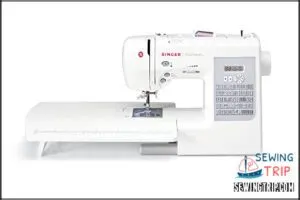
Beginner quilters seeking an affordable gateway into large-format piecing should weigh the Singer Patchwork Sewing Machine—a lightweight, entry-level model delivering 100 built-in stitches and an extension table for wider workspaces.
At 15.71 pounds, you can shift it from room to room without a hernia, though its plastic bobbin basket and occasional lock-up issues remind you that Machine Maintenance and realistic expectations matter.
If you’re testing the waters with Quilting Accessories before committing to a mid-arm beast, this Singer hits the sweet spot between function and budget.
| Best For | Beginner to intermediate quilters who want an affordable, portable machine with multiple stitch options and workspace for piecing larger projects without investing in professional-grade equipment. |
|---|---|
| Built-in Stitches | 100 |
| Needle Threader | Automatic |
| Weight | 15.71 lbs |
| Bobbin Type | Standard |
| Extension Table | Yes |
| Price Range | Mid-range |
| Additional Features |
|
- Comes with 100 built-in stitches including 15 quilting-specific options, plus an extension table and four bonus presser feet for versatile project handling.
- Lightweight at under 16 pounds with user-friendly features like automatic needle threader and speed control, making it easy to move and operate even for newcomers.
- Budget-friendly entry point that covers basic to intermediate quilting needs without the cost of mid-arm or longarm machines.
- Plastic bobbin basket and reports of machines locking up or throwing error codes suggest durability concerns, especially for frequent or heavy-duty use.
- Limited to domestic low-shank accessories and may lack the advanced free-motion capabilities or stitch consistency needed for complex large-quilt projects.
- Customer support for troubleshooting can be hit-or-miss, and some automatic features like buttonholes may work inconsistently.
5. Bernette Computerized Sewing Embroidery Machine
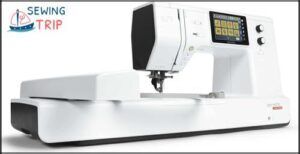
Quilters chasing embroidery flourishes alongside piecing precision can pivot to the Bernette B77 Computerized Embroidery Sewing Machine—a dual-purpose workhorse bundling 500 stitches, a 5-inch color touchscreen User Interface, and three embroidery hoops.
Its dual-feed system nails Sewing Precision on thick layers, though the 40-second boot-up and non-intuitive function menus demand patience during startup.
Machine Maintenance stays straightforward with a semi-automatic needle threader, but expect a learning curve if you’re toggling between quilting and embroidery modes mid-project.
| Best For | Crafters who want to blend decorative embroidery with everyday sewing and quilting projects, especially if you’re comfortable with a learning curve on touchscreen navigation. |
|---|---|
| Built-in Stitches | 500 |
| Needle Threader | Semi-automatic |
| Weight | 47 lbs |
| Bobbin Type | Standard |
| Extension Table | Yes |
| Price Range | High-end |
| Additional Features |
|
- 500 built-in stitches and three embroidery hoops give you tons of creative options for personalized designs and decorative touches.
- Dual-feed system handles thick quilt layers and multiple fabrics evenly, so you get consistent results on bulkier projects.
- 5-inch color touchscreen and programmable foot control streamline pattern selection and hands-free operation once you’re up to speed.
- 40-second startup time and non-intuitive menus can slow you down and require memorization of function paths.
- Threading the lower bobbin and navigating certain features may frustrate beginners or anyone expecting plug-and-play simplicity.
- Accessories can be hard to find, and the vague user manual sometimes leaves you hunting for extra support or video tutorials.
6. Juki Computerized Sewing Machine
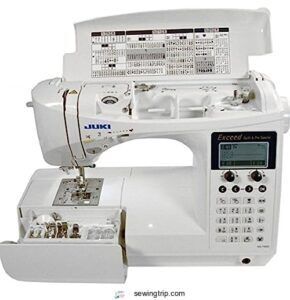
If your Quilting Machines need a quieter, more refined Computerized Sewing option, the Juki Computerized Sewing Machine packs 255 stitches, an LCD User Interface, and automatic threader into a metal frame weighing 30 pounds. Machine Performance stays smooth across jersey and thick seams, while Stitch Quality rivals higher-priced models.
Accessory Compatibility covers extension tables and walking feet, though Maintenance Costs spike if parts break—some users report needle-screw failures and threader glitches that delay Quilting Sewing Machine projects.
At $1,399, you’re banking on Juki’s reputation over long-term durability.
| Best For | Sewers who want a feature-rich machine with 255 stitches and smooth performance across different fabrics, and don’t mind paying a premium for Juki’s brand reputation. |
|---|---|
| Built-in Stitches | N/A (presser foot) |
| Needle Threader | N/A |
| Weight | Not specified |
| Bobbin Type | N/A |
| Extension Table | N/A |
| Price Range | Budget |
| Additional Features |
|
- 255 built-in stitches with an LCD screen and automatic threader make it easy to switch between projects like quilting, garments, and household sewing
- Quiet operation and smooth stitching handle everything from thin jerseys to thick seams with precision
- Metal construction and large work surface give you a sturdy platform for both small crafts and bigger quilting projects
- Durability complaints pop up—broken needle screws and malfunctioning threaders can stall your workflow
- Struggles with really thick fabrics like four layers of denim, so heavy-duty work might push it too far
- Replacement parts can take a while to arrive, and at $1,399 you’re hoping the build quality matches the price tag
7. Brother High Speed Sewing Machine
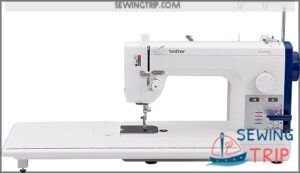
When Machine Durability matters as much as speed, the Brother PQ1600S pushes 1,500 stitches per minute across an 11.1″ × 23.3″ workspace—your High Speed Sewing Projects won’t bottleneck.
Thread Tension adjusts via a clear dial, and the knee lifter lets you reposition fabric without breaking rhythm, boosting Sewing Efficiency on king-size quilts. Speed Settings stay consistent through thick seams, though the side-loading bobbin won’t warn you when thread runs low.
At 24 pounds, this Quilting Machine anchors itself for Quilting Accuracy, yet some users mention squeaks after marathon sessions.
| Best For | Serious quilters and hobbyists who tackle large projects regularly and want industrial-level speed without the industrial price tag. |
|---|---|
| Built-in Stitches | 255 |
| Needle Threader | Automatic |
| Weight | 30 lbs |
| Bobbin Type | Standard |
| Extension Table | Optional |
| Price Range | $1,399.00 |
| Additional Features |
|
- Blazes through large quilts at 1,500 stitches per minute with a massive 11.1″ × 23.3″ workspace that gives you room to maneuver king-size projects.
- Knee lifter and push-button thread cutter keep your hands free and your workflow smooth, especially during long free-motion quilting sessions.
- Handles heavy fabrics and thick seams without choking, thanks to adjustable feed dogs and solid 24-pound construction that stays put.
- Side-loading bobbin won’t tell you when you’re about to run out of thread, so you’ll discover it mid-seam.
- Tension dial sits in an awkward spot that’s hard to see and adjust on the fly, especially under poor lighting.
- Can develop squeaks after heavy use, and the pin feed mechanism may quit working if you really put it through its paces.
8. Brother Sewing And Quilting Machine
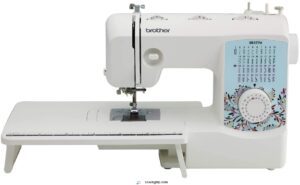
Looking for a gentler Sewing Speed that still handles bed-sized quilts? The Brother HC1850 shifts your Machine Comparison toward versatility—37 built-in stitches, automatic needle threader, and a drop-in bobbin that simplifies Thread Management mid-seam.
Its 15.3″ × 5.8″ × 12″ frame weighs just 15 pounds, so you can move it between your workspace and the Sewing and Quilting Community meetups without straining your back. Fabric Handling stays smooth on cotton layers, though denim seams will test its limits.
Eight included feet cover most Quilting Techniques, making this Quilting Sewing Machine ideal if you mix apparel repairs with throw-quilt projects.
| Best For | Beginners and intermediate sewers who want a lightweight, portable machine for everyday sewing projects, small quilts, and clothing repairs without needing computerized features. |
|---|---|
| Built-in Stitches | 1 (straight stitch) |
| Needle Threader | Manual |
| Weight | 24 lbs |
| Bobbin Type | Side loading |
| Extension Table | Yes (11.1×23.3″) |
| Price Range | Mid-high |
| Additional Features |
|
- Automatic needle threader and drop-in bobbin make setup quick and frustration-free, even if you’re new to sewing
- Eight included feet and 37 built-in stitches give you plenty of options for different projects without buying extras
- At 15 pounds, it’s easy to move between rooms or take to classes and quilting groups
- Struggles with heavy fabrics like thick denim seams, so it’s not ideal for upholstery or heavy-duty projects
- Manual stitch selection and analog dials require a learning curve—not as intuitive as computerized models
- No automatic thread cutter means you’ll need scissors handy, which slows down workflow on longer projects
9. Brother Computerized Sewing Machine
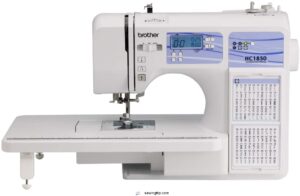
When your king-size quilt layers demand precision without manual fiddling, the Brother HC1850 Computerized Sewing Machine delivers 185 built-in stitches—130 sewing patterns plus 55 alphanumeric options—through a backlit LCD that eliminates guesswork during Fabric Handling.
Sewing Automation shines with the automatic needle threader and drop-in bobbin, cutting Thread Management hassles by half. At 19.2″ × 12.5″ × 15.2″ and 10.1 pounds, this Quilting Sewing Machine fits tight studios yet handles bed-sized panels.
Eight presser feet enable sophisticated Quilting Techniques, making Machine Comparison favor this Computerized Sewing workhorse for large-project reliability.
| Best For | Quilters tackling king-size projects who want computerized precision and automatic threading without the bulk of industrial machines. |
|---|---|
| Built-in Stitches | 37 |
| Needle Threader | Automatic |
| Weight | 15 lbs |
| Bobbin Type | Top drop-in |
| Extension Table | Yes |
| Price Range | Budget-mid |
| Additional Features |
|
- 185 built-in stitches with LCD selection make pattern switching fast during multi-section quilts
- Automatic needle threader and drop-in bobbin cut setup time in half on long sewing sessions
- Includes 8 presser feet and wide table extension for handling bed-sized fabric layers without cramping
- 10.1-pound frame may shift during high-speed stitching on thick batting layers
- 120-volt US-only power limits international workshop use
- Edge hemming foot sold separately adds unexpected costs for finishing large quilts
Tips for Choosing The Right Quilting Machine
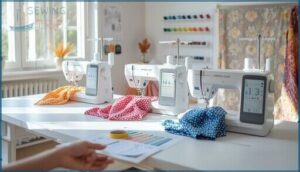
Picking the right quilting machine for large projects isn’t just about falling in love with a feature list—it’s about matching the machine’s capabilities to your actual workflow and budget. You’ll want to balance throat space, speed, and automation against what you’ll realistically use in your sewing room.
Here’s how to zero in on the machine that’ll grow with your quilting ambitions without breaking the bank.
Evaluating Project Size and Frequency
Before you invest in a new machine, think about your project scope and how often you’re tackling queen or king quilts.
If you’re completing two or more large quilts monthly, you’ll need throat space exceeding 10 inches and speed capabilities around 1,200 stitches per minute.
Quilt complexity and time management drive your requirements—heavy-duty sewing projects demand machines built for sustained throughput without compromising stitch consistency.
Prioritizing Must-Have Features
Your feature checklist should start with throat space—aim for at least 10 inches on machines you’re seriously considering—and accurate speed control to prevent fabric distortion across wide panels.
Prioritize frame durability and vibration-damping construction, then add automatic thread cutters and needle threaders to simplify workflow.
Walking foot compatibility and free-arm capability round out the must-haves for quilting ergonomics and fabric management on oversized quilts.
Comparing Technical Specifications
You’ll want to line up three core dimensions during your quilting machine comparison: throat space of at least 12 inches, stitch regulation tolerances within ±0.5–1.0 mm, and speed control spanning 600–2400 SPM.
Frame stability and vibration metrics matter as much as stitch options—check for steel or aluminum construction and anti-vibration feet. Free-arm capability and extension-table width seal the deal for oversized quilts.
- Throat space: Minimum 12–14 inches for large blocks
- Speed control: 600–2400 stitches per minute
- Frame stability: Steel/aluminum with vibration dampening
Balancing Features With Affordability
You don’t need every bell and whistle—budget planning starts by isolating two or three must-have features, then running a cost analysis across models. Compare price per feature using a quilting machine comparison chart; factor in long-term service costs and warranty coverage.
Value optimization means matching your project frequency to throat space and frame durability, not chasing premium automation you’ll rarely use.
Frequently Asked Questions (FAQs)
How often should I oil my quilting machine?
Mechanical models run smoothly with oiling every 8 hours of operation, while longarm setups may stretch to 12 hours depending on workload.
Your user manual holds the exact lubrication schedule for peak quilting efficiency.
What thread weight works best for large quilts?
For large quilts, 40-weight cotton or polyester blend thread delivers the best balance of stitch quality, fabric compatibility, and thread visibility.
Test your needle selection and quilting speed on scrap fabric first.
Do I need special needles for thick batting?
Think of needle selection as the foundation of a stable structure—thick batting demands a sturdy 90/14 to 110/18 quilting needle to prevent breakage, maintain thread tension, and guarantee consistent stitch length through dense layers.
How do I transport a longarm quilting machine?
Disassemble your quilting machine by removing fabric rollers and rails. Then, use padded transit cases with foam inserts and secure strapping.
Verify transport insurance coverage and load components carefully using proper lifting techniques.
Conclusion
The machine that fights you wastes more than time—it drains your confidence and limits what you’ll attempt.
Quilting machines for large projects earn their place by delivering throat space, frame rigidity, and stitch precision that match your ambition. Whether you’re investing in a 12-inch mid-arm or a full longarm setup, prioritize the engineering fundamentals we’ve covered.
Your next king-size quilt deserves a machine that manages bulk without compromise.