This site is supported by our readers. We may earn a commission, at no cost to you, if you purchase through links.
Nothing throws off your sewing rhythm like skipped stitches—one moment you’re gliding along, the next you’re staring at a row of gaps that refuse to behave.
It’s not always the fabric’s fault. Nine times out of ten, threading issues are the hidden culprit. Maybe your thread loops under the fabric, or the machine hiccups when you switch materials.
If you’ve ever felt like your sewing machine has a mind of its own, you’re not alone.
Tackling skipped stitches means digging into the nuts and bolts of threading, tension, and needle choice, so you can stitch with confidence and control every time.
Table Of Contents
- Key Takeaways
- Common Causes of Skipped Stitches
- Diagnosing Threading Issues
- Needle Problems That Cause Skipped Stitches
- Thread Tension and Stitch Quality
- Cleaning and Maintenance for Preventing Skipped Stitches
- Troubleshooting Skipped Stitches Step-by-Step
- Advanced Solutions for Persistent Issues
- Best Practices to Prevent Skipped Stitches
- Frequently Asked Questions (FAQs)
- Conclusion
Key Takeaways
- Improper threading—especially missing the take-up lever or seating the bobbin incorrectly—is the single most common cause of skipped stitches, so rethreading completely (with the presser foot raised) should always be your first move.
- Needle choice matters more than most sewists realize: match the point type and size to your fabric, and swap it out every 8 hours or after any strike against metal, even if it looks fine.
- Thread tension and stitch quality are tightly linked—too loose creates loops underneath, too tight causes puckering, and the fix is always to test on a scrap and adjust the upper dial one number at a time before touching the bobbin screw.
- Regular cleaning of the bobbin case, hook race, tension discs, and thread path every 10 sewing hours prevents the quiet lint buildup that throws off timing and tension before you even notice it.
Common Causes of Skipped Stitches
Skipped stitches rarely happen by accident — something specific is always triggering them.
If you’re curious about the most common culprits, this guide to sewing stretch fabric breaks down needle and thread choices that prevent skipped stitches.
The good news is that most causes come down to a handful of common culprits that are easy to spot once you know what to look for.
Here’s what’s most likely working against you.
Incorrect Needle Type or Size
The wrong needle is often the hidden culprit behind skipped stitches. Needle Size Matching matters more than most sewists realize — a size 80/12 universal works fine on cotton, but switch to denim and you need a 90–110 jeans needle to prevent deflection.
Three things to check immediately:
- Point shape — jersey knits need a ball point for proper Needle Shape Effects
- Eye size — Thread Eye Compatibility ensures the loop forms cleanly
- Fabric-Needle Compatibility — mismatches disrupt Needle Hook Clearance entirely
Following proper needle selection guidelines can prevent skipped stitches.
Poor Thread Quality or Mismatch
Even with the right needle, poor thread quality causes just as many skipped stitches. Stiff Thread delays loop formation, while Sticky Thread twists into figure‑eights instead of clean loops. Thread Age matters too — spools over five years old shred under tension. Watch for Lint Accumulation in tension discs and always check Spool Compatibility before starting.
Regular needle replacement helps prevent skipped stitches. regular needle replacement.
| Thread Issue | What Happens | Fix |
|---|---|---|
| Stiff Thread | Loops form too narrow for hook | Switch to Aurifil or Mettler |
| Sticky Thread | Figure-eight tangles form | Use quality polyester like Isacord |
| Old Thread | Brittle shredding at needle eye | Replace spools with fading or dust |
| Lint Accumulation | Disrupts thread tension consistency | Clean every 10 sewing hours |
| Wrong Thread Weight | Mismatches needle size and fabric type | Match 50-weight cotton to 70/10 needle |
Fabric Thickness and Type Issues
Thread quality isn’t the only culprit — fabric type throws its own surprises at you.
Denim needle deflection happens when layers exceed 4 mm, and silk needle flex causes poor loop formation on anything under 0.5 mm.
Knit stretch pull misaligns timing entirely.
Canvas needle size starts at 100/16, while leather bulk handling demands slow, deliberate feeding.
needle size and tension adjustment to your fabric type every time.
Machine Dirt, Lint, or Debris
Fabric type matters, but so does what’s hiding inside your machine.
Hook Mechanism Lint jars the bobbin case out of position, while Tension Disk Debris prevents disks from gripping thread properly. Feed Dog Grooves packed with lint reduces fabric control. Bobbin Case Lint disrupts lower tension, and Thread Path Obstructions deflect your needle mid‑stitch.
Regular Sewing Machine Cleaning fixes all of it.
Diagnosing Threading Issues
Threading issues are behind more skipped stitches than most people realize. A small misstep in how you thread the upper path or seat the bobbin can throw off the whole stitch formation.
Here’s what to check first.
Signs of Improper Upper Threading
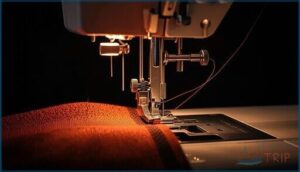
Your upper thread is the first place to look when skipped stitches appear. Thread loops underneath, upper slack between the take-up lever and needle, and frequent breaks are classic red flags.
For extra troubleshooting tips and free printable guides, check out these machine quilting sewing patterns and maintenance resources to keep your stitches smooth.
If the bobbin thread shows on top or stitch gaps cluster at seam starts, improper upper threading is usually the culprit. Re-thread completely with the presser foot raised to restore correct thread tension.
Bobbin Threading Mistakes
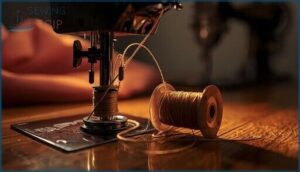
Bobbin issues cause just as many skipped stitches as upper threading problems.
Bobbin Overfill is a common mistake — fill it only 80 to 90 percent.
Wrong Rotation means inserting it clockwise when counterclockwise is required, preventing smooth thread tension.
Misaligned Insertion, a Scratched Case, or Incompatible Size all disrupt bobbin thread flow.
Good thread and bobbin management starts here.
Identifying Thread Path Obstructions
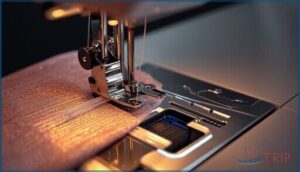
Tracing the thread path from spool to needle is your fastest diagnostic move.
Start with Spool Cap Alignment — a loose or wrong‑sized cap lets the thread wobble and snag. Work down through Guide Path Inspection, checking each guide for cracks or burrs. Do a Tension Disc Clean to clear packed lint. Finish with Needle Bar Snag Detection and Bobbin Race Clearing to restore smooth upper thread and lower thread flow.
Needle Problems That Cause Skipped Stitches

Needles play a bigger role in stitch quality than most people realize. If you’re seeing skipped stitches, the needle is often the culprit.
Here’s what you need to check before you move on.
Bent or Damaged Needles
A bent needle is one of the sneakiest causes of skipped stitches — and it’s easier to miss than you’d think. Even slight deflection shifts needle hook clearance just enough for the hook to miss the thread loop entirely.
Watch for these visual damage indicators:
- The needle looks off-center when lowered through the plate hole
- Rolling it on a flat surface reveals wobble — a reliable bend detection method
- Fabric cut marks or white dots along your seam signal a burred tip
- Thread wear issues like fraying near the eye mean replacement timing is overdue
Replace the needle immediately after any strike against metal, regardless of visible damage.
Worn Needles Affecting Stitch Formation
A needle doesn’t have to be bent to cause trouble. After about 8 hours of stitching, needle tip dullness, needle eye burrs, and groove wear effects quietly add up — disrupting loop timing so the hook misses the thread loop entirely.
That’s when skipped stitches appear "out of nowhere." Follow basic needle lifespan guidance: swap it first, ask questions later.
Choosing The Right Needle for Fabric
The wrong needle for your fabric is basically a guaranteed skip.
Universal needle sizes like 80/12 handle most woven cottons well, but switch to a ballpoint for knits—it slips between loops instead of cutting them.
Microtex for delicates keeps fine fabrics clean, while a denim needle choice manages thick layers without deflecting.
Match needle size to fabric type, and your stitch formation improves immediately.
Thread Tension and Stitch Quality
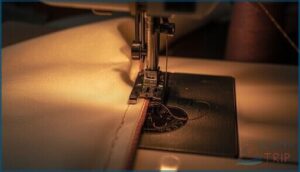
Thread tension is one of those things that looks simple but can quietly throw off your entire stitch quality. Even a small imbalance between your upper and lower thread can lead to skipped stitches, puckering, or loops on the fabric.
Here’s what you need to know about getting tension right.
Effects of Incorrect Tension Settings
When thread tension is off, your seams pay the price fast. Too loose, and you’ll see loop formation under the fabric — those tangled loops weaken your seam hold by up to 50%. Too tight, and seam puckering distorts your fabric along stitch lines. Here’s what bad tension actually does:
- Stitch skip frequency increases — skips cluster every 5–10 stitches
- Thread breakage snaps thread after just 10–20 stitches
- Bird nest buildup jams your bobbin case underneath
- Loop formation pulls top thread down into visible tangles
- Seam puckering compresses lightweight fabric into visible ridges
Adjusting Tension for Different Fabrics
different tension settings — what works for quilting cotton will pucker silk flat. Start with your fabric type as the guide. Lightweight Fabric Tension runs low, around 2–3.5 for silk or chiffon. Medium Weight Settings land near 4–5 for linen or poplin. Heavy Fabric Adjustment climbs to 5–7 for denim or canvas.
Always sew a test seam first — tension adjustment takes seconds, but fixing a ruined seam costs real time.
| Fabric Type | Tension Range | Needle Size |
|---|---|---|
| Chiffon / Silk | 2.0 – 3.5 | 70/10 |
| Quilting Cotton | 4.0 – 5.0 | 80/12 |
| Denim / Canvas | 4.0 – 7.0 | 90/14–100/16 |
| Stretch Knit Tension | 2.0 – 4.0 | 75/11 Stretch |
| Leather Tension Settings | 3.0 – 5.0+ | Leather needle |
Balancing Upper and Lower Thread Tension
Getting your upper and lower tension to agree is like tuning two instruments to the same key — both have to meet in the middle.
- Run a knot position test using contrasting thread colors to see where the knot sits
- Turn your upper tension dial one number at a time — start at 4
- Watch for fabric puckering, your clearest sign that tension is too tight
- Touch the bobbin tension screw only after exhausting upper dial adjustments
Incremental tension adjustment keeps you in control. Balanced upper thread and bobbin thread means no skipped stitches, no loops — just clean seams.
Cleaning and Maintenance for Preventing Skipped Stitches

Skipped stitches are often less about your technique and more about what’s been quietly building up inside your machine.
Lint, dust, and debris sneak into places you’d never think to look, and over time they throw everything off.
Here’s where to focus your cleaning efforts to keep things running smoothly.
Removing Lint and Debris From Thread Path
Lint is the silent saboteur of consistent stitch quality.
Use a Thread Guide Brush to sweep the upper path every 10 sewing hours, working from spool pin down toward the tension area.
A Tension Disc Flush — running dental floss between the discs with the presser foot raised — clears trapped fibers affecting thread tension and thread loop formation.
Blast the needle threader with Needle Threader Air to free the tiny wire hook.
Hit the Take‑Up Lever Oil pivot monthly after brushing.
An Upper Path Vacuum manages stubborn buildup near the needle hook clearance zone.
| Cleaning Task | Tool | Frequency |
|---|---|---|
| Thread Guide Brush sweep | Nylon brush | Every 10 hours |
| Tension Disc Flush | Dental floss/fleece | Monthly |
| Take‑Up Lever Oil | Machine oil | Monthly |
Cleaning The Bobbin Case and Needle Plate
Unplugging before you dig into the bobbin area is non‑negotiable — your fingers and the hook race are too close for comfort. Work through these four steps to restore reliable Thread Tension and prevent Skipped Stitches Repair calls:
- Pop the needle plate, check Needle Plate Alignment marks, and vacuum lint with Vacuum Dust Extraction.
- Pull the bobbin case and do Hook Race Cleaning with a cotton swab and isopropyl alcohol.
- Run a fingernail along the bobbin case lip — any nick needs Burr Polishing by a technician.
- Reseat the case using alignment marks so needle-hook clearance stays exact.
Regular Maintenance Schedule
Think of Sewing Machine Maintenance as layered habits, not a single chore.
Do a Daily Lint Brush around the needle zone before every session. Practice smart Needle Replacement Timing — fresh needle every new project. Apply the Oil Hook Interval after two bobbins.
Follow a Weekly Bobbin Clean and Monthly Service Check. These small steps keep Thread Tension steady and skipped stitches rare.
Troubleshooting Skipped Stitches Step-by-Step
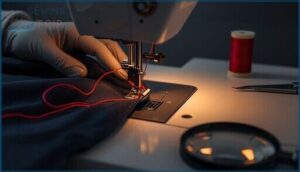
When your stitches keep skipping, the fix is usually simpler than you think — it’s just a matter of knowing where to look. A few targeted checks can save you a lot of frustration and get your machine back on track fast.
Start with these two key areas.
Re-threading The Machine Properly
Re-threading the machine is often the fastest fix you can try. Start with old thread removal — cut near the spool and pull it forward through the needle. Raise the presser foot positioning lever so the tension discs open, then follow your threading guide carefully.
The take-up lever threading step gets skipped more than anything else, and it will cause problems every time. Correct spool orientation, a clean upper thread path, and balanced thread tension make all the difference.
Checking Bobbin and Spool Cap Issues
The bobbin is responsible for more skipped stitches than most sewists realize.
Check bobbin winding quality first — a loose or overfilled bobbin releases thread unevenly, throwing off tension instantly.
Confirm bobbin insertion direction matches your machine’s diagram; wrong orientation bypasses the tension spring entirely.
Run a fingernail along the bobbin case condition to feel for burrs.
Advanced Solutions for Persistent Issues
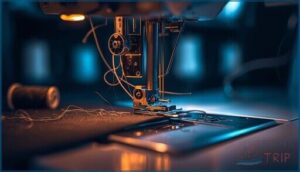
Sometimes the usual fixes just don’t cut it, and that’s when you need to dig a little deeper.
Persistent skipped stitches often point to mechanical issues that go beyond threading or tension adjustments.
Here’s where to look when the basics haven’t solved the problem.
Inspecting Needle-Hook Clearance
If your machine keeps skipping stitches despite perfect threading and tension, needle-hook clearance is likely the culprit. This tiny hook gap measurement — ideally around 0.05mm — determines whether the hook catches the thread loop every time.
- Remove the needle plate and run a magnified visual check as you slowly turn the handwheel.
- Watch for the hook passing just above the needle eye during the clearance light test.
- A ticking sound signals the hook is striking the needle — needle bar alignment needs adjustment.
- Verify hook timing sync by confirming the hook arrives when the needle has risen roughly 2 mm.
- A bent needle shifts needlehook clearance instantly, causing skipped stitches even with correct thread tension and needle size.
Using Specialized Needles or Feet
Sometimes the right tool makes all the difference. When skipped stitches persist, your needle selection and presser foot choice often matter more than any tension adjustment.
| Fabric Type | Recommended Needle | Best Presser Foot |
|---|---|---|
| Knits/Stretch | Ballpoint or Stretch Needle | Walking Foot |
| Vinyl/Leather | Topstitch needle | Roller Foot |
| Knit Hems | Twin Needle | Walking Foot |
Ballpoint needles push knit fibers aside instead of piercing them, improving loop pickup. Stretch needles handle high‑stretch fabrics like Lycra. Twin needles create flexible hems. A walking foot prevents fabric shifting on thick layers — and a roller foot keeps sticky materials feeding smoothly, reducing skipped stitches.
When to Seek Professional Repair
Even the best troubleshooting guide has its limits.
If skipped stitches keep coming back after you’ve changed the needle, re‑threaded, and tested with quality thread, that’s your sign to call a technician.
Persistent timing issues, severe mechanical wear, and electrical sensor failures all need professional hands.
Attempting internal fixes yourself risks warranty violation risks — and usually makes things worse.
Best Practices to Prevent Skipped Stitches
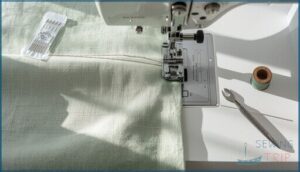
Fixing skipped stitches is really only half the battle — keeping them from coming back is what separates a good sewer from a great one.
Solving skipped stitches is just the start; mastering prevention is what truly defines a skilled sewer
A few consistent habits go a long way toward smoother, more reliable results every time you sit down at the machine.
Here’s what to keep in mind.
Selecting Quality Threads and Needles
Most skipped stitch problems trace back to two overlooked basics: thread quality and needle selection.
Reach for OEKO‑Tex Certified Thread with a core spun construction — it manages needle heat better and keeps upper thread and bobbin thread tension balanced.
Match Thread Weight Selection to your fabric, then align Needle Size Matching and Needle Point Types accordingly.
Good materials do half the troubleshooting for you.
Adjusting Stitch Length for Fabric Type
Once your thread and needle are dialed in, stitch length becomes your next lever. Wrong length causes skipped stitches just as fast as the wrong needle.
- Lightweight stitch length: 1.8–2.2 mm for seams, 2.4–2.8 mm for topstitching
- Medium-weight stitch length: 2.2–2.6 mm construction, 2.8–3.0 mm topstitching
- Heavy fabric stitch length and knit stretch stitch length: 3.0–4.0 mm and 2.5–3.0 mm respectively
Always do stitch length testing on a scrap first.
Proper Fabric Handling Techniques
Stitch length manages spacing, but fabric handling controls everything else.
Keep your material fully supported on a flat surface so the feed dogs can do their job without fighting gravity.
Watch your presser foot pressure on knits — too light and the fabric lifts with the needle.
Use stabilizer usage under delicate layers, mind your layer orientation, and guide with a steady hand.
Frequently Asked Questions (FAQs)
Can a sewing machine cause skipped stitches?
Think of your sewing machine as a conductor—if hook timing, bobbin tension, feed dog alignment, motor speed, or electrical faults go offbeat, skipped stitches follow.
Proper needle size and machine timing are key in sewing machine troubleshooting.
What happens if you miss a stitch on a sewing machine?
A missed stitch leaves a visible gap, weakening seam strength and risking fabric damage.
You’ll notice uneven appearance, compromised project durability, and potential safety hazards—especially at stress points.
Stitch formation issues often trace back to needle size or thread tension problems.
How do you fix skipped stitches on a sewing machine?
Like a chain losing one link, a single skipped stitch can unravel your seam.
Change your needle, check thread tension, and confirm proper bobbin management to restore clean, consistent stitches fast.
Can unbalanced thread tension cause skipped stitches?
Yes — unbalanced thread tension absolutely causes skipped stitches. When upper and bobbin tension don’t match, the hook misses the thread loop entirely, leaving frustrating stitch gap patterns across your seam.
Why is my sewing machine skipping stitches and breaking thread?
Skipping stitches and breaking thread usually point to a worn needle, poor thread quality, or thread tension set too high. Check those three things first and you’ll solve most problems fast.
What is the most common cause of skipped stitches?
Improper threading tops the list every time. If your upper thread misses the take‑up lever or sits wrong in the tension disks, the hook simply never catches the loop.
Can skipped stitches damage your sewing machine?
Absolutely — skipped stitches don’t just ruin your seam. Hook wear, motor strain, belt damage, timing drift, and needle bar fatigue can all quietly build up the longer you ignore them.
Are skipped stitches more common with certain brands?
Not really.
Skipping stitches shows up across every brand — Brother, Singer, Janome, Bernina.
Brand hook design, feed dog variability, and service network quality matter, but wrong thread tension, needle size, or dealer training gaps cause most problems.
How does humidity affect skipped stitches?
Humidity quietly messes with your thread and machine more than most people realize.
Thread moisture causes cotton to swell, increasing tension drift and leading to skipped stitches, while dry air builds static cling on synthetics.
Can skipped stitches occur with hand sewing?
Yes, skipped stitches happen in hand sewing too.
Poor lighting conditions, fabric movement, thread slip, or the wrong needle eye size can all break stitch consistency — leaving gaps just as frustrating as any machine problem.
Conclusion
Studies show that up to 80% of sewing machine problems trace back to threading errors alone—a surprisingly simple root cause for such a frustrating result.
Once you understand how needle choice, thread tension, and a clean machine all work together, skipped stitches, threading issues lose their mystery. You’re not fighting your machine anymore; you’re working with it.
Keep up with routine maintenance, trust your troubleshooting process, and clean stitches will become your new normal.
- https://support.handiquilter.com/hc/en-us/articles/115001348352-Skipping-Stitches-bobbin-thread-not-pulling-up
- https://vintagesewingmachinesblog.wordpress.com/2017/07/20/skipped-stitches-and-their-remedies/
- https://weallsew.com/troubleshooting-for-skipping-stitches/
- https://murthysewingmachines.com/blog/sewing-machine-skipping-stitches/
- https://sewingmachineman.substack.com/p/skipped-stitches-troubleshooting