This site is supported by our readers. We may earn a commission, at no cost to you, if you purchase through links.
A dull blade doesn’t just slow you down—it wrecks your fabric before the first seam is sewn. Frayed edges, jagged curves, and dragging cuts are almost always a tool problem, not a skill problem.
The right fabric cutting tools for home sewists can close that gap between a frustrating afternoon and a clean, confident project. From micro-serrated dressmaker shears that grip stubborn denim to self-retracting rotary cutters built for stacking twelve layers, the options in 2026 cover every fabric type and every budget.
These ten picks cut through the noise.
Table Of Contents
- Key Takeaways
- Top 10 Fabric Cutting Tool Picks
- 1. Mundial Bent Trimmer Dressmaker Scissors
- 2. Blue White Polka Dot Embroidery Scissors
- 3. Gingher Knife Edge Applique Scissors
- 4. OLFA 28mm Quick Change Rotary Cutter
- 5. Olfa 45mm Quick Change Rotary Cutter
- 6. OLFA 60mm Ergonomic Rotary Cutter
- 7. Black Decker Cordless Electric Fabric Scissors
- 8. Euro Notions Buttonhole Cutter Set
- 9. Riley Blake Lori Holt Steel Peacock Cutting Mat
- 10. Cottage Mills Acrylic Design Ruler
- Rotary Cutters for Precise Cutting
- Fabric Scissors and Specialty Blades
- Cutting Mats, Rulers, and Safety
- Choosing The Right Fabric Cutter
- Frequently Asked Questions (FAQs)
- Conclusion
Key Takeaways
- Matching your cutting tool to fabric weight and project type—not habit or convenience—is what separates clean cuts from frustrating ones.
- Rotary cutter size is a real decision: 28mm for tight curves, 45mm for everyday garment and quilt work, and 60mm when you’re powering through thick stacks or long yardage.
- Your support system—a self-healing mat, acrylic ruler, and pattern weights—does as much for accuracy as the blade itself.
- A dull blade isn’t a minor inconvenience; it’s the root cause of frayed edges, shifting fabric, and wasted time, so blade maintenance isn’t optional.
Top 10 Fabric Cutting Tool Picks
The right cutting tool can make or break a project before you even thread your needle. These ten picks cover everything from everyday dressmaking to detailed embroidery and multi-layer quilting. Here’s what made the cut for home sewists in 2026.
Whether you’re a beginner or a seasoned sewist, brushing up on fabric cutting techniques and best practices can save you time, reduce waste, and set every project up for success.
1. Mundial Bent Trimmer Dressmaker Scissors
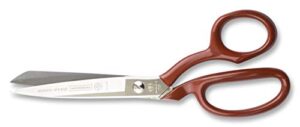
The Mundial Bent Trimmer Dressmaker Scissors are a serious upgrade for anyone tired of fabric shifting mid-cut. The angled blade keeps your material flat on the table, so you’re cutting what you see — no lifting, no guessing.
Hot-forged carbon steel holds its edge through denim, corduroy, and layered textiles. The micro-serrated edge grips fabric instead of pushing it.
At 8 inches with ergonomic red grips, these shears give you real control for long cutting sessions.
| Best For | Dressmakers, tailors, upholsterers, and costume designers who need clean, accurate cuts on heavy or layered fabrics without the frustration of slipping material. |
|---|---|
| Blade Material | High-carbon forged steel |
| Primary Use | Fabric shearing |
| Hand Compatibility | Right-handed |
| Product Weight | Not specified |
| Retail Price | $33.50 |
| Package Quantity | 1 pair |
| Additional Features |
|
- The angled blade lets you cut flat on the table — no lifting, no shifting, just accurate cuts every time.
- Hot-forged carbon steel with a micro-serrated edge grips fabric and holds a sharp edge through denim, corduroy, and layers.
- Nickel plating keeps rust at bay, so these hold up well in busy or humid workspaces.
- They can feel stiff right out of the box — the pivot may need adjusting before they glide smoothly.
- Heavier than standard shears, which can wear on your hand during light, detail-heavy work.
- The micro-serrated edge isn’t ideal for very delicate or fine fabrics where a smooth blade would feel cleaner.
2. Blue White Polka Dot Embroidery Scissors
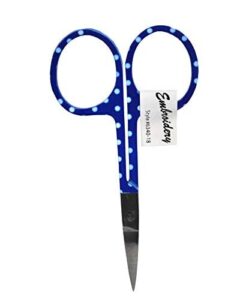
Where the Mundial manages bulk cuts, these do the opposite — they live for the fine stuff. The Blue White Polka Dot Embroidery Scissors are built for close-in work: snipping embroidery floss, trimming quilt knots, clipping threads flush to the fabric.
The 3¾-inch stainless steel blades taper to a fine tip that slides right between stitches without catching. And that polka-dot handle? It’s not just cute — you’ll actually find it in your notion bag on the first try.
| Best For | Sewers, quilters, and embroidery enthusiasts who need a precise, easy-to-spot tool for detailed close-up work. |
|---|---|
| Blade Material | Stainless steel |
| Primary Use | Embroidery & quilting |
| Hand Compatibility | Right-handed |
| Product Weight | Not specified |
| Retail Price | Not specified |
| Package Quantity | 1 pair |
| Additional Features |
|
- Fine-tipped blades slip right between stitches — great for snipping floss and trimming knots without disturbing surrounding fabric
- Stainless steel construction holds up well against rust and everyday wear
- The polka-dot handle is genuinely easy to spot at the bottom of a notion bag
- Not built for thick fabric or multiple layers — the blade length just isn’t there
- That fine tip can bend if you push it too hard
- Generic brand means no real warranty backing if something goes wrong
3. Gingher Knife Edge Applique Scissors
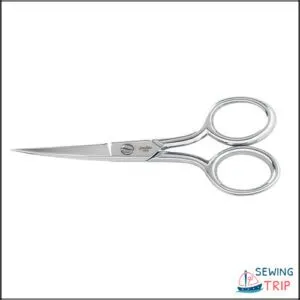
Now, if embroidery scissors handle the tiny stuff, the Gingher Knife Edge Applique Scissors handle something trickier — cutting close without cutting through. That paddle-shaped duckbill blade slides under your top layer, shielding the fabric beneath while you trim right to the seam.
The 6-inch all-metal build feels solid, the chrome-over-nickel finish keeps it sharp, and the ambidextrous offset handle works whether you’re left- or right-handed.
The included sheath keeps that edge protected between sessions.
| Best For | Quilters, embroiderers, and fabric artists who need to trim close to seams or appliqué edges without accidentally cutting the layer underneath. |
|---|---|
| Blade Material | Alloy steel, chrome-nickel plated |
| Primary Use | Appliqué & trimming |
| Hand Compatibility | Ambidextrous |
| Product Weight | Not specified |
| Retail Price | Not specified |
| Package Quantity | 1 pair |
| Additional Features |
|
- The duckbill blade does exactly what it promises — slides under the top layer and shields the fabric below while you cut
- Ambidextrous handle means lefties don’t get the short end of the stick for once
- Comes with a protective sheath, so the blade stays sharp between projects
- No cushioning on the handle, so long sessions can leave marks on your fingers
- Technique still matters — pressing too hard can cut through fabric anyway
- Product images online have confused some buyers about what style they’re actually getting
4. OLFA 28mm Quick Change Rotary Cutter
Where the Gingher excels at trimming close, the OLFA 28mm Quick Change Rotary Cutter excels at cutting fast — and precisely.
That 28mm tungsten steel blade is your go-to for tight curves, miniatures, and intricate quilting templates where a larger cutter just can’t maneuver.
The quick-change blade system swaps out in one hand, no tools needed.
At under an ounce, it won’t tire you out, and the contoured grip works for both left- and right-handed sewists.
| Best For | Quilters, sewists, and crafters who work with tight curves, small-scale projects, or intricate templates where precision matters more than speed over long cuts. |
|---|---|
| Blade Material | Tungsten tool steel |
| Primary Use | Precision rotary cutting |
| Hand Compatibility | Ambidextrous |
| Product Weight | 0.8 oz |
| Retail Price | Not specified |
| Package Quantity | 1 cutter |
| Additional Features |
|
- Tungsten steel blade holds a sharp edge longer and handles fine detail work really well
- Quick-change system means blade swaps take seconds — no fumbling, no tools
- Works for lefties and righties, and at under an ounce it’s easy on the hand during long sessions
- Struggles with thick stacks — more than 3 layers and you’ll feel it losing steam
- Not the right tool if you’re cutting long, straight lines across big yardage
- Only works with OLFA’s own 28mm replacement blades, so you can’t grab generic ones in a pinch
5. Olfa 45mm Quick Change Rotary Cutter

Think of the 45mm as the workhorse in your cutting kit. It’s the blade most quilters and garment sewists reach for first — and for good reason.
The tungsten steel edge stays sharp through up to 8 layers of cotton, and the quick-change system swaps blades in seconds, no tools needed.
It works for both left- and right-handed use, and the ergonomic grip keeps fatigue at bay during long sessions.
At just $13.99, it’s serious value for everyday cutting.
| Best For | Quilters, garment sewists, and crafters who cut frequently and want a reliable, comfortable everyday rotary cutter. |
|---|---|
| Blade Material | Tungsten tool steel |
| Primary Use | General fabric cutting |
| Hand Compatibility | Ambidextrous |
| Product Weight | 1.6 oz |
| Retail Price | $13.99 |
| Package Quantity | 1 cutter |
| Additional Features |
|
- Tungsten steel blade stays sharp through up to 8 layers of fabric — cotton, fleece, leather, you name it.
- Works for both left- and right-handed users, and the ergonomic grip makes long cutting sessions way easier on your hands.
- Quick-change blade system means zero downtime — swap blades in seconds, no tools required.
- You’ll need a cutting mat every time; that blade will go right through a table without one.
- Replacement blades from Olfa can get pricey, and off-brand options might not cut as cleanly.
- Heavy or abrasive materials wear the blade down faster, and it tops out at around 8 layers of dense fabric.
6. OLFA 60mm Ergonomic Rotary Cutter
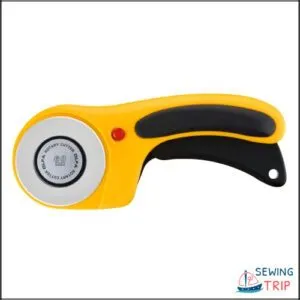
When bigger stacks are on your cutting table, the OLFA 60mm Ergonomic Rotary Cutter earns its place.
Its padded grip reduces fatigue on long cutting sessions, which matters even more when you’re working with demanding materials like those covered in this guide to hand-sewing leather safely and effectively.
The pre-installed 60mm Endurance blade cuts through up to 12 layers of cotton in one clean pass — no second guessing, no fraying. The squeeze-trigger handle self-retracts when you let go, and the dual safety lock keeps things secure between cuts. It’s ambidextrous, too.
At $31.99, you’re getting professional-grade control built for serious volume.
| Best For | Quilters, sewers, and fabric artists who work with thick stacks or long sessions and want a safer, more comfortable cutter that handles serious volume without wearing out their hands. |
|---|---|
| Blade Material | Tungsten tool steel |
| Primary Use | Heavy multi-layer cutting |
| Hand Compatibility | Ambidextrous |
| Product Weight | 4 oz |
| Retail Price | $31.99 |
| Package Quantity | 1 cutter + 1 blade |
| Additional Features |
|
- The 60mm Endurance blade slices through up to 12 layers of cotton cleanly — great for batch cutting and big projects.
- The squeeze-trigger with self-retracting blade makes it much safer to use and set down between cuts.
- Fully ambidextrous, so lefties and righties are both covered without any awkward workarounds.
- Some buyers report the blade arrives dull or coated in oil, meaning you might need to clean or swap it before your first real cut.
- At $31.99, it costs more than most generic rotary cutters — not ideal if you’re on a tight budget.
- Very thick or dense materials still take real pressure, and poor technique can lead to shoulder or arm fatigue over time.
7. Black Decker Cordless Electric Fabric Scissors
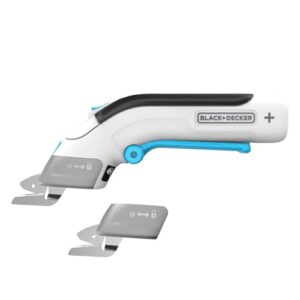
If wrist fatigue has been slowing you down, the BLACK+DECKER Cordless Electric Fabric Scissors (BCSC115FF) might be exactly what your cutting table needs. Weighing just 1.6 oz, it runs on a 4V motor with up to 40 minutes of runtime per charge — plenty for most home sewing sessions.
Swap between the "O" blade for fabric and the "D" blade for leather or vinyl.
USB-C recharging keeps it portable, and the two-button safety lock prevents accidental starts.
| Best For | Sewists, quilters, and anyone dealing with wrist fatigue or recovering from a wrist injury who needs to cut through a variety of materials without the strain of manual scissors. |
|---|---|
| Blade Material | High-carbon & stainless steel |
| Primary Use | Power fabric cutting |
| Hand Compatibility | Ambidextrous |
| Product Weight | 1.6 oz |
| Retail Price | Not specified |
| Package Quantity | 1 unit |
| Additional Features |
|
- Cuts fabric, leather, vinyl, cardboard, and more with ease — no hand strain required
- Lightweight at just 1.6 oz with swappable blades for different materials
- USB-C rechargeable and cordless, so you can use it anywhere
- It’s noticeably loud compared to regular scissors
- Battery might not last through heavy-duty sessions with thick or layered materials
- Official replacement blades are hard to find — you’ll likely need to go third-party
8. Euro Notions Buttonhole Cutter Set
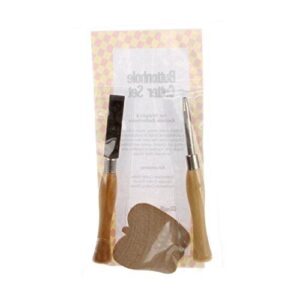
Buttonholes don’t have to be a finishing nightmare.
The Euro Notions Buttonhole Cutter Set (Model 1704) gives you a sharp, hardened steel knife for straight and keyhole buttonholes, plus a circular cutter for English eyelet embroidery — all for just $13.
The included hardwood cutting block keeps your cuts steady and your blades intact.
At 1.6 oz, it’s compact enough for any sewing basket.
Just note: the wooden block can crack under heavy pressure, so go controlled, not forceful.
| Best For | Hobbyists and small-shop sewers who want clean, precise buttonholes — straight, keyhole, or eyelet — without fussing with multiple tools. |
|---|---|
| Blade Material | Steel blade |
| Primary Use | Buttonhole cutting |
| Hand Compatibility | Right-handed |
| Product Weight | 1.6 oz |
| Retail Price | $13.00 |
| Package Quantity | 1 set + board |
| Additional Features |
|
- Handles three buttonhole types in one set, so you’re not buying separate cutters
- Sharp blade gives you a clean cut with minimal cleanup or trimming
- Lightweight and compact — easy to toss in your sewing kit and forget about until you need it
- Blades can dull faster than expected, especially with regular use
- The wooden cutting board is small and prone to cracking under heavy pressure
- At $13, some buyers feel the value doesn’t quite match the durability
9. Riley Blake Lori Holt Steel Peacock Cutting Mat
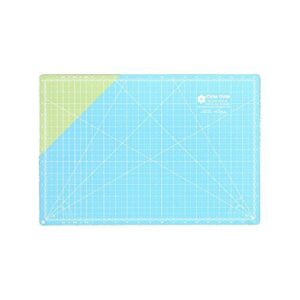
Your cutting surface matters more than most sewists realize. The Riley Blake Lori Holt Steel Peacock Cutting Mat gives you a 12×18-inch self-healing workspace that accommodates everything from quilting blocks to curved lyocell cuts with ease.
Flip it over — both sides carry grid markings in inches, so you get twice the life from one mat. It works smoothly with 45mm and 60mm rotary cutters.
Just store it flat to prevent warping and wipe it clean after each session.
| Best For | Quilters and fabric crafters who want a reliable, dual-sided cutting mat for precise rotary cuts on everything from quilting blocks to curved fabric work. |
|---|---|
| Blade Material | Steel with peacock finish |
| Primary Use | Cutting surface mat |
| Hand Compatibility | Ambidextrous |
| Product Weight | 0.5 lb |
| Retail Price | Not specified |
| Package Quantity | 1 mat |
| Additional Features |
|
- Reversible with grid markings on both sides, so you get more mileage out of a single mat
- Self-healing triple-layer construction holds up well to regular rotary cutter use
- Great for detailed cuts in soft fabrics like lyocell, including curves and interior corners
- Color can be misleading — what’s advertised as green/blue may arrive looking steel-gray or turquoise
- Self-healing properties can fade over time, with some users noticing permanent ridges after extended use
- Durability isn’t guaranteed long-term — a number of reviewers found it didn’t last much beyond a year of regular cutting
10. Cottage Mills Acrylic Design Ruler
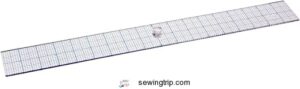
Precision starts with the right ruler. The Cottage Mills Acrylic Design Ruler gives you 2×18 inches of clear, non-flexing acrylic — enough length to handle long straight cuts without repositioning every few seconds.
Blue 1/16-inch markings stay readable under most lighting, and the centered knob lets you reposition quickly without losing your line.
It works equally well with rotary cutters and craft knives. Both sides carry measurements, so there’s no flipping required.
Simple, accurate, and built in the USA.
| Best For | Quilters, sewers, and crafters who need a reliable straight edge for rotary cutting, fabric layout, or drafting work. |
|---|---|
| Blade Material | Clear acrylic |
| Primary Use | Rotary cutting guide |
| Hand Compatibility | Ambidextrous |
| Product Weight | Not specified |
| Retail Price | Not specified |
| Package Quantity | 1 ruler |
| Additional Features |
|
- Clear acrylic lets you see exactly what you’re cutting through, so alignment is easy and accurate
- The centered grip knob makes repositioning fast without losing your place or slipping
- Measurements on both sides mean you never have to flip it mid-project
- Markings can fade over time, especially with regular cleaning or sun exposure
- Only comes in one size, so it won’t work if you need something wider or shorter
- Acrylic can crack under heavy impact or extreme heat, so it’s not ideal for rough environments
Rotary Cutters for Precise Cutting
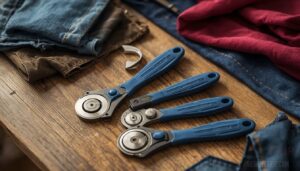
Rotary cutters are where precision really starts to matter. The right size and blade make a surprising difference — whether you’re chasing tight curves or powering through a thick stack of denim.
Here’s what you need to know about each option.
28mm Cutters for Tight Curves and Detail Work
When detail work demands control, the 28mm rotary cutter is your sharpest ally. Its compact blade navigates curved cuts with Micro Curve Precision — tracing necklines, appliqué edges, and clam shell templates cleanly.
Pair it with a Material Stabilizer Use strategy on slippery silks to prevent drift.
Ergonomic grips reduce hand fatigue, while Blade Lubrication Frequency and smart Blade Angle Adjustment keep every Edge Finish crisp.
45mm Cutters for Everyday Garment and Quilting Cuts
Step up from tight curves, and the 45mm rotary cutter becomes your everyday workhorse. It’s the sweet spot for home sewers tackling garment layouts and quilt making alike.
For extra durability, consider the 45 mm rotary cutter set, which includes titanium blades.
- Supports Multi-layer Cutting Capacity of 4–6 cotton layers cleanly
- Blade Coating Options include titanium for longer edge life
- Quick Blade Replacement keeps your fabric cutting tools ready
- Ambidextrous mount fits any hand comfortably
60mm Cutters for Thick Stacks and Long Straight Lines
When your projects scale up — think quilts, denim, or heavy upholstery — the 60mm rotary cutter takes over where the 45mm leaves off.
Its larger blade delivers Long Stroke Efficiency across wide fabric panels, while Blade Angle Stability keeps your cuts true through thick stacks.
Ergonomic grips reduce fatigue, and Stack Compression Management means fewer passes, cleaner edges every time.
Fine Blades for Silk, Lawn, and Delicate Fabrics
Delicate materials demand a different kind of blade. For silk and lawn, micro-serrated edges — your Micro Serration Benefits in action — grip slippery weaves without snagging.
Silk Blade Coating and Lawn Edge Polishing keep cuts clean and fray-free.
That Delicate Grip Design matters too. Follow Blade Longevity Tips: clean after every use, store sheathed, and swap blades at the first sign of dullness.
Heavy-duty Blades for Denim and Layered Projects
When denim and stacked layers push your blade to its limits, you need steel that fights back. Titanium Coating keeps the edge sharp through 1,000-plus cuts, while a Micro Bevel Edge and Serrated Edge Grip lock into tightly woven plies.
The Black Oxide Finish reveals wear fast.
At 1.2–1.5mm Blade Thickness, you get heavy-duty cutting performance without flex — pure blade durability built for layered fabric cutting.
Ergonomic Handles and Blade-lock Safety Features
Your rotary cutter’s ergonomic grips do more than feel good — they keep you cutting longer without strain. Contour Grip Design and Anti-slip Texture hold firm even when your hands tire. Weight-balanced grips lower wrist fatigue on long straight cuts.
The Thumb-access Blade Lock engages with one deliberate press, and a Visual Lock Indicator confirms it’s secure.
Smart ergonomic design in fabric cutting tools means safer, cleaner work every time.
Fabric Scissors and Specialty Blades
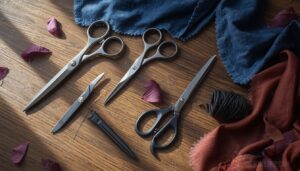
Not every cut calls for a rotary cutter — sometimes you just need a good pair of scissors. The right blade makes all the difference, whether you’re trimming threads or powering through thick denim.
Here’s what you need to know about the scissors and specialty blades worth having in your kit.
Dressmaker Shears for General Sewing Tasks
Dressmaking shears are your sewing room’s workhorse. With blade edge types ground to a precise bevel angle and handle balance that keeps the blade flat against your cutting surface, they handle cotton, linen, and lightweight blends with ease. Keep pivot tension smooth with light oiling and stick to a sharpening routine.
- Ergonomic grips reduce hand fatigue during long cutting sessions
- Blade sharpness stays consistent with regular honing and proper storage
- Hand ergonomics improve with offset grips that align naturally with your wrist
Embroidery Scissors for Thread Snipping and Detail Work
Tiny scissors, massive impact. Embroidery scissors deliver Fine Point Snipping exactly where you need it — between dense stitches, near hoops, in spaces where your dressmaking shears simply can’t reach.
Curved Tip Precision keeps the blade above the fabric while you trim, and Nickel Plating resists corrosion from frequent handling.
| Feature | Why It Matters |
|---|---|
| Precision Edge Angle | Clean thread cuts without fraying |
| Ergonomic grips | Hand fatigue reduction during long sessions |
Thread Tension Control starts with the blade sharpness you can rely on.
Appliqué Scissors for Close Trimming Around Seams
Duckbill appliqué scissors are built for one job — getting close without cutting what you shouldn’t. The Seam Guard Design and Blade Tip Shape work together, sliding under fabric so your seam stays intact.
Offset Handle benefits your line of sight, reducing hand strain during Stabilizer Removal.
With a Precision Blade Angle, these fabric scissors deliver precision cutting exactly where you need it.
Pinking Shears for Reducing Frayed Woven Edges
Pinking shears do more than create a pretty edge — their Pinking Blade Geometry disrupts the straight grain pull that causes fabric fraying. That’s Zigzag Edge Mechanics working in your favor.
Fray Reduction Testing shows tightly woven cotton and linens hold up noticeably better after washing.
Weave Stability Impact matters too: the better the weave, the more effective the Edge Finish Comparison.
Look for ergonomic grips to reduce hand strain.
Electric Scissors for Thick Fabrics and Multiple Layers
When thick stacks of denim or canvas stop you in your tracks, electric scissors step up fast. High-torque motors keep blade speed steady across multiple fabric layers — no stalling, no drama.
Look for ergonomic grips, solid battery life, and smart blade heat management to prevent overheating. For home sewers tackling heavy fabrics, layer cutting capacity of six to eight millimeters changes everything.
Blade Material, Sharpness, and Hand Comfort
Blade material shapes every cut you make. Titanium coating cuts friction and holds sharpness through dense layers, while carbon steel durability means your edge outlasts cheaper alternatives — just oil it regularly.
Ceramic blades stay razor-sharp on delicate fabrics, but shatter on hard surfaces.
For handheld cutting tools, ergonomic handle design and blade heat dissipation matter as much as sharpness.
Replace blades before they drag.
Cutting Mats, Rulers, and Safety
Your rotary cutter and scissors deserve the right support system to do their best work. A good mat, a reliable ruler, and a few safety basics can completely change how your cutting sessions go.
Here’s what every home sewist should have on the table.
Self-healing Mats for Protecting Surfaces and Blades
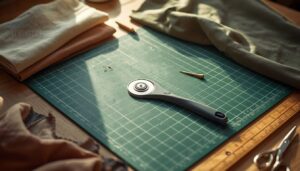
A self-healing cutting mat is your work surface’s best defense. Its layered PVC construction absorbs blade cuts and reseals, reducing blade drag and extending edge life by up to 40%.
Mat thickness options — 3mm, 5mm, or 7mm — balance protection with portability. Built-in grid customization keeps cuts aligned.
For mat maintenance tips, wipe after each use and store flat to prevent warping.
Acrylic Rulers for Straight Cuts and Grainline Alignment
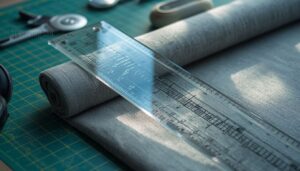
Your mat keeps the surface safe — now your acrylic ruler keeps your cuts honest.
These fabric cutting tools bring real cutting accuracy to every project.
A beveled edge reduces glare and improves edge visibility along grain lines, while magnetic backing options hold steady on layered fabric.
Measurement scale types in metric and imperial, plus ruler material durability from crack-resistant PMMA, make straight lines easy.
Pattern Weights for Pin-free Cutting Control

Skip the pins — pattern weights give you faster, cleaner cuts every time.
Understanding pattern weights versus pins changes your whole cutting technique:
- Weight Shape Selection — curve, straight, and 90-degree weights cover every edge.
- Even Pressure Distribution — prevents fabric shift on slippery satin or silk.
- Material Compatibility Guidance — heavier weights for denim, lighter for delicate fabrics.
Color Visibility Benefits and rust-resistant coatings make these sewing accessories worth every penny.
Follow basic Weight Maintenance Tips: wipe clean, store safely.
Safety Gloves and Blade Guards for Hand Protection
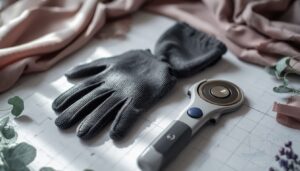
Your hands are your most valuable cutting tool — protect them.
| Feature | Safety Gloves | Blade Guards |
|---|---|---|
| Cut Resistance Levels | HPPE, ANSI-rated | Impact-resistant plastic |
| Glove Material Compatibility | Nitrile, breathable liners | N/A |
| Retractable Guard Mechanisms | N/A | Spring-loaded or magnetic |
| Ergonomic Fit Options | Curved seams, flexible knuckles | Snap-fit designs |
| Maintenance and Inspection | Check for tears before use | Inspect fit regularly |
Reliable safety gloves and blade guards transform cutting safety from an afterthought into a habit. Always use a protective sheath during rest breaks — it’s a simple safety consideration when using fabric cutters that prevents most accidents.
Retractable Blade Handles for Safer Storage and Use
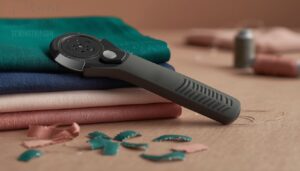
Retractable blade grips take your safety protocols for cutting to the next level. When pressure releases, the Automatic Blade Retractor kicks in instantly — no fumbling, no exposed edges.
- Two-Step Blade Release stops accidental deployment cold
- Knuckle Guard Integration shields your hand mid-cut
- Rubberized Handle Coating and ergonomic softgrip handle reduce fatigue
Blade Channel Lubrication keeps retraction smooth, and blade replacement packs make swaps smooth.
Clean Workspaces That Improve Cutting Accuracy
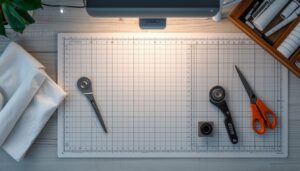
Your cutting accuracy lives and dies by what’s around your tools, not just the tools themselves.
Bright task lighting — think 4000K to 5000K — sharpens grainline visibility and cuts misreads fast.
A level surface keeps your self-healing cutting mat true within a millimeter.
Dust management, smart tool organization, and ergonomic positioning complete the picture.
clean workspace isn’t optional — it’s your edge.
Choosing The Right Fabric Cutter
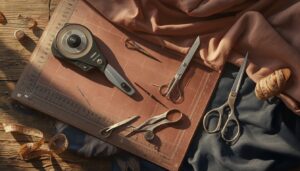
The right cutting tool can make or break your project before you ever thread a needle. Your fabric type, project goals, and how often you sew all point toward a different answer.
The right cutting tool can make or break your project before you ever thread a needle
Here’s what to think about when making your choice.
Match The Tool to Fabric Type and Thickness
Your tool choice starts with the fabric — full stop.
Silk Blade Selection means fine rotary blades; Denim Tool Matching calls for 60mm heavy-duty cutters.
Knit Edge Control demands sharp curved blades, while Leather Shear Choice requires non-marking heavy shears.
Layer Count Guidelines matter too:
- Under 4 oz — 28mm cutter
- 7–11 oz — 45mm cutter
- 11 oz+ — 60mm or electric scissors
Use Manual Tools for Control and Portability
Nothing beats the feel of a blade tracking your pencil line with total precision. Manual cutting methods put that control entirely in your hands.
| Situation | Best Manual Tool |
|---|---|
| Tight curves | 28mm rotary cutter |
| Travel projects | Lightweight scissors |
| Detailed trimming | Fabric scissors with ergonomic grips |
| On-the-go setup | Compact Toolkits with Travel-Friendly Mats |
Tactile Feedback, portable cutting devices, and a Modular Blade System make manual tools your most reliable travel companions.
Choose Electric Cutters for Speed and Repeat Cuts
When volume matters, electric cutting machines like the Cricut Maker 3 and Silhouette Cameo 4 shift everything.
Brushless Motor Efficiency keeps cutting speed steady through long runs, while Programmable Cut Lengths mean fewer measuring pauses.
LED Worklight Integration sharpens visibility instantly.
Battery Life Optimization and Auto Shutoff Safety let you cut confidently all day without babysitting the machine between precision cuts.
Plan for Quilting, Garment Sewing, or Craft Projects
Every project tells you what it needs — if you listen.
Quilters lean on 60mm rotary cutters and wide cutting mats for fast, layered work.
Garment sewists need Skill Level Assessment and Yardage Estimation before touching the fabric.
Craft projects reward a solid Notion Inventory and Project Timeline.
Match your fabric cutting machines and ergonomic fabric rotary cutting tools to the work, not the other way around.
Reduce Hand Strain With Ergonomic Cutting Tools
Matching your tool to the project is smart — but how that tool feels in your hand matters just as much. Ergonomic grips with Silicone Overmold Comfort distribute pressure evenly, so Grip Pressure Reduction becomes real, not just marketing.
A Counterbalanced Blade Edge and Weight Distribution Balance keep wrist torque low.
Lever Trigger Design and ergonomic softgrip handle options on ergonomic fabric rotary cutting tools genuinely cut hand fatigue down.
Maintain Blades for Cleaner Cuts and Longer Life
Even the best blade goes dull. A sharp edge isn’t permanent — it’s maintained.
- Sharpening Angle matters: use a fine stone at a consistent angle to restore the edge without chipping.
- Cleaning Solvents remove fabric resin and glue after each session.
- Oil Lubrication and Rust Prevention go hand-in-hand — a light wipe keeps corrosion away.
- Blade Inspection tells you when blade replacements are overdue.
Smart rotary blade care, blade selection, and replacement strategies extend blade longevity for every cut.
Frequently Asked Questions (FAQs)
What is the best cutting tool for sewing?
There’s no single perfect answer—it depends on your project.
A rotary cutter with ergonomic grips excels at precision, while fabric scissors offer control.
Pair either with a self-healing cutting mat for best results.
What are quilting dies?
Quilting dies are steel or carbide blades paired with cutting machines for sewing like the Sizzix Big Shot Express.
They cut shapes — hexagons, circles, triangles — for patchwork and appliqué designs quickly and precisely.
What tool cuts fabric quickly?
Rotary cutters and electric scissors cut fabric the fastest.
A motorized cutting head with high-speed blade vibration slices through layers in seconds, boosting cutting efficiency and precision cutting technology beyond any hand tool.
How do I store fabric cutting tools safely?
Store tools in a closed storage container, use a protective sheath on every blade, and add desiccant packs for humidity control.
A labeling organization system keeps each cutter in its place.
Can I cut fabric outdoors or on the go?
Yes.
A compact cutting kit with a 45mm rotary cutter, portable surface solutions, stabilizing weights, and travel‑friendly blade storage accommodates most fabrics cleanly outdoors.
Secure fabric against wind before cutting.
What cutting tools work best for childrens projects?
For kids, blunt tip scissors with rounded blade edges and ergonomic grips are ideal.
Pair them with snap-on blades, quiet battery tools, and a self-healing cutting mat for safe, supervised crafting.
How do digital cutting machines compare in price?
Digital cutting machines range from $179 for entry-level to $600+ for premium models. The Cricut Maker 3 and Silhouette Cameo 4 sit mid-range, but subscription fees impact your total ownership cost considerably.
Conclusion
Even a medieval armorer knew a craftsman’s output is only as sharp as their tools. The right fabric cutting tools for home sewists don’t just improve your cuts—they change how you approach every project.
Match your tools to your fabric, respect your blades, and your workstation becomes a place where ideas actually become garments.
Precision isn’t luck. It’s the natural result of choosing well, cutting cleanly, and never settling for dull.