This site is supported by our readers. We may earn a commission, at no cost to you, if you purchase through links.
A tangled drawer full of thread is one of those slow disasters — it starts with a few loose spools, then a bobbin rolls under the machine, and suddenly you’re 20 minutes into untangling instead of sewing. Sound familiar?
Thread storage boxes for beginners solve exactly that problem, but picking the wrong box — or setting it up without a plan — just trades one mess for another. The good news: getting organized doesn’t require a big collection or an elaborate system.
A few smart choices upfront save hours of frustration later. Here’s exactly how to make them.
Table Of Contents
Key Takeaways
- Count your spools and verify their dimensions before buying any box, since the wrong size means you’ll outgrow your storage before your next big project.
- Sort threads by type and color family first, then store bobbins paired with their matching spools so you’re never hunting for the right combo mid-project.
- Label every spool with its color code, brand name, and fiber type (a simple "C" or "P" goes a long way), and back up your chart digitally so restocking stays effortless.
- Protect stored threads from UV light, humidity above 60%, and dust by using sealed boxes with silica gel packets and keeping everything away from windows and concrete floors.
Choose Your First Thread Storage Box
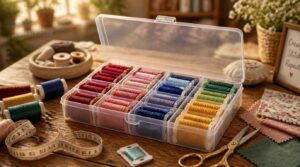
Picking your first thread storage box doesn’t have to be overwhelming — a few simple factors will point you in the right direction. Before you buy anything, it helps to think through what your collection actually needs right now. Here’s what to keep in mind as you choose your box.
A quick look at basic sewing supplies and storage options can help you understand exactly what you’ll need before your thread collection outgrows a simple box.
Count Your Thread Spools
Before picking any box, count every spool you own — seriously, dump them all out.
- Tally by brand and color family
- Note each spool’s size category
- Record totals in a notebook or digital note
- Compare counts periodically to catch misplacements
This quick inventory audit tells you exactly how many compartments you need, so you don’t buy too small. You should also check for thread end security features to make sure your organized spools stay tangle-free.
Check Spool Sizes
Once you know your count, spool sizes become the next puzzle piece. Standard 1kg spool diameters run 197–205 mm, while 2kg versions stretch to around 300 mm — a meaningful difference when fitting spools into thread storage boxes.
| Spool Type | Outer Diameter | Width |
|---|---|---|
| Budget 1kg | ~195 mm | ~55 mm |
| Standard 1kg | 197–205 mm | 64–68 mm |
| 2kg spool | ~300 mm | ~100 mm |
Verifying arbor bore (usually 52–54 mm) keeps your spools seated properly on rack posts without wobbling loose.
Pick Clear Plastic Boxes
With spool dimensions sorted, the box material you choose shapes everything else. Clear acrylic and translucent polypropylene let you spot thread colors at a glance — no lid-lifting required. These plastic organizer storage cases resist moisture and dust, and polypropylene is widely recyclable.
For fragile contents, polycarbonate offers real impact resistance. Thread storage containers made from PET balance clarity with everyday toughness beautifully.
Look for Secure Latches
Once your box material is sorted, the latch deserves real attention. A no-spill latch keeps spools locked in place during transport — no surprise tangles on your craft table.
Look for these three latch types ranked by security:
- Toggle latches — clamp firmly with minimal effort
- Cam latches — smooth, one-motion closure
- Compression latches — grip the strike plate automatically when shut
Stainless steel resists humidity beautifully.
Choose Room to Grow
Think ahead before you buy. The best thread storage boxes leave a few compartments empty on purpose — those open slots aren’t wasted space, they’re room for next month’s haul.
Pairing that built-in breathing room with a smart thread organization system — like rotating racks for daily-use spools and labeled bins for seasonal colors — keeps your whole collection easy to navigate.
Modular systems with adjustable dividers let your sewing room organization grow without starting over. A box that fits perfectly today might feel tight by your next project.
Sort Threads Before Storing
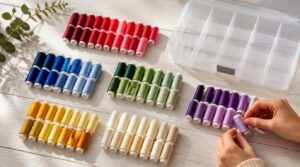
Before anything goes into your storage box, it’s worth taking a few minutes to sort what you actually have. Tossing everything in randomly might seem faster now, but you’ll pay for it later when you’re hunting for the right spool mid-project. Here’s how to get your threads organized in a way that actually makes sense.
Separate by Thread Type
Mixing threads randomly wastes time. Separate by type first:
- Hand sewing thread — cotton or linen, designed for hand stitching tension
- Machine embroidery thread — polyester or rayon, built for machine compatibility
- Bobbin thread — lightweight (~60 wt), lives on the seam underside
- Metallic specialty threads — decorative accents that need their own dedicated slot
- Weight labels (40 wt vs 50 wt) — signal the right fabric match
Your thread storage boxes stay genuinely useful when each type has its own home.
Group by Color Family
Once your threads are sorted by type, color family becomes your next organizing layer.
| Color Family | Common Shades | Palette Pairing |
|---|---|---|
| Warm Reds & Pinks | Rose, crimson, blush | Golds, warm browns |
| Oranges & Yellows | Tangerine, goldenrod | Tropical, sunlit schemes |
| Greens & Turquoise | Emerald, sage, olive | Browns, creams |
| Blues & Purples | Navy, lavender, cobalt | Silvers, deep neutrals |
| Neutrals & Hybrids | Taupe, blue-gray, olive-green | Any dominant hue family |
Warm vs cool grouping makes color palette organization instinctive — warm tones advance visually, cool tones recede. Watch your hybrid hues closely; blue-gray belongs under its dominant color, not floating between families. Label each section by saturation level so you don’t confuse a dusty sage with a vivid lime. Your thread storage boxes work hardest when embroidery thread color sorting has a clear, visual logic behind it.
Match Bobbins With Spools
Your bobbin is only useful when it truly matches the spool riding above it.
- Matching diameters keep both pieces flush inside your bobbin storage box
- Winding direction alignment prevents mid-project tangling when thread is pulled
- Go 1–2 weights lighter on the bobbin for balanced tension
- Same fiber type (cotton with cotton) reduces lint and incompatibility
- Batch number tracking keeps lot-matched pairs accurate over time
Store each pair upright inside your thread storage boxes, labeled and color-coded.
Remove Damaged Thread
Worn-out thread is a quiet saboteur hiding in plain sight. Run your finger along each spool — flat spots, stripped grooves, or fraying signal thread that won’t hold tension reliably.
Pull it. Damaged thread belongs in the bin, not your thread storage boxes. Keeping compromised spools only guarantees mid-project snaps and frustration. When in doubt, toss it.
Keep Favorites Accessible
Your go-to colors deserve front-row seats. Before sealing your thread storage boxes, pull out the five shades you reach for constantly and treat them differently:
- Drop them into a dedicated index tray
- Position them in your box’s front row
- Slip a quick-reference note inside the lid listing each color code
That simple system makes spool management a breeze.
Set Up Box Compartments
Once you’ve sorted your threads, it’s time to actually set up the box so everything fits and stays put. A few small adjustments can make a big difference in how easy it is to grab what you need mid-project. Here’s how to get each compartment working for you.
Adjust Divider Sizes
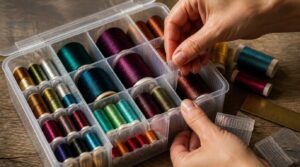
Sizing your dividers correctly makes the difference between spools that sit snugly and ones that tip over constantly. Most adjustable systems let you resize compartments in 5 mm increments, accommodating spool widths from 9 mm to 28 mm.
Sliding or screw-actuated dividers lock firmly into place, so nothing shifts during transport. Got a mix of tall and short spools? Partial-height inserts handle mixed spool heights within a single box.
Place Spools Upright

Once your dividers are set, drop each spool in upright position — standing on its edge, label facing out. This keeps tension consistency along the spool wall and makes label visibility instant, so you’re not guessing colors mid-project.
- Upright spools allow one-handed removal without disturbing neighbors
- Labels stay readable at a glance
- Dust prevention improves since less surface sits exposed
- Spool stability holds through bumps and transport
Prevent Loose Unraveling

Even perfectly placed spools can cause headaches if thread tails are left loose. A quick fix: fold the tail under a few turns before dropping the spool in, keeping it tucked and snag-free.
For metallic threads especially, secure the tail with fabric glue — just a thin dab locks it without stiffening the spool. Thread nets work great here too, sold in 10-packs for around $2.65.
Add Bobbin Spaces
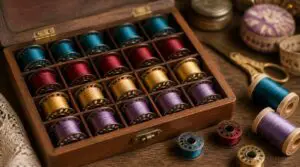
Once thread tails are secured, bobbins are the next piece to sort out. Without a dedicated bobbin storage area, they roll, tangle, and disappear mid-project.
Look for boxes with compartmentalized storage that matches your bobbin size — slots too wide let them tip. Some systems fit two small bobbins per slot. Numbered bobbins paired with labeled compartments make restocking a breeze.
Leave Empty Compartments

Resist the urge to fill every slot. Empty compartments improve airflow, reduce thread friction, and give your eyes instant visual relief when scanning for a color.
- Reserve gaps between color families to prevent mix-ups
- Leave space for future thread additions
- Use empties as quick-glance inventory checkpoints
That breathing room keeps your compartmentalized storage functional — not just full.
Label Threads for Easy Finding

Good labels are the difference between a quick find and a five-minute rummage through every compartment you own. Once your spools are sorted and settled into their spots, a simple labeling system keeps everything working exactly the way you set it up. Here’s how to make your thread storage actually talk back to you.
Use Color Number Labels
Think of color number labels as a shortcut your future self will thank you for. Each spool gets a unique numeric code tied to its hue, so you can find the right thread even in dim lighting — no more misreading similar color names.
Place labels consistently on every compartment, back up your chart digitally, and update codes whenever a dye lot shifts noticeably.
Add Thread Brand Names
Two spools that look identical can come from completely different brands — and that gap matters when you’re trying to replicate a project.
Include the brand name on every label alongside the color code, so you’re never guessing whether that red is Madeira, DMC, or Sulky. Different manufacturers use their own dye lot systems, and mixing them mid-project can shift your results noticeably.
Mark Cotton or Polyester
Fiber type changes everything about how you sew and care for your finished project. A small "C" or "P" on each label keeps cotton and polyester spools instantly sorted — no burn test needed.
Polyester resists shrinking and dries fast, while cotton breathes better but demands gentler washing. That single letter saves real headaches later.
Track Embroidery Colors
Embroidery threads live or die by their color codes. Manufacturer codes like DMC or Madeira numbers are your anchor — they eliminate guesswork when restocking or substituting shades mid-project.
Keep a digital color chart with three quick entries per thread:
- Manufacturer code and color name
- Colorfastness rating
- Substitution alternative if that shade runs out
Sync this with your embroidery software when possible.
Create a Simple Chart
A simple chart turns your thread labels into a quick-reference system. Map each spool by chart type, color code, and fiber in one tidy row.
| Thread Name | Color Code | Fiber Type |
|---|---|---|
| Cotton White | DMC Blanc | Cotton |
| Metallic Gold | Madeira 9842 | Metallic |
| Polyester Black | Gutermann 000 | Polyester |
Keep axis labeling minimal — color code on one column, brand on another. High contrast and clear fonts make it readable at a glance.
Protect and Maintain Stored Thread

Good storage isn’t just about organization — it’s about keeping your threads in working condition for years to come. A few simple habits can make a real difference in how long your spools last. Here’s what to do to protect them properly.
Keep Boxes Dust-free
Dust is a quiet enemy — it creeps into open containers and clings to thread fibers over time. Choose boxes with tight-fitting snap lids to cut off most of that access. Tuck a desiccant pack inside each sealed box to manage moisture that dust loves to travel on.
Wipe shelves weekly, and consider a HEPA air purifier nearby for cleaner air around your whole storage area.
Avoid Direct Sunlight
Sunlight does more damage than most beginners expect. UV rays can fade thread colors by up to 30% within six months and weaken cotton and rayon fibers until they fray easily.
UV rays can fade thread colors by up to 30% in just six months, silently weakening fibers until they fray
- Store boxes in a shaded closet or cabinet
- Apply UV-blocking window film to nearby windows
- Keep plastic containers off heat-absorbing surfaces
- Rotate spools monthly to prevent uneven color fading
Store in Dry Areas
Moisture is the quiet threat that sunlight doesn’t cover. Relative humidity above 60% causes thread fibers to swell, colors to bleed, and mold to creep in fast.
Keep boxes elevated at least 2 inches off concrete floors to block moisture wicking. A digital hygrometer near your storage area gives continuous readings, so you catch humidity spikes before they cause real damage.
Use Silica Gel Packets
Even with boxes sealed and humidity monitored, moisture still sneaks in. That’s where silica gel packets earn their place — they absorb up to 40% of their weight in moisture, keeping your storage environment between 40–60% humidity.
Tuck three to five packets into each box, but keep them from touching thread directly to avoid residue transfer. When they feel damp, regenerate them at 275°F for one hour.
Reorganize After Projects
After finishing a project, take a few minutes to reset your boxes before putting everything away. Return stray spools to their correct compartments, toss any damaged thread, and update your color chart if you used up a shade.
Think of it like closing a tab — quick now saves confusion later. Your future self will thank you.
Frequently Asked Questions (FAQs)
Can I store thread and needles together safely?
Yes — with the right setup. Keep needles in a rigid needle sheath, use a lint-free lining to prevent snags, and store metallic threads away from steel points to avoid corrosion.
How do I store thread long-term without using?
Long-term thread storage comes down to three things: light, moisture, and air quality. Seal spools in clear polyethylene boxes with silica gel packets, keep humidity at 40–60%, and store away from windows.
What box materials are safe for metallic threads?
Think of metallic threads as armor — impressive, but vulnerable to the wrong environment. Stainless steel, polycarbonate, and aluminum boxes are your safest choices, resisting corrosion, controlling static, and protecting delicate coatings from tarnish or abrasion.
Should children have their own separate thread box?
Yes — giving kids their own box builds responsibility and autonomy while keeping your embroidery supplies safe. It sharpens fine motor skills through sorting and helps early literacy when children label their own threads.
Can storage boxes double as portable project carriers?
A box that travels with you is more than just storage — it’s a mobile studio. Many include integrated carrying grips and secure latching lids, keeping your embroidery supplies safe wherever the project takes you.
Conclusion
The moment you stop untangling and start sewing — that’s the whole point. It’s the same moment thread storage boxes for beginners stop being a purchase and start being a decision that pays you back every single time you sit down to create.
Label it. Protect it. Grow with it. Your future self, mid-project and reaching for exactly the right spool without a second thought, will quietly thank you for starting this right.
- https://www.arabesque-scissors.com/articles/clever-thread-storage-solution-ikea-hack
- https://stitchobsessed.com/best-sewing-box
- https://www.serendipityneedleworks.com/3-essential-tips-organizing-storing-needlepoint-thread
- https://threadistry.com/blog/best-thread-rack
- https://www.thescrapshoppeblog.com/best-bobbin-storage-ever