This site is supported by our readers. We may earn a commission, at no cost to you, if you purchase through links.
A machine that runs 10,000 stitches without a hiccup doesn’t get there by accident. Behind every clean design and tight registration is a technician who treats maintenance like part of the craft—not an afterthought.
Preventive maintenance for embroidery machines is the difference between a production floor that hums and one that stalls mid-job. Lint builds up silently. Needles dull faster than you’d expect. A dry rotary hook can score the race before you notice anything’s wrong.
The good news: none of this requires guesswork. Follow the right routines, in the right order, and your machine will tell you far less about what’s broken.
Table Of Contents
Key Takeaways
- Daily cleaning of the bobbin area, feed dogs, needle plate, and tension discs prevents the lint buildup and friction that silently cause thread breaks and stitch inconsistencies.
- Replacing needles every 6–8 hours of sewing time and oiling the rotary hook daily are the two highest-impact habits for protecting both stitch quality and machine longevity.
- A weekly inspection — checking the bobbin case for burrs, tracing thread paths, and examining tension assemblies — catches wear before it becomes an unplanned, costly stoppage.
- Documented maintenance intervals, correct lubricants, and professional servicing every 1,500–2,000 hours are what keep your warranty valid and your machine out of the repair queue.
Why Preventive Maintenance Matters
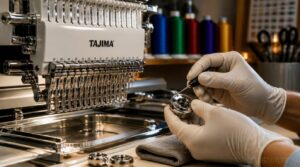
Skipping maintenance doesn’t just slow you down — it quietly chips away at every stitch your machine produces. The good news is that a simple, consistent routine protects your equipment far better than any reactive fix ever could. Here’s exactly why preventive maintenance should be at the top of your priority list.
One of the easiest wins in your routine is knowing how to replace a sewing machine needle — a quick swap that can instantly restore stitch quality and spare your fabric from unnecessary damage.
Prevents Thread Breaks
Thread breaks don’t happen randomly — they’re usually the result of something you could have caught earlier. Lint accumulation in the bobbin area disrupts tension calibration, and even minor path friction from a worn thread guide can shred a filament mid-run.
Matching needle size to your thread diameter and keeping design density reasonable goes a long way toward eliminating those frustrating mid-stitch stops. You should also perform regular needle maintenance and selection to prevent burrs from causing fraying.
Reduces Machine Downtime
Every unplanned stoppage costs you time you can’t recover. A preventive maintenance schedule catches wear before it becomes failure — and that’s the difference between a 10-minute oil check and a 3-hour repair.
Real-time monitoring and sensor alerts flag anomalies early. Stocking critical spares shortens repair windows. Maintenance log analysis helps you predict the next problem before it pulls your machine off the floor.
Improves Stitch Quality
Downtime hurts, but poor stitch quality damages your reputation. Clean tension discs keep resistance consistent, so stitches lock evenly on both sides of the fabric. The right needle size reduces deflection, and proper stabilizer placement stops fabric shift mid-run.
- Clear thread paths cut friction and random skips
- Balanced tension prevents puckering on medium-weight fabrics
- Correct needle size sharpens stitch density
- Accurate stabilizer placement locks fabric during long runs
Extends Machine Lifespan
Stitch quality and machine longevity go hand in hand. Cleaning and lubrication slow the wear that quietly grinds bearings, gears, and hook assemblies down over years of production.
High-grade bearings and hardened gears hold their tolerances longer when debris stays out and oil stays fresh. That’s why contamination control isn’t optional — it’s what separates a machine that lasts a decade from one replaced in five.
Contamination control isn’t optional — it’s what separates a machine that lasts a decade from one replaced in five
Protects Warranty Coverage
Skipping maintenance records is a fast way to void your coverage. Most manufacturers require documented service intervals — dates, parts, and technician notes — before honoring any claim. Gaps in that log can get your claim denied outright.
Authorized service centers use genuine parts and verify serial numbers, keeping every repair within warranty scope. A transferable warranty can also boost resale value by up to 20 percent.
Daily Embroidery Machine Cleaning
Daily cleaning is the foundation of a well-running embroidery machine. It doesn’t take long, but skipping it — even once — can lead to thread breaks, tension problems, and buildup that’s hard to clear later. Here’s what you need to do every day to keep things running clean.
For a deeper dive into preventing those exact issues, basic sewing machine maintenance tips walk you through the habits that keep lint, tension, and skipped stitches from becoming bigger problems.
Clear Bobbin Area
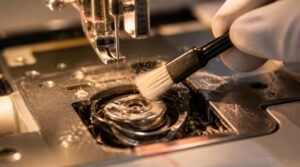
The bobbin area is where most lint problems start. Before each new project, power off and unplug the machine first. Use a small brush to sweep thread fragments from the bobbin housing and beneath the needle plate.
After cleaning, check the bobbin case for burrs or scratches. Reinstall it until the latch clicks securely and the bobbin spins freely.
Brush Feed Dogs
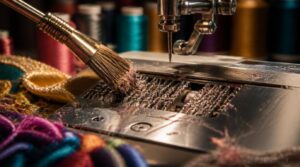
Those serrated teeth beneath the needle plate collect lint faster than you’d expect. After every project, run a small cleaning brush between the feed dog teeth to clear trapped thread and dust.
Debris buildup creates feeding resistance that throws off your stitch consistency. A quick brush-out keeps the teeth gripping fabric cleanly, so every row advances the way it should.
Clean Needle Plate
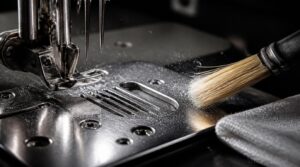
The needle plate takes a beating every session. Lint and dust settle into the aperture slots and around the edges, where they interfere with clean fabric feed.
Clean it daily using this sequence:
- Brush away loose debris with a soft cleaning brush
- Wipe the surface with a dry microfiber cloth
- Inspect edges for metal burrs and smooth them with emery cloth
- Perform plate alignment checks to prevent needle strikes
Removing adhesive residue promptly stops fabric from dragging mid-stitch.
Check Tension Discs
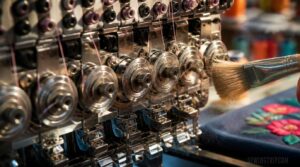
Tension discs are the gatekeepers of every stitch. Clean them daily using a soft brush or compressed air to remove lint and oil residue that alter disc pressure calibration.
Check that thread sits flat against each disc — curls or twists signal thread alignment issues. Worn or grooved discs affect fabric weight compatibility, so inspect surfaces for damage while you clean.
Run Test Stitches
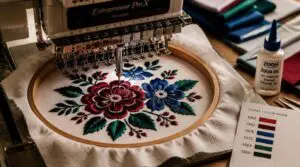
After oiling or cleaning, always run a test stitch on scrap fabric before production. Use the same stabilizer, fabric, and hoop you’ll use on the real job.
- Check fill areas for stitch consistency and gaps
- Watch for fabric puckering or distortion
- Verify color order matches your design file
- Confirm outlines align with registration marks
Catching issues here costs seconds. Skipping it can cost an entire run.
Weekly Inspection Checklist
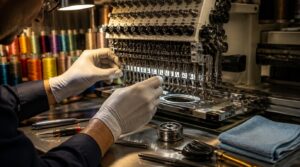
Daily cleaning keeps things running, but once a week you need to slow down and really dig in. A weekly inspection catches the small problems that a quick brush-out won’t reveal. Here’s what to check every week to stay ahead of bigger issues.
Inspect Bobbin Case
Pull the bobbin case out once a week and give it a real look. Run your fingernail along the inner edge — burrs or nicks snag thread and kill stitch consistency fast.
Do a tension drop test: hold the thread and let the case hang. It should descend slowly, with steady resistance. Erratic drop or free-fall means the spring assembly needs attention.
Check Thread Paths
Once the bobbin case checks out, trace every thread from spool to needle. Look for worn or damaged guides — even a small burr frays thread silently and ruins stitch quality over time.
- Check that tension discs sit flat with no visible gaps
- Confirm spool size matches needle size to avoid path binding
- Run a test stitch sample to catch misrouting before production starts
Clean Air Filters
Thread paths checked — now look up. Your machine’s air filters collect lint constantly, and a clogged filter chokes airflow, forcing internal components to work harder.
Clean filters weekly using compressed air or an air hose. Blow lint and dust outward, away from the machine. A blocked filter risks particle bypass, letting debris reach sensitive parts where it doesn’t belong.
Examine Tension Assemblies
With airflow sorted, shift your attention inward. Your tension assembly is a spring-loaded system — when springs weaken or discs wear, thread grip becomes inconsistent.
Pull thread through slowly. Resistance should feel smooth and even. Misaligned tension discs cause loops or skipped stitches. Wipe discs with a lint-free cloth and check that gaps match manufacturer specs. Metallic or high-twist threads need lower tension settings to prevent fraying.
Look for Burrs
Sharp edges hide in plain sight. Burrs on metal parts snag thread and cause skipped stitches before you notice anything’s wrong.
Run a fingernail along the needle plate and bobbin case edges. Feel for raised lips or rough patches.
Check these five spots every week:
- Needle plate edges
- Bobbin case rim
- Drilled screw holes
- Thread guide channels
- Feed dog slots
File or chamfer any burr you find immediately.
Lubrication and Mechanical Care
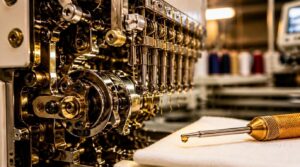
Keeping your machine properly lubricated is what separates a smooth-running workhorse from one that fights you on every job. Skipping this step — even briefly — can lead to friction, wear, and the kind of mechanical damage that’s expensive to fix. Here’s what to stay on top of regarding lubrication and mechanical care.
Oil Rotary Hook
The rotary hook is your machine’s heartbeat — and like any moving part under pressure, it needs consistent lubrication to keep running clean. Apply one drop of sewing machine oil to the hook race daily, or every four to five hours of active production.
That thin oil film prevents metal-to-metal contact, grips high-speed heat, and keeps the lubrication feeding wick clear. Always run a test stitch after oiling to avoid fabric staining.
Follow Brand Intervals
Not every machine oils on the same schedule. Happy HCH-701 machines need lubrication every 2 to 3 bobbin changes. Melco AMAYA hooks run on a longer cycle — every 200,000 z-shaft rotations.
Check your manual. Treating your brand’s interval like a firm deadline, not a loose suggestion, is how you build a lubrication schedule that actually protects your investment.
Grease Moving Parts
Gears, cams, and drive shafts need grease every 3 to 6 months. Unlike oil, grease stays in place — its thickener holds the base oil like a sponge, releasing it gradually to reduce friction.
Use grease that matches your machine’s temperature range and seal materials. The wrong type degrades rubber and attracts contaminants.
Target these three areas each cycle:
- Gears and cams
- Drive shafts
- Cam followers
Inspect Belts and Rails
Belts and rails are your machine’s skeleton — when they fail, everything else follows.
Check belts for glazing, cracks, or missing teeth. A shiny belt surface means it’s slipping, not gripping. Verify belt tension matches manufacturer specs and confirm pulleys are parallel.
Rails must slide smoothly. Any binding, corrosion, or lateral play signals worn guide blocks. Use a flashlight to catch micro-cracks early.
Avoid Improper Oils
Wrong oil isn’t just a minor mistake — it can quietly destroy your machine from the inside out.
Household oils and WD-40 leave gummy deposits along thread paths and attack the rubber seals inside tension assemblies. Stick to machine-grade mineral oil with the viscosity your manufacturer specifies. The right oil maintains film strength at operating temperatures, preventing metal-to-metal contact that shortens machine life fast.
Needles, Threads, and Servicing
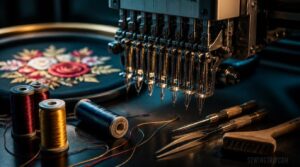
Needles and thread do more quiet damage than most operators realize — and ignoring them is one of the fastest ways to ruin otherwise clean work. The good news is that staying on top of this part of maintenance doesn’t take much time. Here’s what you need to know.
Replace Needles Regularly
Needles wear out faster than most operators realize. Dull tips cause skipped stitches, and micro-bends in the shaft throw off alignment entirely.
Replace embroidery machine needles every 6 to 8 hours of sewing time — sooner with metallic threads or high humidity, which accelerates corrosion. Log each change. That record helps you catch patterns before small needle wear turns into costly repairs.
Install Needles Correctly
Changing the needle means nothing if you install it wrong. Push it fully into the needle bar — full insertion height matters.
The needle scarf orientation must face backward, flat side aligned with the clamp. Tighten the clamp screw firmly, then wiggle the needle gently to confirm it’s seated. A tilted eye causes fraying before you’ve stitched a single line.
Use Quality Thread
A seated needle still can’t rescue you from poor thread. Cheap thread frays, clogs tension discs, and triggers skipped stitches fast.
Choose thread based on four factors:
- Thread weight — weight 40 suits most embroidery work
- Fiber composition — polyester offers colorfastness; cotton delivers a matte finish
- Lint output — low-lint thread shields your tension settings
- Tensile strength — match it to your fabric to prevent thread breaks
Schedule Professional Service
Even the best thread routine can’t replace what a certified technician catches. Schedule professional servicing every 1,500 to 2,000 hours of machine use.
A qualified tech takes care of internal repairs, firmware updates, and diagnostics you can’t access yourself. That’s how you keep machine downtime prevention on track and your equipment upkeep from becoming expensive reactive fixes.
Protect Machine Electronics
Your electronics are the brain of the machine — protect them like it. Plug into a surge protector to clamp voltage spikes before they reach the control board.
Keep cables routed away from power lines to cut EMI. Ground your machine properly; good grounding can reduce interference by up to 90 percent. After any firmware or software update, always run a calibration test.
Frequently Asked Questions (FAQs)
How often do you need to oil your embroidery machine?
Oil too little and your machine fights back. Heavy use intervals mean oiling every 3–4 hours. Commercial oiling schedules often require oiling after each shift. For light use frequency, weekly or monthly is enough.
Can embroidery machines run during extreme temperature changes?
Yes, but with limits. Temperatures between 15 and 30°C keep electronics stable and lubricants flowing correctly. Beyond that range, you risk condensation damage, static buildup, and viscosity shifts that strain moving parts.
How do humidity levels affect embroidery machine performance?
Humidity quietly shapes how your machine runs. High humidity boosts thread elasticity, reducing sudden breakage. But moisture accelerates metal oxidation, risks condensation on components, and weakens fabric grip. Keep levels between 40–60 percent for consistent results.
Should machines be covered when not in active use?
Think of your machine as a precision instrument left in a workshop — dust settles fast. Cover it when idle. A breathable, snug cover blocks lint, moisture, and debris without trapping condensation against sensitive electronics.
How often should operators receive machine maintenance training?
Train every operator at onboarding, then schedule a refresher session every six months. High-change facilities need quarterly sessions. After any firmware update, complete retraining within 30 days.
Conclusion
Clean machines don’t happen by accident. They happen because you showed up daily, brushed the lint, changed the needle, and oiled the hook. Every small habit stacks into something bigger: fewer breaks, tighter stitches, and longer machine life.
Preventive maintenance for embroidery machines isn’t extra work—it’s the work. Skip it, and the machine will remind you in the worst possible moment. Stay consistent, and your equipment becomes the one thing on your floor you can count on.
- https://drdtg.com/feeds/blog/embroidery-machine-maintenance
- http://www.melco-service.com/docs/AMAYA_OS_v10/AMAYA/ReplacingaNeedle.htm
- https://www.ibaima.com/how-to-maintain-embroidery-machine
- https://thesewinggallery.net/blogs/the-sewing-gallery/how-often-should-you-change-your-sewing-machine-needle
- https://tex-inc.com/blogs/digitizing-embroidery-blog/embroidery-machine-maintenance