This site is supported by our readers. We may earn a commission, at no cost to you, if you purchase through links.
Most sewers blame themselves when stitches go crooked, seams pucker, or fabric shifts sideways—but the culprit is usually the foot still attached to their machine. The standard all-purpose foot that came in the box manages basic tasks, but it was never designed for leather, ruffles, or a perfectly invisible hem.
Swap it out, and the same machine suddenly performs like a different tool entirely. Sewing machine attachments don’t just add convenience—they fix the exact problems that make projects frustrating. The right foot gives you control over fabric feed, stitch placement, and edge finishing that your hands alone can’t replicate.
Table Of Contents
- Key Takeaways
- How Attachments Improve Stitching
- Essential Presser Feet Functions
- Specialty Attachments for Better Results
- Top 8 Sewing Machine Attachments
- 1. Madam Sew Low Shank Walking Foot
- 2. Honeysew Open Toe Walking Foot with Guide
- 3. Honeysew SA129 Quilting Foot for Brother
- 4. Singer Adjustable Ruffler Sewing Machine Attachment
- 5. Honeysew Adjustable Bias Binder Presser Foot
- 6. Singer Grooved Pintuck Presser Foot
- 7. Low Shank Sewing Machine Presser Feet
- 8. Explicit Product for General Use
- Choosing Compatible Sewing Attachments
- Maintaining Attachments for Stitch Quality
- Frequently Asked Questions (FAQs)
- Conclusion
Key Takeaways
- Swapping out your standard presser foot is often the fastest fix for crooked stitches, puckering seams, and fabric that won’t cooperate — the right foot changes what your machine can actually do.
- Specialty feet like the walking foot, Teflon foot, and straight stitch foot each solve a specific problem, so matching the foot to your fabric and project is what separates polished results from frustrating ones.
- Compatibility isn’t optional — your machine’s shank type (low, high, or slant) determines which attachments actually fit, and a mismatch can damage both the foot and your work.
- Keeping your attachments clean, lightly oiled, and properly stored isn’t just good habit — it’s what maintains stitch quality and extends the life of every foot in your kit.
How Attachments Improve Stitching
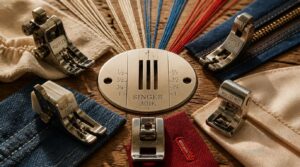
The right attachment doesn’t just make sewing easier — it changes what your machine can actually do. Small tools, big difference. Here’s how attachments improve your stitching results across the board.
From needle guides to rufflers, exploring top-rated sewing machine attachments helps you pinpoint exactly which tools will unlock your machine’s full potential.
Better Fabric Control
Getting fabric to behave is half the battle. The right attachment takes care of that for you. Walking feet and roller feet synchronize your layers, while Teflon feet eliminate drag on synthetics and vinyl.
Presser foot pressure and feed system optimization work together to keep material moving evenly — no bunching, no skewing, just smooth, controlled feeding from start to finish.
More Consistent Seam Lines
Fabric control sets you up — but it’s consistent seam lines that separate polished work from amateur results. A straight stitch foot narrows the needle opening, keeping your stitching locked to the intended line. Pair that with a seam guide attachment, and your seam line alignment stays parallel to the grain across every inch. Additionally, magnetic guide accessories are ideal for topstitching, hemming, and quilting.
A walking foot does the heavy lifting for layered projects. It synchronizes top and bottom fabric movement, so nothing drifts mid-seam.
Cleaner Stitch Formation
Consistent seam lines bring you closer to clean — but stitch formation is where precision lives. The right presser foot creates proper contact between needle, thread, and fabric. That contact is everything.
The right presser foot is where precision lives — proper contact between needle, thread, and fabric is everything
Thread tension balance keeps stitches locked flat. Needle size selection matters too — a mismatched needle frays thread and distorts edges. A walking foot distributes even grip, preventing skipped stitches on layered work.
Faster Repetitive Sewing
Speed gains don’t stop at clean stitches — they multiply once you start working smarter. Chain sewing links seams together so you’re not stopping to snip and rethread constantly. Automatic backtack secures every start and end without lifting a finger.
Stitch length memory and bulk hemming settings lock in your preferences, keeping repetitive runs fast and consistent.
Reduced Hand Fatigue
Long sewing sessions take a real toll on your hands. Ergonomic grip design reduces squeeze force by up to 40%, and lightweight presser feet cut the effort of lifting and pivoting throughout your project.
- Smooth fabric glide means less steering effort
- Balanced tool weight lowers wrist torque
- Walking feet reduce hand exertion on layers
- Quick-change attachments cut repetitive handling
- Nonstick feet extend sessions with fewer breaks
Essential Presser Feet Functions
Not all presser feet are created equal — and the one you choose can make or break a project. Each foot has a job, and knowing which does what saves you time, frustration, and a lot of seam ripping. Here are the essential ones worth keeping in your kit.
All-purpose Foot Versatility
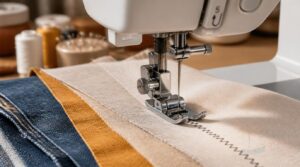
The all-purpose foot is the one attachment every sewist actually reaches for daily. It accommodates both straight and zigzag stitches across fabrics — lightweight cotton to mid-weight denim — without a single swap.
| Benefit | What It Does |
|---|---|
| Universal Stitch Handling | Processes straight and zigzag stitches consistently |
| Multi-Fabric Support | Works across cotton, linen, and denim |
| Beginner Stitch Confidence | One foot covers most starter projects |
| Reduced Setup Time | No swapping feet for basic tasks |
| Cross-Project Compatibility | Fits most low- to mid-range machines |
It keeps fabric feeding evenly, reduces puckering, and maintains consistent needle alignment — boosting your overall sewing efficiency without complicating your workflow.
Zipper Foot Precision
[ORIGINAL TEXT]
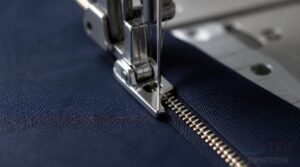
The zipper foot might be the most underrated presser foot in your kit. Its narrow toe gets the needle right up against zipper teeth — giving you zipper edge alignment that’s nearly impossible to achieve with an all-purpose foot. That tight clearance is what separates a clean, professional zipper from one that puckers or drifts.
Needle position accuracy is where this foot really earns its place. Many zipper feet let you shift the needle left or right, so you control exactly how close you sew to the coil. Pair that with foot guide adjustment, and your stitch lines stay parallel every time.
For invisible zippers, look for a coil grip design — a grooved toe that holds the coil open as you sew. It’s a small detail that makes insertion look clean. Some industrial-style feet even offer left-handed foot use, with mirrored configurations that ease access on tricky garment sides.
[/ORIGINAL TEXT]
Teflon Foot Smooth Feeding
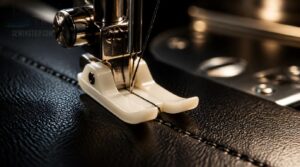
Sticky fabrics have a way of turning a simple seam into a frustrating fight. That’s exactly what a Teflon presser foot solves.
Its nonstick fluoropolymer coating lets leather, vinyl, and laminated fabrics glide through without drag or puckering — no more fabric gripping the foot mid-stitch. For consistent stitch quality on tricky materials, it’s one of the most practical sewing machine attachments you’ll own.
Straight Stitch Foot Accuracy
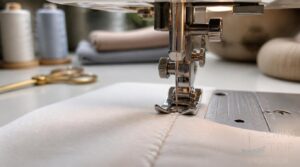
When you need a perfectly straight seam, the straight stitch foot is your go-to among sewing machine attachments. Its narrow needle opening locks the fabric path, dramatically improving stitch quality on everything from lightweight cottons to synthetics.
- Edge alignment techniques keep seams parallel and clean
- Needle clearance optimization prevents deflection and skipped stitches
- Fabric tension balance reduces puckering on fine materials
Pair it with correct presser foot pressure and built-in precision seam guides, and your sewing efficiency gets a real boost.
Blind Hem Foot Guidance
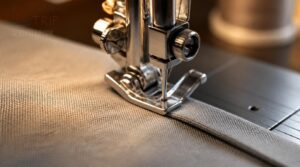
The blind hem foot is the quiet achiever of sewing machine attachments. Its centered metal guide runs along the fold, keeping your fabric edge alignment consistent so the needle catches only a thread of the hem.
Adjust the guide, match your thread, loosen upper thread tension control slightly, and the result is virtually invisible — clean, professional, smooth.
Specialty Attachments for Better Results
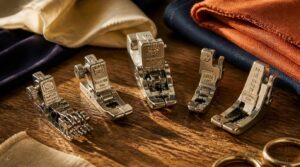
Once you move past the basics, specialty attachments are where things get genuinely interesting. Each one solves a specific problem — and solves it well. Here are five worth adding to your toolkit.
Walking Foot Layer Control
The walking foot is one of those sewing machine attachments that quietly changes everything. Its dual feed mechanism grips both layers simultaneously, so fabric doesn’t drift or pucker — even on long seams.
Here’s what that means for your projects:
- Layer synchronization keeps quilt sandwiches moving as one unit
- Fabric thickness handling stays consistent across denim, knits, and slippery fabrics
- Seam alignment precision reduces rippling and keeps grain lines true
For multi layer quilting, it’s essential.
Ruffler Foot Pleating
The ruffler foot takes repetitive pleating off your hands entirely. Instead of pinning and measuring every fold, the ruffler blade adjustment controls how much fabric gets pushed into each pleat — automatically and consistently.
Set your stitch length, use a fabric feed guide, and the foot maintains even pleat spacing across lightweight chiffon or medium cotton alike. Quick ruffles creation has never been more straightforward.
Pintuck Foot Decoration
The pintuck foot brings a different kind of detail work to the table — decorative, precise, and surprisingly adaptable. It uses grooved channels and a twin needle to create evenly spaced raised tucks across your fabric.
Lighter fabrics get finer, more numerous tucks; heavier ones need wider groove spacing. Want bolder definition? Thread a thin cord beneath for corded pintuck effects that really pop.
Bias Binder Edge Finishing
The bias binder foot takes edge finishing to a different level. Where pintucks add surface texture, this attachment wraps raw edges in folded bias tape — clean, durable, and wash-resistant.
Feed fabric and tape together, and the binder keeps spacing consistent every time. Tape width options usually run 13 mm to 25 mm, so match your choice to the project scale.
Side Cutter Seam Trimming
Trimming and finishing a seam in a single pass — that’s exactly what a side cutter attachment delivers. A built-in blade trims the fabric edge while you sew, producing a clean overcast finish without a separate serger.
- Blade Width Adjustment controls how much fabric you trim
- Differential Feed Control prevents puckering on knits
- Maintenance Blade Care keeps cuts sharp and consistent
Top 8 Sewing Machine Attachments
Now that you know what these attachments can do, it’s time to look at some solid options worth having in your kit. These eight picks cover a range of tasks — from quilting to ruffling to clean edge finishing. Here’s what made the cut.
1. Madam Sew Low Shank Walking Foot
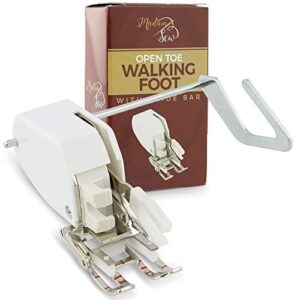
The Madam Sew Low Shank Walking Foot is built for sewists who refuse to let fabric win. Its integrated dual feed system moves your top and bottom layers in sync, so thick materials like leather, minky, and denim feed evenly without shifting or puckering. The open toe design keeps your needle line visible the whole time.
It fits most low-shank machines — but won’t work on high-shank models, so confirm your shank type before ordering.
| Best For | Sewists working with thick, slippery, or tricky fabrics who want clean, even stitches without the constant battle of shifting layers. |
|---|---|
| Material | Stainless Steel |
| Brand | Unbranded |
| Machine Compatibility | Low-Shank Domestic |
| Shank Type | Low-Shank |
| Primary Technique | Top-Stitching |
| Fabric Suitability | Thick & Tricky |
| Additional Features |
|
- Keeps multiple fabric layers moving in sync, so no more puckering or misalignment
- Open toe design gives you a clear view of your needle line — great for top-stitching and stitch-in-the-ditch work
- Handles tough materials like leather, vinyl, knits, and minky without breaking a sweat
- Only works with low-shank machines, so high-shank owners are out of luck
- Moving parts can produce black shavings over time, which may affect your fabric
- Some machine models may experience a clanking noise or needle clearance issues
2. Honeysew Open Toe Walking Foot with Guide
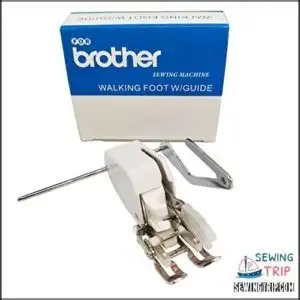
The Honeysew Open Toe Walking Foot with Guide is a solid step up if you’re tackling quilts or layered projects. Its open toe keeps your needle entry point fully visible — no guesswork on decorative stitching or tight seam lines. The integrated guide bar helps you track previously sewn lines with real consistency.
It fits low-shank machines and manages tough fabrics like denim and canvas well. Just confirm clearance on your model before you start.
| Best For | Quilters and sewists who work with layered, slippery, or heavy fabrics and need precise stitch placement. |
|---|---|
| Material | Stainless Steel |
| Brand | HONEYSEW |
| Machine Compatibility | Low-Shank Domestic |
| Shank Type | Low-Shank |
| Primary Technique | Walking & Quilting |
| Fabric Suitability | Thick & Multi-Layer |
| Additional Features |
|
- Open toe design gives you a clear view of your needle — great for decorative stitching and tight seam work
- The integrated guide bar keeps your lines consistent without constant measuring
- Built from stainless steel, so it holds up to denim, canvas, and other thick materials
- A few users have reported breakage or durability issues with regular use
- Needles can occasionally catch on the foot, which interrupts your flow
- The waffle-style feed mechanism and potential clearance issues mean it may not play nice with every machine model
3. Honeysew SA129 Quilting Foot for Brother
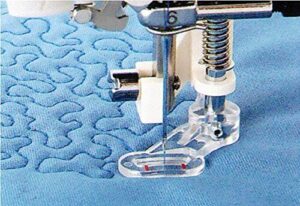
Free motion quilting takes real skill — and the right foot makes a measurable difference. The SA129 from Honeysew is a clear plastic, spring-action foot designed specifically for Brother machines. It moves up and down with the needle, letting you reposition fabric between each stitch for completely custom stitch paths.
The open toe and transparent build keep your needle drop fully visible. Just note it requires a low-shank Brother model and can crack under repeated needle strikes if misaligned.
| Best For | Quilters and embroidery enthusiasts who want free-motion control on a compatible Brother machine. |
|---|---|
| Material | Plastic |
| Brand | Unbranded |
| Machine Compatibility | 7mm Feed Dog |
| Shank Type | Standard |
| Primary Technique | Free Motion |
| Fabric Suitability | Light to Medium |
| Additional Features |
|
- Spring-action mechanism moves with the needle, so repositioning fabric between stitches feels smooth and natural
- Clear plastic build keeps your needle drop visible the whole time — no guessing
- Works as a solid budget-friendly way to get free-motion quilting on a standard Brother machine
- Plastic construction can snap or crack, especially if the needle strikes it from misalignment
- Stitch length is entirely manual — you control it by how fast you move the fabric, which takes practice
- Only compatible with 7mm feed dog Brother machines, so double-check your model before buying
4. Singer Adjustable Ruffler Sewing Machine Attachment
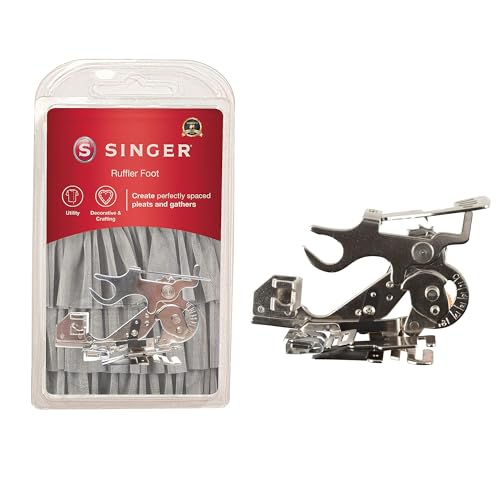
Ruffles and pleats used to mean hours of hand-gathering. The Singer Adjustable Ruffler cuts that time dramatically.
This metal-and-plastic attachment mounts to any low-shank machine and automates the tucking process entirely. Set it to pleat every 1, 6, or 12 stitches, then dial in your depth with the regulating screw.
It processes cotton, lawn, and poplin beautifully — just keep your speed slow and your fabric lightweight for clean, consistent results.
| Best For | Home sewers and garment makers who want to add ruffles, pleats, and gathers to dresses, skirts, and curtains without spending hours doing it by hand. |
|---|---|
| Material | Metal & Plastic |
| Brand | SINGER |
| Machine Compatibility | Low-Shank |
| Shank Type | Low-Shank |
| Primary Technique | Ruffling & Pleating |
| Fabric Suitability | Light to Medium |
| Additional Features |
|
- Adjustable stitch settings (every 1, 6, or 12 stitches) give you real control over how tight or loose your ruffles turn out
- The regulating screw lets you fine-tune pleat depth, so you’re not stuck with a one-size-fits-all result
- Saves a ton of time on projects like curtains, pillow covers, and tiered skirts
- You have to sew slowly — rush it and the results get messy
- Barely any instructions in the box, so expect to hunt down a video tutorial before your first use
- Only works with low-shank machines, so check your machine’s compatibility before buying
5. Honeysew Adjustable Bias Binder Presser Foot
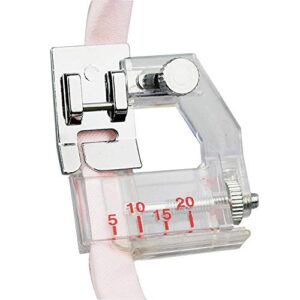
Bias binding can feel like a wrestling match — until you have the right tool. The Honeysew Adjustable Bias Binder (Model 6290) snaps onto any low-shank machine and guides binding through two channels in a single pass. The front screw adjusts width from 3/16 to 3/4 inch, so you’re covered from delicate necklines to blanket edges.
No pins, no fussing — just consistent, clean binding every time. It takes a little practice to dial in, but once you do, finishing work becomes genuinely satisfying.
| Best For | Sewers who regularly work on bias tape, shoulder straps, or blanket binding and want cleaner, more consistent results without the pinning hassle. |
|---|---|
| Material | Metal |
| Brand | HONEYSEW |
| Machine Compatibility | Domestic Machines |
| Shank Type | Universal |
| Primary Technique | Bias Binding |
| Fabric Suitability | Woven Fabrics |
| Additional Features |
|
- Adjustable width (3/16 to 3/4 inch) handles everything from delicate necklines to heavy blanket edges
- Metal construction means it’ll hold up through a lot of use
- Works with most domestic low-shank sewing machines — no specialty setup needed
- Curved edges are tricky; this tool really shines on straight runs
- Takes some trial and error to get the positioning right
- You’ll want scrap fabric on hand before diving into a real project
6. Singer Grooved Pintuck Presser Foot
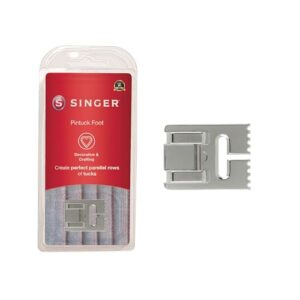
If pintucks are on your list, the Singer Grooved Pintuck Foot (Model 2500264) is worth keeping in your kit. It uses evenly spaced grooves on its underside to guide a twin needle along precise, parallel rows — no measuring between tucks.
It’s best on lightweight fabrics like silk or batiste, and you’ll likely need to increase upper thread tension for crisp, raised results. Clean the grooves after each use to keep alignment sharp.
| Best For | Sewists who do heirloom or fine fabric work and want perfectly spaced pintucks without the guesswork. |
|---|---|
| Material | Metal |
| Brand | SINGER |
| Machine Compatibility | Standard Domestic |
| Shank Type | Standard |
| Primary Technique | Pintucking |
| Fabric Suitability | Lightweight Only |
| Additional Features |
|
- Grooves guide the twin needle automatically, so your rows stay parallel every time
- Works great for adding texture to garments, table linens, and bed linens
- Compatible with decorative cord for even more dimension
- Twin needle not included, so that’s an extra purchase
- Not the right fit for heavier fabrics — stick to silk, batiste, or organdy
- You may need to fiddle with upper thread tension to get crisp, raised tucks
7. Low Shank Sewing Machine Presser Feet
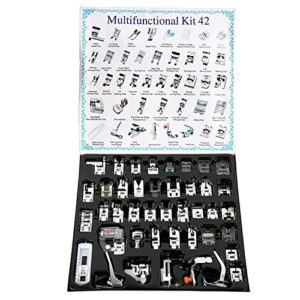
If you’ve been reaching for adapters or second-guessing compatibility, a low-shank presser feet set cuts through that frustration fast. The SWE-P-01 fits most domestic machines made after 1980 — Singer, Brother, Janome — and covers the everyday bases without a toolbox full of extras.
Woven fabrics, knits, topstitching, edge work — one set covers it all.
Just note: foot labels are on the packaging, not the feet themselves, so organize them before you need them.
| Best For | Home sewers with domestic machines made after 1980 who want a versatile presser feet set without the hassle of compatibility guesswork. |
|---|---|
| Material | Plastic |
| Brand | Unbranded |
| Machine Compatibility | Low-Shank Domestic |
| Shank Type | Low-Shank |
| Primary Technique | Multi-Purpose |
| Fabric Suitability | Various Fabrics |
| Additional Features |
|
- Works with most major brands — Singer, Brother, Janome — right out of the box
- Covers a wide range of projects from quilting to decorative curtain borders
- Lightweight and easy to swap out on low-shank machines
- The plastic storage tray feels flimsy and bends easily
- Tipping the tray over means a frustrating reorganization session
- Foot names are only on the packaging, so you’ll want to label them yourself early on
8. Explicit Product for General Use
![Most Versatile [Explicit] B01IJH6NBK](https://sewingtrip.com/wp-content/uploads/2026/05/most-versatile-explicit-b01ijh6nbk-300x300.jpg "How Sewing Machine Attachments Improve Your Stitching Results 8")
Once you’ve sorted your low-shank set, it helps to have one foot you can grab without thinking. This general-use presser foot — priced at just $9.49 — fits most low and high-shank machines and accommodates straight stitches, zigzag, and basic decorative work without special adjustments. The flat sole keeps fabric feeding evenly, and the snap-on mechanism means you’re sewing in seconds.
Clean it after every session, and it’ll stay reliable for years.
| Best For | Anyone who sews regularly and wants one reliable, no-fuss foot that works across most machines and stitch types. |
|---|---|
| Material | Not Specified |
| Brand | Not Specified |
| Machine Compatibility | Not Specified |
| Shank Type | Not Specified |
| Primary Technique | Not Specified |
| Fabric Suitability | Not Specified |
| Additional Features |
|
- Fits most low and high-shank machines, so you’re not hunting for a specific match
- Handles straight, zigzag, and basic decorative stitches without any extra adjustments
- Snaps on fast, getting you sewing in seconds instead of fiddling around
- Won’t cover specialty techniques like zippers, buttonholes, or quilting — you’ll need dedicated feet for those
- No extra features or adjustability for more advanced sewing needs
- Limited info on materials or durability beyond general maintenance guidance
Choosing Compatible Sewing Attachments
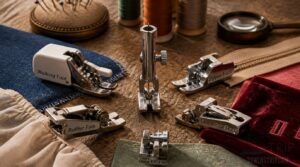
Not every attachment fits every machine, and buying the wrong one is an easy mistake to make. Compatibility comes down to a few key factors — your shank type, needle clearance, and the fabric you’re working with. Here’s what to check before you buy.
Low-shank Machine Fit
Most home sewing machines are low shank — meaning there’s just 3/4 inch between the presser bar screw and the needle plate. That small measurement controls everything. It determines which sewing machine attachments and presser feet actually fit your machine.
Before buying any foot, measure your shank. A mismatch won’t just hurt stitch quality — it can cause binding or damage.
High-shank Machine Fit
High-shank machines sit about 1 1/4 inches from the presser bar screw to the needle plate — that extra clearance is what lets thick layers pass through without bunching. If you’re sewing denim, upholstery, or quilted panels, this matters.
A walking foot or zipper foot built for high shank keeps alignment precise and stitches consistent across every bulky seam.
Slant-shank Machine Limits
Slant-shank machines are a different animal. The needle bar sits at a diagonal, which creates Throat Space Limitations and tighter clearance overall — meaning bulky fabrics can bind up fast.
Watch for these common challenges:
- Foot Compatibility Challenges with standard feet requiring dedicated slant-shank versions or adapters
- Stitch Width Constraints limiting decorative stitch options
- Fabric Feeding Challenges on thick or layered materials
- Needle Clearance Issues when using specialty attachments
Needle Clearance Checks
Before mounting any new presser feet or sewing machine attachments, always check needle clearance first. Raise the presser bar fully, then rotate the handwheel slowly by hand. The needle should pass cleanly through the center of the needle plate hole — no scraping, no resistance.
Hook Gap and Needle Height both affect this. Aim for roughly 0.5–1 mm of clearance depending on your fabric thickness.
Fabric and Project Matching
Not every attachment works with every fabric — and ignoring that mismatch will cost you clean results. Lightweight fabrics like voile need finer control, so a straight stitch foot is your best tool. Heavier fabrics like denim or canvas pair well with a walking foot to move layers evenly without shifting.
Match the attachment to the project, not just the machine.
Maintaining Attachments for Stitch Quality
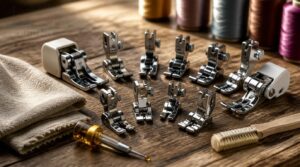
Your attachments can only do their best work when you take care of them. A little routine maintenance goes a long way toward keeping your stitches clean and consistent. Here’s what to stay on top of.
Remove Lint From Grooves
Lint is the silent saboteur of clean stitching. After each project, clean grooves immediately on your presser feet and sewing machine attachments — buildup sneaks in fast.
- Use a small nylon lint brush along grooves
- Follow with a microfiber wipe for residue
- Finish with short bursts of compressed air
Work from the groove entrance inward — never push debris deeper.
Check for Rough Edges
A rough edge on your presser foot can wreck a seam before you’ve sewn a single inch. Run your fingertip slowly along every edge and groove — you’re feeling for burrs or sharp transitions that snag thread.
If you find one, smooth it with a fine emery board, then recheck. Replace any foot where damage won’t resolve.
Oil Moving Parts Lightly
Once you’ve handled rough edges, turn your attention to movement. Any sewing machine parts that pivot, slide, or rotate need a light oil layer to keep working smoothly.
- Apply oil after cleaning, never before
- Use a pea-sized amount — less is more
- Target pivots, linkages, and gears specifically
Over-oiling attracts lint and forms sludge. Under-oiling scores metal surfaces. Get it right, and your presser feet and attachments last far longer.
Store Feet Safely
Good oiling habits mean nothing if you toss your presser feet loose into a drawer afterward. Closed storage case protection is non-negotiable — dust, impact, and moisture are silent killers for sewing machine attachments.
Keep your storage area dry. Moisture prevention matters especially for metal feet, where even light humidity starts corrosion fast. Air-dry feet completely before storing.
Use a labeling compartments system to separate feet by compatibility — mixing brands causes confusion and scratches plastic tips and delicate grooves. Place each foot with the shank facing up to protect those tips.
Replace Damaged Attachments
Even the best storage routine can’t save a foot that’s already damaged. Replace damaged attachments the moment you notice bent guides, burrs, or worn nonstick surfaces — they’ll drag on fabric and wreck your stitch quality fast.
- Check wear indicators on edges and grooves regularly
- Match the replacement shank type to your machine
- Inspect locking lugs before installing
- Test at low speed after fitting
- Keep a spare parts inventory for common feet
Frequently Asked Questions (FAQs)
What are the uses of sewing machine attachments?
Sewing machine attachments — presser feet, walking foot, zipper foot — transform your machine from a one-trick tool into a full workshop. They handle fabric edge management, boost speed, and cut fatigue fast.
Can attachments work with computerized sewing machines?
Yes — most sewing machine attachments work with computerized machines. Many support automatic stitch adjustment when a foot is detected. Just confirm your shank type and check firmware requirements before installing.
Do attachments affect thread tension settings?
Attachments don’t just change how fabric feeds — they shift your thread tension balance too. Different presser feet alter fabric thickness exposure, so expect to fine-tune your needle thread dynamics after every swap.
Are universal attachments compatible with all brands?
Not quite. Universal attachments work across many brands, but rarely all of them. Shank type—low, high, or slant—determines fit. Always confirm needle clearance and use adapters when needed.
How do attachments handle thick or layered fabrics?
Think of thick layers like a traffic jam — without the right tools, everything stalls. A walking foot keeps top and bottom layers moving in sync, eliminating shifting.
Can beginners use specialty attachments without experience?
Beginners can absolutely use specialty presser feet without prior experience. Start with the all-purpose foot, practice on scrap fabric, and follow manufacturer guides. A walking foot or zipper foot is easier than it looks.
Conclusion
Think of your presser feet as the crew behind the scenes—your hands steer, but the right attachment does the precision work. Understanding how sewing machine attachments improve stitching isn’t just technical knowledge; it’s the difference between fighting your fabric and moving with it.
Start with one new foot. Practice until it feels natural. Then add another. You won’t just sew better—you’ll think like someone who always knows which tool earns the right result.
- https://www.goldstartool.com/blog/when-and-how-to-use-a-walking-foot-sewing-machine.htm
- https://theluckyneedle.com/walking-foot-sewing-machine-what-is-it
- https://sewing.com/walking-foot-attachment-for-quilting-thick-layers
- https://www.singer.com/collections/singer-presser-feet-attachments
- https://textilelearner.net/important-techniques-for-sewing-needle-selection/