This site is supported by our readers. We may earn a commission, at no cost to you, if you purchase through links.

Scissors chew up silk. I learned, hunched over a yard of chiffon that kept sliding and puckering, that no matter how sharp my blades were.
Then a pattern-cutting mentor handed me a rotary cutter and said, glide, don’t saw. One pass later, dressmaker’s shears stayed in the drawer.
That’s the quiet power behind rotary cutters for dressmaking — the right one turns shaky, uneven cuts into crisp, confident lines, whether you’re slicing through denim or coaxing silk into submission.
Blade size, grip, and bevel angle all matter more than you’d think, and picking wrong costs you fabric, time, and patience.
Table Of Contents
- Key Takeaways
- Top 10 Rotary Cutters for Dressmaking
- 1. Olfa 45mm Rotary Cutter Set
- 2. Olfa 12×18 Self Healing Cutting Kit
- 3. Fiskars Titanium Softgrip Rotary Cutter
- 4. Fiskars Easy Change Rotary Cutter
- 5. Martelli Left Hand Rotary Cutter
- 6. TrueCut 28mm Ergonomic Rotary Cutter
- 7. Fiskars Titanium Rotary Cutter 60mm
- 8. Fiskars 45mm Rotary Fabric Cutter
- 9. Fiskars Titanium Rotary Fabric Cutter
- 10. Fiskars Rotary Cutter Ruler
- Choosing The Right Blade Size
- Dressmaking Fabric Cutting Performance
- Comfort and Safety Features
- Essential Rotary Cutting Accessories
- Using Rotary Cutters Correctly
- Frequently Asked Questions (FAQs)
- Conclusion
Key Takeaways
- Match your blade size to the job: grab a 28mm for tight curves and detail work, a 45mm for everyday garment cutting, and a 60mm for denim, canvas, or thick stacked layers.
- A titanium-coated blade holds its edge way longer than regular steel, so you’re not stopping mid-project to swap in a fresh one.
- Comfort features like soft grips, ambidextrous handles, and quick magnetic blade changes make a real difference if you’re cutting for hours or dealing with hand fatigue.
- Good technique matters as much as the tool itself, so keep your fabric flat and weighted, your ruler steady, and your pressure even all the way through each cut.
Top 10 Rotary Cutters for Dressmaking
Here are ten rotary cutters worth knowing about — from compact detail blades to heavy-duty workhorses built for thick layers. Each one brings something different to your cutting table, whether you’re shaping silk or slicing through denim. Let’s get into what makes them stand out.
For a deeper look at how each one performs in real use, this guide to rotary cutters for crafts breaks down the specs that actually matter.
1. Olfa 45mm Rotary Cutter Set
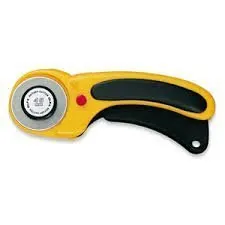
The Olfa 45mm Rotary Cutter Set is a solid first pick — especially if you deal with long cutting sessions and your hand starts complaining halfway through. The comfort-grip handle keeps pressure low, and the ambidextrous design means it doesn’t matter which hand you favor.
You get a self-retracting blade with a safety lock, plus a spare 45mm blade included.
One heads‑up: the instruction booklet is in Japanese, so look up a quick tutorial before changing blades.
| Best For | Quilters, sewers, and fabric crafters who do long cutting sessions or have arthritis and limited grip strength. |
|---|---|
| Blade Diameter | 45 mm |
| Blade Material | Alloy steel |
| Safety Mechanism | Self-retracting blade lock |
| Handle Design | Comfort-grip ergonomic |
| Handedness | Ambidextrous |
| Primary Use | Quilting & fabric crafts |
| Additional Features |
|
- Ambidextrous comfort-grip handle keeps hand fatigue low, even during extended use
- Self-retracting blade with safety lock makes it safer around kids
- Comes with a spare 45mm blade so you’re not caught short right away
- Instruction booklet is in Japanese only, so you’ll need to find an outside guide for blade changes
- Factory blade can sometimes be dull out of the box, meaning an early replacement
- Tops out at six fabric layers — thicker stacks need multiple passes
2. Olfa 12×18 Self Healing Cutting Kit
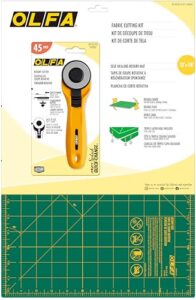
The mat matters just as much as the cutter, and this kit gets that right from the start. The self-healing surface reseals after every cut, so you’re not staring at grooves chewing up your fabric line by line. It’s double-sided, too — gridded for quick alignment, plain on the flip for fussy work.
Paired with a 45mm tungsten-steel blade, it manages up to 8 layers of cotton, perfect for quilting blocks and bias strips. Just skip it for denim or leather.
| Best For | Quilters and sewists working with light-to-medium cotton fabrics who need precise, repeatable cuts for blocks, bias strips, and garment pieces. |
|---|---|
| Blade Diameter | 45 mm |
| Blade Material | Tungsten steel |
| Safety Mechanism | Spring guard |
| Handle Design | Alloy steel ergonomic |
| Handedness | Ambidextrous |
| Primary Use | Quilting & garment construction |
| Additional Features |
|
- Self-healing mat reseals after each cut, keeping the surface smooth instead of grooved over time
- Double-sided design gives you a gridded side for fast alignment and a plain side for detail work
- Cuts through up to 8 layers of cotton at once, speeding up repetitive quilting tasks
- Not built for heavier materials like denim or leather
- Blade can dull faster than expected with frequent use, meaning more replacements
- Mat may develop permanent cuts over time, gradually weakening its self-healing ability
3. Fiskars Titanium Softgrip Rotary Cutter
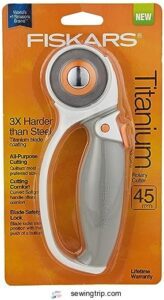
Once your mat’s handled, the cutter itself needs to pull its weight — and this one delivers. Fiskars built it around a 45mm titanium-coated blade, three times harder than standard steel, so it holds an edge through layer after layer without dulling fast.
The Softgrip handle cushions your hand during long sessions, while the ambidextrous design gives left- and right-handed sewists the same clear line of sight on every cut.
| Best For | quilters, patchworkers, and sewists — especially left-handed crafters or anyone prone to hand fatigue — who need clean, precise cuts through thick fabric, batting, or multiple layers. |
|---|---|
| Blade Diameter | 45 mm |
| Blade Material | Titanium carbide |
| Safety Mechanism | Push-button retraction |
| Handle Design | Softgrip rubber loop |
| Handedness | Ambidextrous |
| Primary Use | Quilting & apparel alterations |
| Additional Features |
|
- The titanium carbide blade core holds its edge through layer after layer without dulling quickly
- Softgrip rubber handle eases hand strain during long cutting sessions
- Ambidextrous blade mounting gives both left- and right-handed users the same clear sightline on every cut
- The blade mounting screw can loosen with use, so it occasionally needs retightening
- Fabric fibers build up behind the blade and require manual cleaning after several cuts
- Replacement blades are sold separately and aren’t titanium-coated unless you buy that specific version
4. Fiskars Easy Change Rotary Cutter
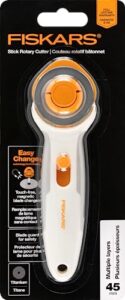
Swapping blades usually means getting uncomfortably close to that edge, but Fiskars solved that with a magnetic blade hub. Pop the dull one out, snap a fresh one in, no fingers anywhere near the cutting surface.
This Easy Change model also works with both 45mm and 60mm blades, so you’ve got precise garment cuts and heavy-fabric muscle in one tool. The SoftGrip handle keeps long sewing sessions comfortable, and that magnetic connection holds firm through every pass.
| Best For | crafters and sewists who need fast, no-fuss blade swaps while cutting through multiple layers of fabric, felt, or vinyl at different angles. |
|---|---|
| Blade Diameter | 45 mm |
| Blade Material | Titanium-coated steel |
| Safety Mechanism | Sliding safety guard button |
| Handle Design | SoftGrip ergonomic |
| Handedness | Ambidextrous |
| Primary Use | Fabric, felt & vinyl |
| Additional Features |
|
- Magnetic blade hub lets you swap blades without ever touching the cutting edge
- 7 mm blade exposure handles angled cuts through thick or layered material with ease
- Ambidextrous SoftGrip handle stays comfortable through long cutting sessions, whether you’re left- or right-handed
- Some users notice the blade dulling faster than expected on heavier fabrics
- Blade may need a quick wipe-down to clear factory debris before first use
- Packaging is sometimes sealed loosely, so there’s a chance of damage in transit
5. Martelli Left Hand Rotary Cutter
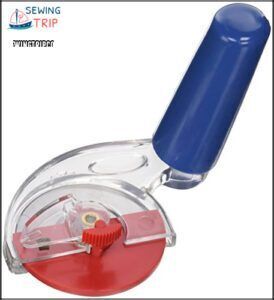
Most rotary cutters treat left-handed sewists as an afterthought, but Martelli built this one specifically for left-hand control. The symmetrical handle settles naturally into your palm, spreading grip pressure evenly so fingers don’t cramp halfway through a quilt top.
A 45mm blade cuts garment curves with a tool-free, quick-release swap, while the spring-loaded guard snaps shut the moment you ease off pressure. Color-coding means you’ll never grab the wrong cutter by accident.
| Best For | Left-handed quilters, sewists, and crafters dealing with hand or wrist pain who need a comfortable, fatigue-reducing cutter built with their dominant hand in mind. |
|---|---|
| Blade Diameter | 60 mm |
| Blade Material | Tungsten steel |
| Safety Mechanism | Spring-loaded blade guard |
| Handle Design | Dough-roller ergonomic |
| Handedness | Left-handed only |
| Primary Use | Quilting & fashion design |
| Additional Features |
|
- Designed specifically for left-handed users, with a blue rubber grip that places your fingers right where they should be naturally
- The 60mm blade powers through 6–8 fabric layers in one clean pass, making it a serious time-saver for quilting and batch cutting
- The spring-loaded safety guard covers the blade automatically, keeping you and your cutting edge protected between cuts
- The long blade can wobble slightly when cutting through dense or heavy fabrics, which may affect precision at higher layer counts
- The forward-push motion takes some getting used to, especially if you’re switching from a traditional rotary cutter
- Very thick or tightly woven materials may start to challenge the blade beyond 4–5 layers, despite the 6–8 layer rating
6. TrueCut 28mm Ergonomic Rotary Cutter
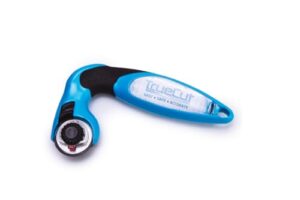
Detail work is where this cutter earns its place. The 28mm swivel blade navigates tight curves — princess seams, darts, small appliqué — without the awkward pivoting bigger cutters demand. At just 4.32 oz, it barely registers in your hand, and the rubberized thumb rest genuinely reduces wrist fatigue over long sessions.
Pairing it with a sharp blade designed for left-handed rotary cutters makes those intricate cuts even more effortless and precise.
It’s ambidextrous, works with the TrueCut guide-track system for ruler-straight lines, and swaps blades without tools. Light to medium fabrics only — thick denim will need a bigger blade.
| Best For | Quilters, sewists, and crafters who do a lot of detail work or struggle with hand and wrist fatigue — especially left-handed users who are often left out by standard designs. |
|---|---|
| Blade Diameter | 28 mm |
| Blade Material | Steel rotary |
| Safety Mechanism | Swivel blade guard |
| Handle Design | Rubberized thumb rest |
| Handedness | Ambidextrous |
| Primary Use | Quilting & pattern drafting |
| Additional Features |
|
- The 28mm blade handles tight curves and intricate cuts that larger rotary cutters simply can’t manage cleanly
- Ambidextrous design and featherlight 4.32 oz weight make it genuinely comfortable for nearly any user, even during long cutting sessions
- Locks into the TrueCut guide-track system for ruler-straight lines without any slipping
- You’ll need to buy a TrueCut ruler separately to unlock the straight-cut guide feature
- Struggles with thick or layered materials like denim — larger blades handle those better
- The blade-change mechanism has a small learning curve before it feels intuitive
7. Fiskars Titanium Rotary Cutter 60mm
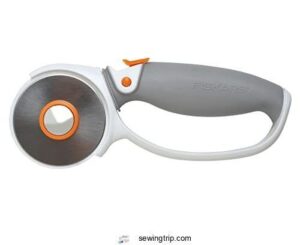
Heavy fabrics meet their match with this one. The 60mm titanium-carbide blade slices through denim, canvas, and multiple layers without dragging or skipping — that titanium coating runs three times harder than standard steel, so you’re not swapping blades every other project.
The positionable lock/release knob flips the blade for left- or right-handed use instantly, no reassembly needed. Add the Softgrip loop handle, and your wrist stays comfortable even through long cutting sessions.
| Best For | Quilters, sewists, and crafters who regularly cut heavy or multi-layer fabrics and want a durable, ambidextrous cutter that holds its edge over time. |
|---|---|
| Blade Diameter | 60 mm |
| Blade Material | Titanium carbide |
| Safety Mechanism | Lock/unlock blade knob |
| Handle Design | Softgrip ergonomic |
| Handedness | Ambidextrous |
| Primary Use | Quilting, sewing & patchwork |
| Additional Features |
|
- Titanium carbide coating keeps the blade sharp far longer than standard steel, so you spend less time swapping blades mid-project
- Works seamlessly for both left- and right-handed users with a simple knob flip — no disassembly required
- The Softgrip handle reduces hand fatigue during extended cutting sessions
- The 60mm blade is overkill for small, detailed cuts — a smaller cutter is better suited for intricate work
- Replacement blades are sold separately, which adds up over time
- Sits at a higher price point than basic rotary cutters, which may not suit casual crafters
8. Fiskars 45mm Rotary Fabric Cutter
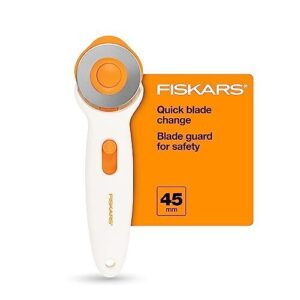
If you do most of your cutting in the 45mm sweet spot — garments, quilts, felt, vinyl — this cutter just works. The precision-ground blade slices through multiple layers cleanly, and the symmetrical ambidextrous handle means lefties and righties both cut naturally without adjusting a thing.
The sliding button lock extends, holds, and retracts the blade with one thumb. Blade changes are tool-free and fast. Lifetime warranty included — blades aside.
| Best For | Sewers, quilters, and crafters who regularly cut garments, quilts, felt, or vinyl and want a reliable, ambidextrous cutter that works equally well for left- and right-handed use. |
|---|---|
| Blade Diameter | 45 mm |
| Blade Material | Titanium carbide |
| Safety Mechanism | Sliding lock button |
| Handle Design | Symmetrical ergonomic |
| Handedness | Ambidextrous |
| Primary Use | Sewing, quilting & crafts |
| Additional Features |
|
- Slices cleanly through multiple fabric layers in one pass, saving time on quilting and garment projects
- Symmetrical handle works naturally for both left- and right-handed users with no adjustments needed
- Tool-free blade changes and a one-thumb sliding lock make it quick and safe to use
- Blade dulls faster on thick or abrasive materials, adding to long-term replacement costs
- Warranty doesn’t cover the blade itself — the part most likely to need replacing
- Not suitable for deco mesh or specialty meshes, with some users reporting blade stalling on those materials
9. Fiskars Titanium Rotary Fabric Cutter
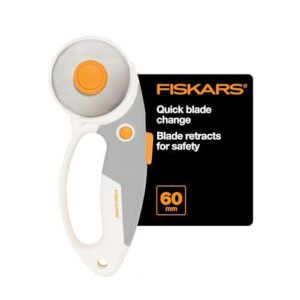
When you’re cutting through denim, canvas, or thick batting, you need a blade that doesn’t quit halfway through. The Fiskars Titanium 60mm delivers — titanium-carbide coating makes it three times harder than standard steel, so edges stay sharp longer and glide through multiple layers without dragging.
The loop handle with sliding button extends, locks, and retracts the blade one-handed. It’s ambidextrous, lightweight at 0.24 lb, and backed by a full lifetime warranty. A genuinely hard-working tool.
| Best For | Quilters, sewists, and crafters who regularly cut through thick or layered fabrics and want a durable, fatigue-friendly tool they can rely on for years. |
|---|---|
| Blade Diameter | 60 mm |
| Blade Material | Titanium carbide |
| Safety Mechanism | Sliding lock button |
| Handle Design | Loop handle ergonomic |
| Handedness | Ambidextrous |
| Primary Use | Fabric, batting & foam |
| Additional Features |
|
- Titanium carbide coating keeps the blade sharp through heavy use, slicing cleanly through denim, batting, and multiple fabric layers without dragging
- One-handed sliding button extends, locks, and retracts the blade safely, making it practical for both left- and right-handed users
- Full lifetime warranty on both the cutter and blade means you’re covered for the long haul
- The retaining screw can loosen over time with heavy use and needs occasional tightening to keep the blade secure
- Not the best choice for cutting thick foam boards around 2 inches deep — it’ll struggle
- Blade longevity depends on using a self-healing cutting mat underneath; skip the mat and you’ll wear it out faster
10. Fiskars Rotary Cutter Ruler
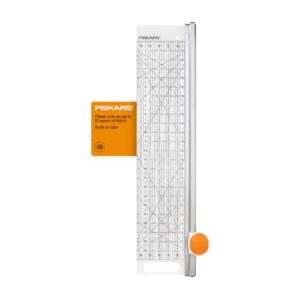
Two tools in one — the Fiskars Rotary Cutter Ruler is exactly what it sounds like, and it genuinely works. A spring-action 45mm blade rides along an integrated 24-inch acrylic ruler printed on both sides for lefties and righties alike. Angle guides at 30°, 45°, and 60° make bias cuts straightforward.
The magnetic, touchless blade change keeps your fingers safe, and the built-in handle means you’re not hunting for your ruler mid-project. Not ideal for curves, but for straight cuts? Hard to beat.
| Best For | Quilters, sewists, and crafters who want accurate straight cuts without juggling a separate ruler and rotary cutter. |
|---|---|
| Blade Diameter | 45 mm |
| Blade Material | Steel (standard) |
| Safety Mechanism | Spring-action blade |
| Handle Design | Blade carriage handle |
| Handedness | Ambidextrous |
| Primary Use | Quilting & sewing projects |
| Additional Features |
|
- Two tools in one — the integrated 24" ruler eliminates the need to line up a separate guide every cut
- Magnetic blade-change system makes swapping blades quick and finger-safe
- Built-in angle guides (30°, 45°, 60°) take the guesswork out of bias cuts
- Minimum cut length of about 1.5" makes it awkward for small, detailed work
- The acrylic ruler can feel a little flimsy under firm pressure
- 24" max length won’t cover larger projects that need a longer continuous cut
Choosing The Right Blade Size
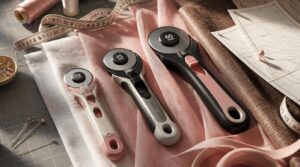
Blade size is one of those decisions that looks minor but genuinely changes how you work. Get it wrong and you’re fighting your fabric — get it right and cutting almost feels smooth. Here’s how each size breaks down so you can pick what actually fits your projects.
28mm for Curves
Small but mighty, the 28mm rotary cutter is your go-to for precision cutting along curved seam lines. It hugs rounded pattern edges without pulling the fabric grain off course.
Here’s what makes it work:
- Tight radius precision — smaller blade contact keeps curves clean
- Slower pressure prevents cutter drift on gentle arcs
- Smooth curve transitions feel natural on cotton and linen
- Grid-marked mats help prevent edge waviness
Your dressmaking workflow gets sharper, literally.
45mm for Garments
Once you move past tight curves, the 45mm rotary cutter becomes your everyday workhorse. It processes most garment cutting with ease — cottons, linens, light wools, even silk blends — without constant blade swaps.
Cutting pressure consistency stays natural through long sessions, and that grainline alignment accuracy you need for clean seam edges. This blade delivers it reliably, start to finish.
Check the 44‑inch fabric estimate to plan material needs for various shirt sizes.
60mm for Thick Fabrics
When you’re working with heavyweight fabrics like denim, canvas, or thick wool, a 60mm rotary cutter is the only blade that keeps up. That larger radius glides through dense weaves cleanly — less snagging, less drag.
Titanium coating reduces friction and extends blade life noticeably, which matters when you’re pushing through tough material.
It’s the go-to for serious yardage.
Multiple Fabric Layers
Stacking multiple fabric layers is where blade size really proves itself. A heavy duty 60mm blade performs multilayer cutting with ease — slicing through 8–10 plies cleanly in a single pass.
Here’s what layering actually demands:
- Fabric thickness control — layers add bulk fast
- Layered stability — stacked plies shift without a sharp blade
- Impact resistance — denser stacks need consistent downward pressure
Sharp blade, flat mat, clean cut.
Detailed Pattern Cutting
When you’re cutting slopers or refining a sloper development block, a 28mm blade is your precision instrument. Those tight curves — think armholes, necklines, dart manipulation lines — demand clean, controlled passes.
Grainline accuracy suffers the moment your blade wanders, and a smaller blade simply stays truer through every slash and spread adjustment or pattern grading pivot.
Dressmaking Fabric Cutting Performance

Not every fabric plays by the same rules, and your rotary cutter needs to rise to the occasion no matter what’s on the table. From breezy cotton to stubborn denim, each material has its own quirks that can make or break a clean cut. Here’s how the best rotary cutters hold up across the fabrics you’ll actually work with.
Cotton and Linen
Cotton and linen are the bread-and-butter fabrics of dressmaking — reliable, natural, and surprisingly different under the blade. Cotton’s cellulose fibers absorb moisture quickly and respond beautifully to a sharp 45mm blade, giving you clean, confident cuts every pass. Linen cuts crisp too, though its polygonal fiber structure means precision matters more.
- Cotton swells slightly when damp — always cut it dry for cleaner edges
- Linen’s high tensile strength resists fraying mid-cut, so your rotary cutter glides steadily
- Both fibers reward fabric cutting precision on a self-healing mat
- Linen’s breathability makes it ideal for summer garment construction
- A sharp blade cuts through multiple cotton layers cleanly — dulling shows fast on linen
Knits and Jersey
Jersey’s looped structure stretches in both directions — and that’s what makes knit fabric cutting uniquely tricky. A sharp 45mm blade with careful fabric handling tips keeps cuts precise, edges clean, and drape intact.
| Knit Challenge | Cutting Solution |
|---|---|
| Jersey elasticity | Sharp 45mm blade |
| Stretch recovery | Cut flat, no pulling |
| Knit drape | Mat holds fabric steady |
| Fabric shrinkage | Always pre-wash before cutting |
Silk and Slippery Fabrics
Silk is the paramount test of your cutting precision. Those triangular fibers create a slippery, light-reflecting surface that shifts the moment your blade touches it.
- Stabilize with tissue paper before cutting
- Use a sharp 28mm blade for control
- Prevent fabric drift with a grippy mat
- Choose size 9–11 sharp needles for clean penetration
Stabilizing slippery silk makes everything easier.
Denim and Canvas
Denim and canvas don’t forgive a dull blade — they’ll eat it. Denim’s right-hand twill weave creates serious resistance, especially in 10–14 oz weights. Canvas is even denser.
Your go-to here is a 60mm rotary cutter, slicing through multiple layers cleanly. Titanium-carbide blades handle both without shredding fibers or distorting that indigo warp thread structure.
Layered Garment Pieces
Layered garment pieces are where your rotary cutter really earns its place. A fall outfit — moisture-wicking base, fleece mid-layer, weatherproof shell — means you’re cutting three distinct fabric weights at once.
Blade size matters here: 45mm cuts most layered stacks cleanly, but add denim or canvas to that pile, and your 60mm becomes essential for consistent, accurate pattern cutting without shifting layers.
Comfort and Safety Features
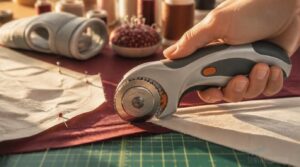
A sharp blade is only half the story — how the cutter feels in your hand (and how safely it behaves when you’re not using it) matters just as much.
After hours at the cutting table, the wrong handle can leave your wrist aching, and a blade without a proper lock is just an accident waiting to happen.
Here’s what to look for regarding comfort and safety.
Ergonomic Handle Shape
Anatomic contouring isn’t just a buzzword — it’s the difference between a smooth cutting session and an aching wrist by lunchtime. Ergonomic rotary cutters follow the hand’s natural curve, with palm support zones and finger grooves that distribute pressure evenly across contact points.
Ergonomic rotary cutters follow your hand’s natural curve, turning hours of cutting into comfort instead of pain
Proper finger diameter keeps your grip secure without squeezing, so you maintain control through every long, continuous cut without building up hand fatigue.
Soft Grip Control
The shape of your handle matters — but so does what it’s made of. Soft cushion grip grips compress slightly under your fingers, conforming to irregular textures like knits and wovens without slipping.
- Rubberized coatings ease palm pressure across long sessions
- Textured surfaces boost friction on silky, slippery fabrics
- Ridge patterns sharpen finger engagement during extended cuts
- Grip materials stay elastic through repeated cleaning and blade swaps
Left-handed Cutting Options
Grip texture helps — but if you’re cutting with your left hand, texture alone won’t fix an awkward angle.
Left-handed rotary cutters place the blade on the right side of the handle, aligning with your natural cutting line.
Mirrored safety features retract away from your left thumb automatically, and the ergonomic left-hand grip reduces wrist twist across long dressmaking sessions.
Blade Lock Mechanisms
The handle orientation matters — so does what keeps the blade where you put it.
Blade lock mechanisms fall into a few styles: liner lock, back lock, and frame lock being the most common. Each one physically engages the blade tang to prevent unwanted closure. Lock wear maintenance matters too — clean out lint regularly, or that satisfying click gets soft and unreliable over time.
Automatic Blade Retraction
When you set down your rotary cutter, the blade shouldn’t wait for you to remember it’s exposed. Spring-loaded mechanisms pull the blade back in under 50 milliseconds — fast enough that it’s retracted before your hand even lifts. Sensor-based retraction takes it further, triggering the moment cutting pressure releases.
Keep those springs clean, though — debris is the enemy of reliable safety lock performance.
Essential Rotary Cutting Accessories
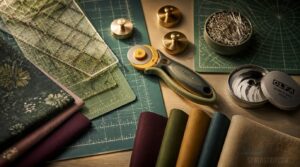
Your rotary cutter is only as good as the tools backing it up. The right accessories make every cut cleaner, safer, and a whole lot less frustrating. Here’s what you actually need on your cutting table:
Self-healing Cutting Mats
Ever wonder why your mat never shows old cuts? Polymer layer technology lets the surface heal itself, burying blade lines instead of grooving.
Pick thicker mats (5-7mm) for extra cutting surface protection, and keep grid lines crisp for accuracy. Clean with mild soap, store flat to prevent warping, and your self‑healing mat stays workshop‑ready for years.
Rotary Cutting Rulers
A good ruler does more than measure — it actively guides your blade. TrueCut’s raised edge design keeps your rotary cutter tracking true, reducing the chance of veering mid-cut. Pair that with a thermoplastic acrylic quilting ruler for drop-proof durability, and precision graduation clarity that won’t fade.
Ruler alignment for rotary cutting directly affects your seam allowance accuracy, so invest wisely.
Replacement Rotary Blades
A dull blade is a thief — it steals clean cuts and frays your fabric before you’ve even begun. Replace blades regularly to keep your work sharp and precise.
- High carbon steel blades resist corrosion and hold their edge longer
- A 9–10 degree bevel angle ensures clean, consistent slicing through fabric layers
- Titanium or ceramic coatings reduce friction and heat buildup during long sessions
- Micro-serrated profiles improve control on delicate, slippery materials
Specialty Edge Blades
Standard blades are workhorses — but specialty edge blades open up a whole new creative range.
Pinking, wave, and scalloped blades add decorative finishes in a single pass.
Micro bevel edges give you pinpoint control on curves and fine stitching lines.
Nonstick-coated blades glide through silk and chiffon without snagging.
For heavy denim, tungsten carbide tips stay sharp far longer.
Pattern Weights
Pattern weights are the unsung hero of a clean pattern layout. When you’re using rotary cutter and fabric cutting tools together, even a tiny shift in your pattern can ruin a precision straight cut.
- Traditional metal weights lie flat without pin marks
- Magnetic weights lock onto rulers instantly
- Fabric-safe coated weights protect silk and delicate textiles
- Place weights along every exposed edge to prevent slippage
Using Rotary Cutters Correctly
Even the best rotary cutter won’t save you if your technique is off — a sharp blade and good habits work together. A few simple moves make all the difference between clean, confident cuts and fabric that shifts, frays, or fights back. Here’s what to get right every time you pick up your cutter.
Prepare Fabric Flat
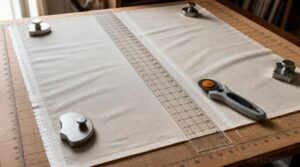
Before your rotary cutter even touches the fabric, grain alignment decides whether your cuts are precise or a disaster waiting to happen.
Lay fabric on a flat surface, smoothing from center outward. Use pattern weights to hold edges taut — bias stretch sneaks in fast. Check selvage alignment too; skewed selvages mean skewed seams.
| Step | Technique | Why It Matters |
|---|---|---|
| Smooth fabric | Center-outward motion | Prevents new folds |
| Align grain | Parallel to cut line | Ensures precision straight cuts |
| Fix selvages | Check before cutting | Avoids pattern mismatches |
Cut Away Safely
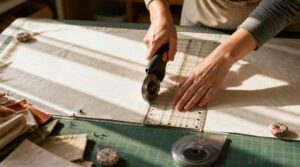
Once your fabric’s flat and weighted, it’s time to actually cut — and how you move matters as much as where you cut.
Stand feet shoulder-width apart, keep elbows close to your torso, and always cut away from your body. Apply steady, even pressure — no jerky strokes. On thick layers, make two shallow passes instead of forcing one deep cut. Retract the blade immediately after each pass.
Hold Ruler Firmly
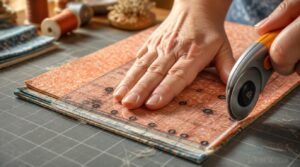
After cutting away safely, your grip takes over. Your non-cutting hand matters just as much as the rotary cutter itself. Press firmly with non-slip ruler grips, preventing ruler drift mid-cut.
- Steady hand positioning stops zigzag lines
- Stabilizing fabric layers keeps everything aligned
- Achieving precise paths boosts cutting accuracy
This fabric cutting technique protects measurement accuracy on every quilting ruler pass.
Use Steady Pressure

Once your ruler’s locked, pressure becomes the next piece of the puzzle. Think of it like pressing a rolling pin into dough — even, continuous contact is everything. A sharp rotary cutter glides when you apply firm, steady downward force. Let up even slightly, and you’ll see jagged edges or skipped spots.
| Pressure Mistake | What Happens |
|---|---|
| Uneven force | Blade deflects off the ruler line |
| Too light | Fabric creep shifts layers apart |
| Too heavy, sudden | Edge dulls unevenly faster |
| Rushing the pass | Skipped cuts, frayed edges |
| Tense grip | Wrist fatigue sets in quickly |
Consistent edge quality comes from treating every cut like a slow, deliberate stroke. Your arm stays aligned with the cut line, wrist relaxed but stable — that’s your grip stability technique working quietly. Don’t squeeze; guide.
Replace Dull Blades
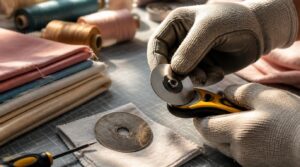
A dull blade doesn’t just frustrate — it ruins your fabric.
When cuts start snagging or fraying, replace the blade immediately.
Before swapping, wipe the edge with a lint-free cloth and wear cut-resistant gloves.
Align the new blade with the guide notch, tighten securely without overdoing it, then test on scrap fabric to confirm smooth, clean rotation.
Frequently Asked Questions (FAQs)
What to look for in a rotary cutter for fabric?
Good tools earn their keep through blade material durability, true grip comfort, and reliable safety locks.
Match blade size to fabric thickness, prioritize precision cutting accuracy, and check accessory compatibility — that combo prevents hand fatigue and keeps every cut clean, session after session.
Can dull rotary blades be sharpened instead of replaced?
Yes — but it’s sharpening vs replacement trade-off territory. Stainless steel hones nicely; titanium coating damage happens easily. Try a blade sharpener once, inspect the edge closely, then weigh maintenance cost analysis against just grabbing a fresh blade.
How do electric rotary cutters differ from manual ones?
Think of it as horsepower versus elbow grease: an electric rotary cutter brings motorized speed control and consistent blade pressure to your fabric cutting machine, while manual versions need plug-free agility, steady hands, and real effort—trading cutting speed performance for fatigue reduction and feel.
Are blades larger than 60mm available for cutting?
Oversized blade availability does exist—70mm blades show up in industrial cutting tools for serious heavyweight material limits.
For dressmaking, though, the 60 mm rotary cutter covers nearly every fabric thickness you’ll meet, so bigger rarely means better for garment work.
Can rotary cutters cut paper or other crafts?
Absolutely — these handheld cutting devices handle cardstock, craft foam, and felt beautifully.
Just keep dedicated paper blades separate from fabric ones, test scraps first, align layers for multi-layer accuracy, and you’ll get clean, scissor-free results every time.
Are rotary cutters safe for children to use?
With close adult supervision, a small 28mm blade, child-safe locking safety guard, and protective gloves, kids can build real beginner control on this handheld cutting device. Store blades securely out of reach—safety always comes first.
Conclusion
Think of your old scissors as a dull plow dragging through soil — it gets there, but it tears the ground apart. A good rotary cutter glides like a sharpened blade through butter, leaving clean rows behind. That’s the difference rotary cutters for dressmaking make: less wrestling, more gliding.
Pick the blade size that fits your fabric, keep it sharp, and trust the tool to do what it’s built for. Smooth seams start with smooth cuts.
- https://thecraftyquilter.com/2023/01/what-size-rotary-cutter-is-best-for-quilting
- https://www.sailrite.com/scissors-or-rotary-cutters
- https://suzyquilts.com/quilting-rotary-cutters-a-complete-guide
- https://fabriccompany.com/blogs/updates/best-rotary-cutter-for-quilting
- https://www.doinaalexei.com/rotary-cutters-or-fabric-scissors.html