This site is supported by our readers. We may earn a commission, at no cost to you, if you purchase through links.
You pin three layers of a quilt, sew a straight seam, and somehow the backing puckers while the top shifts a full inch off-center. That’s not a skill problem. That’s a foot problem.
Regular presser feet push fabric from below and hope the top layer keeps pace, which works fine for a single layer of cotton but falls apart under batting, vinyl, or anything with stretch.
The difference between quilting and regular presser feet comes down to one thing: who grips the top fabric, and who doesn’t. Once you see how that changes your seams, you’ll never blame your tension settings again.
Table Of Contents
- Key Takeaways
- Quilting Foot Vs Regular Foot
- How Regular Presser Feet Work
- How Quilting Presser Feet Work
- Feeding and Fabric Control
- Stitch Quality Differences
- Best Uses for Quilting Feet
- Best Uses for Regular Feet
- Quilting Foot Types Compared
- Fit, Shank, and Attachment
- Choosing The Right Foot
- Frequently Asked Questions (FAQs)
- Conclusion
Key Takeaways
- A walking foot grips the top layer with upper feed dogs while a regular foot relies solely on lower feed dogs, and that single mechanical difference is what separates clean quilt seams from frustrating drift.
- When you’re working with thick sandwiches, slippery fabrics, or stretch knits, a walking foot isn’t a luxury — it’s the only tool that keeps every layer moving at the same pace.
- Your regular presser foot still earns its place on stable wovens, lightweight cotton, and simple straight seams, where its smooth sole and constant pressure are all you need.
- Before buying any quilting foot, check your machine’s shank type — low, high, or slant — because even the best walking foot is useless if it doesn’t fit your machine.
Quilting Foot Vs Regular Foot
Choosing between a quilting foot and a regular presser foot comes down to more than just preference — it changes how your fabric moves and how your finished seams look. Before you swap feet or start a new project, it helps to know exactly where these two tools differ. Here’s a closer look at the key points that separate them.
If you’re ready to put that knowledge into practice, mastering how to change the presser foot on a Singer sewing machine is a natural first step toward confidently switching between feet mid-project.
Key Differences at a Glance
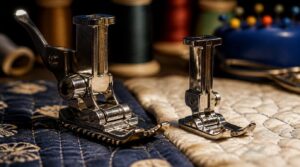
One foot grips. The other glides. That single difference shapes every result you get at the machine.
The grip or glide of your presser foot determines every result you get at the machine
| Feature | Walking Foot | Regular Presser Foot |
|---|---|---|
| Feed mechanism | Dual upper + lower feed dogs | Lower feed dogs only |
| Sole texture | Toothed for grip | Smooth for glide |
| Best use | Thick, layered, or slippery fabrics | Stable wovens, simple seams |
A walking foot uses upper feed dogs to move the top layer in sync with the bottom, preventing shifting across thick quilt sandwiches. A regular presser foot relies entirely on the machine’s lower feed dogs, which works fine for lightweight cotton but loses control on bulky or slippery layers. Sole texture reinforces that gap — toothed soles grip, smooth soles glide. Machine compatibility matters too; walking feet require shank-type checks before purchase, while regular feet come standard with virtually every machine. Its dual feed system keeps layers aligned during quilting.
Feeding Method
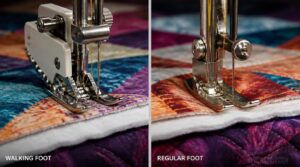
The difference you saw in the table — toothed vs. smooth sole — comes down to how each foot interacts with fabric feeding from the start.
| Feeding Aspect | Walking Foot | Regular Foot |
|---|---|---|
| Top layer movement | Driven by upper feed dogs | Passive, no drive |
| Bottom layer movement | Driven by lower feed dogs | Driven by lower feed dogs |
| Synchronized layer movement | Yes, both layers move together | No synchronization |
| Even feed rates | Consistent across all layers | Only consistent on single layers |
| Dual-feed mechanics | Engages upper and lower simultaneously | Single feed system only |
A walking foot — also called an even feed foot — uses upper feed dogs that grip and advance the top layer in sync with the machine’s lower feed dogs below. That dual feed system eliminates the speed gap between layers, which is exactly what causes shifting on thick stacks. A regular foot has no upper drive at all, so preventing fabric slippage depends entirely on pressure alone.
Fabric Control
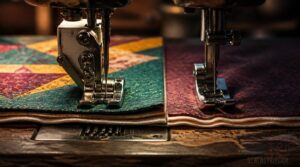
How each foot feeds fabric directly shapes how well it holds your layers in place.
| Control Factor | Walking Foot | Regular Foot |
|---|---|---|
| Managing Layer Shift | Actively prevented | Relies on pressure only |
| Preventing Fabric Creep | Upper feed dogs grip top layer | No upper grip mechanism |
| Controlling Slippery Textiles | Toothed sole reduces drift | Smooth sole allows slippage |
| Optimizing Feed Synchrony | Top and bottom move together | Bottom layer advances faster |
| Maintaining Surface Tension | Lifts between stitches | Continuous downward contact |
Best Project Uses
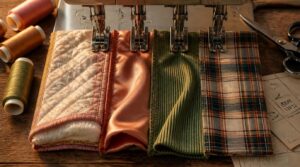
Knowing how each foot controls fabric makes it easier to match the right tool to the right job.
| Project Type | Best Foot | Reason |
|---|---|---|
| Quilt sandwich | Walking foot | Layered sandwich stability across all layers |
| Satin or silk | Even feed foot | Prevents slippery satin handling drift |
| Jersey or knit | Walking foot | Eliminates stretch knit distortion |
| Plaid or striped fabric | Quilting foot | Locks patterned fabric alignment across seams |
Cost and Compatibility
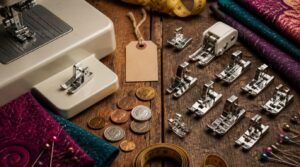
Price shapes every accessory decision you make. Regular presser feet come standard with most machines, while quilting feet run $15–$75 depending on type. OEM vs aftermarket matters here — branded feet guarantee fit, but third-party options cut costs.
| Consideration | Regular Foot | Quilting Foot |
|---|---|---|
| Upfront Cost | Included free | $15–$75 |
| Shank Compatibility | Standard | Requires shank match |
Shank height adapters solve most compatibility gaps affordably.
How Regular Presser Feet Work
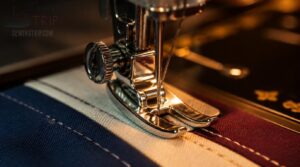
Regular presser feet are the default tool on virtually every sewing machine, and understanding how they work helps you know exactly when to reach for something else. Their design is straightforward, but each part plays a specific role in how your fabric moves and behaves under the needle.
Here’s what’s actually happening when you sew with one.
Smooth Sole Design
Run your finger across a regular presser foot, and you’ll notice it’s almost glassy. That’s intentional.
The smooth sole uses durable polymer with a polished finish for friction reduction and fabric snag prevention. Micro-embossing controls static without grooves.
This surface finish technology suits stable fabric feeding for single layers, though it won’t manage even feeding of fabric layers like a walking or quilting foot does.
Lower Feed Dog Movement
The lower feed dogs work in a four-motion rectangle: rise through the throat plate, grip the fabric, advance it forward, then drop and return. A vertical lift cam controls that rise, while a separate cam drives the horizontal push.
This coordinated motion determines stitch length consistency — but with a regular foot, it’s managing only what’s directly below.
Continuous Fabric Pressure
A regular presser foot holds fabric against the throat plate with constant downward pressure — no lifting, no gripping teeth, just steady contact. That pressure keeps the fabric taut so the lower feed dogs can advance it cleanly.
Proper pressure tuning matters here: too much compresses layers unevenly, too little lets fabric drift. The result directly controls stitch uniformity and seam flatness.
For structured seams where precision is paramount, pairing correct pressure with the right presser foot for your fabric type — like a straight-stitch foot for shirts or trousers — keeps every layer feeding evenly and stitch lines consistent.
Best for Simple Seams
When the project is simple, the regular presser foot is exactly what you need. Straight seams on cotton, linen, or poplin move through cleanly with zero extra setup.
The all-purpose presser foot manages standard seam allowances on lightweight fabrics without fuss, and you can run at full machine speed.
For basic garment construction, it’s the fastest, most straightforward tool on your machine.
Limits on Thick Layers
Thick layers expose every weakness a regular foot has. When you stack a quilt sandwich — top fabric, batting, and backing — single-layer fabric feeding can’t keep up. The bottom moves faster, the top drags, and your seam drifts before you notice.
Three specific problems follow:
- Skipped stitches from inconsistent feed dog grip
- Needle deflection through dense plies
- Fabric protrusion under the needle plate
That’s exactly where a walking foot takes over.
How Quilting Presser Feet Work
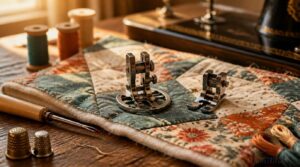
Quilting presser feet work differently from regular feet in ways that directly affect how your layers move through the machine. Understanding the mechanics behind that difference helps you make smarter choices for every project. Here’s what sets them apart.
Walking Foot Feeding
Walking a quilt sandwich through your machine without a walking foot is like trying to slide two stacked rugs across a floor — the top always lags behind.
A walking foot solves this through dual-feed mechanics that grip the top fabric while your machine’s lower feed dogs handle the bottom, delivering synchronized layer advancement and eliminating stitch misalignment before it starts.
Upper Feed Dogs
The upper feed dogs are what give the walking foot’s dual feed system its real grip. They sit inside the foot body and press down onto the top fabric layer, engaging in synchronized feeding mechanics with the lower feed dogs below.
Both sets move in unison, so fabric feed synchronization happens across every layer simultaneously — top, batting, and backing all advance at the same rate.
Layer Movement Control
When upper and lower feed dogs work together, synchronized fabric feeding becomes the whole point. That coordination is what keeps your quilt sandwich from sliding out of alignment mid-seam.
Preventing layer slippage across batting thickness is where the walking foot earns its place — layer synchronization locks every layer in step, so stitch drift stops before it starts.
Open Toe Visibility
Synchronized layers solve one problem. Seeing where your needle lands solves another.
An open-toe quilting foot cuts away the front of the sole, giving you a clear sightline straight to the needle. That aperture width determines how much of the needle path you can actually track — wider means better visibility around curves and across complex pattern lines, which tightens your needle position control considerably.
Guide Bar Options
Once you can see your needle clearly, the next step is controlling where each line of stitching lands relative to the last.
Many walking foot guide bars slide into a side slot and ride along a previous stitch line, letting you space parallel quilting rows consistently — no marking required. Spacing commonly ranges from ⅛ inch to ¾ inch, giving you precise, repeatable line work across the entire quilt surface.
Feeding and Fabric Control
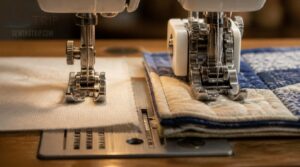
How your presser foot moves fabric is what separates a clean seam from a frustrating one. The feeding system underneath — and sometimes on top — determines whether your layers stay together or drift apart mid-stitch. Here’s how each system works and what that means for your sewing.
Single Feed System
A regular presser foot runs on a single feed system — the lower feed dogs do all the work. One centralized mechanism controls feed speed and fabric tension, advancing only the bottom layer.
That simplicity makes maintenance straightforward, but it creates a real problem with multiple layers: the top fabric lags behind, causing drift. No upper engagement means layer feeding stays uneven.
Dual Feed System
A dual feed system solves exactly what single feed can’t — it moves fabric from both above and below simultaneously. The walking foot’s upper feed dogs coordinate with the lower feed dogs through feed synchronization, delivering identical advance rates to every layer.
This matters most on slippery fabrics like satin, where fabric tension control keeps layers locked in position without distortion.
Preventing Fabric Shifting
Fabric shifting starts before your first stitch. Pre-baste slippery layers with long machine stitches or spray adhesive to lock everything in place.
- Use a walking foot for even feed across all layers
- Match thread weight to fabric to avoid tension drag
- Select the correct needle size for thickness to reduce fabric drag
Pin at regular intervals too.
Reducing Puckers
Puckering is your seam telling you something’s off — usually tension, needle size, or thread choice. Drop your upper thread tension by 0.5 to 1 step on dense layers; lighter fabric tension alone can cut puckers by around 12 percent on medium-weight cottons.
A walking foot’s even fabric feed eliminates the root cause — uneven layer movement — before tension even becomes an issue. Pair it with a size 70/10 microtex needle on fine wovens or a 90/14 on thick layers, and add a tear-away stabilizer behind stretch seams to resist pull. Match your thread’s stretch properties to your fabric, and avoid heavily waxed threads that drag unevenly.
Keeping Seams Aligned
Misaligned seams start before you ever stitch — they start at the cutting table. Always cut and sew along the grain line, then pin generously and check edges with a clear ruler before feeding fabric through.
A walking foot keeps layer alignment steady through corners, where fabric layer dragging usually ruins stitch accuracy — the same principle that makes even feed for upholstery so reliable.
Press seam edges after every pass, and mark reference points with fabric chalk to keep blocks tracking true.
Stitch Quality Differences
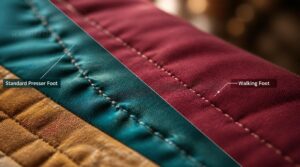
Feeding control is only half the story. The real payoff shows up in your finished stitches, where a walking foot’s steady grip makes a visible difference. Here’s what changes once that even feed kicks in.
Even Stitch Length
Every stitch should land the same distance apart, start to finish.
A walking foot delivers that kind of stitch spacing consistency by syncing top and bottom feed, even through dense layers.
Tension and length work together here: uneven feed throws off both.
Fabric thickness impact matters too — thick batting fights a regular foot, while even feed for upholstery-weight projects stays steady, stitch after stitch.
Cleaner Quilt Lines
Clean lines come down to one thing: layer control. A walking foot keeps every layer moving at the same pace, so minimizing stitch show on top becomes natural rather than a fight.
That even pull also manages batting shifting before it starts — no wandering lines, no seam puckering mid-project.
Line precision improves when your foot does the managing.
Less Seam Drift
Seam drift happens when layers creep sideways at the seam, throwing off alignment row by row. A walking foot counters this by synchronizing upper and lower feed dogs, so every layer advances at the same rate.
- Use basting or spray starch to stabilize fabric before sewing
- Keep stitch length between 2.0–2.5 mm for consistent layer control
- A seam allowance guide prevents lateral offset across rows
- Reduce presser foot pressure slightly on thick multi-layer sections
- Sew at moderate machine speed so the upper feed engages fully
Fewer Bulky Seam Issues
Bulk builds up fast in a quilt sandwich — multiple layers pressing against a single feed system creates uneven compression and thread tension problems. A walking foot distributes presser foot pressure evenly across all layers, so fabric feeds without stacking up under the needle.
Grade seam allowances before you sew, trimming each layer slightly narrower than the last. Then trim excess bulk from corners. Press seams open with a steam iron to flatten intersections. Managing needle tension carefully on thick sections prevents thread from digging into compressed layers and distorting the finished seam.
Better Pattern Matching
Pattern matching hinges on one thing: every layer moving at the same rate. A walking foot makes that possible by syncing the top and bottom fabric simultaneously.
Whether you’re chasing stripe continuity across a seam or nailing pattern repeat consistency in plaid blocks, even feed keeps motifs aligned. Use visual reference marking on your fabric so you can track layer alignment stitch by stitch.
Best Uses for Quilting Feet
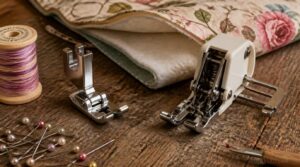
A walking foot earns its place when your project demands more than a regular foot can deliver. Knowing exactly where it outperforms gives you a real edge in choosing the right tool before you even thread your machine. Here are the situations where a quilting foot is the clear choice.
Quilt Sandwiches
A quilt sandwich is the paramount test for any presser foot. You’ve got three layers — quilt top, batting, and backing — and they all need to move as one.
That’s exactly where a walking foot earns its place. Its upper feed dogs sync with the lower feed dogs, locking all layers together so nothing drifts, puckers, or shifts mid-stitch.
Thick Fabric Layers
Heavy fabrics — denim, canvas, fleece-backed layers — can increase total weight by up to 60 percent, forcing your machine to work harder with every stitch. Needle penetration depth matters here. Set your stitch length between 2.5 mm and 3 mm to clear the bulk cleanly.
A walking foot accommodates thick layers by preventing layer compression from creating uneven seam ridges that a regular foot simply can’t correct.
Slippery Fabrics
Satin, silk charmeuse, and vinyl share one problem: they glide out from under a regular foot before the feed dogs can do their job. Hydrophobic fibers like polyester have low surface energy, making fabric slippage almost inevitable without the right tool.
A walking foot grips both layers simultaneously, so the feed rate stays consistent from start to finish.
Key strategies:
- Use tissue paper or stabilizer underneath slippery layers to temporarily increase friction
- Reduce presser foot pressure slightly to prevent fabric puckering
- A Teflon foot works alongside a walking foot on coated or faux-leather surfaces
Stretch Knit Fabrics
Stretch knits like jersey and interlock move constantly — they stretch, recover, and shift under pressure. A walking foot keeps both layers feeding at the same rate, preventing fabric puckering and stitch distortion.
| Factor | Walking Foot Advantage |
|---|---|
| Elastane recovery | Feeds without overstretching loops |
| Needle selection | Use ballpoint to avoid snags |
| Stitch flexibility | Allows stretch stitches cleanly |
| Fabric gauge | Accommodates fine to mid-weight knits |
Plaids and Stripes
Lining up a grid takes patience, not luck. A walking foot feeds both layers evenly, so your plaid seam continuity and stripe alignment hold steady instead of drifting off-grid mid-seam.
- Match balance points at center front and side seams
- Square up large pattern repeats before cutting
- Watch for bias cut distortion on diagonal pieces
- Pin generously near curves for precision sewing
Best Uses for Regular Feet
Not every project calls for a walking foot, and that’s fine. Your regular presser foot still earns its keep on plenty of everyday sewing tasks. Here’s where it does its best work.
Stable Woven Fabrics
Stable woven fabrics — cotton, linen, poplin, chambray — are where a regular presser foot truly earns its place.
Their plain weave properties create tight warp and weft interlacing, giving you dimensional stability that resists skewing, puckering, and seam drift without any help from a walking foot. Balanced warp‑weft tension means your seam allowance stays clean, and selvedge construction keeps fabric width consistent from cut to finish.
Short Straight Seams
Short straight seams — think sleeve plackets or waistband ends — are where a regular foot manages everything cleanly.
Set your stitch length to 2.0–2.5 mm, align the grain, and let the feed dogs do the work.
A straight-stitch foot keeps your seam allowance precise at ¼ to ⅜ inch without overcomplicating the setup.
Everyday Garment Sewing
Button plackets, collars, set-in sleeves — your regular presser foot manages standard garment construction without a fuss.
It’s reliable for seam finishing, basic topstitching, and pattern alignment at darts or notches.
Skip the walking foot here; switching feet for every seam just slows you down.
Save it for fabrics with real bulk or slip — wovens like quilting cotton don’t need that extra grip.
Lightweight Cotton Projects
When your project calls for cotton lawn, voile, or poplin — fabrics weighing around 60–100 gsm — a regular presser foot is all you need. Prewash your fabric first to prevent post-stitch shrinkage.
- Use a 70/10 or 75/11 needle for cleaner punctures
- Apply lightweight fusible interfacing at collars and facings
- Finish edges with a narrow rolled hem on sheers
Basic Topstitching
For clean topstitching, a regular straight-stitch foot is all you need.
Set your stitch length to 3.0–3.5 mm for defined, visible lines.
Match your needle to the fabric — a 90/14 for medium wovens works reliably.
Choose polyester thread for durability or cotton for a classic finish.
A slightly reduced presser foot pressure prevents tunneling and keeps your seams flat.
Quilting Foot Types Compared
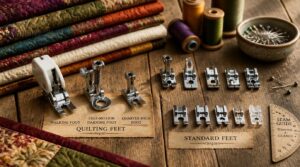
Quilting foot" isn’t just one tool, it’s a whole toolbox. Each variation covers a different job, from anchoring layers to tracing perfect seams. Here’s how the main types stack up against each other.
Walking Foot
The walking foot — also called an even-feed foot — is the workhorse of quilting presser feet. Its dual-feed mechanics grip your fabric from both the top and bottom simultaneously, moving all layers at the same rate.
Key advantages:
- Even-feed synchronization prevents the top layer from lagging behind
- Stops fabric slippage on satin, fleece, and vinyl
- Maintains layer alignment across thick quilt sandwiches
- Reduces puckering on multi-layer seams
Quarter-inch Foot
For patchwork precision, nothing beats the quarter-inch foot. Its built-in guide aligns directly with the needle, locking in a fixed ¼-inch seam allowance every time.
You’ll find scant and standard versions, plus open-toe variants for better visibility.
Snap-on and screw-on options guarantee machine compatibility, while regular seam guide maintenance keeps indexing accuracy sharp for tight, well-matched piecing.
Free-motion Foot
The free-motion foot trades control for creative freedom. Unlike a walking foot, it uses manual fabric guidance — you move the material; the machine just stitches.
Drop or cover your feed dogs, lower presser foot tension slightly to reduce puckering, and you’re steering.
Its open-toe visibility keeps freeform quilting lines clear, making curves and organic shapes genuinely achievable.
Stitch-in-the-ditch Foot
The stitch-in-the-ditch foot does one thing exceptionally well: it locks your needle directly over the seam line. Its narrow inner slot centers each stitch invisibly in the seam ditch.
Use matching thread, and the topstitching virtually disappears.
The low-profile body improves visibility across patchwork seams, and the built-in edge guide keeps long quilting runs steady without constant repositioning.
Open-toe Quilting Foot
Picture stitching a curve with no view of your needle — risky, right? The opentoe foot fixes that. Its open front gives full needle visibility, perfect for tracing pattern accuracy and decorative stitch control.
The wide clearance accommodates bulky seam crossings easily, while excellent visibility for quilting assists precise, free-motion quilting and confident, precision sewing around curves on any quilting presser feet setup.
Fit, Shank, and Attachment
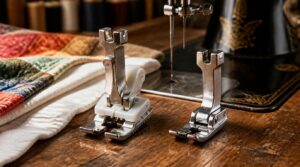
A walking foot only works if it actually fits your machine. Shank type and attachment style decide whether it sits straight or tilts off course. Here’s what to check before you buy or install one.
Low Shank Machines
Workhorse and unfussy, the low shank machine sits at the center of most home sewing rooms. The shank attachment type measures roughly ¾ inch below the needle bar, giving you snap-on foot mechanics with no screws required.
This low shank compatibility means:
- Quick foot swaps mid-project
- Wide brand availability
- Easy walking foot attachment
- Affordable regular presser foot options
- Reliable foot replacement access
High Shank Machines
Step up from low shank, and you’ll find high shank machines built for muscle. This shank measures about one inch or more, giving real shank clearance benefits for thick batting and heavyweight fabric support.
| Feature | Low Shank | High Shank |
|---|---|---|
| Shank Height | ¾ inch | 1+ inch |
| Foot Mounting | Snap-on | Screw-on, specialized |
| Best For | Everyday sewing | Industrial machine durability |
High shank adapters expand machine shank compatibility further.
Snap-on Feet
Snap-on feet are the fastest attachment style you’ll find. A quick-release lever locks the foot in place — no tools needed. That means swapping between a walking foot and an open-toe quilting foot takes seconds, not minutes.
Most snap-on feet suit low shank machines, but universal adapters exist for broader compatibility. Keep the snap mechanism lint-free for a secure fit every time.
Screw-on Walking Feet
Screw-on walking feet take a different approach than snap-on. You’ll need a screwdriver to secure the set screw firmly against the shank. Remove your standard adaptor first, align the foot’s lever with the needle clamp, and tighten carefully — no cross-threading.
The hardened steel construction accommodates heavy quilting sessions reliably, and some models include a rubber bumper to reduce vibration during stitching.
Needle Clamp Alignment
Beyond shank type, your walking foot’s performance depends on needle clamp alignment. A loose or shifted needle bar causes skipped stitches, fabric drift, or rubbing noise — clear misalignment symptoms.
Use a small screwdriver for micro-adjustments, checking needle clearance against the plate. Loosen, center, retighten, then test stitch uniformity on scrap fabric.
Proper alignment prevents needle bar wear and keeps your machine setup reliable.
Choosing The Right Foot
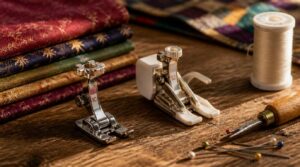
With both feet explained, the real question is which one belongs on your machine right now. That answer comes down to a handful of practical factors, not guesswork. Run through these five before you sew your next seam.
Fabric Thickness
Thickness isn’t just about weight. Fabric density, yarn size, and finishing all change how a layer feels under the needle, and moisture can shift it further before drying.
For heavyweight fabrics or a quilt sandwich, a walking foot works with bulk seam areas far better than a regular foot, keeping stitches even no matter how thick the layers are.
Layer Count
Three layers or more are where regular feet fall apart. A quilt sandwich — top, batting, backing — demands multi-layer stability that only a walking foot can deliver.
Without upper feed dogs, your top layer lags behind, shifting with every stitch. The result is layer shift and misaligned seams. More layers mean more risk.
Use a walking foot.
Seam Accuracy Needs
How precise does your seam really need to be? That answer drives your foot choice.
For patchwork accuracy, a quarter-inch or stitchguide foot locks in precision seam allowance every time. A stitchintheditch foot keeps topstitching invisible along seam lines.
- Crisp, matching corners on every block
- No frustrating un-picking sessions
- Patterns that align like they’re meant to
- Confidence in every seam guide line
- Pride in perfect precision stitching
Maintaining thread tension prevents stitch drift and fabric puckering throughout.
Machine Compatibility
That fancy walking foot won’t help if it doesn’t fit your machine. Check your shank type first — low, high, or slant — since machine shank height determines what attaches correctly.
Some brands use proprietary snap systems requiring their own feet, while others support universal adapters.
Newer machines with electronic foot detection auto-adjust settings.
Always confirm brand certification before buying.
Budget Considerations
Good feet aren’t cheap, but cheap feet aren’t good either. Basic regular feet run 5-15 euros; quilting walking feet land between 25-80 euros, with alignment guides pushing past 100.
Weigh price vs quality: aftermarket compatibility issues plague bargain feet.
Buy bundles for savings, check resale value (40-60% retained), and prioritize long-term durability over upfront cost when budgeting sewing notions.
Frequently Asked Questions (FAQs)
When to use a quilting foot?
Use a walking foot when tackling layered fabric management — specifically quilt sandwiches, slippery textiles, or bulky batting. It prevents seam drift and improves stitch precision across every layer simultaneously.
Can walking feet work with decorative stitch patterns?
Yes, walking feet work well with many decorative stitches. Match stitch width to the foot opening, test on scrap first, and adjust thread tension to keep patterns feeding evenly across layers.
How do walking feet handle curved seam lines?
Picture stitching a curved fan block: dual-feed curve control grips both layers, while the guide bar tracks radius. Open-toe visibility offers precise pivoting, minimizing fabric drift and delivering clean, drift-free stitch quality.
Does foot weight affect machine wear over time?
Yes, foot weight does affect machine wear over time. Heavier feet increase motor torque, accelerate bearing vibration, and can loosen mounting hardware — shortening component life if maintenance schedules aren’t adjusted accordingly.
Can regular feet be used with quilting guides?
Yes, a regular presser foot can work with a quilting guide. Attach it securely, test on scrap fabric first, and confirm your machine’s shank style accommodates the guide before starting.
How does foot choice affect thread tension settings?
Your foot choice directly shifts thread tension needs. A walking foot allows slightly lower upper tension across layers. Regular feet often need tighter tension matching to avoid puckering or skipped stitches on thicker fabric.
Conclusion
A bad craftsman blames his tools—but a smart one simply chooses better ones. Understanding the difference between quilting and regular presser feet isn’t about collecting equipment.
It’s about matching the right mechanism to what your fabric actually needs. Thick layers demand dual feeding. Slippery fabrics need top-side grip.
Once your foot works with the fabric instead of against it, your seams stop fighting you. That’s not luck. That’s control.
- https://www.goldstartool.com/blog/walking-foot-vs-regular-foot-whats-the-difference.htm
- https://madamsew.com/blogs/sewing-blog/why-and-when-to-use-a-walking-foot-on-your-sewing-machine
- https://www.sewessential.co.uk/blogs/sewing/sewing-machine-presser-feet-guide
- https://bethannwilliams.com/2023/05/03/my-top-5-specialty-presser-feet-for-quilters
- https://www.bobbininquilts.com/blogs/news/my-three-favorite-presser-feet-for-quilting