This site is supported by our readers. We may earn a commission, at no cost to you, if you purchase through links.

Most women own at least six bras, yet fewer than one in four wears a correctly fitted one. The strap is usually where the problem starts—either cutting into shoulders by midday or sliding off with every arm movement. What makes this frustrating is that the fix takes about 60 seconds and no special tools.
Straps do more than hold fabric in place. They work alongside the band to distribute weight, keep cups aligned, and protect your posture throughout the day. When the tension is off, your body compensates in ways you don’t notice until you’re sore.
Adjusting bra straps for fit is a small habit that changes how every bra you own feels.
Table Of Contents
Key Takeaways
- Your band does 80% of the support work, so always check its fit before touching the straps—tight straps are often a symptom of a loose band, not the real problem.
- The one-finger rule is your fastest calibration tool: slide a finger under each strap at the shoulder, and if they’re too snug or slip right through, adjust until it’s just snug enough to stay put.
- Uneven strap lengths aren’t a flaw—your shoulders naturally differ, so adjust each side independently until both sit flat and comfortably on their own.
- Wash cycles quietly loosen elastic and shift sliders, so a quick re-adjust after every wash keeps the fit you dialed in from slowly drifting away.
Why Bra Straps Affect Fit

Bra straps do more than hold things in place — they directly affect how comfortable and supported you feel all day. Getting the tension right can mean the difference between straps that dig in and ones you forget you’re wearing.
A few small tweaks go a long way, and adjusting bra straps for a better fit is one of the easiest ways to transform how a bra feels throughout the day.
Here’s what you need to know about how straps actually work.
How Straps Support Comfort and Stability
Straps do more than hold things in place — they’re the active support system keeping everything comfortable through a full day of movement. Good bra strap ergonomics means the elastic recovery keeps tension steady, while grip surfaces and material breathability prevent slipping and irritation.
Think of it like pressure mapping across your shoulder: proper bra strap length distributes weight evenly, making shoulder comfort seamless rather than something you’re constantly fighting.
Proper strap length maps pressure evenly across your shoulder, turning comfort into something you feel — not something you fight
Why The Band Should Carry Most Support
Your bra band does the heavy lifting — about 80% of the support, to be exact. Proper bra band fit creates wide band stability, keeping straps from overworking.
With silicone gripper edges and core elasticity retention, a well-fitted band controls load distribution naturally.
When adjusting your bra straps, always check band fit first — tight straps often signal a loose band, not a strap problem.
How Strap Tension Affects Posture
Tension does more than keep your bra in place — it quietly shapes how you carry yourself all day.
Too tight, and shoulder muscle load increases as your upper trapezius compensates.
Too loose, and scapular alignment shift creeps in, nudging you toward rounded shoulders.
Uneven bra strap tension creates asymmetrical tension, subtly tilting your posture sideways.
Getting strap tension adjustment right enhances genuine posture improvement.
Signs Strap Fit is Too Tight or Too Loose
Your body usually tells you when something’s off. Watch for these three signals:
- Too tight: Red marks, shoulder groove indentations, or numbness or tingling after just a few hours of wear.
- Too loose: Straps slip, the band rides up, or bra strap looseness causes cup distortion.
- Posture clue: Forward shoulder tilt often means it’s time for strap tension adjustment.
Consider using silicone strap cushions to prevent slipping.
Check Band and Cups First

Before you touch the straps, take a closer look at how your band and cups are fitting.
Strap problems are usually symptoms, not the root cause. Here’s what to check first.
Why a Loose Band Causes Strap Problems
Think of your band as the foundation of a house — if it shifts, everything above it does too. Slack band dynamics put the straps under a heavier load than they’re built to handle, triggering a chain reaction of strap load shift and stability loss.
Over time, that added strain can wear down your motor faster than expected, so knowing when and how to replace a failing sewing machine motor can save you from a much bigger repair down the line.
That band-strap interaction mean adjusters wear faster, straps keep sliding up, and no amount of tightening actually fixes the real problem.
How to Tell if The Band Rides Up
Spotting a riding band issue is easier than you think. Raise your arms overhead — if the back band lifts away from your ribcage, that’s your sign.
Check for these four telltale signals:
- Back band elevation above your shoulder blades
- Front center gap pulling away from your chest
- Upper back tension or shoulder bone pressure from overworked straps
- Band sits level standing but shifts during movement
Adjusting bra strap length won’t fix this — the band does.
Cup Fit Issues That Change Strap Tension
Cup fit quietly drives strap tension more than most people realize. Cup Overflow pushes tissue outside the edge, so you instinctively start tightening bra straps to compensate.
Foam Lining Compression changes how a molded cup hugs your chest, shifting Cup Seam position with every adjustment. Breast Volume Asymmetry means each side behaves differently — a built-in part of adjusting bra strap length correctly.
| Cup Issue | What Happens | Strap Effect |
|---|---|---|
| Cup Overflow | Tissue escapes the edge | You over-tighten to compensate |
| Molded Cup Tension | Cup pulls from chest wall | Creates uneven cup sit |
| Foam Lining Compression | Top edge gaps or folds | Straps feel perpetually loose |
When Uneven Strap Adjustment is Normal
Uneven straps don’t always mean something’s wrong. Natural shoulder variance means your left and right sides naturally differ, so one strap sitting slightly longer — within about 1.5 cm — is completely normal.
Minor elasticity loss, fabric grip disparity, activity-induced slip, and temporary moisture effects all shift tension throughout the day.
If the band stays level and cups sit correctly, minor unevenness is fine.
Signs The Bra Size May Be Wrong
Sometimes the straps are just telling you what the bra can’t hide. If you’re dealing with cup spillage over the top or sides, a center gore that won’t lie flat, or underwire pinching along breast tissue, those aren’t strap problems — they’re size problems.
Asymmetrical cups, elastic stretch that fades quickly, or a band size that rides up despite adjustment all point to diagnosing common bra fit issues. Seek professional bra fitting guidance for solutions.
Adjust Bra Straps Step by Step
Now that your band and cups are sitting right, it’s time to dial in the straps. The process is simpler than it sounds — just a few small moves that make a real difference.
Here’s how to work through each step.
Find The Strap Slider or Adjuster
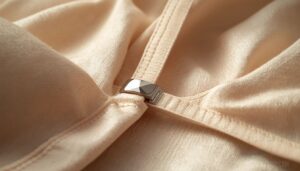
Before adjusting your bra straps, you need to find the slide adjuster — a small metal or plastic piece threaded onto each strap.
Slider identification is straightforward once you know what to look for:
- Slider location: It sits between the cup and your shoulder blade.
- Slider material: Metal or plastic, depending on the bra style.
- Slider mechanism: It grips the strap and holds your chosen length.
Loosen Straps Before Putting on The Bra

Loosen each strap completely before putting the bra on. This step enables easier cup alignment and keeps shoulder strain low from the outset. By sliding into loose straps, you speed up the dressing process and establish balanced initial tension across both sides.
This approach also prevents premature wear on the elastic before any adjustments are made.
How to Tighten Straps Correctly

With loose straps in place, grip the slider firmly—that’s your Slider Grip Technique—and pull the front section toward the cup.
Apply the Even Tension Test: check both sides match.
Do a Breathing Pressure Check; straps should flex slightly when you inhale.
Use the Shoulder Alignment Cue: one finger fits underneath, snug but never tight.
How to Loosen Straps Correctly

Tightening is straightforward, but loosening needs just as much care. Hold the adjuster firmly, then use a gentle adjuster glide—push it toward the cup to release tension gradually. This shoulder pressure reduction keeps things balanced, not slack.
As part of any pre-wear strap check, perform a quick elastic stretch assessment on both sides. Loosen and adjust them symmetrically for balanced tension testing.
Set Each Strap for One-finger Space

Once both straps feel snug, apply the one-finger guideline: slide one finger under each strap at the shoulder. You want exactly a finger’s width of space — not a gap, not a squeeze.
Do an active movement check by lifting your arms overhead. Factor in fabric thickness if you’re layering.
Use these visual anchor points to adjust symmetrically on each side.
Adjust Left and Right Straps Separately

Most people aren’t perfectly symmetrical — and that’s completely normal. Use the adjuster on each strap independently, treating left and right as separate adjustments rather than a matched pair. This dual adjuster technique lets you personalize shoulder mapping on both sides.
Adjust symmetrically as a starting point, then fine-tune individually until each strap sits flat, snug, and comfortably on its own shoulder.
Fix Common Strap Fit Problems
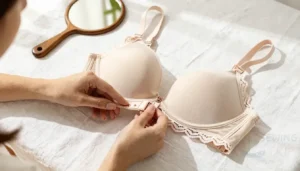
Even when you’ve followed every adjustment step, certain problems still show up — and they usually point to something specific. Each issue has its own fix, and most are easier to solve than you’d think.
Here’s what to look for and how to handle it.
Straps Digging Into Shoulders
Digging straps usually mean one thing — your band isn’t pulling its weight. When the band is too loose, your straps compensate, creating painful pressure points across your shoulders. First, loosen strap tension, then check your band.
Wider straps distribute load better, reducing skin irritation triggers. After workouts, post-workout adjustments matter, as moisture-induced slipping causes unconscious over-tightening.
Elastic fatigue timelines shorten with heat and sweat, accelerating wear.
Straps Slipping Off The Shoulders
Slipping straps often come down to shoulder anatomy — narrow or sloped shoulders simply give the strap less surface to grip. Sweat-induced slip exacerbates the issue, as moisture rapidly reduces clothing friction.
To address this, tighten each strap until one finger fits snugly underneath, then inspect for elastic fatigue. For persistent slipping, straps featuring friction-enhancing coatings or silicone liners provide effective solutions when basic adjustments prove insufficient.
Bra Riding Up in Back
When your band rides up in back, tight straps are usually pulling it there — not helping it stay put. Over-tightened straps tilt the entire bra upward, creating a bra strap sliding up band issue that no strap adjustment methods can fully fix alone.
Check these first:
- Band fit: A loose band loses material grip coefficient against your ribs
- Closure alignment issues: Hooks sitting off-center shift back panel construction and encourage creep
- Strap elasticity: Worn elastic forces straps to overcompensate
- Shoulder blade tilt: Rounded posture changes seam placement impacts and lifts the back edge
Straps That Will Not Stay Adjusted
Slider grip weakens when hardware wear sets in, especially on satin or smooth fabrics prone to fabric slip. Elastic fatigue causes tightened straps to creep loose within hours, while a longer tail length allows the strap to drift.
To address this, try strap adjustment methods like knotting the tail or replacing worn hardware to effectively tighten bra straps and prevent sliding for good.
Non-adjustable Strap Quick Fixes
Non-adjustable straps don’t have to be a lost cause. A silicone grip sleeve slipped over the strap grips your shoulder without any sewing. Double-sided tape works surprisingly well under sleeveless tops. For a firmer fix, a heat-molded pad or hook counter supports holds position throughout the day.
Even a fabric softener soak smoothes rough edges that dig in.
When Strap Problems Mean Replacement
Sometimes quick fixes only go so far. If you notice frayed edges, hardware corrosion on the sliders, or elastic loss that no amount of tightening can correct, it’s time to stop patching and start replacing worn-out bra straps.
Strap elongation and padding degradation are real signs of strap wear and tear. When bra strap repair stops working, bra strap replacement is the smarter move.
Choose and Maintain Better Straps

Getting the fit right is only half the battle—keeping it that way takes a little know-how.
The strap style you choose and how you care for your bra both play a bigger role than most people realize.
Here’s what to focus on.
Best Strap Styles for Shoulder Shape
Your shoulder shape matters more than you might think when choosing a strap style. Here’s a quick guide:
- Narrow or sloping shoulders — Racerback straps, criss-cross straps, or a leotard-back design keep straps from sliding off.
- Broad shoulders — Adjustable width straps and contoured padded straps spread weight evenly and prevent digging.
- Uneven shoulders — Halter straps or crossback straps offer the flexibility to balance tension on each side.
Racerback and Convertible Strap Options
Once you’ve matched straps to your shoulder shape, consider how your outfits factor in. A J-Hook Mechanism lets you clip convertible straps into a racerback conversion in seconds — no new bra needed. These racerback conversion hacks are perfect for Backless Outfit Compatibility.
Some styles even feature Ventilation Mesh Panels at the back, enhancing comfort for such designs.
Convertible Bra Versatility means one bra manages multiple looks effortlessly.
Wider Straps for Better Weight Distribution
Wider straps—think 1.5 inches or more—improve load distribution by spreading weight across your shoulder instead of concentrating it on one narrow line. This design choice delivers shoulder pressure relief you can feel by day’s end.
Padding integration adds another cushioning layer, enhancing comfort during extended use.
Material reinforcement ensures the strap resists twisting, even under activity-specific width demands.
Re-adjusting Straps After Washing
Every wash shifts things a little—laundry slack creeps in, and straps that fit perfectly yesterday may feel looser today. That’s why a post-wash check matters.
- Do slider reseating by moving each adjuster up and down after drying
- Hand wash and air dry to minimize drying impact on elasticity
- Recheck tension restoration with the one-finger space test
- Confirm bra strap adjustment feels even on both sides
Protecting Strap Elasticity With Proper Care
Caring well for your straps makes a real difference. Gentle handwash with mild soap and lukewarm water is the simplest way to slow elasticity loss—machine cycles stretch fibers fast. Pat dry, then lay flat for Flat Storage, away from direct sunlight.
Sun Protection and Heat Avoidance both matter here, since UV and temps above 140°F degrade elastic quickly.
Moisture Control after each wash preserves bra strap elasticity longer.
When Worn Straps Need Repair or Replacement
Watch for material fatigue signs like cracking, fraying, or visible sag—these signal elasticity loss that no amount of tightening can fix. Such wear indicates straps have reached their limit and cannot recover tension effectively.
If the adjuster malfunction prevents proper tension from holding, or if you notice two or more wear indicators, replacement becomes necessary. These combined issues confirm the straps are no longer functional.
A professional re-stitching by a tailor is more affordable than DIY techniques might suggest. This service offers a durable, cost-effective solution, making it worth the investment over makeshift modifications.
Frequently Asked Questions (FAQs)
How do you make bra straps fit?
Getting bra straps to fit right starts with your band — not the straps themselves.
Slide each bra strap slider until one finger fits snugly underneath, then move and adjust from there.
How to adjust bra straps correctly?
Slide the adjuster lock along the strap, tighten until one finger fits underneath, then align with your shoulder anatomy for balanced, comfortable support.
How do you know if your bra straps are too loose?
Loose bra straps show up fast.
Look for a visible gap between the strap and your shoulder, or try the arm raise test — if they slip, it’s time to loosen bra straps and readjust.
What to do if your bra straps are too long?
Move the strap slider toward the cup to shorten the length. If that doesn’t help, try shortening the strap by sewing, a simple knot, or a double loop.
Persistent issues may mean bra replacement.
How do bra materials affect strap fit?
The fabric your straps are made from changes how they feel and hold.
Elastane proportion affects stretch, while polyester rigidity maintains position.
Cotton stiffness reduces give, and mesh breathability cuts heat.
Silicone grip prevents sliding.
Can strap adjusters wear out over time?
Yes, they can. Over time, material fatigue, corrosion risk from sweat, and daily friction shorten any adjuster’s lifespan.
Watch for wear indicators like slipping or grinding — clear signs the replacement schedule is overdue.
Do different sports bras require specific adjustments?
Different sports bras require specific adjustments based on activity. High-impact tension keeps straps snug for running, while medium-impact settings balance lift for cycling. Low-impact adjustments prevent digging during yoga.
Always perform a post-warmup recheck to ensure optimal fit and comfort.
How to prevent strap irritation on sensitive skin?
Sensitive skin reacts quickly. Use moisture-wicking liners, hypoallergenic materials, and bra strap padding as a skin barrier layer.
Rotate strap placement daily and choose gentle adjuster designs to prevent chafing before it starts.
Are there techniques for enhancing strap durability?
Yes — material reinforcement, stitching upgrades, and protective coatings all help. Rotate straps, follow care instructions for extending bra lifespan, and replace worn-out bra straps before elastic loss affects support.
Can I convert regular straps to racerback style?
Convert regular straps to racerback style using clip compatibility tools, DIY stitching, or J-hooks for bulk minimization.
These racerback conversion hacks make bra strap conversion simple and safe without special equipment.
Conclusion
Small shifts, serious comfort—that’s the real promise behind adjusting bra straps for fit. When each strap sits right, your whole body feels the difference: no digging, no sliding, no midday tension creeping up your neck.
Check the band first, set that one-finger space, and re-adjust after every wash. You now have every step to get there.
A bra that fits well doesn’t demand your attention—it just quietly does its job, all day long.
- https://www.herroom.com/bra-accessories-band-extenders,901,30.html
- https://pmc.ncbi.nlm.nih.gov/articles/PMC5005736/
- https://www.alterationsneeded.com/find-a-bra-specialist
- https://pubmed.ncbi.nlm.nih.gov/15456033/
- https://www.mychiro.com.au/blog/posture-corrector-warning-what-spine-specialists-wont-tell-you/