This site is supported by our readers. We may earn a commission, at no cost to you, if you purchase through links.
A worn-out operator spending 40 minutes per job manually swapping threads isn’t a skill gap—it’s the wrong machine. The difference between a 10-needle and a 15-needle unit can collapse that time by 18%, and at steady production volume, that gap compounds into real money.
Needle count, field dimensions, stitch speed, software connectivity, and total cost of ownership each pull the decision in a different direction.
The best commercial embroidery machines reviewed here span $1,179 to $11,000, and the right choice depends entirely on what your workload actually demands—not what the spec sheet makes sound impressive.
Table Of Contents
- Key Takeaways
- Top 10 Commercial Embroidery Machines Reviewed
- 1. Smartstitch S1501 Commercial Embroidery Machine
- 2. BAi Mirror 15 Needle Embroidery Machine
- 3. Smartstitch S1001 Commercial 10 Needle Embroidery Machine
- 4. BAi Vision 2 Head Commercial Embroidery Machine
- 5. Smartstitch S1201 Compact 12 Needle Embroidery Machine
- 6. Smartstitch Beast Dual Head Embroidery Machine
- 7. Poolin EOX 15 Needle Embroidery Machine
- 8. BAi Vision 15 Needle Embroidery Machine
- 9. Brother PE900 Wireless Embroidery Machine
- 10. Brother NQ1700E Large Embroidery Machine
- Commercial Machine Comparison Factors
- Business Production Requirements
- Total Cost and ROI
- Support, Training, and Reliability
- Frequently Asked Questions (FAQs)
- Conclusion
Key Takeaways
- Upgrading from a 10-needle to a 15-needle machine cuts multi-color job time by up to 18%, and at steady production volume, that efficiency gap compounds into real profit gains.
- Your true cost of ownership runs $3,000–$10,000 above the sticker price once you factor in installation, electrical, ventilation, and network infrastructure — so budget accordingly before you commit.
- Dual-head machines like the BAi Vision 2 Head double your output without expanding your footprint, but at 800 lb and $11,000, they’re a serious operational commitment, not a casual upgrade.
- The Smartstitch S-1501 hits the sweet spot for small-to-medium shops at $5,299, delivering 15 needles, 1,200 SPM, and a 14-month ROI under consistent production volume.
Top 10 Commercial Embroidery Machines Reviewed
Picking the right commercial embroidery machine can make or break your production workflow and bottom line. Each machine below was evaluated on speed, needle count, embroidery area, and real-world ROI — the numbers that actually matter to your business.
If you’re still weighing your options, browsing commercial embroidery machines for sale side-by-side can help clarify which specs align with your actual production volume.
Here’s what made the cut.
1. Smartstitch S1501 Commercial Embroidery Machine
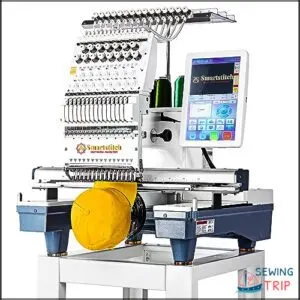
The Smartstitch S-1501 is the machine serious production shops keep coming back to — and the numbers explain why. At $5,299, you get 15 needles, a 14″ × 20″ embroidery field, and a top speed of 1,200 SPM.
This combination alone cuts multi-color job time by up to 18% through automatic color changes.
The 12-inch touchscreen enables fast on-machine edits, while built-in Wi-Fi ensures seamless design workflow management.
For small-to-medium commercial operations, this setup is difficult to argue with.
| Best For | Small-to-medium commercial embroidery shops that need to run high-volume, multi-color jobs without stopping every five minutes to swap threads. |
|---|---|
| Needle Count | 15 needles |
| Max Stitch Speed | 1,200 SPM |
| Embroidery Area | 14″ x 20″ |
| Connectivity | Wi-Fi & USB |
| Touchscreen | 12-inch LCD |
| Price | $5,299 |
| Additional Features |
|
- 15 needles with automatic color changes means you can load up a complex design and let it run — way less babysitting.
- The 14″ × 20″ field combined with 1,200 SPM keeps big jobs moving fast, which adds up when you’re doing bulk runs.
- The 12-inch touchscreen makes edits and setup pretty straightforward, even if you’re not a seasoned pro.
- No automatic needle threading — you’re doing that by hand every time, which gets old fast on a 15-needle machine.
- There’s no low-bobbin alert, so you have to check manually or risk a ruined run mid-job.
- At $5,299 and 209 lbs, this isn’t something you’re sliding into a spare corner — it needs space, a solid setup, and a real budget commitment.
2. BAi Mirror 15 Needle Embroidery Machine
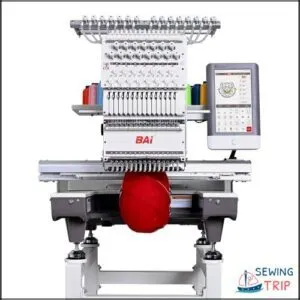
The BAi Mirror is the bigger-field sibling of the S-1501 workhorse. At $6,400, its 20" × 14" embroidery area and 15-needle setup effortlessly handle large-format logos and hat runs.
The Institch I5 touchscreen simplifies job setup, while Wi-Fi transfers designs in under 30 seconds. These features streamline workflow efficiency for high-volume operations.
Built-in LED lighting, automatic thread trimming, and a laser positioning system minimize errors per run. This precision is critical when pushing volume daily, ensuring consistent, error-free output.
| Best For | Small business owners, custom shops, and Etsy sellers who need industrial-level speed and a wide embroidery field without the full industrial price tag. |
|---|---|
| Needle Count | 15 needles |
| Max Stitch Speed | 1,200 SPM |
| Embroidery Area | 20″ x 14″ |
| Connectivity | Wi-Fi & USB |
| Touchscreen | 5-inch LCD |
| Price | $6,400 |
| Additional Features |
|
- Huge 20" × 14" embroidery area handles large logos and multi-design runs with ease
- Cap embroidery at 850 SPM is roughly double what most comparable machines offer, meaning faster turnaround on hat orders
- Comes loaded with accessories and free design software, so you’re not nickel-and-dimed after the initial purchase
- At 391 lbs, moving this thing is a real project — you’ll want a pallet jack or a couple of strong friends
- Wi-Fi file transfers are convenient until your network acts up, and then you’re scrambling for a USB workaround
- There’s a real learning curve jumping to 15-needle operation, so budget time for training before you go full production
3. Smartstitch S1001 Commercial 10 Needle Embroidery Machine
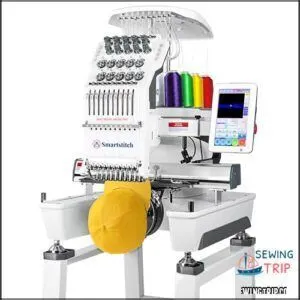
Not every shop needs 15 needles to run profitably. The Smartstitch S1001 makes a strong case for the 10-needle tier — priced at $3,959, it hits 1,200 SPM and covers a 9.5" × 14.2" field that manages caps, bags, denim, and leather without complaint.
Laser positioning keeps placement tight, and automatic color-changing cuts down manual thread swaps during multi-color runs.
At 93 lb with a 25" × 34" footprint, it fits cleanly into a small shop without major workspace rearrangement.
| Best For | Small shop owners and serious hobbyists who want commercial-grade multi-color embroidery without jumping to a 15-needle machine. |
|---|---|
| Needle Count | 10 needles |
| Max Stitch Speed | 1,200 SPM |
| Embroidery Area | 9.5″ x 14.2″ |
| Connectivity | Wi-Fi & USB |
| Touchscreen | 7-inch LCD |
| Price | Not listed |
| Additional Features |
|
- Ten needles with automatic color-changing means you can run complex multi-color designs start to finish without stopping to swap threads manually.
- Laser-guided positioning takes the guesswork out of placement — great for hats, bags, and anything where alignment really matters.
- Comes with a full starter kit right out of the box, so you’re not hunting down frames, stabilizers, and accessories separately.
- At 93 lb with a sizable footprint, this machine needs a dedicated, stable spot — you’re not moving it around easily.
- Only DST and DSB files are supported, so any designs in other formats need to be converted before you can use them.
- Returns require original packaging, accessories, and documentation all intact, which can be a headache if you’ve already dug in.
4. BAi Vision 2 Head Commercial Embroidery Machine
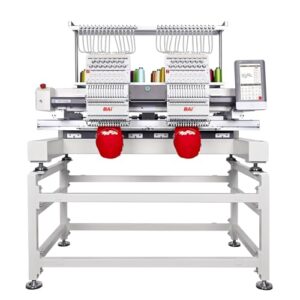
If your order volume is pushing past what a single head can handle, the BAi Vision 2 Head changes the math entirely. Two 15-needle heads run simultaneously across a 400 mm × 500 mm field at 1,200 SPM — doubling your output without doubling your floor space.
At $11,000 and 800 lb, it’s a serious investment, but Institch OS5, built-in cost calculator, and cloud fleet management mean you’re running a production operation, not just a machine.
| Best For | High-volume embroidery shops ready to scale production without expanding their footprint — especially those doing large commercial runs or high-margin hat work. |
|---|---|
| Needle Count | 15 per head (30 total) |
| Max Stitch Speed | 1,200 SPM |
| Embroidery Area | 15.7″ x 19.7″ |
| Connectivity | Wi-Fi & Cloud |
| Touchscreen | 10-inch LCD |
| Price | $11,000 |
| Additional Features |
|
- Two heads running at once means you’re basically doubling output for the same labor cost and floor space
- The built-in cost calculator takes the guesswork out of pricing jobs — you know your margins before you hit start
- Solid build (welded aluminum frame, German belts, Swedish bearings) means fewer breakdowns and a longer machine life
- At 800 lb, moving this thing isn’t a one-person job — you’ll need lift equipment just to get it in the door
- $11,000 upfront is a real barrier for smaller shops still finding their footing
- Support runs mostly at night, and occasional software glitches mean you could be waiting on fixes at inconvenient times
5. Smartstitch S1201 Compact 12 Needle Embroidery Machine
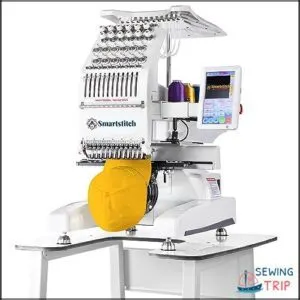
The Smartstitch S1201 hits a sweet spot for small to mid-size shops that don’t need maximum firepower — just consistent, reliable production. Its 12-needle setup performs automatic color changes across a 9.5″ × 12.6″ field at 1,200 SPM, ensuring multi-color runs move faster than expected at this price tier.
For shops ready to scale, exploring industrial embroidery machine types and capabilities helps clarify where the S1201 fits as production demands grow.
The machine’s 10-inch LCD, built-in Wi-Fi, laser positioning, and 100-million-stitch memory deliver real commercial capability without the footprint of a larger unit.
| Best For | Small business owners and home-based embroiderers who need reliable multi-color production without stepping up to a full commercial floor machine. |
|---|---|
| Needle Count | 12 needles |
| Max Stitch Speed | 1,200 SPM |
| Embroidery Area | 9.5″ x 12.6″ |
| Connectivity | Wi-Fi & USB |
| Touchscreen | 10-inch LCD |
| Price | Not listed |
| Additional Features |
|
- 12 needles with automatic color changes means you’re not stopping every few minutes to swap thread — great for batch orders
- Wi-Fi, USB, and a big 10-inch touchscreen make loading and running designs pretty straightforward
- Comes with a solid starter kit so you can actually start stitching the day it arrives
- At 86 lbs, "compact" is doing a lot of heavy lifting — you’ll probably need help moving it
- Support runs through a Facebook group based in China, so don’t expect a quick reply if something goes wrong at 9 AM your time
- The quality of your output is only as good as your digitized files — bad files mean bad results, full stop
6. Smartstitch Beast Dual Head Embroidery Machine
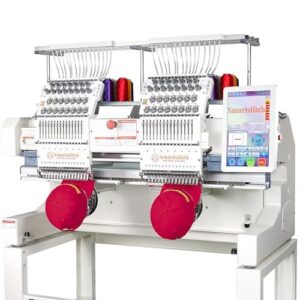
The Beast Dual Head is a production multiplier, featuring two independent 15-needle heads that stitch simultaneously across a 20″ × 16″ field per head. This design effectively doubles output without doubling labor.
Operating at 1,200 SPM and priced at $9,999, the machine handles two garments at once with advanced features: automatic color changes, thread-break detection, and a 12-inch Smart Control touchscreen managing both heads.
For shops processing 50+ orders daily, this investment pays for itself faster than expected, streamlining high-volume production efficiently.
| Best For | Small-to-mid-size embroidery shops running high-volume orders who need to double their output without hiring extra hands. |
|---|---|
| Needle Count | 15 per head (30 total) |
| Max Stitch Speed | 1,200 SPM |
| Embroidery Area | 20″ x 16″ per head |
| Connectivity | Wi-Fi & USB |
| Touchscreen | 12-inch LCD |
| Price | $9,999 |
| Additional Features |
|
- Two heads stitch simultaneously, so you’re essentially getting two machines in one — cuts production time nearly in half.
- Automation handles the tedious stuff (color changes, thread breaks, trimming), so you spend less time babysitting and more time running orders.
- Massive 20″ × 16″ field per head means you can tackle everything from caps and tees to leather and canvas without breaking a sweat.
- At 772 lbs, moving this thing is a serious undertaking — you’ll need at least six people or a forklift just to get it in place.
- The $9,999 price tag is a real commitment, so hobbyists or brand-new startups might want to wait until the business is more established.
- It takes up serious floor space and needs reinforced flooring to stay stable at full speed — not a great fit for tight or unfinished workspaces.
7. Poolin EOX 15 Needle Embroidery Machine
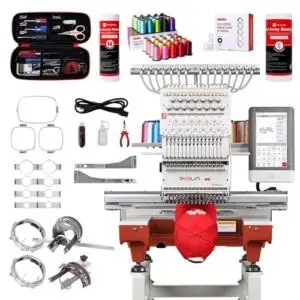
The Poolin EOX brings serious competition to the 15-needle tier at a price point worth examining.
Its 20″ × 14″ embroidery field accommodates full jacket backs and oversized tote designs without re-hooping, and its 1,200 SPM speed keeps your production line moving.
Wi-Fi and USB connectivity ensure design transfers don’t slow you down.
The full metal frame absorbs vibration during long runs, enhancing stability.
Automatic color changes trim both thread and downtime — a practical combination for shops pushing multi-color orders daily.
| Best For | Small commercial shops and growing embroidery businesses that regularly handle multi-color bulk orders — think teamwear, branded merch, and large apparel pieces. |
|---|---|
| Needle Count | 15 needles |
| Max Stitch Speed | 1,200 SPM |
| Embroidery Area | 20″ x 14″ |
| Connectivity | Wi-Fi |
| Touchscreen | 10-inch LCD |
| Price | $5,289 |
| Additional Features |
|
- That 20″ × 14″ hoop area is genuinely big — jackets, hoodies, tote bags all fit in one pass, no re-hooping headaches.
- 15 needles with auto color changes and automatic trimming means less babysitting and more output on multi-color jobs.
- The 270° cap system handles front, side, and 3-D puff work, so hats aren’t an afterthought.
- At 400 lbs, moving this thing is a real project — you’ll need a dolly, extra hands, and possibly a wider doorway.
- The setup learning curve is real, and the factory manual doesn’t hold your hand through hoop installation.
- Needle bar sensitivity means one wrong move with the retaining screw can turn a quick needle change into a repair job.
8. BAi Vision 15 Needle Embroidery Machine
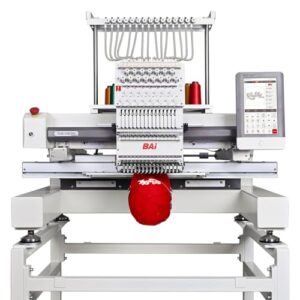
The BAi Vision 15 is built for shops that can’t afford slowdowns. Its 15-needle head manages complex multi-color designs in a single pass at up to 1,200 SPM, while the 400 × 500 mm work area accommodates jackets, bags, and wide-format branding panels.
Hat embroidery operates at a steady 1,000 SPM, with 3D foam support up to 5 mm.
Institch OS ensures intuitive controls, and Wi-Fi cloud sync eliminates manual file transfers, keeping your design library seamlessly organized.
| Best For | Small to mid-sized embroidery shops that need reliable batch production speed without paying for premium smart features they don’t need. |
|---|---|
| Needle Count | 15 needles |
| Max Stitch Speed | 1,200 SPM |
| Embroidery Area | 20″ x 16″ |
| Connectivity | Wi-Fi & Cloud |
| Touchscreen | 10-inch LCD |
| Price | $8,600 |
| Additional Features |
|
- Runs at 1,200 SPM with a 15-needle setup, so multi-color jobs move fast without constant rethreading.
- The built-in cost calculator is genuinely useful — it helps you price jobs accurately and keep tabs on your margins.
- Solid build quality with a claimed 10-year lifespan, which makes the $8,600 price tag easier to justify over time.
- At 727 lbs, getting it into your shop is a whole project — you’ll need professional movers and possibly a doorway check first.
- No auto-threading, laser centering, or other time-saving smart features that pricier machines include.
- Support is remote and based in China, so if something goes wrong, you may be waiting longer than you’d like for help.
9. Brother PE900 Wireless Embroidery Machine
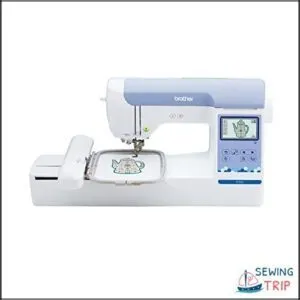
The Brother PE900 won’t replace a 15-needle commercial workhorse, but it earns its spot on this list for a specific reason: it’s where small-batch operators start building real skills.
At $1,179.99, you get a 5″ × 7″ embroidery field, Wi-Fi design transfer via the Artspira app, and 193 built-in designs across 13 fonts.
Speed tops out at 650 SPM—modest, but workable for boutique volumes. Automatic jump stitch trimming and color sort keep multi-color jobs clean without constant manual intervention.
| Best For | Hobbyists and small-batch creators who want to develop real embroidery skills and handle mid-sized projects without jumping straight to commercial-grade equipment. |
|---|---|
| Needle Count | 1 needle |
| Max Stitch Speed | Not specified |
| Embroidery Area | 5″ x 7″ |
| Connectivity | Wi-Fi & USB |
| Touchscreen | 3.7-inch LCD |
| Price | $1,179.99 |
| Additional Features |
|
- Wi-Fi and the Artspira app make sending designs to the machine genuinely painless — no fussing with cards or cables every time.
- The 5″ × 7″ hoop gives you enough room for apparel patches, home décor, and bigger motifs without feeling boxed in.
- Color sort and automatic jump trimming handle the tedious stuff for you, which adds up fast on multi-color runs.
- It’s embroidery only — if you ever need to sew a seam, you’ll need a second machine sitting next to it.
- Some users have run into needle-threader failures and tension issues, which can mean downtime and a trip to the repair shop.
- Built-in designs are locked to personal use, so if you’re selling finished goods, you’ll need to sort out separate commercial licensing.
10. Brother NQ1700E Large Embroidery Machine

If the PE900 is where you start, the NQ1700E is where you grow. At $2,399.99, it steps up to a 6″ × 10″ embroidery field — big enough for jacket backs, quilts, and full-size home décor pieces. You get 258 built-in designs, 13 fonts, Wi-Fi transfer, and 850 SPM.
The 4.85″ touchscreen lets you resize, rotate, and edit on the fly. It’s not a 15-needle commercial beast, but for serious single-head volume, it punches well above its price class.
| Best For | Home sewists and serious hobbyists who’ve outgrown starter machines and want professional-level embroidery without jumping to a full commercial setup. |
|---|---|
| Needle Count | 1 needle |
| Max Stitch Speed | Not specified |
| Embroidery Area | 6″ x 10″ |
| Connectivity | Wi-Fi & USB |
| Touchscreen | 4.85-inch LCD |
| Price | $2,399.99 |
| Additional Features |
|
- Huge 6" × 10" field means you can tackle jacket backs and large home décor without swapping hoops mid-project
- Built-in Wi-Fi and touchscreen editing make the whole design-to-stitch workflow genuinely smooth
- BES Blue software comes included — 800 designs and 199 fonts is a lot of creative runway right out of the box
- $2,399.99 is a real investment, and the magnetic hoop can be on backorder, so you might wait to use what you paid for
- At 27 lbs, this isn’t a machine you’re hauling to a class or guild meeting without some effort
- BES Blue has a learning curve, and if you’re not comfortable with software, it can feel overwhelming before it feels useful
Commercial Machine Comparison Factors
Choosing the right commercial embroidery machine comes down to more than price — the specs that matter most depend entirely on what you’re actually producing.
Before you commit to any model, there are five key factors worth measuring your options against. Here’s what to look at.
Needle Count and Colors
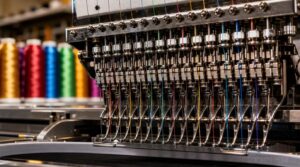
Needle count shapes your output more than almost any other spec. A 15-needle machine with automatic color change cuts multi-color job time by up to 18%, while 10-needle models force manual thread swaps that quietly drain your day.
Multi-Needle Color Matching and Needle Color Standards ensure Thread-Needle Compatibility remains consistent—color coding eliminates guesswork during setup.
| Needle Count | Key Advantage |
|---|---|
| 10-needle | Budget-friendly entry point |
| 12-needle | Balanced mid-range flexibility |
| 15-needle | Automatic Needle Selection, fewer stops |
| Dual-head (30) | Parallel multi-color embroidery |
| Premium (20+) | Complex designs, single-pass efficiency |
Embroidery Field Size
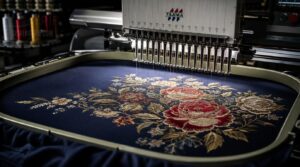
Field size is where specs meet reality. Your machine’s embroidery area dimensions determine whether a jacket back stitches clean in one pass or gets split awkwardly across two setups. For large-format work, that gap matters. The industry’s rapid growth is highlighted by a projected $11.3 billion global embroidery market by 2030.
| Machine | Embroidery Area | Best For |
|---|---|---|
| Smartstitch S‑1501 | 14×20 embroidery area | Blankets, tote bags |
| BAi The Mirror | 20″×14″ | Large-format embroidery, panels |
| Ricoma MT‑1501 | 22″×14″ | Full jacket backs |
| Janome MB‑7 | 9″×7.9″ | Polos, standard tees |
| Compact models | ~9.5″×12.6″ | Boutique, small runs |
Interchangeable hoops expand your range without buying a second machine. Keep fabric stabilization tight across large embroidery areas — design overflow prevention starts with proper backing, not software fixes. Stitch density scaling also shifts as field size grows, so always re-check your digitizing margins.
Stitch Speed and Quality
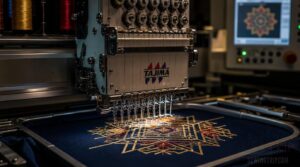
Speed without quality is just noise. Servo-driven motors and microstepping control ensure precision stitching consistent from the first to the ten-thousandth stitch. Jump stitch minimization alone cuts finishing time by 20%, while real-time tension monitoring and underlay stitch stability prevent puckering at high-speed stitching rates.
Speed without quality is just noise — precision motors and tension control ensure every stitch holds from the first to the ten-thousandth
| Machine | Stitch Speed | Quality Feature |
|---|---|---|
| Smartstitch S‑1501 | 1,200 SPM | Thread-break detection |
| Poolin EOX | 1,200 SPM | Real-time tension control |
| Smartstitch S‑1502HC | 950 SPM | Dual-head sync (±0.2 mm) |
| Smartstitch S‑1201 | 1,000 SPM | Underlay stitch stability |
| Smartstitch S‑1001 | 800 SPM | Microstepping control |
Stitch quality consistency at 1200 SPM separates production machines from expensive hobbies.
Connectivity and Software
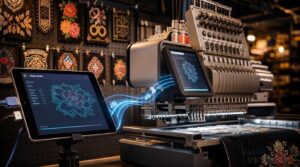
Fast machines mean nothing if your designs can’t reach them reliably. Wi‑Fi design transfer, LAN connectivity, and encrypted file transfer keep your workflow tight and your IP protected.
| Machine | Connectivity | Software Feature |
|---|---|---|
| Smartstitch S‑1501 | Wi‑Fi + USB | DST/DSB, API Integration |
| BAi The Mirror | Institch Cloud platform | Cloud Design Library, 30‑sec upload |
| Poolin EOX | USB + Wi‑Fi | Remote Diagnostics, software integration |
| Brother PR1050X | USB + LAN connectivity | 699 designs, design software compatibility |
Hats, Shirts, and Bags
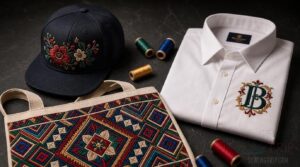
Each product type demands something different from your machine.
Shirts require flat hoops and breathable cotton twill fabrics to ensure compatibility with delicate materials.
Bags necessitate large-format embroidery fields and dense stabilizer selection to accommodate bulkier items and maintain structural integrity.
Hat embroidery specialization hinges on curved cap frames, where panel construction and design placement matter more than most beginners expect.
| Product | Key Requirement |
|---|---|
| Hats | Curved hoop, tear-away stabilizer |
| Shirts | Flat frame, fabric compatibility |
| Bags | Large-format embroidery field |
Business Production Requirements
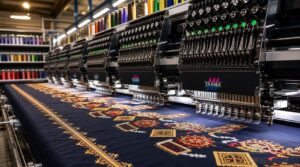
Before you spend a dollar on a commercial embroidery machine, you need to understand exactly what your business demands from it every single day. The right machine isn’t just about specs — it’s about matching real production pressure to the right hardware.
Here’s what to think through before you commit.
Daily Order Volume
Your daily order volume is the heartbeat of your production floor. Peak Day Forecasting shows midweek demand can spike 40% above average, making Batch Size Optimization and Order Backlog Management critical survival skills.
Staffing Flexibility and Overtime Planning ensure steady production throughput during volume surges.
Tracking this number daily directly sharpens production efficiency and protects lead times.
Single-head Versus Dual-head
Choosing between a single-head and dual-head setup hinges on where your production sits today — and where you want it tomorrow.
Single-head machines simplify Thread Path Management and demand lower Operator Skill Level, making them accessible for simpler operations. However, dual-head designs double production throughput, though this comes at the cost of tighter Sync Reliability requirements and higher Utility Consumption.
For businesses prioritizing serious machine scalability and production line scalability, the efficiency gains of dual-head configurations ultimately prevail.
Large-format Project Needs
Large-format embroidery isn’t just a bigger canvas — it’s a different discipline entirely. Machines like the BAi The Mirror deliver a 20″ × 14″ workspace, making them the clear Best for Large Designs requiring high-speed stitching across blankets and jacket backs.
Plan your Installation Timeline carefully: large-format work demands 2–6 weeks of scheduling, proper workspace footprint, color calibration, weather-resistant inks, and consistent preventive maintenance to protect output quality.
Hat Embroidery Workload
Hat embroidery operates by its own rules — and when you’re producing 800 to 1,200 hats daily, every minute of downtime costs real money. Machines designed specifically for hat embroidery handle the entire process, including Stabilizer Setup, Cap Frame Alignment, and structured hat capability, which are essential features rather than optional extras.
Key workload factors to plan around:
- Stitch Count Load: logos average 2,000–8,000 stitches, adding 20–40% more time per hat
- Color Change Speed: automatic systems cut per-hat color swap time by up to 80%
- Cap Frame Alignment: misalignment causes up to 0.5 mm distortion per piece
- Post‑Stitch Inspection: quality checks add 5–10 minutes per hat
- Dualhead design on units like the CH1501 Commercial Digital Hat Embroidery Machine doubles throughput for high-volume production runs
Future Scalability Planning
Scaling isn’t just about buying more machines — it’s about building a system that grows without breaking.
Modular Hardware Architecture lets you add embroidery heads without rewiring your entire floor. Cloud Production Orchestration tracks queues across locations in real-time. Predictive Maintenance Alerts cut unplanned downtime before it hits your ROI.
| Scalability Factor | Business Impact |
|---|---|
| Modular Hardware Architecture | Add heads without full retooling |
| Cloud Production Orchestration | Real-time Multi-Site Asset Management |
| Flexible Staffing Models | 30% faster onboarding per new machine |
| Predictive Maintenance Alerts | Reduces repair downtime by 20% |
| Production Volume Planning | Enables 24-hour expandable embroidery operations |
Total Cost and ROI

The sticker price is just the beginning — what you’re really paying for is everything that follows. Before you commit, it helps to see the full financial picture laid out clearly.
Here’s what to take into account across five cost factors that shape your actual return.
Purchase Price Comparison
Every machine’s Base MSRP is just your starting point. Optional upgrades, bulk discounts, and freight charges — including currency conversion for international buyers — shift your total cost of ownership fast.
Run a real cost-benefit analysis before committing:
- Compare price-performance ratio across needle counts
- Factor in optional upgrade packages
- Request volume pricing for multi-unit orders
- Calculate your investment payback period upfront
Installation and Workspace Costs
Professional installation alone run $300–$800 for heavier units. Factor in electrical requirements ($200–$600 per circuit), ventilation setup ($1,000–$3,000), and floor space planning — roughly 100–300 square feet per 12-head group.
Network infrastructure, safety compliance upgrades, and cable management push your total cost of ownership $3,000–$10,000 higher before a single stitch runs.
Thread and Consumables
Once installation costs are accounted for, recurring consumables quietly shape your real margins. Monthly thread and supply costs run $200–$500, plus $0.50–$1.00 per garment. Smart thread management systems—covering tension calibration, spool storage, and waste management—keep that number predictable.
- Use pre-wound bobbins for consistent stitch length on long runs
- Apply metallic thread handling guidelines: wire guides prevent snagging at speed
- Schedule tension calibration every 8 operating hours to cut thread breakage by up to 60%
- Leverage built-in thread break detection and auto thread trimming to protect thread longevity
- Cap spools in humidity-controlled storage (40–60%) for thread breakage prevention
Labor-saving Automation
Cutting consumable costs is one thing — cutting labor hours is where the real leverage hides. Robotic thread trimming and auto thread trimming finish garments two to three times faster than manual trims.
Automated pattern loading processes 200 designs per hour. Additional systems like smart material handling, predictive maintenance, thread break detection, WiFi design transfer, automatic color changing, and operator safety assists further streamline workflows.
Integrating these technologies—including a laser positioning system—enables operators to run more heads with less fatigue, maximizing productivity while minimizing errors.
Payback Timeline Estimates
Your break-even analysis starts with one key metric: the Smartstitch S-1501 achieves ROI in 14 months at 1,200 SPM under steady volume. Cash flow timing shifts this figure significantly—seasonal demand spikes can front-load returns and shorten the payback period.
Running sensitivity scenarios across best, base, and worst cases is critical. Financing impact and operational cost analysis ultimately determine whether your cost-benefit analysis concludes at month 12 or month 20.
Support, Training, and Reliability
Buying a commercial embroidery machine isn’t just a hardware decision — it’s a long-term working relationship. How well a brand backs you up after the sale can make or break your production schedule.
Key factors include warranty coverage, support access, and the features that streamline ownership. These elements ensure reliability and ease of use over time.
Warranty Coverage
A machine warranty is your financial safety net — and the details matter more than the headline number. When comparing options, Tajima’s four-year warranty on the needle bar and frame surpasses most competitors, while Barudan’s Elite Pro II offers a three-year warranty backed by a global service network.
Before committing, scrutinize the covered components, exclusion limits, and transferability rules. These finer points often determine real-world value and flexibility.
The claims process typically requires proof of purchase and service by authorized technicians. Understanding these requirements upfront ensures smoother resolutions if issues arise.
Technical Support Access
When a machine goes down mid-run, every minute costs you money. That’s where strong manufacturer support separates the contenders from the rest. Remote Diagnostics let technicians connect directly to your machine and run tests without an onsite visit. The 24/7 Helpdesk manages urgent calls after hours, while Tiered Escalation routes complex issues to senior engineers within two hours.
A solid Knowledge Base, Onsite Service options, and user training resources ensure your operation keeps moving.
Included Accessory Kits
What comes in the box matters more than most buyers expect. Smartstitch and BAi bundle a genuine accessory package value into every purchase — Variety Hoops, a Cleaning Kit, Tool Kit, Starter Designs, and Cable Management organizers arrive ready to use.
Pre-wound bobbins, spare needles, stabilizers, and specialty threads cut your startup costs considerably. That’s roughly $800 in accessories you won’t need to source separately.
Maintenance Requirements
Every commercial embroidery machine runs on a rhythm — and skipping that rhythm costs you money. A robust maintenance schedule is key, including tasks like:
- Needle bar lubrication every 20 operating hours
- Thread path cleaning and consumable replacement schedules tracked per shift
- Safety interlock testing weekly, plus firmware update protocols before major production runs
Built-in diagnostics and self-lubrication features on top models significantly reduce downtime, ensuring minimal warranty and support claims.
Beginner-friendly Setup Features
Auto threading completes each needle in under 5 seconds, while color-coded threading paths and tension presets eliminate guesswork entirely.
Magnetic hoop alignment holds to within 0.5 mm — ensuring no second-guessing placement.
The setup wizard walks you through hoop, fabric, and stitch selection in under three minutes, making training and onboarding genuinely painless.
Frequently Asked Questions (FAQs)
Is Tajima or Ricoma better?
Tajima wins on frame durability and motion precision; Ricoma offers a stronger price-performance ratio. Your best pick depends on daily volume and budget.
Is embroidery a profitable small business?
Yes, embroidery can be highly profitable. With margins ranging from 30 to 60 percent and steady market demand, smart pricing strategy and operational efficiency turn a modest business investment into reliable ROI.
What is the best brand of embroidery machines?
No single brand wins every category. Tajima leads on innovation track and dealer network, while Brother and Ricoma dominate value tiers.
Your best brand depends entirely on production scale and budget.
Which company is best for computer embroidery machines?
Brother excels in software integration and after-sales service, while Tajima and Barudan dominate in market leadership and customization options.
Your optimal choice hinges on prioritizing brand reputation or workflow automation.
Is commercial embroidery profitable?
Commercial embroidery is genuinely profitable when you align margin optimization with smart pricing strategy. Labor efficiency and volume discounts compound fast — shops averaging 50 daily orders often hit ROI within 14–16 months.
What is the best thread for commercial embroidery machine?
Polyester dominance makes it the clear winner for most commercial work — strong, colorfast, and consistent.
For decorative pieces requiring rayon sheen, use it carefully. Metallic challenges demand slower speeds and proper thread tension.
How often should commercial embroidery machines be serviced?
Service your machine every 6–12 months — or every 100,000–250,000 stitches. High-volume shops running 8+ hours daily need quarterly preventive maintenance plans to avoid costly operational downtime and protect warranty coverage.
What are the average power consumption costs?
Power draw on most commercial embroidery machines runs 400–800 watts. At Germany’s 33 €/kWh tariff, your cost-per-stitch stays minimal — energy price standard rarely exceeds €2–4 daily under full production loads.
Can commercial embroidery machines handle metallic threads?
Yes — with the right setup. Use size 90/14 needles, thread netting, and drop speeds to 700–1,000 SPM. Proper tension management and lubricated threads keep breakage low and finishes clean.
Are there eco-friendly options for commercial embroidery?
Absolutely. Sustainable threads like OEKO-TEX-certified recycled polyester and organic cotton, paired with zero-waste design digitizing and renewable energy sources, let your operation run cleaner without sacrificing the stitch quality your clients expect.
Conclusion
No single machine dominates every workload—that’s the reality the best commercial embroidery machines reviewed here make clear. A 15-needle dual-head unit won’t save a low-volume startup, and a Brother PE900 won’t scale with a growing wholesale operation.
Match the spec to your actual daily output, not your aspirational one. Focus on needle count, field size, and cost-per-stitch—these are your real decision levers. Pull the right ones, and the machine pays for itself faster than the spec sheet suggests.
- https://www.punchdigitizing.com/best-commercial-embroidery-machines/
- https://www.fujamachine.com/a-the-top-industrial-embroidery-machines-of-2024.html
- https://www.maggieframes.com/blogs/embroidery-blogs/top-6-good-embroidery-machines-for-2024
- https://www.aquadigitizing.com/top-commercial-embroidery-machines-for-2024-features-models-and-benefits/?srsltid=AfmBOopYyNnRgJuy4DRThcumWRg8si9brMPpGmlJvv-MA5U0Llut98MY
- https://k-embroidery.com/top-embroidery-machine-manufacturers/