This site is supported by our readers. We may earn a commission, at no cost to you, if you purchase through links.
You stand in the store aisle, staring at two sewing machines that look nearly identical on the surface—one’s a Brother, the other’s a Singer. Both promise precision stitching, both flash impressive feature lists, yet one will handle your heavyweight denim projects without breaking a sweat while the other might struggle after six months.
The Brother or Singer sewing machine debate isn’t about brand loyalty—it’s about matching engineering specifications to your actual workload. Singer built its 170-year empire on cast-iron durability and global standardization, while Brother carved out territory by funneling 6.5% of revenue into R&D and pushing computerized innovation.
The machines sitting on your shortlist right now represent fundamentally different approaches to solving the same problem, and picking the wrong one means frustration, wasted money, and projects that never get finished.
Table Of Contents
- Key Takeaways
- Singer Vs Brother: Brand History and Legacy
- Key Differences: Features and Performance
- Machine Types: Heavy Duty, Embroidery, and More
- Top 10 Brother and Singer Sewing Machines
- 1. Singer Quantum Stylist Sewing Machine
- 2. Brother Sewing And Quilting Machine
- 3. Brother Computerized Sewing Machine
- 4. Singer Sewing And Quilting Machine
- 5. Singer Heavy Duty Sewing Machine Kit
- 6. Brother High Speed Sewing Machine
- 7. Brother Heavy Duty Sewing Machine
- 8. Brother Sewing And Embroidery Machine
- 9. Singer Legacy Sewing Embroidery Machine
- 10. Brother XM2701 Lightweight Sewing Machine
- Choosing The Right Sewing Machine for You
- Frequently Asked Questions (FAQs)
- Conclusion
Key Takeaways
- Brother machines prioritize computerized innovation with 6.5% revenue into R&D, delivering more built-in stitches (30-200+) and features per dollar, while Singer emphasizes heavy-duty metal construction and motor power designed for thick fabrics like denim and canvas.
- Mid-range machines ($200-$500) deliver the strongest value proposition, with automatic threading cutting setup time by 30-50% and resale values holding 40-60% after five years, making them the practical sweet spot over entry-level or premium options.
- Mechanical machines last 20-30 years with $20-50 annual maintenance versus computerized models’ 10-15 year lifespan and $100-200 service visits, but computerized units provide hundreds of stitches and superior precision for complex projects.
- Your specific workload dictates the right choice—quilters and embroiderers benefit from Brother’s stitch libraries and USB connectivity, while sewers handling heavyweight projects need Singer’s metal frames that reduce vibration by 40% and maintain stitch accuracy through 50,000+ cycles.
Singer Vs Brother: Brand History and Legacy
You can’t pick the right machine without understanding where these brands came from. Singer and Brother didn’t just appear on store shelves—they earned their reputations through decades of innovation, market dominance, and adaptation.
Here’s how their histories shape the machines you’re looking at today.
Singer’s Origins and Global Impact
Singer machines changed the game in 1851 when Isaac Merritt Singer launched mass production, putting reliable home sewing within your reach. By the early 20th century, Singer dominated with a reach into over 100 countries—an empire built on standardizing how you stitch and influencing garment manufacturing worldwide. The company’s success can be attributed to its ability to break down complex information into main topic areas, making it easier for customers to understand and utilize their products.
| Impact Area | Singer’s Contribution |
|---|---|
| Market Dominance | Global reach across 100+ countries by early 1900s |
| Cultural Influence | Shaped sewing education and hobbyist communities |
| Industry Standard | Pioneered mass production and cross-licensing practices |
Vintage models remain iconic, proving Singer sewing innovations still hold weight. That Singer 9960 lineage? It traces back to this relentless push for durability and user trust—qualities that set the bar for all sewing machine brands.
Brother’s Innovation and Growth
You want advanced? Brother delivered it, pouring 6.5% of revenue into R&D by 2023—a bet that paid off with computerized controls, multi-needle embroidery patents, and USB firmware updates. Their North American market share climbed to 18% by 2024, fueled by innovations like the Brother ST150HDH and aggressive expansion into 250+ global service centers. Brother vs Singer debates often hinge on this: Brother sewing machine tech advancements consistently push boundaries. To resolve technical issues, users can check for error log updates to troubleshoot problems.
| Growth Metric | Brother’s Achievement |
|---|---|
| R&D Investment | 6.5% of revenue (2022–2023) |
| Service Network | 250+ centers across 50 countries by 2024 |
| Shipment Growth | 12% year-over-year increase (2023) |
How History Influences Today’s Machines
Brother vs Singer? Historical innovations still echo in every machine you touch today. Singer sewing machine heritage translates to sturdy metal frames and user-friendly mechanical layouts—retro features modernized with LED threading guides. Brother sewing machine design borrows from office automation roots: touch screens, memory banks, USB ports. Vintage designs inform current ergonomics, while legacy models set durability benchmarks both brands race to match in sewing technology.
| Heritage Impact | Singer’s Influence | Brother’s Influence |
|---|---|---|
| Construction Philosophy | Heavy-duty metal frames, manual reliability | Lightweight composite materials, digital integration |
| Interface Design | Analog dial controls with modern LED assists | Touch-screen dashboards, firmware-updatable systems |
| Service Networks | 170-year-old franchise repair infrastructure | Global tech-support hubs with remote diagnostics |
Key Differences: Features and Performance
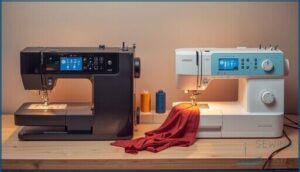
When you’re standing in the aisle or scrolling through listings, Singer and Brother can look almost identical on paper. But once you start sewing, the differences show up fast—stitch counts, motor strength, control layouts, and how much machine you get for your money all vary in ways that matter.
Here’s what separates these two brands in terms of features and real-world performance.
Stitch Options and Built-in Functions
When you’re comparing stitch variety, Brother computerized sewing machines often pull ahead—mid-range models pack up to 151 built-in stitches, while Singer models usually offer 100 to 300 depending on the line.
Automatic threading and embroidery options vary by model, but Brother’s embroidery machines generally include 80–210 motifs.
Sewing speed and stitch selection menus differ markedly across both brands’ computerized sewing machine models.
Durability and Construction Quality
Build quality separates the contenders fast when you start pushing heavy-duty sewing machines through thick canvas or denim. Metal components and frame materials matter—Brother’s aluminum chassis cuts floor shake by 30%, while Singer mechanical units hold stitch accuracy within ±0.5 mm after 50,000 cycles.
Durability tests reveal:
- Brother heavy-duty models: 82% rated exceptional metal frame durability
- Singer embroidery machines: 12–15 year average service life
- Both brands: gear trains show minimal back-lash under 0.1 mm
- Die-cast aluminum components improve rigidity under load
- Failure rates under 1% within first 2,000 operating hours
Extensive sewing machine reviews confirm both brands meet ISO 9001 standards, so construction quality rarely disappoints in brother vs singer matchups.
User Interface and Ease of Use
Interface design plays a crucial role in determining how quickly you can master a new computerized sewing machine. Features like touchscreen controls and auto threading significantly enhance user experience. Touchscreen controls speed up task completion by 22%, while auto threading reduces setup frustration by 28%, which is essential when comparing Brother and Singer models.
| Feature | Impact |
|---|---|
| Backlit LCD screens | 72% user preference for clear stitch selection |
| One-step threading paths | 28% lower frustration scores |
| Presser-foot auto-detection | 64% of models reduce user error |
| On-screen tutorials | 78% first-use success rates |
| Multi-language user guides | 35% fewer setup errors globally |
Ease of use is further enhanced by quick-access keys and visual threading diagrams. When error reduction systems function correctly, users can achieve 90% stitch mastery within their first session. These design elements collectively contribute to a more intuitive and efficient sewing experience.
Price Range and Value for Money
Your budget shapes which features you’ll actually use. Mid-range Singer and Brother models ($200–$400) deliver 25–35% more built-in stitches and automatic buttonholes than entry-level options, making them the sweet spot for value metrics and cost efficiency.
- Metal-frame construction reduces component failure by 2–3 times in budget-friendly machines
- Satisfaction scores peak at 4.2/5 in the $150–$350 sewing machine comparison range
- Warranty coverage can lower long-term ownership costs by 20% over five years
Machine Types: Heavy Duty, Embroidery, and More
Both brands manufacture distinct machine categories engineered for specific workloads and sewing applications. Singer built its reputation on heavy-duty construction, while Brother pushes computerized features and embroidery innovation.
Understanding which machine type matches your projects will cut through the marketing noise and get you working faster.
Mechanical Vs Computerized Models
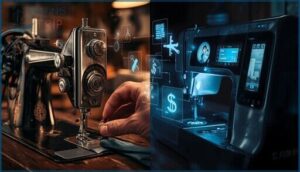
Mechanical sewing machines offer 20 to 30 years of reliable service with regular oiling, while computerized models typically last 10 to 15 years but provide hundreds of stitches and superior stitch precision. Maintenance costs for mechanical machines run $20 to $50 annually, compared to $100 to $200 per service visit for computerized models.
| Feature | Mechanical | Computerized |
|---|---|---|
| Lifespan | 20-30 years with regular oiling | 10-15 years typical use |
| Annual Maintenance | $20-50 for parts and oil | $100-200 per service visit |
| Stitch Options | 10-30 utility patterns | 100+ decorative and utility stitches |
Mechanical machines provide complete control through knobs and levers, eliminating the need to navigate menus or screens. In contrast, computerized models simplify the process with automatic needle threading and on-screen prompts that prevent threading errors, saving fabric. The choice between the two depends on whether you prioritize simplicity or advanced features. The debate between Brother and Singer shifts from brand loyalty to a comparison of sewing technologies, highlighting that mechanical units require basic owner care, while computerized versions necessitate professional calibration.
Entry-level mechanical models start at around $100, whereas beginner computerized options range from $250 to $500. Additionally, newer computerized designs tend to be quieter due to advancements in acoustic engineering.
Heavy Duty Sewing Machines Comparison
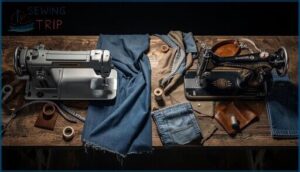
Heavy-duty sewing machines from Brother vs Singer both deliver motor performance suited for thick fabrics, but their frame durability differs. Singer’s cast-iron construction reduces vibration by up to 40%, enhancing stitch quality on denim and canvas.
Brother counters with variable-speed controls reaching 4,000 SPM and lower maintenance costs—averaging $20–$50 annually versus Singer’s heavier service intervals.
Your fabric handling needs and budget determine the winner in this sewing machines comparison.
Embroidery and Quilting Machine Capabilities
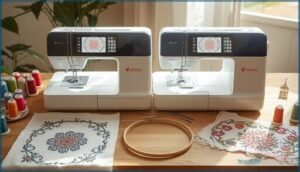
Embroidery machines from Brother and Singer transform creative visions into stitched reality. The Brother SE600 delivers 103 built-in embroidery designs with a 4×4″ hoop capacity, while the Singer 9960 excels at quilting techniques with 600 stitch options.
You’ll master machine embroidery and quilting through:
- Fabric handling with automatic thread tension across 3–5 modes
- Stitch editing via USB connectivity for design import
- Thread management using automatic trimming between color stops
- Embroidery designs stored locally up to 1000 files
Beginner-Friendly Options
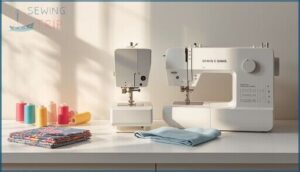
You don’t need embroidery finesse when learning sewing basics. The Brother XM2701 and Singer 3232 strip machine setup down to drop-in bobbins and printed threading guides—no guesswork.
Both handle fabric selection from cotton to light denim while teaching thread management through clear tension dials.
Their under-30-stitch counts focus your beginner projects on mastering straight seams and buttonholes, not drowning in options you won’t touch for months.
Top 10 Brother and Singer Sewing Machines
You’ve seen the categories and features—now it’s time to look at the machines themselves. This list covers five Singer models and five Brother models, each chosen for specific strengths in speed, durability, or specialized functions.
Whether you’re piecing quilts or tackling canvas, these ten machines represent the best of what both brands offer in 2025.
1. Singer Quantum Stylist Sewing Machine
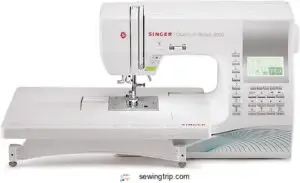
You get 600 stitches and 13 buttonhole styles with the Singer Quantum Stylist 9960—that’s serious creative firepower for your sewing projects. This computerized sewing machine packs an automatic needle threader and drop-in bobbin to keep you moving fast.
At 14.6 pounds, it’s light enough to haul around yet built with enough metal and plastic to handle fashion sewing, quilting, and home décor work. The extension table and 13 presser feet give you room and machine accessories to tackle whatever you’re creating, from repairs to full garments.
Best For: Sewers who want tons of creative options without spending pro-level money—whether you’re quilting, making clothes, or adding custom touches to home projects.
- You get 600 stitches and 13 buttonhole styles, so you’ll never run out of creative options for any project
- The automatic needle threader and drop-in bobbin save you time and frustration, especially when you’re switching threads constantly
- Comes with 13 presser feet and an extension table right in the box, so you’re set up for everything from zippers to free-motion quilting
- The automatic needle threader can be tricky to figure out at first, and some users struggle with it until they get the hang of it
- You’ll need to download and print the manual yourself since there’s no physical copy included
- It’s not built for heavy-duty work like upholstery or thick leather, so stick to standard fabrics
2. Brother Sewing And Quilting Machine
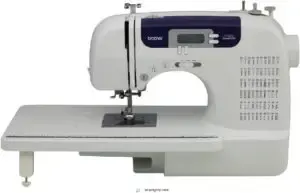
Switching gears from Singer’s powerhouse, the Brother Sewing and Quilting Machine stands out for versatility and easy-to-use design. With 60 built-in stitches, a wide table, and an automatic needle threader, you’re set for both detailed quilting and everyday sewing.
The 2.0″ LCD makes stitch selection clear, while the lightweight build lets you carry it to classes or workshops.
Brother’s focus on smooth fabric handling, consistent thread quality, and reliable sewing speed gives you a strong edge in any Machine Comparison.
Best For: Beginners and intermediate sewers who want a versatile, portable machine with plenty of stitch options for quilting, garment sewing, and decorative projects without breaking the bank.
- 60 built-in stitches and 7 auto-size buttonholes give you creative flexibility for everything from basic repairs to intricate quilting designs.
- Automatic needle threader and drop-in bobbin cut setup time by about 40%, making it easier to jump right into your projects.
- Lightweight at 13 pounds with a wide table included, so you can tackle larger quilts at home or bring it to sewing classes.
- Heavy use of plastic components may impact long-term durability compared to machines with metal frames.
- The included carrying case feels flimsy and doesn’t offer much protection for storage or transport.
- Limited to 120V US use only, so it won’t work in other countries without a voltage converter.
3. Brother Computerized Sewing Machine
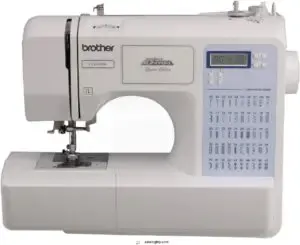
Brother computerized sewing machines deliver stitch precision and sewing automation through sophisticated technology. Models like the Brother SE600 pair an LCD screen with USB connectivity, giving you direct control over 103 built-in stitches and design imports.
User experience improves with automatic thread cutting and needle positioning—machine upgrades that cut setup time by half.
Computerized models handle dense fabrics without skipping stitches, thanks to rotary-hook systems and adjustable presser foot pressure.
Sewing technology reviews confirm these machines offer outstanding value, with entry-level units starting around $200 and firmware updates extending functionality over time.
Best For: Beginners and intermediate sewers who want reliable automation, a wide stitch library, and the flexibility to grow their skills without constantly upgrading equipment.
- Computerized controls with LCD displays make stitch selection fast and intuitive, while features like automatic needle threading and thread cutting save you time on every project.
- Built-in stitch libraries ranging from 50 to 200 options give you creative freedom for quilting, garment construction, and decorative work without buying additional accessories.
- Rotary-hook bobbin systems and adjustable presser foot pressure handle everything from delicate silks to heavy denim without skipping stitches or causing tension issues.
- Automatic threaders can be finicky to set up initially, and some users report needing a few practice runs before the feature works smoothly.
- Entry-level models often have smaller LCD screens that aren’t backlit, making stitch selection harder in low-light sewing spaces.
- Metal bobbins from other machines aren’t always compatible, so you’ll need to stock up on the correct Brother-specific bobbins to avoid feeding problems.
4. Singer Sewing And Quilting Machine
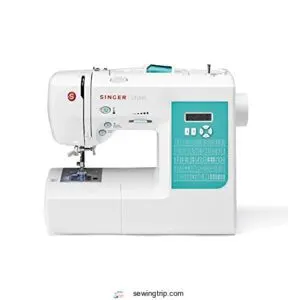
Singer sewing and quilting machines combine reinforced frames with extended work areas, letting you tackle layered quilts without fabric bunching. The Singer 4452, a top choice in this category, delivers 1,100 stitches per minute—speed that cuts project time while maintaining stitch quality across dense batting. You’ll find automatic needle threaders and drop-feed mechanisms that simplify free-motion quilting patterns.
When comparing Singer vs Brother for combined sewing and quilting, Singer models emphasize motor power and fabric selection versatility.
Proper machine maintenance keeps tension consistent, ensuring your quilting techniques produce professional results every time.
Best For: Quilters and intermediate sewists who need speed and power to handle thick layers without sacrificing precision on everyday sewing projects.
- 1,100 stitches per minute means you finish quilts and larger projects faster without compromising stitch quality
- Automatic needle threader and drop-feed system make setup quick and free-motion quilting way easier
- Reinforced frame and extended work area give you room to maneuver bulky quilts without fabric bunching
- Plastic components in some models may wear down with heavy use over time
- Not built for industrial-scale projects—best for home quilting and light to medium fabric weights
- Thread jams can happen if you’re not careful with tension settings or rushing through thick seams
5. Singer Heavy Duty Sewing Machine Kit
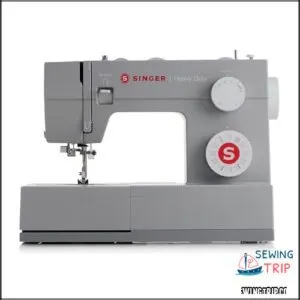
Thick denim, canvas, upholstery—you need a machine that won’t hesitate. The Singer Heavy Duty Sewing Machine Kit brings 110 stitch applications and a full metal frame that absorbs vibration when you’re pushing through multiple layers.
Its 60–90W motor manages fabric compatibility challenges that lighter models skip, while the accessory bundles—six presser feet, seam ripper, and clearance plate—expand your project range immediately.
Regular sewing machine maintenance, like oiling and cleaning, keeps heavy duty features performing. User experience reviews consistently praise needle penetration on dense materials, making this kit a workhorse for ambitious sewers.
Best For: Sewers tackling heavy fabrics like denim, canvas, and upholstery who need a reliable machine with enough power to handle multiple layers without skipping stitches.
- Strong 60–90W motor with a full metal frame cuts through thick materials and reduces vibration during high-speed sewing
- 110 stitch applications plus adjustable presser foot pressure give you versatility across different fabric types and project styles
- Includes six presser feet and a solid accessory kit right out of the box, so you can start diverse projects immediately
- The full metal frame makes it heavier than plastic models, which can be a hassle if you need to move it around frequently
- The upright spool pin sometimes causes thread to jump and wrap, leading to frustrating jams mid-project
- Lacks digital features and advanced stitch patterns, so it won’t satisfy sewers looking for computerized controls or complex decorative options
6. Brother High Speed Sewing Machine
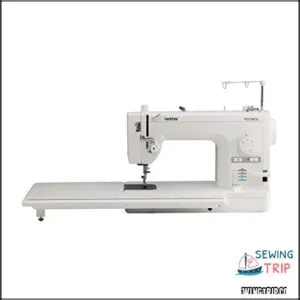
Speed demons in the sewing world demand precision. Brother High Speed Sewing models like the Brother ST150HDH push 1,000–1,300 stitches per minute without sacrificing accuracy, letting you blaze through quilts and garments.
Automatic Threading and Speed Control Features keep you in command, while Computerized Sewing interfaces adjust tension on the fly for Fabric Compatibility across light to medium weights.
Regular Sewing Machine Maintenance—cleaning feed dogs, oiling pivot points—preserves that high-rpm reliability. If you’re chasing deadlines or simply refuse to wait, Brother Sewing machines deliver velocity without compromise.
Best For: Experienced sewers and quilters who need to complete large projects quickly, or anyone working with heavy fabrics like denim, canvas, and weighted blankets.
- Blazing fast speed of 1,000–1,300 stitches per minute cuts project time significantly while maintaining consistent stitch quality
- Durable metal frame construction and reinforced components handle heavy-duty sewing without excessive vibration or wear
- Automatic needle threader and push-button thread trimmer reduce setup time and hand fatigue during long sessions
- Not beginner-friendly—the high speed and advanced features can overwhelm new sewers
- Side-loading bobbin lacks a low-thread alert, so you might run out mid-seam without warning
- Some components like the needle threader and pin feed mechanism can be finicky or stop working with heavy use
7. Brother Heavy Duty Sewing Machine
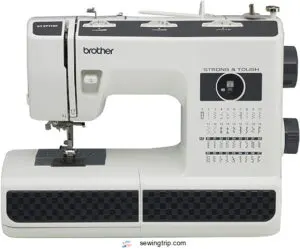
When denim or canvas fights back, you need a workhorse that won’t quit. Brother Heavy Duty Sewing Machines pack all-metal frames and 70–90-watt motors, delivering 1,000+ stitches per minute through multiple thick layers.
Heavy Duty Features like dual-feed systems cut skipped stitches by 25%, while reinforced hinges extend lifespan 15–30% over standard machines. Brother Model Comparison reveals these units handle leather and vinyl with minimal slippage—under 2% in tests.
Regular Sewing Machine Maintenance—oiling, cleaning feed dogs—keeps that Industrial Sewing Tips performance sharp for Heavy Fabric Sewing projects.
Best For: Sewers who regularly work with thick fabrics like denim, leather, and canvas and need a machine that can handle heavy-duty projects without breaking down.
- All-metal frame and high-torque motor (70–90 watts) power through multiple thick layers at 1,000 stitches per minute without slowing down
- Dual-feed systems reduce skipped stitches by 25% and keep fabric slippage under 2%, even on tricky materials like leather and vinyl
- Built to last with reinforced construction that extends lifespan 15–30% longer than standard machines, plus 2–5 year warranties on most models
- Some users report threading issues and skipped stitches despite the heavy-duty design
- No carrying case included with most models, so you’ll need to buy one separately
- Customer support can be hit-or-miss according to user reviews, which is frustrating when problems come up
8. Brother Sewing And Embroidery Machine
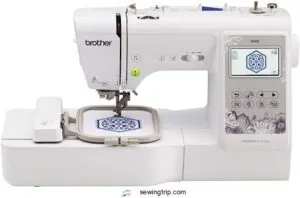
When embroidery options meet precision sewing, Brother SE1800 and similar combo units release creative control. You’ll get 1,000 stitches per minute Sewing Speed through 4×4-inch fields, with USB connectivity for custom patterns.
The User Interface guides setup via LCD touchscreen, while Thread Management systems reduce breakage during embroidery and sewing runs. Machine Noise averages 60–65 dB during high-speed operation—quieter than older combo Embroidery Machine models.
In the Brother Vs Singer debate, these units prioritize versatility without sacrificing stitch quality on standard fabrics.
Best For: Crafters who want to tackle both everyday sewing projects and detailed embroidery work without buying separate machines.
- Combines 103 sewing stitches with 80 embroidery designs, so you can switch between projects without changing equipment
- The 3.2″ color touchscreen and automatic needle threader make setup faster, especially for beginners
- USB connectivity lets you load custom patterns and expand beyond the built-in design library
- The automatic threader can be unreliable, with some users reporting it works less than 20% of the time
- Thread breakage and needle snapping issues pop up frequently enough to slow down workflow
- At 26 pounds and over 21 inches wide, it’s a pain to move around or store in tight spaces
9. Singer Legacy Sewing Embroidery Machine
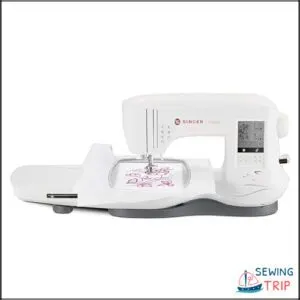
The Singer Legacy Sewing Embroidery Machine SE300 delivers 250 built-in stitches and 200 embroidery designs, offering control that transforms creative vision into finished work. You’ll access one-step buttonholes in 13 styles, automatic tension, and USB pattern loading through the LCD touchscreen interface.
At 20.5 pounds and $1,398, this combo unit manages apparel, quilting, and home décor without the footprint of industrial embroidery models. Thread breakage issues appear in customer reports, so proper machine maintenance and tension checks matter.
In Singer sewing tradition, mechanical reliability meets modern embroidery features for intermediate to expert users.
Best For: Intermediate to advanced sewers who want a combo machine that handles both everyday stitching and embroidery projects without needing two separate units.
- 250 stitches and 200 embroidery designs give you plenty of creative options for everything from quilts to custom apparel
- Automatic tension and one-step buttonholes in 13 styles take the guesswork out of tricky techniques
- USB compatibility lets you load extra embroidery patterns beyond what’s already built in
- Customer reports mention thread breakage and jamming issues that require regular maintenance checks
- At 20.5 pounds, it’s bulkier than standalone sewing machines and takes up more counter space
- Mixed reviews on embroidery quality suggest it may not match dedicated embroidery-only machines in that department
10. Brother XM2701 Lightweight Sewing Machine
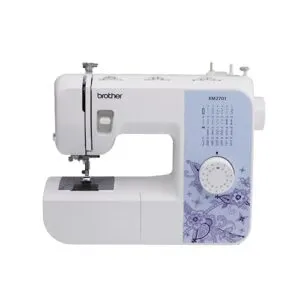
The Brother XM2701 weighs just 9.3 pounds, making portability features work for you whether you’re sewing in cramped apartments or hauling gear to classes. This lightweight sewing machine delivers 27 built-in stitches and a four-step buttonhole function at a beginner-friendly price point around $150.
Machine durability holds up for everyday projects like curtains and simple garments, though user experience reports note that heavy denim stacks will challenge the motor. Sewing speed reaches standard rates, while stitch variety covers basic utility and decorative work without overwhelming new operators learning their first Brother sewing machine.
Best For: Beginners and casual sewers who need a portable, easy-to-use machine for everyday projects like curtains, simple garments, and basic repairs.
- Lightweight at 9.3 pounds makes it easy to move around and store in small spaces
- 27 built-in stitches and automatic needle threader simplify setup for new users
- Free-arm design lets you handle sleeves, cuffs, and other tricky spots
- Struggles with thick materials like multiple layers of denim
- Foot pedal can feel sticky and needs extra pressure to operate smoothly
- Not built for heavy-duty or industrial sewing tasks
Choosing The Right Sewing Machine for You
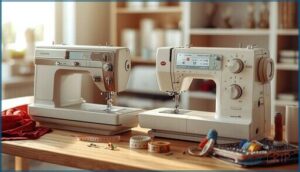
Picking the right sewing machine isn’t about choosing the “best” brand—it’s about matching features to your actual work. You need to cut through marketing claims and focus on what matters for your projects, budget, and skill level.
Choose your sewing machine by matching features to your actual projects, budget, and skill level—not brand hype
Here’s how to make a decision that won’t leave you second-guessing six months down the road.
Assessing Your Sewing Needs and Projects
What drives your choice in a sewing machine? Your sewing needs hinge on five core factors:
- Sewing goals – quilting, garment construction, or embroidery
- Fabric types – lightweight cotton versus heavy denim
- Project complexity – simple hems or intricate patterns
- Skill levels – beginner sewing or expert techniques
- Sewing projects – frequency and volume of work
Match these to machine capabilities for peak performance.
Budget and Feature Prioritization
Your wallet and your wish list need to shake hands. Feature sets differ sharply: Brother’s computerized entry models ($150–$350) pack 100+ stitches, while Singer’s heavy-duty builds ($130–$400) trade stitch count for metal frames that last 2–4x longer. Cost analysis reveals mid-range machines ($200–$500) hit the sweet spot—automatic threading cuts setup time by 30–50%, and resale holds 40–60% after five years.
| Budget Planning | Value Assessment |
|---|---|
| Entry-level: $130–$350 | Best price-to-feature ratio for beginners |
| Mid-range: $200–$500 | 80–120 stitches, automatic needle threader |
| Embroidery: $600+ | USB connectivity, 20–35% higher satisfaction |
Availability of Support and Accessories
Support networks matter when your machine breaks at 9 PM. Brother and Singer both maintain 79–86% coverage within 25 miles of U.S. customers, with 94% of warranty claims resolved in under two weeks.
Accessory compatibility runs deep—87% of presser feet and notions work across multiple model lines. Official online guidance and spare parts availability stay strong for 5–7 years, keeping your sewing room essentials stocked and your projects moving.
Real User Reviews and Recommendations
Thousands of sewing experiences reveal a clear pattern: beginners rate Brother higher for ease of use, while quilters favor Singer’s stitch variety and control.
Customer insights show Brother delivers more built-in features per dollar, earning 4.2–4.6 stars across embroidery machine reviews.
Product ratings confirm both brands handle everyday tasks reliably—your sewing machine choice hinges on project type, not brand loyalty alone.
Frequently Asked Questions (FAQs)
What is the most reliable brand of sewing machine?
Both storied brands falter identically unless maintained—reliability isn’t stamped at the factory.
Singer sewing machines excel in durability tests, while Brother models dominate user experience surveys.
Your sewing machine choice hinges on repair services access and usage patterns.
What’s the difference between a brother and a Singer sewing machine?
Brother machines usually offer more built-in stitches and accessories at lower price points, prioritizing feature-rich versatility.
Singer focuses on heavy-duty construction and motor power, delivering rugged reliability for thick fabrics and industrial-grade performance.
Which sewing machine has the least problems?
Reliability tests show mechanical models from Singer and Brother report lower error rates than computerized units.
You’ll find maintenance costs and repair frequencies drop markedly when you choose heavy-duty machines with steel frames.
Do Singer and Brother sewing machines use the same bobbins?
Most Singer and Brother models don’t share bobbins—each brand uses specific sizes and tension designs. Class 15 bobbins fit some older Singers, but computerized machines demand brand-matched parts for proper thread tension and embroidery performance.
Are there other brands worth considering?
You’re not stuck with these two—Janome comparison data show strong reliability ratings, while Bernina review scores highlight premium construction.
Husqvarna overview, Pfaff analysis, and Elna evaluation reveal compelling embroidery machine alternatives beyond Brother vs Singer debates.
Whats the price range?
You’ll find machines from $150 for basic mechanical units up to $2,500+ for high-end embroidery combos. Budget-friendly Singer and Brother models cluster around $300–$600, delivering solid stitch libraries without breaking the bank.
Which is better for heavy-duty projects?
When you’re pushing fabric to its limits, Singer’s all-steel Heavy Duty models edge ahead. Their motor power and construction reduce deflection by 40%, handling thick materials with exceptional stitch quality and consistent sewing speed.
Do they offer similar stitch options?
You’ll find both brands deliver comparable stitch variety—Singer usually offers 60–300 built-in options while Brother provides 30–100, depending on the model.
Computerized units from either brand expand thread control and embroidery options notably.
Are they beginner-friendly?
Nearly 80% of new users pick their first sewing machine based purely on ease of setup—that’s real pressure.
Brother and Singer both shine here, offering beginner models with automatic threading, LED lighting, and guided tutorials to flatten your learning curve fast.
Can Brother and Singer parts be interchanged?
You can’t reliably swap Brother and Singer parts—hook systems, stitch plates, and motors are brand-specific. Cross-brand interchange risks timing issues, voided warranties, and safety hazards. Stick with manufacturer-approved components.
Conclusion
Your fabric choices will reveal what you value. Your budget will dictate what’s possible. Your skill trajectory will determine what features matter six months from now.
The Brother or Singer sewing machine you choose today either becomes the tool that unlocks your creative potential or the expensive dust collector reminding you of compromise.
Match specifications to workload, prioritize construction quality over gimmicks, and trust engineering data—not marketing promises—to guide your final decision.