This site is supported by our readers. We may earn a commission, at no cost to you, if you purchase through links.
Your small business sewing operation won’t survive on domestic machines—those consumer-grade units buckle under the stress of eight-hour production days, thick materials, and the relentless pace commercial work demands. Industrial sewing machine types for small business separate weekend hobbyists from legitimate manufacturers: flatbeds power through garment construction with unwavering precision, cylinder beds navigate curved leather goods without fabric bunching, and walking feet synchronize multiple layers that would jam ordinary machines in seconds.
The right machine transforms your operation from constantly fighting equipment limitations to meeting deadlines with capacity to spare, but matching machine architecture to your specific materials, production volume, and stitch requirements requires understanding how each type delivers distinct mechanical advantages.
Table Of Contents
- Key Takeaways
- Key Industrial Sewing Machine Types for Small Business
- Features That Matter for Small Businesses
- Matching Machine Types to Business Needs
- Top 9 Industrial Sewing Machines for Small Business
- 1. Singer Heavy Duty Sewing Machine
- 2. Juki Industrial Straight Stitch Sewing Machine
- 3. Brother PQ1500SL Sewing and Quilting Machine
- 4. Consew Industrial Walking Foot Sewing Machine
- 5. Juki Cover Stitch Machine
- 6. Janome Heavy Duty Sewing Machine
- 7. Industrial Straight Stitch Sewing Machine Head
- 8. Leather Sewing Machine Heavy Duty
- 9. Singer Professional Metal Frame Serger Machine
- Tips for Selecting and Maintaining Your Machine
- Frequently Asked Questions (FAQs)
- Conclusion
Key Takeaways
- Industrial sewing machines split into seven core types—flatbed, cylinder bed, post bed, overlock, coverstitch, walking foot, and blind hemmer—each solving distinct production challenges from curved seams to multi-layer synchronization that consumer machines can’t handle.
- Walking foot and cylinder bed machines dominate heavy-duty operations by preventing fabric slippage on thick materials like leather and upholstery, while overlock and coverstitch machines specialize in edge finishing and stretch fabric hems for garment production.
- Servo motors cut energy costs by up to 70% compared to clutch systems, and programmable stitch functions with memory slots dramatically reduce setup time on repeat jobs, making motor type and automation features critical for long-term profitability.
- Regular maintenance every 8-12 hours—including lubrication, lint removal, and tension checks—prevents the majority of production stoppages, while matching machine architecture to your specific materials and volume requirements eliminates bottlenecks that constrain business growth.
Key Industrial Sewing Machine Types for Small Business
Choosing the right industrial sewing machine starts with understanding which type matches your business operations, materials, and production goals. Each machine category—from flatbed to specialized blind hemmers—fulfills distinct purposes and manages different fabric challenges.
If you’re just starting out, checking out top-rated industrial machines for beginners can help you find models that balance power with ease of use.
Here’s a breakdown of the seven essential machine types you’ll encounter when building or expanding your small business sewing operation.
Flatbed Sewing Machines
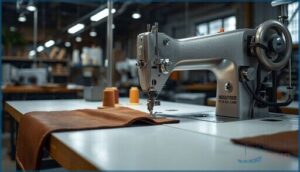
Flatbed sewing machines deliver rock-solid performance with their flat, table-like work surface—ideal for garment production, upholstery, and wide-panel projects where you need stability.
The rigid metal frame resists vibration during high-speed stitching, while the level bed height keeps your hands aligned with the needle for precise control.
You’ll handle heavyweight fabrics like leather with minimal needle deflection, thanks to durable one-piece bed casting that stands up to daily production demands. For updated product details and specs, see the latest options among top flatbed sewing machine features.
Cylinder Bed Sewing Machines
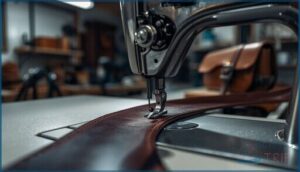
When your shop processes bags, footwear, or curved leather goods, cylinder bed sewing machines give you the edge—their narrow tubular bed, usually 5 to 10 centimeters in diameter, wraps fabric around tight corners and seams without bunching.
Here’s what makes cylinder bed design indispensable for small business industrial sewing machine types:
- Material handling: Compound walking feet move thick layers evenly, processing 8 to 10 ounce leather with precision.
- Sewing speed: Servo motors deliver 2,000 to 3,000 stitches per minute for high-volume runs.
- Industrial applications: Stitch pet harnesses, automotive seat covers, and backpack gussets faster than flatbed alternatives.
- HeavyDuty sewing equipment: Larger bobbins hold size 138 thread, reducing downtime during production.
- Machine maintenance: Clean hooks and feed dogs every 10 to 12 hours to prevent skipped stitches. For more detail, review this guide on.
Post Bed Sewing Machines
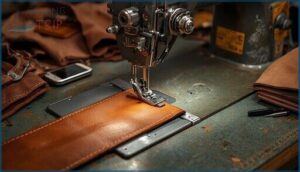
Stitching around boot toes, bag seams, or thick upholstery edges calls for post bed sewing machines—their tall vertical post, combined with roller feed systems, guides curved stitching and tubular sewing with control you won’t find on flatbed models.
These heavy duty materials specialists handle 10-ounce leather and multiple foam layers without deflection, making them a superb choice for footwear shops and leather goods production.
Post bed maintenance includes monthly lubrication of joints, roller cleaning, and belt tension checks to keep stitch quality consistent across high-volume runs.
Overlock (Serger) Sewing Machines
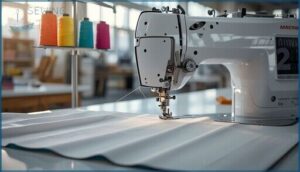
Where flatbed and post bed machines excel at construction, overlock sewing machines—or sergers—dominate edge finishing techniques and seam neatening, trimming fabric while wrapping threads around raw edges to prevent fraying. Your high-speed serging workflow gains efficiency through serger thread management systems that handle four threads simultaneously, creating professional overlock stitch formation that stretches with knits.
Key advantages for sewing machines for business include:
- Integrated cutting blade that trims fabric as you sew, ensuring uniform seam width
- Differential feed mechanisms that prevent stretching or puckering during serging fabric preparation
- Adjustable tension dials per thread for balanced loopers and needles
- Speed capability reaching thousands of stitches per minute for high-volume production
These industrial sewing machines for small business handle garment finishing, activewear construction, and any project requiring durable, flexible seams.
Coverstitch Sewing Machines
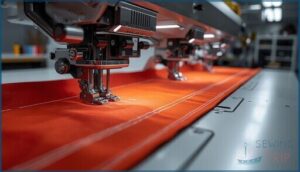
Coverstitch sewing machines are essential for creating the parallel top stitches and flexible underside loops commonly seen on athletic apparel and jersey hems. These features are critical for garments that require stretch without thread breakage. Proper machine calibration and thread tension adjustments are key to determining hem width, stitch formation quality, and fabric handling precision, especially when working with knits. Most heavy-duty sewing machines designed for business use include a differential feed mechanism, which helps prevent wavy edges during high-volume production runs.
| Feature | Specification | Business Benefit |
|---|---|---|
| Needle Configuration | 2–3 needles, multiple loopers | Creates durable, flexible hems on stretch fabrics |
| Stitch Formation | Parallel top stitches, chain underside | Maintains fabric drape, reduces seam bulk |
| Differential Feed | Adjustable stretch control | Prevents puckering on lightweight knits |
| Thread Tension | Multi-path adjustable settings | Tailors hem density for varied materials |
| Sewing Efficiency | Flat, elastic seams ideal for activewear | Increases output in garment finishing workflows |
Walking Foot Sewing Machines
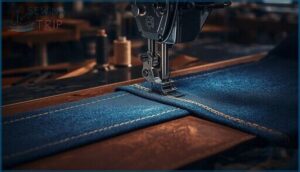
You’ll find walking foot machines indispensable when tackling thick denim, leather, upholstery, and layered fabrics that challenge standard industrial sewing machines. The walking foot mechanism synchronizes top and bottom feed dogs, preventing slippage and puckering across uneven seams.
Feed system variants—including triple feed and compound configurations—deliver outstanding fabric handling on heavy-duty sewing projects.
The Consew Walking Foot Industrial Sewing Machine exemplifies this category, offering sturdy performance for industrial upholstery and multi-layer construction tasks.
Blind Hemming Machines
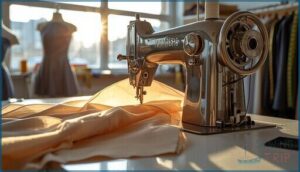
You’ll achieve rapid, discreet hems on trousers, skirts, and lightweight fabrics with blind hemming machines—a superb choice for alteration shops and garment production.
These industrial sewing machines use curved needles and specialized blind hem feet to create nearly invisible stitches, balancing hemming speed with hem stitch quality.
Proper thread tension and fabric compatibility adjustments guarantee consistent results across chiffon to medium-weight wool.
Features That Matter for Small Businesses
When you’re investing in industrial equipment for your business, the features you choose can make or break your productivity and profit margins. Not every bell and whistle matters—but certain capabilities directly impact how quickly you work, how much you spend on utilities, and whether your machine still runs smoothly five years from now.
Here’s what separates a smart purchase from an expensive mistake.
Stitch Quality and Speed
You’ll find that stitch quality hinges on precise stitch formation: high-quality industrial sewing machines maintain accuracy within plus or minus 0.2 mm, ensuring consistent loop formation even on fabrics up to 5 mm thick.
Speed settings ranging from 800 to 4,000 stitches per minute demand careful thread tension control and needle calibration—without these, your fabric interaction suffers through puckering, skipped stitches, or misaligned seams that compromise professional results.
Motor Types and Energy Efficiency
Your choice of motor types directly shapes power consumption, operating costs, and environmental footprint—servo motors with variable frequency drives cut energy use by up to 70% compared to older clutch systems.
- Brushless DC motors deliver high efficiency with solid torque at low speeds, requiring electronic commutation for precise control and reduced energy waste
- Direct drive motors eliminate gear losses by coupling directly to the needle mechanism, transferring power efficiently while lowering vibration and noise
- Servo motors paired with variable frequency drives enable speed adjustments that match your load, reducing power consumption during light stitching or idle periods
- Energy-efficient ratings help you compare models: high-efficiency motors use better materials and winding designs to minimize copper and core losses
- Regenerative braking systems in sophisticated models feed energy back to the supply during deceleration, supporting sustainable manufacturing practices and green technology adoption
Ease of Use and Ergonomics
When you’re stitching hour after hour, ergonomic design transforms fatigue into sustained precision—operator comfort isn’t luxury, it’s productivity. Industrial sewing machines with handheld controls positioned at elbow height cut shoulder strain by 15%, while visual feedback systems and adjustable posture support reduce wrist deviation and leg fatigue.
These sewing machine features deliver sewing business tips that keep your team working efficiently across multi-shift schedules.
Customization and Programmable Functions
Modern sewing machine technology puts programmable stitches and custom profiles at your fingertips, letting you store up to 12 memory slots per machine for fast repeat work.
Automated sequencing chains multiple operations—needle positioning, stitch type, reverse tack—into macro functions that execute without constant input, while material presets adjust tension and feed rate across leather, denim, or knit fabrics automatically.
Durability and Maintenance Requirements
Equipment that runs daily under heavy loads needs proven machine longevity: metal frames resist corrosion for over 5 years, tempered-steel gears handle 10,000-plus cycles, and sealed bearings reach 100,000 movements before wear. Your maintenance scheduling directly impacts component durability—follow these lubrication strategies and wearable parts checks:
Industrial machines built with metal frames, tempered-steel gears, and sealed bearings can deliver over five years of reliable service if you maintain regular lubrication and inspect wearable parts
- Wipe surfaces after each shift to prevent lint buildup
- Apply machine oil every 8 hours of operation
- Vacuum feed dogs and bobbin areas weekly
- Lubricate needle bars and presser foot bars weekly
- Replace lubricant in gear housings annually
Matching Machine Types to Business Needs
Choosing the right industrial sewing machine starts with understanding what you actually make—and how you make it. Different business models demand different capabilities: a bridal alteration shop operates nothing like a leather goods workshop or a high-volume contract manufacturer.
Let’s break down which machine types align with specific business needs, so you can invest in equipment that pays for itself.
Garment Production and Alterations
Your garment production and alterations business demands machines that handle diverse fabric sourcing and construction tasks with precision. Match your industrial sewing machines to the textile and apparel industry sewing techniques you perform most.
For pattern-based work, a flatbed plainsewer delivers 8 to 12 stitches per centimeter—ideal for garment fitting and quality control. Overlockers finish seams and prevent fraying, while blind hemmers enable rapid alteration methods.
Upholstery and Leatherwork
Upholstery and leather goods demand machines built for thickness: walking foot models handle multiple layers of vinyl, canvas, and full-grain leather without skipping stitches. You’ll need heavy-duty sewing capabilities—machines that accept leather needles, waxed thread, and offer adjustable presser foot pressure for material finishing.
For upholstery tools and fabric selection spanning batting to top-grain hides, prioritize stitch techniques like saddle-style seams and welting attachments that reinforce edges on cushions, bags, and saddles.
Quilting and Craft Businesses
Quilting studios thrive when your sewing machine for small business handles intricate quilt patterns, layer-by-layer precision, and diverse textile trends—all while keeping pace with sewing communities that demand speed and artistry. Brother sewing and quilting machine models deliver high-speed stitching capabilities and programmable needle placements for:
- Fabric sourcing from regional wholesalers offering panel lots and precuts
- Craft marketing through Instagram reels and Etsy storefronts showcasing finished quilts
- Sewing equipment including specialized feet, walking foot attachments, and thread stands
- Sewing machine accessories like adjustable presser feet for varied fabric weights and textures
High-Volume Vs. Niche Production
Production scale dictates your industrial sewing machines choice: high-volume garment production efficiency demands specialized feeders, synchronized timing belts, and speeds above 2,000 stitches per minute to optimize volume efficiency through continuous flow lines.
Niche markets favor batch production at controlled speeds—preserving intricate details while serving customization requests.
Heavy-duty sewing machines with rapid changeovers, often under 15 minutes, bridge both worlds for your sewing machine for small business operations.
Fabric and Material Considerations
Fabric texture drives your material selection strategy: cotton and linen demand different needle sizes and tensions than silk, while fiber blends require adjusted sewing techniques for garment durability.
Industrial sewing machines excel when matched to fabric weight—lightweight drapes need delicate handling, heavier materials demand walking foot mechanisms.
The textile industry rewards precision in fabric and material handling, ensuring proper garment construction through fabric sewing techniques customized to each project’s demands.
Top 9 Industrial Sewing Machines for Small Business
Choosing the right industrial sewing machine can make or break your small business operations, so you need equipment that delivers consistent performance without eating into your profit margins.
The machines below represent the most reliable options for 2026, each designed to handle specific production demands—from garment construction to heavy-duty leatherwork.
Here’s a breakdown of the top 9 industrial sewing machines that small businesses are relying on this year.
1. Singer Heavy Duty Sewing Machine
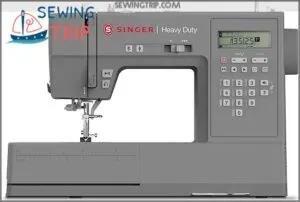
When you’re looking for a workhorse that won’t quit on denim or canvas, the Singer Heavy Duty HD6700 delivers 411 stitch applications with enhanced piercing power and a sturdy metal frame. This machine reaches 1,100 stitches per minute, features a stainless steel bed plate for smooth fabric feeding, and includes an LCD screen with speed control for precision work.
You’ll get 10 presser feet, automatic needle threading, and 7 one-step buttonhole styles—making it a superb choice for garment construction, alterations, and home decor projects.
| Best For | Sewers who regularly work with heavy fabrics like denim, canvas, or upholstery and need a reliable machine that can handle thick layers without losing power. |
|---|---|
| Brand | SINGER |
| Weight | 14.6 lbs |
| Material | Metal/Stainless Steel |
| Max Speed | Not specified |
| Primary Use | Heavy-duty home sewing |
| Power Source | Electric 110V |
| Additional Features |
|
- 411 stitch options give you plenty of creative flexibility for everything from basic repairs to decorative quilting
- Strong piercing power and metal frame construction make it genuinely capable on thick materials
- Comes ready to go with 10 presser feet and helpful features like automatic needle threading and adjustable speed control
- Some users report the machine struggles with very thick fabrics despite being marketed as heavy-duty
- The LCD screen isn’t backlit, so you might have trouble reading it in dim lighting
- Durability concerns have popped up in reviews, with a few users experiencing issues over time
2. Juki Industrial Straight Stitch Sewing Machine
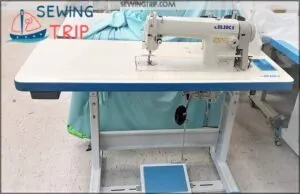
If speed and precision are your top priorities, the Juki DDL-8700 industrial straight stitch machine operates at up to 5,500 stitches per minute—ideal for high-volume garment production and topstitching on light to medium-weight fabrics.
You’ll work with a quiet servo motor, automatic thread trimming, and programmable needle points that simplify repetitive tasks.
The cast iron frame minimizes vibration during continuous operation, while the box feed system ensures uniform stitch length across denim, twill, and canvas; this machine excels in small workshops requiring durable, consistent seams.
| Best For | Fashion designers, small sewing businesses, and serious home sewers who need industrial-level speed and precision for light to medium-weight fabrics like denim, twill, and canvas. |
|---|---|
| Brand | Generic |
| Weight | 28 lbs |
| Material | Metal/Leather |
| Max Speed | 5500 SPM |
| Primary Use | Light to medium fabrics |
| Power Source | Electric 110V |
| Additional Features |
|
- Operates at an impressive 5,500 stitches per minute with consistent stitch quality, perfect for high-volume production work
- Quiet servo motor makes it suitable for in-home workshops without disturbing noise levels
- Durable cast iron construction minimizes vibration and ensures long-lasting performance even with continuous use
- Not designed for heavy materials like leather, limiting its versatility for certain projects
- Assembly can be time-consuming and challenging, with some users reporting missing parts or unclear instructions
- Bobbin access is limited, and some units have issues with vibration and noise despite the quiet motor design
3. Brother PQ1500SL Sewing and Quilting Machine
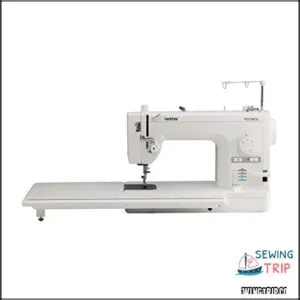
You’ll appreciate the Brother PQ1500SL for straight-stitch quilting projects that demand consistent 1,500-stitches-per-minute speed across bulky layers, weighted blankets, and large quilts.
This machine features a precision pin feed system, automatic thread trimmer, and knee-lifter for hands-free fabric repositioning during long piecing runs.
The extra-large extension table holds multi-layered quilts, while LED lighting illuminates your work area; with adjustable feed dogs and full-range foot pressure, you’ll handle canvas, denim, and delicate fabrics with stable, reliable stitching under a heavy-duty metal frame.
| Best For | Experienced quilters and sewers who need a powerful straight-stitch machine for handling thick fabrics, large quilts, and free-motion quilting at high speeds. |
|---|---|
| Brand | Brother |
| Weight | 29.8 lbs |
| Material | Metal |
| Max Speed | 1500 SPM |
| Primary Use | Quilting/straight stitch |
| Power Source | Electric 110V |
| Additional Features |
|
- Blazing fast 1,500 stitches per minute with precision pin feeding for consistent results on heavy or multi-layered fabrics
- Automatic thread trimmer and knee-lifter make long quilting sessions more efficient and comfortable
- Sturdy metal construction with a large extension table supports big projects like weighted blankets and bulky quilts
- Threading system and side-loading bobbin case are tricky for beginners, with no low-thread alert
- Automatic needle threader can be finicky and may struggle with budget or thicker threads
- Top tension dial placement makes adjustments harder to see, and the machine needs regular lubrication to stay quiet
4. Consew Industrial Walking Foot Sewing Machine
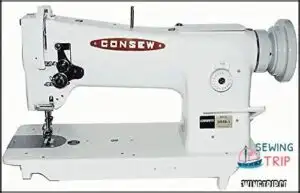
When upholstery, leather, or marine-grade vinyl enters your production lineup, the Consew 206RB-5 walking foot machine delivers compound feed synchronization that grips thick multi-layer stacks without slippage. You’ll benefit from an extra-long 10mm stitch length, high 14mm foot lift, and large bobbin capacity—ideal for furniture covers, tarpaulins, canvas shoes, and outdoor gear.
This cast-iron head ships with table and servo motor, though assembly demands patience; the triple-feed mechanism ensures even tension across materials that would buckle or shift on standard flatbed units.
| Best For | Professional upholsterers, leather workers, and marine fabricators who need to stitch heavy multi-layer materials like vinyl, canvas, and thick leather without slippage. |
|---|---|
| Brand | CONSEW |
| Weight | 200 lbs |
| Material | Leather |
| Max Speed | Not specified |
| Primary Use | Upholstery/leather work |
| Power Source | Electric |
| Additional Features |
|
- Triple-feed walking foot system handles thick stacks of leather, vinyl, and canvas without shifting or puckering
- Extra-long 10mm stitch length and 14mm foot lift tackle heavy-duty projects that standard machines can’t handle
- Includes table and servo motor right out of the box, so you get a complete workstation ready for production
- Assembly requires outside help or YouTube tutorials since no setup instructions are included
- Some users report thread breakage and tangling issues that need troubleshooting
- Table surface chips easily and customer service doesn’t always resolve problems quickly
5. Juki Cover Stitch Machine
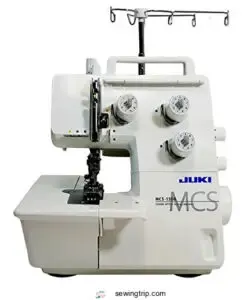
For knit hems, necklines, and stretchy activewear, the Juki MCS-1500 features a three-needle cover stitch and four-thread chain stitch at 1,350 stitches per minute—fast enough for small-scale garment runs without industrial pricing.
You’ll appreciate the lower looper threading system that cuts setup time, adjustable stitch length and width, and differential feed to prevent puckering on lightweight jerseys.
Its metal frame delivers stability during long sessions, though threading takes practice if you’re new to cover-stitch paths; color-coded guides ease the learning curve.
| Best For | Sewers who work with knit fabrics and want professional-looking hems, necklines, and activewear without investing in industrial equipment. |
|---|---|
| Brand | SINGER |
| Weight | 17.6 lbs |
| Material | Metal/Plastic |
| Max Speed | Not specified |
| Primary Use | Heavy-duty home sewing |
| Power Source | Electric |
| Additional Features |
|
- Fast 1,350 stitches per minute with stable metal frame for consistent results on stretchy fabrics
- Color-coded threading guides and lower looper system make setup easier once you learn the process
- Adjustable stitch settings and differential feed prevent puckering on lightweight jerseys
- Threading paths take patience to master, especially if you’re new to cover stitch machines
- Limited English tutorials available—most instructional videos are in Japanese
- Small work area requires reaching over the machine to operate the presser foot
6. Janome Heavy Duty Sewing Machine
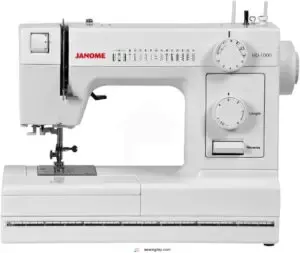
When versatility matters more than pure speed, the Janome HD1000 works with thick denim and multiple fabric layers through 14 built-in stitches—utility, stretch, and a four-step buttonhole—at a fraction of industrial pricing.
You’ll rely on its cast aluminum body and 23-pound metal frame for stability during garment sewing, quilting, and home-decor runs, plus an automatic needle threader and free arm for cuffs and collars.
Manual tension adjustment requires hands-on tweaking, yet that trade-off grants control for small studios balancing durability with budget.
| Best For | Home sewists and small studios who need a reliable workhorse for heavy fabrics and layered projects without breaking the bank. |
|---|---|
| Brand | JUKI |
| Weight | 1 lb |
| Material | Metal |
| Max Speed | 1350 SPM |
| Primary Use | Cover/chain stitch |
| Power Source | Electric |
| Additional Features |
|
- Cast aluminum body and 23-pound frame provide rock-solid stability when working with thick materials like denim or multiple layers
- Free arm and automatic needle threader make detail work on cuffs, collars, and buttonholes much easier
- Handles heavy-duty tasks and thick threads that would bog down lighter machines
- Only 14 stitches might feel limiting if you’re into decorative work or advanced techniques
- Manual tension adjustments mean you’ll spend time tweaking settings instead of relying on automation
- At 23 pounds, it’s not the easiest machine to move around or store if space is tight
7. Industrial Straight Stitch Sewing Machine Head
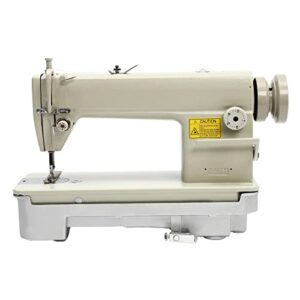
A bare sewing head—model 6150 in high-temperature iron with automatic bobbin winder and oil-return pump—gives you the freedom to build your own workstation around a straight-stitch foundation that processes thick materials through replaceable presser feet and manual thread-roll clamping.
You’ll bolt it onto a custom table, add a clutch or energy-saving belt motor, then dial presser-foot pressure and tension for uniform seams on woven fabrics, reaching several thousand stitches per minute once you sync the direct-drive setup with routine lubrication and needle-bar alignment.
| Best For | Experienced sewers and small manufacturers who need a high-speed workhorse for heavy-duty materials like leather and canvas and want to customize their own machine setup. |
|---|---|
| Brand | Janome |
| Weight | 23 lbs |
| Material | Aluminum/Metal |
| Max Speed | Not specified |
| Primary Use | Heavy fabric sewing |
| Power Source | Electric |
| Additional Features |
|
- Handles thick, tough fabrics that would jam a regular machine—think boots, bags, and upholstery
- Automatic bobbin winder and oil-return pump cut down on tedious prep work and fuel costs
- Replaceable presser feet let you switch between different sewing jobs without buying a whole new machine
- You have to supply your own motor, table, and safety equipment, which adds cost and assembly time
- Missing or incorrectly installed parts can cause injuries, so it’s not beginner-friendly
- Limited to straight stitching only—no zigzag or decorative options
8. Leather Sewing Machine Heavy Duty
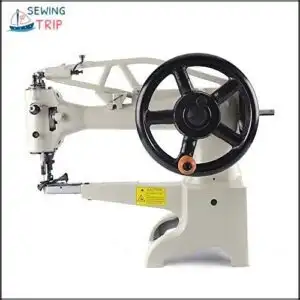
A specialized leather machine handles dense hides up to 7/8 inches thick with a high-torque servo motor that maintains consistent stitch tension through 6 to 8 oz material. Walking-foot or needle-feed mechanisms grip multiple layers, while reinforced metal frames absorb vibration at sustained speeds, preventing needle deflection.
You’ll push boots, bags, and saddle work through generous presser-foot clearance, relying on industrial-grade components that deliver reliable torque across long production runs without overheating, essential for maintaining a professional finish on leather goods.
| Best For | DIY enthusiasts and small-scale professionals who need a manual leather sewing machine for repairing or creating thick leather goods like boots, bags, and belts without the cost of an industrial setup. |
|---|---|
| Brand | Generic |
| Weight | Not specified |
| Material | Iron |
| Max Speed | Not specified |
| Primary Use | Shoe/boot repair |
| Power Source | Fuel Powered |
| Additional Features |
|
- 360-degree rotatable presser foot lets you sew in any direction, making it easier to handle curved seams and cylindrical items like boots
- Manual hand-crank operation gives you precise control over stitch placement and speed, which is great for detailed work on thick materials up to 7/8 inches
- Sturdy cast-iron construction at 59 pounds provides stability when sewing through dense leather, canvas, or rubber without the machine shifting
- Hand cranking only works clockwise and can be tiring during longer projects, especially when working through multiple layers of thick leather
- Small bobbin case fills up quickly, so you’ll need to stop and refill thread more often than you’d like on bigger jobs
- Threading setup isn’t well-documented, and some users report tension issues or damage that may require trial-and-error or modifications to get right
9. Singer Professional Metal Frame Serger Machine
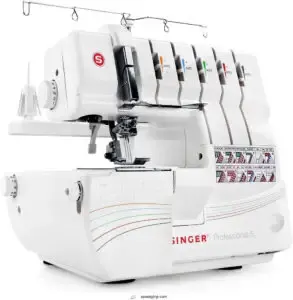
The Singer Professional Metal Frame Serger delivers 2-3-4-5 thread versatility through a fully automatic tension system, threading light cottons or heavier knits at 1,300 stitches per minute without pucker. You’ll configure rolled hems, overlock seams, and coverstitch finishes—though switching between modes demands 3 to 10 minutes of setup, making it less practical for constant changeovers.
The metal frame maintains alignment during high-speed runs, while differential feed grips stretch fabrics smoothly; beginners may find threading intimidating, yet the color-coded diagram simplifies repeat configurations once you master the initial setup.
| Best For | Experienced sewers who need multi-thread versatility for garments and home décor projects and don’t mind spending extra time on setup. |
|---|---|
| Brand | YIYIBYUS |
| Weight | 59.4 lbs |
| Material | Cast Iron |
| Max Speed | 500 SPM |
| Primary Use | Leather/thick materials |
| Power Source | Manual |
| Additional Features |
|
- Handles both delicate and heavy fabrics smoothly with differential feed that prevents puckering
- Metal frame stays stable at 1,300 stitches per minute for professional-quality seams
- Automatic tension system takes the guesswork out of thread adjustments
- Threading is intimidating for beginners, even with the color-coded diagram
- Switching between overlock and coverstitch modes takes 3–10 minutes each time
- May need occasional mechanical maintenance like tightening screws
Tips for Selecting and Maintaining Your Machine
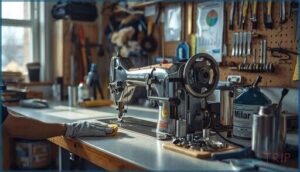
Getting the right industrial sewing machine is only half the battle—you’ll need to know how to choose wisely and keep it running smoothly for years. Your investment depends on matching the machine to your actual workload, understanding what kind of support you’ll get when problems arise, and staying on top of routine maintenance.
Here’s what you need to focus on to make a smart purchase and protect your equipment long-term.
Assessing Business Needs and Budget
Before you commit a single dollar to Industrial Sewing Machines, pin down exactly what you’ll sew, how much you’ll produce, and which fabrics you’ll handle daily.
Investment Strategies hinge on clear Financial Projections: map your Sewing Business Requirements against realistic Cost Analysis, factor in Risk Assessment for seasonality or demand shifts, and align your Budget Planning with specific Sewing Equipment Cost benchmarks—ensuring every Industrial Sewing Machine Selection drives measurable returns without draining cash reserves.
Evaluating Warranty and Support
A rock-solid warranty separates true industrial-grade sellers from fly-by-night suppliers: you need clear Service Response timelines—ideally 24-hour troubleshooting access, documented Maintenance Schedules, and accessible Warranty Claims processes that specify parts, labor, and authorized service centers near your shop.
Customer Satisfaction ratings and Support Quality reviews reveal whether a manufacturer backs its Industrial Sewing Machines with action, not just promises.
Regular Cleaning and Lubrication
Think of your Industrial Sewing Machine as a high-performance engine—it demands consistent care. You’ll want Cleaning Schedules every 8 to 12 hours of production, applying the right Lubricant Types: light machine oil on needle bars, white lithium grease on moving parts, and synthetic gear lubricant where specified.
Maintain detailed Maintenance Logs, practice strict Contamination Control by capping containers immediately, and listen for squeaks signaling insufficient Oil Application—your HeavyDuty Sewing Machines will reward diligence with decades of perfect stitching.
Using Specialized Accessories and Parts
Your Industrial Sewing Solutions expand dramatically when you master Accessory Compatibility and strategic Part Replacement. Genuine Juki Parts, color-coded presser feet, and Teflon glides transform baseline machines into specialized workhorses:
- Thread Management systems: automatic tensioners and bobbin winders maintain consistency across fabric weights, reducing operator fatigue through excellent Sewing Ergonomics.
- Machine Customization via programmable stitch sequences: save preferred settings for repeat jobs.
- Specialty feet and needle plates: enhance Sewing Machine Maintenance intervals while unlocking new capabilities in Embroidery Supplies and heavy materials.
Troubleshooting Common Issues
Even with proper accessories, your Industrial Sewing Machine will face occasional hiccups: electrical faults from voltage inconsistencies, thread breaks caused by bent needles or excessive tension, feed issues when presser foot pressure crushes delicate fabrics, and needle problems from incorrect insertion.
Regular Sewing Machine Maintenance—oiling schedules, lint removal, and bobbin area cleaning—prevents most Industrial Sewing Solutions from grinding to a halt mid-production.
Frequently Asked Questions (FAQs)
What are the different types of industrial sewing machines?
Your fabric-handling needs determine which sewing machine types work best: Flatbed Sewing Machines handle large panels; Cylinder Bed Sewing Machines navigate tubular items; Post Bed Sewing Machines reach deep into bulky materials with precision.
What is the best sewing machine for business?
Your best sewing machine for business depends on sewing machine comparison factors: matching heavy duty sewing machine types to business fabric needs, evaluating machine cost analysis, and prioritizing industrial sewing tips that boost sewing efficiency boosters daily.
What is a class 7 sewing machine?
When you’re pushing thick leather or canvas through demanding production runs, Class 7 machines deliver.
Built with sturdy lock stitch mechanisms, independent dual feeds, and high presser foot lift, they handle heavy-duty sewing without compromise.
Which is better Jack or Juki?
Juki industrial sewing machines deliver exceptional stitch consistency, machine longevity, and global parts availability, justifying their higher cost.
Jack offers competitive motor efficiency and lower upfront pricing, making brand comparison dependent on your budget and production volume needs.
What are the types of industrial sewing machines?
When you need to hem 500 t-shirts by Friday, your choice matters. The main industrial sewing machine types include flatbed lockstitch machines, cylinder arm machines for tubes, post bed models, overlock machines, and coverstitch machines for stretch fabrics.
What brand is best for an industrial sewing machine?
When you’re comparing brands for an industrial sewing machine, Juki stands out for sewing efficiency and machine durability.
The DDL8700 delivers cost-effective heavy-duty performance backed by strong customer support networks worldwide.
How do I choose an industrial sewing machine?
Start by evaluating your daily tasks, fabric types, and production volume to match machine capabilities—whether you need straight stitch speed, walking foot power for heavy materials, or overlock finishing for stretchy garments.
What are the 7 types of sewing machines?
Sewing machine basics aren’t stitched in stone: flatbed machines handle rectangular fabric; cylinder beds navigate tubular items; post beds tackle bulky industrial applications; overlock sergers finish edges; coverstitch machines hem knitwear; walking foot models advance thick layers; blind hemmers create invisible seams.
What is the cost of machine replacement parts?
Replacement Strategies and Component Pricing shift dramatically across machine types: flatbed feed dogs run $20–150, while walking foot assemblies reach $120–800, with motors spanning $200–1,500 depending on torque.
Maintenance Budgeting demands careful Repair Estimates planning.
How to train employees on industrial machines?
Picture a new operator hesitating at the machine, uncertain where to start—structured training prevents this. Implement hands-on safety modules with documented checklists, practice sessions, and performance monitoring to build operator confidence and guarantee proper equipment familiarization across industrial sewing technology.
Conclusion
The right tool for the right job—this principle determines whether your production line runs smoothly or stalls constantly. Selecting industrial sewing machine types for small business means matching mechanical architecture to your materials, volume, and finish requirements: flatbeds deliver garment precision, cylinder beds navigate curves, walking feet synchronize layers.
Invest in equipment that eliminates bottlenecks rather than creates them, prioritize maintenance accessibility, and your machinery becomes the foundation for expansible growth instead of a perpetual constraint.
- https://www.mysewingmall.com/
- https://www.topeaglesewing.com/info/what-are-the-advantages-and-application-range-96529458.html
- https://www.techsew.com/blogs/techsew-blog/cylinder-arm-sewing-machine-buying-guide
- https://www.kingmaxsew.com/news/the-difference-between-a-post-bed-and-a-cylind-84959549.html
- https://www.jacksew.com/blog/best-practices-on-maintaining-your-sewing-machine/