This site is supported by our readers. We may earn a commission, at no cost to you, if you purchase through links.
Snipping threads between seams sounds minor until you’ve sewn through fifty quilt blocks and your fingertips are sore from scissors.
That small interruption, repeated dozens of times per project, quietly eats hours.
Computerized sewing machines with automatic thread cutting solve this with a single button press or heel-pedal kick—blades engage, both upper and bobbin threads trim cleanly, and you’re back to sewing before the rhythm breaks.
Brands like Bernina, Juki, and Janome have built these systems into machines at a wide range of price points, so knowing which features actually hold up separates a smart buy from an expensive regret.
Table Of Contents
- Key Takeaways
- How Automatic Thread Cutting Works
- Benefits of Built-in Thread Cutting
- Top 10 Machines to Compare
- 1. Singer Quantum Stylist 9960 Sewing Machine
- 2. JUKI HZL-F300 Sewing Quilting Machine
- 3. Bernette B38 Swiss Design Sewing Machine
- 4. Janome 3160QDC Quilting Sewing Machine
- 5. Brother SE1900 Sewing Embroidery Machine
- 6. Janome Skyline S3 Sewing Machine
- 7. Juki HZL DX7 Computerized Sewing Machine
- 8. Janome MC6650 Sewing and Quilting Machine
- 9. Juki TL2010Q Portable Lockstitch Sewing Machine
- 10. Brother PQ1500SL Sewing Quilting Machine
- Key Features That Matter Most
- Choosing The Right Sewing Machine
- Frequently Asked Questions (FAQs)
- Conclusion
Key Takeaways
- Machines like the Juki HZL-DX7 and Brother PQ1500SL offer three trimming methods — button, heel-pedal, and programmable auto-cut — so you can match the workflow to the project instead of adapting to the machine.
- Automatic thread cutting isn’t just a convenience feature; it directly reduces thread nesting, shortens tail lengths, and keeps tension consistent across dozens of repeated seams.
- Your use case should drive the buying decision — the Brother SE1900 handles sewing and embroidery in one setup, while the Juki TL-2010Q and Brother PQ1500SL are purpose-built straight-stitch workhorses for serious quilters.
- Keeping your cutter running well comes down to simple habits — clear the lint, maintain the blade, and schedule a tech check every 12–18 months to avoid mid-project failures.
How Automatic Thread Cutting Works
Automatic thread cutting isn’t magic — it’s a handful of smart mechanisms working together to save you time. Knowing how each one works helps you pick the machine that actually fits your workflow.
If you want to see these mechanisms in action on a beginner-friendly machine, the Brother SE625 automatic thread cutting review breaks down exactly how it handles the whole process.
Here’s a breakdown of the key systems you’ll find across today’s top computerized models.
Button-activated Thread Cutter Systems
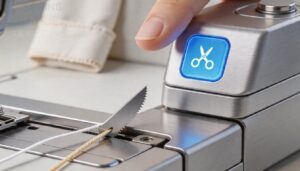
Most automatic thread cutters start with one press of a button — that scissor icon on your control panel. Here’s what actually happens when you press it:
- A solenoid actuation fires, converting electrical current into a precise cutting motion.
- Blade alignment guides the cutter arm through both upper and bobbin threads simultaneously.
- A safety interlock prevents activation mid-stitch.
- Noise dampening components absorb the mechanical impact.
It provides consistent thread lengths for a professional finish.
Clean cut. No scissors needed.
Programmable Auto-cut After Lock Stitches
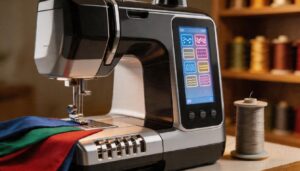
Pressing a button is one thing — but programmable automatic thread cutting takes it further.
With Lock Stitch Timing built in, your machine waits until the lock stitch finishes before trimming.
No loose ends, minimal Thread Waste Reduction issues, and Thread Tail Length stays consistently short.
Memory Recall Integration lets you save those settings, so every session starts exactly where you left off.
Heel-pedal and Hands-free Trimming Control
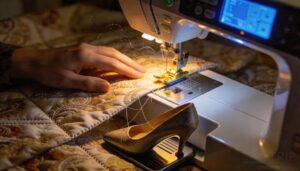
Once your machine locks the stitch, trimming hands-free is the next logical step. With Heel Kick Mapping, you rock your heel back and the cut happens — no button-reaching, no scissors. That’s Foot Control Customization doing real work.
- Keep both hands on the fabric during chain piecing
- Programmable Heel Functions reduce fatigue across long sessions
- Brands like BERNINA and Husqvarna Viking support full Hands-Free Trim Workflow
- Foot Pedal Ergonomics improve precision without interrupting your rhythm
Top and Bobbin Thread Trimming Process
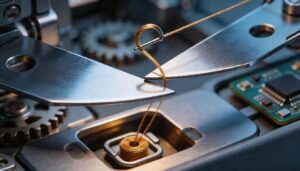
Behind every clean cut is a precise sequence. The trim cycle starts when your automatic thread cutter receives its command, then briefly slows the stitch cycle so the knife assembly can engage properly.
Knife Alignment determines Cut Quality — the movable and fixed blades work together, handling Thread Capture and Bobbin Retention in one pass.
| Stage | What Happens |
|---|---|
| Thread Capture | Picker hooks the loop before cutting |
| Trim Cycle Timing | Machine slows, knives engage cleanly |
| Bobbin Retention | Under-thread presser holds tail for restart |
Manual Vs Automatic Thread Cutting
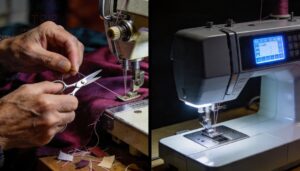
Both methods cut thread — but that’s where the similarity ends. Here’s how they actually compare:
- Operator Fatigue — Auto-cut removes constant snipping, reducing hand strain over long sessions.
- Thread Tail Length — Manual trimming gives you control; automatic cutting leaves a fixed tail.
- Learning Curve — Built-in thread cutters are simple once set up, but manual is instinctive.
- Cost of Maintenance — Automatic mechanisms add moving parts, which means occasional servicing.
- Safety Considerations — Auto-cut keeps fingers away from sharp scissors near fast-moving fabric.
Benefits of Built-in Thread Cutting
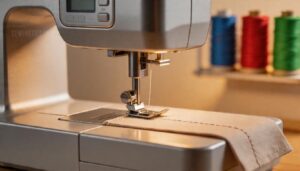
Once you’ve sewn your last stitch, the last thing you want is to hunt for scissors or pick apart tangled threads.
A built-in cutter changes that whole experience in ways that go beyond simple convenience. Here’s what you actually gain when your machine performs the trimming for you.
Faster Sewing and Quilting Workflow
Every second you spend reaching for scissors is a second you’re not sewing. With automatic thread cutting, you stay in rhythm — especially on repetitive quilt stitching.
Batch stitching techniques flow faster when foot pedal automation manages the trim.
Add heel-pedal coordination and speed memory recall on computerized sewing machine features, and your thread tail management practically runs itself.
Cleaner Seam Ends With Less Cleanup
Automatic thread cutting trims both the needle and bobbin threads tight to the stitch — so your fabric leaves the machine with short, consistent thread lengths instead of dangling tails. That means a Neater Backside Finish, better Seam Edge Uniformity, and Efficient Post‑Sewing with less hand‑trimming.
Automatic thread cutting leaves every seam clean, short, and ready — no scissors, no dangling tails
Seam finishing automation delivers Reduced Thread Waste and cleaner results than manual snipping, seam after seam.
Reduced Thread Tangles and Nesting
Thread nests rarely happen by accident — they’re the result of small mistakes stacking up. Built-in automatic thread cutting breaks that chain by leaving shorter, controlled tails after every seam.
- Thread Path Optimization keeps tension consistent from stitch to stitch.
- Bobbin Winding Consistency prevents sudden slack under the fabric.
- Tension Calibration stops top thread from pulling loose into the bobbin area.
- Seam Start Technique improves when auto‑trimmed tails don’t drag back through.
Better Efficiency for Repetitive Stitching
Repetitive stitching is where automatic thread cutting really earns its keep. Reduced setup time between seams adds up fast—no grabbing scissors, no repositioning.
Batch Stitch Automation keeps your Continuous Thread Flow moving through dozens of identical seams without breaking the rhythm.
Efficient Stitch Sequencing and an Optimized Foot Pedal combine sewing, locking, and trimming into one motion.
That’s the real impact of automatic thread cutters on sewing workflow.
Improved Convenience for Embroidery Projects
Embroidery projects live and die by how color changes flow. With automatic thread cutting and embroidery combination functionality built in, machines handle Integrated Color Change sequences without constant hand intervention.
One-touch Design Loading and Mobile App Control let you manage your thread management system from the interface itself.
Add Quick Hoop Change and automatic needle threader support, and each segment moves faster — start to finish.
Top 10 Machines to Compare
Not every machine earns a spot on this list — these ten made the cut because they actually deliver on automatic thread cutting without sacrificing speed, stitch variety, or build quality.
Each one brings something different to the table, from budget-friendly computerized options to high-speed workhorses built for serious quilters.
Here’s what you’re working with.
1. Singer Quantum Stylist 9960 Sewing Machine
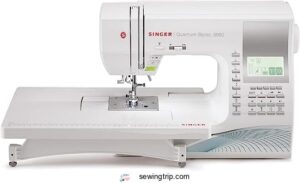
The Singer Quantum Stylist 9960 punches well above its $540.99 price tag. You get 600 built-in stitch types, 13 automatic buttonhole styles, and five lettering fonts — enough variety to handle everything from garment construction to decorative quilting.
The one-touch thread cutter trims both top and bobbin threads simultaneously, leaving clean tails without any scissors work. Add the automatic needle threader, drop-in bobbin, and 13 presser feet, and this machine covers most sewing needs right out of the box.
| Best For | Home sewers and crafters who want a feature-packed machine that can handle everything from garment sewing and quilting to decorative projects without needing to upgrade equipment. |
|---|---|
| Built-in Stitches | 600 |
| Auto Thread Cutter | Yes |
| Auto Needle Threader | Yes |
| Machine Weight | 14.6 lb |
| LED Lighting | Yes |
| Bobbin System | Top drop-in |
| Additional Features |
|
- 600 stitch types plus five lettering fonts give you serious creative range, whether you’re quilting, sewing apparel, or making home décor.
- The automatic needle threader, drop-in bobbin, and one-touch thread cutter cut down setup and finishing time significantly.
- Comes with 13 presser feet and a large extension table, so you’re ready for most projects straight out of the box.
- The throat plate is on the smaller side, which can get frustrating when you’re working with large quilt pieces.
- There’s a real learning curve here — beginners may feel overwhelmed by 600 stitch options and all the features.
- The 90-day limited warranty feels short for a $540 machine, and you’ll need to register to unlock the full stitch-quality guarantee.
2. JUKI HZL-F300 Sewing Quilting Machine
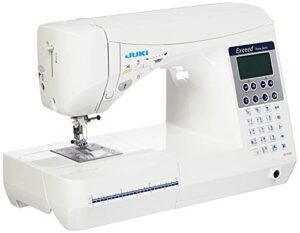
If the Singer impresses you with variety, the JUKI HZL-F300 wins on precision and power.
It sews at up to 900 spm and manages everything from sheer voile to stacked wool layers — thanks to a 7-point feed dog and industrial-style box-feed system.
The thread cutter works three ways: push-button, heel-pedal, or programmable auto-cut after lock stitches. You get 106 built-in stitches, 16 sensor-controlled buttonholes, and an LCD display that keeps settings front and center.
| Best For | Intermediate to advanced sewers who work with heavy fabrics like quilts and wool coats and want a reliable, precise machine for serious projects. |
|---|---|
| Built-in Stitches | 106 |
| Auto Thread Cutter | Yes |
| Auto Needle Threader | Yes |
| Machine Weight | 25 lb |
| LED Lighting | Yes |
| Bobbin System | Top drop-in |
| Additional Features |
|
- The box-feed system handles thick layers without jamming — great for quilting and heavy garments
- 16 sensor-controlled buttonholes and an LCD display make setup fast and accurate
- Built-in LED lighting and electronic thread cutter keep your workflow smooth and efficient
- No knee lever included — you’ll have to buy one separately if you need it
- Only 106 stitches, which feels limited compared to higher-end machines with 200
- Runs on 120V only, so it won’t work abroad without a voltage converter
3. Bernette B38 Swiss Design Sewing Machine
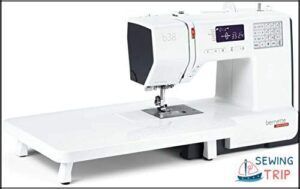
Where the JUKI leans industrial, the Bernette B38 takes a more refined approach — Swiss-designed, practical, and surprisingly full-featured at $899.
It runs at 820 spm and carries 394 built-in stitches, including 67 decorative patterns and three alphabets.
The automatic thread cutter trims at the push of a button or activates after a lock stitch automatically. Adjustable presser foot pressure manages everything from delicate knits to heavy canvas. Eight presser feet, an extension table, and a drop-in bobbin round out a genuinely well-balanced package.
| Best For | Sewists of all skill levels who want a refined, feature-packed machine that handles everything from delicate fabrics to large home-decor projects with ease. |
|---|---|
| Built-in Stitches | Not specified |
| Auto Thread Cutter | Yes |
| Auto Needle Threader | Yes |
| Machine Weight | 22 lb |
| LED Lighting | Yes |
| Bobbin System | Top drop-in |
| Additional Features |
|
- Automatic thread cutter and tie-off make finishing work fast and clean — no more hunting for scissors
- Adjustable presser foot pressure means you can go from silky knits to heavy denim without breaking a sweat
- The extension table and 394 built-in stitches (including alphabets) give you serious range for quilts, garments, and embroidery
- The foot-lifting lever takes real arm strength, which can wear you out during long sessions
- Plastic bobbins only — slip in a metal one by mistake and you’re looking at potential damage
- Customer service is limited in availability, and getting a replacement through Amazon isn’t an option
4. Janome 3160QDC Quilting Sewing Machine
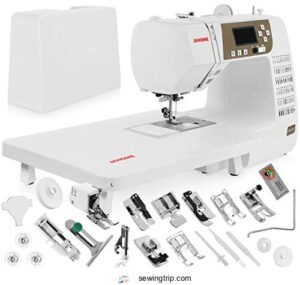
If the Bernette leans on variety, the Janome 3160QDC leans on precision. At $749, it’s built for quilters who want clean results without fighting their machine.
The Premium Plus Feed System uses 7-piece feed dogs to move everything from slippery silk to thick batting without puckering. You get 60 stitches, one-touch automatic thread cutting after lock stitches, and a speed slider for full control — no foot pedal needed. The extension table and hard cover make it genuinely portable.
| Best For | Quilters and home sewists who want precise, consistent results across a range of fabrics — from delicate silks to thick quilt sandwiches. |
|---|---|
| Built-in Stitches | 60 |
| Auto Thread Cutter | Yes |
| Auto Needle Threader | Yes |
| Machine Weight | 12.5 lb |
| LED Lighting | Yes |
| Bobbin System | Top drop-in |
| Additional Features |
|
- The SFS 7-piece feed system keeps fabric moving smoothly without puckering or shifting, even through multiple layers.
- Automatic needle threader and thread cutter make setup and finishing fast, so you spend more time sewing and less time fussing.
- Speed slider and start/stop button give you full control without needing a foot pedal — great for detailed work.
- The bulkier post-bin arm can make hemming small garments (like kids’ pants) more awkward than on older models.
- Very heavy stacks — think six layers of denim — may cause the machine to shift, and you might need a grip mat to keep it stable.
- No embroidery module, and the built-in button-sewing function has a bit of a learning curve.
5. Brother SE1900 Sewing Embroidery Machine
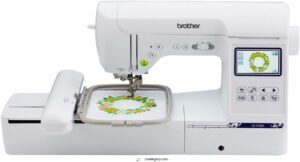
Want a machine that sews and embroiders without switching setups? The Brother SE1900 does both at $1,084.95.
You get 240 built-in stitches, 138 embroidery designs, and a 5"×7" hoop — big enough for serious monograms and multi-element designs.
The automatic thread trimmer cuts both top and bobbin threads mid-project, keeping your workflow tight.
A 3.2-inch color touchscreen facilitates design editing, and USB import means your custom.PES files are always welcome.
At 22 lbs, it stays put on your work table.
| Best For | Sewists and crafters who want one machine that handles both garment construction and embroidery without juggling two setups. |
|---|---|
| Built-in Stitches | 240 |
| Auto Thread Cutter | Yes |
| Auto Needle Threader | Yes |
| Machine Weight | 22.05 lb |
| LED Lighting | Yes |
| Bobbin System | Top drop-in |
| Additional Features |
|
- Huge 5"×7" hoop means fewer re-hoopings and more room for big monograms or multi-element designs
- 240 stitches plus 138 embroidery designs gives you plenty to work with right out of the box
- USB import lets you bring in your own.PES files, so you’re not stuck with what’s built in
- No Wi-Fi or Bluetooth — design transfers are USB-only, which feels a little dated at this price
- Larger hoops and an extension table cost extra, and you’ll probably want both
- At 22 lbs, it’s not something you’re hauling to a sewing class without thinking twice
6. Janome Skyline S3 Sewing Machine
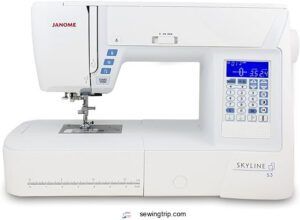
The Janome Skyline S3 is a workhorse that doesn’t make you work harder. It runs at 820 stitches per minute, packs 120 built-in stitches, and includes a button-activated automatic thread cutter that trims both top and bobbin thread simultaneously.
The Advanced Plus Feed System manages thick layers without skipping.
You get 15 needle placements, an extra-high presser foot lift, and a roomy 210 mm × 120 mm workspace — plenty of room for quilts or bulky projects.
At 20.9 lbs, it’s solid without being a burden.
| Best For | Sewists who tackle heavy fabrics, quilts, or bulky projects and want a reliable machine that handles the hard stuff without a steep learning curve. |
|---|---|
| Built-in Stitches | 120 |
| Auto Thread Cutter | Yes |
| Auto Needle Threader | Yes |
| Machine Weight | 22 lb |
| LED Lighting | Yes |
| Bobbin System | Top drop-in |
| Additional Features |
|
- Handles thick, multi-layer fabrics like denim and brocade smoothly — no skipping, no fuss
- Automatic thread cutter and one-hand needle threader make the whole process faster and less frustrating
- Backlit LCD and 120 built-in stitches give beginners an easy start while keeping experienced sewists happy
- At 22 lbs with a bulky footprint, it’s not the easiest machine to move around or store
- The bobbin winder can wind loosely sometimes, so you’ll want to double-check before sewing
- Only one alphabet character for buttonhole lettering — anything more complex means doing it by hand or using another tool
7. Juki HZL DX7 Computerized Sewing Machine
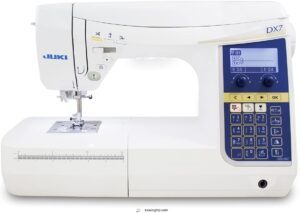
If you want a machine that manages thread trimming three different ways, the Juki HZL-DX7 delivers. Press the button, program a cut after each lock stitch, or use heel control on the foot pedal — your choice.
At 1,050 stitches per minute with 277 built-in patterns, it’s fast and adaptable.
The BOX Feed system keeps fabric steady, and the free-float mode manages thick layers cleanly.
The presser foot lifts automatically after every trim, so you’re not stopping to reposition.
Priced at $1,499.99, it earns its spot.
| Best For | Sewists and quilters who want a fast, feature-rich machine for everything from detailed embroidery to large quilting projects in a quiet home or shared studio. |
|---|---|
| Built-in Stitches | 277 |
| Auto Thread Cutter | Yes |
| Auto Needle Threader | Yes |
| Machine Weight | 16 oz listed (approx 25 lb) |
| LED Lighting | Yes |
| Bobbin System | Top drop-in |
| Additional Features |
|
- 277 built-in stitches plus three thread-trimming options give you serious flexibility without slowing down your workflow.
- The BOX Feed system and free-float mode keep fabric — even thick, layered pieces — feeding smoothly and evenly.
- Quiet motor and time-saving features like the auto threader and auto cutter make long sewing sessions a lot less tiring.
- The automatic needle threader has a reputation for breaking down sooner than it should.
- Bobbin winding can be finicky — get the placement wrong and you’ll run into thread direction problems.
- At $1,499.99, it’s a real investment, and the learning curve means you’ll want to spend some quality time with the manual before diving in.
8. Janome MC6650 Sewing and Quilting Machine
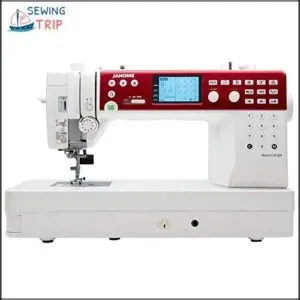
MC6650 isn’t just built for speed — it’s built to keep up with you.
At 1,000 stitches per minute, with 172 built-in stitches and a 10-inch all-metal flatbed, it manages quilts, garments, and home décor without breaking a sweat.
The automatic thread cutter trims top and bobbin threads together in one shot.
Add 12 presser feet, a 7-piece feed dog, and memory banks for your favorite settings, and you’ve got a serious workhorse at $2,050.
| Best For | Serious hobbyists and semi-professional sewists who tackle high-volume projects like quilting, garment construction, and home décor and want a fast, durable machine that grows with their skills. |
|---|---|
| Built-in Stitches | 172 |
| Auto Thread Cutter | Yes |
| Auto Needle Threader | Yes |
| Machine Weight | 24.25 lb |
| LED Lighting | Yes (6 LEDs) |
| Bobbin System | Top-loading rotary |
| Additional Features |
|
- Blazing 1,000 spm speed with 172 stitches and a 10" flatbed makes it a genuine workhorse for big, complex projects
- Beginner-friendly touches — auto-threader, LCD screen, and memory banks — cut down setup time significantly
- Solid all-metal construction means it holds up under heavy, frequent use
- Some users have reported stitch skipping, thread-cutter failures, and motor lock-ups that needed servicing
- At 24 lbs and $2,050, it’s a serious investment that isn’t easy to move around
- The manual is reportedly lacking, and useful add-ons like the knee-lift foot cost extra
9. Juki TL2010Q Portable Lockstitch Sewing Machine
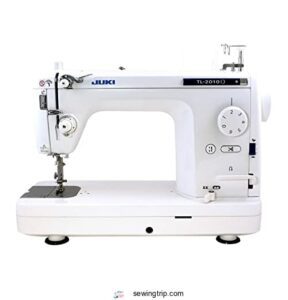
The TL-2010Q is a straight-stitch specialist that doesn’t compromise — it tops out at 1,500 stitches per minute with an aluminum die-cast body that kills vibration and holds tight under pressure.
You get a button-activated thread cutter that trims both top and bobbin threads cleanly, plus heel-pedal activation for truly hands-free control.
The knee lifter raises the presser foot up to 12 mm, and stitch length runs 0–6 mm.
At $1,187, it’s built for quilters who mean business.
| Best For | Quilters and sewists who work with heavy fabrics and need a fast, reliable straight-stitch machine they can take to classes or move between workstations. |
|---|---|
| Built-in Stitches | 1 (straight only) |
| Auto Thread Cutter | Yes |
| Auto Needle Threader | Yes |
| Machine Weight | 38 lb |
| LED Lighting | Not specified |
| Bobbin System | Standard lockstitch |
| Additional Features |
|
- Cuts both threads with a single button press — huge time saver on long projects
- Knee lifter lets you reposition fabric without putting down what you’re doing
- Aluminum body keeps it solid and surprisingly portable at the same time
- Straight stitch only — no zigzag, no decorative stitches, full stop
- The automatic needle threader has a learning curve; expect to read the manual a few times
- Walking foot accessories can get noisy, and the needle area could use better lighting
10. Brother PQ1500SL Sewing Quilting Machine
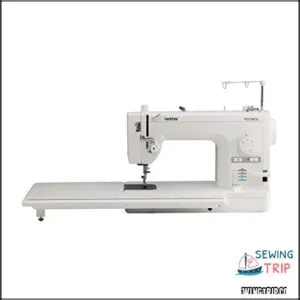
The Brother PQ1500SL is built for one thing: fast, clean, straight-stitch work at 1,500 spm.
push-button automatic thread cutter trims both top and bobbin threads in one motion, so you’re not reaching for scissors between seams.
The pin-feed system accommodates velvet, satin, and layered quilts without puckering.
Add the knee lifter, a wide extension table, and seven included feet — including a walking foot — and you’ve got a serious quilting machine.
At roughly 30 lbs, it stays on the table, not in your bag.
| Best For | Quilters and sewists who need serious speed and precision for large projects like quilts, blankets, or heavy-fabric work. |
|---|---|
| Built-in Stitches | 1 (straight only) |
| Auto Thread Cutter | Yes |
| Auto Needle Threader | Yes |
| Machine Weight | 29.8 lb |
| LED Lighting | Yes |
| Bobbin System | Drop-in top bobbin |
| Additional Features |
|
- Blazing 1,500 spm speed knocks out long straight-stitch seams fast — great for big quilting projects.
- The knee lifter and pin feed keep both hands free and fabrics smooth, even on delicate or layered materials.
- Comes loaded with seven feet, a walking foot, and a wide extension table right out of the box.
- No bobbin thread alert — you won’t know you’ve run out until your seam falls apart.
- At nearly 30 lbs, it’s not going anywhere; forget hauling it to a class or retreat.
- It gets loud at top speed, which can be a real issue in apartments or shared spaces.
Key Features That Matter Most
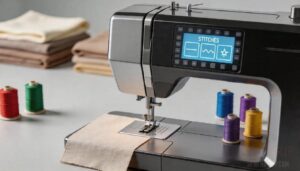
A high stitch count and fast motor grab attention on spec sheets, but they’re just two pieces of a bigger puzzle.
The features that actually shape your daily sewing experience go well beyond speed. Here’s what to look at closely before you buy.
Stitch Count and Built-in Applications
Stitch Library Size determines how much your machine can actually do. The Singer Quantum Stylist 9960 packs 600 built-in stitch applications—enough to handle nearly any project without extra software. Embroidered Density Metrics and Design Thread Usage also matter here, as dense patterns demand more thread and time.
Application Matching Tips to keep in mind:
- Match utility stitches to construction seams
- Use stretch stitches on knits and jersey fabrics
- Apply decorative stitches where visibility matters
- Leverage Memory Stitch Recall to lock in repeat settings
Sewing Speed and Motor Performance
Speed matters, but so does control. A servo motor running at 850 spm delivers better torque delivery and heat management than older clutch motors that burn energy even at idle.
Stable motor power enables features like clean automatic thread cutting in sewing machines.
Smart servo efficiency, speed reduction settings, and low energy consumption ensure your machine runs smoothly under load.
Needle Threader and Thread Management
Once your motor’s humming at the right pace, threading should keep up. A built-in needle threader manages upper thread routing automatically — but needle height positioning matters first; the needle must sit fully raised or the hook may miss.
Hook size matching ensures compatibility with standard needles.
Bobbin thread guidance and tension balance adjustment work together to maintain smooth operation, while a reliable thread management system ensures automatic thread cutters trim cleanly every time.
Feed System and Fabric Handling
Good thread management means nothing if your fabric shifts mid-seam.
Drop Feed Mechanics handle most everyday sewing reliably — the feed dog grips underneath while your presser foot holds firmly.
Need stretch or gather control? Differential Feed Control balances both fabric layers.
For thick quilts, Compound Feed Action and Walking Foot Advantages keep plies locked in place. The Advanced Plus Feed System, found on the Janome 3160QDC, takes automatic fabric feed further with high precision.
Presser Feet, Extension Tables, and Extras
Beyond feed systems, what’s in the box matters just as much. Buttonhole Foot Variants — from sensor-style to sliding-scale — keep buttonholes consistent every time.
Walking Foot Benefits shine when quilting layered fabric. Knee Lift Ergonomics free both hands during pivoting.
Extension Table Sizes up to 24×24 inches support bulky projects. Accessory Kit Essentials, like extra bobbins and presser feet, round out a capable sewing machine accessories setup.
LCD Controls and Programmable Settings
The right LCD display does more than look nice — it puts control at your fingertips.
A Smart LCD screen shows your Stitch Memory Display, Presser Foot Indicator, and Tension Adjustment Interface on one screen.
Custom Stitch Keys cut switching time, while Onscreen Feed-Dog Status confirms your setup instantly.
Pair a solid digital display with programmable settings and automatic thread cutting, and you’ve got a genuinely efficient machine.
Knee Lift and Ergonomic Operation
Lifting the presser foot dozens of times per session adds up fast — and that’s where a knee‑activated presser foot lifter earns its place. A knee‑lift lever shifts that repetitive work to your leg, delivering real, reduced upper-body strain during long sessions.
- Hands-Free Foot Control keeps both hands on the fabric for Precision Fabric Positioning
- An Adjustable Knee Lifter like Brother’s KL1 fits your body, not the other way around
- Paired with automatic thread cutting on computerized sewing machines, it creates genuinely easy-to-use sewing interfaces
Ergonomic considerations for sewing machine design matter most when you’re hours deep into a project.
Choosing The Right Sewing Machine
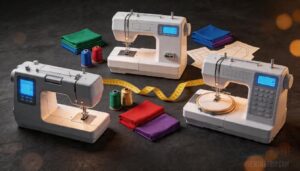
The right machine depends entirely on what you’re making and how often you sew. A quilter, a beginner, and someone doing embroidery all need something different — and budget plays a real role too.
Here’s how the top options break down by use case.
Best Options for Beginners
For beginners, the best computerized sewing machines balance an affordable price point with features that actually reduce frustration. Look for easy thread loading, simple stitch selection, and a straightforward control panel.
The Brother SE1900 and Janome 3160QDC both nail this — beginner-friendly interfaces, automatic thread cutters, and compact machine sizes that don’t overwhelm. Auto-cut alone saves countless interruptions when you’re still building confidence with the machine.
Best Models for Quilting Projects
Quilting demands precision at every layer — and the right machine makes that possible. The Brother PQ1500SL manages Fabric Layer Management with ease, while its automatic thread cutter delivers clean Thread Trim Precision at 1,500 spm.
For versatility, the Janome MC6650 offers Stitch Density Control, a kneelift lever, and Extension Table Support.
Both mid-level computerized sewing machines bring serious quilting capabilities to every Quilt Seam Finish.
Best Choices for Sewing and Embroidery
Want one machine that manages both sewing and embroidery without compromise? The Brother SE1900 and SE600 are your best bets. These sewing and embroidery combination machines include automatic thread cutting features in sewing machines that trim cleanly between design sections — no scissors needed.
What makes them genuinely useful for mixed projects:
- Fabric Compatibility across knits, wovens, and sheers with the right Stabilizer Selection
- Bobbin Thread Options that match your Thread Material Guide for consistent tension
- Needle Size Matching built into stitch recommendations
- Automatic thread cutter that trims both top and bobbin threads instantly
- Embroidery combination functionality with 240+ stitches on the SE1900
These mid-level computerized sewing machines manage serious creative work without breaking the bank.
Picking a Machine for Heavy Fabrics
Heavy fabric work demands a different kind of machine. Think denim, canvas, upholstery — materials that chew through weak motors and flexible frames. Industrial Motor Strength, Sturdy Metal Construction, and Presser Foot Pressure Adjustment aren’t optional here; they’re the whole game.
| Feature | Why It Matters | What to Look For |
|---|---|---|
| Heavy Needle Size | Penetrates dense layers cleanly | Size 90/14–110/18 denim needle |
| Walking Foot Support | Feeds thick layers evenly | Included or compatible accessory |
| Automatic Thread Cutting | Trims cleanly after heavy seams | Button-activated or programmable |
Machines with automatic thread cutting systems and industrial-style home sewing specs — like the Singer 4452 — handle heavy-duty sewing without skipped stitches or tangles.
Balancing Budget, Features, and Durability
Matching budget to build quality isn’t guesswork — it’s math. Cost per stitch and component wear rates matter more than sticker price.
Focus on:
- Long-term reliability over flashy stitch count
- Maintenance frequency and blade replacement for automatic thread cutters
- Value engineering in metal vs. plastic chassis construction
Price ranges for sewing machines with thread cutters vary widely, so features affecting sewing machine performance and machine durability should drive every budget consideration.
When Auto-cut is Worth Paying For
Once you’ve sorted budget and durability, the real question is whether automatic thread cutters actually pay off for you. In professional studios and high-volume production ROI is clear — time savings per seam add up fast.
For hobbyist value, it depends on project frequency. If you’re running many short seams regularly, the impact of automatic thread cutters on sewing workflow is impossible to ignore.
Frequently Asked Questions (FAQs)
Which sewing machines have automatic threading?
Most mid-range machines include a built-in needle threader today.
Models like the Janome 3160QDC, Brother CS7000X, and Singer Quantum Stylist 9960 all feature automatic needle threaders, making color changes practically easy.
Which singer is best for heavy fabrics?
The Singer Heavy Duty 4452 is your strongest pick. Its powerful motor, metal frame, walking foot, non-stick foot, and heavy-duty needles handle denim, canvas, and leather without hesitation.
Do they make sewing machines that thread themselves?
Yes, they do. Most computerized machines include a built-in needle threader using One-Touch Threading and Automatic Needle Loading — but you still guide the thread path.
True Self-Threading Technology remains rare on home models.
What is auto cutter in sewing machine?
An automatic thread cutter is a built-in blade mechanism that trims both your needle and bobbin threads instantly — no scissors needed.
It activates at the touch of a button or automatically after a seam ends.
Are computerized sewing machines worth it?
You get what you pay for — but only if you actually use what you pay for.
Computerized sewing machines are worth it when your projects demand speed, repeatability, and an automatic thread cutter that keeps you moving.
What maintenance does automatic thread cutter require?
Keep the cutter clean, the blade sharp, and lint cleared after every project. A light oil drop at manufacturer points and a tech check every 12–18 months keeps it running reliably.
Can automatic thread cutter be disabled?
On most computerized machines, the automatic thread cutter can be disabled through the settings menu using a Software Disable Mode or Menu Off Setting, giving you full Thread Tail Management and Pedal Trim Control without hardware changes.
How do different thread materials affect cutter performance?
Thread material hardness matters more than most sewists realize. Thicker, coarser threads put more strain on your automatic thread cutter’s blade, accelerating wear and affecting surface finish over time.
Stick to recommended thread weights for cleaner cuts.
Can automatic thread cutter be used on other projects?
Yes, automatic thread cutters work across many projects — free-motion quilting, appliqué detailing, patchwork projects, and even tailoring repairs.
Leather crafting is the exception; thick hides can strain the thread cutting mechanism.
What factors determine cutter blade lifespan?
Like a kitchen knife, a cutter blade lasts longer with proper care. Blade Material Quality, speed-feed balance, Material Hardness Impact, and Cooling & Lubrication all affect lifespan, alongside regular Alignment & Maintenance.
Conclusion
Like a master weaver, you’ve threaded your way through options. Computerized sewing machines with automatic thread cutting, such as those from Bernina and Janome, save time.
With the right machine, your sewing workflow will be smooth, much like a well-crafted quilt. Choose wisely, and your creations will be the envy of all—a true masterpiece—with computerized sewing machines with automatic thread cutting at your fingertips; every stitch perfect.
- https://www.maggieframes.com/blogs/embroidery-blogs/the-complete-guide-to-industrial-thread-trimmers-boost-productivity-in-sewing-operations
- https://sjfzxm.com/global/en/313148.html
- https://www.semanticscholar.org/paper/26b968eb29d5219209b9f0b13aabb86f7994bfd8
- https://www.sewingmachinefun.com/sewing-machines-automatic-thread-cutters/
- https://impall.eu/category/industrial-sewing-machines/1-needle-lockstitch-machines/lockstitch-machines-with-automatic-thread-trimming/