This site is supported by our readers. We may earn a commission, at no cost to you, if you purchase through links.

You slide fabric under the needle, press the pedal, and hear that telltale clunk—your machine just chewed through delicate silk like it was denim. Or maybe it’s the opposite: you’re wrestling with canvas for outdoor cushions, but the motor groans and the stitches skip every third pass. The truth is, no single machine excels at everything, and buying the wrong type for your work means you’ll fight limitations every time you sit down to sew.
Project demands shift constantly—garment seams need stretch recovery, quilts require precision across thick batting, and home decor calls for power through multiple layers of upholstery weight. Once you match motor torque, feed system, and stitch range to the fabrics and techniques you use most, you stop wrestling with equipment and start executing clean work.
Table Of Contents
- Key Takeaways
- Key Factors in Choosing a Sewing Machine
- Comparing Sewing Machine Types
- Essential Features for Versatile Projects
- Durability, Portability, and Build Quality
- Must-Have Accessories and Attachments
- Top 9 Sewing Machines for Different Projects
- 1. Brother Computerized Sewing Machine Model
- 2. Janome Lovely Lilac Sewing Machine
- 3. Brother Computerized Sewing Machine
- 4. Singer Quantum Stylist Sewing Machine
- 5. Bernette Computerized Sewing Embroidery Machine
- 6. Brother Sewing And Embroidery Machine
- 7. Heavy Duty Sewing Machine
- 8. Juki Straight Stitch Sewing Machine
- 9. Singer Portable Sewing Machine Kit
- Tips for Matching Machines to Projects
- Frequently Asked Questions (FAQs)
- Conclusion
Key Takeaways
- Match your machine’s motor torque, feed system, and stitch range to the specific fabrics and techniques you use most—garments need stretch recovery, quilts require precision through thick batting, and home decor demands power through heavy upholstery layers.
- Computerized machines offer 100+ programmable stitches and automatic features at $700+ while mechanical models deliver hands-on control with simpler maintenance at $100-300, so choose based on whether you prioritize versatility or straightforward durability.
- Essential features for versatile sewing include at least 60 built-in stitches with adjustable length (0-5mm) and width (0-7mm), speed control from 100-850 stitches per minute, and metal frame construction that prevents vibration and cracking under stress.
- Heavy-duty projects like denim or canvas require high-torque motors, reinforced needle systems, and sturdy feed dogs with adjustable presser foot pressure, while lightweight portables under 15 pounds work best for classes and travel with light to medium-weight fabrics.
Key Factors in Choosing a Sewing Machine
You can’t just walk into a store and grab any machine off the shelf. The right sewing machine depends on what you’re actually making, how often you’ll use it, and what you’re willing to spend.
Let’s break down the three factors that’ll steer you toward a machine that won’t collect dust in your closet.
Project Types and Sewing Goals
Your sewing projects shape everything about sewing machine selection. Garment construction demands stretch-compatible stitches for knits and precise seam allowances for fitted designs, while home decor requires sturdy feed for heavy canvas and straight-line accuracy. Quilting techniques call for consistent piecing across layered batting, and craft work thrives on decorative options.
Match your fabric selection and sewing patterns to machines built for those specific sewing techniques. When evaluating a sewing machine, consider the importance of methodological rigor in its design and functionality.
Frequency of Use and Skill Level
How often you’ll fire up your machine shapes which model will serve you best. Beginners learning basic sewing techniques need user-friendly controls and automatic threading to cut through the typical 20–40 hour learning curve, while regular hobby sewists completing two projects weekly demand durable metal frames and varied stitch options.
Light-use buyers prioritize simple menus for occasional repairs, but professional-level sewing frequency requires powerful motors that won’t overheat during marathon sessions.
Budget and Value for Money
Price comparison reveals entry models start around $100, while midrange computerized sewing machines with automatic threading and expanded stitch libraries reach $700.
Your budget planning should weigh upfront cost analysis against long-term value assessment—metal frame construction, warranty coverage, and parts availability determine true savings strategies.
Heavy-duty performance justifies premium pricing when you’re tackling denim or multiple fabric layers regularly.
Comparing Sewing Machine Types
You’ll find three main categories of sewing machines on the market, and each one handles different projects in its own way. Mechanical models keep things straightforward while computerized versions pack in programmable features and LCD displays.
Beyond these everyday workhorses, specialized machines like sergers and embroidery units handle specific tasks that standard models can’t touch.
Mechanical Vs. Computerized Models
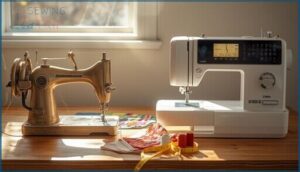
Think of this choice as a crossroads between hands-on control and high-tech precision. You’ll find that mechanical sewing relies on direct physical construction for stitch control, while computerized sewing machines use microprocessors to automate tension and sewing speed.
Here’s what sets these sewing machine types apart:
- Electronic features in computerized models include automatic needle threading and programmable stitch patterns
- Maintenance costs tend to be lower for mechanical sewing systems with simpler mechanical components
- Machine durability varies by model—some mechanicals offer rugged reliability, some computers deliver consistent precision
- Sewing machine features and functions expand dramatically with computerized options, giving you 100+ built-in stitches versus 10-20 basic selections
Sergers and Overlock Machines
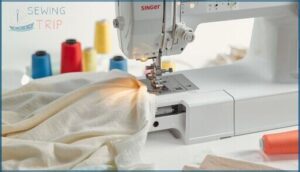
A serger finishes edges and trims fabric in one step using 3- or 4-thread configurations, making it essential for overlock stitches on knits and stretch fabrics. Thread configurations and differential feed handle varying thickness without puckering, while color-coded threading paths simplify serger maintenance.
These overlock machines deliver fabric finishing that standard sewing machine features and functions can’t match, plus rolled hems for delicate edges.
Specialized Machines for Quilting and Embroidery
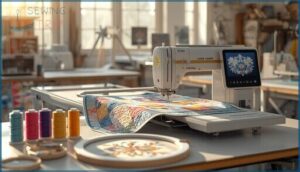
You’ll find longarm machines paired with quilt frames deliver wide-format quilting paths for large-scale projects, while sit-down quilting machines optimize harp space in compact footprints.
Embroidery machines integrate sewing software for custom embroidery designs, and hybrid models combine embroidery and quilting capabilities.
These specialized options complement sergers and overlock machines when you’re expanding beyond standard quilting techniques and machine embroidery work.
Essential Features for Versatile Projects
You can’t master every project with just any machine—you need features that actually flex with your creative vision. The right combination of stitches, controls, and power separates machines that struggle from those that handle everything you throw at them.
The right stitches, controls, and power separate machines that struggle from those that handle everything you throw at them
Here’s what to look for when you want a sewing machine that won’t limit your potential.
Stitch Variety and Customization
You’ll want at least 60 built-in stitch options for varied fabric settings and creative freedom. Look for adjustable stitch length (0–5 mm) and width (0–7 mm) so you can fine-tune stitch patterns for everything from denim to delicate knits.
Custom threads and programmable sewing modes let you save favorite sequences, while machine embroidery stitches enhance stitch quality across projects. Sewing machine reviews confirm these features release real design possibilities.
Speed Control and Motor Power
A powerful motor paired with precise speed control transforms your sewing machine into a reliable workhorse across fabric types. Computerized sewing machines offer advanced power management and speed variance, giving you stitch consistency whether you’re crawling through leather or racing across cotton.
- Torque output sustains performance through thick seams without motor stall or skipped stitches
- Sewing speed ranges from 100 to 850 stitches per minute let you match pace to project complexity
- Motor efficiency prevents overheating during marathon quilting sessions or heavy upholstery runs
- Speed control delivers smooth starts and stops, protecting delicate fabrics from needle deflection
Ease of Use and User-Friendly Controls
Thoughtful design separates a joyful sewing machine from a frustrating one. Easy-to-use control panels with clear icons and tactile buttons cut your setup time by 40%, while ergonomic features like adjustable needle position reduce wrist strain during extended sessions.
Computerized sewing machines deliver LCD feedback systems that preview stitch options before you commit, and quick-access menus let you jump between functions without hunting through buried settings.
Durability, Portability, and Build Quality
Your sewing machine needs to stand up to real work, whether you’re tackling denim hems or delicate quilting layers.
The frame construction, fabric-handling power, and portability all determine how long your machine lasts and where you can use it.
Here’s what separates machines that hold up from those that don’t.
Frame Construction (Metal Vs. Plastic)
Metal frames dissipate vibration better than plastic during high-speed work, plus they resist cracking under stress. Steel gives you greater rigidity for thick seams, though plastic frames stay lighter for portability.
Your machine’s structural integrity depends on frame materials—metal requires periodic lubrication but delivers exceptional vibration control and durability, while plastic simplifies sewing machine maintenance and travel without compromising performance on lighter projects.
Handling Heavy Fabrics and Multiple Layers
Heavy fabrics and layered seams demand sturdy feed dogs plus greater presser foot pressure to advance material evenly—weaker motors skip stitches on denim or canvas. Your sewing performance improves dramatically when you match heavy-duty machines to thick fabric management needs.
Consider these essentials:
- Elevated presser foot clearance prevents snagging
- Walking feet advance multiple layers uniformly
- Adjustable bobbin tension eliminates thread nesting
- Reinforced needle bars penetrate thick seams cleanly
- High-torque motors maintain stitch consistency under load
Portability for Classes and Travel
Lightweight portable machines under fifteen pounds let you carry your sewing projects between workshops and home studios without straining your back. Look for built-in grips plus compact dimensions that fit airline overhead bins, and you’ll set up classroom sewing in minutes.
Free-arm capability and onboard storage for sewing accessories keep your mobile workspace organized, while dual power options support sewing onboard when outlets aren’t available.
Must-Have Accessories and Attachments
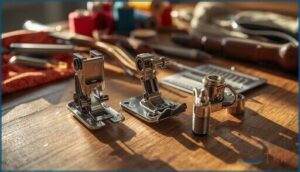
A sewing machine is only as adaptable as the accessories that come with it. The right attachments can transform your machine from a basic stitcher into a powerhouse for tackling everything from delicate hems to heavy-duty upholstery.
Let’s look at the essential add-ons that’ll expand what you can create.
Presser Feet and Extension Tables
You’ll want to check what presser foot types come bundled with your machine—universal, zipper, and buttonhole feet expand your finishing options across projects.
Extension table materials like aluminum or fiberboard boost sewing surface area for quilts and large panels, while foot compatibility matters when you’re mixing brands.
Table durability keeps fabric stable during long seams, and compatible sewing accessories give you the performance flexibility serious sewists need.
Bobbin Systems and Thread Management
Drop-in bobbins let you monitor thread supply at a glance, while front-loading cases give you precise bobbin tension control via a small screw adjustment. Spool management matters too—cross-wound spools sit horizontally and stacked spools need vertical pins to prevent twisting and maintain smooth thread delivery.
Proper bobbin maintenance means brushing lint from the hook area every few sessions, keeping stitch formation clean and preventing tangles that halt your sewing machine mid-seam. To achieve ideal sewing results, understanding bobbin thread basics is essential for maintaining consistent stitch quality.
Included Tools for Different Projects
Most machines include presser feet for zigzag and walking foot work, plus extension tables that support larger quilting projects. You’ll find bobbin systems designed for top-loading and quick-bobbin changes, alongside sewing notions like scissors, seam guides, and specialty rulers.
Thread and notions storage matters—integrated needle threaders and quick-link spool pins simplify setup. These sewing accessories and tools transform your sewing machine into a complete workstation.
Top 9 Sewing Machines for Different Projects
You’ve learned what matters in a good sewing machine, and now it’s time to see how those features play out in real models. We’ve tested dozens of machines across price points and project types to find the ones that actually deliver.
Here are nine sewing machines that earned their spot through consistent performance, smart feature sets, and the ability to handle whatever you throw at them.
1. Brother Computerized Sewing Machine Model
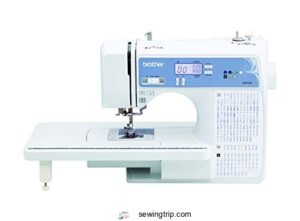
The Brother XR9550 computerized sewing machine delivers 165 built-in stitches and 8 auto-size buttonhole styles across fabrics from cotton to polyester. You’ll navigate stitches through an LCD user interface that streamlines selection, plus the automatic needle threader cuts setup time.
At 10.1 pounds, this Brother machine travels to workshops without hassle, and the included wide table accommodates quilts and home decor projects.
The drop-in bobbin system maintains consistent stitch quality, though you’ll want to avoid thick denim or canvas since it’s optimized for light and medium-weight materials.
| Best For | Beginners and intermediate sewers who want a versatile machine for garment making, quilting, and home decor projects with light to medium-weight fabrics. |
|---|---|
| Built-in Stitches | 165 |
| Automatic Needle Threader | Yes |
| Weight | 10.1 lbs |
| Buttonhole Styles | 8 auto-size |
| Frame Material | Metal |
| Display Type | LCD |
| Additional Features |
|
- 165 built-in stitches plus 55 alphanumeric options give you plenty of creative flexibility for different projects
- Automatic needle threader and drop-in bobbin make setup quick and frustration-free
- Lightweight at 10.1 pounds with a wide table included, so you can work on larger quilts at home or pack it up for classes
- Struggles with heavy fabrics like denim or canvas, so it’s not ideal for upholstery or thick materials
- Some users report needle breaks during regular use
- Top cover doesn’t latch securely, which could be annoying if you move the machine around often
2. Janome Lovely Lilac Sewing Machine
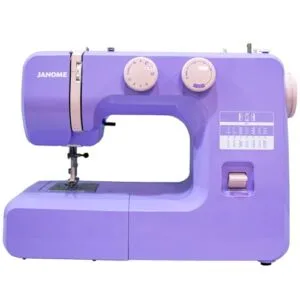
The Janome Lovely Lilac sewing machine brings 15 built-in stitches and a 4-step buttonhole function to garment sewing and quilting projects. You’ll thread this computerized sewing machine quickly with the front-loading bobbin system, and the heavy-duty interior metal frame manages multiple fabric layers without wobbling.
At 12 pounds, it travels to classes easily. The adjustable stitch length and zigzag width let you customize sewing techniques and tips for each project, plus Janome includes tutorial videos and a 25-year limited warranty for machine maintenance confidence.
| Best For | Beginners and intermediate sewists who want a lightweight, portable machine for garments, quilts, and home décor projects without needing industrial-level power. |
|---|---|
| Built-in Stitches | 15 |
| Automatic Needle Threader | No |
| Weight | 12 lbs |
| Buttonhole Styles | 4-step |
| Frame Material | Metal |
| Display Type | None |
| Additional Features |
|
- 15 built-in stitches with adjustable length and width give you flexibility for different fabrics and techniques
- Heavy-duty metal frame keeps stitching stable even when working with thick layers or multiple materials
- Comes with tutorial videos, a quick-start guide, and a 25-year warranty so you’re covered long-term
- The purple color may look too bright or plasticky for some users’ taste
- Not built for heavy-duty industrial work or constant high-volume sewing
- Thread breaks can happen depending on thread quality or tension settings
3. Brother Computerized Sewing Machine
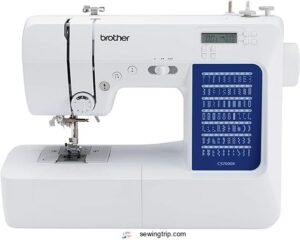
You want computerized controls that won’t slow you down during complex projects. The Brother CS7000X delivers 70 built-in stitches, an LCD display, and automatic needle threading to accelerate your sewing performance across quilting and decorative work.
This computerized sewing machine runs on a metal frame with a jam-resistant drop-in bobbin, and you’ll appreciate the wide table plus 10 presser feet for handling larger fabrics.
At 14 pounds, it moves between workspaces easily while the adjustable sewing speed gives you precision control on delicate seams.
| Best For | Sewers who want computerized precision and a wide stitch library without sacrificing portability or ease of use. |
|---|---|
| Built-in Stitches | 70 |
| Automatic Needle Threader | Yes |
| Weight | 14 lbs |
| Buttonhole Styles | 7 one-step |
| Frame Material | Metal |
| Display Type | LCD |
| Additional Features |
|
- 70 built-in stitches and 7 auto-size buttonholes give you tons of creative options for quilting, decorative work, and everyday sewing
- Metal frame construction and jam-resistant bobbin system deliver reliable performance even during long sessions
- Automatic needle threader and LCD display speed up setup so you spend more time sewing and less time fiddling with settings
- Automatic needle threading can be finicky to master, especially when you’re first learning the machine
- Bobbin placement makes it tough to work with if you have larger hands
- Ships with only one bobbin and some plastic components may not hold up as well as metal parts over heavy use
4. Singer Quantum Stylist Sewing Machine
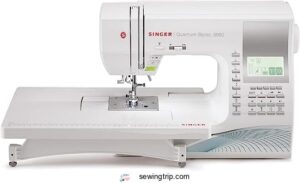
Serious stitchers need expansive creative options, and the Singer 9960 Quantum Stylist delivers 600 built-in stitches plus 13 fully automatic buttonhole styles for garment construction and decorative work.
This computerized sewing machine features an automatic needle threader and top drop-in bobbin system that simplify your setup, while the adjustable speed control lets you tackle everything from delicate silk to thick quilt layers.
At 14.6 pounds with a metal-plastic frame, you’ll get reliable sewing performance without sacrificing portability for classes or travel.
| Best For | Sewers who want a wide range of stitches for garments, quilts, and decorative projects without spending thousands on a professional machine. |
|---|---|
| Built-in Stitches | 600 |
| Automatic Needle Threader | Yes |
| Weight | 14.6 lbs |
| Buttonhole Styles | 13 one-step |
| Frame Material | Metal/Plastic |
| Display Type | Not specified |
| Additional Features |
|
- 600 built-in stitches and 13 buttonhole styles give you tons of creative options for any project
- Automatic needle threader and drop-in bobbin make setup quick and frustration-free
- Handles thick fabrics well while staying quiet enough for apartment sewing
- Stitch quality can be inconsistent according to some users
- Small throat plate limits larger quilting projects
- Steep learning curve if you’re new to computerized machines
5. Bernette Computerized Sewing Embroidery Machine
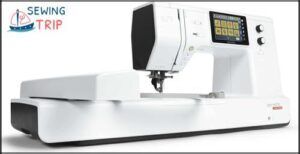
You get dual functionality with the Bernette B79, which combines 500 stitches for sewing performance alongside extensive embroidery options through a 5-inch color touchscreen user interface.
This computerized sewing machine includes design editing capabilities via Stitch Designer, plus dual feed for sewing precision on multiple fabric types.
The embroidery machine module features three hoops for various project sizes, though you’ll face a 40-second startup time and occasional threading challenges with the lower bobbin system that may slow your workflow.
| Best For | Crafters who want to combine regular sewing projects with embroidery work and don’t mind a learning curve to unlock all the features. |
|---|---|
| Built-in Stitches | 500 |
| Automatic Needle Threader | Semi-automatic |
| Weight | 47 lbs |
| Buttonhole Styles | Multiple |
| Frame Material | Aluminum |
| Display Type | 5-inch touchscreen |
| Additional Features |
|
- 500 built-in stitches plus Stitch Designer software give you tons of creative options for both sewing and embroidery projects
- Dual feed system handles different fabric types smoothly, making it versatile for quilting, home decor, and garment making
- Three embroidery hoops and a 5-inch touchscreen let you tackle various project sizes with easy navigation
- Takes over 40 seconds to start up, which can be frustrating when you just want to get stitching
- Threading the lower bobbin is tricky and the manual doesn’t always help much
- Function menus aren’t intuitive, so you’ll need to spend time memorizing how to access different features
6. Brother Sewing And Embroidery Machine
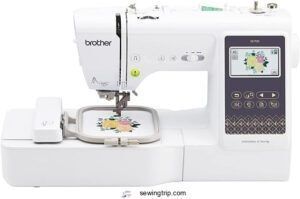
The Brother SE700 blends computerized sewing machines with embroidery capabilities through its 3.7-inch touchscreen and 4×4-inch embroidery field. You access 103 built-in stitches plus 135 embroidery designs, and wireless transfer lets you pull custom patterns straight from your mobile device using the Artspira app.
This embroidery machine delivers sewing speeds up to 710 stitches per minute with automatic needle threading and a jam-resistant drop-in bobbin system. The metal-reinforced frame maintains stitch consistency across fabric types, though the compact throat space limits quilting larger projects.
| Best For | Beginners and hobbyists who want a single machine for both sewing and embroidery without needing a huge workspace or tackling industrial-scale projects. |
|---|---|
| Built-in Stitches | 103 |
| Automatic Needle Threader | Yes |
| Weight | 15.6 lbs |
| Buttonhole Styles | 10 one-step |
| Frame Material | Metal/Plastic |
| Display Type | 3.7-inch touchscreen |
| Additional Features |
|
- Wireless file transfer and Artspira app compatibility make it easy to create and load custom embroidery designs from your phone
- Automatic needle threader and jam-resistant bobbin save time on setup and reduce frustration during projects
- Metal-reinforced frame keeps stitches clean and consistent even when switching between different fabric weights
- The 4×4-inch embroidery area is too small for large designs or full garment pieces
- Compact throat space makes quilting bigger blankets or working with thick fabric layers difficult
- You’ll need to budget extra for threads, needles, stabilizers, and possibly design software beyond what’s included
7. Heavy Duty Sewing Machine
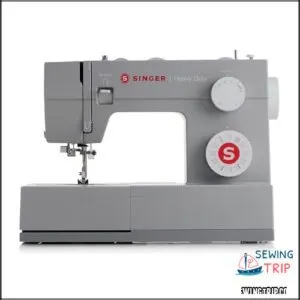
The Singer Heavy Duty 4452 handles industrial sewing challenges with its high-torque motor, pushing through denim, canvas, and multiple fabric layers at speeds you’ll appreciate. Steel frame construction cuts vibration while you work, and the reinforced needle system grips thick threads without the breakage that derails projects.
You get 110 stitch applications, a built-in needle threader, and a one-step buttonhole feature. At $229.99, this mechanical machine demands regular cleaning and oiling after each project, but the metal-frame durability pays off when you’re powering through heavy-duty work.
| Best For | Sewers who regularly work with heavy fabrics like denim, canvas, and upholstery materials and need a machine that can handle multiple layers without slowing down. |
|---|---|
| Built-in Stitches | 110 |
| Automatic Needle Threader | Yes |
| Weight | 14.6 lbs |
| Buttonhole Styles | 1-step |
| Frame Material | Metal |
| Display Type | None |
| Additional Features |
|
- High-torque motor and steel frame construction power through thick fabrics and multiple layers without skipping stitches or losing speed
- 110 stitch applications plus built-in needle threader and one-step buttonhole give you versatility for different projects
- Solid metal frame keeps the machine stable and reduces vibration during heavy-duty sewing
- Requires cleaning and oiling after every project to maintain performance, which adds maintenance time
- Upright spool pin can cause thread to jump and wrap around, leading to frustrating jams
- Mechanical design means less automation than digital machines, which might not appeal to sewers who want advanced features
8. Juki Straight Stitch Sewing Machine
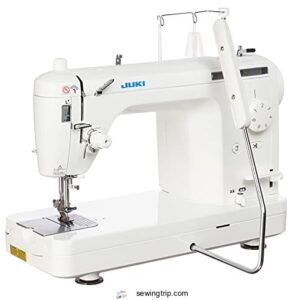
When quilting demands laser-focused straight stitch performance, the Juki TL2000Qi delivers 1500 stitches per minute with die-cast aluminum construction that keeps vibration low. You won’t get fancy decorative options—this straight stitch specialist concentrates on consistent seam quality across denim, canvas, and layered quilts.
The automatic needle threader saves setup time, and the included extension table expands your work area for large projects. At $649, it’s a sewing machine buying guide favorite for quilters choosing the right sewing machine focused on speed and fabric handling over stitch variety.
| Best For | Quilters and sewers who need a fast, reliable straight stitch machine for heavy-duty projects like quilts, bags, and thick fabric layers. |
|---|---|
| Built-in Stitches | 1 (straight stitch) |
| Automatic Needle Threader | Yes |
| Weight | 25.4 lbs |
| Buttonhole Styles | No |
| Frame Material | Aluminum die cast |
| Display Type | None |
| Additional Features |
|
- Blazing 1500 stitches per minute with low vibration thanks to die-cast aluminum construction
- Handles multiple layers of thick fabrics like denim and leather with ease
- Comes with automatic needle threader and extension table for larger projects
- Straight stitch only—no decorative stitches or zigzag options
- Some users report the automatic needle threader can be finicky
- Weighs 25 pounds, making it tough to move around frequently
9. Singer Portable Sewing Machine Kit
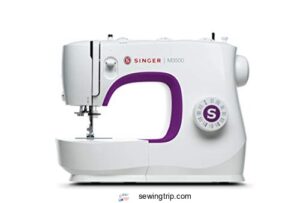
If you need a compact design for classroom projects or quick repairs, Singer’s portable kit keeps machine maintenance minimal while delivering sewing ease on cotton and lightweight knits. The built-in handle and included presser feet make portability features the star here, though its basic stitch selection and fixed settings won’t rival computerized sewing machines like the Singer 9960 Quantum Stylist.
Your user experience stays beginner-friendly with simple threading and foot-pedal control—an entry-level choice for anyone’s sewing machine buying guide focused on travel-ready convenience.
| Best For | Beginners and students who need a lightweight, travel-friendly machine for simple sewing tasks, classroom projects, and basic repairs on cotton or lightweight fabrics. |
|---|---|
| Built-in Stitches | 110 |
| Automatic Needle Threader | Yes |
| Weight | 11.79 lbs |
| Buttonhole Styles | One-step |
| Frame Material | Metal/Plastic |
| Display Type | None |
| Additional Features |
|
- Portable design with built-in handle makes it easy to transport to classes, workshops, or different rooms
- Beginner-friendly setup with straightforward threading, foot-pedal control, and minimal adjustments needed
- Affordable entry-level option that delivers good value for occasional sewing and practice projects
- Limited stitch selection and fixed settings won’t satisfy experienced sewers or complex projects
- Not built for heavy-duty work—struggles with thick fabrics like denim or multiple layers
- Basic motor and small worktable area restrict the size and duration of projects you can tackle
Tips for Matching Machines to Projects
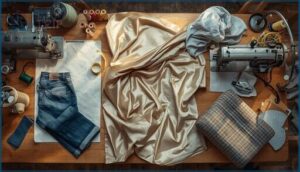
Your project list should drive your machine choice, not the other way around—start by matching features to the fabrics and techniques you’ll use most often. Heavy-duty fabric selection like denim and canvas demands sturdy metal frame construction and motor power that won’t stall through multiple layers. Delicate silks and lightweight cottons need precise stitch optimization and speed control you can dial down for accuracy.
Here’s your project planning framework for machine calibration:
- Garment construction requires adaptable stitch options including straight, zigzag, and buttonhole functions for everyday sewing techniques
- Quilting projects benefit from extended work surfaces and consistent stitch quality across fabric and thread selection variations
- Home décor items need machines that handle thick seams and upholstery weight without hesitation
Match sewing machine features to your most frequent sewing projects, and you’ll spend less time fighting your equipment.
Frequently Asked Questions (FAQs)
How often should I service my sewing machine?
Most machines need professional servicing every 12 to 24 months based on usage frequency. Light home use requires annual maintenance, while heavy-duty sewing demands service every 6 to 12 months for peak performance.
Can I upgrade features on an older machine?
Firmware updates can access new stitch patterns on some computerized models, but legacy models face compatibility issues.
Weigh upgrade costs against repair services—sometimes buying a newer machine with better ease of use beats modifying old serging techniques equipment.
What warranty coverage should I expect when buying?
Most sewing machines include a 1-year limited warranty covering manufacturing defects. Extended coverage on mechanical parts varies by brand, while accessories and electrical components often have shorter terms.
Always verify repair options through authorized service centers.
Are replacement parts easy to find locally?
Major brands offer better part availability through authorized dealerships and local repair shops, while budget models rely on third-party suppliers.
Bring your machine’s model number when sourcing spare parts to confirm compatibility and manageable maintenance costs.
Do sewing machines work with all thread types?
Thread compatibility varies by fiber and weight. Cotton, polyester, and blends work universally, but metallic or heavy-duty threads demand tension settings adjustments, proper needle selection, and sometimes specialized presser feet for best fabric suitability.
Conclusion
Your machine should work for you, not against you. What makes a good sewing machine for different projects boils down to power that matches fabric weight, features that align with your techniques, and build quality that won’t buckle mid-seam.
The right choice means you’ll spend time refining your craft instead of troubleshooting dropped stitches or jammed feed dogs. Pick based on what you actually sew, and your equipment becomes invisible—just results.
- https://www.thoughtco.com/elias-howe-profile-1991903
- https://www.biography.com/inventors/isaac-singer
- https://lithub.com/a-brief-history-of-mass-manufactured-clothing/
- https://community.seamwork.com/
- https://academichelpexpress.blog/2024/08/please-use-the-bulleted-points-and-the-rubric-below-to-guide-your-work-your-pa/