This site is supported by our readers. We may earn a commission, at no cost to you, if you purchase through links.
Try wrestling a queen-size quilt through your machine with only the standard work surface—you’ll end up fighting gravity, fabric drag, and a serious backache within minutes. That’s why quilting machines have extension tables: they create a level support surface that holds your fabric’s weight instead of letting it pull downward off the machine bed.
Without that extra surface area, large projects bunch, shift, and create uneven tension that throws off your stitch quality.
Extension tables transform your machine into a true quilting station where fabric glides smoothly and you maintain consistent control from first stitch to binding. The difference isn’t subtle—it’s the upgrade that turns frustrating wrestling matches into controlled, precise work.
Table Of Contents
Key Takeaways
- Extension tables eliminate fabric drag and bunching by creating a level support surface that distributes weight evenly across large quilts, preventing uneven tension and poor stitch quality.
- A stable, expanded workspace reduces physical strain on your back, neck, and shoulders while improving fabric control through better positioning and reduced repositioning during long quilting sessions.
- Built-in rulers, adjustable height settings, and smooth surface materials transform your machine into a precision quilting station that increases both stitch accuracy and overall quilting speed.
- Choosing the right extension table requires matching your machine model’s specifications, evaluating size and material quality, and considering portability needs alongside your budget and workspace constraints.
Why Quilting Machines Use Extension Tables
You’ll notice extension tables on most serious quilting setups for good reason. They solve real problems that come up when you’re working with anything larger than a placemat.
Let’s look at the main reasons quilters rely on these workspace extenders.
The Need for Expanded Workspace
When you’re quilting a king-size bedspread, you need real estate. A sewing machine extension table gives you that expanded workspace—so large quilts don’t fold or bunch between passes.
You’ll cut down handling time, keep battings and bindings within reach, and see your stitch lines clearly. That extra surface area turns cramped sewing into smooth, efficient fabric support and workspace optimization.
The importance of thorough auditing, like scientific study audits, can also be applied to optimizing workspace efficiency.
Supporting Large and Heavy Quilts
Heavy Duty projects demand a rock-solid platform. When you spread a queen-size quilt across an extension table, the rigid surface stops sagging at the needle, so your stitches form evenly across thick batting. That extra width distributes weight and cuts drag—no more bunching mid-seam.
Many quilting machine reviews highlight models with built-in extension-table compatibility, so you can lock in that stable surface from day one.
Your sewing machine gains the Workspace Optimization it needs for king-size quilts. To enhance your quilting experience, understanding language patterns is vital for efficient project management.
- Quilt Stability through a rigid tabletop that resists fabric sag
- Fabric Support across the entire width for even weight distribution
- Reduced drag on heavy layers for smoother feeding
- Better edge access for aligning Large Projects designs
- Room for rulers to guide precise quilting on bulky fabrics
Improving Stitch Accuracy and Consistency
A stable platform locks your fabric in place, so wobble won’t shift seams mid-stitch. With better Needle Alignment and Fabric Tension across a wide surface, you’ll see improved Seam Consistency and Quilting Precision.
That’s why many quilters invest in a quilting sewing machine extension table to maximize their workspace and control.
That extra Fabric Support on your sewing machine extension table gives you clearer sight lines to the presser foot, boosting seam accuracy. Fewer mid-project adjustments mean you maintain Stitch Regulation through precision sewing techniques.
Minimizing Fabric Drag and Bunching
Once your seams are locked in, the next win is smooth Fabric Flow. A polished acrylic or fiberglass extension table cuts Surface Friction so fabric glides instead of snagging.
A quality sewing machine extension table also gives you breathing room for larger projects like quilts or curtains, so you’re not wrestling fabric off the edge.
That larger contact area spreads tension evenly, preventing puckering and keeping Quilt Stability high.
Many top-rated home sewers include adjustable presser feet that enhance this effect, giving you professional results without the bulk.
Proper alignment between feed dogs and the table edge stops bunching at transitions, giving you reliable Needle Guidance and rock-solid Seam Consistency.
Key Benefits of Extension Tables for Quilting
You’ve seen why extension tables matter for quilting—now let’s look at what they actually do for you at the machine.
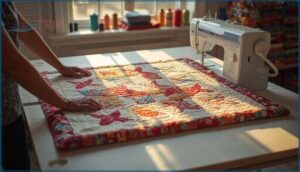
They give you a flat, stable surface that supports fabric weight evenly—especially helpful when you’re working on projects that need precision and control.
These benefits go beyond just having more space. They affect how your fabric moves, how your body feels, and how fast you can finish those bigger projects.
Enhanced Fabric Management and Control
A wider working surface keeps your fabric flat and taut, giving you command over every inch of your quilt. Extension tables offer that control by reducing drift and yawing along the edges.
- Integrated guides and rulers help you align selvages and batting layers for consistent feed
- Extra surface area minimizes repositioning bulky quilts, decreasing distortions
- Consistent tabletop friction facilitates smooth hand guiding with reduced snagging
Reduced Physical Strain and Fatigue
Long sessions hunched over your machine take a toll on your back, neck, and shoulders. Extension tables combat that wear by promoting better quilting posture and spreading the workload across a larger surface.
| Ergonomic Design Feature | Fatigue Reduction Benefit |
|---|---|
| Adjustable height alignment | Upright seating with less forward lean |
| Wider workspace | More natural forearm positioning |
| Smooth, level surface | Reduced grip tension and hand strain |
Key muscle relief advantages:
- Sewing machine ergonomics improve when your fabric glides without constant repositioning
- Better sewing comfort through stable hand guidance and fewer awkward wrist angles
- Enhanced sewing workspace optimization lowers cumulative load during marathon quilting
You’ll notice the difference in endurance. A roomy table accommodates longer uninterrupted runs, keeping your rhythm steady and your energy conserved. That translates to improved quilting precision and sewing efficiency without the burnout. Proper stress management starts with a setup that works with your body, not against it.
Smoother Free-motion and Straight-line Quilting
A larger platform transforms both free motion quilting and straight-line work by giving you the fabric control that makes every pass smoother. When your quilt glides without drag, stitch consistency improves dramatically.
Here’s what a sewing machine extension table delivers for quilting techniques:
- Surface stability reduces needle deflection and thread tangling during continuous stitching
- Integrated rulers guide precise straight-line registration and spacing for quilting accuracy
- Level height relative to the needle drop improves foot-pedal control at varying speeds
- Wider hand positioning promotes steadier, more confident free-motion maneuvering across thick layers
These sewing machine accessories support uniform stitch formation through bulky sections without bias wandering or puckering.
Increased Quilting Speed and Efficiency
You’ll move through large quilts faster when your extension table keeps fabric flowing smoothly. That flush surface eliminates snagging at the needle drop, so you’re not stopping and starting every few inches. Better support means fewer mid-seam adjustments and more consistent stitch timing.
The combination of better fabric flow and stitch optimization keeps your quilting pace steady, turning what used to feel like a marathon into manageable, efficient sessions at your sewing machine.
| Speed Enhancer | How It Works | Efficiency Gains |
|---|---|---|
| Expanded Surface | Stabilizes fabric during guiding | Reduces repositioning time |
| Flush Tabletop | Prevents snagging at needle area | Minimizes stop-start intervals |
| Integrated Guides | Maintains straight lines and spacing | Cuts rework, speeds execution |
| Improved Fabric Flow | Reduces manual handling | Sustains higher quilting pace |
| Fatigue Reduction | Eases physical strain | Extends productive sessions |
Essential Features of Quilting Extension Tables
Not all extension tables are built the same. The features you choose can make the difference between a table that truly aids your work and one that just takes up space.
Let’s look at what separates a solid investment from a frustrating compromise.
Integrated Rulers and Measurement Guides
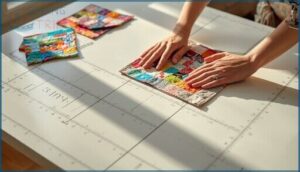
Built-in rulers along the edges of your sewing machine extension table eliminate guesswork when you’re measuring seam allowances. Most quilting table surfaces show a 6 to 12 inch scale for quick reference, plus grid alignment marks that help square your blocks during free-motion work.
Here’s what makes these measurement guides essential for sewing precision:
- Ruler Accuracy – Calibrated scales guarantee consistent stitch distance across every panel
- Grid Alignment – Tactile lines keep fabric corners square and borders straight
- Table Calibration – Removable guides adapt to different quilting feet and machine bed sizes
Adjustable Legs and Ergonomic Design
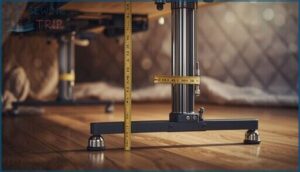
You’ll reduce shoulder and back strain when your extension table height matches your elbow—adjustable legs let you dial in that sweet spot. Height-adjustable designs transform your sewing machine extension table into a comfort powerhouse, whether you sit or stand.
Proper sewing machine ergonomics mean less fatigue and longer productive sessions.
| Feature | Impact on User Comfort |
|---|---|
| Lockable height settings | Maintain table stability across quilting sessions |
| Tool-less adjustment | Quick posture support changes reduce setup time |
| Anti-skid feet | Prevent movement, boosting sewing efficiency |
Durable, Smooth Surface Materials
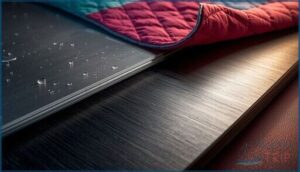
Surface finishes make or break your quilting table experience. Polycarbonate offers impact resistance and smooth fabric glide, while ABS-plastic blends deliver abrasion resistance for consistent feeding. Aluminum with anodized coating resists denting under heavy loads. High-density laminated composites reduce stitch resistance and snagging. Ceramic-coated surfaces improve material durability, prolonging your sewing machine extension table life under repetitive use—smart table maintenance starts with choosing the right surface textures.
Compatibility With Various Quilting Machines
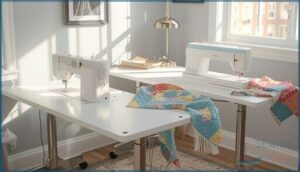
Once you’ve chosen a surface that won’t snag your fabric, you need a table that actually fits your sewing machine. Extension tables work with household and industrial quilting machines across most brands.
Universal clamps and adjustable legs let you mount the same quilting table on different machines—Brother extension table brackets and standard connector heights guarantee your setup stays stable no matter which model you own.
Choosing The Right Extension Table
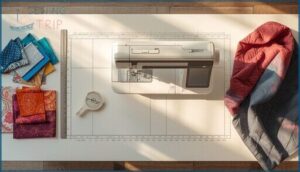
Picking the right extension table means matching your workspace needs with your machine’s specs. You’ll want to weigh factors like surface size, build quality, and whether the table fits your specific quilting machine model.
Let’s break down the key considerations that’ll help you make a smart choice.
Assessing Size and Material Quality
Table stability starts with smart material selection and size considerations. Extension tables usually need 12 to 24 inches beyond your sewing machine bed to handle quilts effectively. Quality assurance matters—look for medium-density fiberboard or acrylic with a smooth surface finish that resists warping.
Key specs to check:
- Flatness tolerance within ±1/16 inch across 24 inches
- Load capacity exceeding 50 pounds for fabric handling
- Non-porous coating that resists dye and lint
- Surface hardness suitable for long-term quilting projects
Matching Table to Machine Model
Once you’ve nailed down size and material quality, the next step is machine compatibility. Check your sewing machine model against the extension table’s mounting pattern—most vendors list compatible models or provide adapters.
Verify the throat plate opening aligns with the table’s work surface so fabric glides without snags. Model verification prevents gaps that catch thread or create uneven support during quilting.
Considering Portability and Storage Options
Beyond fit and finish, think about where you’ll stash your extension table between quilting sessions. Foldable frames drop the storage footprint by up to 60%, perfect for tight sewing spaces.
Portable designs weighing 3–8 pounds slip into closets or travel cases without drama. Table stability matters just as much on the go—locking feet prevent shifting when you’re handling fabric on temporary surfaces or teaching weekend workshops.
Price Range and Warranty Considerations
Budget options for sewing machine extension tables start around $20 for basic plastic models, while premium quilting designs push past $150 with solid frames and rulers.
Most sewing machine accessories carry 1–3 year warranty terms covering defects.
Price comparison across retailers reveals seasonal discounts of 10–20%, and return procedures usually allow 30 days with possible restocking fees on opened sewing machine extension tables.
Top Extension Tables for Quilting Machines
You’ve narrowed down your needs and budget, so now it’s time to look at actual models that deliver on workspace and stability.
The following tables stand out for their build quality, compatibility with popular machines, and real-world performance in quilting spaces.
Each option offers a different balance of features, price, and portability to match your specific setup.
1. Sewing Machine Extension Table
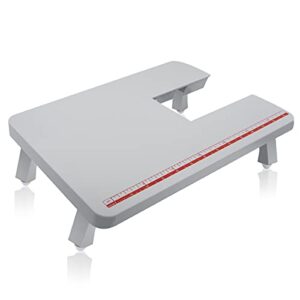
When you need a quilting sewing machine extension table that won’t break the bank, this plastic expansion board delivers solid workspace optimization. The PLANTIONAL table weighs just 530 grams and features adjustable feet for machine compatibility with various models, including Singer Heavy Duty machines.
You’ll find measuring markings along the edge for quick reference during sewing. While table stability and fabric support meet basic needs, the inside corners at the “U” shape can feel weak. The adjustable legs require some fiddling to achieve proper sewing ergonomics, but it’s a budget-friendly option among sewing machine accessories.
| Best For | Home sewers and quilters on a budget who need extra workspace for medium-sized projects and don’t mind minor adjustments to get a stable setup. |
|---|---|
| Material | Plastic |
| Weight | 530 Grams |
| Storage | Compact design |
| Surface Measurements | Extension board |
| Measuring Guides | Edge markings |
| Compatibility | Various Singer models |
| Additional Features |
|
- Lightweight at 530 grams with adjustable feet that fit various machines including Singer models
- Built-in measuring markings along the edge save time during projects
- Budget-friendly alternative to expensive brand-name extension tables
- Weak corners at the U-shaped top reduce durability for heavier fabrics
- Adjustable legs require trial and error to achieve a level, snug fit
- Mixed customer feedback on overall sturdiness and long-term value
2. Singer Extension Table for Sewing Machines
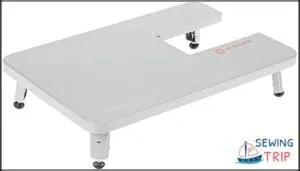
Singer’s metal-and-plastic extension table snaps onto compatible Heavy Duty machines (4411, 4423, 4432, 4452, 5511, 5523, 6335) with foldable legs for table installation in seconds. You get 15¼” x 10″ of workspace that levels with your machine bed for fabric support during quilting.
The grey surface reduces snagging on larger projects, improving sewing comfort across extended sessions. Machine compatibility matters—older models may need tab removal, and drop-down tables won’t work.
At 1.4 pounds, portability isn’t an issue, though extension materials cost more than off-brand alternatives.
| Best For | Quilters and home sewers working with bulky fabrics on compatible Singer Heavy Duty machines who need extra workspace without a permanent setup. |
|---|---|
| Material | Metal, Plastic |
| Weight | 1.4 Pounds |
| Storage | Foldable legs |
| Surface Measurements | 15.25″ x 10″ |
| Measuring Guides | Not specified |
| Compatibility | Singer Heavy Duty |
| Additional Features |
|
- Snaps on in seconds with foldable legs—no tools, no hassle, and stores flat when you’re done
- 15¼” x 10″ surface sits flush with your machine bed so fabric glides smoothly during large projects
- Durable metal-and-plastic build handles quilts and heavy materials without sagging at 1.4 pounds
- Only fits specific Singer Heavy Duty models from Fall 2019 onward—older machines may need modifications or won’t work at all
- Pricier than generic extension tables that deliver similar workspace
- Won’t attach to machines with drop-down tables, limiting flexibility across different Singer lines
3. Michley Sewing Machine Extension Table
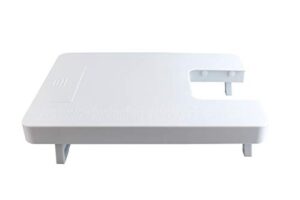
Michley’s compact extension table delivers a 14 x 10-inch workspace for LSS-505 and LSS-505+ models. Check machine compatibility before ordering, as it won’t fit Brother or other brands.
You’ll find ruler markings on the white wood surface, plus foldable legs that simplify table installation and storage options when you’re not quilting. At 0.9 pounds, it’s easy to slide on and off your sewing machine.
Extension table care is minimal: wipe the surface materials clean between sessions, and you’re set for your next project.
| Best For | Quilters with Michley LSS-505 or LSS-505+ machines who need extra workspace for larger flat projects without a big investment. |
|---|---|
| Material | Wood |
| Weight | 0.9 Pounds |
| Storage | Folds for storage |
| Surface Measurements | 14″ x 10″ |
| Measuring Guides | Ruler markings |
| Compatibility | Michley LSS-505 series |
| Additional Features |
|
- Lightweight at 0.9 pounds with foldable legs makes it simple to attach, remove, and store between sewing sessions
- Ruler markings printed on the surface help you measure and align fabric without reaching for separate tools
- Built-in storage slot keeps thimbles and thread within reach while you work
- Only fits Michley LSS-505 and LSS-505 models, so you can’t use it with Brother or other sewing machine brands
- Mixed customer reviews mention concerns about fit accuracy and overall sturdiness during use
- May require manual adjustments or tweaking to sit perfectly level with your machine bed
Frequently Asked Questions (FAQs)
How do I clean my extension table properly?
Regular table maintenance keeps your workspace smooth. Wipe the extension table with mild soap and a microfiber cloth, then dry immediately.
For polish applications, use manufacturer-approved products to protect surface integrity and enhance fabric handling.
Can extension tables reduce machine vibration and noise?
Extension tables can reduce vibration and noise by increasing contact surface area, dampening tremors, and minimizing fabric drag.
Table stability, rigid materials, and proper mounting improve quilting efficiency while creating a quieter workspace.
Are extension tables compatible with all sewing machines?
Not all models work with every table. Machine compatibility depends on arm height, throat space, and mounting systems. Some tables offer universal fit with adapters, while others are model-specific.
Do extension tables come with a warranty?
Most quilting sewing machine extension tables include a one- to five-year warranty covering material defects. Check warranty terms, product registration requirements, and return policies before purchase.
Customer support through authorized dealers helps with table maintenance issues.
Where can I buy a quilting extension table?
Like finding the perfect fabric, sourcing your quilting sewing machine extension table happens through online retailers, sewing stores, and manufacturer sites.
Read table reviews, compare sewing accessories, and check buying tips before purchasing these essential quilting tools.
Conclusion
Test this theory yourself: try free-motion quilting a king-size project without extra support, then add an extension table and notice how your shoulders drop, your stitches even out, and your speed doubles.
That’s why quilting machines have extension tables—they’re not optional accessories for serious quilters. They’re the foundation that turns your machine into a legitimate quilting workstation where large projects move like they’re weightless and your hands guide fabric instead of wrestling it into submission.