This site is supported by our readers. We may earn a commission, at no cost to you, if you purchase through links.
You can drop $5,000 on a quilting machine loaded with 800 stitches and still produce crooked seams if the throat space can’t handle your batting. The gap between advertised features and actual performance trips up quilters daily—especially when flashy touchscreens distract from fundamentals like consistent tension and reliable stitch regulation.
What separates machines that deliver professional results from expensive disappointments isn’t the stitch count or the price tag. It’s understanding which quilting machine features that matter most align with how you actually work: the throat space that accommodates your projects, the motor power that manages thick layers without choking, and the intuitive functions that keep you quilting instead of troubleshooting.
Table Of Contents
- Key Takeaways
- Key Quilting Machine Features Explained
- Essential User-Friendly Functions
- Must-Have Accessories for Quilting
- Types of Quilting Machines Compared
- Top Quilting Machines to Consider
- 1. Juki Computerized Sewing Machine
- 2. Brother High Speed Sewing Machine
- 3. Singer Quantum Stylist Sewing Machine
- 4. Brother Sewing And Quilting Machine
- 5. Brother Computerized Sewing Machine
- 6. Juki Straight Stitch Sewing Machine
- 7. Janome Sewing And Quilting Machine
- 8. Bernette Sewing And Quilting Machine
- 9. Juki High Speed Sewing Machine
- Choosing The Right Quilting Machine
- Frequently Asked Questions (FAQs)
- Conclusion
Key Takeaways
- Throat space, motor power, and stitch regulation matter far more than stitch count or touchscreens—these three features determine whether you’ll breeze through thick layers or battle puckering on every seam.
- Domestic machines with 9-11 inches of throat space handle queen-sized quilts with strategic rolling, while longarms offering 18-30 inches let you tackle king-sized projects without constant repositioning or shoulder strain.
- Automatic needle threaders, thread cutters, and walking feet aren’t just conveniences—they cut your setup time by 20 percent and keep you focused on quilting instead of fiddling with mechanics mid-project.
- Match your machine choice to how you actually work: beginners need simple speed control and automatic features, intermediates benefit from stitch regulation, and experts demand full customization with professional-grade throat clearance and frame compatibility.
Key Quilting Machine Features Explained
Not all quilting machine features deserve equal attention—some truly transform your work while others just sound impressive in marketing copy. The right combination of capabilities determines whether you’ll breeze through projects or battle frustration at every seam.
The right quilting machine features separate weekend hobbyists from serious quilters who breeze through projects instead of battling frustration
Here’s what actually matters when you’re evaluating machines, starting with the features that separate weekend hobbyists from serious quilters.
Consistent Stitch Quality
Precision sets professional quilts apart from the rest. Your quilting machine’s stitch quality depends on five critical systems working in harmony—thread tension, fabric handling, needle quality, motor performance, and stitch regulation technology.
- Balanced thread tension prevents loops and puckering on both quilt sides
- Dual feed systems reduce fabric shifting through thick batting layers
- Sharp, undamaged needles eliminate skipped stitches and fabric snags
- Consistent motor performance maintains uniform stitch formation at 600–2,000 stitches per minute
- Built-in stitch regulation automatically adjusts speed to match your movement, keeping stitch length consistent
For ideal results, consider investing in a machine with refined quilting machine features to improve your stitching experience.
Adjustable Throat Space
Throat space—the gap between needle and machine body—directly determines which quilts you can tackle. Domestic machines offer 8.5 to 11 inches, handling queen- and king-size projects with strategic rolling. Longarm models stretch to 24 inches, letting you quilt larger sections in one pass.
Beyond throat space, choosing the right quilting machine involves weighing stitch quality, frame compatibility, and whether you need portability or dedicated studio setup.
That extra room reduces shoulder strain during free-motion quilting and cuts repositioning time in half on big projects. When choosing a quilting machine, consider the high speed options for efficient stitching.
Speed Control and Motor Power
Motor efficiency and speed regulation define how you conquer thick batting and intricate designs. Domestic machines reach 750–1,300 stitches per minute, while longarms push 2,000–3,500.
Modern brushless servo motors deliver:
- Variable speed from below 100 to maximum stitches per minute
- Consistent torque control through multiple quilt layers
- Electronic foot controllers for smooth acceleration
- Direct drive power output reducing vibration
That precision transforms your stitch quality across any project size.
Stitch Regulation Technology
Speed control means little if every stitch varies wildly—stitch regulation fixes that. This control system synchronizes needle speed with your hand movement, keeping stitch length constant during free-motion quilting.
Domestic regulators use motion sensors under the presser foot; longarm encoder systems track X-Y carriage movement. You’ll find precision modes that stop when you stop, and cruise modes that maintain minimum speed through corners, delivering 8–16 uniform stitches per inch regardless of how fast you glide across the quilt.
Frame Compatibility
Your machine’s frame compatibility determines whether you can graduate from lap quilting to ambitious bed-sized projects. Not every machine fits every frame—check throat space, mounting plate dimensions, and rail system specs before investing.
A detailed quilting sewing machine comparison chart can help you match throat space and frame compatibility before you buy.
- Frame sizing: 8-foot frames handle throws; 10-foot systems quilt queen tops up to 100 inches wide
- Rail systems: Rolling rails require machines under 11.5 inches thick for secure carriage mounting
- Quilt mounting: Leaders and rollers reduce usable throat depth by 2–4 inches
- Machine fitting: Long arm quilting machines need dedicated track systems; midarms adapt to modular frames
Essential User-Friendly Functions
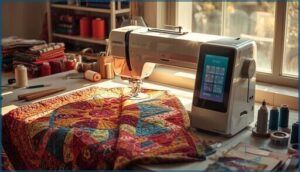
The best quilting machines don’t just stitch well—they make your entire workflow easier. Modern intuitive functions can save you hours of frustration and help you focus on the creative work you actually enjoy.
Before you invest, make sure you understand your quilting machine’s compatibility with presser feet to avoid costly mistakes down the line.
Here are the essential features that separate machines you’ll love from ones you’ll tolerate.
If you’re planning to tackle quilts regularly, check out these top-rated home sewing machines that balance throat space, walking feet, and workspace for ambitious projects.
Digital Controls and Displays
You’ll spend hours at your machine—clear digital controls make every minute count. Touchscreen interfaces let you tap, drag, and fine-tune without hunting through menus, while bright displays keep stitch quality, speed regulation, and throat space settings visible even in dim light. Automation displays preview your design path before the first stitch, so you control placement with confidence.
| Control Type | Key Benefit | Typical Use |
|---|---|---|
| Touchscreen Interfaces | Tap-and-go stitch selection | Quick pattern changes mid-project |
| Digital Stitch Regulation | Consistent length at any speed | Free-motion quilting accuracy |
| Speed Control Panels | Set max stitches per minute | Match pace to fabric weight |
| Automation Displays | Real-time design preview | Edge-to-edge layout confirmation |
Automatic Needle Threaders
Threading a needle by hand tests your patience—especially when tremors or poor lighting slow you down. Automatic needle threaders push a tiny hook through the eye, catch your thread, and pull a loop back in one lever press. Modern quilting machines from Brother, Janome, and Juki include this sewing technology to keep you stitching instead of squinting.
Here’s how you maintain stitch quality with smart threading techniques:
- Raise the needle to its highest position before engaging the threader—misalignment bends the hook and breaks the mechanism.
- Guide thread horizontally under the threader arm so the hook design catches cleanly without forcing the lever.
- Avoid damaged needles that throw off needle alignment and increase the risk of hook deformation during operation.
When the hook strikes the needle shaft repeatedly, you’ll need professional repair. Follow these maintenance tips to protect your investment: always use the needle-up button, hold thread lightly, and never force resistance.
Automatic Thread Cutters
You’ll save twenty percent of your time when an automatic thread cutter snips needle and bobbin threads after every seam. Modern quilting machines synchronize cutter blade design with the main shaft, so sharp blades trim cleanly without fraying.
That means better thread management, safer sewing efficiency, and no scissors cluttering your throat space—just press the pedal and keep stitching.
Programmable Stitch Patterns
You gain creative freedom when computerized quilting machines let you build custom designs from libraries of over 200 built-in stitches. Pattern editing and stitch sequencing tools let you arrange decorative motifs into continuous sequences, then store them in memory banks for repeat projects.
Digital controls on automated quilting systems simplify scaling and rotation, so your stitch quality stays consistent across every panel—no manual re-marking needed.
Connectivity and Software Integration
Modern computerized quilting machines turn your workspace into a connected creative studio through digital interfaces that sync patterns, update features, and expand capabilities. Wireless connectivity eliminates USB shuffling—machines like the Baby Lock Solaris series receive designs straight from your tablet.
Network integration matters because:
- Firmware updates enable new hoops and functions on your BERNINA or Brother
- Software compatibility lets EQStitch export patterns in multiple formats
- Wireless connectivity via FlashAir SD cards streams files without cables
- USB interfaces on APQS Quilt Path tablets import libraries instantly
- Digital controls keep stitch quality consistent across every panel
Check which file formats your machine accepts before investing in design software.
Must-Have Accessories for Quilting
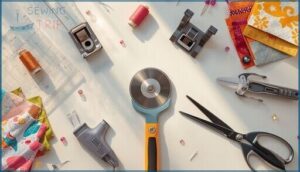
Your machine is only half the story—the right accessories turn good quilts into great ones. Extension tables give you working room, specialty feet handle tricky techniques, and sharp rotary cutters make prep work painless. Here’s what belongs in every quilter’s toolkit.
Extension Tables
A proper extension table transforms your quilting machine into a control center. You need a stable workspace that holds heavy quilt layers without drag—look for options in 18×24 or 24×24 sizes.
Polycarbonate materials provide the smooth glide free-motion work demands, while adjustable fronts accommodate different throat space configurations.
Your table must match your machine’s footprint exactly, ensuring smooth surface adjustments that protect stitch quality and workspace ergonomics.
Walking and Quilting Feet
Walking feet move thick quilt layers evenly—the dual feed dogs eliminate puckering on high-loft batting. Your walking foot manages straight-line work at 3–4 mm stitch length, while a quarter-inch foot guarantees accurate piecing seams. Free motion quilting feet with open-toe designs give you clear sightlines for stippling and curves.
Match foot compatibility to your machine’s shank types:
- Low shank for most domestic machines
- High shank for industrial models
- Open-toe free motion feet for visibility
- Closed-toe ruler feet for guided work
- Quarter-inch feet for precision piecing
Check throat space clearance before buying aftermarket quilting feet—darning foot height matters for consistent stitch formation.
Quilting Hoops and Frames
Hoops and frames anchor your fabric with the tension control throat space demands. Round hoops, ranging from 8 to 18 inches, are ideal for portable hand work, while floor frames adjust from 24 by 45 inches up to 24 by 90 inches, catering to machine quilting needs. Q-Snap plastic systems offer a tighter grip compared to screw hoops, resulting in fewer puckers.
| Frame Types | Quilting Space | Ergonomic Designs |
|---|---|---|
| Round hoops | 8–18 inch diameter | Tilt-adjustable stands |
| Oval floor hoops | 16 by 27 inches | Height range 16–37 inches |
| Floor frames | 24 by 90 inches | Two-handed operation |
| Snap frames | Variable with rods | Lightweight composite |
To ensure smooth layer rolling, match the leader cloth length—88, 112, or 136 inches—to your quilting machine’s rail spacing.
Rotary Cutters and Mats
Once you’ve got fabric secured in hoops or frames, clean cuts become your next priority—OLFA introduced the first circular-blade rotary cutter in 1979, and it revolutionized quilting techniques overnight. You’ll cut through four to eight layers of cotton in one pass with a sharp 45 mm rotary blade. Pick a 24 by 36 inch self-healing mat to handle full-width yardage without repositioning.
- Rotary blade materials: High carbon SKS-7 steel and titanium-coated options deliver edge retention across hundreds of cuts
- Cutting mat sizes: 3 to 5 mm thick PVC mats with printed 1-inch grids support accurate strip piecing for quilting machines
- Ergonomic grips: Squeeze-trigger designs reduce hand strain during extended fabric handling sessions
Specialty Needles and Threads
Thread weight and needle types work together—your quilting machine won’t deliver consistent stitch formation if you match 30-weight polyester with a size 70 needle. Adjust thread tension when switching weights, and swap needles every six to eight hours to maintain stitch quality across quilting techniques.
Quilting fibers matter: 100 percent cotton in 40 or 50 weight blends seamlessly with cotton fabrics, while polyester resists abrasion in bed quilts.
Types of Quilting Machines Compared
Not all quilting machines are built the same—and knowing the differences can save you from buyer’s remorse. The right type depends on your space, your projects, and how serious you’re about quilting.
Here’s how the main categories stack up so you can figure out what fits your needs.
Domestic Quilting Machines
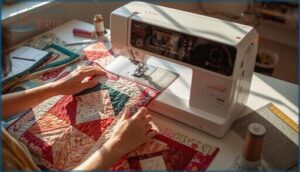
Domestic quilt sewing machines are your workhorse for piecing, applique, and finishing quilts at home—without commandeering an entire room. You’ll find throat space around 9 to 11 inches on quilting-focused models, giving you room to maneuver bulky layers. Look for machines that deliver:
- Stitch quality: Adjustable stitch length from 0 to 5 millimeters for precision
- Speed control: Manual or computerized regulation to maintain your pace
- User interface: Digital displays or mechanical dials—match your comfort level
- Machine durability: Established brands minimize maintenance costs over years of use
Longarm Quilting Machines
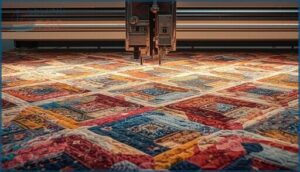
Longarm quilting machines deliver throat space of 18 to 30 inches—room to spread out king-size quilt patterns without bunching fabric.
Frame design becomes critical here: you roll your quilt onto rails and glide the machine head across the surface.
Speed control often reaches 2,500 stitches per minute, while stitch regulation technology keeps every line uniform. Automatic thread cutters and machine upgrades push efficiency even further.
Midarm Quilting Machines
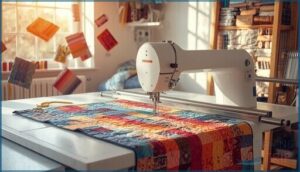
Midarm quilting machines bridge the gap with 12 to 18 inches of throat space—enough to handle queen-size quilts without constant repositioning.
You’ll find speeds around 1,800 to 2,000 stitches per minute, plus stitch regulation that keeps your lines consistent.
Frame options range from compact hoop styles to full-length rails, fitting smaller studios while delivering midarm benefits that domestic machines can’t match.
Frame-Ready Machines
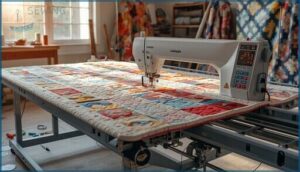
Frame-ready machines mount directly onto quilting frames, letting the machine move over the quilt instead of wrestling fabric under the needle. You’ll need to check frame compatibility and throat space—15 to 21 inches works on most rails—and confirm your carriage bears the weight.
Stitch regulation syncs speed with movement, keeping lines even. Longarm quilting machines dominate this category, delivering efficiency on king-size projects.
Mechanical Vs. Computerized Models
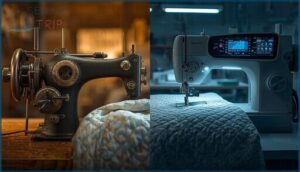
Mechanical machines run on dials and foot pressure—you control every stitch with your skill. Machine durability leans mechanical: fewer electronics mean simpler fixes. Cost comparison? Mechanical models start lower and stay cheaper to service.
Computerized quilting machines pack digital controls, hundreds of patterns, and speed limiters for quilting precision. Computerized units offer higher-quality stitch quality and user interface features but demand a bigger investment upfront.
Top Quilting Machines to Consider
You’ve learned what features to look for—now let’s talk specific machines. The models below represent solid options across different price points and quilting styles.
Each brings something different to the table, so you can match your needs with the right tool.
1. Juki Computerized Sewing Machine
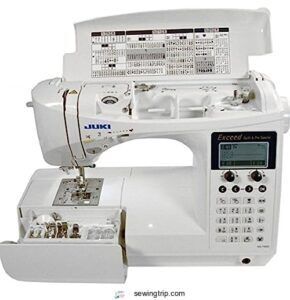
You’ll find serious power in Juki models built for quilters who demand precision. The HZL-G220 delivers 180 stitch options with speed control up to 900 stitches per minute—ideal when you’re switching between detailed piecing and fast seam work.
The HZL-DX7 ups the ante with 287 built-in patterns and 1,050 stitches per minute, giving you computerized quilting machine features that match your ambition. Stitch quality stays consistent across jersey to denim, and the automatic needle threader cuts setup time.
Machine durability shows in the metal construction, though you’ll want to budget around $1,400 for this level of quilting performance.
| Best For | Quilters and sewers who want a fast, computerized machine with hundreds of stitch options and solid metal construction for handling everything from lightweight fabrics to multiple denim layers. |
|---|---|
| Built-in Stitches | 255 |
| Automatic Needle Threader | Yes |
| Weight | 30 lbs |
| Extension Table | Optional |
| Maximum Speed | Standard |
| Price Range | $1,399 |
| Additional Features |
|
- 255 built-in stitches (up to 287 on the DX7) with LCD screen control and automatic needle threader for quick project changes
- High-speed performance up to 1,050 stitches per minute with smooth, quiet operation and variable speed control for detailed work
- Large work surface and sturdy metal build handle quilts and thick fabrics reliably
- Some users report durability issues like broken needle screws and malfunctioning automatic threaders over time
- Struggles with very thick materials like 4 layers of jeans despite the strong motor
- $1,400 price point and potential delays in getting replacement parts may not suit all budgets
2. Brother High Speed Sewing Machine
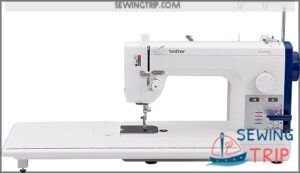
Brother’s PQ1600S hits 1,500 stitches per minute—double what most domestic machines manage. You get 5.7 by 8.7 inches of throat space plus a massive 11.1 by 23.3-inch table, making lap quilts far easier to wrangle.
The automatic thread cutter and knee lifter keep your hands free for pivoting bulky layers. Four feed-dog settings handle everything from chiffon to thick seams without skipped stitches.
It’s straight-stitch only and lacks stitch regulation, so free-motion work demands practice—but for speed and motor power on heavy quilts, this machine delivers.
| Best For | Quilters and serious sewists who need industrial-level speed and motor power for large projects and heavy fabrics but don’t require decorative stitches. |
|---|---|
| Built-in Stitches | 1 (straight stitch) |
| Automatic Needle Threader | Included (awkward) |
| Weight | 24 lbs |
| Extension Table | Included (11.1″ x 23.3″) |
| Maximum Speed | 1500 SPM |
| Price Range | Mid-range |
| Additional Features |
|
- Blazing 1,500 stitches per minute with a robust motor that powers through thick layers and multiple quilts without skipping stitches
- Generous 5.7″ x 8.7″ throat space and huge extension table give you room to maneuver bulky quilts without constant repositioning
- Knee lifter and automatic thread cutter let you pivot and trim hands-free, speeding up your workflow on big projects
- Straight-stitch only with no stitch regulation means free-motion quilting takes practice and manual control
- Side-loading bobbin doesn’t alert you when thread runs out, and the tension dial can be hard to see and adjust
- Pin feed mechanism and needle threader may wear out or become awkward with heavy use or cheaper threads
3. Singer Quantum Stylist Sewing Machine
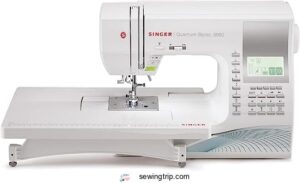
Singer’s Quantum Stylist 9960 flips the script with 600 stitches and 850 stitches per minute—ideal if you crave decorative options alongside quilting modes. The automatic needle threader and one-touch thread cutter simplify setup, while the extension table steadies medium-size projects.
You get 7 mm stitch width and accessory bundles with 18+ presser feet, but throat space remains domestic-scale—not built for king-size bed quilts. Stitch quality shines on appliqué and piecing; user experience scores high for variety, though free-motion work needs patience without true stitch regulation.
| Best For | Sewers who want extensive decorative stitch options and automated features for quilting, apparel, and craft projects at a home-machine scale. |
|---|---|
| Built-in Stitches | 600 |
| Automatic Needle Threader | Yes |
| Weight | 14.6 lbs |
| Extension Table | Included |
| Maximum Speed | Adjustable |
| Price Range | Mid-range |
| Additional Features |
|
- 600 built-in stitches with 7mm width adjustment and programmable sequences give you creative freedom for decorative work, monogramming, and detailed piecing.
- Automatic needle threader, one-touch thread cutter, and 13 buttonhole styles cut down setup time and keep you focused on sewing instead of fiddling with threads.
- Extension table and 18 presser feet included in most bundles expand your workspace and technique range without extra purchases.
- Domestic throat space limits maneuverability on large bed quilts—this isn’t a longarm substitute if you’re tackling king-size projects regularly.
- No true stitch regulation means free-motion quilting takes practice and patience to achieve consistent results compared to machines with that feature built in.
- Quality control complaints pop up in user reviews, with some reporting machines arriving damaged or customer support being slow to resolve issues.
4. Brother Sewing And Quilting Machine
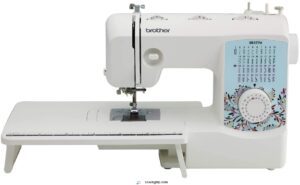
If 600-stitch machines feel like overkill, the Brother XR3774 pulls you back to quilting fundamentals. This domestic workhorse delivers 37 built-in stitches—enough for piecing, appliqué, and straight-line work without menu overload.
You’ll appreciate the automatic needle threader and drop-in bobbin when prepping fabric layers, plus the wide extension table accommodates baby quilts and lap-size projects with ease.
Throat space stays domestic-scale at around 6 inches, and stitch quality remains consistent at moderate speeds. At 15 pounds, it’s portable enough for classes yet stable for everyday sewing and small quilting projects.
| Best For | Quilters who want a straightforward machine for piecing and small projects without the complexity of computerized features. |
|---|---|
| Built-in Stitches | 37 |
| Automatic Needle Threader | Yes |
| Weight | 15 lbs |
| Extension Table | Included (wide) |
| Maximum Speed | Standard |
| Price Range | Budget |
| Additional Features |
|
- Automatic needle threader and drop-in bobbin make setup quick, especially when switching between fabrics
- Wide extension table gives you room to maneuver baby quilts and lap-size projects comfortably
- 37 stitches cover quilting essentials—piecing, appliqué, decorative work—without overwhelming you with options
- Manual stitch selection with analog dials requires a learning curve if you’re used to digital displays
- Struggles with heavy fabric layers like thick denim seams, limiting versatility for bag-making or upholstery
- No automatic thread cutter means you’ll reach for scissors more often than on higher-end models
5. Brother Computerized Sewing Machine
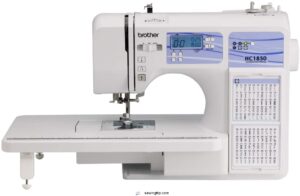
Precision matters—especially when you’re chasing Machine Accuracy and Stitch Variety. With 185 built-in stitches and a crisp LCD User Interface, this Brother sewing machine puts digital controls at your fingertips.
You’ll breeze through Thread Management thanks to the automatic thread cutter and enhanced needle threader. Quilting Speed is easy to dial in with speed control, while the extension table gives you room for larger quilts.
It’s lightweight, portable, and designed for easy learning—ideal if you want creative freedom without complexity.
| Best For | Beginners and intermediate sewists who want a versatile, computerized machine for quilting, decorative stitching, and garment work without a steep learning curve. |
|---|---|
| Built-in Stitches | 185 |
| Automatic Needle Threader | Yes |
| Weight | 10.1 lbs |
| Extension Table | Included (wide) |
| Maximum Speed | Standard |
| Price Range | Mid-range |
| Additional Features |
|
- 185 built-in stitches with an LCD screen make stitch selection fast and intuitive, plus the automatic threader and thread cutter save time on repetitive tasks.
- Lightweight at 10.1 pounds with a detachable wide table, so you can easily take it to classes or spread out for larger quilting projects at home.
- 25-year limited warranty and lifetime tech support give you solid long-term backing, especially useful when you’re learning or troubleshooting new techniques.
- Designed for 120 volts (US only), so international use or voltage conversion will void the warranty and may damage the machine.
- Lightweight construction can cause the machine to shift or vibrate during high-speed sewing or when working with heavy fabrics and multiple quilt layers.
- Some specialty feet like an edge hemming foot aren’t included and must be purchased separately, adding to the upfront cost if you need them.
6. Juki Straight Stitch Sewing Machine
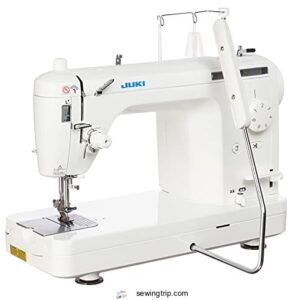
When simplicity meets power, you get the Juki TL2000Qi—a straight stitch specialist built for serious quilting accuracy. This machine races up to 1500 SPM, giving you sewing speed that handles thick layers and large projects without hesitation.
The aluminum frame keeps vibration low, while generous throat space lets you maneuver bulky quilts with ease. Thread control is seamless thanks to the automatic needle threader and cutter. Speed control via one-pedal operation means you dictate the pace, whether you’re piecing or free-motion quilting.
| Best For | Quilters and sewers who work with thick fabrics or large projects and want a fast, reliable straight stitch machine without the distraction of decorative stitches. |
|---|---|
| Built-in Stitches | 1 (straight stitch) |
| Automatic Needle Threader | Yes |
| Weight | 25.4 lbs |
| Extension Table | Included |
| Maximum Speed | 1500 SPM |
| Price Range | Mid-range |
| Additional Features |
|
- Blazing 1500 SPM speed handles heavy-duty fabrics like denim and leather with ease
- Low vibration aluminum frame and generous throat space make quilting large projects smooth and stable
- Automatic needle threader and thread cutter speed up your workflow on repetitive tasks
- Straight stitch only—no zigzag or decorative stitches if you need versatility
- Needle threader can be finicky and may not work reliably for all users
- At 25.4 pounds, it’s on the heavier side and tough to move around frequently
7. Janome Sewing And Quilting Machine
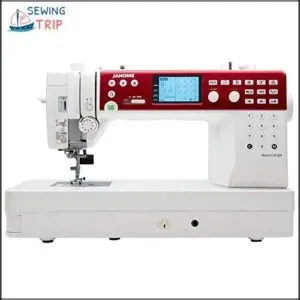
The Janome MC6650 sewing and quilting machine delivers 1000 stitches per minute across a smooth 10-inch flatbed—space you’ll appreciate when wrestling queen-sized quilt sandwiches.
This model combines 172 built-in stitches with automatic thread management: one-push needle threader and a built-in cutter that slashes setup time. The all-metal construction signals machine durability, while adjustable presser foot pressure manages everything from delicate quilting cottons to denim.
You get 12 presser feet, programmable memory, and stitch regulation that keeps your free-motion work consistent—features that matter when you’re chasing professional results.
| Best For | Quilters and sewists who need generous throat space for large projects and want professional features like automatic threading and high-speed stitching without a steep learning curve. |
|---|---|
| Built-in Stitches | 172 |
| Automatic Needle Threader | Yes |
| Weight | 24.2 lbs |
| Extension Table | Included (10″ throat) |
| Maximum Speed | 1000 SPM |
| Price Range | Mid-range |
| Additional Features |
|
- 10-inch throat space and 1000 stitches per minute make quick work of bed-sized quilts and layered fabric projects
- 172 built-in stitches plus automatic needle threader and thread cutter speed up setup and reduce frustration during long sessions
- All-metal construction and adjustable presser foot pressure handle everything from silk to denim, backed by 12 included presser feet for different techniques
- Some users report the machine skips stitches or the automatic thread cutter malfunctions during use
- At 24.2 pounds, it’s heavy enough to make moving between rooms or classes a two-handed job
- The auto needle threader struggles with certain synthetic threads, and the instruction manual leaves some users hunting for clearer guidance
8. Bernette Sewing And Quilting Machine
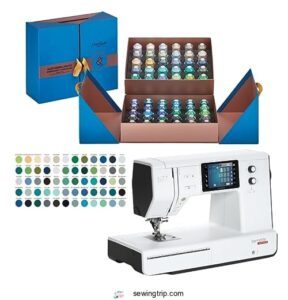
The Bernette B77 sewing and quilting machine offers 9 inches of quilting space to the right of your needle—enough room to manage bulkier projects without wrestling fabric. You’ll find 500+ built-in stitches and automatic thread tension paired with dual feed technology that keeps layers aligned during piecing.
This computerized model includes eight presser feet and sewing accessories, plus an extension table that accommodates quilt weight. At 1000 stitches per minute, it balances sewing speed with machine durability—ideal for mastering various quilting techniques without maxing out your budget.
| Best For | Beginner to intermediate sewers and quilters who want a computerized machine with plenty of built-in stitches, dual feed technology, and a large workspace for handling quilts and home décor projects without breaking the bank. |
|---|---|
| Built-in Stitches | 200+ |
| Automatic Needle Threader | Yes |
| Weight | 30.6 lbs |
| Extension Table | Included (large) |
| Maximum Speed | Standard |
| Price Range | Premium |
| Additional Features |
|
- 9 inches of throat space and included extension table give you room to maneuver bulkier quilts and larger projects comfortably
- Dual feed system keeps multiple fabric layers aligned during piecing, eliminating the need for a separate walking foot
- 500 stitches, automatic thread cutter, and programmable foot pedal offer plenty of creative options and convenient features at a mid-range price
- Some users reported frustrating thread tension issues and problems with stitches not securing properly at the start or end of seams
- The automatic needle threader can break or malfunction, requiring manual threading or repair
- Customer support response times are inconsistent, and warranty service is tied to your original dealer, which may complicate repairs if you move or buy online
9. Juki High Speed Sewing Machine
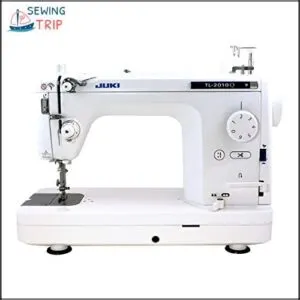
The Juki TL-2000Qi reaches 1,500 stitches per minute, delivering high-speed quilting without sacrificing stitch quality on thick layers. You’ll get 9 inches of throat space for maneuvering bulky quilts, plus an automatic thread cutter that trims both threads simultaneously.
This straight-stitch quilting machine includes speed control, a knee lifter for hands-free positioning, and a micro-oiled motor that demands daily maintenance. Machine durability testing proves its die-cast aluminum body reduces vibration during extended sessions.
When comparing Juki models, the TL-2000Qi excels at precision piecing and free-motion work.
| Best For | Quilters and sewists who need a fast, reliable straight-stitch machine for piecing quilt tops and free-motion quilting on heavy layers. |
|---|---|
| Built-in Stitches | 150 |
| Automatic Needle Threader | Yes |
| Weight | 2.2 lbs |
| Extension Table | Included (wide) |
| Maximum Speed | Standard |
| Price Range | Budget |
| Additional Features |
|
- Sews at 1,500 stitches per minute with excellent stitch consistency, even on thick quilts
- Includes automatic thread cutter and knee lifter for efficient, hands-free workflow
- Die-cast aluminum body keeps the machine stable and quiet during high-speed operation
- Requires daily oiling, which can be messy and time-consuming
- Limited to straight stitch only—no zigzag or decorative stitches
- Threading process and automatic needle threader can be tricky to master
Choosing The Right Quilting Machine
You’ve seen the top machines—now it’s time to find your perfect match. The right quilting machine depends on where you’re in your quilting journey, what you can invest, and how much support you’ll need down the road.
Let’s break down the four factors that’ll guide you to a machine you won’t outgrow.
Matching Features to Your Skill Level
Your skill level isn’t just a label—it’s the compass that should guide every feature decision you make when choosing a quilting machine. Here’s how to match features to where you’re now:
- Beginners: prioritize automatic thread cutters and simple speed control over throat space
- Intermediate quilters: add stitch regulation and moderate throat clearance
- Expert users: demand full customization and professional-grade specs
- Skill level assessment: honestly evaluate your current capabilities before shopping
Budget and Value Considerations
Once you know which features fit your abilities, it’s time for real budget planning and cost analysis. Entry-level machines start around $200, while premium domestic models like the Janome Continental M8 reach $9,999. Longarm systems range from $10,000 to $35,000—serious investment strategy territory.
Compare price against actual use: will you quilt weekly or monthly? That’s your true value assessment for quilting machine selection.
Evaluating Brand Reputation and Support
Price tags mean nothing if your machine sits broken for weeks. Brand reliability separates Janome, Bernina, and Juki from bottom-tier names—quilting machine reviews and the sewing and quilting community consistently rank them Toyota-level dependable.
Check dealer availability within 90 miles; support networks with local service reps solve problems fast. Customer service responsiveness turns a $15,000 longarm into a workhorse, not a paperweight.
Maintenance and Warranty Factors
Warranty coverage and maintenance schedules directly impact your quilting machine’s lifespan. Expect these service realities:
- Professional tune-ups every 12 months for home machines—longarms need inspection every 500 quilts
- Clean bobbin areas with every bobbin change to prevent tension nightmares
- Replacement parts hit wallets at 1–5 year intervals—anti-backlash springs and bobbin cases wear first
- Base service contracts run $200–250 plus travel fees
Check warranty terms: 90-day full coverage often shifts to limited parts-only protection afterward.
Frequently Asked Questions (FAQs)
How much noise do quilting machines typically make?
Most quilting machines hum along at about 60 decibels—think normal conversation levels.
Longarm models with industrial motors run louder, especially at higher speeds, but vibration-damping mats and sturdy frames help tame the racket.
Whats the ideal lighting setup for quilting machines?
You need bright task lighting—700 to 1,500 lux—at your throat space. LED options with daylight color temperature (5,000–6,500 K) reduce eye strain. Combine machine-integrated lights with ambient illumination for shadow-free quilting.
Do quilting machines work with all fabric types?
Most quilting machines handle cotton beautifully, but fabric compatibility depends on weight and weave. Adjust thread tension and machine settings for delicate silks or heavy denim—proper fabric preparation and throat space matter more than the substrate itself.
How portable are midarm quilting machines really?
Midarm quilting machines balance portability and performance. Most weigh 25–45 lb and can be moved on trolleys or roller cases, though their frames demand significant space and setup time for classes or retreats.
Conclusion
Think of your quilting machine as the foundation of a house: without solid framing, the paint color doesn’t matter. The quilting machine features that matter most—throat space, motor power, stitch regulation—determine whether you’ll finish queen-sized projects or fight your equipment.
Skip the gimmicks. Invest in machines that handle your thickest batting, maintain tension through twelve layers, and keep you quilting instead of cursing. Your next masterpiece depends on it.
- https://cinchquilt.com/quilters/tips-for-choosing-the-best-sewing-machine-for-quilting/
- https://www.quiltingboard.com/main-f1/presser-foot-tension-t266733.html
- https://graceframe.com/en/sewing-machines/qnique19
- https://authorizedvacandsew.com/blogs/news/longarm-vs-midarm-quilting-machines-10-key-differences
- https://www.longancraft.com/blogs/sewing-tips/what-tension-should-i-use-for-quilting