This site is supported by our readers. We may earn a commission, at no cost to you, if you purchase through links.
The wrong needle can ruin an entire project — and most sewists don’t realize it until the fabric is already puckered or the thread keeps snapping. A needle that’s even slightly off for your fabric type creates problems that no amount of tension adjusting will fix.
Matching the right needle to your project is one of the simplest ways to get cleaner stitches, less frustration, and professional-looking results at home. From silky microtex fabrics to thick denim and stretchy knits, the right sewing machine needles for home sewists make every stitch count — and the eight picks ahead cover every project in your rotation.
Table Of Contents
- Key Takeaways
- Best Sewing Machine Needles for Home Sewists
- 1. Schmetz Universal Sewing Machine Needles
- 2. Singer Heavy Duty Sewing Machine Needles
- 3. SCHMETZ Stretch Sewing Machine Needles
- 4. Organ Sewing Machine Needles
- 5. SCHMETZ Microtex Sewing Machine Needles
- 6. SCHMETZ Quilting Sewing Needles
- 7. Singer Sewing Machine Needles
- 8. Singer Universal Sewing Machine Needles
- Types of Sewing Machine Needles
- Sewing Machine Needle Sizes Explained
- How to Choose The Right Needle
- Impact of Needle Quality and Material
- Signs You Need to Change Your Needle
- Proper Needle Care and Storage Tips
- Common Needle Problems and Solutions
- Essential Needles Every Home Sewist Should Own
- Frequently Asked Questions (FAQs)
- Conclusion
Key Takeaways
- Matching your needle to your fabric type — not just your machine — is the single biggest factor in getting clean stitches and avoiding puckered seams.
- Needle size, point style, and coating all work together, so a universal 80/12 handles everyday fabrics, while stretch, denim, and microtex needles each solve specific problems that tension adjustments can’t fix.
- Replace your needle every 6–8 hours of sewing, since a dull or bent needle causes skipped stitches, thread breaks, and fabric damage long before you notice the wear.
- Building a small core collection — universals, stretch, denim, and microtex — covers nearly every project you’ll tackle at home without overcomplicating your setup.
Best Sewing Machine Needles for Home Sewists
The right needle can make or break your project — and with so many options out there, it’s easy to feel overwhelmed. These eight picks cover the most reliable needles home sewists reach for, from everyday universals to specialty types built for stretch or heavy fabrics.
If you’re still unsure where to start, this universal sewing machine needle buying guide breaks down exactly what to look for before you even thread your machine.
Find the one that fits your next project.
1. Schmetz Universal Sewing Machine Needles
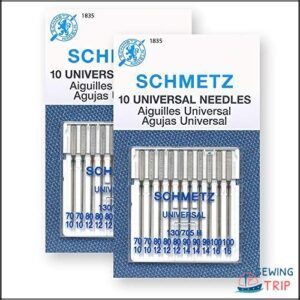
Schmetz Universal needles are a smart starting point for any home sewist. This two-card pack gives you 20 needles across four sizes — 70/10, 80/12, 90/14, and 100/16 — so you’re ready for lightweight cottons, mid-weight blends, and stable knits without swapping needle types.
The slightly rounded point manages most everyday fabrics cleanly, and the flat shank fits Brother, Singer, Janome, and most other household machines.
Keep a pack in your drawer, and you’ll rarely get caught unprepared.
| Best For | Home sewists who want one reliable needle pack that handles everyday fabrics across most household machines. |
|---|---|
| Brand | SCHMETZ |
| Machine Compatibility | All household brands |
| Needle Count | 20 |
| Primary Use | General purpose |
| Needle Sizes | 70/10–100/16 |
| Fabric Type | Wovens and knits |
| Additional Features |
|
- 20 needles across four sizes means you’re covered for lightweight to heavier fabrics without buying multiple packs
- Works with nearly every major brand — Brother, Singer, Janome, Baby Lock, and more
- The slightly rounded point handles both wovens and knits, so you’re not constantly switching needle types
- Some users find the needles lose their sharpness faster than expected
- The packaging can be tricky to open without bending or losing needles
- No specialty options here — if you’re doing stretch, denim, or embroidery work, you’ll need different needles
2. Singer Heavy Duty Sewing Machine Needles
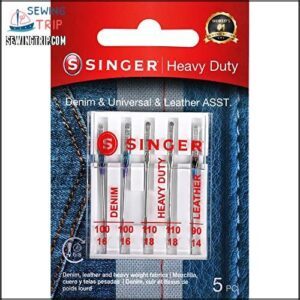
When your projects move into heavier territory — denim, canvas, thick upholstery fabric — you need a needle built for the job. Singer’s Heavy Duty set gives you five needles across three sizes: 90/14, 100/16, and 110/18, color-coded so you’re never guessing.
The reinforced shaft resists bending through dense layers, and the sharp regular point punches cleanly without snagging.
Compatible with most home machines using the standard 130/705 H system, these needles handle everything from jeans hems to bag straps without flinching.
| Best For | Sewers who regularly work with heavy fabrics like denim, canvas, leather, or upholstery and need a reliable needle set that works across multiple machine brands. |
|---|---|
| Brand | SCHMETZ |
| Machine Compatibility | All household brands |
| Needle Count | 20 |
| Primary Use | General purpose |
| Needle Sizes | 90/14 |
| Fabric Type | Wovens and knits |
| Additional Features |
|
- Color-coded sizes make it easy to grab the right needle without squinting at tiny labels
- Works with most home sewing machines, so no compatibility headaches
- Three size options in one pack means you’re covered for a range of heavy-duty projects
- Not a great fit for lightweight or delicate fabrics — these are built for tough stuff only
- If you only need one specific size, buying the whole assortment might feel like overkill
- A small number of machines may not be compatible despite the "universal" design
3. SCHMETZ Stretch Sewing Machine Needles
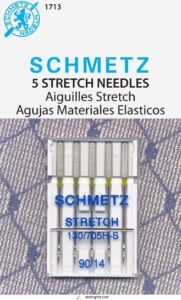
Stretch fabrics are a different beast altogether. If you’ve ever battled skipped stitches on knit or spandex, the SCHMETZ Stretch needle is your fix.
The size 90/14 works especially well on thicker knits like ponte, sweatshirt fleece, and heavy athletic fabric. Its medium ball point slips between fibers instead of piercing them, while the deeper scarf helps your machine’s hook catch the thread reliably.
Sold in packs of five, these needles are compatible with most home machines — Brother, Janome, Bernina, and more.
| Best For | Sewists who regularly work with stretchy fabrics like knits, spandex, and elastic and want to stop fighting skipped stitches for good. |
|---|---|
| Brand | SINGER |
| Machine Compatibility | All household brands |
| Needle Count | 5 |
| Primary Use | Heavy fabrics |
| Needle Sizes | 90/14–110/18 |
| Fabric Type | Denim, leather, corduroy |
| Additional Features |
|
- The medium ball point glides between fibers instead of punching through them, keeping your fabric intact
- Works with virtually any home sewing machine brand, so no compatibility headaches
- The specially designed scarf helps your machine catch the thread consistently, giving you smooth, even stitches
- These are stretch-fabric specialists — swap them out when you move to wovens or other fabric types
- A small number of buyers have reported receiving the wrong product, so double-check your order when it arrives
- You may need to tweak your machine’s tension and stitch length to get the best results
4. Organ Sewing Machine Needles
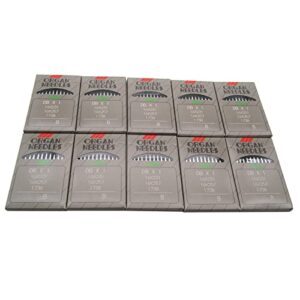
If you sew regularly across different projects, having a reliable go-to needle matters. Organ’s DBX1 needles come in a 100-pack covering sizes 9 through 18 — that’s metric 65 to 110 — so you’re covered from lightweight voile all the way to thick denim and canvas.
They’re compatible with JUKI, Brother, Singer, and Durkopp machines. Titanium-coated versions last three to five times longer than standard chrome needles, making them a smart buy if you’re at your machine often.
| Best For | Frequent sewers who work across multiple machine brands and fabric weights and want a reliable, size-varied needle supply without breaking the bank. |
|---|---|
| Brand | SCHMETZ |
| Machine Compatibility | All household brands |
| Needle Count | 5 |
| Primary Use | Stretch fabrics |
| Needle Sizes | 90/14 |
| Fabric Type | Stretch and knit |
| Additional Features |
|
- Comes in seven sizes (9–18), so you’re ready for anything from delicate fabrics to heavy denim in one pack
- Works with major brands like JUKI, Brother, Singer, and Durkopp — great if you own more than one machine
- 100 needles per pack means you won’t be scrambling for replacements anytime soon
- Some buyers received only 90 needles instead of the advertised 100
- Quality can be inconsistent, with occasional reports of needles breaking or shifting mid-use
- You’ll want to double-check size and type compatibility before ordering — not every needle works with every machine model
5. SCHMETZ Microtex Sewing Machine Needles
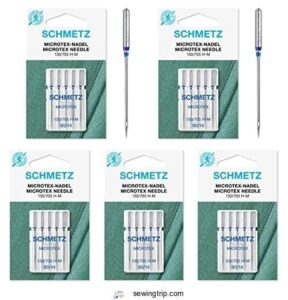
Fine, tightly woven fabrics can be unforgiving — a wrong needle leaves visible holes and snagged threads. That’s where SCHMETZ Microtex needles earn their place.
Their sharp, slim point glides through dense weaves cleanly — much like understanding how machine needles differ from hand needles helps you choose the right tool before damage is done.
The size 90/14 features an extra-slim, very sharp point that pierces dense weaves cleanly, making it ideal for silk, microfibers, batiks, and cotton sateen. It’s compatible with Brother, Janome, Bernina, and most home machines using the standard 130/705 H system.
If precision stitching on delicate or high-thread-count fabric is your goal, this needle delivers it.
| Best For | Sewers who work with delicate, tightly woven fabrics like silk, microfibers, and batiks and need clean, precise stitches without snags or visible holes. |
|---|---|
| Brand | ckpsms |
| Machine Compatibility | JUKI, Brother, Singer, Durkopp |
| Needle Count | 100 |
| Primary Use | Heavy-duty sewing |
| Needle Sizes | 65–110 metric |
| Fabric Type | Thick and varied |
| Additional Features |
|
- Ultra-sharp, slim point pierces dense and fine fabrics cleanly without damaging threads
- Fits most home sewing machines, including Brother, Janome, and Bernina
- Great for detail-heavy work like quilting, topstitching, and free motion sewing
- Not a good fit for thick or heavy fabrics like denim or canvas
- Sharpness wears down over time, so you’ll need to replace them regularly
- Best suited for specific fabric types, so it won’t cover all your sewing needs
6. SCHMETZ Quilting Sewing Needles
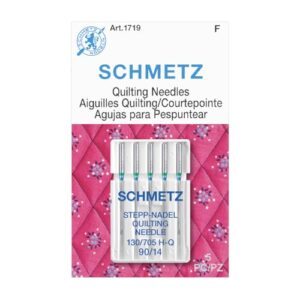
Quilting through multiple fabric layers demands a needle built for the job. The SCHMETZ Quilting Needle in size 90/14 features a specially tapered shaft with a slightly rounded point — designed to pierce cotton, batting, and backing cleanly without enlarging holes or fraying fibers.
Its deeper scarf geometry helps reduce skipped stitches, even during free-motion quilting.
Compatible with most home machines using the 130/705 H system, it’s a reliable choice for piecing, straight-line quilting, and intricate quilting designs alike.
| Best For | Quilters who work with multiple fabric layers and need clean, skip-free stitches for piecing, straight-line quilting, or free-motion designs. |
|---|---|
| Brand | SCHMETZ |
| Machine Compatibility | All household brands |
| Needle Count | 5 |
| Primary Use | Quilting and detail |
| Needle Sizes | 90/14 |
| Fabric Type | Microfiber, silk, polyester |
| Additional Features |
|
- The tapered shaft and slightly rounded point glide through cotton and batting without fraying or enlarging holes
- Works with most major home sewing machine brands, so no compatibility headaches
- Comes in a 5-pack, giving you backups ready for longer or more demanding projects
- Not ideal for very thick or dense fabrics where a heavier-duty needle might be needed
- Like all needles, they require careful storage to stay sharp and last longer
- Limited to machines using the standard 130/705 H system, so less common machine types may not be compatible
7. Singer Sewing Machine Needles
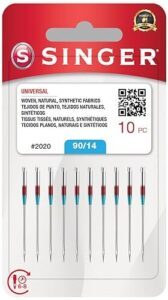
Singer’s size 90/14 needles are a solid everyday pick for medium-weight fabrics — think quilting cotton, light denim, and synthetics. Each pack gives you 10 needles, color-coded with a blue band so you can grab the right size at a glance.
They’re compatible with Singer machines and most other home machines, and the flat-backed shank makes installation straightforward. If you sew regularly, having a pack of these on hand means you’re never caught mid-project with a dull needle.
| Best For | Home sewers who regularly work with medium-weight fabrics like quilting cotton, light denim, and synthetics and want a reliable needle they can always have on hand. |
|---|---|
| Brand | SCHMETZ |
| Machine Compatibility | All major brands |
| Needle Count | 5 |
| Primary Use | Machine quilting |
| Needle Sizes | 90/14 |
| Fabric Type | Cotton and wovens |
| Additional Features |
|
- Pack of 10 color-coded needles means you’re stocked up and easy to grab the right size fast
- Works with Singer and most other home sewing machines, so no compatibility headaches
- Flat-backed shank makes swapping needles quick and painless
- Not the right fit for thick or heavy fabrics — you’ll need a beefier needle for that
- A little pricey compared to off-brand alternatives
- No instructions included, which might trip up newer sewers when opening the packaging
8. Singer Universal Sewing Machine Needles
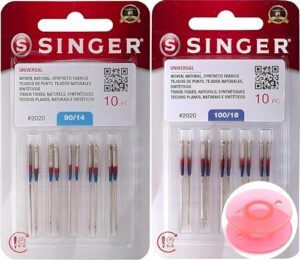
If you want one pack to cover a lot of ground, this bundle delivers. You get 20 genuine Singer Universal needles — 10 in size 90/14 for medium-weight knits and synthetics, and 10 in size 100/16 for heavier woven fabrics.
Both sizes use the standard 130/705 H system, so they fit most home machines from Brother to Janome. A plastic bobbin is included, which is a handy bonus.
Color-coded bands make it easy to tell the sizes apart without squinting at tiny numbers.
| Best For | Home sewers who work with a mix of fabrics and want genuine Singer needles that fit most household machines. |
|---|---|
| Brand | SINGER |
| Machine Compatibility | Singer and others |
| Needle Count | 10 |
| Primary Use | Medium-weight fabrics |
| Needle Sizes | 90/14 |
| Fabric Type | Medium-weight wovens |
| Additional Features |
|
- Two useful sizes in one pack — great for switching between lighter knits and heavier woven fabrics
- Compatible with most home sewing machines, not just Singer
- Comes with a plastic bobbin as a nice little extra
- Only two needle sizes included, so specialty projects may need separate purchases
- Not suitable for industrial or commercial sewing machines
- No sewing machine included, which seems obvious but is worth noting for gift buyers
Types of Sewing Machine Needles
Not all sewing machine needles are built the same, and using the wrong one can throw off your whole project. The type you choose depends on your fabric, your thread, and what you’re trying to accomplish.
Here are the main needle types every home sewist should know.
Universal Needles
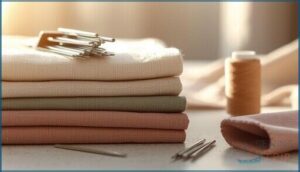
Universal needles are the workhorse of your sewing room — and for good reason. Their slightly rounded needle sharpness lets them pierce most woven fabrics and stable knits without skipping stitches.
Home sewing machine needles in sizes 80/12 or 70/10 cover the sweet spot for everyday fabric compatibility. Pair them with all-purpose thread and standard machine settings, and you’re ready for shirts, cushion covers, and quilts alike.
Ballpoint and Stretch Needles
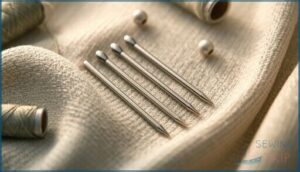
Both ballpoint and stretch needles solve the same core problem — fabric damage on knits — but they handle it differently. A ballpoint needle’s rounded tip slides between yarn loops instead of piercing them, making it ideal for stable cotton jersey and interlock.
Stretch needles add a deeper scarf that locks in the thread loop, preventing skipped stitches on high-elastane fabrics with strong elastic recovery.
Denim and Heavy Duty Needles
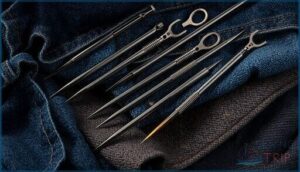
Where stretch needles flex and glide, denim and heavy-duty needles power straight through. These sewing machine needles feature a reinforced shaft and sharp point built for heavy fabric sewing — think jeans, canvas, and duck cloth.
- Size 90/14 manages lighter denim and twills
- Size 100/16 works for standard jeans layers
- Size 110/18 manages bulky seams and thick cuffs
- Topstitch needles pair well for visible jeans stitching
- Fresh jeans needles prevent needle breakage over thick seams
Microtex (Sharp) Needles
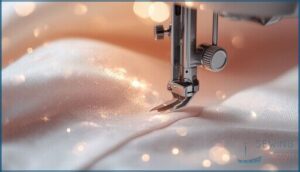
If denim needles are built for brute force, Microtex needles are built for precision. These sharp needle tips slice cleanly through tightly woven fabrics — silk, taffeta, batiste, and high-thread-count cottons — without pushing threads aside. That clean fabric piercing means smaller holes and neater seams.
Microtex needles slice cleanly through silk and fine weaves, leaving smaller holes and neater seams
For topstitching or detailed work, Microtex needles give your home sewing machine the accuracy your project deserves. The Microtex needles are ideal for precision sewing tasks that require smooth fabric penetration.
Quilting Needles
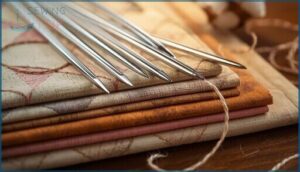
Quilting needles take a different approach than Microtex — instead of slicing through fibers, they glide between them. That slim, tapered point keeps your quilting cottons intact while piercing multiple layers cleanly. Whether you’re working free-motion quilting patterns or joining pieced blocks, these sewing machine needles manage thread tension and fabric selection challenges well.
- Size 75/11 suits fine thread and lightweight quilting cottons
- Size 80/12 works for most everyday quilting projects
- Size 90/14 manages thick batting and dense quilting techniques
- Replace every 6–8 hours to protect needle materials and stitch quality
Sewing Machine Needle Sizes Explained
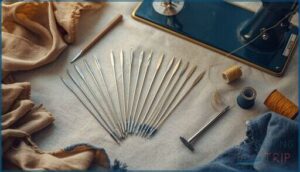
Needle sizes can feel like a foreign language at first — two numbers, a slash, and suddenly you’re second-guessing everything. But once you crack the code, picking the right size becomes second nature.
Here’s what those numbers actually mean and how to use them to your advantage.
Metric Vs. US Needle Sizing
Needle packages print two numbers — a metric size and a US size — side by side, and knowing which is which puts you in control at the store.
Brands like Schmetz use metric needle size first in their labeling formats, so 80/12 means 80 metric, 12 US. Both sizing standards measure the same needle; they’re just different systems saying the same thing.
What The Numbers Mean
The metric needle size tells you the shaft diameter in hundredths of a millimeter — so a size 80 needle is roughly 0.8mm thick.
Needle size codes like 80/12 pair the metric needle size with the imperial needle size, giving you two systems in one label.
System numbers, like 130/705 H, identify needle type and design — separate from needle gauge entirely.
Choosing Size for Fabric Weight
Fabric weight drives needle selection more than almost anything else. Match your needle size to what you’re actually sewing:
- Sheers and lightweight fabrics: size 60–70
- Medium-weight cottons, poplin, linen: size 75–80
- Denim, canvas, coating wools: size 90–100
- Heavy upholstery or multi-layer seams: size 100–110
Thread weight and fabric density factor in too — heavier thread needs a larger eye, or sewing tension suffers.
How to Choose The Right Needle
Picking the right needle doesn’t have to feel like guesswork. A few key factors — your fabric type, thread, and the specific project you’re working on — will point you straight to the right choice.
Here’s what to keep in mind before you thread up.
Matching Needle to Fabric Type
Your fabric selection drives every needle decision you make. Dense wovens like denim need a size 90/14 or 100/16 denim needle to pierce without bending, while delicate sheers call for a fine 60/8 or 70/10 microtex. Stretch knits? Reach for a ballpoint or stretch needle to protect the loops.
Matching needle sizes and fabric types directly improves stitch quality on every project.
Considering Thread and Stitch Type
Thread selection and stitch type work hand-in-hand with your sewing machine needle selection — get them out of sync and tension control falls apart fast.
- Fine threads (50–80 wt): Pair with size 70/10 or 80/12 for smooth stitch formation.
- Heavy threads (30 wt+): Use 90/14–110/18 for proper needle compatibility.
- Metallic threads: Choose a metallic or topstitch needle with a polished eye.
- Stretch stitches: A ballpoint needle protects fabric interaction on knits.
- Dense decorative stitches: Microtex needles keep stitch placement precise.
Project-Specific Needle Selection
Every project tells you what it needs — you just have to listen. Proper sewing machine needle selection ties together fabric type considerations, thread selection, and stitch optimization into one smart decision. Think of it as project planning that starts before you cut a single seam.
A lightweight blouse calls for universal size 70/10 or 75/11; denim jeans need a 90/14 or 100/16.
Impact of Needle Quality and Material
Not all sewing machine needles are created equal, and the difference shows up fast in your stitching. The material a needle is made from, the brand behind it, and how long it holds up under real use all shape the results you get.
Here’s what to know about each of those factors.
Needle Material Differences
Most sewing machine needles share the same hardened steel cores, but the coating on top changes everything. Chrome plating keeps the surface smooth and cool-running — great for synthetics. Titanium-coated needles stay sharper longer through dense layers, making them worth the extra cost for heavy projects. Nonstick surfaces handle adhesives cleanly, and nickel-free options protect sensitive hands.
Needle material directly drives needle durability. For heavy projects, consider using titanium coated needles for improved performance.
Brand Reputation and Reliability
Coating matters — but so does who made the needle. Schmetz Needles have been a trusted name since 1851, and that manufacturer history shows in their quality control. Organ’s factory roots earn consistent praise in customer reviews. Brand loyalty runs deep in sewing communities for good reason:
- Consistent shank dimensions reduce skipped stitches
- Clear packaging simplifies choosing universal sewing machine needles
- Reputable needle brands support sewing machine maintenance routines
Longevity and Performance
A quality needle pays for itself over time. Titanium-coated options — like those from Schmetz Needles — last two to five times longer than standard chrome, which means fewer interruptions and better sewing efficiency.
That needle durability directly bolsters thread longevity and fabric resistance, keeping your universal sewing machine needles performing cleanly through project after project and your machine running at its best.
Signs You Need to Change Your Needle
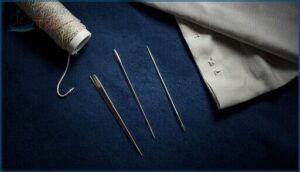
Your needle tells you when it’s done — you just have to know how to listen. A worn or damaged needle shows up in your work before you even realize what’s wrong.
Watch for these three signs that it’s time to swap in a fresh one.
Skipped Stitches and Thread Breaks
Two clear warning signs tell you it’s time to swap your sewing machine needles: skipped stitches and thread breakage.
Needle wear rounds off the tip, disrupting stitch formation and making it harder for the hook to catch the thread loop.
Breakage patterns often point to thread tension problems caused by tiny burrs near the eye — a quick needle change usually fixes both.
Fabric Damage and Popping Sounds
Beyond skipped stitches and thread breakage, a worn needle often leaves its mark directly on your fabric. Popping sounds as the needle enters dense weaves — like denim or tight cotton — mean it’s forcing through fibers instead of parting them cleanly.
That friction causes fiber breakage, fabric tears, and seam distortion. Matching your needle size and fabric type prevents most of this damage.
Stitch Quality Issues
Even small needle problems quietly wreck your stitch quality. Watch for these warning signs:
- Skipped stitches — a dull tip misses the bobbin hook
- Thread breakage — burrs in the eye shred thread constantly
- Fabric puckering — wrong needle sharpness cinches seams tight
- Uneven stitch formation — a bent needle shifts thread tension
- Loops on the underside — poor sewing accuracy from needle mismatches
Proper Needle Care and Storage Tips
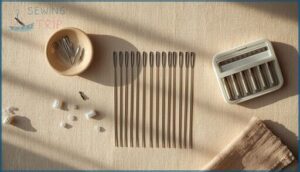
Taking care of your needles is just as important as picking the right one. A little attention goes a long way toward keeping your tools sharp, rust-free, and ready to perform.
Here’s what you need to know about storing and maintaining your sewing machine needles the right way.
Safe Storage Solutions
Scattered needles are a safety hazard waiting to happen. Dedicated storage cases and magnetic holders keep your home sewing machine needles organized and your workspace secure.
Use labeling systems — "Universal 80/12" or "Stretch 75/11" — so you grab the right needle every time. For child safety, choose cases with locking latches.
Smart needle organization is genuinely one of the simplest sewing machine maintenance tips you can follow.
Handling and Maintenance
Good habits around handling your sewing machine needles make a real difference in stitch quality and thread tension. A few simple sewing machine maintenance tips go a long way:
- Replace needles every 6–8 stitching hours for consistent fabric protection
- Check for bends by rolling the needle on a flat surface
- Keep your machine cleaning routine regular to reduce friction at the needle
Skipping these steps invites sewing machine troubleshooting headaches later.
Preventing Rust and Damage
Rust is a quiet needle killer. Store your sewing machine needles in a dry space — humidity below 50% keeps oxidation at bay. Tuck a silica gel packet into your storage drawer for easy humidity control.
Titanium-coated needles resist moisture and wear longer than bare steel. Keep replacement sewing machine needles in their original cases, away from steam, chemicals, and sweaty hands.
Common Needle Problems and Solutions

Even the best needle can cause headaches if something’s off. Most sewing problems trace back to a few common culprits — and once you know what to look for, fixing them is straightforward.
Here’s what to watch out for and how to handle each one.
Bent or Dull Needles
A damaged needle is one of the sneakiest culprits behind frustrating sewing problems. Bent or dull needles in your home sewing machine cause more trouble than most sewists realize. Watch for these warning signs during needle inspection:
- Skipped stitches or thread breaks mid-seam
- Popping sounds as the sewing machine needle pierces fabric
- Puckered, uneven stitches from dull effects on fibers
- Visible wobble when turning the handwheel slowly
Bent causes include hitting pins, pulling fabric, or sewing dense layers too fast. Replacement sewing machine needles are cheap — swap them every 6–8 hours for smoother results.
Needle Compatibility Issues
Not all sewing machine needles play nicely with every machine. Shank styles, needle systems, and machine calibration all factor into true needle compatibility issues.
Most home machines need flat-shank 130/705 H needles — using the wrong system causes skipped stitches and tension issues fast.
Always check thread pairing and needle size against your manual before starting. Compatibility checks take seconds but save your project.
Troubleshooting Stitch Problems
Even with the right needle system, stitch tension and skipped stitches can still catch you off guard. Needle deflection — where a too-thin needle bends away from the hook — causes uneven loops and sewing errors fast.
Thread shredding near the eye points to a burr or wrong size. Fabric puckering? Try dropping a needle size.
Fresh sewing machine needles fix most stitch quality and tension issues instantly.
Essential Needles Every Home Sewist Should Own
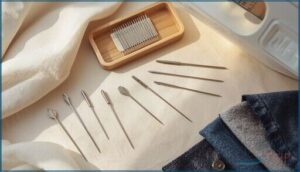
Building a solid needle collection doesn’t have to be complicated — you just need the right starting lineup. A few key types will cover most fabrics and projects you’ll ever tackle at home.
Here’s what every home sewist should keep on hand.
Must-Have Needle Types
Every well-stocked sewing kit needs a core lineup of home sewing machine needles — because the right needle material and point style directly shape your stitch quality.
Universal needles handle most fabric selection and thread choices for everyday projects. Add stretch, denim (jeans needles), and microtex options to cover knits, heavy canvas, and fine fabrics.
Topstitch needles round out your sewing techniques toolkit.
Assorted Packs for Versatility
Assorted packs are a smart shortcut for needle variety without the clutter. A single blister card often bundles universal needles, stretch, and jeans types together — giving you fabric compatibility across knits, denim, and wovens in one purchase.
For home sewing machine needles, these assortment needles boost sewing efficiency without overstocking. Pack benefits are real: more adaptable sewing, less guesswork.
Stocking Up for Various Projects
Once you’ve got a variety pack sorted, smart stocking takes you further. Build your needle inventory around actual projects — not guesswork. Good project planning means fewer mid-seam scrambles.
- Keep 10–20 universal needles in size 80/12 for everyday fabric selection
- Stock 3–5 stretch and denim sewing machine needles per project type
- Budget sewing accessories by buying multipacks to lower per-needle cost
- Use labeled storage solutions to track topstitch needles separately from universal needles
Frequently Asked Questions (FAQs)
What is the best needle for everyday sewing?
For most projects, a universal needle in size 80/12 is your workhorse. It manages everyday fabric selection and delivers reliable stitch quality across wovens and stable knits without constant thread choices or technique changes.
Can I use the same needle for hand sewing?
Technically, yes — but it’s not ideal. Sewing machine needles have a short shank and a tiny eye near the tip, making hand sewing awkward and slow. Grab a proper hand needle instead.
How do needles differ between sewing machine brands?
Most modern machines share the 130/705 H shank system, so needle brands like Schmetz and Organ are broadly compatible.
Differences show up in point design, coating materials, and how each brand marks its shank.
Are titanium-coated needles worth the extra cost?
Titanium-coated needles cost roughly twice as much but last two to three times longer — worth it for heavy quilting or embroidery, less so for occasional light sewing.
How does needle size affect tension settings?
Bigger needle, looser loop — smaller needle, tighter pull. Needle size directly shifts stitch balance, so a quick tension adjustment keeps your thread tension centered and your seams clean.
Can a needle cause damage to my sewing machine?
Yes — a wrong or damaged sewing machine needle can absolutely cause machine wear, fabric tears, skipped stitches, and needle alignment problems.
Proper needle size and sewing safety habits protect your machine long-term.
Conclusion
The right needle protects your fabric, the right needle steadies your thread, and the right needle turns an average stitch into something you’re proud of. Choosing the best sewing machine needles for home sewists isn’t just a technical decision — it’s how you take control of every project before you sew a single seam.
Stock a few key types, replace them often, and your machine will finally perform the way it was always meant to.