This site is supported by our readers. We may earn a commission, at no cost to you, if you purchase through links.
Most embroidery machines look impressive until you’re three hours into a project and the tension goes haywire, the thread breaks for the fifth time, or you realize that stunning design you downloaded won’t even fit in the hoop. The difference between a machine that transforms your creative vision into crisp, professional embroidery and one that becomes an expensive dust collector often comes down to a handful of critical features that manufacturers don’t always highlight in their marketing materials.
Understanding what to look for in embroidery machine specifications—from hoop dimensions and needle configurations to motor strength and connectivity options—separates buyers who thrive from those who struggle with buyer’s remorse.
Whether you’re launching a custom apparel business or elevating your crafting game, the right combination of features, durability factors, and brand support will determine if your machine becomes your most valuable creative partner or your biggest frustration.
Table Of Contents
Key Takeaways
- Your embroidery machine’s hoop size, needle count, and stitch speed directly determine what you can create and how quickly you’ll complete projects, with multi-needle configurations eliminating constant thread changes that slow production.
- Motor strength and frame construction separate machines that maintain consistent stitch quality under pressure from those that wobble, skip stitches, or break thread when tackling dense designs or heavy fabrics.
- Home machines ($300-$2,500) work perfectly for learning and small batches, but commercial models ($8,000+) deliver the speed, durability, and multi-head capacity needed for high-volume production that pays back investment in under two years.
- The right accessories—proper stabilizers, quality thread, sharp needles sized to your fabric, and regular maintenance with machine-specific cleaning supplies—matter just as much as the machine itself for preventing puckering, tension problems, and costly downtime.
Essential Features in an Embroidery Machine
Your embroidery machine’s features directly shape what you can create, how quickly you can work, and whether you’ll hit frustrating limitations down the road. From the physical workspace your hoop provides to the digital tools that let you customize designs on the fly, each specification plays a concrete role in your day-to-day stitching experience.
Your embroidery machine’s features determine what you can create, how fast you work, and whether you’ll outgrow it in months
Let’s break down the must-know features that separate a machine you’ll outgrow in six months from one that scales with your ambitions.
Hoop Size and Embroidery Area
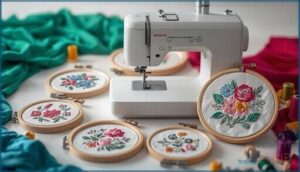
Hoop selection defines your embroidery limits, so you’ll want to evaluate frame types carefully. Domestic machines usually handle 4×4-inch to 6×8-inch areas, while commercial models exceed 12×8 inches for larger motifs.
Larger hoops reduce multi-pass setups, boost stitch density consistency, and simplify design scaling. Magnetic hoops speed fabric mounting without sacrificing precision, making machine embroidery more efficient across projects.
For complex designs, consider the importance of methodological rigor in ensuring high-quality embroidery.
Needle Count and Configuration
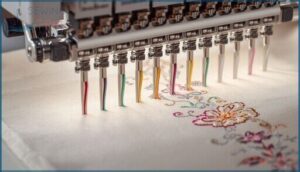
Once you’ve sized up your embroidery area, needle count and configuration become your next power lever. Single needle machines swap thread manually between colors, while multi needle setups—ranging from 2-needle to 6-needle assemblies—automate color change sequences for faster production.
Here’s how needle arrangement shapes your workflow:
- Thread management improves with independent spools feeding each needle position
- Stitch density stays consistent across colors through synchronized tension control
- Needle selection for gauge compatibility prevents fabric damage and skipped stitches
Multi-needle systems slash downtime, letting you tackle complex designs without constant rethreading. That’s your edge when embroidery machine features align with real project demands.
Stitch Speed and Efficiency
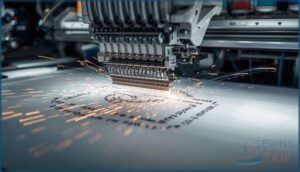
Speed settings matter more than you’d think when evaluating embroidery machine features. Your machine embroidery output hinges on stitch rate—measured in stitches per minute—but raw SPM isn’t everything.
Thread tension stability at higher speeds, automatic thread cutter efficiency, and multi-needle coordination all drive production optimization.
Look for machines balancing velocity with consistent stitch quality, so efficiency metrics translate into real-world throughput without sacrificing precision. Check out this guide to embroidery machine styles to understand how different models handle speed-versus-quality tradeoffs in various production settings.
Built-in Designs and Editing Capabilities
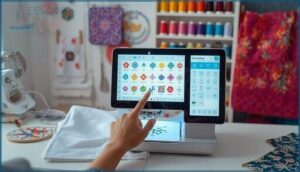
Once speed is dialed in, your digital embroidery creativity starts with builtin designs and onboard editing. Most machines pack 50 to 100 motifs—alphabets, decorative fills, utility shapes—organized by hoop compatibility. Look for models offering: Advanced machines also let you import custom embroidery design tips via USB, giving you access to thousands of specialty patterns beyond the factory library.
- Resize, rotate, and mirror functions without a computer
- Color management for thread-stop mapping
- Lettering with spacing and alignment controls
Sophisticated edit features turn your embroidery machine into a design-creation workhorse, not just a stitcher. Many embroidery machines for home business now include these advanced editing tools right out of the box, letting you customize designs without extra software.
Connectivity and Design Transfer Options
Modern machines let you move designs from desktop to fabric using wireless transfer via Wi-Fi or Bluetooth, USB port for thumb drives, or cloud libraries synced with embroidery software. File compatibility matters—PES, DST, and EXP formats dominate digital embroidery.
Firmware updates expand supported formats, while onboard design editing trims computer time. Wireless connectivity streamlines your workflow, especially for bulk runs.
Evaluating Machine Performance and Durability
You can’t judge an embroidery machine by its flashy features alone, because what really separates the contenders from the pretenders is how well they hold up under pressure. The motor, the frame, and the safety net of warranty support determine whether your machine becomes a trusted workhorse or an expensive paperweight.
Let’s break down the three pillars that define a machine’s true staying power.
Motor Strength and Stitch Quality
Think of your embroidery machine’s motor as the heartbeat of every stitch. When motor torque stays consistent, you’ll see stitch density hold steady, thread tension balance perfectly, and needle penetration power through heavy fabrics without deflection.
Servo control systems fine-tune stitch speed to maintain stitch quality across complex designs, while features like automatic thread cutter and proper machine maintenance keep your workflow humming along with fewer breakages and smoother results.
Frame Construction and Material
Frame rigidity and metal composition determine whether your stitches land precisely where you designed them, especially when the machine hits high stitch counts. Alloy steel frames resist deformation under production stress, aluminum balances stability with lighter weight, and stainless steel components fight wear over time.
You’ll notice the difference in needle alignment and fabric grip during operation—solid frame construction, paired with proper hooping techniques and the right hoop size, keeps your work sharp and consistent.
Warranty and Support Services
Coverage spans one to three years for most embroidery machine models, with Brother and other manufacturers offering extended service plans that include annual maintenance visits and predictable maintenance costs. You’ll want warranty coverage that covers manufacturing defects while recognizing needles and hoops wear naturally.
Support options—phone, chat, authorized centers—matter when thread tension puzzles you at midnight, so check embroidery machine reviews for real customer support experiences before committing your embroidery business management budget.
Matching Machine Type to Your Needs
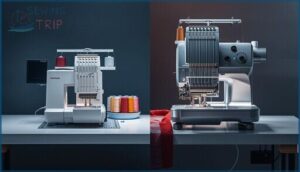
Finding the perfect embroidery machine starts with knowing exactly what you’ll use it for, because a hobbyist stitching baby blankets needs something completely different from someone running a commercial apparel shop.
Your choice between home and commercial models, single-needle versus multi-needle setups, and scalability options will shape your workflow, your output quality, and your ability to grow.
Let’s break down these critical decisions so you can match machine type to your actual needs, not just what sounds impressive on paper.
Home Vs. Commercial Embroidery Machines
Your choice between home and commercial embroidery machines hinges on volume, workspace, and growth trajectory. Home embroidery machines offer lower purchase prices and intuitive interfaces, perfect for prototyping or small-batch projects, but they lack the endurance for continuous operation.
Commercial embroidery models, by contrast, deliver:
- Multi-needle configurations that slash color-change downtime
- High stitch speeds and sturdy duty cycles for production runs
- Extensive service networks and formal maintenance schedules
Machine cost comparison matters less than aligning embroidery machine types with your business scalability goals and embroidery output demands.
Single-Needle Vs. Multi-Needle Models
Single-needle home machines demand manual thread changes between colors, stretching project timelines but keeping your initial investment lean.
Multi-needle machines automate that process with simultaneous thread loading, boosting production capacity and slashing labor costs for bulk orders.
You’ll find design flexibility improves with automatic thread cutters and faster color transitions, though multi-needle home models require more floor space and a higher upfront commitment than their single-needle counterparts.
Scalability for Business Growth
Multi-needle configurations with modular upgrade paths form your foundation for expandable production—these commercial-grade machines let you double capacity without retraining operators or overhauling workflows.
When embroidery business expansion accelerates, high volume output depends on networked design transfer, automated threading, and standardized procedures that cut setup times by 20–40%.
Smart growth strategies match machine selection to demand signals, ensuring your capital investment delivers 12–24 month ROI while preserving floor space for future multi-needle machines.
Key Accessories and Tools to Consider
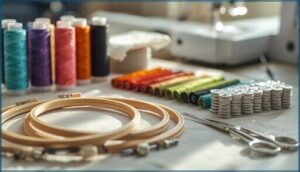
Even the best embroidery machine won’t reach its full potential without the right accessories backing it up. From hoops that hold your fabric steady to the threads and needles that bring your designs to life, these tools directly impact stitch quality, production speed, and how smoothly your projects run.
Here’s what you need to keep your machine performing at its peak, whether you’re stitching one project or a hundred.
Embroidery Hoops and Stabilizers
Think of hoops and stabilizers as your embroidery machine’s foundation—without them, even premium machines can’t deliver crisp results. Hoop materials range from standard plastic to magnetic hoops like MaggieFrame, which speed up fabric preparation while protecting delicate textiles.
Stabilizer types vary by fabric weight: tear-away for knits, cut-away for wovens. Proper embroidery tension and hoop maintenance prevent puckering, while correct fabric stabilization ensures your designs stay sharp through countless washes.
Thread, Needles, and Bobbins
Your thread, needles, and bobbins are the trio that translates digital designs into tangible embroidery. Polyester embroidery thread offers durability and colorfastness for most projects, while metallic thread demands specialized titanium-coated needles to prevent shredding.
Proper needle care means swapping them every four hours of stitching, and bobbin management requires even winding to maintain stitch tension.
Here’s what matters:
- Use 40 weight polyester or rayon for standard embroidery materials
- Match needle size (80/12 to 90/14) to your thread and fabric weight
- Replace needles regularly—dull points cause skipped stitches and fabric damage
- Wind bobbins evenly to prevent tension irregularities and thread nests
- Store metallic thread on uniformly wound spools for smoother feeding
Maintenance Kits and Upgrade Options
Beyond thread and needles, routine machine maintenance keeps your embroidery equipment running smoothly. Quality maintenance kits bundle lint brushes, cleaning swabs, needle lubricants, and specialized solutions—household solvents can damage sensors and electronics, so stick with machine-specific cleaners.
| Kit Component | Purpose | Replacement Frequency |
|---|---|---|
| Lint brushes & swabs | Clear bobbin area debris | After each project |
| Needle lubricant | Reduce friction, prevent breakage | Weekly with heavy use |
| Drive belts & feed dogs | Restore worn mechanical parts | Annually or as needed |
Firmware updates via USB or SD cards access new embroidery software features and design compatibility. Upgrade costs vary, but investing in stability enhancements—improved frame tension or auto-pivoting mechanisms—pays off at higher stitch speeds. When parts fail, consider local repair services for embroidery machine maintenance over DIY fixes that void warranties.
Leading Brands and Model Comparisons
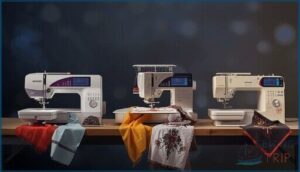
You’ve narrowed down your features, matched your needs to a machine type, and gathered the right accessories. Now it’s time to compare the brands that dominate the embroidery machine market, each bringing distinct strengths to the table.
Let’s break down how Brother, Ricoma, and Bernina stack up, then look at what you’re actually getting for your money.
Brother: Versatility and User-Friendliness
Brother machines, especially models like the Brother SE600, shine in how they simplify your journey from beginner to confident embroiderer. Think of a user-friendly interface that guides you through design editing without a computer, automatic threading that cuts frustrating prep time, and quick setup features that get you stitching fast. When choosing an embroidery machine for home embroidery, Brother’s diagnostic tools catch tension hiccups before they derail your project.
| Feature | Benefit | Example Use |
|---|---|---|
| Built-in designs & editing | Customize without a computer | Resize monograms on-screen |
| USB/wireless transfer | Expand your design library instantly | Download patterns from anywhere |
| Automatic needle threading | Eliminates eye-strain and setup delays | Thread in seconds, not minutes |
| Quick-change presser feet | Swap tools mid-project seamlessly | Switch from standard to zipper foot |
| Diagnostic alerts | Catch issues before they escalate | Tension warnings prevent thread breaks |
Ricoma: Commercial-Grade Capabilities
Ricoma machines dominate commercial embroidery with multi-needle configurations that eliminate thread changes, slashing production time for high-volume orders. You’ll find large format embroidery areas spanning 15″x15″ or bigger, perfect for jacket backs and oversized designs. These commercial-grade machines handle continuous operation without overheating, making them the backbone of embroidery businesses targeting bulk contracts and rapid turnaround.
| Feature | Commercial Advantage | Business Impact |
|---|---|---|
| 10-15 needle systems | Zero thread-change delays | Complete multi-color designs in one run |
| 15″x15″+ embroidery area | Tackle oversized projects | Expand product catalog instantly |
| 1,200+ stitches/minute | Double your output capacity | Meet tight deadlines consistently |
Bernina: Precision for Hobbyists
Bernina machines deliver Swiss-engineered precision for home embroidery projects, with guided editing that transforms hobbyist ambitions into professional results. You’ll appreciate the user-friendly interface designed for mastering complex techniques without frustration, while sturdy construction manages everything from delicate monograms to dense fill patterns. The presser foot stability and consistent tension minimize those annoying bobbin issues that derail beginners.
| Bernina Advantage | Your Creative Win |
|---|---|
| High-precision stitch consistency | Professional-quality results from day one |
| User-friendly guided editing | Master complex designs faster |
| Extensive presser foot options | Tackle any fabric with confidence |
| Minimal bobbin tension issues | Less troubleshooting, more stitching time |
Comparing Price Points and Value
Your budget planning starts with understanding that entry-level machines ($300–$800) suit beginners, while mid-range Brother models ($800–$2,500) balance features and affordability. Commercial embroidery multi-needle machines ($8,000+) deliver faster return on investment through higher stitch speeds and simultaneous garment production.
Smart cost analysis looks beyond price tags to value metrics like energy savings, maintenance costs, and payback periods—often under two years for busy shops. When choosing an embroidery machine, consider the importance of embroidery machine features and brand reputation.
| Price Tier | Best Value Scenario |
|---|---|
| Entry ($300–$800) | Learning embroidery fundamentals, small projects |
| Mid-Range ($800–$2,500) | Growing home business, larger hoops |
| Commercial Single-Head ($8,000–$15,000) | Consistent orders, faster turnaround |
| Multi-Head ($25,000+) | High-volume production, maximum efficiency |
Frequently Asked Questions (FAQs)
Can embroidery machines handle leather or thick materials?
A leather jacket customization shop learned quickly that their standard home embroidery machine couldn’t punch through thick hides.
Yes, embroidery machines can handle leather and thick materials, but you’ll need powerful motors, sharp needles sized 90–110, and cut-away stabilizers to prevent puckering and perforation during stitching.
How loud are embroidery machines during operation?
Most embroidery machines hum along at 60 to 70 decibels during operation, roughly matching normal conversation volume.
Commercial multi-needle models can spike louder at peak speed, while home machines often include quiet modes for sound reduction.
Do embroidery machines require special electrical outlets?
Most home embroidery machines, including Brother models, run on standard 110–120 V household outlets without special wiring, though commercial units may need dedicated circuits for electrical safety and stable voltage requirements.
Whats the learning curve for complete beginners?
You’ll spend one to two hours mastering basics, with proficiency developing over eight to twelve practice hours.
Prior sewing experience can shorten beginner embroidery learning pace by roughly twenty to forty percent through natural skill transfer.
Can you embroider on pre-made garments easily?
You’re seam-lessly in luck—yes, you can embroider pre-made garments with proper garment preparation, stabilizer choice, and embroidery placement.
Your embroidery machine manages fabric and thread selection, embroidery techniques, and automatic thread cutter beautifully.
Conclusion
Think of choosing an embroidery machine like building a creative engine—every component, from hoop capacity to motor strength, determines whether you’ll cruise through projects or constantly troubleshoot breakdowns.
Now that you know what to look for in embroidery machine specifications, features, and brand distinctions, you can confidently invest in equipment that matches your ambitions.
The right machine doesn’t just execute designs; it amplifies your vision, turning thread and fabric into professional results that justify every dollar spent.
- https://x.com/godofprompt/status/1990526288063324577
- https://www.sciencedirect.com/science/article/pii/S0749208123000268
- https://arxiv.org/html/2507.17948v2
- https://www.scribd.com/document/683678057/Academic-Research-Manual-V1-1-April-2016
- https://academichelpexpress.blog/2024/08/please-use-the-bulleted-points-and-the-rubric-below-to-guide-your-work-your-pa/