This site is supported by our readers. We may earn a commission, at no cost to you, if you purchase through links.
The wrong thread ruins good embroidery fast. A polyester spool that works perfectly on a jacket patch will shred through silk organza before you finish the first color. Thread choice isn’t a minor detail—it determines whether your design looks sharp or falls apart mid-run.
Five main thread types power most embroidery machines: polyester, rayon, cotton, silk, and metallic. Each behaves differently under needle and tension. Weight, fiber structure, and sheen all shift the final result in ways that matter.
Knowing which thread fits your fabric, machine speed, and design style puts you in control from the first stitch.
Table Of Contents
- Key Takeaways
- Best Embroidery Thread Types
- Top 7 Thread Picks
- 1. New Brothread Polyester Embroidery Thread
- 2. New Brothread Mercerized Cotton Thread
- 3. Simthread Multi Color Glow Embroidery Thread
- 4. Brothread Variegated Polyester Embroidery Thread
- 5. New Brothread UV Color Changing Embroidery Thread
- 6. Doublelin Prewound Polyester Bobbins Size A
- 7. Embroidex Embroidery Thread Stand
- Thread Weight and Stitch Quality
- Needle and Bobbin Matching
- Thread Choice by Project Type
- Thread Quality and Storage
- Frequently Asked Questions (FAQs)
- Conclusion
Key Takeaways
- Polyester thread is your most reliable all-rounder — colorfast, durable, and built to handle high speeds without breaking.
- Thread weight drives everything: 40wt handles most projects, 30wt powers through heavy fabrics, and 60wt keeps delicate materials from puckering.
- Your needle must match your thread — a 75/11 for 40wt, 90/14 for metallic, and 65/9 for fine 60wt work.
- Store thread away from sunlight and moisture, because UV exposure quietly destroys fiber strength and color before you ever load the spool.
Best Embroidery Thread Types
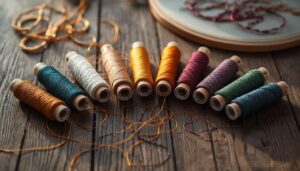
Not all embroidery threads are created equal, and the type you choose shapes everything — color payoff, durability, and how your finished piece actually feels. Each material brings its own strengths to the table, so knowing the difference saves you from frustrating guesswork.
Understanding how thread weight affects embroidery results is just as important as picking the right material.
Here are the main thread types worth understanding before you load your machine.
Polyester Embroidery Thread
Polyester embroidery thread is the workhorse of machine embroidery. Its slick surface feeds smoothly at high-speed stitching without breaks.
Low moisture absorption — under 1% — keeps your design stable through every wash.
You get abrasion resistance on tough fabrics like denim, thermal stability under heat, and colorfastness retention that holds vibrant color for years.
For thread longevity, polyester wins every time. Its trilobal filament construction provides extra sheen and smoothness.
Rayon Embroidery Thread
Rayon embroidery thread is built on a cellulose fiber base, giving it that silk-like glow that polyester simply can’t match.
It’s the go-to for rayon thread for decorative projects and rayon thread for luxury garments.
A mercerized finish benefits the sheen further. Core spun blends boost durability. Practice sunlight fading prevention by storing spools away from windows. Tension optimization, thread weight, and needle matching keep breaks minimal.
Cotton Embroidery Thread
Unlike rayon’s glow, cotton embroidery thread keeps things grounded — literally.
It’s made from long staple cotton fibers, combed and twisted into a three-ply construction that holds up stitch after stitch.
Colorfast testing ensures your colors stay true through washing.
Perfect for hand embroidery suitability, linen blend compatibility, and cotton thread for vintage designs, heirloom work, and soft matte finishes.
Silk Embroidery Thread
Cotton gives you matte and grounded. Silk gives you glow.
Silk embroidery thread is the luxury pick — prized for its luster, longevity and smooth slip through tight hoops. Fiber shape recovery means stitches stay crisp after pressing. Its moisture tolerance manages gentle handling well.
- UV colorfastness holds on dark backgrounds but fades under direct sun
- Thread tension adjustment matters — silk needs lighter pressure
- Thread weight and needle matching: use a fine 65/9 needle for delicate silk thread applications in fine embroidery
Metallic Embroidery Thread
Metallic embroidery thread turns heads — but it demands respect.
Most use a Foil Core Construction: polyester or nylon wrapped in metallic foil for shine and strength.
Premium options like KingStar Metallic threads include Polymer Stabilizer Use to cut fraying.
Watch for Iridescent Color Shifts with Multicolor Gradient Foils.
Always use a 90/14 metallic needle.
Slower speeds and fine-tuned tension solve most Metallic Thread Challenges and Solutions instantly.
Glow-in-the-Dark and UV Threads
Want stitches that glow at night? Glow-in-the-dark thread and UV-light-reactive thread make that happen.
Both are polyester-based with phosphorescent pigments built in. Master these four fundamentals:
- Charging Techniques — sunlight charges best; 10–20 minutes gives hours of glow
- Phosphor Longevity — store away from sunlight to protect pigments
- UV Safety — pigments are non-toxic and textile-safe
- Stitch Speed Adjustments — slow down and ease tension to prevent breaks
Top 7 Thread Picks
Finding the right thread doesn’t have to feel like a guessing game. These seven picks cover a wide range of needs — from everyday polyester to glow-in-the-dark specialty threads.
Let’s break them down one by one.
1. New Brothread Polyester Embroidery Thread
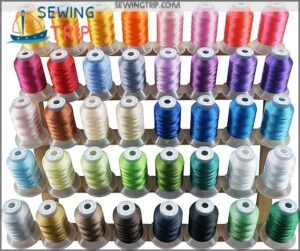
This kit is a solid everyday workhorse. You get 40 spools of 40 wt polyester thread — 500 meters each — for under $23.
That’s a serious amount of yardage. The 100% polyester construction means strong tensile strength, low breakage, and colors that won’t fade through repeated washing or bleach cycles.
It works across major machine brands like Brother, Janome, and Bernina. A printed color chart and Madeira conversion guide are included. No rack, though — plan your own storage solution.
| Best For | Home sewers and hobbyists who do a lot of machine embroidery and want a reliable, affordable thread collection that holds up through frequent washing. |
|---|---|
| Material | 100% Polyester |
| Thread Weight | 40 wt |
| Machine Compatible | Yes |
| Color Count | 40 colors |
| Price (USD) | $22.94 |
| Spool/Unit Count | 40 spools |
| Additional Features |
|
- 40 spools for under $23 is genuinely great value — that’s a lot of color variety without breaking the bank.
- Strong, colorfast polyester means fewer mid-project breakages and colors that stay vivid even after bleach cycles or commercial laundering.
- Works with most major embroidery machines and comes with a color chart plus Madeira conversion guide, so matching threads is easy.
- No spool rack included, so you’ll need to figure out storage yourself before those 40 spools end up everywhere.
- Polyester isn’t the right call for projects needing natural fiber feel or high heat resistance — think delicate quilting or specialty fabrics.
- Getting the best results still takes some dialing in — wrong needle size or machine settings can cause breakage regardless of thread quality.
2. New Brothread Mercerized Cotton Thread
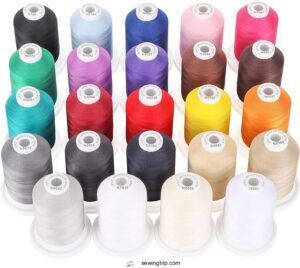
Natural fabrics deserve natural thread — and this one delivers. New Brothread’s mercerized cotton is 100% gassed and mercerized, which means less lint, smoother feed, and a polished sheen that synthetic threads can’t fake.
Each spool holds 600 meters at 50 wt (equivalent to 30 WT), so it’s thicker than your standard 40 wt. Use an 80/12 needle or larger.
It’s best for quilting, piecing, and embroidery on cotton or linen. Low elasticity means slower stitching speeds work better here.
| Best For | Quilters, garment sewers, and embroidery enthusiasts who work primarily with natural fabrics like cotton and linen and want a high-quality, low-lint thread for clean, professional results. |
|---|---|
| Material | 100% Mercerized Cotton |
| Thread Weight | 50 wt |
| Machine Compatible | Yes |
| Color Count | 24 colors |
| Price (USD) | Not listed |
| Spool/Unit Count | 24 spools |
| Additional Features |
|
- Massive 600-meter spool means fewer interruptions on big projects, and the locking snap-spool keeps everything tidy between sessions.
- Mercerized cotton gives you a smooth, polished finish with consistent color that holds up wash after wash.
- Works across machine sewing, hand sewing, and embroidery — genuinely versatile for natural-fabric projects.
- Thicker than standard 40 wt thread, so you’ll need to swap in an 80/12 needle or larger — easy to forget if you’re used to lighter thread.
- Low elasticity means you need to slow down your stitch speed, which isn’t ideal if you’re used to running at full throttle.
- No single-color purchasing option, so if you just need white or black, you’re buying more than you bargained for.
3. Simthread Multi Color Glow Embroidery Thread
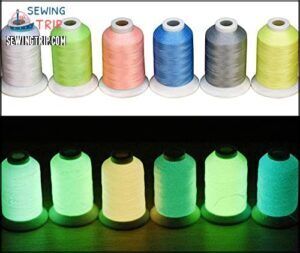
Glow-in-the-dark thread sounds gimmicky — until you see it light up a Halloween costume or festival jacket.
Simthread’s six-color set runs at 30 wt, so grab an NM 80/12 or 85/13 needle.
Each spool holds about 1,000 yards at $19.99 for the set.
Charge the stitched area under regular or UV light for 20 minutes, and it glows 3–8 hours.
Stick to dark fabrics for the strongest effect.
Slow your machine speed slightly to prevent breakage.
| Best For | Crafters and makers who want eye-catching, illuminated embroidery for costumes, festival wear, or creative projects. |
|---|---|
| Material | 100% Polyester |
| Thread Weight | 30 wt |
| Machine Compatible | Yes |
| Color Count | 6 colors |
| Price (USD) | $19.99 |
| Spool/Unit Count | 6 spools |
| Additional Features |
|
- Six colors for $19.99 is genuinely good value — each spool runs about 1,000 yards
- Works with most major machine brands right out of the box
- Child-safe materials make it a solid pick for school or community craft projects
- Colors can look off in daylight — yellow tends to read as green, and some spools are hard to tell apart
- Everything glows green-ish, so don’t expect true color at night
- Thread can shred at high speeds, so you’ll need to slow your machine down a bit
4. Brothread Variegated Polyester Embroidery Thread
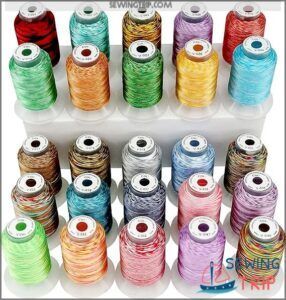
One spool, many colors — that’s the real sell here.
The Brothread Variegated set gives you 25 spools of 40 wt polyester, each 500 meters long. Color shifts happen gradually, so you get smooth ombre effects without swapping threads mid-project.
At $23.73 for the whole kit, it’s hard to beat.
Use a 75/11 needle and match your bobbin thread weight. Slow down slightly on longer runs — some variegated spools can split at higher speeds.
| Best For | Hobbyists and small-business makers who want versatile, multi-color embroidery thread without spending a fortune or constantly swapping spools. |
|---|---|
| Material | 100% Polyester |
| Thread Weight | 40 wt |
| Machine Compatible | Yes |
| Color Count | 25 colors |
| Price (USD) | $23.73 |
| Spool/Unit Count | 25 spools |
| Additional Features |
|
- 25 variegated spools for $23.73 is genuinely great value — that’s under a dollar per spool
- Color-fast and tough enough for workwear and uniforms that go through heavy laundering
- Works with most major machines (Brother, Singer, Janome, Bernina, and more)
- Variegated spools can split or break at higher speeds, so you’ll need to slow down
- Spools are only 500m each, which means frequent changes on big projects
- Variegated colors may run slightly weaker in tensile strength than solid-color options
5. New Brothread UV Color Changing Embroidery Thread
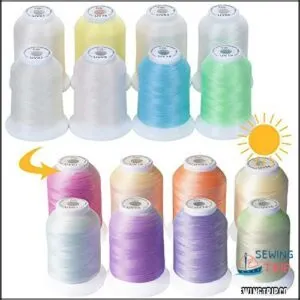
Want your embroidery to literally change in sunlight? That’s exactly what this thread does.
The New Brothread UV Color Changing set comes with 8 spools — 500 meters each at $23.39. It’s 30 wt polyester, so it’s thicker and stronger than standard 40 wt. Use a SCHMETZ Topstitch 90/14 needle to cut down on friction and breakage.
Keep wash temps under 104°F and skip the bleach. No steam iron either — dry iron only, max 176°F.
| Best For | Embroiderers and sewists who want eye-catching, color-changing designs on outdoor gear, kids’ clothing, or accessories. |
|---|---|
| Material | 100% Polyester |
| Thread Weight | 30 wt |
| Machine Compatible | Yes |
| Color Count | 8 colors |
| Price (USD) | $23.39 |
| Spool/Unit Count | 8 spools |
| Additional Features |
|
- The UV color-shift effect is genuinely fun — same piece looks totally different indoors vs. in sunlight.
- Strong 30 wt construction holds up well on dense stitch patterns and multi-needle machines.
- Skin-safe polyester makes it a solid pick for baby clothes and anything worn close to the body.
- Weak indoor UV means the color change can be pretty subtle — you really need direct sunlight to see the full effect.
- Needs specific large-eye needles and silicone lubricant, so there’s a bit of extra setup involved.
- Not great for hand-sewing or knitting — the thin filament tends to spool and tangle easily.
6. Doublelin Prewound Polyester Bobbins Size A
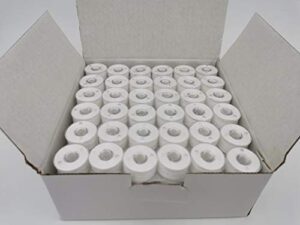
Bobbin work rarely gets much attention — until it starts causing problems. That’s where the Doublelin Prewound Bobbins earn their place.
Each pack gives you 144 ready-to-load Size A bobbins (Class 15 / SA156), wound with 60 wt white polyester. That’s the ideal bobbin weight — thin enough to avoid bulk, strong enough to hold tension. Each bobbin holds about 3,600 inches of thread. Clear plastic sides let you see exactly how much is left. No guessing. No downtime.
| Best For | Home sewists, embroidery studios, and production workrooms that run Class 15 machines and want to stop wasting time winding bobbins. |
|---|---|
| Material | 60S/2 Spun Polyester |
| Thread Weight | 50 wt |
| Machine Compatible | Yes |
| Color Count | 1 color (white) |
| Price (USD) | Not listed |
| Spool/Unit Count | 144 bobbins |
| Additional Features |
|
- 144 bobbins per pack means you can keep machines running without constant interruptions — great for high-volume work.
- Consistent tension right out of the box, and the plastic sides let you see at a glance when a bobbin is running low.
- Works across a wide range of popular brands like Brother, Janome, Juki, and Singer, so no compatibility headaches.
- Only comes in white, so if your project needs a dark or contrasting bobbin thread, these won’t cut it.
- Plastic construction means they can crack if you force them in — handle with a little care.
- Only fits Size A / Class 15 machines, so double-check your bobbin size before buying.
7. Embroidex Embroidery Thread Stand
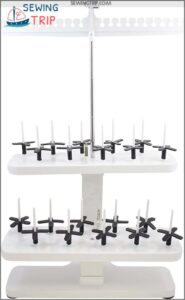
Keeping your bobbins in order is half the battle. The other half? Managing the threads waiting their turn.
The Embroidex Thread Stand holds up to 20 spools at once — king cones, snap spools, mini-kings — all ready to go.
It sits behind your machine, takes up about 16 × 6 inches of desk space, and weighs just 3.57 lb. At $27.99, it’s a simple way to cut color‑change downtime and keep your project flowing without hunting for the next spool.
| Best For | Embroiderers who juggle multi-color projects and want their threads organized, accessible, and ready to swap without slowing down their workflow. |
|---|---|
| Material | Polypropylene Plastic |
| Thread Weight | N/A |
| Machine Compatible | Yes |
| Color Count | N/A |
| Price (USD) | $27.99 |
| Spool/Unit Count | 1 stand |
| Additional Features |
|
- Holds 20 spools of mixed types, so you can line them up in project order and just grab and go
- Built-in thread guide, cutter, and retainer make feeding smooth and tangle-free
- Affordable at $27.99 and light enough to move between machines easily
- Assembly instructions are vague, and several included accessories leave users guessing what they’re even for
- The sand-weighted base can still shift if you’re working with heavier spools
- The footprint is pretty wide — if your table is on the smaller side, it may crowd your workspace
Thread Weight and Stitch Quality
Thread weight quietly controls how your finished design looks and feels. number on your spool affects everything from stitch density to the needle you reach for.
Here’s what you need to know about each weight option.
Why 40 Wt Fits Most Designs
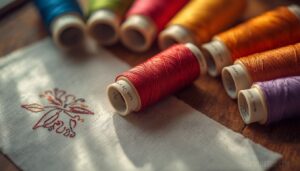
Think of 40wt thread as your everyday workhorse — reliable, clean, and ready for almost anything. Thread weight selection doesn’t get simpler than this.
It delivers efficient stitch definition on both lightweight and medium fabrics, balanced bulk that won’t pucker or pile up, and adaptable fabric compatibility from cotton blends to knits.
Standard machine compatibility means no rethreading, no fuss. Consistent color coverage, too. That’s why covers roughly 90% of embroidery projects.
When to Use 30 Wt Thread
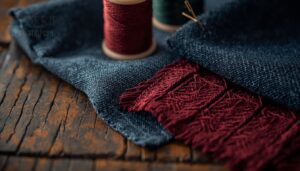
30wt thread is built for tough jobs. When you’re working on Denim Canvas Projects or Decorative Quilting, this thicker thread weight delivers bold, visible lines that lighter options simply can’t match.
- Rapid Stitch Fill — covers heavy fabric faster, cutting your stitch count
- Mid-Dark Contrast — pops cleanly on darker materials without excess shine
- High Tension Tolerance — holds steady on industrial machines without breaking
- Needle Size Compatibility with Thread Weight — requires an 80/12–14 needle
- Thread density adjustment — reduce density slightly to prevent stiff, over-packed fills
When to Use 60 Wt Thread
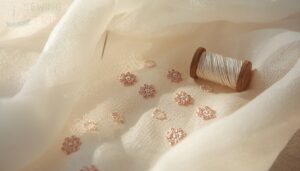
60wt thread is your go-to for micro stitching and precise monograms on delicate materials. When sheer fabric work is on your list — think organza or silk chiffon — this thread weight keeps reduced stitch bulk in check without puckering.
Use a 65/9 needle size, dial in your thread tension carefully, and skip high‑speed stitching. A lightweight bobbin underneath completes the balance.
Weight Changes Stitch Density
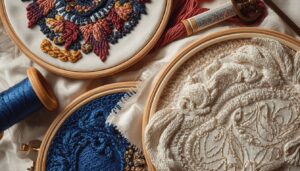
Thread weight directly controls stitch density impact on your fabric. Heavier thread — like 30wt — fills space fast, raising fabric weight gain noticeably. Lighter 60wt thread spreads thinner, reducing thread consumption rate per square inch. That shift affects density-driven drape and overall feel.
- 40wt thread suits standard density settings
- Higher density increases stabilizer weight effect
- Denser stitches pack more thread per inch
- Thread thickness changes how designs sit on fabric
- Lower weight thread reduces visible stitch bulk
Weight Changes Needle Choice
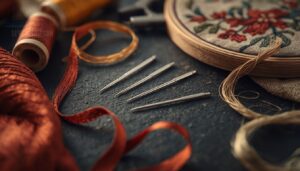
Weight changes demand immediate needle adjustments. Heavier thread thickness calls for larger needles — 80/12 to 14 — to support proper thread flow and prevent breakage.
Finer 60wt needs a 65/9 for stitch consistency optimization.
Mid-design needle switches during weight-driven needle size shifts protect thread tension balance.
Skipping this real-time tension calibration causes loops, breaks, and uneven density fast.
Needle and Bobbin Matching
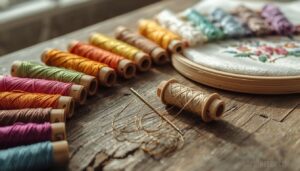
The right needle makes all the difference between smooth stitching and constant thread breaks. Matching needle and bobbin to your thread weight isn’t complicated — it just takes knowing a few key pairings. Here’s what you need to get it right.
75/11 Needles for 40 Wt Thread
A 75/11 embroidery needle is the go-to match for 40‑wt thread — and for good reason. Every detail of its design works together to protect your thread and your stitch quality.
- Eye Shape Benefits: Reduces friction and heat during high-speed stitching
- Scarf Area Design: Cradles the thread, preventing bunching near the tip
- Thread Path Groove: Aligns the thread to minimize snagging
- Needle Shaft Hardness: Resists bending under typical embroidery loads
- Stabilizer Compatibility: Works reliably with stabilizers on cotton and knit fabrics
Get this pairing right, and your thread tension stays consistent from first stitch to last.
90/14 Needles for Metallic Thread
Metallic thread snaps easily — and the wrong needle is almost always the culprit. A 90/14 needle solves this.
Its elongated eye delivers real Eye Size Benefits, cutting friction as metallic foil passes through. Titanium coatings add Coating Durability and Needle Life Extension across dense fills.
This needle size also manages multiple stabilizer layers without bending, giving you full Thread Feed Optimization and reliable metallic thread troubleshooting tips built right in.
65/9 Needles for 60 Wt Thread
Switch from that 90/14 and go smaller — a 65/9 with a Sharp Needle Point is built for 60 wt thread. Its Eye Size Compatibility prevents friction that causes thread breakage.
Coated Needle Benefits keep heat low during Stitch Speed Optimization.
Use a fabric stabilizer to avoid puckering.
Check your needle chart and fine‑tune thread tension adjustment for clean, crisp results.
Choosing 60 Wt Bobbin Thread
Now that your needle is dialed in, your bobbin thread deserves the same attention.
Use 60 wt thread in the bobbin — it’s your best bulk reduction strategy for clean, flat results on the underside.
- Pairs with 40 wt top thread for balanced bobbin tension settings
- White works as a universal thread color coordination choice
- Matches your fabric compatibility guide for delicates like silk or chiffon
Avoid thread breakage by checking tension after every switch.
Tension Fixes for Loops and Breaks
Loops and breaks often trace back to one thing: tension that’s off.
| Problem | Likely Cause | Fix |
|---|---|---|
| Loops on top | Upper Tension Adjustment too loose | Tighten upper tension slightly |
| Loops on bottom | Bobbin Tension Balancing off | Loosen upper or tighten bobbin |
| Thread breakage causes and solutions | Wrong needle size | Match needle to thread weight |
| Uneven stitches | Stitch Density Tuning needed | Adjust density for fabric weight |
| Puckering | Fabric Weight Influence ignored | Recheck tension for lighter fabrics |
Use Loop Diagnosis Techniques — test on scrap first. Thread breakage troubleshooting starts there. Adjust in quarter-turns. Thread tension and needle size considerations matter every time you switch thread types.
Thread Choice by Project Type
The thread you pick should match the job you’re doing. Different projects call for different materials, and the wrong choice can slow you down or wreck the final look.
Here’s how each thread type fits the work.
Polyester for High-speed Embroidery
Polyester embroidery thread is built for speed. Its Heat Resistance keeps filaments stable up to 180°C, so Friction Stability stays consistent across long industrial embroidery runs.
You get strong Color Retention after 25+ washes, minimal thread breakage, and a Lint-Free Formulation that reduces Needle Wear considerably.
For highspeed stitching, 40 wt thread weight is your go-to — reliable, durable, and virtually trouble-free.
Rayon for Glossy Decorative Designs
Want that luminous, silk-like finish on your decorative work? Rayon thread delivers it.
Its light refraction effects create a stunning thread luster that pops on dark fabrics — especially with satin stitch enhancement techniques on monograms or ornate frames.
- satin stitch samples to preview thread shine before full designs.
- color saturation strategies with dense, single-pass fills.
- Pair with metallic threads for amplified glossy finish techniques.
- Confirm stabilizer compatibility to prevent puckering and preserve the reflective surface.
Rayon thread for luxury garments and decorative top stitching is hard to beat.
Cotton for Matte Natural Looks
Cotton is the go-to when you want a flat, natural look. Its Matte Fiber Purity and Low Sheen Finishes keep thread shine minimal — no gloss, just clean stitch definition.
Cotton thread for soft sheen and matte finishes works beautifully with Earth Tone Compatibility palettes.
You’ll notice the Hand Feel Texture stays soft, and Sunlight Fade Resistance holds up well with proper care.
Silk for Delicate Luxury Pieces
Silk thread is the quiet luxury of embroidery. Its Luminous Silk Sheen and Silky Hand Sensation make it perfect for delicate fabrics and luxury garments. Temperature Regulating Silk keeps the fabric comfortable. Use Fine Silk Stabilization to prevent warping during stitching.
- Use 65/9 needle for clean stitch detail
- Lower tension for smooth thread sheen
- Apply Gentle Silk Care — hand wash or dry clean
- Back with stabilizer to protect delicate fabrics
- Store away from sunlight to preserve silk embroidery thread color
Metallic for Bold Accent Work
Metallic thread turns flat fabric into something that catches the eye across a room. Its reflective surface creates real impact — but it comes with trade‑offs.
Foil Edge Fraying is common without the right Metallic Thread Needle (use a 90/14).
Slow your machine down for Glare Control Techniques and smoother Accent Stitch Placement.
Smart Color Pop Pairing on dark fabrics makes every stitch shine.
Thread Quality and Storage
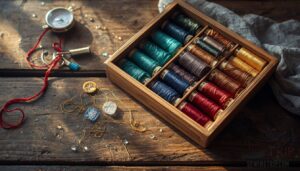
Good thread doesn’t just stitch well — it lasts.
Knowing how to check quality and store your spools properly can save you from frustrating mid-project breaks and dull, faded colors down the line. Here’s what to look for and how to keep your thread in top shape.
Checking Smoothness and Uniformity
Bad thread ruins good designs. Before you load a spool, run your fingers along a short length — smooth and even means it’ll feed well. Bumpy or fuzzy spots signal trouble ahead.
Before you load a spool, run your fingers along it — smooth means it’ll stitch clean, bumpy means trouble ahead
Quick thread quality testing methods to use every time:
- Surface Roughness Metrics: Feel for slubs or thick spots that disrupt tension variation monitoring
- Diameter Consistency Testing: Look for uneven sections under oblique lighting — a CV% above 5% flags poor uniformity
- Visual Defect Detection: Check for pilling or twist irregularities that cause breakage mid-stitch
Choosing Trusted Thread Brands
Brand reputation matters more than price. Sulky, Gutermann, and Coats & Clark publish colorfastness guarantees — threads that hold color through 40+ washes.
They offer warranty support and clear needle compatibility charts.
Yes, you’ll pay 20–50% more than budget options. But fewer breaks, less rethreading, and consistent supplier availability make that investment worth it every time.
Storing Thread Away From Sunlight
Good brands protect your investment — but so does how you store your thread.
UV light is silent damage. It breaks down fibers and causes UV fading of thread colors before you even notice.
Use opaque storage solutions and UV‑blocking containers to block light completely. Add silica gel packs for moisture control.
Keep everything in a cool dry environment, away from windows.
Preventing Lint, Fading, and Tangles
Storage protects your thread — but daily habits protect your work.
Wash embroidered pieces in cold water to slow fading. Use mesh garment bags to cut tangling and thread fraying. Toss in color catching sheets for mixed loads. On dark fabrics, anti-static sprays reduce lint attraction. Choose lint-free fabrics when possible.
Small steps, consistent results.
Frequently Asked Questions (FAQs)
What are the best quality embroidery threads?
The best embroidery machine thread combines strong tensile strength, high colorfastness rating, and consistent luster level. Polyester and rayon lead for most projects, offering cost efficiency without sacrificing quality.
Which is better for machine embroidery, rayon or polyester thread?
Polyester wins for durability. Rayon wins for sheen.
Polyester thread manages breakage speed, moisture resistance, and colorfastness longevity better. Rayon thread delivers superb sheen vs strength tradeoff for decorative work.
Choose based on your project’s priority.
Which thread is best for embroidery?
For most projects, polyester thread wins. It balances thread longevity, machine compatibility, and color matching better than any other option.
Rayon thread shines for gloss, but polyester endures daily wear without fading.
What is the best embroidery thread for machine embroidery?
Polyester wins for most machine embroidery. It offers top thread durability, a high colorfastness rating, and strong cost efficiency.
It manages machine speed impact well and delivers reliable thread compatibility across fabric types.
What are the different types of machine embroidery threads?
Think of thread types like paint colors — each one changes the whole look.
Fiber composition, sheen variations, and colorfastness levels vary across Polyester, Rayon, Cotton, Metallic, and Variegated and Multicolor Thread options.
How to choose embroidery thread?
Match your thread to your fabric, project finish, and wash needs. Consider thread weight, colorfastness testing, and budget considerations. The right thread compatibility makes every stitch land clean.
What are embroidery threads?
Embroidery threads are specialized yarns built for decorative stitching.
Fiber composition, thread construction, and colorfastness levels vary by type — polyester, rayon, cotton, silk, or metallic — each designed for machine compatibility and specific applications.
What is the difference between regular and machine embroidery thread?
Regular sewing thread frays fast and lacks the tensile strength machine embroidery thread demands.
Machine embroidery thread wins on sheen comparison, colorfastness variance, and machine compatibility — built to perform under speed.
What are the different weights of machine embroidery thread?
Weight Range Overview starts at 30 wt and climbs to 60 wt. Lower numbers mean thicker thread. Your Weight Selection Guide is simple: 40 wt manages most projects reliably.
How do embroidery thread colors affect design visibility?
High contrast between thread color and fabric background drives visibility. Bright hues on dark fabric sharpen edge definition.
Glossy rayon adds a luminance boost. Match hue saturation carefully for clean, readable results.
Conclusion
Think of your embroidery machine as a skilled chef—even the best technique falls flat without the right ingredients. The best embroidery machine thread types are those ingredients.
Polyester manages speed. Rayon brings shine. Cotton stays matte. Silk whispers luxury. Metallic draws focus.
Match thread to fabric, weight to needle, and storage to longevity. Every choice compounds. Get those choices right, and your designs don’t just finish—they land exactly the way you envisioned them.