This site is supported by our readers. We may earn a commission, at no cost to you, if you purchase through links.
I’ve watched plenty of folks squint at a needle for five straight minutes, jabbing a frayed thread tip at that tiny hole like they’re playing some cruel carnival game.
Nine times out of ten, the needle isn’t the problem—the thread is.
blunt-cut end, a needle with a hidden burr, or a spool that’s been sitting in a damp drawer can turn a thirty-second task into a battle that ends with you tossing the whole project across the room.
Good needle needle threading maintenance tips fix that frustration at the root, not just the symptom.
Get your tools in order, and threading stops being a fight and starts being second nature.
Table Of Contents
- Key Takeaways
- Prepare Thread Ends Properly
- Choose The Right Needle
- Match Thread to Your Project
- Thread Needles Without Tools
- Use Needle Threaders Correctly
- Try Paper-Fold Threading
- Maintain Sewing Machine Threaders
- Improve Lighting and Control
- Prevent Threading Problems
- Store Needles and Thread Safely
- Frequently Asked Questions (FAQs)
- Conclusion
Key Takeaways
- Cutting your thread at a 45-degree angle and keeping strands under 24 inches eliminates most threading frustration before you even touch the needle.
- Matching your needle type and eye size to your specific thread and fabric is the single biggest factor in clean stitches and fewer breakages.
- Good lighting, a white background card, and holding the needle at eye level cost nothing, but fix more threading failures than any gadget will.
- Storing needles dry and thread at 40–60% humidity protect your tools from rust, mold, and brittleness that quietly sabotage your next project.
Prepare Thread Ends Properly

Most threading headaches start way before you ever get near the needle eye. A ragged, fuzzy thread tip is basically fighting you from the start, and no amount of patience fixes that. Here’s how to set yourself up for a clean, easy pass every single time.
Cut at a 45-degree Angle
Grab your scissors and slice the thread end at a 45-degree angle, not straight across.
This simple trick creates a stiffer, more pointed tip that slides through the needle’s eye far more easily, as explained in these sewing needle threading tips.
That bevel geometry boosts thread surface area roughly 70%, helping fibers glide smoothly toward the eye. It guides needle entry along the shaft, fights fiber fraying, and works whether you’re stitching cotton, polyester, or silk—a small habit that seriously cuts thread breakage.
Moisten Frayed Thread Tips
After that angled cut, moisten the tip with a damp finger or a touch of saliva, a natural binding agent for loose fibers.
This thread moisture for easier threading suits cotton and silk; metallic threads need less to avoid staining. Smoothing the thread tip curbs thread breakage.
Check it’s neat—a quick post-threading quality check before final thread end preparation.
The traditional wetting technique helps the thread stay stiff and pass through the eye in one motion.
Use Beeswax Sparingly
Once your tip is moistened and neat, a thin beeswax coat takes thread care further—less is always more here.
- Apply a barely-there film, not a thick coat
- Prevents wax buildup and gummy needle eyes
- Stops fabric staining on delicate materials
- Avoids thread tension issues mid-stitch
- Try silicone alternatives if wax feels finicky
Sparing beeswax thread lubrication smooths fibers without stiffening them.
Keep Thread Length Manageable
Cut about 20 inches of thread—that’s your ideal thread length, balancing tension stability with control. Longer strands add drag and fiber friction; too-short pieces force constant rethreading. Trim it down before fraying starts, and you’ll dodge knotting issues before they happen.
| Length | Result |
|---|---|
| 18–24 in | Smooth, even tension |
| 30+ in | Heavy drag, tangling |
| Under 12 in | Frequent rethreading |
Smart thread management starts with this one habit.
Check Embroidery Thread Grain
Run your fingers along the embroidery floss before threading—you’re feeling for thread grain direction, how the fibers naturally lie. Pull a short length taut; if it kinks, you’re fighting fiber orientation.
Always check the grain of the thread first: alignment cuts drag, steadies tension, and keeps stitches gliding smoothly.
Choose The Right Needle

Even with perfectly prepped thread, the wrong needle will fight you every step of the way. I learned this the hard way after years of cussing at fabric that just wouldn’t cooperate. Here’s what actually matters when you’re picking one off the rack.
Match Eye to Thread
Here’s the truth: most threading headaches come down to size mismatch, not bad luck.
Pick a needle eye at least twice your thread’s diameter—thin threads need small, smooth eyes; heavier ones need bigger openings so they don’t catch or fray.
Match eye size to thread weight, and threading gets faster, stitches stay cleaner, and breakage drops noticeably.
Use Sharps for Wovens
Stitching dense weaves calls for sharp needle geometry that pierces, not pushes, preserving woven fabric integrity and preventing fabric pucker.
For woven fabrics like cotton, linen, or canvas:
- Match your needle type to fabric types and weight
- Use a needle size guide for needle size selection
- Check needle point performance each time
This keeps your seams crisp and stitches clean.
Use Ballpoints for Knits
Ever watch a tiny snag spiral into a run down your favorite sweater? That’s laddering, and a ballpoint stretch needle stops it cold.
A ballpoint stretch needle stops laddering cold, gliding between knit loops instead of tearing through them
Its rounded tip glides between knit loops instead of piercing them, avoiding stitch distortion and preserving fabric elasticity.
For jersey or interlock, pair sizes 70-100 with stretch stitches and steady thread tension—smooth seams, happy knits.
Pick Embroidery Needle Eyes
Picking the right needle eye size for hand embroidery needles keeps embroidery thread types gliding—aim for eye diameter ratios twice the thread’s thickness.
- Oval eyes ease multi-strand feeding
- Polished eye edges stop snagging
- Eye-to-shaft alignment keeps stitches straight
- Larger eyes boost needle eye visibility
- Smooth eyes protect delicate embroidery techniques
Pick wisely, and your floss glides through without a fight.
Replace Damaged Needles
A burred or bent needle tip will snag fabric every time, so check it under good light. Loosen the clamp screw, remove the damaged needle straight out, then seat the new one with the flat shank side facing correctly—test it on a stitch sample.
Log replacement dates, follow your needle replacement schedule, and toss bent needles in a rigid container.
Match Thread to Your Project
Picking the right needle is only half the battle—your thread has to pull its weight too. The wrong weight or a fraying spool will sabotage even a perfectly matched needle, and that’s a frustration you can easily dodge. Here’s what to check before you thread that eye.
Choose Correct Thread Weight
Thread weight tells you how thick your thread really is, measured in Tex or weight class — and here’s the twist: higher numbers mean finer thread, not thicker.
Use a simple thread weight guide for fabric thread pairing: 30-40wt for cotton, 60-80wt for delicate silk.
Matching fabric weight this way prevents seam bulk and respects thread material strength.
Avoid Bulky Thread Combinations
Once you’ve nailed down thread weight, the next trap is mixing thick threads in one seam.
Pairing bulky embroidery floss with regular thread causes uneven stitch height and puckering on woven fabrics.
Stick to a single strand when possible, match thread texture and thickness to fabric weight, and keep tension consistent — that’s how you avoid snagging, fraying, and a lumpy, amateur-looking seam.
Select Buttonhole Thread Carefully
Buttonholes take more abuse than almost any other stitch on your garment, so don’t grab just any spool.
Polyester thread beats cotton for strength here. For wovens, try cotton-wrapped polyester for softer coverage; for stretchy fabrics, pick polyester with give.
- Match weight (30-50) to fabric
- Test colorfastness before pressing
- Match thread color to fabric, unless going decorative
Condition Metallic Threads
Metallic thread is gorgeous but fussy — that shiny foil layer hates friction. Run a beeswax-coated cloth down the strand before stitching; this cuts static and protects against foil delamination from heat or rough handling.
| Do | Don’t |
|---|---|
| Wax lightly, store cool | Iron directly, expose to humidity |
Light thread conditioning preserves surface luster and saves you from mid-project meltdowns.
Check Thread for Fraying
Run your fingers down the strand before you even thread up — you’re feeling for fiber splits and thinning spots. Beaded fuzz or asymmetric wear are early fraying signs, often tied to thread age or moisture exposure.
Trim past any rough patch.
This quick check is real thread fraying prevention, and good thread care habits like this protect your overall thread quality.
Thread Needles Without Tools
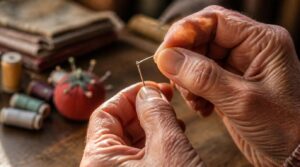
Lost your threader or just don’t feel like digging through your sewing box for it? No problem, your own two hands can get the job done just fine. Here’s how to thread a needle the old-fashioned way, no gadgets required.
Try The Pinch Method
Forget gadgets—your fingers are the best tool you own. Pinch the thread tip lightly, moisten and squeeze it, then guide it straight toward the eye, keeping wrists steady and eyes level with the needle.
- Relax your shoulders
- Keep a shallow angle
- Avoid bending the thread
- Trim fuzzy, kinked ends
- Practice on three needle sizes
Five seconds, steady hands, done.
Fold Thread Over Needle
When the eye on your needle feels too small for the thread you’re working with, try the foldover pinch method instead of fighting it. Fold the thread tip over the needle shaft, then start pinching the thread tight for folding stability before sliding the eye over that doubled section—thread thickness now works for you, not against you.
| Step | What You Do |
|---|---|
| 1 | Moisten and squeeze the tip |
| 2 | Fold over shaft, pinch tight |
| 3 | Slide eye over fold |
| 4 | Smoothing thread tip pulls it free |
Practice this a dozen times and muscle memory training takes over—insertion smoothness becomes second nature.
Use Strong Visual Contrast
Ever squint at a needle eye and just… lose it against your sewing table? That’s a contrast problem, not a vision problem. Grab a white card or sheet, slide it behind the needle, and watch that tiny opening pop.
- Background sheet selection matters most
- Bright, directional lighting kills glare
- High color contrast ratios beat muted tones
- A visual anchor guides your eye fast
- Good lighting protects long-term visual acuity
Hold Needle at Eye Level
Where you hold that needle matters more than you’d think. Bring it up to eye level, straight in front of your face, instead of hunched over your lap.
| Eye Level | Lap Level |
|---|---|
| Gravity aligns thread | Thread fights gravity |
| Less neck strain | Stiff, sore neck |
| Clear needle eye visibility | Squinting and guessing |
| Accurate visual path | Distorted angle |
| Steady, precise threading | Shaky, rushed attempts |
Stabilize Hands Before Threading
Shaky hands ruin more threading attempts than bad eyesight ever will. Try these fixes:
- Rest elbows on the table for elbow stability
- Take one slow breath before guiding thread
- Do quick hand warm-ups first
- Use a relaxed handsewing grip
- Add wrist support if needed
Better hand-eye coordination comes from calm muscles, not white-knuckle focus.
Use Needle Threaders Correctly
If your eyes are tired or your hands just won’t cooperate with the pinch method, a needle threader can save you a lot of frustration.
These little tools aren’t all built the same, though, and using the wrong one (or using the right one wrong) leads to bent wires and busted threaders pretty fast.
Here’s how to use each type the way it’s meant to be used, plus how to keep them in working shape.
Wire-loop Threader Steps
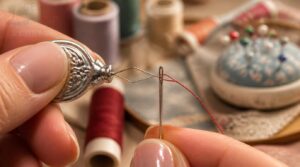
When your eyes just won’t cooperate, a wire loop needle threader saves the day. That thin wire loop slips through the needle eye, leaving a tail for your thread.
| Step | Action | Tip |
|---|---|---|
| 1 | Insert loop | Front to back |
| 2 | Thread the tail | Secure it |
| 3 | Pull loop back | Steady pull |
Avoid Bending The Loop
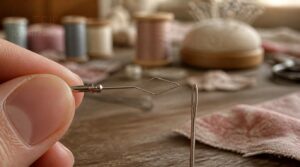
That thin wire loop bends more easily than you’d think, and a bent loop just won’t slide through the eye anymore. Keep gentle, even pressure going in and coming out — no yanking.
A bent or frayed needle threader snags fabric and ruins your tension.
Treat your needle threader device with the same care you’d give good scissors, and it’ll outlast a dozen rushed ones.
Flat-hook Threader Uses

Wire loops bend, but flat-hook threaders skip that problem entirely. The flat profile spreads pulling force evenly, so embroidery floss and other heavy thread won’t shred or snag going through.
For bulk thread efficiency, nothing beats it — multi-strand floss and metallics slide through tight eyes smoothly, keeping thread tension steady and your sewing genuinely smooth, project after project.
Push-button Threader Benefits
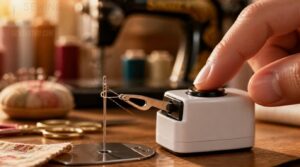
Push-button threaders take convenience a step further. With one press, an automatic needle threader advances the thread through the eye in seconds — no squinting, no fumbling.
That kind of sewing efficiency genuinely reduces hand strain during long sessions. The versatility across needle sizes and thread weights makes it a standout among sewing accessories for simple sewing, every time.
Store Threaders Safely
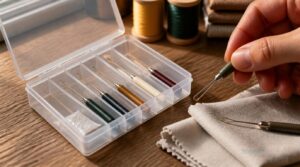
Storing your threaders properly is honestly one of those small habits that saves you real frustration later. Keep them in a rigid, compartmentalized box with a snap lid — humidity below 60% is the sweet spot, so toss in a silica gel pack too.
Three quick rules to live by:
- Wipe with a lint-free cloth after every use
- Apply a light lubricant coat to metal hooks to prevent rust
- Hold by the handle, never the wire loop, during transport
Try Paper-Fold Threading
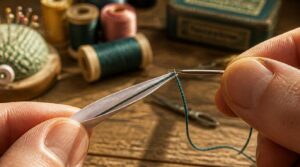
Paper-fold threading is one of those old-school tricks that look almost too simple to work — but it genuinely does, especially when you’re wrestling with a thick needle eye and slippery thread.
The basic idea is that a narrow strip of paper acts like a guide, doing the hard work of steering your thread right where it needs to go.
Here’s exactly how to pull it off.
Cut a Narrow Paper Strip
A narrow paper strip — we’re talking 1 to 5 mm wide — is your best friend here.
Grab a craft knife, a metal ruler, and a cutting mat, and slice lightweight copier paper carefully along a straight edge.
Score the line first, then cut.
Consistent width matters, so take your time.
Fold Paper Over Thread
Folding the paper correctly is where this technique either works or falls apart. Lay your thread along the center of the strip, then fold at a 45-degree angle, creating a clean, tapered crease that acts like a ramp into the needle eye.
- Keep the fold width 2–3 mm
- Use clean, dry hands only
- Crease sharply for stability
- Align fold with eye centerline
Push Through Larger Eyes
Once your paper fold is tight and ready, move in one fluid motion — without hesitating halfway through.
Slide the folded tip straight into the needle eye, using gentle, even pressure. For large-eye needles, this is almost easy.
Before you push, though, quickly run your fingernail around the eye to catch any burrs that could snag your thread.
Remove Paper Gently
Once the thread is through, don’t yank — slow removal matters here. Lift the small piece of paper at a shallow angle and pull it free with a slow, controlled motion. Rushing causes snags.
- Wipe the needle eye with a lint-free cloth
- Check for trapped paper fibers around the eye
- Use a soft brush to clear any fine paper dust
Best Threads for Paper
Not all thread is paper-friendly, so pick wisely.
Cottonized polyester glides through paper cleanly and resists fraying — way better than straight cotton for this job. Waxed cotton grips thick card stock nicely, while nylon monofilament stays nearly invisible on white sheets.
Stick with 40-weight for most paper piece work; it balances visibility and strength without tearing your paper assist technique setup.
Maintain Sewing Machine Threaders

Your sewing machine’s built-in threader is a small miracle — until it isn’t, and suddenly you’re squinting at a bent wire hook wondering what went wrong. Like any mechanical part, it needs a little attention to keep doing its job reliably. Here’s what to stay on top of so it doesn’t let you down mid-project.
Inspect The Tiny Hook
The tiny hook on your machine’s built-in needle threader does a lot of quiet work — and when it starts failing, you’ll feel it immediately.
Run your fingernail lightly across the hook tip; any snag means there’s a burr.
A nicked or visibly bent hook frays thread before it even reaches the eye, so replace it rather than push through the frustration.
Clean Lint Around Needle
Once that hook checks out, look at what’s collecting around it. Lint buildup near the needle causes sluggish threading, especially after knits or fuzzy fabrics.
- Sweep with a soft brush
- Blast gently with compressed air
- Wipe the shaft with a lint-free cloth
Make this part of your regular sewing machine maintenance — every session, honestly, not just when it’s disgusting.
Thread Machine Safely
Before you run a single stitch, power down completely — threading with the machine energized is how accidents happen. Keep hands clear of the needle and presser foot area, and make sure all machine guards are in place.
A loose guard isn’t a minor detail; it’s how fingers meet moving parts. Treat this step like a habit, not a suggestion.
Pull Thread Forward Only
Once the machine’s safely threaded, always pull thread forward only — never tug it backward toward the tension discs. Pulling backward creates slack loops that bunch under the fabric and throw off your stitch rhythm.
A firm, steady forward pull keeps tension consistent, reduces friction at the needle tip, and stops thread breakage before it starts.
Avoid Forcing Stuck Thread
When thread won’t budge, stop pulling and figure out why instead of muscling it through. Forcing it risks thread snap or hidden thread damage that shows up as skipped stitches later.
Check for needle burrs first — they’re a sneaky cause of stuck thread — then look at thread tension control, since tight discs cause just as much resistance as a rough needle eye.
Improve Lighting and Control

Sometimes the smallest tweaks to your setup make threading feel almost smooth, and lighting is where most people leave easy wins on the table. Getting your workspace right — the angle, the brightness, the contrast behind that tiny eye — can cut your frustration in half before you even pick up the thread.
Here are a few simple ways to improve your lighting and control right now.
Add a White Background
Slip a white card or sheet behind your needle eye before threading, and you’ll immediately see what you’ve been missing — literally.
That bright, neutral surface bounces light directly onto the needle, making the tiny eye pop with contrast.
It also shows stray lint at a glance, so your workspace stays clean and your eyes stay relaxed.
Use Directional Task Lighting
Good lighting is one of those things you don’t appreciate until you’re squinting at a needle eye for the third time.
A directional task lamp aimed 30–90 cm above your work delivers concentrated, shadow-free light exactly where you need it. Look for:
- Beam angles of 10–40° for pinpoint focus on fine thread
- CRI 90 or above to distinguish similar thread shades accurately
- 3500K–4500K color temperature for true, fatigue-free visibility
Reduce Glare on Needles
That shiny glint bouncing off your needle isn’t just annoying — it can hide the eye entirely.
Try matte needle finishes or non-reflective materials like bamboo. A diffused lighting setup (light bounced off a wall, not aimed straight on) cuts hot spots fast. Position your task lamp at 45 degrees, and pair it with anti-glare magnification for stubborn cases. These lighting contrast tricks save real frustration.
Use Tweezers for Control
Your fingers are great for a lot of things, but pinching a wisp of thread? Not so much.
Tweezers give you precision grip fingers can’t match — perfect for micro-adjustments at the needle eye.
- Choose anti-static tweezers for synthetic thread
- Use stainless steel for corrosion resistance
- Pick fine, tapered tips for grip
- Go ergonomic to reduce hand fatigue
- Practice steady, gentle squeeze pressure
Keep Tools Within Reach
Think of your sewing space like a cockpit — everything you need, right where your hands naturally fall. Mount a compact tool rack at elbow height, keep a magnetic tray close for pins and needles, and zone your surface so scissors, threaders, and lighting all land within 18 inches.
That kind of setup turns frustrating fumbles into smooth, confident stitching.
Prevent Threading Problems
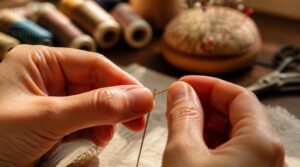
Threading problems don’t always come from bad technique — sometimes it’s just a matter of knowing what to watch for before things go sideways.
A few small habits can save you a lot of frustration, whether you’re dealing with threads that keep shredding or knots that show up out of nowhere.
Here’s what to check when threading starts giving you trouble.
Fix Shredding Thread
Shredding thread is one of those frustrations that can stop a project cold — and it almost always points to something specific in your machine’s path. Check these culprits first:
- Needle eye too small for your thread type or weight
- Burrs on the needle plate snagging fibers mid-stitch
- Dirty tension discs gripping unevenly and fraying thread
- Bobbin case wear disrupting the lower thread loop
- Poor thread quality with visible fuzz along the spool
Re-thread completely, replace the needle, and clean those tension discs.
Stop Thread Tangles
Tangles usually start before you even make a stitch.
If your spool isn’t oriented correctly — horizontal spools should feed horizontally, vertical ones vertically — the thread twists as it unwinds, building slack that knots up fast.
Gently twist out any visible slack before threading, and always anchor your thread end to the spool notch when you’re done.
Avoid Too-long Strands
Once your spool is untwisted, check your strand length. A long tail feels efficient, but it actually causes more snagging, tangling, and uneven tension with every pass through fabric.
Keep strands under 18-24 inches — short enough for steady tension and easy threading, long enough to avoid constant re-threading. Shorter lengths also mean less lint buildup and fewer frayed ends snagging delicate fabric.
Check for Needle Burrs
Here’s something folks skip: actually inspecting the needle tip itself. Hard fabric or pins can raise tiny burrs—rough metal snags that catch thread and cause fraying.
Grab a magnifying loupe, or just tilt the needle under bright light, comparing it to a fresh one. See ridges or metal shavings?
File gently with a fine emery board, or just replace it—better stitch quality beats stubborn frustration.
Retie Loose Knots
A loose knot mid-project is genuinely frustrating — it quietly unravels your work while you’re not looking. When you notice slippage, retie close to the fabric, aligning both thread ends parallel before forming your knot.
- Wet the knot slightly before tightening for better fiber grip
- Pull in small increments to monitor thread tension without snapping
- Use a square knot for cotton threads — reliable and simple
- Add an extra half hitch for knot security on slippery synthetics
- Trim tails close, preventing snagging that loosens the knot
Store Needles and Thread Safely

Threading goes smoother when your tools aren’t fighting rust, moisture, or sun damage before you even pick them up. A little care in how you store your needles and thread saves you from a lot of headaches down the road. Here’s what actually works.
Prevent Needle Rust
A rusty needle will snag fabric and ruin your stitches, so prevent rust before it starts.
Wipe needles dry after use, store in a cool, dry spot with desiccant packets, and avoid plastic bags that trap moisture.
Stainless steel resists corrosion best.
Buff occasionally with a soft cloth, and toss any needle showing rust spots—don’t risk transferring them to your fabric.
Keep Thread Dry
Because damp thread invites mold faster than you’d think, keeping humidity in check matters as much as keeping needles sharp.
Aim for 40-60% relative humidity, toss in silica gel packs, and dry washed thread fully before storing it (silk especially, since heat flattens those fibers).
- Cotton swelling and fraying
- Musty, mildewed spools
- Stiff, brittle linen
Swap desiccants every few months to keep moisture absorption low.
Avoid Direct Sunlight
Sunlight is sneaky—it doesn’t just fade thread, it actually breaks down the fiber bonds holding it together.
| Exposure | Effect | Timeframe |
|---|---|---|
| Direct sun | UV dye fading | Weeks |
| Window light | Brittleness | Months |
| Heat swings | Mold growth | Varies |
Keep spools in shaded, stable spots for real thread longevity.
Use Sealed Spool Boxes
Think of a sealed spool box as a tiny vault for your thread. Airtight seals keep humidity out, and tossing in a desiccant packet locks moisture control in tight.
Modular dividers organize spools by size, which really protects metallic threads from corrosion.
For proper storage that actually works, firm-press that lid until it clicks—that’s your seal engaging.
Label Thread Types Clearly
You know that the "Is this 40 weight or 50 weight?" guessing game? Skip it with clear, consistent labels.
Note thread weight, fiber content (like 60% cotton/40% poly), and dye lot for color matching—mismatched lots ruin projects.
Stick to standard color code families, keep fonts legible, and check for sustainable thread labeling when it matters to you.
Good thread storage and management starts with knowing exactly what’s on the spool.
Frequently Asked Questions (FAQs)
What are common needle threading mistakes?
Most folks mess up with improper angle cuts, frayed tips, or mismatched eye sizes that snag fibers. Add poor lighting and excessive thread length, and you’ve got a recipe for thread breakage—causing tension headaches during any manual threading method.
How do I stop my thread from shredding?
Shredding is thread waving a white flag against friction. Run a needle burr check first, then fix thread tension settings, swap in a wax thread conditioner, and oil your machine—cheap thread breaks down faster under stress.
How often should sewing machines get professional servicing?
Weekly sewers need annual professional servicing; daily use calls for every 6-12 months. Watch for grinding noise, skipped stitches, or timing issues—these maintenance signs mean it’s time for inspection, lubrication, and oil mechanisms checks.
What needle sizes work best for heavyweight fabrics?
Think of your needle like a key — the wrong size won’t turn the lock. For heavyweight fabrics, use 90/14 to 100/16 for denim, 110/18 for leather and upholstery, and 120/19 for dense canvas.
Why buff needle eyes with an emery cushion?
Buffing the needle eye with an emery cushion removes tiny burrs and rust, reducing thread friction and preventing snagging — keeping your eye smooth and your stitches clean.
What humidity level keeps stored thread from weakening?
Ironically, thread doesn’t need much — just 40–60% relative humidity keeps fibers flexible and strong. Above 65% invites mildew; below 30% causes brittleness. Simple, consistent conditions mean dramatically longer thread life.
Conclusion
A thousand threading battles are won or lost before you ever pick up a needle. Every needle threading maintenance tip in this guide strips away one more excuse for frustration—dull needles, frayed ends, bad lighting, damp thread storage.
Fix those, and the whole process quietly shifts. You stop fighting your tools and start actually sewing. Keep your setup clean, your needles sharp, and your thread dry.
Threading becomes the easy part.
- https://tillyandthebuttons.com/blogs/sewing/five-tips-for-threading-sewing-machine
- https://www.bernina.com/en-US/Support-US/The-best-sewing-tips/The-best-tips-tricks-for-sewing/Cleaning-your-sewing-machine
- https://www.trivantage.com/sewing-video-series
- https://www.sewingmachineworld.co.uk/essential-tips-for-sewing-machine-maintenance
- https://abeautifulmess.com/how-to-thread-a-needle-4-easy-ways