This site is supported by our readers. We may earn a commission, at no cost to you, if you purchase through links.
Sewing machines haven’t looked like sewing machines for a while now. The latest computerized models ship with touchscreens that respond in under 20 milliseconds, servo-driven tension systems that adjust mid-stitch, and LED arrays pumping out 1,200 lumens of shadow-free light—engineering you’d expect from a precision lab instrument, not a home workroom.
That shift matters because the machine you choose directly shapes what you can build, how accurately you can build it, and how long the process takes. Whether you’re constructing structured garments, running embroidery files across 5×7-inch fields, or pushing six layers of denim through a heavy-duty frame without a single skip, the hardware doing the work needs to match the ambition behind it.
These ten computerized sewing machines with futuristic design represent the current ceiling—selected for technical specification, build quality, and the kind of programmable control that turns complex projects into repeatable results.
Table Of Contents
- Key Takeaways
- Top 10 Futuristic Computerized Sewing Machines
- 1. Janome Cat Fancy Beginner Sewing Machine
- 2. Brother SE1900 Sewing Embroidery Machine
- 3. Janome JW8100 Computerized Sewing Machine
- 4. Elna eXcellence 580 Computerized Sewing Machine
- 5. Brother CS7000X Computerized Sewing Quilting Machine
- 6. Janome MOD200 Computerized Sewing Machine
- 7. MILLEPUNTI MHP30 Electronic Sewing Machine LCD Display
- 8. Singer Sew Mate 5400 Computerized Sewing Machine
- 9. VEVOR Computerized Heavy Duty Sewing Machine
- 10. Singer Quantum Stylist 9960 Sewing Machine
- Futuristic Features to Prioritize
- Design Elements That Improve Sewing
- How to Choose The Right Model
- Best Uses for Futuristic Machines
- Frequently Asked Questions (FAQs)
- Conclusion
Key Takeaways
- Today’s computerized sewing machines are precision instruments — touchscreens, servo-driven tension, and 1,200-lumen LED arrays — engineered to match serious creative ambition, not just basic stitching needs.
- The machine you choose directly shapes your output: stitch range, fabric compatibility, and programmable control determine what you can build and how consistently you can build it.
- Features that actually move the needle include adaptive thread tension, variable speed control, automatic trimming, and precise needle positioning — not just a high stitch count on the box.
- Matching hardware to workload is the real decision: beginners need guided interfaces and reliability, while advanced sewists need embroidery fields, pattern memory, and heavy-duty frames that don’t flex under pressure.
Top 10 Futuristic Computerized Sewing Machines
The right machine doesn’t just sew — it thinks, adapts, and keeps pace with your vision. In 2026, futuristic computerized sewing machines are redefining what’s possible on the workshop floor.
Whether you’re embroidering, quilting, or tailoring, exploring top computerized sewing machines for every skill level helps you match the right tech to your creative goals.
Here are ten models worth your attention.
1. Janome Cat Fancy Beginner Sewing Machine
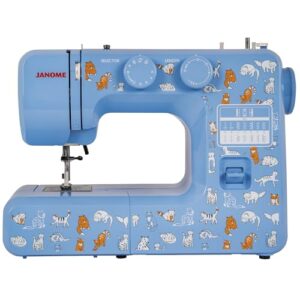
Don’t let the cat-themed exterior fool you — the Janome Cat Fancy means business for anyone starting their sewing journey. Built on a sturdy interior metal frame, it delivers real stability at a compact 12 pounds.
You get 15 built-in stitches, a 4-step buttonhole, and a free-arm design that manages sleeves and hems with ease.
The integrated LED lighting keeps your work area sharp and clear. It’s purpose-built for beginners who want reliable results without the steep learning curve.
| Best For | Beginners who want a reliable, easy-to-use machine for learning sewing basics — from simple garments to light quilting and home decor projects. |
|---|---|
| Built-in Stitches | 15 |
| Machine Weight | 12 lbs |
| Frame Material | Metal |
| Buttonhole Styles | 1 (4-step) |
| Needle Threader | Not specified |
| LCD Display | No |
| Additional Features |
|
- Sturdy metal frame keeps things stable without adding bulk — still just 12 pounds and easy to carry
- 15 built-in stitches plus a free-arm design give you real versatility right out of the box
- Beginner-friendly setup with tutorial videos means you’re not figuring it out alone
- The bold cat-themed look isn’t for everyone and might feel out of place in a more neutral workspace
- The 4-step buttonhole is manual, so it takes a little more patience than an automatic one
- Not built for heavy-duty work — thick leather or stacked denim layers will push it past its limits
2. Brother SE1900 Sewing Embroidery Machine
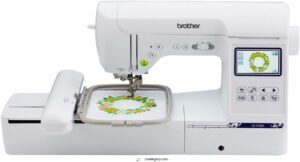
Where the Janome kept things simple, the Brother SE1900 brings serious firepower. This machine bridges sewing and embroidery without compromise — 240 built-in stitches, 138 embroidery designs, and 11 fonts give you impressive creative range.
The 3.2" color LCD touchscreen lets you resize, rotate, and reposition designs before a single stitch drops.
With a 5"x7" embroidery field and USB import support, your customization options don’t stop at what’s built in.
It’s precision-driven versatility, packaged for makers who want full control.
| Best For | Makers and hobbyists who want a true all-in-one machine for embroidery, monogramming, quilting, and custom sewing projects. |
|---|---|
| Built-in Stitches | 240 |
| Machine Weight | 22.05 lbs |
| Frame Material | Metal |
| Buttonhole Styles | 10 auto-size |
| Needle Threader | Automatic |
| LCD Display | 3.2″ color touchscreen |
| Additional Features |
|
- Huge creative range with 240 stitches, 138 embroidery designs, and 11 fonts built right in
- The 5"x7" embroidery field handles bigger projects without constant rehooping
- USB import and the touchscreen preview make customization genuinely easy to use
- Large thread spools need a separate spindle holder, which is an annoying extra purchase
- Only works on 120V US power — not a travel-friendly machine
- Some useful add-ons like the extension table and magnetic hoop cost extra
3. Janome JW8100 Computerized Sewing Machine
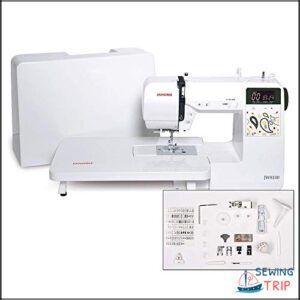
If the Brother SE1900 is your creative powerhouse, the Janome JW8100 is your precision workhorse.
It won’t dazzle you with embroidery features, but it earns its place with 100 built-in stitches, a clean LCD interface, and a 7-piece feed dog system that keeps even stubborn fabrics moving smoothly.
The speed control slider and start/stop button give you real command over every seam.
At 12 pounds and $369, it’s a compact, metal-framed machine built for sewists who value control over complexity.
| Best For | Sewists who want reliable, precise stitching for quilting, garment-making, and heavy fabrics without the learning curve of embroidery machines. |
|---|---|
| Built-in Stitches | 100 |
| Machine Weight | 12 lbs |
| Frame Material | Metal |
| Buttonhole Styles | 7 one-step |
| Needle Threader | Built-in |
| LCD Display | Yes |
| Additional Features |
|
- 100 built-in stitches and 7 one-step buttonholes give you plenty of variety for everyday and specialty projects
- The 7-piece feed dog system handles thick, stubborn fabrics like denim with ease and keeps seams consistent
- Quilting-ready out of the box — comes with an extension table, even feed foot, and ¼" quilting foot
- Limited needle clearance means bulky projects like thick jackets or chunky quilts may need some manual fussing
- A few decorative stitches (like the star pattern) don’t always form cleanly, according to user feedback
- The light isn’t dimmable, which can be a small annoyance if you like adjusting brightness to your workspace
4. Elna eXcellence 580 Computerized Sewing Machine
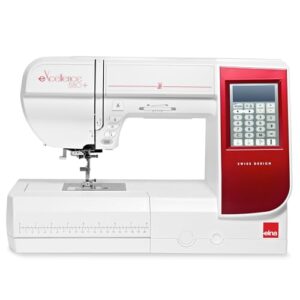
Where the JW8100 keeps things lean, the Elna premium 580 turns up the sophistication.
You get 120 built-in stitches, 15 needle settings, and an 8.2-inch extended workspace — enough room to handle quilts without wrestling your fabric off the edge.
LCD touch panel and four-LED lighting system make precision feel easy, even during long sessions.
At 820 stitches per minute with automatic thread tension and a built-in cutter, the 580 doesn’t just sew — it performs.
| Best For | Intermediate to advanced sewists who want a feature-rich machine for quilting, garment-making, and home decor projects without going fully industrial. |
|---|---|
| Built-in Stitches | 120 |
| Machine Weight | 21.6 lbs |
| Frame Material | Metal/Plastic |
| Buttonhole Styles | 7 one-step |
| Needle Threader | Automatic |
| LCD Display | Yes |
| Additional Features |
|
- 120 built-in stitches and 13 presser feet give you serious versatility right out of the box
- The 8.2-inch extended workspace makes handling big projects like quilts way less frustrating
- Automatic threading, one-step buttonholes, and adjustable speed keep the workflow smooth and efficient
- At 21.6 lbs, it’s not something you’re throwing in a bag for a sewing class
- The $709 price tag is a tough sell for casual sewists or beginners still figuring things out
- The 7 mm stitch width caps your options if you’re into wider decorative stitches
5. Brother CS7000X Computerized Sewing Quilting Machine
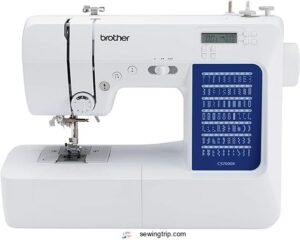
Seventy built-in stitches, a drop-in bobbin that resists jams, and an automatic needle threader — the Brother CS7000X packs serious capability into a $279.99 package.
It holds up well in real-world use too — see how it compares against other top picks in this roundup of best sewing machines for every skill level.
Its metal frame keeps vibration minimal during dense quilting passes, while the detachable wide table gives you the breathing room that bulky projects demand.
You get hands-free control via on-machine start/stop buttons, variable speed up to 750 SPM, and a protective hard case for portability.
For quilters who want reliability without complexity, this machine delivers.
| Best For | Quilters and home sewers who want a reliable, feature-packed machine without a steep learning curve. |
|---|---|
| Built-in Stitches | 70 |
| Machine Weight | 14 lbs |
| Frame Material | Metal |
| Buttonhole Styles | 7 one-step |
| Needle Threader | Automatic |
| LCD Display | Yes |
| Additional Features |
|
- Automatic needle threader and jam-resistant drop-in bobbin make setup quick and frustration-free
- Sturdy metal frame keeps stitching smooth and consistent, even through thick fabrics like denim or quilt layers
- Detachable wide table and free arm give you flexibility for both large projects and small, fiddly items
- Only works with US voltage (120V), so international users need an adapter or transformer
- No built-in embroidery — if that’s on your wish list, you’ll need a different machine
- At 14 lbs, it’s not the lightest option if you’re hauling it to sewing classes regularly
6. Janome MOD200 Computerized Sewing Machine
Two hundred built-in stitches, a 7mm stitch width, and 12 one-step buttonholes — the Janome MOD200 doesn’t just check boxes, it redefines what a mid-range computerized machine can do.
Its aluminum interior frame keeps stitching stable at speed, while the backlit LCD and memory function let you save and recall preferred settings instantly.
At 12.7 pounds with a hard cover included, it’s portable enough for classes yet capable enough for garments, quilts, and precision edgework. Reliable, refined, and ready to work.
| Best For | Sewists of all skill levels who want a reliable, feature-packed machine for garments, quilting, and detailed edgework — and appreciate something portable enough to take to a class. |
|---|---|
| Built-in Stitches | 200 |
| Machine Weight | 12 lbs |
| Frame Material | Metal |
| Buttonhole Styles | 12 one-step |
| Needle Threader | One-hand |
| LCD Display | Backlit LCD |
| Additional Features |
|
- 200 built-in stitches with a memory function means you’re not re-dialing settings every time you sit down
- The one-hand needle threader, backlit LCD, and start/stop button make it genuinely easy to use, not just "easy" in the marketing sense
- At 12 pounds with a hard cover included, it travels well without feeling flimsy
- Motor repairs can get pricey, and they may not be covered under the 25-year warranty — worth knowing upfront
- No built-in embroidery, so if that’s on your wish list, you’ll need a separate machine
- There are some durability questions — at least one user reported motor failure after about three years of moderate use
7. MILLEPUNTI MHP30 Electronic Sewing Machine LCD Display
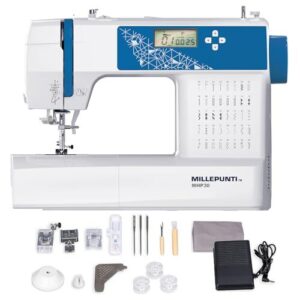
Don’t let the compact size fool you — the MILLEPUNTI MHP30 packs real capability into a 15.78-pound metal-frame body. Its LCD display gives you instant readouts on stitch type, width, length, needle position, and presser foot recommendations, so you’re never guessing mid-project.
Forty built-in stitches cover utility, stretch, and decorative needs, while the automatic needle threader and drop-in bobbin system cut setup time dramatically.
It’s beginner-accessible without feeling limited, though durability and speed constraints are worth weighing before committing.
| Best For | Beginners and casual sewers who want a reliable, easy-to-use machine for everyday projects like garments, home decor, and light repairs. |
|---|---|
| Built-in Stitches | 40 |
| Machine Weight | 15.78 lbs |
| Frame Material | Metal |
| Buttonhole Styles | 1-step |
| Needle Threader | Automatic |
| LCD Display | Yes |
| Additional Features |
|
- The LCD display takes the guesswork out of stitch selection — width, length, and foot recommendations are right there at a glance.
- Automatic needle threader and drop-in bobbin make setup quick and painless, even if you’re just starting out.
- Forty built-in stitches cover a solid range of needs, from basic utility to decorative work, without feeling overwhelming.
- Durability is a real concern — motor failures within two years have been reported, and repair support is limited.
- Speed isn’t adjustable, and it runs slower than a lot of competitors in the same price range.
- The included needle (90/14) skews heavy — if you’re working with lighter fabrics, you’ll need to buy additional sizes separately.
8. Singer Sew Mate 5400 Computerized Sewing Machine
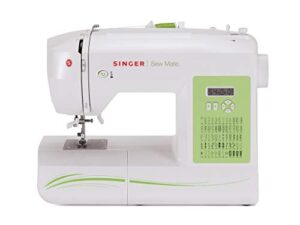
Singer’s Sew Mate 5400 is where reliability meets programmability without overcomplicating your workflow.
Its LCD display gives you real-time control over 60 built-in stitches and 154 stitch applications — covering everything from basic utility work to stretch and decorative options.
Four automatic one-step buttonhole styles, adjustable stitch length and width up to 7mm, and built-in LED lighting make precision feel easy.
The heavy-duty metal frame supports denim and multi-layer fabrics without flexing.
It’s a dependable workhorse, especially if you want consistent output on a compact, cost-effective platform.
| Best For | Beginners and home sewers who want a reliable, feature-packed machine without a steep learning curve. |
|---|---|
| Built-in Stitches | 60 |
| Machine Weight | 13 lbs |
| Frame Material | Metal |
| Buttonhole Styles | 4 one-step |
| Needle Threader | Built-in |
| LCD Display | No |
| Additional Features |
|
- 60 built-in stitches and 154 stitch applications give you plenty of variety for everyday and creative projects
- One-step buttonhole styles and adjustable stitch settings make precision work surprisingly straightforward
- Compact, lightweight, and quiet — a solid fit for home setups where space matters
- Front-loading bobbin can be a bit of an adjustment if you’re used to top-loading machines
- Refurbished units come with some risk — a small number of buyers have reported receiving units with defects
- Stitch consistency and initial setup have gotten mixed reviews from some users
9. VEVOR Computerized Heavy Duty Sewing Machine
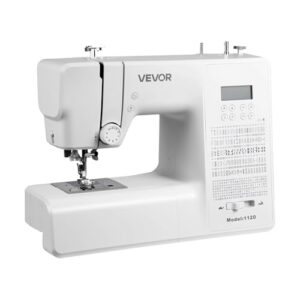
When raw power meets programmability, you get a machine that doesn’t flinch. The VEVOR Computerized Heavy Duty Sewing Machine is built around a sturdy metal frame and a motor calibrated to drive through up to six layers of denim without hesitation.
Its built-in stitch library, LED-lit workspace, and automatic needle threading keep your workflow tight and efficient.
The free-arm configuration manages cuffs and cylindrical projects with ease — making it a serious contender for workshop environments demanding consistency and durability.
| Best For | Sewers of all skill levels who need a versatile, heavy-duty machine that can handle everything from delicate chiffon to thick denim without breaking a sweat. |
|---|---|
| Built-in Stitches | 200 |
| Machine Weight | 11 lbs |
| Frame Material | Metal internal |
| Buttonhole Styles | 8 one-step |
| Needle Threader | Automatic |
| LCD Display | Yes |
| Additional Features |
|
- Punches through up to six layers of denim thanks to a powerful motor and solid metal frame
- 200 built-in stitches plus an LCD display make it easy to dial in exactly what you need
- Automatic needle threader and LED lighting keep things moving without the eye strain
- The plastic exterior feels a little flimsy for a machine marketed as heavy-duty
- Some users find the threading process trickier than expected despite the auto-threader
- Manual inconsistencies — like wrong model info or non-English instructions — can make setup frustrating
10. Singer Quantum Stylist 9960 Sewing Machine
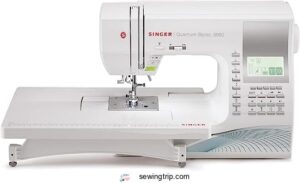
Six hundred built-in stitches, 13 automatic buttonhole styles, and a heavy-duty metal frame — the Singer Quantum Stylist 9960 isn’t just feature-rich, it’s engineered for sewists who demand precision without compromise.
At 850 stitches per minute, you can power through long curtain seams or slow down for intricate decorative work.
The large backlit LCD, automatic needle threader, and one-touch thread cutter keep your workflow clean and efficient.
For $540.99, it delivers professional-grade programmability that punches well above its price point.
| Best For | Intermediate to advanced sewists who want a versatile, feature-packed machine for quilting, garment sewing, and decorative projects without jumping to an embroidery-specific model. |
|---|---|
| Built-in Stitches | 600 |
| Machine Weight | 14.6 lbs |
| Frame Material | Metal/Plastic |
| Buttonhole Styles | 13 automatic |
| Needle Threader | Automatic |
| LCD Display | Yes |
| Additional Features |
|
- 600 stitch types and 1,172 stitch applications give you serious creative range, from basic seams to decorative quilting and monogramming
- Automatic needle threader, top-drop bobbin, and built-in thread cutter make setup and finishing genuinely faster
- Handles heavy, multi-layer fabrics well — great for rag quilts, upholstery, and thick seams without skipping
- The throat space is on the smaller side, which can get frustrating when you’re wrestling a large quilt through
- Beginners may feel overwhelmed by the sheer number of options and features right out of the box
- The 90-day limited warranty feels short given the $540.99 price tag — you’ll want to register carefully to lock in the longer guarantees
Futuristic Features to Prioritize
Not every feature on a spec sheet is worth your attention — but some genuinely change how you work.
The right machine puts precision, creativity, and control directly in your hands through technology that actually earns its place.
Here’s what to look for.
LCD and Touchscreen Control Panels
Your interface is your command center — and today’s LCD display and touchscreen interfaces deliver real control. Screen Resolution reaches 1024×600 pixels, while Touch Sensitivity stays under 20ms latency. Key capabilities include:
- Stylus Integration for precise embroidery placement
- Glare Reduction via anti-glare coatings
- Firmware Updates pushed wirelessly
- Modern User Interface with drag-and-drop editing
- ComputerControlled Sewing through Machine Programmability
uniform backlight for consistency ensures even illumination across the screen, enhancing visibility during detailed stitching.
Built-in Stitches and Pattern Memory
Once your screen’s dialed in, the real power shifts to what your machine already knows.
Built-in stitches covering straight, zigzag, satin, and decorative motifs give you an instant Custom Stitch Programming foundation.
Pattern Storage and Customization let you save up to 100 user-defined sequences, while Cloud Pattern Sync and Memory Recall Speed keep your workflow uninterrupted across sessions — that’s ComputerControlled Sewing working exactly as it should.
Automatic Thread Tension and Trimming
Pattern memory sets the stage — but thread tension determines whether those patterns actually hold.
Adaptive Tension Feedback and Servo-driven Tension Control work together through micro-incremental adjustments each stitch cycle, while Tension Sensor Integration monitors fabric thickness in real time. Real-time Trim Calibration cuts both threads within 0.15 seconds, driving Thread Waste Reduction across production runs.
What this means for you:
- Cleaner seams without manual re-tensioning between fabric types
- Automatic needle threader readiness maintained throughout uninterrupted sessions
- AI in Sewing Automation flags tension drift before defects appear
Adjustable Speed and Precision Controls
Thread tension keeps your stitches honest — but speed control keeps your work in command.
Variable Speed Profiles let you lock exact RPM targets for satin fills or bartack runs, while Closed-Loop Feedback corrects drift in real time.
Thread Tension Sync adjusts feed rates automatically, and Real-Time RPM Display keeps you informed.
Precision Mode Settings on Programmable Sewing Machines deliver Speed and Efficiency without guesswork.
Needle Positioning and Error Reduction
Even a fraction of a millimeter off can unravel your entire design.
That’s why Precise Needle Positioning — backed by Electromagnetic Tracking and Real-Time Pose Correction — reduces tip error to under 2.5mm.
Fiducial Calibration and Image-Guided Navigation align every insertion with your programmed path, while Steerable Needle Design and Automated Stitch Regulation eliminate drift.
The result: Quality Control Automation and Precision Engineering working through Predictive Maintenance Systems.
Embroidery, Quilting, and Decorative Modes
Mastering decorative work means having the right tools already built in. Today’s computerized sewing machines deliver embroidery capabilities that handle everything from satin stitch fills to French knots with programmable precision.
You can layer applique techniques — including layered applique and fusible methods — directly into quilt blocks, while metallic threads catch light exactly where you intend. Modern sewing technologies make decorative stitches less guesswork, more intention.
Design Elements That Improve Sewing
machine’s design isn’t just about looks — it directly shapes how well you sew. From workspace size to frame stability, every physical detail either helps or gets in your way.
Here are the design elements that actually make a difference.
Sleek Modern Machine Styling
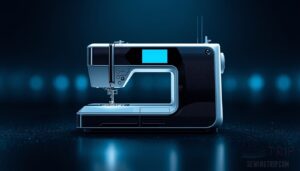
Today’s smart sewing machines don’t just perform — they make a statement.
Matte gloss contrast casings, hidden hinges, and sculpted ribbing strip away visual clutter, leaving clean, purposeful silhouettes. Monochrome metallic finishes and carbon fiber accents signal precision before you’ve sewn a single stitch.
Matte finishes, hidden hinges, and carbon fiber accents signal precision before you’ve sewn a single stitch
Paired with sophisticated user interfaces and modular design, these machines reflect where fashion technology trends are heading — where form and function genuinely can’t be separated.
LED-lit Sewing Areas
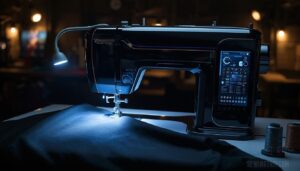
Poor lighting kills precision — and that’s not an exaggeration.
Modern machines now integrate Smart Light Integration with Adjustable Light Arms that shift to follow your fabric edge, delivering 600–1,200 lumens directly at the needle plate.
Energy Efficient LEDs run cool, under 15 watts, preserving thread integrity. Shadow Reduction Techniques paired with Color Temperature Settings guarantee your LCD display and sophisticated user interface reveal every stitch, clearly.
Wide Workspaces for Large Projects
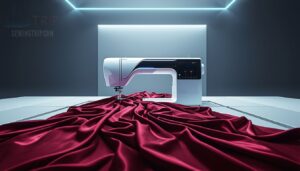
Large projects demand room to breathe. An Extended Throat Area measuring 12 by 8 inches keeps bulky quilts and fabric panels moving freely, while Modular Table Extensions expand your total working width to 40 inches.
Adjustable Height Stands let you dial in comfort between 28 and 36 inches, and Fabric Guide Rulers aligned to 24 inches guarantee every seam lands exactly where you need it.
Intuitive Button Layouts and Navigation
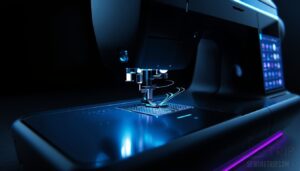
Every button on a futuristic machine should feel like it belongs exactly where it belongs.
With Color Coded Controls and Haptic Feedback confirming each press, you won’t second-guess your selections mid-sequence.
The Enhanced User Interface pairs Live Highlighting with Contextual Tooltips, while Customizable Shortcuts and software compatibility keep your workflow personal and efficient.
- Primary actions cluster right for instant reach
- Customizable stitches preview as visual thumbnails before selection
- LCD display menus stay consistent across all navigation paths
- Disabled options gray out automatically, preventing costly errors
Compact Bodies With Premium Finishes
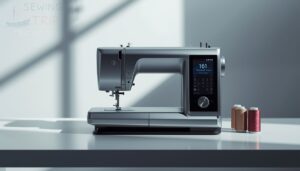
Premium Material Choices shape how a machine feels before you even thread it. Stainless steel panels with Finger-Resistant Finishes keep computerized sewing machines looking sharp session after session, while powder-coated aluminum frames absorb workshop wear without showing it.
Space-Saving Engineering keeps widths under 17 inches — real ergonomic portability without sacrificing workspace. Minimalist Aesthetic Design signals the high-quality materials and modern user interface inside, giving your custom designs the creative freedom they deserve.
Stable Frames for Smoother Stitching
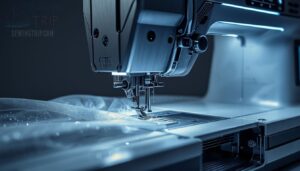
A sleek finish means nothing if the frame underneath flexes mid-run.
That’s where Frame Rigidity and Torsional Stiffness become your real performance drivers — aluminum and steel assemblies deliver up to 25% greater rigidity than plastic, keeping Precision Alignment locked across every stitch.
Vibration Damping mounts cut resonance by 40%, so Material Reinforcement and precision engineering applications translate directly into consistent stitch regulation you can actually count on.
How to Choose The Right Model
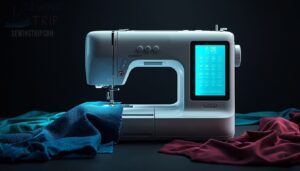
Picking the right computerized sewing machine isn’t just about specs — it’s about finding the one that actually fits how you work.
The wrong choice can slow you down, while the right one makes every project feel smooth.
Here’s what to think about before you commit.
Beginner-friendly Versus Advanced Interfaces
Choosing between a beginner-friendly and an enhanced user interface shapes your entire sewing experience.
Beginner-friendly layouts simplify the learning curve with larger icons, guided onboarding, and straightforward error handling — so you’re not drowning in options on day one.
Enhanced user interfaces enable full customization options, detailed dashboards, and precision controls.
Match the interface design to where you’re now, not where you hope to be.
Sewing-only Versus Embroidery Capability
Once you’ve matched interface to your skill level, the next question is scope: what do you actually need this machine to do?
Sewing-only computerized sewing machines handle seams, construction, and functional stitches with solid sewing efficiency — no Hoop Requirements, no Software Complexity.
Add embroidery capabilities, and you’re managing digitized patterns, Color Change Mechanisms, Thread Management systems, and higher Maintenance Frequency.
Modern sewing technologies don’t come free — match the capability to your real workload.
Stitch Variety and Customization Options
Stitch variety is where computerized sewing machines reveal their true range. You’re not just picking a pattern — you’re controlling Satin Stitch Density, Zigzag Width Control, and Applique Edge Lock precision from a single interface.
Add Metallic Thread Effects, AI Pattern Generation, and Programmable Stitching, and your Custom Designs scale fast. The right Stitch Patterns don’t limit you — they multiply what you can build.
Fabric Compatibility and Power
Not every machine processes every material equally. Canvas and webbing demand higher Torque Requirements and slower speeds to prevent skipped stitches, while knits need precise Thread Tension Calibration to stay smooth.
Look for Fabric Sensor Integration that auto-detects multiple layers of fabric and verify Voltage Compatibility for your region. Strong Power Consumption Metrics signal a machine built for both delicate and demanding fabric types.
Portability, Size, and Storage Needs
If you move between studios, workshops, or job sites, machine footprint matters as much as feature count. A lightweight chassis under 5 kilograms with an integrated accessory tray and compact storage case keeps your setup tight and travel-ready.
Foldable workbench surfaces slim the profile further, while travel-friendly power adapters covering 100–240V handle any outlet.
project size compatibility to your workspace before committing.
Budget, Warranty, and Included Accessories
Price doesn’t tell the whole story — what’s in the box does.
- Budget-friendly pricing starts around entry-level, with accessory bundles including 5 thread spools, 4 presser feet, and spare needles
- Warranty coverage generally runs 1 year on mechanical parts
- Extended service plans add 2–3 years for roughly $20–$100
- Cost-effective packages often include bobbins, dust covers, and cleaning tools
- Accessories included directly affect durability and versatility long-term
Best Uses for Futuristic Machines
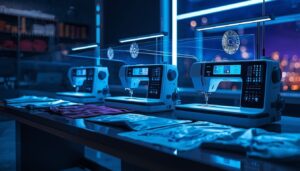
Futuristic sewing machines aren’t just about looks — they’re built to handle real work across a surprisingly wide range of projects.
Whether you’re tailoring garments, stitching through heavy canvas, or crafting intricate embroidery, the right machine makes the difference between frustration and ease. Here’s where these computerized powerhouses truly shine.
Fashion Sewing and Garment Alterations
Fashion sewing demands more than creativity — it demands control. Computerized sewing machines give you that edge through precise Fit Assessment, automated Seam Reinforcement, and programmable stitch settings that support complex garment construction.
Whether you’re adjusting Fabric Stretch in knits or refining Pattern Drafting for custom silhouettes, modern sewing technologies handle the technical load.
Smart sewing machines turn fashion design ambitions into consistent, professional results.
Quilting With Programmable Stitches
Quilting becomes a precision discipline when you pair it with programmable stitches.
Computerized sewing machines let you apply Pattern Scaling Techniques and Multi-Point Alignment to lock designs perfectly across each block.
Stitch Density Optimization adapts automatically as fabric thickness shifts, while Real-Time Error Correction and Hybrid 3D Stitching keep every pass consistent.
These sophisticated sewing features and customizable tools make smart sewing machines indispensable for serious quilting work.
Embroidery and Monogram Projects
Embroidery and monogram work demand the same disciplined precision you’ve applied to quilting — just with sharper personalization goals. Computerized sewing machines deliver embroidery capabilities that transform initials into refined statements through Font Digitization Tips, Stitch Density Optimization, and Stabilizer Selection Guide protocols built into your workflow:
- Apply Placement Measurement Templates for consistent centering across garment runs
- Use Color Contrast Strategies to distinguish center initials from flanking letters
- Leverage pattern storage and customization to recall and repeat approved designs instantly
- Activate AI-powered capabilities for real-time tension correction on delicate fabrics
- Upload custom embroidery design files directly through built-in WiFi connectivity
Home Décor and Craft Sewing
Home décor sewing is where personalization really takes over. Computerized machines handle everything from Wall Fabric Art panels, Table Runner Styling, Curtain Fabric Innovation, and DIY Upholstery Hacks with programmable precision.
Want Pillow Embroidery Trends stitched consistently across twenty cushion covers? Pattern memory makes that repeatable.
For home sewing and creative crafting, these machines don’t just assist — they execute your vision exactly.
Precision Sewing for Delicate Fabrics
Delicate fabrics demand a different kind of control. Silk, chiffon, and organza won’t forgive guesswork — that’s where computerized sewing machines earn their place.
Fine Needle Selection, Low Tension Settings, and smart Thread Choice eliminate puckering before it starts. Pair those with Stabilizer Techniques and precision engineering applications, and your fabric handling becomes surgical.
Modern sewing technologies even automate Pressing Methods, protecting fibers throughout.
Heavy-duty Projects With Thicker Materials
From silk to sailcloth — your machine doesn’t flinch.
Futuristic computerized sewing machines handle Heavy Materials with the same confidence you’d expect from industrial-grade equipment.
High-Load Stitching, Heavy-Duty Chassis construction, and Industrial Material Feeding systems power through webbing, canvas, and layered denim without skipping a beat.
Modern Sewing Technologies automate tension and speed, so Heavy Material Processing stays consistent — even when the project gets demanding.
Frequently Asked Questions (FAQs)
Are computerized sewing machines worth it?
Yes — absolutely. The productivity gains, automation of repetitive tasks, and AI-powered capabilities deliver real cost efficiency over time.
With minimal maintenance requirements and an easy-to-use user interface, the long-term durability justifies every dollar spent.
What is the disadvantages of computerized sewing machine?
Computerized sewing machines carry a High Upfront Cost, Complex Repair needs, Power Dependence, and a Steep Learning Curve.
Technical Glitches, machine maintenance demands, and warranty and support limitations can challenge even experienced users.
Is there an automated sewing machine?
Absolutely — automated sewing machines exist and are more capable than ever.
Today’s smart sewing machines leverage AI-powered capabilities, machine vision integration, and IoT technology to handle stitching, feeding, and trimming autonomously with impressive precision.
How long will a Computerised sewing machine last?
Built to endure or destined to expire — it depends on you.
With proper Sewing Machine Maintenance, metal frame longevity pushes 25 years, though software obsolescence risks and component wear rates may shorten that timeline.
How do computerized machines handle unconventional fabrics?
Through Fabric Sensor Calibration and Smart Tension Control, these machines detect stretch, drape, and thickness automatically.
Variable Feed Rate and Adaptive Needle Selection then adjust in real time, keeping seams clean across silk, denim, or multiple layers of fabric.
Are there subscription services for premium sewing features?
Yes, some smart sewing machines offer subscription pricing tiers unlocking cloud pattern libraries, monthly stitch updates, premium firmware access, and exclusive design collections — generally ranging from $5 to $25 monthly.
Can computerized sewing machines connect to design software?
Most modern computerized sewing machines connect directly to design software via USB or wireless design transfer, enabling real-time stitch preview, cloud pattern sync, and firmware compatibility updates that keep your workflow sharp and future-ready.
How do smart sensors detect and adapt to fabric?
Think of it like a second skin that listens.
Conductive yarn sensors and piezoresistive fiber detect stretch, moisture, and pressure in real-time, while nanocoating sensitivity captures micro-changes, triggering real-time tension adjustment automatically.
Are firmware updates available for older machine models?
Some manufacturers do offer firmware updates for older models through official support portals, but Legacy Model Support varies.
Always verify Update Compatibility Checks against your exact model number before downloading anything.
Do these machines support multi-language interface settings?
Most of these machines do support multi-language interface settings, with options covering English, Spanish, French, and German.
Firmware Language Support lets you access additional Language Pack Updates, while Localized Error Messages guarantee clarity across languages.
Conclusion
Like Edison’s lab, where invention demanded the right instrument before the right idea could take shape, your next project deserves hardware that keeps pace with your vision. The computerized sewing machines with futuristic design reviewed here don’t just execute stitches—they translate precision into repeatability, control into confidence, and ambition into finished work.
Choose the model that matches your output demands, and the machine won’t just support your craft. It’ll accelerate it.