This site is supported by our readers. We may earn a commission, at no cost to you, if you purchase through links.
A sewing table the size of a closet door shouldn’t stop you from cutting clean, accurate pieces. Yet that’s the reality for most sewists—a folded card table, a kitchen counter, maybe a spare corner of a bedroom floor. Pins distort bias-cut fabric and leave holes in delicate chiffon. Pattern weights for small sewing spaces solve both problems without demanding room you don’t have.
The key is choosing weights that do more with less. Flat platelet weights sit flush against fabric without rolling off edges. Glass and steel-fill options pack dense hold into a footprint smaller than a quarter. Stack them, bag them, hang them on a pegboard—they disappear when you’re done.
Right shape, right material, right storage system. That’s the whole equation.
Table Of Contents
Key Takeaways
- Flat, low-profile pattern weights under 1 oz eliminate the need for pins on delicate fabrics like silk and chiffon while taking up almost no cutting table space.
- Distributing several small weights (2–5 grams each) at corners and every 6–8 inches along edges gives you cleaner cuts and better grain control than one heavy weight ever can.
- Material and surface finish matter as much as weight—silicone-coated or glass weights with smooth, non-porous finishes protect delicate fabrics while staying easy to reposition quickly.
- Smart vertical storage—pegboards, hanging drawstring bags, or stackable labeled trays—keeps your weights instantly accessible without surrendering any of your already-limited workspace.
Choosing Compact Pattern Weights
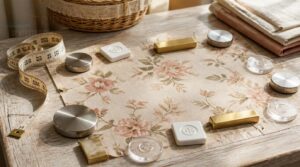
Picking the right pattern weights for a small space comes down to more than just weight — shape, material, and size all affect how well they work without taking over your workspace. Not every weight works with every fabric or fits neatly into a cramped cutting table setup. Here’s what to look for before you buy.
A deeper look at pattern weights for quilting can help you match the right style and material to your specific fabrics and workflow.
Low-profile Weight Shapes
Shape is everything in a tight workspace. Flat platelet weights hug your cutting surface without protrusion, keeping your hands and rotary cutter moving freely. Their low-profile geometry centers mass at a stable point — no wobble, no drift.
Sizes usually run 1 mg to 500 mg, so you get precise control without bulk. Less weight on the table means more room to work.
Best Materials for Storage
Material matters as much as shape when weights go back into your sewing kit. High-density polyethylene boxes resist moisture and handle temperatures from -20 to 60°C — reliable on any sewing table through every season. UV-resistant finishes prevent yellowing near sunlit windows.
For glass weights specifically, PVC-coated dividers stop chipping during storage.
Fabric-safe Smooth Finishes
Once you’ve sorted storage materials, the weight’s surface becomes the next variable worth controlling.
Silicone-coated and calendering-finished weights glide without snagging silk or satin. Low-friction surfaces stay smooth after repeated use.
- Silicone films preserve drape on delicate fabrics
- Calendered finishes reduce surface fuzz transfer
- Hypoallergenic coatings suit sensitive-skin sewists
- Scratch-resistant glass weights protect fine filaments
- Smooth, rounded edges prevent pressure marks on chiffon
Weight Size Versus Control
Smooth finishes handle surface contact — but size determines control.
A 3-gram weight holds most light-to-medium fabrics flat without bulk. For corner stability, skip one heavy unit. Multiple small weights at each corner distribute pressure evenly, keeping grain straight and edges flush.
Distributed pressure beats concentrated force every time. Less shifting. Cleaner cuts. Better sewing efficiency across the whole layout.
Distributed pressure beats concentrated force: less shifting, cleaner cuts, better results
Avoiding Bulky Sewing Tools
Bulky sewing tools eat workspace fast. A heavy pincushion, wide clamps, or thick pin containers crowd your cutting mat before you’ve even unrolled the fabric.
Slim profile weights — under 1 oz, 1–1.5 cm thick — replace all of that. Fewer sewing accessories on the table means cleaner sightlines, faster adjustments, and a leaner sewing kit that actually fits your space.
Using Weights in Small Spaces
Working in a tight space means every move counts, and how you place your weights makes all the difference. Get the technique right and your patterns stay put, your cuts stay clean, and your workflow doesn’t fight you. Here’s how to use pattern weights effectively when space is at a premium.
Pairing smart weight placement with a compact, quilter-friendly ironing board keeps your workspace organized and your pressing station within easy reach without crowding your cutting area.
Anchor Pattern Corners First
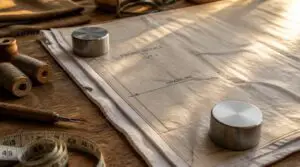
Start with the corners — always. Place your top left corner first, aligning it to the pattern centerline. Then secure the bottom right corner diagonally across. This creates a reference frame that locks in your grainline before anything shifts.
Skipping this step invites fabric drift. With corner alignment confirmed, every subsequent weight placement becomes faster and your cutting precision stays reliable.
Space Weights Every Edge
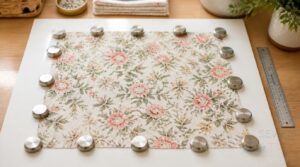
Once corners are locked, long edges need attention. Space weights every 6 to 8 inches along each side to prevent edge curl and stop fabric shifting mid-cut.
Non-slip coatings reduce movement by at least 40 percent on slippery fabrics, keeping uniform pressure distribution consistent from edge to edge. Skip a gap, and your cutting precision pays the price.
Use Several Small Weights
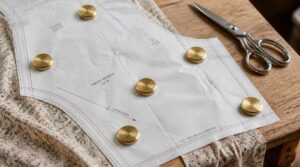
One heavy weight jammed into a tight space does more harm than good. Several small weights — each 2 to 5 grams — give you real maneuverability in tight spaces without crowding the pattern.
Spread them across the piece and you’re managing bias drape, reducing pattern drift, and keeping fabric pattern weights working with your layout, not against it.
Stabilize Slippery Fabrics

Slippery fabrics — chiffon, silk, satin — shift the moment your rotary cutter moves. Before placing weights, hit the fabric with a light spray starch to give fibers temporary grip. It washes out clean.
Then layer your weights over smooth, cotton-covered surfaces to hold without snagging. Silk pins along curved edges stop creep between weight placements.
Support Rotary Cutting Accuracy
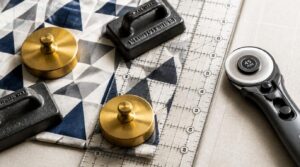
Maintaining fabric flatness is what separates a clean cut from a wavy edge.
Without consistent pressure, even a sharp rotary blade drifts. Pattern weights lock the ruler and fabric together — reducing ruler drift before it starts.
Keep these in mind for cutting accuracy:
- Place weights flush against the ruler edge
- Recheck for lint or residue affecting grip
- Space weights to prevent fabric drift mid-cut
- Apply consistent pressure along the full cutting line
- Inspect weight surfaces regularly to minimize cutting miscuts
Top 5 Pattern Weights for Small Spaces
Not every pattern weight earns a spot in a small sewing space — the right one has to work hard without taking up room. These five options stand out for their size, fabric compatibility, and how easily they fit into a compact setup. Here’s what’s worth your attention.
1. Wisemen Glass Pattern Weights
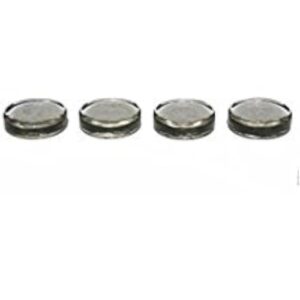
The Wisemen Glass Pattern Weights are a quiet workhorse for compact sewing setups. Each lead-free, food-grade glass disc weighs roughly 5.5 oz and measures about 2¾ inches across — substantial enough to hold medium-weight fabrics flat without pinning.
The transparent surface lets you confirm pattern alignment at a glance. That’s a real advantage when matching plaids or prints. Their ultra-smooth, non-porous finish won’t snag silk or satin. One caution: they’re too light for denim or canvas.
| Best For | Sewists and crafters working with delicate fabrics like silk or satin who want a pin-free way to hold patterns in place. |
|---|---|
| Material | Glass (lead-free) |
| Quantity | 4 pieces |
| Weight Per Piece | ~5.5 oz |
| Shape | Round disc |
| Surface Finish | Smooth, transparent |
| Breakage Risk | High (glass) |
| Additional Features |
|
- Transparent glass lets you see your pattern placement clearly, making it easy to match plaids or prints
- Ultra-smooth, non-porous surface won’t snag or damage delicate materials
- Lead-free, food-grade glass construction means they’re safe to handle and built to a high material standard
- Too light to hold heavy fabrics like denim or canvas in place
- Glass can break if dropped or mishandled, so they require careful storage
- The 2¾-inch size may feel larger than expected, which could be awkward in tight cutting spaces
2. Quilted Bear Pattern Weights
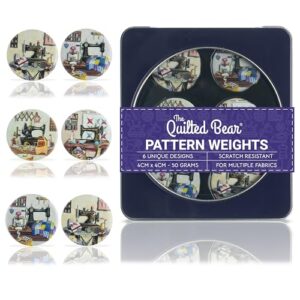
Where the Wisemen weights lean on glass, the Quilted Bear Pattern Weights take a different approach. Each scratch-resistant, paper-covered disc sits flat with zero bulk — ideal when your cutting mat is already crowded.
The set includes six weights per tin, light enough at 1–2 oz each to reposition quickly without disturbing delicate tissue patterns. That tin also doubles as storage.
The trade-off? Skip these for heavier fabrics. They’re built for quilting cotton and craft paper, not denim.
| Best For | Quilters and crafters who work with lightweight fabrics like cotton or craft paper and want a pin-free, low-profile way to hold patterns in place. |
|---|---|
| Material | Coated Paper |
| Quantity | 6 pieces |
| Weight Per Piece | 1–2 oz |
| Shape | Various decorative |
| Surface Finish | Scratch-resistant coating |
| Breakage Risk | Low (paper) |
| Additional Features |
|
- Scratch-resistant coating keeps delicate fabric and paper surfaces safe
- Six weights per set store neatly in a reusable decorative tin
- Light and easy to reposition quickly without shifting surrounding pattern pieces
- Too lightweight for heavy fabrics like denim or thick canvas
- The sealed tin can be tricky to open the first time
- Some units have a fragile internal plastic holder that may break with regular use
3. Blue Canvas Sewing Pattern Weights
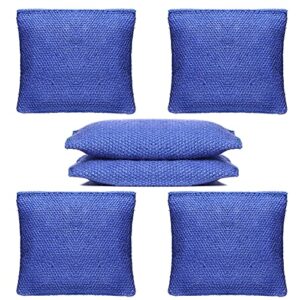
Need something between glass and paper? The Blue Canvas Pattern Weights land in that middle ground. Six square, steel bead-filled pads — each roughly 1.77 × 1.77 inches — deliver steady downward pressure without scratching your fabric surface.
Stack two for heavier materials. Use singles for quilting cotton or tissue patterns. At 11.04 oz total, the whole set fits in a drawer or craft tote pocket.
They won’t anchor thick canvas solo. For standard pattern work, though, they’re reliable and fast to reposition.
| Best For | Sewers, quilters, and crafters who need lightweight, reusable weights to hold pattern pieces or fabric in place without pins. |
|---|---|
| Material | Canvas & Steel Beads |
| Quantity | 6 pieces |
| Weight Per Piece | ~1.84 oz |
| Shape | Square pad |
| Surface Finish | Canvas fabric exterior |
| Breakage Risk | Low (canvas) |
| Additional Features |
|
- Steel bead filling delivers steady, even pressure without scratching delicate fabrics
- Stackable design lets you customize the weight for different materials
- Compact and lightweight — the whole set tucks easily into a drawer or craft bag
- Individual weights may be too light for heavier fabrics like thick canvas or upholstery
- Total set weight is modest, so large projects may need supplemental weights
- Not ideal as a standalone solution for dense or oversized pattern work
4. Clear glass fabric pattern weights
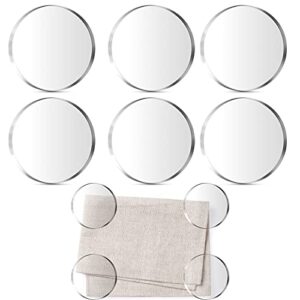
If the Blue Canvas weights feel too soft for precision work, clear glass is a step up in control. These discs — roughly 55 to 60 mm across — let you see every grain line and print alignment through the weight itself. No guessing, no lifting to check.
Each piece weighs around 60 grams: enough hold for quilting cotton and lightweight wovens, not overkill. The polished, non-porous surface won’t pull fibers or leave impressions. Flat bottoms mean no rocking mid-cut.
| Best For | Sewers, tailors, and dressmakers who want precise pattern alignment without pins or guesswork. |
|---|---|
| Material | Glass |
| Quantity | 12 pieces |
| Weight Per Piece | ~1.41 oz (40g) |
| Shape | Round disc |
| Surface Finish | Smooth, transparent |
| Breakage Risk | High (glass) |
| Additional Features |
|
- Transparent glass lets you see grain lines and print alignment right through the weight — no lifting required
- Smooth, polished surfaces won’t snag fibers or leave impressions on delicate fabrics
- Lightweight and compact enough to toss in a bag and take anywhere
- Glass can break if dropped, so they need a bit more careful handling than plastic or metal alternatives
- At 40g each, they may not provide enough hold for heavy or thick fabrics like denim or canvas
- The 2.6-inch diameter is on the smaller side, which may mean using more pieces to cover larger pattern sections
5. Glass pattern and fabric weights
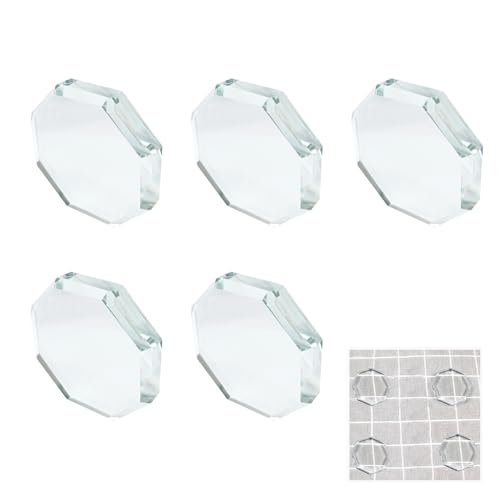
Round, transparent, and deceptively simple — these glass weights pull their weight where it counts. Each piece sits at 2.12 oz and 2.17 inches across: compact enough for tight layouts, substantial enough to hold quilting cotton and lightweight wovens without shifting.
The octagonal shape gives you something to grip. Beveled edges won’t snag or chip mid-session. And like the clear glass options above, you can see your grain lines straight through. Five per pack means full coverage across a standard pattern without hunting for extras.
| Best For | Sewists, quilters, and crafters who need a clear, no-snag way to hold fabric and patterns in place during cutting and layout work. |
|---|---|
| Material | Glass |
| Quantity | 5 pieces |
| Weight Per Piece | 2.12 oz |
| Shape | Octagonal |
| Surface Finish | Smooth, beveled edges |
| Breakage Risk | High (glass) |
| Additional Features |
|
- Transparent octagonal design lets you see grain lines and pattern markings clearly without moving the weight
- Beveled edges are smooth on fabric and easy to pick up, making them quick to reposition
- Five-piece pack gives you enough coverage for full pattern layouts without running short
- High transparency makes them easy to misplace on a busy cutting table
- Not heavy enough to hold thick, bulky, or very slippery materials in place
- Not suited for heavy-duty or industrial use where more substantial weights are needed
Storing Pattern Weights Efficiently
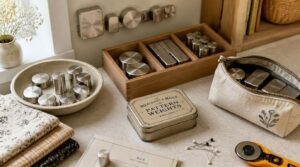
Finding a home for your pattern weights doesn’t have to mean sacrificing precious workspace. The right storage solution keeps them accessible without cluttering your cutting table or spilling across your sewing area. Here are five practical ways to store pattern weights efficiently in a small space.
Stackable Storage Trays
Stackable trays solve the vertical footprint problem without claiming more table space. Look for interlocking tray stability — lips that lock each layer so the stack won’t shift mid-project. Stainless steel mesh or BPA-free plastic both hold up under repeated use.
Some sets include dust protection lids, keeping your pattern weights for sewing clean between projects. Four to six trays fit most compact sewing room organization setups cleanly.
Hanging Drawstring Bags
Hanging drawstring bags turn dead door or wall space into instant sewing accessory storage. Cotton canvas or nylon bags hold up through constant use — cord locks keep the closure secure so nothing spills mid-project.
- Sizes from 8×10 to 18×24 inches
- Lightweight at 80–350 grams empty
- Group multiple bags on one rod for a modular hanging system
- Pack them flat for travel storage utility
Labeled Accessory Bins
Labeled accessory bins give every set of pattern weights a permanent address in your workspace. Color-coded bins pair with clear polycarbonate label windows — resistant to yellowing and readable after repeated cleaning — so you can confirm contents in seconds.
For sewing enthusiasts juggling multiple projects, alphanumeric labeling systems turn a cluttered shelf into a visual index you can scan without touching a single bin.
Drawer Dividers for Glass
Glass sewing weights deserve a dedicated home. Tempered glass drawer dividers create rigid, adjustable compartments that keep your glass pattern weights separated and chip-free.
Look for systems with beveled, ground edges and felt-padded contact points — no scratching, no shifting. Modular kits let you reconfigure the layout as your sewing accessories collection grows, turning any sewing table drawer into a clean visual inventory at a glance.
Pegboard Wall Storage
Your sewing table has limits — your walls don’t. A steel pegboard panel mounted into studs spaced 16 inches apart holds your entire collection of pattern weights for sewing without eating floor space.
- Hang modular accessory kits with bins for small notions
- Use hooks for drawstring bags holding glass weights
- Keep frequently used sewing accessories at eye level
You can even use firearm specific accessories to customize your organizational layout.
Vertical space optimization. That’s the move.
Frequently Asked Questions (FAQs)
How heavy do pattern weights need to be?
Weight depends on what’s under it. Lightweight fabrics need 5–75 oz; medium-weight fabrics hold steady at 1–2 oz. Slippery silks and satins? Go heavier — at least 3–4 oz total across the piece.
How to make your own sewing pattern weights?
Stack four to five large washers, cover them with two fabric circles, and stitch shut. Or fill a scrap fabric pouch with poly pellets for a softer, 2–3 oz alternative.
Are pattern weights worth it?
Think of pinning as parking your car with the handbrake — functional, but slower. Pattern weights are worth it: they’re faster, prevent fabric damage, extend pattern life, and handle slippery fabrics effortlessly.
What is the best filling for pattern weights?
Poly pellets distribute weight evenly without sharp edges. Sand offers dense, stable pressure. Rice is lightweight but can clump. Steel or glass fills provide the most durable, consistent hold for repeated use.
Can pattern weights replace pins entirely when sewing?
Almost. Pattern weights replace pins for most flat cutting tasks — silk, satin, canvas, even leather. But for curved notches and dart placement, a few strategic pins still earn their keep.
How many weights do I need to start?
Start with 4 to 6 weights. That’s enough to anchor corners and hold edges on most patterns. Add more as your projects grow in size and fabric complexity.
Are pattern weights safe for childrens craft projects?
Yes — with the right choice. Opt for non-toxic, smooth-edged weights between 10–50 grams. Avoid glass around young children. Adult supervision during placement keeps little fingers safe and fabric secure.
Do pattern weights work on vertical cutting surfaces?
Pattern weights do work on vertical cutting surfaces. Anchor corners first, then place weights along exposed edges to stop fabric creep. Keep them close to the cut line for rotary cutter precision.
Can I make DIY pattern weights at home?
Absolutely — sewing scraps and a handful of rice are all you need. Fill fabric pouches two-thirds full with dry rice or poly pellets, stitch sealed, and each weight hits that 30–60 gram sweet spot perfectly.
Conclusion
A cluttered workshop doesn’t make a poor craftsman—a poor craftsman blames the workshop. Pattern weights for small sewing spaces are proof that constraint sharpens skill.
Flat platelet weights, glass fills, smart storage—each choice strips away friction. Stack them in a tray. Hang them on pegboard. Pull them out in seconds.
Your cutting table doesn’t need to be large. It needs to be ready. Small space, precise work. That’s the standard worth holding.