This site is supported by our readers. We may earn a commission, at no cost to you, if you purchase through links.
Pin silk charmeuse and watch it pucker, shift, even pull threads right out of the weave. That’s the trouble with slippery fabric: needles fight it instead of holding it.
Pattern weights for slippery fabrics solve this by trading punctures for pressure. Set a cast iron disc on satin and it stays put, grain lines straight, edges true to your pattern. No pinholes, no repositioning, no fighting the fabric on its own terms.
Get the weight, size, and placement right, and cutting day stops being a wrestling match.
Table Of Contents
Key Takeaways
- Pattern weights hold slippery fabric flat by spreading pressure evenly across the surface instead of puncturing it like pins, which prevents distortion, snags, and pinholes.
- Matching weight type and heft to fabric matters: light glass weights (around 0.34 lb) suit delicate silks like charmeuse, while denser cast iron (0.5–1.2 kg) handles heavier satin and velvet without crushing fibers.
- Locking pattern edges to the selvage before placing weights keeps the grainline true, preventing the warp and weft from skewing and causing pieces to hang wrong after cutting.
- Proper care extends the life of your weights: clean glass gently with non-abrasive cleaner, dry and oil cast iron immediately to prevent rust, and store everything in a labeled, humidity-controlled space away from children.
How Pattern Weights Hold Slippery Fabric
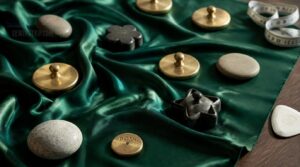
Slippery fabric moves the second you turn your back on it. Weights stop that shift without ever touching a needle to the fabric. Here’s what actually makes them work.
Just set a few weights around your pattern pieces and you can cut clean, accurate lines without fighting fabric that won’t sit still—these easy sewing project layout tips show how to position them for best results.
When Weights Work Best
Slippery fabrics test your patience. Silk charmeuse, chiffon, satin — they shift the second pins go in, throwing off pattern alignment stability. Weights work best right here: any fabric that slides, curls, or bunches under needle pressure.
They also shine on thick layers like denim or canvas, where pins fight you. Less fabric shifting, more precision and stability — exactly when you need it most.
Even Pressure Versus Pins
Pins anchor with a single sharp point. That point concentrates pressure, which on slippery fabrics often means fabric distortion right where you need precision.
Weights spread contact across a wide surface instead. No punctures, no localized stretch — just steady, even hold. Setup’s faster too: drop a weight, start cutting. No pinning, removing, repositioning. For slippery fabrics, that surface contact method beats point-anchoring almost every time.
Weights spread pressure evenly across slippery fabric, holding it steady without a single pin or puncture
Preventing Grain Misalignment
Grain shifts faster than you’d think. Even a slight tug skews the warp and weft out of perpendicular, and that’s when you get post-cut distortion — pieces that hang wrong no matter how careful your sewing.
Lock pattern edges to the selvage before placing weights. True grain stays put under even pressure, no bias stretch, no surprises after washing. Fabric stability starts here. You can identify grainlines to make sure your pieces are cut accurately.
How to Choose Pattern Weights

Not all pattern weights are created equal, and slippery fabric makes that obvious fast. Picking the right one comes down to a handful of practical factors, not guesswork. Here’s what actually matters when you’re choosing.
Weight and Pressure Needs
Not every fabric needs the same heft. Lightweight silks call for modest weight, just enough to stop drift during tracing. Heavy textiles like duchesse satin demand denser pieces, often 0.5 to 1.2 kilograms for cast iron.
The goal is pressure distribution balance: enough force to anchor fabric without crushing fibers or leaving indentation marks behind.
Size and Footprint
Bigger isn’t always better. A weight needs enough footprint consistency to grip fabric evenly, roughly 1 by 2 inches per piece for standard contact pressure.
Glass weights run about 15 square millimeters per inch of edge; cast iron broadens that to 25. Wider bases mean better shape stability against slippery fabrics, keeping fabric shifting to a minimum.
Quantity Per Pattern Piece
Six weights per pattern piece is a solid starting point for slippery fabrics like charmeuse or chiffon. Run the layer calculation math first: NP times NL times NR tells you total pieces, and that number drives weight count, not guesswork.
Symmetrical piece replication doubles your needs for mirrored sleeves. Watch fabric width constraints and managing duplicate counts too — marker efficiency optimization shouldn’t leave corners unweighted, or fabric shifting creeps back in.
Durability and Storage
Cast iron fabric weights shrug off 1,000+ hours of regular handling without bending. Glass fabric weights stay smooth through 50+ cleaning cycles, but humidity control matters most: keep relative humidity under 60%, store in dry cabinets, and toss in silica gel packs to block rust and tarnish.
Storage organization by category—padded sleeves, raised shelving—preserves edges and keeps your sewing workspace tidy season after season.
DIY Versus Store-bought Options
Five bucks of washers and fabric scraps versus a $30 set with silicone grips—your wallet and your fabric both have a vote.
DIY pattern weights keep budget sewing solutions simple: stack washers, wrap in scrap fabric, done. Store-bought wins on consistency and safety.
- DIY: cheap, customizable, needs careful cleaning
- Store-bought: silicone grips, color coding, ready-made
- Hybrid: DIY bulk, store-bought for delicates
Best Weights for Different Slippery Fabrics
Not every slippery fabric behaves the same way, so your weight strategy shouldn’t either. Charmeuse needs a different approach than chiffon, and velvet plays by its own rules entirely. Here’s what actually works, fabric by fabric.
Lightweight Silks and Charmeuse
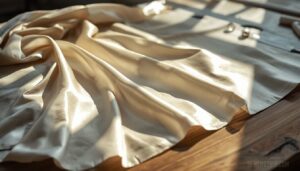
Charmeuse moves like water—that one-sided gloss and liquid drape make it slide off the table before you’ve finished pinning. At 8 to 12 momme, this mulberry silk needs light, even pressure, not pinholes that snag its luster.
Glass weights (around 0.34 lb) work well here—heavy enough to hold the bias-cut fabric flat, light enough to preserve that luminous sheen during precision cutting.
Chiffon and Organza Tricks
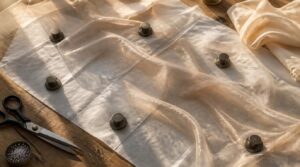
Chiffon and organza float more than fabric should—try pinning either one and watch it pucker.
Cut through a layer of tissue paper instead. It creates static cling that holds sheers steady, no holes, no snags.
- Space weights every 4–6 inches
- Use tissue paper underneath
- Avoid pulling at edges
- Recheck grain alignment after placement
That static cling beats pins for precision cutting on delicate fabrics every time.
Heavyweight Satin and Velvet
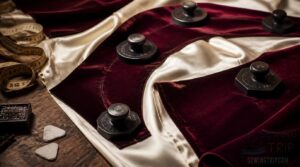
Heavyweight satin and velvet sit at the other end of the spectrum from sheers, dense but still slippery. Satin’s long floats catch light for that mirror-like luster; velvet’s cut pile diffuses it into a softer glow.
Cast iron weights handle the bulk best. Velvet’s plush drape and satin’s fluid fall both need firm anchoring without crushing the pile or flattening the shine.
Using Tissue Paper for Stability
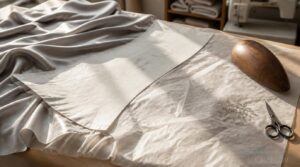
Sometimes the best stabilizer isn’t a weight at all. A tissue paper underlay slides under delicate fabrics, reducing fabric creep and stabilizing loose weaves like chiffon or silk satin.
Why it works:
- Distributes pressure evenly, minimizing seam puckering
- Improves precision and stability for narrow hems
- Enhances edge matching on curved seams
- Tears away clean, leaving no residue
A solid alternative to pins for delicate fabrics.
Top Pattern Weight Products to Try
Knowing what to look for is one thing. Finding the actual product is another. Here are five worth putting on your shopping list.
1. Pattern Cutting Weights Assorted Colors
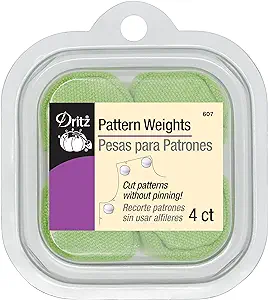
Four steel weights, one box, zero pin holes. This set’s 4-oz heavy-duty steel balls grip pattern paper and slippery knits without crushing seams. Soft, rounded edges protect fabric edges during rotary cuts, and the assorted colors make sorting weight sets a breeze when patterns get complicated.
Heads up: stacking them near tight curves can block your rotary blade. And for big multi-layer projects, four ounces per weight starts feeling thin. Great starter set, not your only set.
| Best For | Sewists and crafters who work with delicate or slippery fabrics like knits and silks and want a pin-free way to hold patterns in place while cutting. |
|---|---|
| Material | Digital |
| Weight | N/A |
| Unit Count | 1 |
| Primary Use | Education |
| Skill Level | All levels |
| Gift Suitability | Yes |
| Additional Features |
|
- Heavy-duty 4-oz steel construction keeps patterns securely in place without damaging fabric
- Soft, rounded edges protect fabric during rotary cutting
- Assorted colors make it easy to sort and organize weight sets for complex projects
- Can obstruct the rotary cutter when stacked together or used in tight, curved spaces
- The 4-oz weight may feel heavy to lift repeatedly during long cutting sessions
- Not enough support for extremely heavy fabrics or multi-layer projects
2. Quilted Bear Fabric Pattern Weights
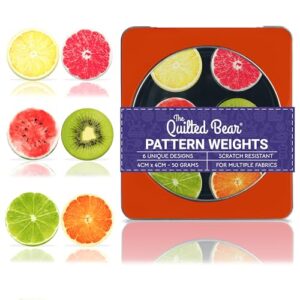
Steel ball weights aren’t your only option. Quilted Bear’s fabric-covered set swaps hard metal for scratch-resistant shells, sized around 5.12 x 6.14 x 0.63 inches, gentle on satin and silk.
The QB-OD2 "Funky Fruit" set ships six high-density plastic weights with a tin storage container. Pin-free, decorative, beginner-friendly.
Drawback: plastic means lighter pressure. Large pattern pieces may shift, and a few users report the internal holder cracking. Fine for small projects, not heavy denim work.
| Best For | Beginners and crafters working on small to medium quilting, dressmaking, or paper projects who want a pin-free, decorative way to hold patterns in place. |
|---|---|
| Material | Steel |
| Weight | 4 oz |
| Unit Count | 4 |
| Primary Use | Sewing |
| Skill Level | Beginner-Pro |
| Gift Suitability | Yes |
| Additional Features |
|
- Pin-free design keeps fabric and patterns stable without damaging delicate materials
- Scratch-resistant finish makes it safe for both fabric and paper surfaces
- Versatile enough for quilting, dressmaking, paper crafting, and even outdoor signage
- Lighter plastic construction may not hold down large or heavy pattern pieces
- Tight packaging can be tricky to open when first unboxing
- Some users have reported the internal plastic holder cracking over time
3. Chromium Plated Slotted Mass Set
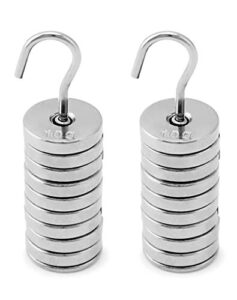
Borrowed from a physics lab, not a sewing room. This 100g set comes in 10g chromium-plated increments, slotted to interlock on a rod, with a hanger for stacking.
That precision makes them oddly handy on small, slippery pieces, darts and pattern notches especially. But the 20mm diameter is tiny. Slotted pieces detach if you bump them, and they’re too light for denim or canvas. Think collar points and cuffs, not yardage.
| Best For | Sewists who need precise, small-scale weights for holding down delicate fabric pieces like collar points, cuffs, and pattern notches, plus anyone teaching physics demos or running balance experiments. |
|---|---|
| Material | Chalk compound |
| Weight | 0.2 lb |
| Unit Count | 12 |
| Primary Use | Marking fabric |
| Skill Level | All levels |
| Gift Suitability | Yes |
| Additional Features |
|
- Precisely stamped 10g increments make it easy to grab exact amounts for weighting or experiments
- Durable chromium-plated metal stands up to repeated handling in classrooms or workrooms
- Slotted design and hanger let you stack and combine weights as needed
- Small 20mm diameter limits use to lightweight or compact materials
- Slotted pieces can pop loose if jostled or moved around
- Too light to hold down heavier fabrics like denim or canvas
4. Sullivans Professional Tailors Chalk
Not a weight, but it earns its spot in this lineup. Twelve triangular chalk pieces in white, red, blue, and yellow give you color-coded marking for darts, seams, and alterations. The shape sits nicely in your hand for fine lines.
Wipe marks off with a damp cloth, no staining, no fuss. Red and blue don’t erase quite as clean as white and yellow, so test on a scrap first. Worth pairing with whatever weights hold your fabric steady while you mark.
| Best For | Sewists, quilters, and professional seamstresses who need precise, color-coded marking across different fabric types. |
|---|---|
| Material | Stainless steel |
| Weight | 11.5 g |
| Unit Count | 2 |
| Primary Use | Jewelry |
| Skill Level | All levels |
| Gift Suitability | Yes |
| Additional Features |
|
- Triangular shape gives a comfortable, precise grip for fine lines
- Four-color set makes it easy to mark darts, seams, and alterations clearly
- Marks wipe away cleanly with just a damp cloth
- Red and blue chalk don’t erase as cleanly as white and yellow
- Pieces can arrive broken if the packaging gets damaged in shipping
- White chalk may run out quickly for heavy or frequent use
5. Madam Sew Rolled Hem Foot Set

Last one on the list, and it’s not a weight either—but once your fabric’s pinned in place, this foot finishes the edge that keeps slippery hems from fraying. The set clamps over your needle, curling fabric through a back groove to form a narrow 1/8 inch rolled edge, no pre-folding needed.
Works best on chiffon and silk charmeuse. Snap-on design, universal adapter included for non-snap machines. Feed slow, especially on curves—rushing it just unravels your work.
| Best For | Sewers working with delicate, slippery fabrics like chiffon and silk charmeuse who want clean, narrow rolled hems without the hassle of pre-folding. |
|---|---|
| Material | Metal |
| Weight | N/A |
| Unit Count | 3 |
| Primary Use | Hemming |
| Skill Level | Intermediate |
| Gift Suitability | Yes |
| Additional Features |
|
- Creates a neat 1/8 inch rolled edge that helps prevent fraying on delicate fabrics
- Snap-on design with a universal adapter, so it works on snap and non-snap machines alike
- Skips the pre-folding step, saving time once fabric is pinned in place
- Requires a slow, careful feed rate, especially on curves, or the hem can unravel
- Best suited to lightweight, delicate fabrics, so it may not handle heavier materials well
- Takes some practice to get smooth, consistent results
Caring for Your Pattern Weights
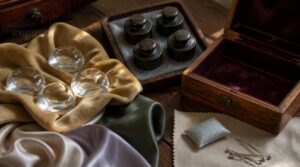
Good weights last for years, but only if you treat them right. Glass needs gentle handling, cast iron needs protection from moisture, and all of it needs a proper home between projects. Here’s what that care actually looks like.
Cleaning Glass Weights Safely
Glass weights look tough but scratch easily, and once that happens, they snag delicate fabrics like silk and satin instead of gliding over them. Inspect for cracks before your next project—damaged glass has no business near good fabric.
Clean with a non-abrasive glass cleaner and soft cloth, never steel wool. Rinse fully to avoid residue buildup. Dry with microfiber to prevent moisture damage.
Preventing Rust on Cast Iron
Cast iron rusts the second moisture sits on it too long. Pat your weights dry immediately after washing, then wipe with a soft cloth while still warm.
For peace of mind:
- Apply a thin oil film after drying
- Choose stable oils like flaxseed or canola
- Bake upside down at 350–450°F to polymerize
That polymerized coating locks out moisture for good.
Proper Storage Between Projects
Once your weights are oiled and cooled, they don’t belong in a junk drawer. Toss them in a labeled bin alongside your other sewing accessories — that’s basic workspace organization, and it pairs with humidity control methods like a small desiccant pack to keep moisture away.
Wipe surfaces down too. A sanitized workspace and tidy quilting supplies make next session’s setup painless.
Safe Handling Around Children
Tidy bins are great, but a curious toddler will find them anyway. Glass weights are a real choking hazard — keep them shut away just like coins or batteries.
Cast iron pieces can tip if stacked loose on a table edge, so store low and secure, the same logic behind anchoring furniture. Treat your sewing accessories with the same caution as outlet covers and car seats: out of reach, always.
Frequently Asked Questions (FAQs)
How to sew slippery fabric without a walking foot?
No walking foot? No problem. Layer tissue paper under silk charmeuse before pinning or cutting, it cuts down slipping fast. Stabilize with spray starch, sew slowly, and use a straight stitch plate for precision and stability.
Are pattern weights better than pins?
For most projects, yes. No pin holes, no snags, no finger jabs. Even pressure keeps grainlines true and fabric distortion low. They’re faster too — a solid alternative to pins that speeds up cutting without sacrificing sewing accuracy.
Can pattern weights damage delicate or sheer fabrics?
Heavy-handed pressure can leave its mark — but used right, pattern weights are gentler than pins. Rotate placement, use smooth glass, and avoid fiber crushing or pressure halos on sheer fabrics; smart sizing prevents creases and snag risks entirely.
Are pattern weights safe for leather or vinyl?
Yes—as long as you choose smartly. Avoiding puncture damage matters more than weight here; smooth, non-marring bases prevent surface abrasion on glossy or soft finishes, while leather-and-steel cores grip without scratching vinyl’s delicate coating.
How much does a typical pattern weight cost?
Don’t assume cost equals quality. Budget vs premium sets run $10–60: DIY washers under $10, resin or steel sets $12–35, glass or magnetic options $25– Value per piece usually lands between $3–
Can pattern weights replace pins entirely for garments?
Mostly, not entirely. For garment construction needing seam allowances secured or layers basted together, pins still earn their keep. Think of weights as your cutting workflow speed booster, pins as backup for stitching and multi-layer stability.
Do pattern weights work on uneven cutting surfaces?
Old shop tables tilt more than you’d think—even a few degrees throws off cutting accuracy.
On uneven surfaces, flat weights placed along pattern edges create adaptive weight placement, resisting fabric creep and giving your rotary cutter the stability it needs.
Conclusion
Worried weights add bulk to your sewing toolkit? A few cast iron discs and a handful of glass nuggets take up less drawer space than a pin tin, and they work harder.
Pattern weights for slippery fabrics aren’t a luxury purchase; they’re the real difference between true grainlines and crooked, ruined seams. Match weight to fabric, keep them rust-free, and cutting day stops feeling like a fight. Your fabric stays flat. Your edges stay honest.
- https://stitchobsessed.com/sewing-weights-pattern
- https://littlelizardking.com/blogs/little-lizard-king-blog/2019-4-30-chiffon
- https://www.moodfabrics.com/collections/pattern-weights
- https://blog.closetcorepatterns.com/tips-for-sewing-with-slippery-fabrics
- https://byhandlondon.com/blogs/by-hand-london/76440965-nerdy-sewing-tips-working-with-drapey-silks-other-slippery-fabrics