This site is supported by our readers. We may earn a commission, at no cost to you, if you purchase through links.
Threading a needle by hand—for the fifth time, on the same project—is the moment most beginners quietly abandon sewing. That one frustration stops more people than any difficult pattern or tricky seam ever could.
The good news: today’s entry-level machines have quietly become impressive, with automatic threaders, jam‑resistant bobbins, and stitch libraries that would have cost serious money a decade ago. Brother and Singer alone now pack 70 to 200‑plus stitches into machines under $200.
Knowing which machine best suits beginners comes down to a few key features, and getting that decision right from the start changes everything.
Table Of Contents
- Key Takeaways
- Best Sewing Machines for Beginners
- 1. Brother CS7000X Sewing Machine
- 2. KPCB Tech Mini Sewing Machine
- 3. Singer M3500 Sewing Machine
- 4. Brother Computerized Sewing Quilting Machine
- 5. Brother SE700 Sewing Embroidery Machine
- 6. Singer Fashion Mate 5560 Sewing Machine
- 7. Nex Kids Portable Sewing Machine
- 8. Singer MX231 Portable Sewing Machine
- 9. JUKI Professional Overlock Serger Machine
- 10. Brother XM2701 Lightweight Sewing Machine
- Beginner Sewing Machine Buying Criteria
- Essential Beginner-Friendly Features
- Mechanical Vs Computerized Machines
- Matching Machines to Sewing Projects
- Beginner Performance and Usability Tests
- Accessories Beginners Should Consider
- Frequently Asked Questions (FAQs)
- Conclusion
Key Takeaways
- The Brother CS7000X and Singer M3500 hit the sweet spot for most beginners, offering metal frames, automatic threaders, and solid stitch counts all under $200.
- You don’t need 200 built-in stitches — 12 to 60 cover nearly every beginner project, so don’t let a long spec list drive your decision.
- Mechanical machines are easier to fix and teach you core skills faster, while computerized models guide you with screens and auto‑tension, so your learning style should decide the choice.
- Features like a drop-in bobbin, automatic needle threader, and adjustable speed control remove the small frustrations that make most beginners quit early.
Best Sewing Machines for Beginners
Finding the right sewing machine as a beginner doesn’t have to be overwhelming. Each machine on this list was chosen for its ease of use, reliability, and real value at different price points.
If you’re still unsure where to start, narrowing it down gets much easier once you understand what makes a sewing machine truly beginner-friendly.
Here are the ten best options worth your attention in 2026.
1. Brother CS7000X Sewing Machine
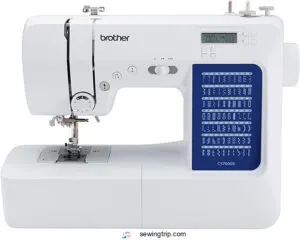
The Brother CS7000X is a strong first machine if you’re serious about learning.
It comes with 70 built-in stitches, an automatic needle threader, and a drop-in bobbin that loads in seconds.
The metal frame keeps stitching steady even on denim or quilting layers.
You also get a wide table, 10 presser feet, and a hard case — all included.
At 14 lb, it’s not the lightest option, but the stability that weight brings is genuinely worth it.
| Best For | Beginners and hobbyists who want a reliable, feature-packed machine that can handle everything from basic repairs to quilting projects. |
|---|---|
| Built-in Stitches | 70 |
| Weight | 14 lb |
| Voltage | 120V US only |
| Needle Threader | Automatic |
| Bobbin System | Drop-in top load |
| Beginner Friendly | Yes |
| Additional Features |
|
- Automatic needle threader and drop-in bobbin make setup quick and frustration-free
- Metal frame keeps stitching consistent, even on heavy fabrics like denim or multiple quilt layers
- Comes loaded with 70 stitches, 10 presser feet, a wide table, and a hard case — serious value out of the box
- At 14 lb, it’s heavier than it sounds — not ideal if you move it around a lot
- US-only voltage means you’ll need a transformer to use it abroad
- The automatic threading and bobbin system has a small learning curve before it clicks
2. KPCB Tech Mini Sewing Machine
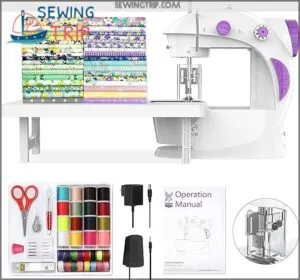
Not every beginner needs a 14-pound machine on their desk. If you’re just starting out — or shopping for a kid — the KPCB Tech Mini Sewing Machine at $39.99 is worth a look.
It weighs only 3 lb, accommodates up to 5 layers of fabric, and includes a full 42-piece starter kit.
Two speed settings keep you in control, and the finger guard adds real safety.
Just know it’s built for small repairs and practice, not full garments.
| Best For | Beginners, kids, or anyone who wants to learn basic sewing without spending a lot or taking up much space. |
|---|---|
| Built-in Stitches | 1 |
| Weight | 3 lb |
| Voltage | Not specified |
| Needle Threader | Manual tool included |
| Bobbin System | Manual double-thread |
| Beginner Friendly | Yes |
| Additional Features |
|
- Comes with everything you need to start right away — fabric squares, threads, needles, scissors, and more
- Finger guard and two speed settings make it genuinely beginner-friendly and safer for younger users
- Light enough to toss in a bag, so it’s great for travel or small living spaces
- Plastic build feels flimsy compared to real machines, and it may not hold up over time
- Tension issues can cause thread breaks or bent needles on thicker fabrics
- Manual knob operation gets tiring fast — no foot pedal means less control during longer projects
3. Singer M3500 Sewing Machine
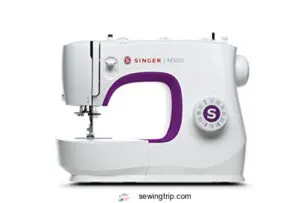
If you’re ready to step up from mini machines, the Singer M3500 is a solid next move. It packs 110 built-in stitches, a one-step buttonhole, and an automatic needle threader into a metal-framed body that weighs just over 13 lb.
The 5.7-inch sewing space manages everything from lightweight knits to denim, while a free arm simplifies cuffs and sleeves.
One heads-up: the manual isn’t always included, so bookmark Singer’s tutorial videos before your first project.
| Best For | Beginners and hobbyists who want a reliable step-up machine that handles everyday sewing projects without a steep learning curve. |
|---|---|
| Built-in Stitches | 110 |
| Weight | 13 lb |
| Voltage | 110V US only |
| Needle Threader | Automatic |
| Bobbin System | Not specified |
| Beginner Friendly | Yes |
| Additional Features |
|
- 110 stitches plus a one-step buttonhole covers everything from basic hemming to garment repairs
- Automatic needle threader and LED light make setup quick and easy, even in low light
- Free arm and 5.7-inch sewing space handle tricky spots like cuffs and sleeves with no fuss
- Manual isn’t always in the box, so you may have to hunt for tutorials online
- Occasional bobbin jamming reported by some owners, which can interrupt your workflow
- Only works with 110 V outlets — not compatible with UK or EU power without a transformer
4. Brother Computerized Sewing Quilting Machine
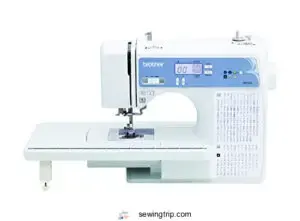
If quilting is your goal, this machine is built around it. The Brother XR9550 packs 165 built-in stitches, including 55 alphanumeric options and 8 auto-size buttonhole styles, into a 10.1-pound frame you can actually carry.
The LCD screen makes stitch selection feel simple, and the wide quilting table gives you real workspace. An automatic needle threader and jam-resistant drop-in bobbin keep setup frustration low.
At around $170–$300, it’s a strong pick if you want room to grow into bigger projects.
| Best For | Beginners and hobbyists who want to quilt, sew garments, or explore decorative stitching without a steep learning curve. |
|---|---|
| Built-in Stitches | 165 |
| Weight | 10.1 lb |
| Voltage | 120V US only |
| Needle Threader | Automatic |
| Bobbin System | Drop-in jam-resistant |
| Beginner Friendly | Yes |
| Additional Features |
|
- 165 built-in stitches give you plenty to work with, from basic utility to decorative and alphanumeric options
- Automatic needle threader and drop-in bobbin make setup quick and low-frustration
- Lightweight at 10.1 lbs with a wide quilting table, so it’s easy to move and comfortable to use on bigger projects
- Plastic components may not hold up as well over years of heavy use
- Warranty is US-only, so it’s a no-go if you’re outside a 120V region
- A few users have noted minor quirks like the hard cover fit and occasional stitch tension pulling left
5. Brother SE700 Sewing Embroidery Machine
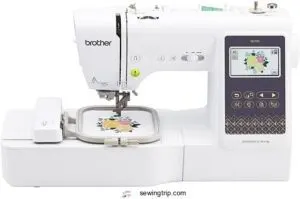
Want to stitch and embroider without buying two machines? Brother SE700 does both.
It comes loaded with 135 embroidery designs, 103 sewing stitches, and a 3.7-inch color touchscreen that lets you preview edits before a single thread moves.
Artspira app connects wirelessly, so you can design on your phone and send it straight to the machine.
At $579.99, it’s a bigger investment, but the automatic threader and speed control make it genuinely manageable for beginners.
| Best For | Beginners and hobbyists who want to sew and embroider without juggling two separate machines. |
|---|---|
| Built-in Stitches | 103 |
| Weight | 15.6 lb |
| Voltage | 120V US only |
| Needle Threader | Automatic |
| Bobbin System | Drop-in |
| Beginner Friendly | Yes |
| Additional Features |
|
- Wireless design transfer via the Artspira app means you can sketch something on your phone and stitch it minutes later — no USB hunting required.
- 135 built-in embroidery designs plus 103 sewing stitches give you a lot to work with right out of the box.
- Automatic needle threader and thread cutter are genuine time-savers, especially if you’re still learning the ropes.
- The 4×4 inch embroidery area is pretty limiting — great for monograms, not so great for bigger statement pieces.
- Small throat opening makes it tricky to maneuver large fabric or bulky quilts.
- Wi-Fi features can be finicky, and some users have run into thread-tension issues that take a bit of troubleshooting to sort out.
6. Singer Fashion Mate 5560 Sewing Machine
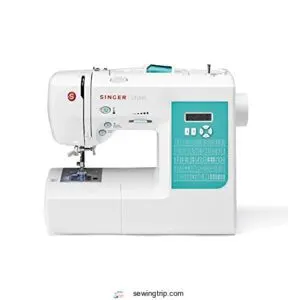
If you’re looking for a solid all-rounder without breaking the bank, the Singer Fashion Mate 5560 is worth a close look. At $199.99, it gives you 203 stitch applications, an automatic needle threader, and a built-in thread cutter — features that genuinely cut down setup frustration.
The metal frame keeps things stable as you work.
Just know that some users report tension issues on lightweight or stretchy fabrics, so it performs best on cotton and light denim.
| Best For | Beginners and hobbyists who want a reliable, feature-packed machine for everyday sewing, quilting, and garment work without spending a lot. |
|---|---|
| Built-in Stitches | 203 |
| Weight | 22 lb |
| Voltage | 120V US only |
| Needle Threader | Automatic |
| Bobbin System | Metal Class 15 |
| Beginner Friendly | Yes |
| Additional Features |
|
- 203 built-in stitches plus a one-step buttonhole — plenty of options for fashion, quilting, and repairs
- Automatic needle threader and thread cutter save time and cut down on setup headaches
- Solid metal frame keeps the machine stable while you sew
- Tension issues and skipped stitches can pop up on lightweight or stretchy fabrics
- Build quality feels a bit flimsy to some users — a few have reported needle breakage and a loose front housing
- No printed manual in the box, so you’ll likely be hunting down a PDF or YouTube video to get started
7. Nex Kids Portable Sewing Machine
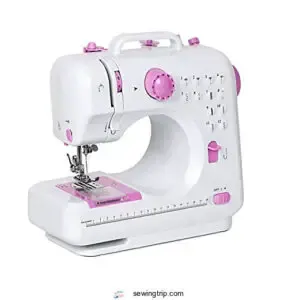
The Nex Kids Portable Sewing Machine is a smart pick if you want something small, safe, and genuinely beginner-friendly.
It weighs just 2.2 pounds and fits comfortably on a desk or small table.
You get 12 built-in stitches, a needle guard for safety, and a battery or AC adapter option for flexible use.
The LED work light helps you see every stitch clearly.
It’s best on lightweight fabrics — don’t expect it to handle denim or heavy canvas.
| Best For | Kids and beginners who want a simple, portable machine for light sewing projects like hemming, mending, or small garments. |
|---|---|
| Built-in Stitches | 3-4 |
| Weight | 5 lb |
| Voltage | Not specified |
| Needle Threader | Not included |
| Bobbin System | Integrated compartment |
| Beginner Friendly | Yes |
| Additional Features |
|
- Compact and lightweight at just 5 lbs — easy to move around or pack for travel
- Built-in LED light and foot pedal with speed settings make it genuinely easy to use
- Rechargeable battery means you can sew anywhere, no outlet required
- Threading is tricky — the upper thread path uses holes instead of smooth guides, which can frustrate beginners
- Plastic parts like the presser foot lever and bobbin cover feel fragile and may not hold up over time
- The foot pedal is known to fail early, and it can’t handle anything thicker than lightweight fabric
8. Singer MX231 Portable Sewing Machine
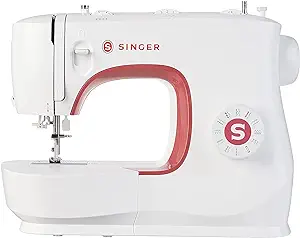
The Singer MX231 punches above its $149.99 price tag, offering impressive value. At 11.8 pounds, it’s lightweight and easy to move without feeling flimsy, balancing portability and sturdiness.
Its 97 stitch applications—basic, decorative, and stretch—are selected via intuitive dials, while the automatic needle threader and front-load bobbin significantly reduce setup time.
The machine accommodates everything from cotton to light denim, making it versatile for repairs and small projects.
No printed manual is included, so keep the PDF guide accessible during initial setup.
| Best For | Beginners and casual sewers who want a reliable, affordable machine for everyday repairs, garment projects, and light crafts without breaking the bank. |
|---|---|
| Built-in Stitches | 23 |
| Weight | 11.8 lb |
| Voltage | 120V US only |
| Needle Threader | Automatic |
| Bobbin System | Front-load |
| Beginner Friendly | Yes |
| Additional Features |
|
- 97 stitch applications give you plenty of variety for basic sewing, decorative work, and stretch fabrics all in one machine
- The automatic needle threader and front-load bobbin make setup quick and painless, so you spend more time sewing and less time fussing
- At under 12 pounds, it’s easy to move around the house or take to a class without any hassle
- No printed manual included, so you’ll need to download the PDF or find video tutorials before your first use
- Some users have reported thread tension problems and occasional fabric catching, especially at higher speeds or with delicate materials
- Presser foot pressure isn’t adjustable, which can be frustrating if you regularly sew thicker or specialty fabrics
9. JUKI Professional Overlock Serger Machine
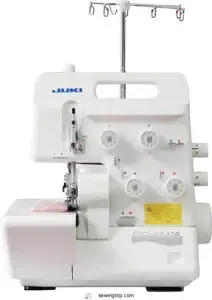
The JUKI MO-654DE isn’t your typical beginner machine — it’s a dedicated serger built for clean, professional edges on knit and woven fabrics alike. It runs at 1,500 stitches per minute and accommodates 2, 3, or 4-thread configurations.
Color-coded threading makes setup far less intimidating than you’d expect. The differential feed, adjustable from 0.7 to 2.0, keeps stretchy fabrics from waving or puckering.
Just know it doesn’t do coverstitching, so you’d need a separate machine for that finish.
| Best For | Home sewists and small-business owners who need fast, professional edge finishing on knit and woven fabrics. |
|---|---|
| Built-in Stitches | N/A (serger) |
| Weight | 15.2 lb |
| Voltage | 110V US only |
| Needle Threader | Not included |
| Bobbin System | External looper |
| Beginner Friendly | Moderate |
| Additional Features |
|
- Runs at 1,500 stitches per minute, so you can power through seams and thick layers without slowing down
- Color-coded threading and external adjustments make setup quick and approachable, even if you’re new to sergers
- Handles everything from lightweight knits to heavy upholstery fabrics with ease
- No coverstitch function — you’ll need a second machine if you want that clean hemming finish
- Only wired for 110V, so international users will need a voltage converter
- The manual is pretty bare-bones, especially for advanced stitch setups, so grab a serger reference book to go alongside it
10. Brother XM2701 Lightweight Sewing Machine
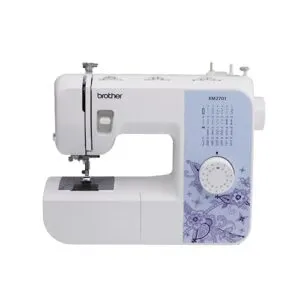
The Brother XM2701 is one of those machines that just makes sense for beginners. At $149, it offers 27 built-in stitches, an automatic needle threader, and a jam-resistant drop-in bobbin — everything you need without the overwhelm.
The free-arm design accommodates sleeves and cuffs with ease, while the 25-year limited warranty ensures long-term coverage.
It won’t tackle thick denim or leather, but for everyday garments, repairs, and quilts, it’s a reliable, portable starting point you can trust.
| Best For | Beginners and hobbyists who want a simple, reliable machine for everyday sewing projects like garments, repairs, and quilts without spending a lot. |
|---|---|
| Built-in Stitches | 27 |
| Weight | 12.6 lb |
| Voltage | 120V US only |
| Needle Threader | Automatic |
| Bobbin System | Top-drop jam-resistant |
| Beginner Friendly | Yes |
| Additional Features |
|
- 27 built-in stitches plus an automatic needle threader and jam-resistant bobbin make setup and use genuinely easy
- Free-arm design lets you sew sleeves, cuffs, and pant hems without any extra attachments
- Backed by a 25-year limited warranty and lifetime technical support — solid peace of mind at this price
- Struggles with heavy fabrics like thick denim, leather, or multiple layers stacked together
- The plastic spool pin can feel fragile with regular, repeated use
- No LCD screen or embroidery options — you’ll outgrow it if your projects get more advanced
Beginner Sewing Machine Buying Criteria
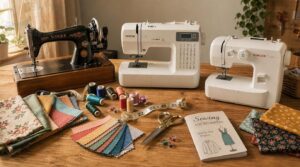
Picking the right sewing machine isn’t just about grabbing the cheapest one on the shelf. A few key factors will tell you whether a machine is actually built for where you’re starting.
Here’s what to look for before you buy.
Ideal Beginner Price Range
The sweet spot for a beginner machine sits between $150 and $350. That’s your best Cost Performance Balance — enough to get solid features without overspending.
Budget vs Value matters here: machines under $100 often cut corners on durability. Price Tier Guidance is simple — aim for $150–$250 to start. Watch for Seasonal Sale Timing; prices regularly drop 20–30% during major shopping events.
Many beginner models include adjustable speed control for easier stitching.
Mechanical Vs Computerized Controls
Once you’ve nailed your budget, the next call is choosing between mechanical versus computerized sewing machines.
Mechanical models respond instantly — zero latency comparison issues — and repairs are simple at home.
Computerized machines offer better error diagnostics and broader upgrade path options, but carry a steeper interface learning curve. For most beginners, mechanical keeps things straightforward while you build confidence.
Ease of Threading and Bobbin Loading
Threading trips up most beginners fast. Look for color-coded guides that map your thread path clearly, plus an automatic needle threader that guides the eye in one motion.
drop-in bobbin with a clear bobbin window lets you monitor thread at a glance.
Jam-resistant housing prevents bird-nesting, while a quick-load mechanism cuts setup time so you spend more time sewing.
Stitch Options Beginners Actually Need
Once threading clicks, stitch selection is your next decision. You don’t need 200 built-in stitches — honestly, 12 to 60 cover 90% of beginner projects.
Focus on the basics: straight stitch, zigzag, blind hem, and buttonhole.
Stitch length and width adjustments, reverse stitch function, and stitch density control matter far more than decorative stitch variety you’ll rarely use.
Portability, Weight, and Storage
If you plan to sew in different rooms — or take your machine to a class — portability matters more than most beginners expect.
Look for a lightweight build under 12 pounds, a compact footprint around 12–16 inches wide, and an integrated carrying case.
- Lightweight portable design — easier to lift and move daily
- Foldable base — cuts storage footprint considerably
- Quick-release bobbin — speeds setup anywhere
- Removable extension table — adds workspace, then tucks away
Warranty, Durability, and Repair Support
A machine warranty can mean the difference between a costly fix and a free repair. Most beginner machines offer 1–3 years of coverage, but durability starts with the metal frame — metal frame benefits include better resistance to flex and wear over time.
Register your machine right after purchase, and always use authorized service networks to keep coverage valid.
| Factor | What to Look For |
|---|---|
| Warranty Registration Tips | Register within 30 days of purchase |
| Machine Warranty Length | 1–3 years for most beginner models |
| Sewing Machine Durability | Metal frame over all-plastic builds |
| Parts Availability | OEM parts through authorized centers |
| Repair Turnaround Times | Usually 3–14 business days |
Essential Beginner-Friendly Features
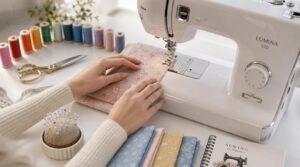
Some features on a sewing machine look great on a spec sheet but don’t actually help you learn faster or finish projects with less frustration.
The ones that truly matter for beginners are the features that remove friction — the small annoyances that make you want to quit before you’ve really started.
The best beginner features are the ones that quietly remove friction before frustration makes you quit
Here’s what to look for.
Automatic Needle Threader
If you’ve ever squinted at a needle eye for five minutes straight, you already know why an automatic needle threader matters. It guides thread through in seconds, cutting setup frustration fast.
Check threader alignment before each session and keep lint cleared as part of your maintenance routine.
Design variants handle different needle sizes, so threader compatibility is rarely an issue on today’s best sewing machines for beginners.
Drop-in Bobbin With Clear Cover
A drop-in bobbin with a Transparent Bobbin Window takes the guesswork out of loading. You can see thread levels at a glance — no plate removal, no interruptions.
This Easy-to-use Bobbin Access enables Speedy Thread Inspection mid-project, and the Simplified Winding Process means most beginners load in under 60 seconds. For sewing for beginners, it’s one less thing to stress about.
Adjustable Speed Control
Speed control is a beginner’s best friend. With adjustable speed settings and Speed Dial Settings, you set the pace before your foot even touches the pedal.
Foot Pedal Sensitivity determines how gradually you accelerate, while Speed Preset Modes let you lock in a safe maximum.
Servo Motor Benefits include quieter operation and lower energy consumption impact.
Adjustable sewing speed keeps your stitches steady and your confidence growing.
Free Arm for Sleeves and Cuffs
Think of the free arm as your secret weapon for sleeves and cuffs. This removable Arm Extension Types feature exposes the machine bed, making Curved Seam Stitching on tubular fabric surprisingly manageable.
Slide the sleeve over, select the right Presser Foot Selection, dial in your Stitch Length Adjustment, and choose your Needle Choice carefully.
Every entry-level sewing machine worth considering in Top picks for beginner sewing machines 2026 includes one.
Built-in Stitches and Buttonholes
Built-in stitches do more than fill a spec sheet. Most beginner machines offer straight, zigzag, blind hem, and decorative options, with Stitch Width Adjustment letting you fine-tune each one.
Features like Stitch Memory and automatic buttonhole make repetitive tasks faster. Buttonhole Reinforcement manages bar tacks automatically, while multiple Buttonhole Styles — slit, keyhole, round — cover nearly any project you’ll start with.
LED Work Light
A good built‑in lamp makes a real difference when you’re lining up seams. LED lighting for stitching gives you a clear, LED-lit work area without straining your eyes.
Look for these features:
- Color Temperature around 5000K–6500K for accurate fabric color
- Brightness Levels with multiple modes for adjustable visibility
- Mounting Options and Durability Features that hold up over time
Included Presser Feet and Accessories
What comes in the box matters more than you’d think. Most beginner machines include a presser foot kit covering the basics — zipper, buttonhole, blind hem, and all‑purpose feet. Here’s a quick Foot Functionality Overview to guide your choices:
| Foot Type | Best Use |
|---|---|
| Zipper Foot | Invisible zipper alignment |
| Buttonhole Foot | Repeatable, even buttonholes |
| Blind Hem Foot | Clean, hidden hem finishes |
Foot Material Durability varies, but metal feet outlast plastic ones. The snap‑on Foot Attachment Mechanism makes switching fast.
Mechanical Vs Computerized Machines
Choosing between a mechanical and computerized sewing machine is one of the biggest decisions you’ll make as a beginner.
Each type has real advantages, and the right pick depends on how you learn, what you plan to sew, and how much upkeep you’re willing to handle. Here’s a closer look at both sides.
Benefits of Mechanical Sewing Machines
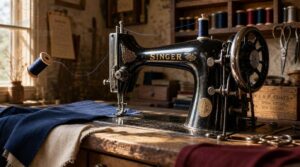
A mechanical machine is like a reliable old truck — simple, tough, and it just works. Its Durable Metal Frame cuts flex during stitching, while mechanical springs deliver Consistent Stitch Rhythm without any software involvement. You’ll also notice Lower Operating Noise and far Simpler Maintenance. That hands‑on experience builds real Long‑Term Learning Value.
| Feature | Mechanical | Computerized |
|---|---|---|
| Frame Durability | Metal, long‑lasting | Varies by model |
| Maintenance | Oil and clean only | Needs circuit care |
| Learning Curve | Teaches core skills | Shortcuts fundamentals |
Benefits of Computerized Sewing Machines
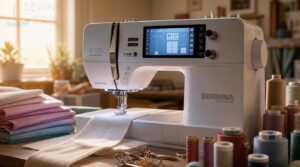
Switching to a computerized sewing machine feels like upgrading from a paper map to GPS — suddenly, everything is clearer. The LCD screen displays your exact stitch settings at a glance, while Consistent Tension Control and automatic needle threading manage the tedious tasks. Digital Pattern Memory saves your favorite configurations, and Automatic Thread Cutting trims time between seams.
| Feature | What It Does for You |
|---|---|
| On-screen Tutorials | Guides you step-by-step without guessing |
| Automatic Buttonhole | Creates clean buttonholes in one step |
| Quick Foot Change | Swaps presser feet in seconds |
| Thread Tension and Speed Control | Adjusts automatically for different fabrics |
| Digital Pattern Memory | Saves your settings for next time |
Which Type is Easier for Beginners
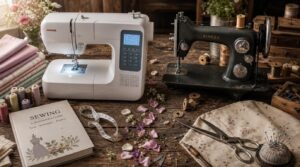
For most beginners, computerized machines win on User Interface Simplicity and Learning Curve Speed — one-touch stitch selection beats hunting through dials. But mechanical models shine in Error Recovery Ease and Setup Time Comparison because there’s less to go wrong.
| Factor | Computerized | Mechanical |
|---|---|---|
| Control Feedback Clarity | LCD screen guides you | Dial feel teaches you |
| Setup Time | Faster | Minimal but manual |
Both work as entry-level sewing machines — your best pick depends on how you learn.
Maintenance and Repair Differences
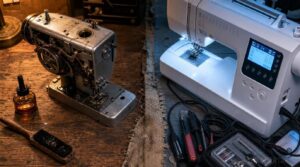
Think of it this way: a mechanical machine is like a reliable old truck — fewer parts mean fewer breakdowns.
Lubrication schedules are simple, belt wear indicators are visible, and gear replacement frequency is low. Computerized models need electronic diagnostics when something glitches, which often means professional repair service.
| Maintenance Factor | Mechanical | Computerized |
|---|---|---|
| Sewing Machine Maintenance | DIY-friendly | Requires tech support |
| Mechanical Parts Longevity | Decades with oiling | Shorter without servicing |
| Sewing Machine Warranty and Service | Simpler claims | Complex coverage |
| Maintaining and Servicing a Home Sewing Machine | Monthly brush and oil | Annual professional tune-up |
Best Choice for Long-term Learning
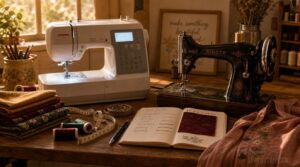
Your long-term progress depends less on the machine and more on how you practice with it. A computerized model facilitates Feedback Loops and Habit Formation through consistent, guided use, while a mechanical builds fundamentals fast.
| Learning Goal | Best Machine Type |
|---|---|
| Spaced Repetition drills | Computerized |
| Real-World Projects | Mechanical |
| Interleaved Practice | Either |
| Budget-friendly growth | Mechanical |
Matching Machines to Sewing Projects
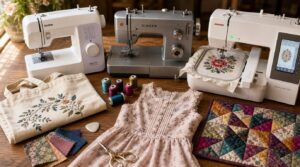
Not every sewing machine fits every project, and picking the wrong one early can make learning feel harder than it needs to be.
The good news is that once you know what you want to make, right machine becomes a lot easier to spot.
Here’s a look at which machines work best for each type of beginner project.
Best Machines for Basic Clothing Repairs
Most clothing repairs come down to four things: Hem Stitching, Seam Reinforcement, Patch Application, and Button Replacement.
For Fabric Tear Repair, you need solid thread tension and a reliable buttonhole function.
Budget-friendly picks like the Brother CS6000i shine here — lightweight, with an automatic needle threader and drop-in bobbin.
You won’t fight the machine.
You’ll just fix the shirt.
Best Machines for Quilting Beginners
Quilting demands more from your machine than basic repairs do. You need at least 6 inches of throat space size to maneuver bulk layers, walking foot compatibility for smooth multi-layer fabric feed, and metal frame stability to handle long sessions without wobbling.
A quilt table extension helps enormously.
Budget-friendly sewing machine options like the Brother CS6000i offer a free arm and quilt foot attachment, making them solid beginner sewing machine picks.
Best Machines for Embroidery Beginners
Embroidery takes things up a notch from basic sewing. You want a machine with real embroidery capabilities — not just decorative stitches.
Look for:
- A built-in design library with 135 built-in embroidery designs to start immediately
- Touchscreen navigation for easy color-coded editing
- A quick-release hoop and portable embroidery unit for flexible setups
- Thread tension automation and an automatic needle threader to reduce frustration
A budget-friendly pick with an LED-lit work area keeps things manageable.
Best Machines for Thick Fabrics
Thick fabrics like denim and canvas demand more from your machine. You need a Heavy Duty Motor, a Reinforced Frame, and a High Torque Gear system that won’t stall mid-seam.
The Singer Heavy-Duty 4432 performs this well, reaching 1,100 stitches per minute with solid Industrial Needle Compatibility. Its Thick Fabric Feed keeps layers moving evenly — no bunching, no frustration.
Best Machines for Kids and Teens
Kids and teens need a different kind of machine — one built around safety and simplicity. Look for Finger Guard Safety features, Snap-On Presser Feet, and Low Noise Operation under 60 dB.
The Brother XM2701 is lightweight, budget-friendly, and portable; small size makes it easy to move between rooms.
Battery-powered options like the Nex Kids Portable add flexibility. Interactive Learning Guides help young sewers build confidence on their own.
When Beginners Should Avoid Sergers
Once your young sewist has the basics down, you might wonder: what’s next? A serger isn’t it — not yet.
Here’s when to hold off:
- Threading Complexity overwhelms beginners still learning standard machines.
- Learning Curve is steeper than most expect.
- Safety Risks from fast blades catch beginners off guard.
- Budget Constraints make a budget-friendly sewing machine the smarter first buy.
- Fabric Suitability — serging for fraying edges works best after you’ve mastered wovens.
Beginner Performance and Usability Tests
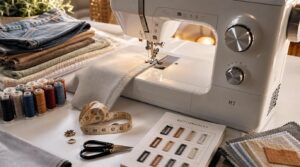
Testing a sewing machine tells you what the specs never will. We ran each beginner model through real stitching tasks — cotton seams, denim layers, buttonholes, and more — to see how they actually hold up.
Here’s what we found across every key performance category.
Straight Stitch Accuracy
A straight stitch is the foundation of almost every project you’ll tackle. On most beginner sewing machines, proper presser foot alignment and needle position keep your seams within ±0.5 mm over six inches.
Use a fabric guide, keep your stitch length consistent, and slow down your speed control. Tension calibration matters too — tight thread puckers, loose thread wanders.
Zigzag Stitch Quality
Once you move past straight stitches, zigzag stitch quality becomes your next real test. On a beginner sewing machine, Zigzag Width Settings between 3.5–4.5 mm give you clean Zigzag Edge Finish on most fabrics without tunneling.
Stitch Density Control and Fabric Stabilization Techniques matter too — slippery material shifts without a stabilizer.
Needle Type Impact is real: the wrong needle skips stitches and ruins consistent stitch quality.
Buttonhole Performance
Buttonhole performance is where many beginner machines quietly disappoint. A reliable buttonhole function depends on consistent Stitch Density, solid Bar Tack Strength at both ends, and stable Size Stability after washing.
Look for these in a good automatic buttonhole:
- Even stitch density with no Fabric Pucker
- Firm bar tacks that don’t fray
- Accurate sizing via preprogrammed style options
- Smooth one-step buttonhole completion
Buttonhole Speed matters less than consistency.
Thread Tension Consistency
Thread tension consistency is the difference between a seam that holds and one that unravels after three washes. For a beginner sewing machine, automatic thread tension takes the guesswork out — but it’s not foolproof.
Upper thread balance and bobbin tension tuning need to work together. Regular thread path cleaning and a simple calibration routine keep results predictable across cotton, knit, and everything between.
Fabric Handling on Cotton and Denim
Cotton and denim behave like two completely different beasts — and your beginner sewing machine needs to handle both. Fabric grain alignment keeps seams smooth on cotton, while proper denim needle selection and presser foot pressure prevent skipped stitches on thick layers.
Set your cotton stitch length around 2.0 mm, bump to 3.0 mm for denim, and always use a walking foot for even feeding.
Jam Resistance and Troubleshooting Ease
A jam doesn’t have to ruin your project. Most issues trace back to lint buildup, bobbin winding errors, or misaligned thread paths — all preventable.
Use your Jam Diagnostic Checklist: check Bobbin Cover Visibility, confirm Thread Path Color-Coding, and verify Fabric Feed Alignment.
An automatic needle threader and drop-in bobbin reduce setup mistakes substantially. Maintain your Lubrication Routine, balance thread tension and speed control, and troubleshooting stays simple.
Noise, Vibration, and Sewing Speed
Once jams are handled, noise and speed become your next comfort challenge. Most midrange machines run at 60–70 dB — about the level of a normal conversation.
For quiet operation tips, place your machine on a padded mat; it’s one of the simplest vibration dampening strategies available.
Use manual speed control to find your ideal stitch speed, balancing speed vs stability without rattling your whole table.
Accessories Beginners Should Consider
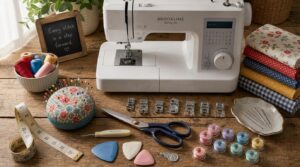
good sewing machine gets you started, but the right accessories keep you going. Without a few key tools, even simple projects can turn frustrating fast.
Here’s what you’ll want to pick up alongside your new machine.
Basic Presser Feet
Most beginner machines ship with a basic kit, but understanding presser foot types change what you can actually make.
Here are four worth knowing:
- Zipper foot guide stitches close to coil without snagging
- Edge foot technique keeps topstitching perfectly straight
- Walking foot advantage prevents shifting on quilts or denim
- Overcasting foot purpose finishes raw edges like a serger
Adjustable presser foot pressure helps you handle delicate and thick fabrics confidently.
Extra Needles for Different Fabrics
Your presser feet handle technique — but needles handle the actual fabric. Using the wrong one causes skipped stitches, snags, or even tears.
| Fabric Type | Needle Type | Size |
|---|---|---|
| Knit fabric | Knit Ballpoint Tips | 70/10 |
| Denim | Denim Needle Size | 90/14–100/16 |
| Silk | Silk Needle Selection | 60/8 |
| Leather projects | Leather Needle Types | 90/14 |
Follow this Stretch Needle Guide for swimwear: size 75/11 protects elastic fibers. Fabric compatibility matters more than most beginners expect.
Compatible Bobbins
Needles keep your stitches clean — bobbins keep your thread supply steady. Getting the wrong bobbin is a surprisingly common mistake.
Always check your manual for Bobbin Size Standards before buying.
Most Brother and Singer models use Class 15 or L-Style Compatibility bobbins. M-Style Usage unless your machine specifies it.
Stock multiple bobbins so you’re never mid-project without backup.
Seam Ripper and Measuring Tools
Two tools every beginner overlooks are a seam ripper and a measuring tape. An Ergonomic Seam Ripper with Replaceable Blade Care keeps your work clean without hand fatigue. A Flexible Measuring Tape manages curves and body measurements easily.
Fabric Marking Methods like washable pens and a Multi-tool Ripper use combo saves you switching tools mid-project.
Extension Table for Larger Projects
Working on a quilt or larger sewing project without enough surface space is like trying to eat soup with a fork — frustrating and messy. An extension table solves that immediately.
- Leaf Installation takes under a minute — no tools, just locking pins
- Stability Mechanics keep all four legs grounded during heavy-duty fabric handling
- Weight Distribution across reinforced rails facilitates quilt making and bag making evenly
- Material Compatibility suits most rectangular machines, including free arm setups
Cleaning Brush and Maintenance Kit
Lint is a sewing machine’s quiet enemy — it builds up fast in the bobbin housing and feed dogs. A good maintenance kit covers lint removal techniques with both fine and stiff bristle brush material types, plus a small bottle of oil for hook race lubrication.
Follow your manual’s oil application frequency, replace worn brushes every 6–12 months for spare brush replacement, and always power off first — basic safety precautions that protect both you and your machine.
Beginner Sewing Starter Kit
A good starter kit sets you up before your first stitch.
Stock your workspace with a measuring tape guide, sharp fabric cutting tools, and a thread color palette covering at least white, black, and a few basics. Keep stitch test swatches handy to dial in tension on scrap fabric first.
A portable storage bag keeps everything tidy — and beginner-friendly sewing machine accessories organized within reach.
Frequently Asked Questions (FAQs)
What type of fabric is easiest for beginners?
Cotton lawn and poplin weave are your best starting points. Both fabrics are lightweight, stable, and forgiving.
Chambray denim, poly-cotton blend, and ponte knit also handle smoothly — ideal fabric selection for beginner sewing projects.
Which sewing machine has the least problems for beginners?
The Brother XM2701 earns top marks for jam-free design and easy troubleshooting. Its solid construction, high reliability rating, and low user issue frequency make it the best overall entry-level pick.
What is the simplest sewing machine to operate?
The Janome MOD 19 wins here. Its minimalist stitch menu, easy-to-use control layout, and quiet motor operation keep things simple.
Add automatic needle threader and one-step buttonhole, and you’re sewing confidently in minutes.
Which sewing machine has the least problems?
The XM2701 consistently earns thousands of positive Amazon reviews and top User Satisfaction Scores. Reliability Rankings and Failure Rate Analysis show minimal Common Jam Issues, making it a dependable pick.
How do I choose my first sewing machine?
Start with your projects and your budget. Pick a Brand Reputation you trust, stay in the €150–€350 range, and don’t overthink stitch count — reliability beats features every time.
Can a beginner use a computerized sewing machine?
Yes, absolutely.
Most computerized sewing machines guide you through setup with on-screen prompts, Guided Stitch Selection icons, and Automatic Thread Tension — making Beginner Error Recovery nearly smooth right from your first stitch.
How do I choose a sewing machine brand?
Focus on brand reputation first—look for consistent reviews across models and clear warranty length.
Then check service network strength, parts availability, and community support.
A trusted brand saves you headaches later.
Can beginners use industrial sewing machines?
Technically, yes — but it’s a bit like handing a new driver a Formula 1 car.
With proper supervised training, safety gear, and the right workspace setup, beginners can absolutely learn on industrial machines.
What are the safety concerns with sewing machines?
Sewing machine safety covers electrical hazards, needle injuries, kickback risks, and fire prevention.
Always unplug before changing needles, keep fingers clear of moving parts, and practice safe threading every time you sit down to sew.
Is there a big difference in sewing machine weights?
Absolutely — the range is wider than most people expect.
Lightweight, portable small size machines can weigh as little as 3 pounds, while a heavy-duty sewing machine with a metal interior frame can hit 30-plus.
Conclusion
Picture your first finished seam—straight, clean, and entirely yours. That moment becomes real when machine that best suits beginners is the right one from the start.
right fit removes friction and keeps you moving forward, project after project.
Brother and Singer both deliver strong options under $200, but your choice should match your pace, your projects, and your goals.
Start simple, stay consistent, and the skill will follow.
- https://www.brother-usa.com/products/XS37?utm_source=openai
- https://www.janome.com/janome-arctic-crystal/?utm_source=openai
- https://www.youtube.com/results?search_query=first+sewing+project+for+beginners
- https://www.babylock.com/machines/sewing/zeal
- https://www.husqvarnaviking.com/en-US/Machines/H-CLASS-E20