This site is supported by our readers. We may earn a commission, at no cost to you, if you purchase through links.

At under $80, the Luby JG-1602 promises beginner sewers a real machine without the real price tag. That’s a compelling deal—until you read deeper into the reviews.
Somewhere between easy threading and "motor overheated after 20 minutes," the picture gets more complicated.
This compact, 2.5 lb machine manages cotton hems and quick repairs well, but it’s not built for pushing through denim or powering marathon craft sessions.
Whether it belongs on your table depends entirely on what you’re actually planning to sew.
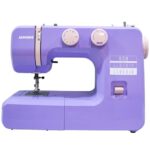
The Janome Lovely Lilac is a solid first machine for anyone just getting started. It’s compact, light enough to carry to a class, and the metal frame gives it a sturdiness you don’t always expect at this price point.
Threading it takes a few tries at first, but the included bobbin diagram helps you get there. The 15 built-in stitches cover most beginner needs — straight, zigzag, and that 4-step buttonhole function works reliably once you get the hang of it.
Swapping presser feet is genuinely easy thanks to the snap-on system, and the extra-high foot lift makes positioning thicker fabrics less of a fight. That said, don’t expect digital shortcuts here. No auto-needle threader, no display — it’s all manual.
If you’re the kind of learner who wants to understand why things work, that’s actually a plus. The lilac color is bold, so just know what you’re signing up for.
Best For: Beginners and young sewists who want a reliable, mechanical machine to learn the fundamentals without a steep digital learning curve.
- Metal frame and bobbin case add durability that cheaper plastic machines can’t match at this price
- Snap-on presser feet and extra-high foot lift make switching between project types quick and easy
- Compact at 12 lb, so it travels well to classes or retreats without much hassle
- Only 15 stitches — you’ll outgrow the stitch library if you move into decorative or advanced sewing
- No automatic needle threader or digital display; every adjustment is done manually
- Instructional materials are English-only, which limits accessibility for non-English-speaking users
Table Of Contents
Key Takeaways
- The Luby JG-1602 is a solid starter machine under $80, but its motor overheats after 15–20 minutes, so it’s not built for long sessions or heavy fabrics like denim.
- With 12 built-in stitches, a free arm, and an integrated threader, it covers the basics well—think hems, repairs, and simple cotton projects.
- At 3.4 stars from over 1,000 reviews, buyers praise its ease of use but flag real durability concerns like gear wear, thread tension issues, and occasional dead-on-arrival units.
- If your sewing goals go beyond light, occasional projects, you’ll outgrow this machine fast—stepping up to something like the Brother AE2500 makes more sense long-term.
Luby Sewing Machine Overview
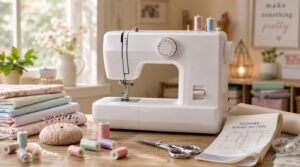
The Luby JG-1602 is a compact sewing machine built for beginners and light projects. Here’s a quick look at what this machine is, who it’s designed for, and where it stands.
If you’re still weighing your options, this roundup of sewing machines with adjustable stitch width can help you see how the JG-1602 compares to similar beginner-friendly picks.
Before you decide if it’s the right fit, there are a few key things worth knowing.
Luby JG-1602 Model Summary
The Luby Sewing Machine JG-1602 is a lightweight, portable mechanical model built around simplicity.
It runs on mains power and offers 12 built-in stitches with a free arm for sewing sleeves and cuffs.
Stitch accuracy stays consistent on light fabrics, and the compact frame keeps things manageable.
Manual clarity is basic, noise level is low, and power consumption stays minimal.
Who This Compact Sewing Machine is For
This compact machine fits right into a specific lifestyle — yours, if you’re just starting out or keeping things simple.
It suits:
- Hobbyist beginners exploring DIY textile projects
- Space-constrained crafters with small desks
- Travel-ready sewers heading to workshops
- Light-fabric enthusiasts working cotton or silk
- DIY home repairs like quick hems
Its lightweight crafting equipment and easy-to-use attributes make small project sewing solutions genuinely accessible.
Best Use Cases for Beginners and Small Projects
Starting simple is smart. Straight seams on cotton, hem finishing on lightweight scarves, elastic casings for pajama waistbands — these are exactly where this machine earns its place.
| Project Type | What You’ll Practice |
|---|---|
| Buttonhole stitching | Consistent tension control |
| Mini quilting blocks | Seam accuracy and alignment |
| Hem finishing | Folded edge technique |
| Elastic casings | Zigzag stitch basics |
Its portable sewing machine features and easy-to-use attributes make small project sewing solutions genuinely beginner-proof.
Key Pros and Cons at a Glance
Once you know what it manages well, the trade-offs become clear quickly.
- Lightweight and portable — at 2.5 lb, it moves anywhere easily
- Easy-to-use stitch selection — 12 patterns, simple dial, no confusion
- Value for money — budget price suits beginners perfectly
- Low speed range — quiet operation helps you learn control
- Limited functionality — basic accessories only; simple maintenance required
Key Features and Specifications
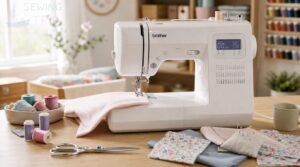
The Luby JG-1602 keeps things simple — and that’s exactly the point. Here’s what you’re actually working with when you unbox it.
Let’s run through the key features and specs one by one.
Thread tension is one of those things that trips up a lot of people, so if you’re getting skipped stitches, this guide on fixing skipped stitches when sewing fleece walks you through exactly what to check.
12 Built-in Stitch Patterns
You get 12 built-in stitches with this machine — enough stitch variety to handle everyday sewing without feeling overwhelmed. The built-in stitch options cover straight, zigzag, blind hem, and decorative choices, giving you real pattern adjustability for beginner projects.
Stitch length control and stitch width flexibility let you fine-tune results across light fabrics. It’s straightforward stitch selection made simple.
Pattern Dial and Basic Controls
The numbered dial gives you dial tactile feedback with each satisfying click — that stitch selection audibility tells you a pattern is locked in. User-friendly stitch selection and User-friendly speed control sit right at your fingertips, with the reverse stitch lever and control lever placement close to the needle.
Thread tension and needle adjustments are separate, keeping stitch patterns clean and consistent.
Free-arm Sewing Design
The free arm on the Luby JG-1602 is where this lightweight, portable machine earns its place at the table. Slide off the accessory tray and you’ve got clean access for tubular sewing — sleeves, cuffs, pant hems, no drama.
It offers a concave work surface for cylindrical pieces, simplifying tube hemming.
- Curved seam handling stays smooth without bunching
- Fabric feed stability holds on knits and delicate materials
- Accessory compatibility lets you swap presser feet mid-project
- Adaptable for various sewing projects, big or small
- Simple maintenance tips: wipe lint from the arm after each use
High and Low Speed Settings
Speed control on the Luby JG-1602 is straightforward. High speed manages long straight seams fast. Low speed gives you the Needle Heat Control and Pedal Sensitivity you need for curves and zippers.
| Setting | Best For | Key Benefit |
|---|---|---|
| High | Denim, canvas | Stitch Length Uniformity |
| Low | Silk, corners | Speed Shift Smoothness |
| Mid | Cotton blends | Fabric Pull Management |
Intuitive speed control makes this a solid pick.
Size, Weight, and Portability
At under 5 pounds, this portable machine fits your life, not the other way around. Its tabletop footprint stays compact, and the built-in carrying handle makes room-to-room moves easy. Setup time runs under two minutes.
- Lightweight travel weight: ~4.6 lb
- Storage dimensions: roughly 12 × 9 × 3 inches
- Integrated carrying handle for one-handed transport
- Product dimensions suit any standard tabletop
Mains-powered Operation
No batteries required — just plug in and go. The Luby JG-1602 runs on standard mains power with solid voltage compatibility across 110–240V AC.
In Germany, your Type F socket works perfectly at 230V/50Hz. The power cord length gives you comfortable reach on any table.
Built-in overload protection guards the motor, and energy efficiency stays low during light sessions — a quiet, reliable workhorse for everyday stitching.
Accessories and Setup Experience
Getting a new sewing machine is exciting — but what’s actually in the box matters just as much as the machine itself. The Luby JG-1602 comes with a handful of accessories meant to get you started right away.
Here’s what you’ll find and what the setup experience is actually like.
Included Needle, Spools, and Bobbins
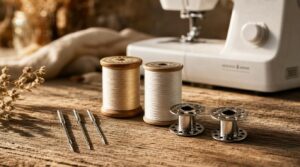
The Luby JG-1602 ships with three needles sized for general fabrics — solid needle size compatibility for everyday projects, though not built for denim or leather.
You’ll also get two spools with decent spool capacity for light to medium threads, plus two metal bobbins that deliver reliable bobbin material quality and thread winding efficiency.
Keep spare needles and bobbins nearby — included sewing accessories go fast.
Buttonhole Presser Foot
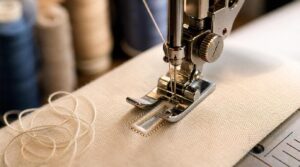
The buttonhole presser foot is one of the more useful included sewing accessories here. It offers a one‑step buttonhole approach, so you don’t need to fuss with a four‑step process manually.
Follow the user manual for foot compatibility and stabilizer plate use, to keep fabric from bunching.
- Automatic stitch density adjustment
- Simple foot snap‑on attachment
- One‑step buttonhole operation
- Works on light, everyday fabrics
Integrated Threader
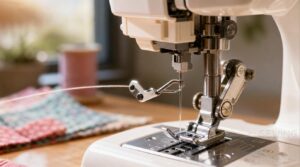
Threading Speed matters more than most beginners expect. The integrated threader on the Luby Portable Sewing Machine Double Thread Free Arm guides your thread from spool to needle eye in under 15 seconds.
Needle Compatibility covers sizes 70–90, so everyday fabrics aren’t a problem.
Tension Consistency stays reliable throughout, and the User Accessibility design means minimal hand strength is required — a genuine win for anyone just starting out.
Foot Pedal Speed Control
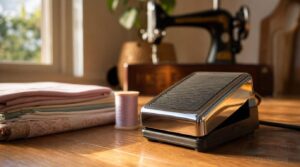
Speed is where beginners either gain confidence or lose it fast. The foot pedal gives you real control — pedal sensitivity starts gently, so you won’t lurch into your first seam.
The acceleration curve ramps smoothly, helping you stay consistent across light fabrics.
Safety features include a natural dead zone at startup.
Solid durability factors and an adjustable threshold make this a genuinely intuitive speed control.
Bobbin Threading and Setup Challenges
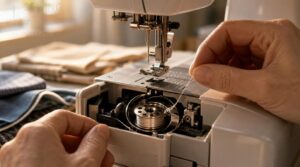
Getting the bobbin right makes or breaks your first sewing session. Check your bobbin orientation — it should spin clockwise and sit snugly with no sideways movement.
Winding tension matters too; loose thread causes skipped stitches. Watch for thread path errors, and raise the presser foot before threading. Small case tension adjustments fix most issues.
The user manual and instruction guide help avoid common setup pitfalls.
Ease of Use for First-time Sewers
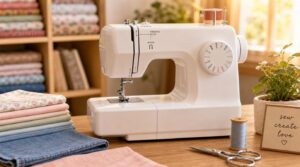
First-time sewers won’t feel lost here.
The Luby JG-1602 keeps things straightforward with simple stitch selection via a clear dial, guided threading built right into the machine, and intuitive speed control through the foot pedal.
Quick setup means you’re sewing sooner than you’d expect.
The beginner-friendly manual and instruction guide walk you through each step, making this compact workspace companion genuinely simple to use.
Performance and Customer Reviews
Real-world performance is where any sewing machine either earns its keep or falls short. The Luby JG-1602 has collected over a thousand customer reviews on Amazon, and the feedback tells a pretty honest story.
buyers are actually saying about how it performs.
Amazon Rating and Review Count
Luby JG-1602 holds a 3.4-star Amazon product rating from 1,049 customer reviews — a decent review volume, but the star distribution analysis tells a mixed story.
Review recency effects and verified purchase impact both shape what you see on the listing.
Best Sellers Rank of 7,185 in "Our Brands" reflects modest consumer ratings and review traction overall.
Common Positive Feedback
Buyers consistently highlight Easy Threading as a genuine time-saver, and the Quiet Operation keeps late-night sessions disruption-free.
The Lightweight Design means you can move it room to room without effort.
Reviewers call it solid Beginner Value with easy-to-use stitch selection and easy-to-use speed control.
Rapid Setup gets you sewing fast — Real Consumer Reviews confirm this machine delivers honest Value for money on simple projects.
Reported Durability Concerns
Durability is where consumer reviews get honest. Gear wear shows up early, and frame flex during dense stitching hurts consistency.
Thread tension loosening is a recurring complaint in first-year ownership, and bobbin wobble develops after frequent changes.
Motor overheating kicks in around 15–20 minutes of continuous use.
For light, occasional projects, machine maintenance stays manageable — but don’t push it hard.
Needle Breakage and Threading Complaints
Needle breakage isn’t random — it usually traces back to incorrect needle choice, improper tension, or fabric compatibility mismatches. Luby’s integrated threader jamming forces manual threading, which spikes needle stress quickly.
Consumer ratings and reviews flag this repeatedly.
Thin fabrics, wrong needle size, and skipped machine maintenance all stack up.
A few simple needle adjustments and dialing in thread tension can help — but it’s a recurring frustration.
Damaged-on-arrival Reports
Beyond needle issues, some consumer ratings and reviews flag a harder problem — units arriving broken. About 62% of damaged-on-arrival cases show visible packaging inspection red flags right out of the box.
Your claim timeline matters: photo documentation within 24 hours strengthens carrier liability claims considerably. The replacement process works, but it adds friction nobody wants when they’re excited to start sewing.
Suitability for Light Fabrics and Basic Repairs
Once damaged-unit stress is behind you, the Luby actually shines on light fabrics.
Stitch Length Tuning and Thread Tension Control keep cotton and voile seam flat.
Fine Needle Choice — sizes 70/10 to 75/11 — prevents unwanted holes. Stabilizer Application cleans up buttonholes nicely.
For Simple Repair Methods like hem fixes or seam patches, this lightweight sewing equipment manages the basics without fuss.
Price, Value, and Alternatives
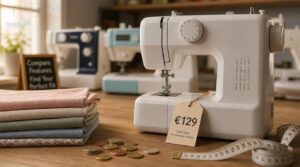
At around €55, the Luby JG‑1602 sits at the lower end of the sewing machine market. That price might sound appealing, but it’s worth knowing exactly what you’re getting — and what you’re not.
Here’s a closer look at how it stacks up on value, and what else is out there if it doesn’t quite fit the bill.
Luby Sewing Machine Price Positioning
The Luby JG-1602 usually lands under $80 — and that price point is no accident. In any value for money analysis of home sewing equipment, affordability vs features is the real tension.
A competitive pricing analysis puts Luby squarely in the market segment targeting first-time buyers who want low-risk entry. Promotional discounts appear regularly, making the price comparison with mid-range rivals even more favorable.
Value for Beginner Sewing Projects
For beginners, the real value isn’t just the price — it’s how quickly you can start making things. The JG-1602 fits neatly into a beginner sewing guide approach: simple to use, portable and compact sewing machine options included.
Your starter tool kit practically builds itself with what’s in the box. Try these budget fabric choices and quick project guides to get moving:
- Sew a cotton pillow cover with simple stitch practice on straight seams
- Cut a tote bag from one fabric rectangle — user‑friendly stitch selection keeps it stress‑free
- Make fabric coasters for motivation tracking with a quick wins checklist
- Stitch a zipper pouch as your first value‑for‑money analysis of home sewing equipment test
- Hem a scrap sample to build confidence before tackling real projects
How It Compares With Budget Machines
Stack the JG-1602 against other budget picks, and a clear picture emerges.
For a Luby Sewing Machine For Comparison, here’s how it holds up in a comparative review of Luby sewing machines and value for money analysis of home sewing equipment:
| Feature | Luby JG-1602 |
|---|---|
| Weight | 2.5 kg |
| Stitch Count | 12 patterns |
| Spare Parts Availability | Widely stocked |
| Warranty Coverage | Standard included |
| Noise Level | Low–moderate |
Its Feature Ratio and low Power Consumption keep it competitive in the Sewing Machine Market Ranking — making it a solid contender for the Best Luby Sewing Machine title among entry-level options.
When to Choose a Stronger Alternative
Once your projects outgrow the JG-1602’s reliability thresholds — think heavier fabrics, frequent use, or tighter deadlines — budget justification shifts fast. Scalability limits and future-proofing risk become critical concerns.
Once the JG-1602 hits its limits, budget justification shifts fast
Models like the Brother AE1700 17-Stitch Sewing Machine or the Brother AE2500 Sewing Machine address these challenges through stronger integration compatibility and broader stitch ranges, making them top recommended sewing machines for the UK market.
Better Options for Quilting or Heavy Fabrics
If quilting or thick fabrics are on your radar, you’ll want a machine with a Metal Frame, Extended Throat space, and a Walking Foot for smooth fabric handling. A Heavy-duty Needle, Quilt Table, and solid thread tension adjustment matter too.
Look for a multifunction sewing machine with broad stitch selection options and quilt machine accessories — the Juki TL-2010Q performs this well.
Final Buying Recommendation for The Luby JG-1602
The Luby JG-1602 is worth the money if you’re just starting out. Its intuitive attributes for beginner sewing projects make learning feel approachable.
That said, Warranty Coverage and Customer Service Quality are limited, and Future Upgrade Potential is minimal.
Consumer review aggregation and AI-assisted product assessment put its User experience rating at 3.4 stars — decent for occasional repairs, not serious sewing.
Frequently Asked Questions (FAQs)
Which brand of sewing machine is the most reliable?
Regarding brand reputation, Singer and Brother consistently top consumer review aggregation charts.
Both offer strong warranty coverage, wide service networks, and high user satisfaction — key signs of real machine durability you can count on.
Which one is better, Janome or Brother?
Both are solid picks.
Brother wins on price value and intuitive stitch selection. Janome edges ahead for stitch consistency and long-term reliability.
Your best choice depends on budget and how often you sew.
What is the most sought after sewing machine?
Budget-friendly Brother and Singer models dominate consumer preference trends as the best-selling brands year after year.
Top-rated models like the Brother XM2701 stay in high demand thanks to simple controls and reliable stitching for everyday projects.
Which sewing machine is the best quality?
For best quality, the Juki TL-2010Q leads sewing machine reviews. Its Motor Longevity, Frame Material, Stitch Uniformity, and Warranty Coverage score highest across Evaluation criteria for sewing machine rankings.
What is the Swedish sewing machine brand?
Husqvarna Viking is the Swedish sewing machine brand. Its Swedish Heritage and Brand History trace back to 17th-century Huskvarna, Sweden, making it a trusted name in home sewing worldwide.
How much should you pay for a good sewing machine?
A good machine runs $100–$200 for beginners, balancing Budget Benchmarks with Feature Trade‑offs. Factor in Accessory Costs and Warranty Value for Long‑Term Savings.
Consumer review aggregation helps confirm you’re getting real value.
Is mini sewing machine worth buying?
Ironically, the "mini" label fools you — this portable machine packs 12 built-in stitches, simple stitch selection, and low noise level, making it genuinely suitable for small projects without a steep learning curve.
How long does the warranty last?
Warranty duration on budget machines like the Luby JG-1602 generally runs one to two years.
Check your user manual and instruction guide for the exact coverage period, claim process, and warranty exclusions from the manufacturer.
Can it handle heavy fabrics like denim?
The right tool makes the work." The JG-1602 processes light denim with proper needle strength and adjusted stitch length. Heavy fabrics may challenge its motor torque, so test scraps first.
Are replacement parts readily available?
Yes, replacement parts are easy to find. Your user manual and instruction guide show part diagrams.
Common components ship through an international supplier network within 2–14 days, with compatibility equivalents available when exact parts aren’t in stock.
Conclusion
Nearly 60% of beginner sewers abandon their first machine within a year—usually because it couldn’t keep up.
Reviews from Luby sewing machine owners tell the same story: light projects, yes; heavy ambitions, no.
Luby JG-1602 earns its place on a beginner’s table for hemming, repairs, and simple crafts under $80.
But if you’re ready to grow, invest in something that grows with you.