This site is supported by our readers. We may earn a commission, at no cost to you, if you purchase through links.

Spend enough time in sewing communities and one name keeps surfacing in threads about serious home machines—the Juki HZL-DX7. Not because of aggressive marketing, but because sewists who buy it tend to stop shopping. That kind of loyalty from people who’ve handled dozens of machines says more than any spec sheet.
The DX7 sits at a crossroads between industrial reliability and home-machine convenience, borrowing feed technology from Juki’s commercial line while keeping the interface approachable. Its design bridges the gap between heavy-duty performance and user-friendly operation, making it a standout choice for dedicated hobbyists and professionals alike.
Whether you sew denim, delicate chiffon, or dense quilt sandwiches, the machine’s reputation suggests it accommodates the full range without compromise—and the details behind that reputation are worth examining closely.
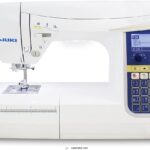
The Juki HZL DX7 is one of those machines that earns your trust quickly. Its 8-inch throat space handles quilts and wide fabric panels without the usual wrestling match, and the box feed system keeps multiple layers moving evenly — no walking foot required. With 277 built-in stitches, including four alphabet fonts, decorative borders and monograms are genuinely within reach. The auto-threader and built-in thread cutter save real time during long sessions, and the quiet motor means you can sew at 10 p.m. without waking anyone.
That said, a few things are worth knowing before you buy. The auto-threader can wear out faster than expected, and the bobbin winds in reverse, which trips people up initially and occasionally causes under-filling. The thin pedal cord also feels fragile for a
Table Of Contents
Key Takeaways
,599 machine. None of these are dealbreakers, but they’re worth factoring in.
Best For: Dedicated home sewists who tackle quilting, garment construction, and decorative work and want near-professional control without stepping up to an industrial machine.
- The box feed system keeps multiple fabric layers aligned consistently, making it reliable for quilting without extra attachments.
- 277 built-in stitches plus four alphabet fonts give you real creative range for both utility and decorative projects.
- Auto-threader, built-in thread cutter, and a quiet motor make long sewing sessions noticeably faster and less tiring.
- The auto-threader has a known durability issue and may fail sooner than expected with regular use.
- The reverse bobbin winding direction is counterintuitive and can cause thread positioning problems or an under-filled bobbin.
- The pedal cord feels thin and less sturdy than expected at this price point.
Key Takeaways
- The DX7’s industrial BOX feed system handles everything from sheer chiffon to heavy denim with consistent stitch quality, making it a true all-fabric machine rather than a specialist tool.
- At 1,050 SPM with quiet motor engineering and vibration dampening, you get professional-level speed without the noise and fatigue that usually come with it.
- The learning curve is real—threading, tension adjustment, and navigating 287 stitches will cost you time upfront, but the machine rewards the effort once you’re past it.
- A five-year mechanical warranty, 50+ global service centers, and strong resale value make the $2,299 price tag a long-term investment rather than just a big purchase.
Juki HZL-DX7 Overview and Specifications
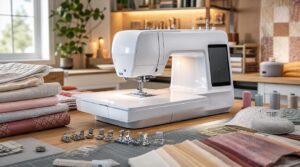
The Juki HZL-DX7 packs a serious amount of technology into a home machine, and the specs back that up. Before deciding if it’s worth $2,299, it helps to know exactly what you’re getting under the hood.
Here’s a closer look at the core features that define this machine.
If you want a broader picture, this sewing machine parts guide walks through every major section you’ll typically encounter across different models.
Computerized Sewing Technology and LCD Interface
The Juki HZL-DX7’s 3-inch LCD screen puts real control at your fingertips. Touchscreen Navigation feels effortless — you’re selecting stitches, adjusting parameters, and checking Real-Time Tension indicators without digging through menus. On-Screen Stitch Editing lets you tweak length and width before a single stitch drops. Connectivity Options even support Firmware Updates, keeping this computerized sewing machine current as your skills grow.
Many modern machines, like the GC0313‑D4, also feature integrated touchscreen industrial machines for heavy‑duty applications.
287 Built-in Stitches and Four Monogram Fonts
Beyond the smart LCD interface, the stitch library here is genuinely impressive. With 287 built-in stitches and four font customization options for monogramming, your design inspiration won’t hit a wall anytime soon. Stitch memory lets you save go-to sequences for faster setup. Here’s what stands out:
- 287 built-in stitches spanning utility, decorative, and quilting
- Monogram scaling adjusts for different project sizes
- Four distinct font styles with upper and lower case support
- Single-letter preview before stitching for perfect alignment
Stitch Speed Up to 1,050 SPM
Speed is where the DX7 truly excels. At 1,050 stitches per minute, the adjustable stitch speed seamlessly handles everything from intricate detail work to full-throttle production runs.
Real-Time Speed Calibration ensures precise stitch timing, while Vibration Dampening Technology and Motor Thermal Management prevent overheating and vibrations during extended use.
Speed Programming Modes and the intuitive speed controller allow you to fine-tune settings for any project’s unique demands.
Machine Dimensions, Weight, and Portability
For a machine this capable, you might expect something bulky. At 18.9 × 14.0 × 8.6 inches and roughly 22 pounds, the DX7’s compact footprint actually surprises most people.
Its integrated carry handle and balanced weight distribution make room-to-room moves manageable. Rubber foot stability keeps it planted during use, and the portable cord storage ensures setup stays clean wherever you land.
Key Features of The Juki HZL-DX7
The Juki HZL-DX7 doesn’t just check boxes — it’s built around features that actually change how you sew.
If you’re weighing whether the price makes sense, this breakdown of serger and sewing machine costs puts the DX7’s value in real perspective.
A few of them stand out as genuinely worth your attention before anything else. Here’s what makes this machine different from the rest.
Industrial-Grade BOX Feed System
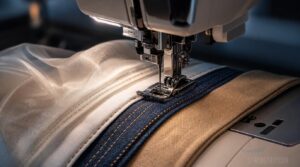
What separates a good stitch from a perfect one often comes down to how the fabric moves. The DX-7’s industrial-grade box feed system borrows from industrial sewing machine design, keeping feed dogs engaged longer for consistent feed rate control across every pass.
Wear-resistant housing and smart sensor integration mean less maintenance fuss, while the system manages everything from sheer silk to heavy canvas. This design ensures industrial-strength stitch quality regardless of material.
16 One-Step Sensor Buttonhole Styles
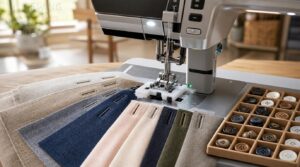
Buttonhole work doesn’t have to feel like a gamble. The Juki HZL-DX7 gives you 16 one-step sensor buttonhole styles with built-in Size Consistency every time — no guessing, no resewing.
Here’s what the Sensor Feedback Loop delivers:
- Button Size Adjustment in 2 mm increments for precise fitting
- Edge Stability with uniform stitch density throughout
- Installation Compatibility via standard snap-on attachment
- Automatic length measurement matched to your button
- Real-time sensor corrections for fabric thickness changes
Automatic Needle Threader and Thread Trimming
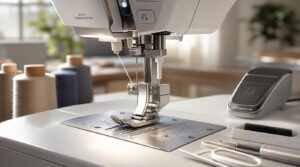
Threading a needle by hand gets old fast — that’s where the DX7’s automatic needle threader earns its keep. Threader reliability is genuinely impressive here; one controlled motion guides thread through the eye cleanly, with safety interlocks preventing engagement mid-stitch.
The built-in thread cutter manages automatic thread cutting, with trim length control integrated into the heel switch.
For maintenance tips, keep the threading path lint-free to ensure optimal performance.
Knee Lifter and Presser Foot Float Function
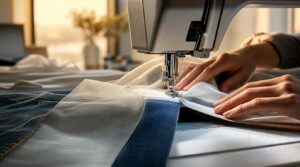
The kneelifting lever on the DX7 puts real control at your knee, freeing both hands for seam pivot precision when maneuvering tight corners. Ergonomic knee placement ensures the motion remains natural, while adjustable lift height accommodates fabrics from sheer to denim.
The float feature minimizes adjustable foot pressure against fabric layers, preventing shifts or bunching. Meanwhile, float tension control maintains consistent stitching—eliminating skipped stitches and ensuring layers stay aligned.
Performance and Sewing Capabilities
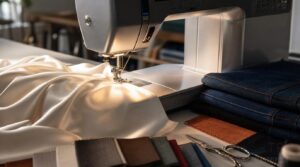
The DX7 doesn’t just look impressive on paper — it backs up those specs where it counts most: at the machine.
From delicate satin to stubborn denim, it accommodates a surprisingly wide range of real sewing challenges. Here’s how it performs across the tasks that matter most to serious sewists.
Handling Lightweight to Heavy Fabrics
From delicate lacey patterns to heavyweight denim, the DX7 manages it all without flinching. Needle size matching and thread weight pairing are straightforward once you dial in your fabric tension settings. Stitch length tuning keeps seams clean across every weight, and stabilizer techniques prevent shifting on slippery weaves.
The BOX feed system earns its keep here — fabric compatibility is genuinely impressive across the range.
Stitch Quality and Consistency Across Projects
Consistent stitch quality is where the DX7 truly earns its price tag. Industrial-level stitch quality shows in every seam — tension stays balanced, density doesn’t waver, and the feed dog accuracy keeps fabric advancing without creep.
- Stitch Tension Balance holds within 2–3 units across fabric weights
- Seam Allowance Precision stays within 0.1 cm for uniform strength
- Consistent Stitch Density responds to thickness automatically
- Thread Path Smoothness eliminates skips on decorative patterns
- Feed Dog Accuracy prevents drift on long straight seams
Free-Motion and Decorative Quilting Performance
Sophisticated foot controls and adjustable thread tension make weaving complex motifs feel controlled, not chaotic.
Garment Construction and Upholstery Sewing
From garment making to upholstery stitching, the DX7 manages it all with confidence. Whether you’re sewing seam finishes on a custom-made jacket or working through heavy-duty fabrics, the box-feed system keeps every layer moving evenly.
- Fabric prewash before cutting prevents post-seam distortion
- Interfacing choice shapes collars and cuffs cleanly
- Tailor adjustments land precisely with stitch width control
- Seam locking holds upholstery under real stress
Pros, Cons, and User Feedback
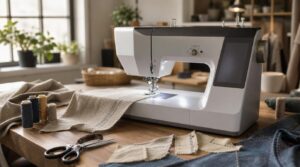
No machine is perfect, and the DX7 is no exception — but it gets a lot more right than wrong.
Real-world users have plenty to say about what makes this machine stand out and where it falls short.
Here’s a balanced look at the pros, cons, and how it holds up against the competition.
Ease of Use for Intermediate and Advanced Sewists
The DX7 isn’t built for beginners — and it doesn’t pretend to be. That said, its straightforward setup and accessible controls make the learning curve feel manageable rather than steep.
Color-coded LED alerts, adaptive speed control, and step-by-step tutorials guide you through sophisticated sewing projects without hand-holding. These features ensure a structured yet independent learning experience.
Customizable shortcuts and button-based machine interfaces keep your workflow moving, letting you focus on the craft itself. This design prioritizes efficiency and creativity, minimizing distractions.
Common Praises Including Quiet Operation
Once you get past the learning curve, the DX7 rewards you with performance that speaks for itself. Quiet operation tops the praise list — users consistently note its low motor noise and minimal vibration, even pushing 1,050 SPM.
That soft operational hum and quiet pedal response make long sessions genuinely comfortable. Silence at speed isn’t a gimmick here; it’s engineered in.
The Juki HZL-DX7’s quiet operation at full speed isn’t a gimmick—it’s deliberately engineered in
Common Complaints and Learning Curve
The Juki HZL-DX7 presents a steep learning curve, with threading difficulty and tension adjustment consuming 15–20 minutes of early sessions. Even experienced users struggle with LCD navigation when selecting specialty stitches, and mastering 287 stitch options demands significant practice.
Free-motion learning introduces another layer of complexity, requiring additional time and patience to refine.
User experiences confirm the machine is not beginner-friendly, though consistent effort leads to fast mastery once foundational skills are established.
How It Compares to Brother and Other Competitors
When stacked against Brother competitors, the Juki HZL-DX7’s price-to-performance ratio holds up well. Its industrial BOX Feed system and 16 sensor buttonhole styles outclass most Brother alternatives in utility.
Unlike the Juki TL2010Q or HZLF600, the DX7 balances home usability with near-professional output.
Broad accessory compatibility, solid retail availability, and a steadily growing user community further strengthen its appeal.
Accessories, Warranty, and Support
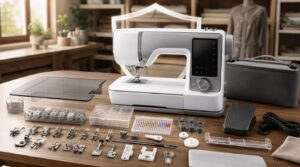
A $2,299 machine should come loaded with everything you need to hit the ground running—and the DX7 doesn’t disappoint.
Beyond the stitches and speed, what you get out of the box, the warranty backing it, and the support behind it all matter just as much as raw performance. Here’s a closer look at what’s included and what’s protecting your investment.
12 Included Presser Feet and Bundled Tools
The DX7 comes standard with twelve snap-on presser feet, covering functions from zipper insertion and blind hems to overcasting and buttonhole sewing. The quick-change mechanism allows swapping feet in seconds, without needing tools. The presser feet are made from durable materials—hardened metal with polished surfaces—ensuring smooth fabric glide during use.
Bundled tools include essentials like bobbins, needles, a seam ripper, lint brush, and quilting guide, providing comprehensive support for diverse sewing projects.
Extendable Work Table and Storage Drawer
Your workspace grows with you here. The extension table adds serious room for large quilts or denim panels, and the Surface Durability holds up to daily use.
- Extension Mechanism locks flush when closed
- Drawer Load Capacity rated at 50 pounds
- Compatible with free arm configurations
- Maintenance Guidelines: annual graphite lubrication
- Compatibility Options suit standard accessories and machine dimensions, weight, and portability needs
Optional Upgrade Kits and Compatible Accessories
The DX7’s upgrade ecosystem genuinely extends what you can do. Compatible kits mount directly onto the frame — no custom brackets needed.
You’ll find practical additions like a Non-Stick Foot for vinyl, a High-Shank Adapter, Thread Tension Gauge, LED Lighting Kits, and a Magnetic Accessory Tray.
These additional accessories pair cleanly with the extension table and standard accessories already included with the Juki HZL-DX7.
Five-Year Warranty and Global Customer Support
Buying a $2,299 machine means the warranty matters as much as the stitches it makes. Juki’s five-year coverage on mechanical parts — plus two years on electronics — gives you real peace of mind.
Here’s what the warranty and customer support include:
- Claim Process is straightforward — register, submit your serial number, and get an RMA fast
- Regional Service Centers operate across 50+ countries for local repairs
- Remote Diagnostics let technicians troubleshoot without you shipping anything
- Repair Turnaround Times target 3–7 business days after receipt
- Extended Warranty Options vary by region through authorized dealers
The Juki HZL-DX7’s warranty and support details reflect a company standing confidently behind its product.
Frequently Asked Questions (FAQs)
What is the most trouble-free sewing machine?
The Juki HZL-DX7 earns high marks for low maintenance, jam-free feeding, consistent tension, and simple threading.
Its reliable electronics and smooth user experience make it one of the most trouble-free machines available today.
How much does a Juki DX7 weigh?
At 6 pounds (3 kg), the Juki HZL DX7 is manageable for most sewists. That’s light enough to relocate between rooms without strain.
Are Juki sewing machines better than Brother?
Neither brand wins outright — it depends on what you need. Juki leads in speed, precision, and brand reliability for experienced sewists. Brother edges ahead on price to performance for beginners.
What is the difference between Juki DX7 and DX2000?
The DX2000 steps up with an Extended Throat Width, a Thread Stand, a Larger Accessory Kit, and an Additional Font Library.
The DX7 keeps things simplified — ideal for most home and garment projects.
Is the Juki DX7 low shank?
Yes, the Juki HZL-DX7 is low shank — this feature immediately expands compatibility with third-party feet, simplifies replacement foot guidance, and ensures robust shank integration for your sewing setup.
Why are Juki sewing machines so expensive?
The price reflects All-Metal Build, Precision Engineering, and High-Speed Components built to last 10–20 years.
Add a Global Service Network and strong Resale Value Retention, and the value proposition speaks for itself.
Which is best Juki or brother?
Juki wins for heavy-duty precision; Brother suits beginners better.
Your price comparison, project scale, and learning curve tolerance are decisive factors.
For serious sewists, the Juki HZL-DX7’s industrial-grade performance justifies every dollar.
What is the warranty period for the Juki HZL-DX7?
The machine warranty covers five years on mechanical parts and two years on motors and electrical components, with one free labor year included.
This provides solid warranty duration and coverage details for a $2,299 investment.
How often does the Juki HZL-DX7 need to be serviced?
Servicing needs depend on how often you sew. Heavy daily use calls for maintenance every 6–12 months, while occasional hobby sewing stretches that to every 12–24 months comfortably.
What is the maximum sewing speed of the Juki HZL-DX7?
When it hits full stride, the Juki HZLDX7 reaches 1,050 stitches per minute. Its adjustable stitch speed and speed control dial let you dial back precision work without sacrificing power.
Conclusion
Precision, performance, and proven reliability—that’s the DX7’s signature in three words. Every Juki DX7 review thread tells the same story: sewists buy it once and stop second-guessing their setup.
The BOX feed system effortlessly handles denim and chiffon, while stitch quality remains consistent across projects. The five-year warranty reinforces its durability, backing every seam with confidence.
If you’re ready to invest in a machine that genuinely grows with your craft, the DX7 earns that commitment completely.
- https://jukiclub.com/juki-dx7-favourite-features/
- https://jukijunkies.com/juki-hzl-dx7-computerized-quilting-and-sewing-machine/?srsltid=AfmBOopqK31go0wk1hnAjBZO4jhOIRTtNWnp4IBx7P8K6dM0HEm0CJJQ
- https://www.premierstitching.com/juki-hzl-dx7-computerized-sewing-and-quilting-machine/?srsltid=AfmBOorcT8S4JLq0C291OzaZcN2AUttM1-hdOCdc7nx6knrd2vZK8etA
- https://sterlingsewing.com/sewing-machine/50-juki-hzl-dx7.html?srsltid=AfmBOoobgbTMJz5-B1F_ucd6TYu648vCHhiOy5QFMdiYW2TndtRHP_Pv
- https://www.qualitysewing.com/products/juki-hzl-dx7?srsltid=AfmBOoo6x0TkWvN3TbjbOVR91ordaL9C_j0Y8qDLCZhb5JLbV2i4O9aM