This site is supported by our readers. We may earn a commission, at no cost to you, if you purchase through links.
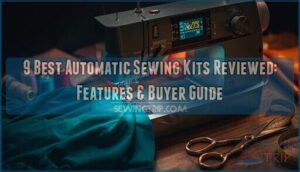
Modern sewing machines can execute 1,000 stitches per minute with digital precision, yet many sewers still wrestle with manual threading, tension adjustments, and inconsistent stitch quality.
Automatic sewing kits eliminate these friction points by bundling computerized controls with essential accessories, transforming fabric work from a test of patience into a well-organized technical process.
These systems incorporate electronic needle positioning, programmable tension management, and one-touch stitch selection—features that compress setup time and expand creative possibilities.
Whether you’re reinforcing seams on heavy canvas or finishing delicate silk hems, the right automatic kit matches machine architecture to your specific workflow demands, balancing upfront investment against long-term efficiency gains.
Table Of Contents
- Key Takeaways
- What Are Automatic Sewing Kits?
- Key Features of Automatic Sewing Machines
- Benefits of Using Automatic Sewing Kits
- Types of Automatic Sewing Machines
- Choosing The Right Automatic Sewing Kit
- Top 9 Automatic Sewing Kits Reviewed
- 1. SINGER Heavy Duty Sewing Machine Kit
- 2. Singer Start 1304 Sewing Machine
- 3. Brother Computerized Sewing and Quilting Machine
- 4. SINGER M3500 Sewing Machine with Kit
- 5. Singer Quantum Stylist Sewing Machine
- 6. Juki TL-2000Qi Sewing Quilting Machine
- 7. Bernette B79 Sewing and Embroidery Machine
- 8. Brother XM2701 Lightweight Sewing Machine
- 9. Brother SE700 Sewing Embroidery Machine
- Essential Maintenance for Automatic Sewing Kits
- Comparing Automatic and Manual Sewing Machines
- Future Trends in Automatic Sewing Technology
- Frequently Asked Questions (FAQs)
- Conclusion
Key Takeaways
- Automatic sewing kits integrate computerized controls with electronic needle positioning and programmable tension management, compressing setup time from minutes to seconds while delivering stitch rates up to 1,000 per minute with precision that manual systems can’t match.
- Key automation features—automatic needle threading, built-in stitch libraries exceeding 100 patterns, adaptive tension sensors, and thread-cutting mechanisms—eliminate the manual calibration and repeated adjustments that traditionally frustrated beginners and slowed experienced sewers.
- Choosing the right kit demands matching machine capabilities to your actual fabric weight range and project complexity rather than chasing feature counts, with entry-level models starting around $150 for basic automation and mid-range computerized units reaching $300–$1,200 for expanded stitch libraries and touchscreen interfaces.
- Proper maintenance through regular lint removal every 2–3 bobbins, needle replacement every 6–8 sewing hours, and annual professional servicing extends machine lifespan to 10–20 years while preventing the tension inconsistencies and skipped stitches that compromise stitch quality.
What Are Automatic Sewing Kits?
Automatic sewing kits represent a significant shift from the needle-and-thread sets your grandmother used, integrating electronic controls and precision engineering into compact sewing systems.
These kits bundle computerized or mechanized machines with essential accessories, streamlining tasks like threading, tension adjustment, and stitch selection that traditionally required manual dexterity and experience.
Understanding what sets these systems apart—from their core components to how they function compared to conventional sewing tools—helps you make informed choices when upgrading your sewing setup.
Definition and Components
Automatic sewing kits bring computerized precision to your fabric projects, replacing manual guesswork with electronic controls that handle everything from stitch formation to speed adjustments. These component-rich systems integrate mechanical parts with digital interfaces, letting you switch between 10 to 500 built-in patterns depending on model variations you choose. A beginner could also consider purchasing a complete sewing kit to learn the basics.
Core components include:
- Needle bar and presser foot assemblies for precise thread manipulation
- Feed dogs that advance fabric 0.5 to 6 stitches per inch
- Bobbin case system enabling interlocking upper and lower thread loops
- Electronic controls managing servo motors at speeds up to 850 stitches per minute
- LCD screens displaying stitch options with real-time preview functions
How Automatic Sewing Kits Work
Once you’ve selected your stitch pattern on the LCD interface, embedded microprocessors control servo motors that drive needle bar movement, feed dog advancement, and thread tensioning in synchronized cycles. Electronic control systems use sensors to detect fabric thickness and adjust penetration force automatically, while system feedback loops monitor each stitch formation at rates exceeding 850 cycles per minute. Component integration allows adaptive sewing that reacts to material variations without manual recalibration. These machines also offer simple controls, reducing the learning curve for new users.
| Component | Function | Automation Benefit |
|---|---|---|
| Servo motors | Drive needle and feed dogs | Consistent stitch speed |
| Tension sensors | Monitor thread resistance | Auto-adjust for fabric type |
| Microprocessors | Coordinate all operations | Eliminate manual timing errors |
| Feedback loops | Detect stitch irregularities | Real-time error correction |
Differences From Traditional Kits
Unlike mechanical machines with manual dials, automatic sewing machines offer digital interfaces and LCD screens that replace analog controls. You’ll find hundreds of decorative and utility stitches instead of basic options, slider-based speed control rather than foot-pedal-only operation, and one-step buttonhole automation versus multi-step manual processes.
Computerized sewing machines also provide precise needle positioning digitally, while standard mechanical machines generally offer only left, center, and right placements.
Key Features of Automatic Sewing Machines
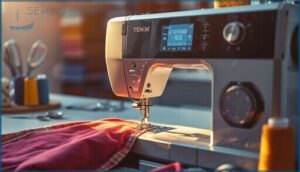
Automatic sewing machines distinguish themselves through integrated features that simplify the mechanics of stitching and eliminate repetitive manual adjustments. These machines incorporate electronic controls and precision components that handle tasks you’d otherwise manage by hand, from threading the needle to regulating thread tension.
Understanding which features matter most for your projects will help you identify machines that align with your technical requirements and creative ambitions.
Automatic Needle Threading
You’ll quickly appreciate how the threading mechanism in modern sewing machines addresses one of the biggest sources of user frustration. Automatic needle threading cuts setup from minutes to under 5 seconds, using a thin wire hook to capture thread through needle eyes sized 9 to 18.
Thread compatibility works best with thin to medium weights, maintaining a 95% success rate.
Regular maintenance tips include cleaning to prevent hook misalignment—extending functionality across beginner sewing machines and heavy-duty models alike.
Built-in Stitch Selection
Modern automatic sewing machines come loaded with preprogrammed stitch selection—entry-level models offer under 20 builtin stitches, while high-end units exceed 600 patterns. You’ll navigate stitch variety through dials or digital user interfaces, achieving stitch accuracy via mechanical cams or stepper motors.
Stitch customization lets you adjust length and width, expanding your project versatility.
Future innovations include AI-powered pattern recognition, enhancing stitch patterns and overall automatic sewing machine features.
Automatic Tension Adjustment
Automatic tension adjustment eliminates the guesswork that once demanded experience to balance upper and lower thread forces. Your machine’s sensors monitor fabric thickness and stitch pattern, dynamically regulating paired tension discs to prevent puckering from excessive pull or loose loops from insufficient grip—maintaining consistent stitch quality at speeds up to 1,000 stitches per minute.
- Productivity benefits: You’ll cut setup time when switching between delicate silk and heavy denim, minimizing material waste from defects that require seam removal.
- User experience: Beginners achieve predictable results without repeated manual tuning, while skilled users retain digital fine-tuning for specialized projects.
- Stitch quality: Sensors catch thread behavior anomalies in real time, reducing thread breakage and unplanned downtime across sewing machine features.
- Market availability: Midrange and high-end automatic sewing machines now bundle tension mechanisms with auto thread cutting, reflecting growing consumer demand in buying guides.
Thread Cutting and Bobbin Features
How does your machine eliminate thread tails without scissors? Automated trimming systems cut both threads at fabric-adjacent locations up to 3,450 rpm, matching industrial workflows that boost productivity by 20 percent.
Bobbin capacity extends sewing runs—jumbo designs hold 70 percent more thread—while low-thread detection sensors stop stitching before depletion.
Consistent tension and winding integration promote uniform seam appearance and reduce manual handling interruptions.
Benefits of Using Automatic Sewing Kits
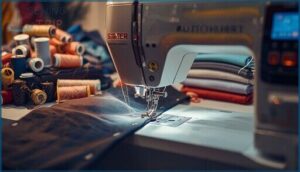
Automatic sewing kits transform how you approach fabric projects, whether you’re threading your first needle or running production batches through industrial machines. The shift from manual control to automated precision isn’t just about convenience—it’s about measurably better results, faster turnaround times, and fewer headaches when you’re working with challenging materials.
Automatic sewing kits deliver measurably better results, faster turnaround, and fewer headaches through automated precision—whether you’re a beginner or running production batches
Let’s break down the concrete advantages you’ll gain when you switch to automation.
Increased Efficiency and Productivity
You’ll see the biggest impact in your workflow automation when you switch to automatic sewing machines. Documented output gains show robotic lines producing 1,142 shirts per eight-hour shift versus 669 from manual setups. That’s nearly double the productivity gains.
Time savings add up quickly—automation benefits include reduced task cycles and 80% less downtime, boosting both labor productivity and equipment utilization across your operation.
Enhanced Stitch Quality and Consistency
Programmable tension control cuts seam puckering by 20–30%, while computerized feed delivers uniform stitch length within 2.0–4.0 mm. You’ll achieve repeatable stitch accuracy across fabric types, with electronic systems holding under 5% variation in lockstitch formation.
Smart fabric adaptation adjusts parameters for material stiffness and thickness, and long-term reliability maintains consistent seam quality over thousands of cycles at speeds approaching 1,000 stitches per minute—error reduction without manual intervention.
User-Friendly Operation for Beginners
You’ll find that beginner-friendly sewing machines eliminate much of the early frustration through simplified controls and automated setup. Automatic needle threading cuts installation time below 5 seconds, while built-in guidance with preset stitch parameters removes guesswork.
Speed management prevents runaway stitching, and ergonomic design—including free-arm configuration and top-loading bobbins—gives you visual confirmation and better control during your first projects.
Versatility for Various Projects
Your automatic sewing kit adjusts to evolving project needs with multi-fabric compatibility spanning cotton, denim, canvas, and technical textiles. Built-in stitches and pattern programmability let you shift from garment work to upholstery or accessories without manual recalibration.
- Handle home décor, quilting, and apparel on one platform
- Support precision applications from curved seams to reinforced stress points
- Scale seamlessly from home-industrial use to small-batch production
- Access diverse fabrics and weaving techniques with appropriate accessories
Types of Automatic Sewing Machines
Automatic sewing machines come in several distinct configurations, each engineered to address specific operational requirements and user skill levels. The primary distinctions involve internal control mechanisms, portability characteristics, and power delivery systems designed for different fabric weights and production volumes.
Understanding these categories will help you match machine architecture to your intended applications and workspace constraints.
Computerized Vs. Mechanical Models
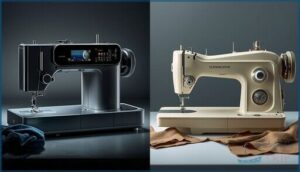
When you’re weighing computerized sewing machines against mechanical machines, you’ll find digital vs. analog approaches that shape user experience distinctly. Computerized models offer hundreds of built-in stitch capabilities with touchscreen controls, while mechanical machines deliver fewer than 20 options through manual adjustments.
Your cost analysis reveals computerized units demand higher initial investment but automate tension and threading, whereas mechanical types require more hands-on maintenance needs yet often outlast electronic components by years.
Portable and Handheld Options
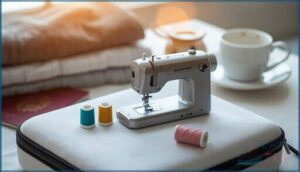
If you need travel sewing solutions or repair convenience on the go, portable sewing machines and handheld sewing machines deliver compact power in remarkably small footprints—many weigh under 1 kg and measure less than 30 cm. Their portable design suits quick fixes and hemming, yet stitch limitations with heavier fabrics like denim remain a real concern. Market growth continues at 2.7–8.9% annually, driven by DIY enthusiasm.
Consider these mini sewing machines for:
- Emergency clothing repairs during trips
- Curtain alterations in dorm rooms
- Craft projects requiring minimal setup
- Battery-powered off-grid mending
- Drawer storage between seasonal uses
Heavy Duty and Industrial Machines
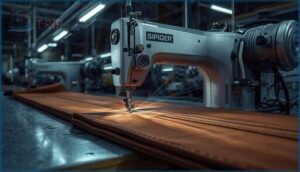
When portable machines hit their limit, heavy-duty sewing machines take over. Industrial-grade sewing equipment in factories often runs 3,000–5,000 stitches per minute, handling leather, canvas, and upholstery at production capacities manual units can’t match.
Automation features like thread trimming and programmable tension reduce operator workload, while servo motors boost energy efficiency by 70%. Material handling upgrades and durable metal frames ensure these workhorses survive multi-shift schedules on demanding fabrics.
Choosing The Right Automatic Sewing Kit
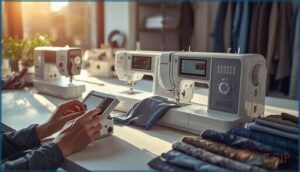
Choosing the right automatic sewing kit isn’t about picking the fanciest machine on the shelf—it’s about matching technical capabilities to your actual workflow and project demands. You’ll need to evaluate everything from fabric weight compatibility and stitch regulation precision to long-term value and feature sets that align with your skill progression.
Let’s break down the key factors that separate a smart investment from an expensive mistake.
Assessing Your Sewing Needs
Your sewing goals shape every feature you’ll actually use. Before browsing automatic sewing machines, match your reality to machine capabilities through five key factors:
- Skill Level – Beginners need easy-to-use controls; experienced sewers demand precision adjustments
- Time Availability – Weekly sessions of 2–4 hours suit hobbyists; daily sewing justifies premium investment
- Project Complexity – Simple garments require basic stitches; tailoring demands specialized functions
- Sewing Frequency – Occasional projects tolerate entry-level machines; regular use needs durability
- Motivation Factors – Creative exploration versus wardrobe construction drives different sewing machine buying guide priorities
Fabric Compatibility and Project Types
Your machine’s fabric compatibility determines which sewing projects you can tackle confidently. Domestic automatic machines handle fabric weight from 60 g/m² lightweight cotton to 400 g/m² medium canvas when you pair appropriate needle selection with fabric types.
Quilting projects and woven garments work best with universal needles sized 70/10 to 90/14, while knit projects demand ballpoint needles to prevent fiber damage and skipped stitches across home sewing projects.
Budget and Value Considerations
Before you commit financially, entry-level pricing generally starts around USD 150 to 300 for machines with essential automatic features, while mid-range computerized models stretch from USD 300 to 1,200—a sewing machine price range that reflects genuine capability differences.
Your budget considerations should balance three priorities:
- Upfront affordability against your immediate project needs and feature prioritization
- Long-term costs including routine maintenance averaging USD 50 to 85 per service visit
- Brand value and repair affordability, since control board replacements can exceed USD 300
Comparing Features and Performance
Speed vs. Accuracy forms your performance baseline—entry-level automatic sewing machines deliver 600 to 1,000 stitches per minute with reliable stitch consistency, while mid-range computerized models reach 1,000 to 1,500 SPM without sacrificing precision.
| Feature Category | Entry-Level Models | Mid-Range/High-End Models |
|---|---|---|
| Automation Levels | Needle threading, basic tension | Programmable stitches, fabric sensors, app integration |
| Material Compatibility | Cotton, polyester, light denim | Heavy-duty fabrics: leather, canvas, multiple layers |
| Built-in Stitches | 20-60 utility stitches | 100-200+ utility, decorative, quilting patterns |
| Digital Interface | LCD display, button controls | Touchscreen, Wi-Fi connectivity, tutorials |
| User Satisfaction | High for beginners, limited versatility | Excellent across skill levels, professional results |
Your sewing machine comparison should prioritize actual sewing machine performance metrics—motor power (50-100W domestic vs. 450-550W industrial), warranty coverage (90 days to 25 years), and computerized sewing machines’ self-diagnostic capabilities that reduce troubleshooting time and improve long-term value.
Top 9 Automatic Sewing Kits Reviewed
You’ve narrowed down your requirements, and now it’s time to see what’s actually available. The machines reviewed here represent a range of capabilities, from entry-level models suited for beginners to heavy-duty options built for demanding projects.
Each review highlights the technical features, performance characteristics, and ideal use cases to help you make an informed decision.
1. SINGER Heavy Duty Sewing Machine Kit
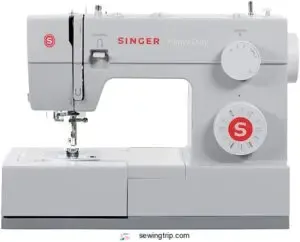
You’ll find the Singer Heavy Duty Sewing Machine delivers outstanding motor performance at 1,100 stitches per minute, handling thick fabrics with ease. Its heavy-duty metal frame provides the stability you need for demanding projects, while the automatic needle threading streamlines setup.
With 97 stitch applications and built-in stitch selection, you can tackle everything from upholstery to denim. Market adoption remains strong due to reliable construction and competitive pricing.
The included sewing machine accessories make it ideal for beginner sewing machines yet powerful enough for proficient work.
Best For: Beginners and experienced sewers tackling heavy-duty projects like upholstery, denim, and layered fabrics who need speed and durability without breaking the bank.
- Powerful 1,100-stitch-per-minute motor handles thick materials like leather and canvas with ease
- Heavy-duty metal frame keeps things stable during high-speed sewing, reducing vibration
- 97 stitch applications and automatic needle threader make it versatile and beginner-friendly
- Thread tension adjustment can be tricky, especially if you’re just starting out
- Foot pedal feels overly sensitive and the cord runs short for some setups
- Manual lacks detail, and some users report bobbin jams or uneven stitching
2. Singer Start 1304 Sewing Machine
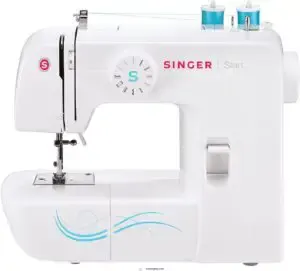
You won’t find simpler operation than the Singer Start 1304 Sewing Machine—it’s built for clarity, not complexity. Delivering 57 stitch applications through just 6 core stitches via a rotatable dial, this lightweight automatic sewing machine eliminates guesswork with preset tension and stitch parameters.
Its internal metal frame provides durability uncommon at this price point, while included accessories—general purpose, zipper, and buttonhole feet—cover fundamental garment construction immediately.
Beginner sewing machines rarely offer a 25-year limited warranty on the head, making this model exceptionally reassuring for first-time users exploring sewing machine features.
Best For: Absolute beginners and casual sewers who want a straightforward, no-frills machine for basic mending, simple garments, and small craft projects without the learning curve of computerized models.
- Metal frame construction gives you better durability and stability than most budget machines, which helps reduce vibration and skipping during use.
- 25-year limited warranty on the head is unusually generous for an entry-level machine and shows the manufacturer stands behind the build quality.
- Preset stitch settings and simple dial controls mean you can start sewing right away without adjusting tension or stitch parameters—perfect if you just want to fix a hem or start a basic project.
- Only 6 built-in stitches limits your creative options compared to machines with dozens of decorative patterns, so you’ll outgrow it quickly if you advance beyond basic projects.
- No adjustable stitch length or width means you can’t fine-tune for different fabrics or techniques, which becomes frustrating once you’re ready to experiment.
- Low speed range (350-400 stitches per minute) and light weight make it less suitable for heavy fabrics like upholstery or denim, and the machine may shift on the table during faster sewing.
3. Brother Computerized Sewing and Quilting Machine
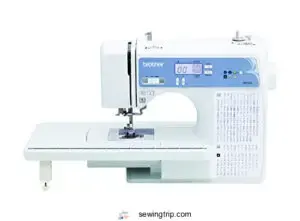
You’ll appreciate the Brother Computerized Sewing Machine‘s precision when stitch capabilities matter most—60 built-in options span utility, decorative, and heirloom work, all managed through a backlit LCD display.
Quilting features shine through the included wide table and nine presser feet, including a walking foot that keeps layers aligned during piecing.
Automation benefits like the needle threader and drop-in bobbin cut setup time considerably, while the 850-stitch-per-minute speed tackles everything from garment construction to intricate quilting lines.
This accessory overview confirms it’s designed for performance context beyond basic sewing machine features.
Best For: Beginners to intermediate sewers and quilting enthusiasts who want a feature-rich, user-friendly machine for garment construction, home décor projects, and quilting without stepping into industrial-grade territory.
- 60 built-in stitches with automatic buttonholes and an intuitive LCD display make stitch selection quick and hassle-free for both beginners and experienced users.
- Impressive quilting setup with a wide table, walking foot, and nine included presser feet that handle everything from free-motion quilting to precise ¼-inch piecing.
- Time-saving automation like the automatic needle threader, drop-in bobbin system, and 850-stitch-per-minute speed let you focus on creativity instead of tedious setup.
- Not built for heavy-duty fabrics like canvas or leather—this is a household machine best suited for light to medium-weight materials.
- The top cover doesn’t latch securely, which could be a hassle if you’re frequently moving the machine between locations or classes.
- Some users find the reverse button awkward to use, and you might need to reference online tutorials or the manual to get comfortable with all the features.
4. SINGER M3500 Sewing Machine with Kit
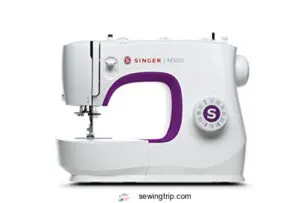
The Singer M3500 Sewing Machine delivers 110 stitch applications through an easy-to-use selector dial, making it beginner-friendly without sacrificing fabric handling versatility—you’ll work everything from sheer voiles to heavyweight denim with adjustable stitch length up to 4mm.
Automatic needle threading paired with the one-step buttonhole feature reduces setup errors, while the removable free arm manages cuffs and hems efficiently.
Maintenance needs stay minimal with included bobbins, presser feet, and cleaning tools. At 11.79 pounds with a 25-year limited warranty, its value proposition centers on accessible automation for diverse sewing machine features.
Best For: Beginners and casual sewers who want a straightforward machine with plenty of stitch variety for everyday projects like garment mending, quilting, and crafts without a steep learning curve.
- 110 stitch applications with automatic needle threader and one-step buttonhole make setup quick and minimize frustration for new users
- Handles multiple fabric types from sheer to denim with adjustable stitch settings and extra high presser foot lifter
- Strong warranty coverage (25 years on machine head) and includes comprehensive accessory kit with multiple presser feet and tools
- Reliability concerns with reported jamming issues and needle problems that may interrupt workflow
- Lightweight plastic construction feels flimsy to some users and may lack durability for heavy-duty projects
- Poor customer support experience and missing manual make troubleshooting difficult when problems arise
5. Singer Quantum Stylist Sewing Machine
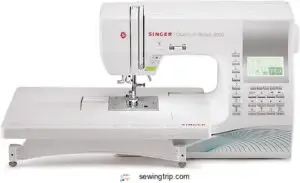
When you need substantial stitch variety—600 built-in options and 13 buttonhole styles—the Singer Quantum Stylist Sewing Machine establishes itself as a computerized platform for expanding beyond basic construction. Its automatic needle threader and tension adjustment cut setup time, while the 850-stitches-per-minute speed aids project throughput without sacrificing fabric handling across silk to denim weights.
Consumer reception consistently highlights ease of use and machine reliability, backed by a 25-year warranty. This automatic sewing machine’s drop-feed capability and mirror imaging functions extend versatility into quilting and decorative applications.
Best For: Sewers who want a computerized machine with extensive stitch variety and automated features for garment construction, quilting, and decorative work without stepping up to industrial equipment.
- 600 built-in stitches with automatic needle threader and tension control reduce setup time and expand creative options for everything from basic repairs to complex quilting projects.
- 850-stitches-per-minute speed with adjustable controls and start/stop button lets you work quickly on long seams or slow down for precision details without constantly managing a foot pedal.
- 25-year warranty and heavy-duty metal frame provide long-term reliability and stability across fabric weights from silk to denim, backed by consistently high user ratings.
- 600-stitch library and computerized features require time spent with tutorials and the manual to fully understand and utilize all capabilities.
- Automatic needle threader can be tricky to master initially, and some users report occasional issues with bobbin winding or thread tension that need troubleshooting.
- Not suitable for heavy-duty industrial work, and the manual must be downloaded rather than included in physical form with the machine.
6. Juki TL-2000Qi Sewing Quilting Machine
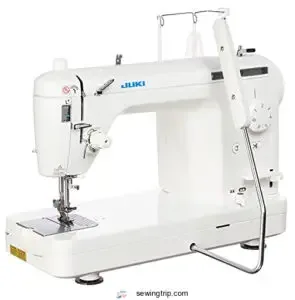
When broad stitch menus won’t address your high-speed quilting demands, you’ll want the Juki TL-2000Qi Sewing Quilting Machine—a straight-stitch specialist engineered for 1,500 stitches per minute without compromise. Its aluminum die-cast frame delivers vibration reduction that stabilizes even thick batting layers, while the automatic thread cutter and needle threader cut setup friction.
The 23-inch extension table accommodates large quilt maneuvers, and the adjustable presser-foot pressure lets you calibrate feed for denim or canvas. This heavy-duty sewing machine earns its 25-year warranty through consistent lockstitch performance.
Best For: Quilters and home sewers who need industrial-grade straight-stitch speed and stability for handling thick fabrics, multiple layers, and large projects without the distraction of decorative stitch options.
- Blazing 1,500 stitches per minute with rock-solid aluminum construction that minimizes vibration, even when plowing through heavy denim or quilt sandwiches
- Automatic thread cutter and needle threader save time on repetitive tasks, plus the 23-inch extension table gives you room to wrestle king-size quilts
- 25-year warranty on the machine head backs up the semi-industrial build quality, and the adjustable presser-foot pressure lets you dial in perfect feed for any fabric weight
- Straight-stitch only—if you need zigzag, decorative stitches, or buttonholes, you’ll have to keep a second machine around
- At 25 pounds it’s a beast to move, and some users report the automatic needle threader can be finicky or stop working over time
- You may need to budget for extras like a free-motion foot, knee lifter upgrades, or a voltage converter if you’re outside the U.S.
7. Bernette B79 Sewing and Embroidery Machine
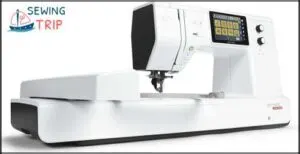
If you’re ready for a two-in-one powerhouse that delivers 500 stitches and 208 embroidery designs under one roof, the Bernette B79 Sewing and Embroidery Machine won’t disappoint. Its 5-inch color touchscreen simplifies stitch selection across computerized sewing machines, while dual feed handles thick quilt sandwiches at speeds up to 1,000 stitches per minute.
At around $2,299, you’ll gain bundled Creator software and three embroidery hoops—positioning it as a top-tier hybrid for ambitious hobbyists prioritizing both sewing/embroidery performance and user interface clarity in one chassis.
Best For: Ambitious hobbyists or small craft-business owners who want professional-grade sewing and embroidery in a single machine without juggling separate units.
- Combines 500 built-in stitches with 208 embroidery designs, plus Creator software and three hoops included—eliminating the need to buy separate machines or accessories upfront.
- Fast performance at 1,000 sewing stitches per minute and 850 embroidery stitches per minute, with dual feed technology that handles thick quilts and layered fabrics smoothly.
- 5-inch color touchscreen and multi-function knobs make navigation intuitive, while the Stitch Designer feature lets you customize patterns beyond the preloaded library.
- Mixed user feedback on threading the lower bobbin and occasional difficulty with very thick or heavy-duty fabrics despite the dual feed system.
- At $2,299, it’s a significant investment that may feel steep for casual sewers who don’t need both sewing and embroidery capabilities.
- Limited long-term reliability data beyond six months of frequent use, and accessories or replacement parts can be hard to track down through third-party channels.
8. Brother XM2701 Lightweight Sewing Machine
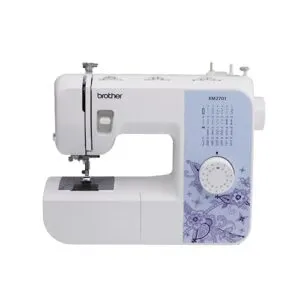
At 12.57 pounds, the Brother XM2701 Lightweight Sewing Machine delivers remarkable portability without sacrificing stitch variety—its 27 built-in options span decorative, zigzag, and blind hem for varied project coverage.
Automatic sewing machines like this model excel in beginner suitability: you’ll thread needles in seconds via its automatic threader, while the one-step buttonholer and jam-resistant bobbin reduce setup frustration.
Brother’s 25-year limited warranty details reinforce chassis durability, and at typical prices around $120 to $130, it balances affordability with easy-to-use controls for everyday projects.
Best For: Beginners and casual sewers who need a lightweight, portable machine with enough stitch variety for everyday projects like garment repairs, simple quilts, and home décor.
- Automatic needle threader and one-step buttonholer make setup quick and frustration-free, even for first-time users.
- 27 built-in stitches offer solid versatility for decorative work, hemming, and stretch fabrics without overwhelming new sewers.
- 25-year limited warranty and sub-13-pound weight combine long-term durability with easy storage and transport.
- Struggles with heavy materials like thick denim or multiple fabric layers, limiting its use for more demanding projects.
- Mechanical design lacks computerized features like automatic tension adjustment or thread cutting found in pricier models.
- Some users report sticky foot pedals and occasional missing parts like bobbin covers in the package.
9. Brother SE700 Sewing Embroidery Machine
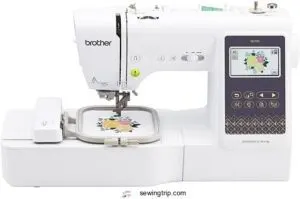
With a 4-by-4-inch embroidery field and 135 built-in designs, the Brother SE700 Sewing Embroidery Machine bridges two crafts under one chassis—you’ll toggle between 103 sewing stitches and custom embroidery projects via its 3.7-inch touchscreen display.
Wireless connectivity streams patterns from your PC or mobile device through the Artspira app, while automatic needle threading and jam-resistant bobbin features align with beginner suitability.
At roughly 15 pounds and approximately $600–$700, it presents itself as a computerized sewing machine for users wanting to explore embroidery capabilities without separate equipment.
Best For: Beginners and hobbyists who want a versatile machine that handles both everyday sewing projects and custom embroidery work without buying separate equipment.
- Wireless design transfer via Wi-Fi and the Artspira mobile app lets you create and send custom embroidery patterns straight from your phone or computer.
- The 4×4-inch embroidery field, 135 built-in designs, and 103 sewing stitches give you plenty of creative options for clothing, quilts, and home décor.
- Automatic needle threader and jam-resistant top-loading bobbin make setup and maintenance easier, especially for people new to embroidery machines.
- The 4×4-inch embroidery area is on the smaller side, so large or continuous designs will need repositioning or won’t fit at all.
- You’ll need to buy extra materials like stabilizer, embroidery thread, and potentially a subscription to Brother’s design system for full functionality.
- The throat space can feel tight for bigger quilting projects, and at 15 pounds it’s not the easiest machine to move around or store if space is limited.
Essential Maintenance for Automatic Sewing Kits
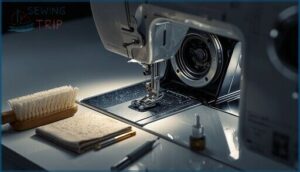
Your automatic sewing machine won’t maintain itself, and neglecting routine care can lead to skipped stitches, tension problems, and expensive repairs down the road.
Regular maintenance extends your machine’s lifespan and keeps stitch quality consistent across every project.
Let’s walk through the essential maintenance tasks you’ll need to master, from basic cleaning routines to calibration checks that prevent long-term performance issues.
Cleaning and Lubrication Tips
Think of lint and dust as the silent saboteurs of your automatic sewing machine. You’ll want to remove lint every 2–3 bobbins and brush beneath the needle plate weekly if you sew daily.
Lubrication intervals depend on your workload—apply fresh oil to moving parts after thorough cleaning, always unplugging first.
For deep contamination, schedule annual professional servicing to maintain precision and prevent costly repairs.
Needle and Accessory Replacement
You’ll notice your needle dulls faster than you’d expect—plan on swapping it every 6–8 hours of active sewing or every few projects to prevent thread breakage and skipped stitches. Listen for a telltale popping sound during penetration; that’s your safety indicator to replace immediately.
Inspect bobbins and presser feet for burrs or warping, replacing damaged sewing machine accessories before they compromise stitch quality or cause troubleshooting headaches.
Storage and Calibration Best Practices
Store your machine in a temperature-controlled space between 15°C and 25°C, keeping humidity levels steady at 40–60% to prevent thread degradation and lubricant displacement. Use protective containers—opaque plastic bins with silica gel packets work well—to shield components from dust and UV exposure.
Calibrate stitch width with seam guides every few projects, documenting adjustments to maintain ±0.1 mm accuracy and prevent wandering seams that waste fabric.
Comparing Automatic and Manual Sewing Machines
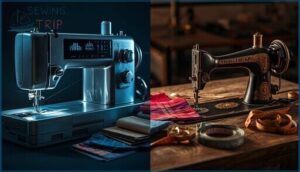
Choosing between automatic and manual sewing machines isn’t about one being universally better—it’s about matching the technology to your specific needs, skill level, and budget. Each system brings distinct advantages in performance, user experience, and long-term cost, which affect everything from your first project to your investment over years of use.
Let’s break down the key differences across three critical areas that matter most when you’re deciding which machine belongs on your workspace.
Performance and Efficiency Differences
Speed control systems in automatic sewing machines deliver stitching rates up to 850 stitches per minute, tripling manual throughput at 250, while computerized sewing machines slash error rates by 60% through precise tension and feed regulation. Automation impact translates into measurable gains:
- Production efficiency: 40% faster continuous operation boosts output consistency
- Error reduction: Built-in corrections cut defects, trimming rework by 12%
- Labor savings: 20% cost reduction from decreased manual intervention
Ease of Use and Learning Curve
Automatic machines drastically flatten the learning curve through features like automatic needle threading and drop-in bobbins—55% of beginners now choose computerized models for this reason. You’ll reach basic proficiency in 2.5 to 5 hours of guided practice, while approachable interfaces and color-coded threading paths boost perceived usability.
Beginner adoption rates climb as design improvements reduce manual complexity by 60%.
Cost and Long-Term Value
Beyond the ease of setup, you’ll find real differences in purchase price and long-term economics. Entry-level automatic machines generally run USD 150 to 300, while capable quilting units land between USD 300 and 700—solid territory for balancing affordability with feature value.
Consider these factors when evaluating your sewing machine budget considerations:
- Upfront investment spans USD 150 to over USD 15,000 depending on automation complexity
- Servicing costs add up with annual or biennial professional maintenance under regular use
- Operating costs vary—home sewing saves money on premium garments, less so on basics
- Warranty policies signal expected lifespan and protect against early failures
- Resale value offsets initial expense, especially for high-end brands with enhanced features
Machines serviced yearly and properly maintained can deliver 10 to 15 trouble-free years, lowering your annualized expense. Maintenance schedules matter—regular bobbin cleaning and lubrication prevent costly breakdowns and extend machine life.
When you’re disciplined about project selection and fabric sourcing, automatic kits prove their worth over time.
Future Trends in Automatic Sewing Technology
Automatic sewing technology isn’t standing still—it’s evolving faster than most sewers realize, driven by connectivity, artificial intelligence, and shifting consumer expectations. The machines you’ll use in the next few years won’t just follow your commands, they’ll anticipate your needs and adapt to your fabric choices in real time.
Here’s where the industry is headed and what you can expect from the upcoming automatic sewing equipment.
Smart and Connected Sewing Machines
You’ll see IoT integration transforming your workspace as wireless connectivity lets you control machines from tablets or smartphones. Computerized sewing machines now feature touchscreen interfaces and digital features that track fabric tension in real-time.
Machine learning algorithms enable predictive maintenance and remote diagnostics, catching issues before they halt production.
Smart fabrics pair with computerized sewing machine technology to create intelligent garments that respond to environmental conditions.
Advancements in Stitch Automation
Sensor regulation and computer control improve stitch accuracy. You’ll find motion detectors and vision systems automatically adjusting needle speed and feed to maintain consistent seam length, even on flexible fabrics.
Pattern libraries in computerized sewing machines let you execute intricate designs without manual adjustments, while quality integration and AI robotics drive sewing automation forward, reducing defects and enabling adaptive stitch paths that respond to real-time fabric movement.
Market Growth and Consumer Demand
As consumer trends shift toward DIY customization and smart‑home integration, you’ll see the global sewing machine market expand from roughly USD 4.7 billion in 2024 to about USD 6.7 billion by 2030.
Regional demand peaks in Asia‑Pacific, while growth drivers—computerized features, automated threading, IoT connectivity—push technology impact beyond 8% annual gains, reshaping your automatic sewing machines buying guide and comparison priorities.
Frequently Asked Questions (FAQs)
Can automatic sewing kits handle leather or denim?
Like testing a bridge under load, heavy fabrics reveal what automatic sewing machines can truly handle.
Heavy duty sewing machine models with powerful motors and walking-foot systems tackle denim layer capacity and leather thickness limits when paired with appropriate needle compatibility for each fabric.
Are replacement parts readily available for automatic machines?
Yes, replacement parts are widely available through brand warranty support, online distribution channels, and aftermarket suppliers. The parts market reached USD 6 billion in 2024, ensuring strong availability across machine types.
How long do automatic sewing machines typically last?
Your automatic sewing machines generally run strong for 10 to 20 years with proper maintenance. However, vintage mechanical models often outlast computerized versions—some vintage units continue threading fabric after 40 years of faithful service.
Do automatic sewing kits work with all thread types?
Most automatic sewing kits handle polyester and cotton-polyester blends well, but metallic thread issues arise without tension adjustment needs.
Testing thread behavior on scrap fabric ensures ideal thread types match your fabric compatibility and accessories before starting projects.
What warranty coverage comes with automatic sewing kits?
Most automatic sewing machines include tiered warranty structures: 25-year coverage on frames, 2–5 years on electronic components like circuit boards, and 90 days on adjustments and accessories, excluding consumables like needles and belts.
Conclusion
A quilter in Oregon cut her project prep time by 40% after switching to a computerized model with automatic tension control—what once demanded constant manual adjustment now runs through layered cotton without intervention.
When you match automatic sewing kits to your fabric weight range and stitch repertoire, you convert tedious calibration into predictable output. Evaluate needle threading speed, tension consistency, and accessory compatibility before committing, then let the machine handle precision while you focus on design execution.
- https://www.verifiedmarketreports.com/product/sewing-kit-market/
- https://dataintelo.com/report/smart-sewing-machine-market-report
- https://www.nextmsc.com/report/sewing-machine-market
- https://www.cognitivemarketresearch.com/household-sewing-machines-market-report
- https://www.accio.com/business/latest-industrial-sewing-machines-attachments-and-folders-trend