This site is supported by our readers. We may earn a commission, at no cost to you, if you purchase through links.
A seam ripper at 2 a.m., a costume due by morning, and the nearest craft store closed an hour ago—college life has a way of turning small sewing emergencies into full‑blown crises. That’s exactly why more students are keeping a sewing machine tucked beside their mini fridge.
The right portable sewing machines for college students don’t just patch a torn hem; they open the door to DIY fashion, custom alterations, and serious money saved on tailoring bills.
With options ranging from featherlight mini machines under 3 lb to heavy‑duty workhorses that power through denim, finding your match comes down to knowing what your dorm room—and your projects—actually demand.
Table Of Contents
- Key Takeaways
- 8 Best Portable Sewing Machines
- 1. Brother XM2701 Lightweight Sewing Machine
- 2. Singer Heavy Duty 4411 Sewing Machine
- 3. KPCB Tech Mini Sewing Machine for Beginners
- 4. Singer M1500 Portable Sewing Machine
- 5. Singer Fashion Mate 5560 Sewing Machine
- 6. Singer Fashion Mate 3342 Sewing Machine
- 7. Singer 4411 Pink Heavy Duty Sewing Machine
- 8. Singer Quantum Stylist 9960 Sewing Machine
- Key Features for College Students
- Mechanical Vs Computerized Machines
- Best Machines by Student Needs
- Dorm-Friendly Portability and Storage
- How to Choose The Right Model
- Frequently Asked Questions (FAQs)
- Conclusion
Key Takeaways
- The Brother XM2701 is the smartest starting point for most students — it’s light, affordable at $149, and handles everyday repairs without a steep learning curve.
- Weight and footprint matter more than you’d think in dorm life, so aim for machines in the 6–12 lb range with a compact frame that won’t eat your whole desk.
- If you regularly work with denim or canvas, the Singer Heavy Duty 4411 is worth the extra cost — its 84W motor and metal frame handle tough fabrics without stalling.
- Matching the machine to your actual projects is the real move — stitch count, presser feet, and frame durability all shift depending on whether you’re doing quick repairs or full fashion builds.
8 Best Portable Sewing Machines
Finding the right sewing machine for college life comes down to a few things — size, price, and what you actually plan to make. These eight machines cover a solid range of budgets, skill levels, and project types.
Whether you’re hemming jeans or tackling a full outfit, checking out sewing machines with the best automatic features can help you narrow down which of these eight is worth your money.
Here’s a closer look at each one.
1. Brother XM2701 Lightweight Sewing Machine
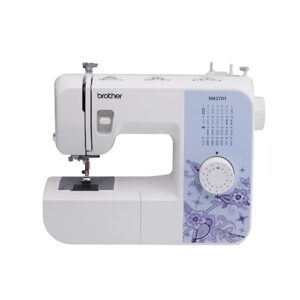
The Brother XM2701 is a solid starting point if you’re new to sewing and tight on space. At 12.6 lb, it’s easy to carry between your dorm and class.
You get 27 built-in stitches, an automatic needle threader, and a jam-resistant drop-in bobbin — so setup doesn’t feel like a puzzle. The free arm makes hemming jeans or sleeves much simpler.
Backed by a 25-year warranty and priced at $149, it’s practical value without cutting corners.
| Best For | Beginners and students who want an affordable, easy-to-use machine for everyday sewing projects without a steep learning curve. |
|---|---|
| Stitch Count | 27 stitches |
| Weight | 12.6 lb |
| Bobbin Type | Drop-in top bobbin |
| Power Supply | 120V US |
| Buttonhole Function | Auto 1-step |
| Portability | Carry handle |
| Additional Features |
|
- Automatic needle threader and drop-in bobbin make setup quick and frustration-free
- 27 built-in stitches cover everything from basic hems to buttonholes and stretch fabrics
- Lightweight at 12.6 lb with a free arm design — easy to move around and great for tight spaces
- Struggles with thick or heavy fabrics like denim and leather
- The plastic spool pin is fragile and a known weak point for breakage
- Only works on 120 V, so using it outside the US voids the 25-year warranty
2. Singer Heavy Duty 4411 Sewing Machine
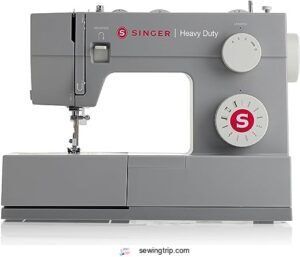
If you need something that can handle more than a light hem or a quick repair, the Singer Heavy Duty 4411 is worth a serious look. It runs at 1,100 stitches per minute with an 84W motor — strong enough to push through denim, canvas, and leather without a fight.
The metal frame keeps things steady, and the LED lighting is a real bonus for late-night sessions.
At 14.6 lb, it’s still portable.
You get 69 built-in stitches and a 25-year warranty too.
| Best For | Home sewers and hobbyists who regularly work with heavy fabrics like denim, canvas, or leather and need a reliable, fast machine without jumping to industrial equipment. |
|---|---|
| Stitch Count | 69 stitches |
| Weight | 14.6 lb |
| Bobbin Type | Top drop-in bobbin |
| Power Supply | 120V US |
| Buttonhole Function | 4-step |
| Portability | Carry handle |
| Additional Features |
|
- Powerful 84W motor handles thick, tough fabrics without bogging down or skipping stitches
- Metal frame and stainless-steel bed keep everything stable, even at full 1,100 stitches-per-minute speed
- 25-year warranty gives solid long-term peace of mind for the investment
- Only works with U.S. 110V outlets — international users need a converter to use it
- Warranty registration doesn’t support non-U.S. addresses, leaving overseas buyers in a tough spot
- Some users run into thread-catching on the spool holder, which means fiddling with spool orientation to avoid breaks
3. KPCB Tech Mini Sewing Machine for Beginners
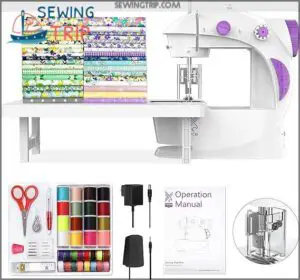
Not every student needs a powerhouse like the 4411. If you’re just starting out and want something that won’t take up half your desk, the KPCB Tech Mini is hard to beat.
It weighs under 3 lb and fits neatly into a small space — perfect for dorm life.
You get two speed settings, a finger guard for safety, and a solid starter kit with fabric bundles and basic tools.
At its price point, it’s a genuinely smart first machine.
| Best For | Beginners and dorm-dwellers who want a compact, affordable machine for basic repairs, hemming, and simple craft projects. |
|---|---|
| Stitch Count | 20 stitch applications |
| Weight | 3 lb |
| Bobbin Type | Standard bobbin |
| Power Supply | 110-120V US |
| Buttonhole Function | Not included |
| Portability | Ultra-compact |
- Comes with everything you need to get started — fabric squares, bobbins, needles, threads, and more
- Two speed settings plus a finger guard make it approachable and safe for first-timers
- Tiny and light enough to tuck in a drawer or toss in a bag
- Plastic build means it won’t hold up to heavy use — needle bending and thread tension issues are common complaints
- No back-stitch function, so seams aren’t as secure as they’d be on a full-featured machine
- Struggles with thick or textured fabrics — best to stick to lightweight materials
4. Singer M1500 Portable Sewing Machine
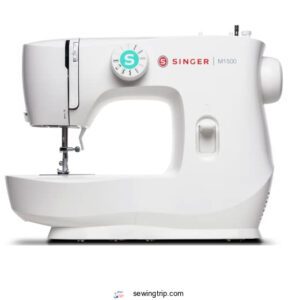
If you want something a step up from mini machines without hauling a heavy unit across campus, the Singer M1500 hits a sweet spot.
It weighs 9.7 lb and comes with a built-in carry handle — grab it and go.
You get 57 stitch applications, an LED work light for late-night projects, and preset stitch settings that take the guesswork out of setup.
The metal frame keeps things stable, and the clear threading guides mean you won’t waste half an hour just getting started.
| Best For | Beginners and hobbyists who want a simple, portable machine for everyday sewing tasks like mending, alterations, and light crafting. |
|---|---|
| Stitch Count | 57 applications |
| Weight | 9.7 lb |
| Bobbin Type | Standard bobbin |
| Power Supply | Standard AC |
| Buttonhole Function | 4-step |
| Portability | Lightweight |
| Additional Features |
|
- 57 stitch applications with preset settings — no fiddling with length or width, just pick and sew
- Lightweight at 9.7 lb with a built-in handle, so it’s easy to move between rooms or take to a class
- LED work light and printed threading guides make setup and late-night projects much less frustrating
- Thread jams and tension issues pop up, especially if the bobbin case screws work themselves loose
- Only 6 basic stitch types, so it won’t cut it for decorative embroidery or more advanced work
- Threading can be tricky at first — most users end up turning to YouTube to figure it out
5. Singer Fashion Mate 5560 Sewing Machine
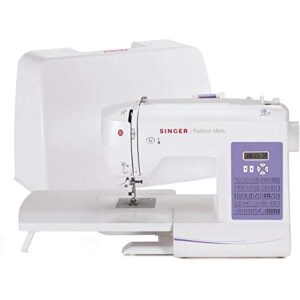
The Singer Fashion Mate 5560 is built for students who want serious versatility without a steep learning curve. Its 203 built-in stitches — including six automatic buttonhole styles — cover everything from quick repairs to full fashion projects.
An LCD screen makes stitch selection straightforward, and the built-in LED light keeps your work visible during late-night sessions.
The metal frame adds stability, and the free arm helps you tackle sleeves and cuffs.
That 25-year warranty? Solid peace of mind for the price.
| Best For | Beginners and hobbyists who want a versatile, easy-to-use machine for everything from small repairs to bigger sewing projects. |
|---|---|
| Stitch Count | 203 stitches |
| Weight | 20 lb |
| Bobbin Type | Class 15 metal bobbin |
| Power Supply | Standard AC |
| Buttonhole Function | 1-step auto |
| Portability | Hard cover included |
| Additional Features |
|
- 203 built-in stitches plus a one-step buttonhole function — plenty of options without needing to fuss with manual settings.
- The automatic needle threader saves time and frustration, especially if you’re newer to sewing.
- Comes with a hard cover and a removable extension table, handy for working in tighter spaces.
- It’s a refurbished unit, and some buyers have run into issues like a loose bobbin holder or a cracked cover.
- The extension table can feel wobbly and may not attach securely on every unit.
- First-time threading can be tricky, and a few stitch numbers have been known to display incorrectly.
6. Singer Fashion Mate 3342 Sewing Machine
If you’re after something simple that just works, the Fashion Mate 3342 deserves a look. It gives you 32 built-in stitches — enough for everyday repairs, hems, and light garment projects.
The automatic needle threader saves you squinting, and the one-step buttonhole keeps things clean and consistent.
Built-in LED lighting helps when you’re sewing past midnight, and the metal frame keeps everything steady.
It’s not flashy, but for a no-fuss beginner machine, it covers the basics well.
| Best For | Beginners, kids, and casual sewers who want a reliable machine for everyday repairs, hems, and light creative projects without a steep learning curve. |
|---|---|
| Stitch Count | 110 stitches |
| Weight | 16 oz |
| Bobbin Type | Top drop-in bobbin |
| Power Supply | Standard AC |
| Buttonhole Function | 1-step auto |
| Portability | Lightweight |
| Additional Features |
|
- 110 stitch options gives you plenty of variety for garment work, quilting, and appliqué
- Built-in needle threader and drop-in bobbin make setup quick and painless
- Lightweight and portable — easy to pack up and take to a class or a friend’s place
- Not built for heavy-duty materials like leather or thick upholstery
- Some users report missing accessories or occasional bobbin area jams
- Stitch count is lower than mid-to-high-end machines if you want more advanced options down the road
7. Singer 4411 Pink Heavy Duty Sewing Machine
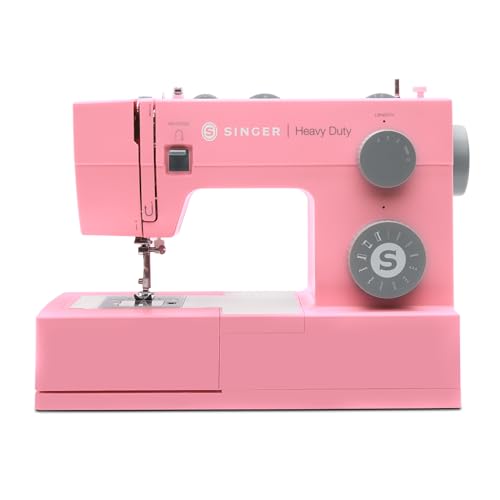
Think of this as the Fashion Mate 3342’s bolder sibling — built for when your projects get serious. The Singer 4411 Pink runs at 1,100 stitches per minute with a motor 60% stronger than standard machines.
That means denim, canvas, and leather aren’t a problem.
The metal frame keeps things stable at high speed. The included accessory kit gets you started right away.
At 14 lb, it’s not the lightest, but the power it delivers is hard to beat.
| Best For | Makers and small-business sewers who regularly tackle heavy fabrics like denim, leather, or canvas and want a durable, no-fuss machine that can keep up with a serious workload. |
|---|---|
| Stitch Count | 69 applications |
| Weight | 14 lb |
| Bobbin Type | Standard bobbin |
| Power Supply | 110V US |
| Buttonhole Function | 1-step auto |
| Portability | Compact design |
| Additional Features |
|
- Powerful motor handles tough fabrics without stalling — denim, canvas, leather, no problem
- Metal frame and stainless-steel bedplate mean this thing is built to last, not just look good
- Comes ready to go with a full accessory kit, so you’re not hunting down extras before your first project
- No automatic needle threader, so setup takes a bit more patience each time
- The spool holder can snag thread if the spool isn’t seated just right — something to watch for
- 110V US-only plug means international users need a transformer, and warranty service can get complicated outside the US
8. Singer Quantum Stylist 9960 Sewing Machine
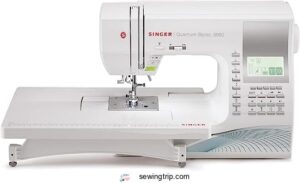
If you’re ready to level up, the Singer Quantum Stylist 9960 is in a class of its own. It packs 600 built-in stitches and hits 850 stitches per minute — fast enough for any project you throw at it.
The automatic needle threader, top drop-in bobbin, and LED work light make setup quick and easy.
Five alphabet fonts let you personalize anything.
At 14.6 lb and $542.99, it’s a serious investment, but the features back it up completely.
| Best For | Intermediate to advanced sewers who want a feature-packed machine for quilting, garment making, and personalized projects without needing a separate embroidery unit. |
|---|---|
| Stitch Count | N/A |
| Weight | 14 lb |
| Bobbin Type | Standard bobbin |
| Power Supply | 110V US |
| Buttonhole Function | 4-step |
| Portability | Soft cover included |
| Additional Features |
|
- 600 stitches and five built-in fonts give you serious creative range — monograms, decorative edging, you name it.
- The walking foot and strong motor handle thick, multi-layer projects (think 8-layer quilt seams) without breaking a sweat.
- Auto needle threader, drop-in bobbin, and one-touch thread cutter mean less fussing and more sewing.
- At 14.6 lb with the extension table, it’s not exactly grab-and-go for classes or travel.
- Beginners might feel overwhelmed — there’s a real learning curve, and some features (like buttonholes) don’t work with a double needle.
- The automatic needle threader can struggle with fine or specialty needles, so manual threading isn’t always avoidable.
Key Features for College Students
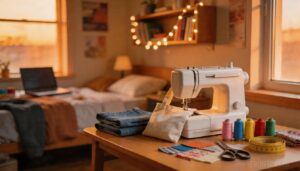
Not every sewing machine is built with college life in mind. The right one fits your dorm, your budget, and your skill level without making things complicated.
Here are the key features worth looking for before you buy.
Lightweight Designs for Easy Carrying
Carrying your machine across campus shouldn’t feel like a workout. That’s why lightweight portable sewing machines for students lean on aluminum alloy bodies and foldable frames — some models drop to just 2.5 pounds.
Integrated carry grips and retractable straps make the commute smooth, while magnetic tool pockets keep your essentials secure.
A smart portable design means your creative toolkit goes wherever you do.
The cases also incorporate impact‑resistant design features to protect your machine during transport.
Compact Size for Dorm Storage
Dorm rooms don’t give you much real estate — every inch matters. The right compact size means your machine slides under the bed with under-bed clearance to spare, tucks into a desk corner, fitting perfectly, and stores accessories in an integrated storage compartment.
Here’s what smart portable design delivers for college students:
- Wall-mount compatibility frees your desk entirely
- Foldable accessory tray collapses flush against the body
- Under-bed clearance keeps your floor and workspace open
Lightweight and portable sewing machines for students prove that a travel machine doesn’t need a permanent home.
Beginner-friendly Controls and Threading
Once your machine is tucked away, getting started shouldn’t feel like solving a puzzle.
An automatic needle threader does the fiddly work for you, while visual threading guides show exactly where each thread goes.
Drop in a top loading bobbin, adjust with large stitch dials, and hit the start stop button — simple controls that make beginner-friendly sewing feel second nature, fast.
Built-in Stitches for Class and Repairs
Good controls mean nothing without the right stitches behind them.
Built-in stitches on lightweight portable models handle everything that student sewing projects demand:
- Straight Stitch Basics — clean seams on woven fabrics every time
- Zigzag Edge Finishing — stops fraying before it ruins your work
- Stretch Stitch Applications — flexible seams for knits and activewear
- Buttonhole Creation — one-step results on bags and garments
Budget-friendly sewing options like the Brother XM2701 offer 27 stitches, while the Singer M1500 delivers 57 — plenty for blind hem techniques and everyday repairs.
LED Lighting for Late-night Sewing
Late-night sewing sessions hit differently when you can actually see what you’re doing. That’s why LED lighting matters on portable sewing machines.
Singer models like the M1500, Heavy Duty 4411, and Fashion Mate 3342 all have built-in LEDs — solid lumens range, clean color temperature, and smart shadow positioning right over the needle.
Energy efficiency and mounting compatibility make them perfect for student sewing projects.
Free Arm and Buttonhole Convenience
Beyond good lighting, free arm functionality for cuffs and sleeves is a significant improvement for dorm repairs. Slide a pant leg or sleeve right onto the cylindrical arm — no twisting, no bunching.
Circular seam handling becomes almost smooth.
Pair that with one-step buttonhole efficiency and quick fixes take minutes.
Accessory foot compatibility boosts dorm project speed, making lightweight, budget-friendly sewing options even more adaptable.
Mechanical Vs Computerized Machines
Choosing between a mechanical and computerized machine is one of the first real decisions you’ll make as a student sewist. Each type has its own strengths depending on your skill level, project goals, and budget.
Here’s what you need to know before picking your match.
Why Mechanical Models Suit Beginners
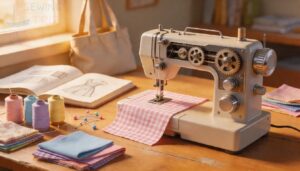
If you’re just starting out, a mechanical sewing machine is your best first partner. Simple controls and visible gear mechanics mean you learn by doing — no confusing menus, just real tactile feedback.
And when something jams? Straightforward maintenance gets you back on track fast.
| Why It Works | Beginner Benefit |
|---|---|
| Durable metal frame | Survives dorm life |
| Affordable spare parts | Stays budget-friendly |
| Lightweight design | Easy to carry anywhere |
| Simple controls | Less confusion, more sewing |
When Computerized Features Are Worth It
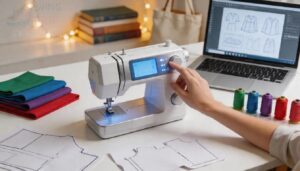
Once your skills grow, computerized machines start pulling serious weight.
Features like LCD Interface Benefits, Programmable Stitch Presets, and Stitch Memory Recall save real time on class projects.
| Feature | What It Does | Student Benefit |
|---|---|---|
| Auto Threader Efficiency | Threads needle automatically | Saves 10–20 seconds per setup |
| Digital Tension Control | Auto-adjusts to fabric type | Reduces puckering instantly |
| LCD Interface Benefits | Displays stitch settings clearly | No guesswork mid-project |
| Stitch Memory Recall | Stores up to 50 stitches | Quick access during repairs |
| Programmable Stitch Presets | Saves favorite combos | Faster setup every time |
Stitch Variety for Fashion Projects
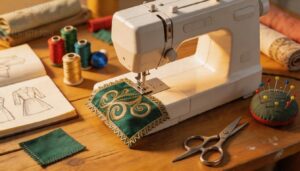
Stitch variety is where your machine either creates opportunities — or closes them. For fashion projects, built-in stitches like Satin Embroidery, Appliqué Detailing, and Couching Techniques let you move beyond basic seams into real design territory.
| Stitch Type | Best Use | Fashion Benefit |
|---|---|---|
| Zigzag Decorative | Knits and edges | Stretch-friendly, clean finish |
| Blind Hem Finishes | Hemlines | Invisible, polished look |
| Satin Embroidery | Decorative panels | Mimics hand embroidery |
Speed Control and Ease of Learning
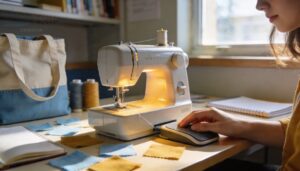
Speed control can make or break your early sewing experience.
Machines with Pedal Sensitivity and Ergonomic Foot Control let you ease in slowly — no sudden lurches, no tangled thread.
Progressive Speed Training builds your rhythm naturally over time.
| Feature | Beginner Benefit |
|---|---|
| Speed Presets | Skip manual guessing |
| Visual Speed Indicators | Track your pace easily |
| Ergonomic Foot Control | Reduce leg fatigue |
| Simple Controls | Flatten the learning curve |
| Progressive Speed Training | Build confidence gradually |
Cost Differences for Student Budgets
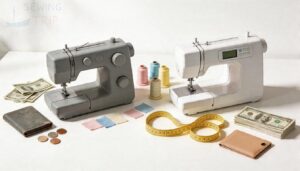
Your budget tells you which machine actually makes sense.
Mechanical models land between $70–$120, while computerized ones jump to $180–$260 — that’s your Electronic Feature Premium in real dollars.
| Cost Factor | Budget Impact |
|---|---|
| Entry-level Pricing | $60–$150 range |
| Accessory Bundle Savings | $20–$50 saved |
| Warranty Cost Impact | 1-year limit |
| Seasonal Discount Effects | 10–30% off |
| Electronic Feature Premium | +$20–$60 |
Best Machines by Student Needs
Not every student sews for the same reason, and the right machine really depends on what you’re making. Whether you’re patching jeans, designing outfits, or just starting out, there’s a model that fits your situation.
Here’s a breakdown of the best picks by student needs.
Best Budget-friendly Portable Machine
If you want the best price-to-performance ratio without sacrificing quality, the Brother XM2701 is hard to beat. This lightweight design tips the scales at just 12.6 lb and fits comfortably on any dorm desk.
Its beginner-friendly sewing controls, solid warranty coverage, and strong user ratings make it a go-to among budget-friendly sewing options.
Fabric compatibility covers everyday projects, and portable sewing machines don’t get more practical than this.
Best Mini Machine for Dorm Rooms
Not every dorm room has space for a full-size machine. That’s where a mini model shines — its compact size and lightweight design make it easy to tuck away after use. The Pllieay Mini weighs just 3.06 lb and comes with a portable case, so storage is never a headache.
Top mini machine features for dorm rooms:
- Ultra-compact size fits on any tight desk
- Lightweight design under 4 lb for easy carrying
- LED light for late-night stitching sessions
- Beginner-friendly sewing controls with adjustable thread tension
- Portable case keeps accessories organized and clutter-free
Best Beginner Sewing Machine
Starting out doesn’t have to feel overwhelming. The Brother XM2701 is one of the best beginner-friendly portable sewing machines you’ll find — its lightweight design, automatic needle threader, and drop-in bobbin make setup genuinely simple.
With 27 built-in stitches, LED lighting, and an affordable starter kit, it’s built for learning. The compact design fits your dorm desk without drama.
Best for Thick Fabrics and Denim
Not every project stops at cotton. When you’re working with denim, canvas, or layered fabrics, you need something tougher.
The Singer Heavy Duty 4411 delivers exactly that — a heavy-duty motor, solid metal frame construction, and presser lift designed for heavy fabrics.
Pair it with denim needles and a walking foot, and thick seams stop being a struggle. Compact size, serious capability.
Best for Fashion Design Students
Fashion design students need more than basic repairs — your machine should keep up with your creativity.
The Singer Fashion Mate 5560 checks the right boxes:
- Built-in stitch options support design portfolio integration across garment types
- LED lighting keeps late-night sessions productive
- Lightweight design moves easily between studio and dorm
- Fabric swatch management stays organized with free-arm access for sleeves and cuffs
Portable sewing machines like this one turn fashion design education into hands-on momentum.
Best for Advanced Stitch Variety
stitch variety is your priority, the Singer Quantum Stylist 9960 is in a class of its own. With 600 built-in stitches — including Embroidery Stitch Modes, Decorative Stitch Options, and Memory Stitch Functions — you won’t run out of creative room.
Adjustable Stitch Width and Free Motion Stitching give you real control. For portable sewing machines with a lightweight design, this one punches well above its weight.
Dorm-Friendly Portability and Storage
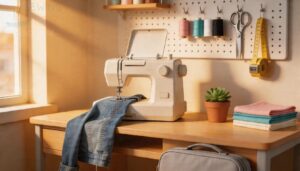
Living in a dorm means every inch of space counts — and your sewing machine needs to earn its spot. The right portable model fits your lifestyle without taking over your desk or your life.
Here’s what to look for when dorm-friendly storage and easy transport matter most.
Ideal Weight Range for Campus Use
Not all portable sewing machines carry the same — weight matters more than you’d think when you’re hauling gear across campus.
For student transport weight, the sweet spot sits between 6 and 12 pounds, balancing lightweight design with real stability:
- Under 6 lbs: true one-hand carry, ideal campus carry capacity
- 7–9 lbs: ideal weight balance for dorm desk use
- 10–12 lbs: more features, still manageable
- Above 12 lbs: noticeable weight stability tradeoff
- Machine weight considerations affect shoulder strain on long walks
Small-footprint Machines for Tight Spaces
When desk space is basically a myth in dorm life, footprint dimensions matter just as much as weight. A compact design under 15 inches wide gives you real desk clearance to actually work.
Mini sewing machine models fold the pedal away and keep cable management clean.
With portable power options, these lightweight designs tuck into tight corners without taking over your entire room.
Easy Transport Between Dorm and Class
Carrying your machine across campus shouldn’t feel like hauling furniture. A lightweight machine benefits you most when it actually moves with you.
Here’s what makes transport smooth:
- Handle Design — a top carry handle allows one-handed setup and easy grabbing between classes
- Detachable Power Cord — reduces tangling and cuts pack time considerably
- Backpack Fit — compact size models slip into larger bags effortlessly
- Travel Case Compatibility — protects your portable sewing machine without adding much bulk
Accessories That Reduce Clutter
clutter-free dorm starts with the right organizers.
Stackable Storage Bins keep bobbins and notions sorted without eating up precious desk space. Labelable Pocket Organizers, Integrated Tool Couches, and Modular Drawer Inserts each handle a specific category of tools.
Compact Project Bags fit your lightweight machine, accessory kit, and extras in one go — no rummaging, no mess, just your creative flow ready whenever you’re ready.
Noise and Workspace Considerations
Sewing at midnight in a shared dorm is a real balancing act. Most portable sewing machines run between 58 and 72 dB — think vacuum cleaner territory. Vibration Dampening Mats and Acoustic Desk Pads can shave off several decibels instantly. If your machine has a Soft Start Motor, even better.
Portable sewing machines can hit 72 dB at midnight — a vibration mat makes all the difference
For Quiet Night Sewing in limited sewing or storage space, Soundproofing Panels and LED lighting for sewing visibility make a compact setup genuinely livable.
How to Choose The Right Model
Picking the right machine comes down to knowing what you actually need it for. A few key factors — like stitch count, frame build, and what’s in the box — can make or break your choice.
Here’s what to look at before you buy.
Match Features to Your Sewing Goals
Before you pick a machine, think about what you actually want to make. Alterations? Garments? Repairs?
Portable sewing machines vary a lot in what they offer. Look for Threading Simplicity, Adjustable Tension, and Stitch Length Control so practice feels smooth, not frustrating.
Presser Foot Options and Needle Compatibility matter too — especially for cotton, denim, or knits. Match the built-in stitch options for mobile use to your real projects.
Compare Stitch Count and Sewing Speed
Once you’ve matched features to your goals, stitch count and speed become your next checkpoints.
For most student projects, a range of 57–70 built-in stitches covers everyday needs well.
But the Singer Quantum Stylist 9960 offers 600 built-in stitches at 850 stitches per minute — serious range for fashion design work.
Watch SPI impact and stitch density too — higher speed can affect thread tension and vibration effects, so start slow.
Check Frame Durability and Fabric Handling
Speed matters, but so does what’s holding everything together. Metal Frame Reinforcement and solid metal frame construction keep your machine steady under pressure — literally.
Models like the Singer Heavy Duty 4411 use metal interior frames built for heavy fabrics like denim and canvas.
Good Throat Clearance, Fabric Clamp Design, Pivot Bearing Quality, and Vibration Damping rubber feet mean cleaner stitches on any portable sewing machine’s fabric handling capability.
Evaluate Included Feet and Accessories
The frame holds your machine steady — but the right feet enable what it can actually do. A solid Presser Foot Variety means you’re ready for hems, zippers, and buttonholes without buying extra accessories.
Do a Foot Compatibility Check before purchasing.
The Brother XM2701 ships with six presser feet, which is a strong Kit Completeness Review win. Specialty Foot Options like a quilt foot expand your creative range fast.
Balance Price, Portability, and Performance
Finding your sweet spot between cost and capability doesn’t have to feel overwhelming. The best Cost-Performance Ratio comes from machines priced between $50 and $200 that still deliver solid Stitch speed performance.
Think about what you actually need:
- Weight-to-Speed Balance: under 10 lb with 800 spm
- Compact Power Efficiency for desk and dorm use
- Affordability vs Durability: metal frames last longer
- Portability-Driven Design with built-in grips
Frequently Asked Questions (FAQs)
What are some things to sew that college students need?
College students can sew study accessories, cord organizers, face masks, scarf headbands, travel pillow covers, and DIY clothing creation projects.
On-the-go mending solutions, home décor, crafts and mending, and portable sewing for travel and classes keep campus life running smoothly.
What is a good sewing machine for a teenager?
The Brother XM2701 hits the sweet spot — a intuitive interface, affordable price, and durable build with flexible stitches.
Its lightweight body and compact design make it a solid, beginner-friendly pick for any teenager ready to start creating.
What is the easiest sewing machine to learn on?
Brother XM2701 is a top pick. Its Drop-In Bobbin, Threader Automation, and One-Dial Stitching make setup fast.
Simple Speed Pedal gives you full control from your very first stitch.
What kind of sewing machines do schools use?
Schools commonly use electric portable sewing machines with foot pedal safety controls and mechanical single-needle lockstitch designs.
These prioritize machine durability standards, curriculum integration, and accessory compatibility — keeping beginner-friendly operation and power supply requirements simple for students.
Do handheld portable sewing machines work?
Yes, handheld portable sewing machines work — but with limits.
They handle lightweight fabrics well for quick fixes, though stitch consistency, tension control, and fabric compatibility drop on thicker materials like denim.
Which sewing machine has the least problems?
The Brother XM2701 and Singer 4411 top durability charts. Both feature metal interior frames, low failure rate stats, and solid warranty coverage — making either a smart, nearly problem-free pick.
What are the benefits of portable sewing machines for students?
Portable sewing machines save time, cut costs on repairs, and build real skills.
They support creative expression and stress relief — all through beginner-friendly features, LED lighting, and budget-friendly options you can carry anywhere.
How do I choose the right portable sewing machine brand?
Focus on brand reputation, warranty terms, and spare parts availability. Strong customer service and community support make troubleshooting easier. These factors keep your machine running longer without unexpected repair costs.
Can I use a portable sewing machine for embroidery work?
You can do light embroidery on a portable sewing machine, but expect limits. Small hoop size, lower stitch density, and proper stabilizer requirements matter.
Watch your thread tension, and don’t count on software compatibility.
What are the essential features of a portable sewing machine?
Look for a lightweight travel sewing machine with built-in stitches, an automatic needle threader, LED light, thread tension adjustability, and flexible power source options — including battery operated models — packed in a durable carrying case.
Conclusion
With a portable sewing machine, you’re just a stitch away from transforming your college experience. Imagine having a superpower that lets you repair, create, and customize on a whim.
The right portable sewing machines for college students can be transformative. From dorm room hacks to fashion emergencies, these machines offer freedom and flexibility.
By choosing wisely, you’ll open up a world of DIY possibilities, saving time and money while expressing your unique style perfectly, always.